
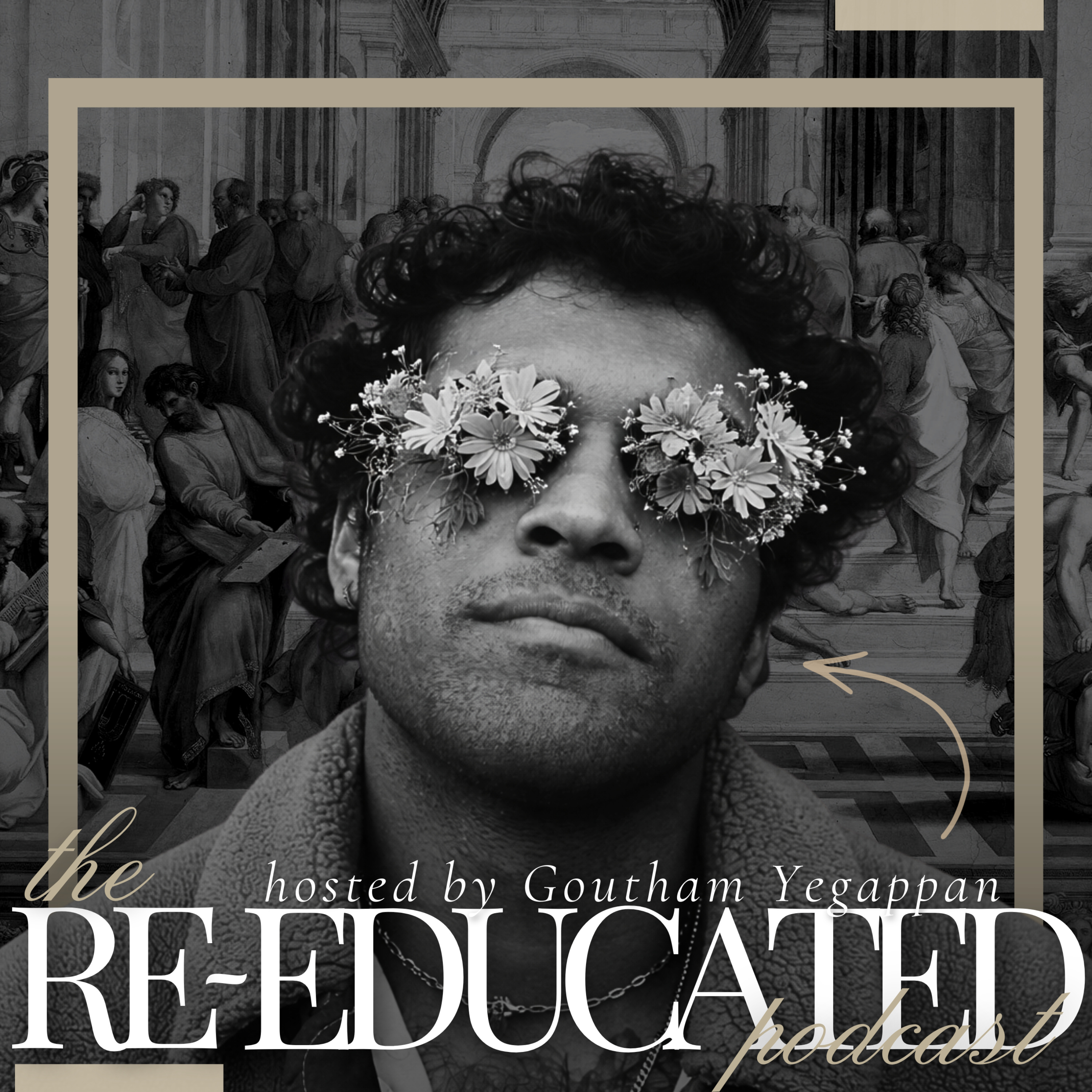
PODCAST · education
reeducated
by Goutham Yegappan
Conversations reimagining, rethinking, and reinventing modern education.
-
247
Beyond STEM: Building Kids Who Believe They Belong | Dr. Jennifer Berry | CEO of SmartLab and STEM Education Leader | Season 13 Episode 26 | #247
As artificial intelligence rapidly transforms education and work, what abilities will matter most for the next generation? In this episode, I sit down with Dr. Jennifer Berry, CEO of SmartLab, to explore how schools can prepare students for a future where knowledge is instantly accessible but curiosity, resilience, creativity, and human judgment become increasingly valuable. Rather than viewing STEM as simply science and technology, Jennifer argues that it is fundamentally about developing a mindset in which students believe they belong, can overcome difficult challenges, and know that their ideas matter.Our conversation explores the philosophy behind project-based learning, the importance of productive struggle, and why education should prioritize exploration over memorization. We discuss how AI should support rather than replace thinking, why failure is essential for developing the brain, and how hands-on learning helps students build confidence, collaboration, and critical thinking. Jennifer also explains SmartLab's vision for creating "STEM identity" through meaningful experiences rather than isolated classroom lessons.We also examine some of the biggest structural challenges facing education today, including standardized testing, grading systems, siloed subjects, and the difficulty of implementing meaningful change within large school systems. Throughout the conversation, Jennifer makes the case that education should ultimately help young people become thoughtful, compassionate, and adaptable human beings who are prepared not only for careers, but for life itself. Chapters (1:02:22 Episode)00:00 – Introduction02:18 – AI, Education, and the Purpose of Learning05:28 – Why Students Should Think Before Using AI08:18 – Productive Struggle and How the Brain Learns13:47 – What Is a STEM Identity?20:05 – Why Hands-On Learning Matters24:20 – Play, Curiosity, and Critical Thinking26:18 – Can Project-Based Learning Scale?30:02 – Why Schools Separate Knowledge into Subjects31:05 – Do Grades Actually Measure Learning?36:05 – SmartLab's Vision for Educational Change41:35 – Integrating Project-Based Learning into Schools47:48 – Why Educational Change Is So Difficult52:12 – Curiosity, Success, and the Purpose of Education54:00 – Empathy, Perspective, and Raising Better Humans58:05 – Finding Hope in Education01:00:12 – Coaching, Leadership, and Lifelong Learning01:01:15 – Final Reflections and ClosingOther Topics & Resources MentionedSmartLab and the concept of STEM IdentityProject-Based Learning (PBL)International Baccalaureate (IB) educationArtificial Intelligence tools (ChatGPT, Claude, Gemini)Google Classroom
-
246
Three Lessons From Living in an Aikido Dojo | Goutham Yegappan | Season 13 Episode 25 | #246
In this solo episode, Goutham reflects on a month spent living inside an Aikido dojo in Montreux, Switzerland, exploring what the experience revealed about education, learning, and human development. Rather than focusing on martial arts techniques, he examines the philosophy behind Aikido and the lessons it offers for teaching, mentorship, and personal growth. Drawing comparisons with his own experiences studying Indian classical music, he argues that the best teachers do more than teach skills; they help students discover why a practice matters and connect technical mastery with deeper philosophical questions. Throughout the episode, Goutham explores three central lessons from his time at the dojo. First, he reflects on the importance of purpose in education, suggesting that meaningful learning begins when students understand why they are learning rather than simply treating education as a means to an external reward. Second, he discusses the power of role models and community, explaining how living alongside practitioners from around the world reshaped his understanding of leadership, masculinity, trust, and mentorship. Finally, he argues that modern education has become overly dependent on intellectual knowledge while neglecting the intelligence of the body, sharing how Aikido helped him rediscover intuition, embodied learning, and the wisdom that can only emerge through direct experience. Ultimately, this episode is an invitation to rethink what it means to learn. Goutham suggests that education should move beyond classrooms, textbooks, and abstract knowledge toward immersive experiences that transform both the mind and the body. Whether through martial arts, music, travel, or other deeply embodied practices, he argues that some of life's most important lessons cannot simply be read; they must be lived.
-
245
Leading Through Change | Rosabeth Moss Kanter | Professor at Harvard Business School, Specializing in Leadership, Organizational Change, Innovation, and Corporate Culture | Season 13 Episode 24 | #245
Why do people resist change? And what separates organizations that successfully adapt from those that struggle to survive?In this episode, I sit down with Rosabeth Moss Kanter, one of the world's leading scholars of leadership and organizational change. Drawing on decades of research at Harvard Business School, Rosabeth explains why change is rarely resisted because people dislike improvement itself. Instead, resistance often comes from feeling excluded, uncertain, or powerless throughout the process. She argues that successful change depends less on announcing a new strategy and more on empowering people to become active participants in shaping it.Our conversation explores organizational culture, leadership, innovation, collaboration, long-term thinking, and the importance of empathy in building resilient institutions. We discuss why organizations fail during periods of transformation, how leaders create cultures of trust, what sustainable companies have in common, and why purpose, values, and storytelling often outlast products, technologies, and even generations of employees.Whether you're leading a business, a school, a nonprofit, or simply trying to navigate change in your own life, this conversation offers practical insights into how people, organizations, and societies can adapt while remaining true to their core values.Chapters:00:00 – Introduction01:35 – How Rosabeth Began Studying Organizations02:26 – What Is an Organization?03:40 – Why People Resist Change06:10 – Empowerment vs. Top-Down Leadership09:00 – Communicating Change Without Resistance11:20 – Why Training Matters During Change12:40 – Change Is a Journey, Not an Announcement14:10 – Collaboration and Community Leadership17:05 – Why Great Leaders Lead with Empathy19:15 – Building a Culture That Embraces Change23:10 – The Three Pillars of Organizational Culture27:30 – Leading by Example30:05 – Long-Term Thinking and Sustainable Institutions35:00 – IBM, Innovation, and Organizational Identity38:45 – Stories, Purpose, and Shared Values41:10 – Collaboration Across Organizations43:15 – Lessons from Sports Teams and Winning Cultures45:20 – Teaching Leadership to Children48:00 – Leadership, Self-Awareness, and Humility49:45 – What Makes a Great Leader?51:55 – Kanter's Law and Never Giving Up53:20 – Final Leadership Advice & Closing Books MentionedThe Change Masters — Rosabeth Moss KanterConfidence — Rosabeth Moss KanterSuperCorp — Rosabeth Moss KanterMen and Women of the Corporation — Rosabeth Moss KanterThink Outside the Building — Rosabeth Moss Kanter
-
244
Money Is a Relationship, Not Just a Currency | Bill Maurer | Cultural Anthropologist and Dean of the School of Social Sciences at the University of California, Irvine | Season 13 Episode 23 | #244
What is money? Most of us think of it simply as something we earn, save, and spend. But according to cultural anthropologist Bill Maurer, money is far more than a medium of exchange it is a technology for creating relationships, preserving memory, organizing society, and expressing political authority.In this episode, I sit down with Bill Maurer, Dean of the School of Social Sciences at UC Irvine and one of the world's leading scholars of the anthropology of money. We explore the surprising history of money, from ancient clay tablets and cowrie shells to credit cards, mobile payments, cryptocurrencies, and artificial intelligence. Along the way, we discuss why money is deeply connected to politics, law, trust, and social relationships rather than simply economics.Our conversation also explores inequality, generational wealth, capitalism, debt, financial technologies, education, and why understanding money requires perspectives from anthropology, sociology, history, philosophy, and economics. Above all, Bill challenges us to see money not as an object we possess, but as a system of relationships that shapes nearly every aspect of human life. Chapters:00:00 – Introduction01:35 – How Bill Maurer Became an Anthropologist of Money08:20 – From Tax Havens to Financial Technology10:30 – Why Money Is a Technology of Relationships16:05 – Money, Authority, and the Power of the State20:15 – Wealth, Inequality, and Generational Advantage24:05 – Cash, Digital Payments, and Cryptocurrency29:10 – Money, Politics, and Global Financial Systems33:20 – Why We Have Such a Complicated Relationship With Money36:20 – Hoarding Wealth, King Midas, and Human Connection39:00 – Meritocracy, Capitalism, and the Origins of Modern Wealth44:50 – What Would Happen If Money Disappeared?48:20 – How Economics Should Be Taught51:20 – The First Forms of Money in Human History54:40 – Love, Relationships, and the Social Meaning of Money58:20 – Curiosity, Everyday Money, and Learning to See01:00:40 – Recommended Books on Money01:02:10 – Closing ReflectionsBooks MentionedThe Memory Bank — Keith HartThe Social Meaning of Money — Viviana ZelizerOverinvested: The Emotional Economy of Modern Parenting — Nina BandeljA Cultural History of Money (6-volume series, edited by Bill Maurer)
-
243
How Democracy Shapes the Economy and the Economy Shapes Democracy | Lisa Herzog | Professor of Political Philosophy, University of Groningen | Season 13 Episode 22 | #243
What kind of economy creates a healthy democracy? And can markets ever truly reflect our values?In this episode, Goutham sits down with Lisa Herzog, Professor of Political Philosophy at the University of Groningen, to explore the philosophical foundations of economics. Together they examine why economic systems are never value-neutral, how ideas about competition and incentives shape our institutions, and why democracy should extend beyond elections into our workplaces, markets, and everyday lives.They discuss meritocracy, inequality, workplace democracy, intrinsic motivation, education, collective action, and the relationship between individual success and the common good. Along the way, Lisa challenges many of the assumptions underlying modern capitalism, arguing that flourishing societies depend not only on efficient markets, but on justice, cooperation, and democratic participation.Whether you're interested in economics, philosophy, politics, or education, this conversation offers a thoughtful look at how the systems we build ultimately shape the people we become. Chapters:00:00 Introduction to Lisa Herzog02:28 Growing Up Between Two Economic Systems05:05 Why Economics Needs Philosophy09:20 The Hidden Values Inside Economic Theory12:27 Markets, Morality, and Intellectual Property17:31 Does Economics Shape Human Behavior?19:02 Incentives, Competition, and Collective Action24:45 Silicon Valley, Meritocracy, and the Fear of Falling Behind30:36 The Myth of the Self-Made Individual32:28 Value, Wages, and Why Money Doesn't Measure Contribution35:34 What Really Motivates People to Work?39:28 Why Economic Inequality Threatens Democracy44:27 What Would a Democratic Economy Look Like?49:10 Freedom, Equality, and the Purpose of Work53:43 Should Democracy Shape the Economy—or Vice Versa?56:08 Meritocracy, Luck, and Equality of Opportunity58:31 Individual Success vs. the Common Good01:01:40 Migration, Community, and Shared Responsibility01:04:21 Final Reflections Books MentionedCitizen Knowledge: Markets, Experts, and the Infrastructure of Democracy — Lisa HerzogThe Democratic Marketplace: How a More Equal Economy Can Save Our Political Ideals — Lisa HerzogDrive: The Surprising Truth About What Motivates Us — Daniel H. Pink
-
242
The Stories That Still Shape America | Joshua D. Rothman | Professor of History at the University of Alabama | Season 13 Episode 21 | #242
History is often taught as a collection of dates, names, and events. But historians rarely see it that way. Instead, they assemble incomplete fragments of evidence into narratives that help explain how societies change, why institutions endure, and how the past continues to shape the present.In this episode, I speak with historian Joshua Rothman about the craft of historical research, the history of slavery in the United States, and the challenge of interpreting the past without reducing it to simple stories. We explore how historians construct meaning from limited evidence, why history is always an act of interpretation, and how economic systems, political institutions, and cultural beliefs emerge through centuries of gradual change.We also discuss why conversations about slavery remain difficult today, the role history should play in education, the relationship between patriotism and historical honesty, and why understanding the past requires humility rather than certainty. Throughout the conversation, Joshua argues that history is most valuable not when it reinforces comforting narratives, but when it helps us ask better questions about ourselves and the societies we inherit.Chapters:00:00 Introduction to Joshua Rothman01:42 Discovering history through stories rather than theories08:00 What historians actually do with historical evidence13:55 Narratives, interpretation, and making sense of the past19:28 Causation, contingency, and why history is never a straight line24:45 Why people love history after leaving school26:30 The origins of slavery and the Atlantic world32:35 Slavery's lasting influence on economic and social structures36:25 Studying the psychology of slave traders39:10 Why conversations about slavery remain so difficult48:55 Teaching painful history in schools and universities55:05 Patriotism, national identity, and historical honesty01:01:10 Final reflections on why history still matters Books MentionedThe Ledger and the Chain — Joshua D. RothmanThe Flush Times and Fever Dreams — Joshua D. RothmanBeyond Freedom — Joshua D. RothmanHistorical Figures ReferencedAbraham Lincoln
-
241
Why China Doesn't Fit Western History | R. Bin Wong | Director of the UCLA Asia Institute and Distinguished Professor of History | Season 13 Episode 20 | #241
For centuries, the story of modernity has largely been told through a European lens. But what if that story is only one of many possible paths? In this episode, I sit down with R. Bin Wong, one of the world's leading historians of China and comparative world history, to explore how Chinese history challenges many of our deepest assumptions about capitalism, state formation, economic development, and modernization. Rather than treating Europe as the universal model, Professor Wong argues that societies have arrived at similar outcomes through remarkably different historical processes.Our conversation examines the rise of modern states, the evolution of markets, the relationship between governments and economic growth, and why comparing China and Europe reveals both shared challenges and fundamentally different solutions. We discuss industrialization, political institutions, imperial governance, global trade, environmental sustainability, colonialism, and the dangers of viewing history through a single civilizational perspective.What stayed with me most was Professor Wong's insistence that history is not a search for one correct path but an opportunity to understand the diversity of human experience. By comparing civilizations rather than ranking them, we gain a richer understanding of the institutions, values, and historical contingencies that continue to shape our world today.Chapters:00:00 – Introduction02:15 – Growing Up Between Cultures08:10 – Discovering Chinese History15:20 – Why Compare China and Europe?23:45 – Different Roads to Modernity31:30 – The Rise of States and Political Institutions39:40 – Markets, Capitalism, and Economic Development47:55 – Industrialization Without One Universal Model56:30 – Imperial China and European Empires01:05:15 – Colonialism and Global Historical Narratives01:13:40 – Why Comparative History Changes Everything01:21:20 – Sustainability, Environment, and Long-Term Thinking01:29:45 – Education, Knowledge, and Historical Understanding01:36:30 – What History Can Teach the Future01:42:15 – Closing ReflectionsBooks MentionedChina Transformed — R. Bin WongThe Limits to Growth — Donella H. Meadows et al.Braiding Sweetgrass — Robin Wall Kimmerer
-
240
Why Humans Don't Think Like Economists | Dr. Colin Camerer | Behavioral Economist, Neuroeconomics Pioneer, and Professor of Behavioral Economics at California Institute of Technology | S13 Ep19 | #240
For decades, economics was built around a simple assumption: people are rational. But what if that assumption is only partially true? In this episode, I sit down with Colin Camerer, one of the pioneers of behavioral economics and neuroeconomics, whose work helped transform economics into a discipline that takes psychology, cognition, emotion, and biology seriously. We begin with his unusual educational journey as a gifted student and trace how he became interested in the puzzles that traditional economic theory struggled to explain.Our conversation explores what economists mean by rationality, why people systematically deviate from rational models, and how behavioral economics emerged as an attempt to better understand real human decision-making. Colin explains concepts such as choice consistency, Bayesian reasoning, judgment under uncertainty, and the psychological forces that shape our choices. Along the way, we discuss financial markets, game theory, cooperation, incentives, and the limits of human prediction.We also examine the rise of neuroeconomics, cultural evolution, and artificial intelligence. Colin shares how technologies like AlphaGo reveal new forms of human learning and how AI may reshape the future of expertise, decision-making, and scientific discovery. This episode is an exploration of how humans think, why we make mistakes, and what economics can learn from psychology, neuroscience, and human behavior.Chapters:00:00 – Introduction01:00 – Growing Up as a Gifted Student06:30 – Educational Acceleration and Early Learning12:00 – Discovering Economics16:20 – The Market Efficiency Hypothesis18:30 – Why Behavioral Economics Emerged19:37 – What Does It Mean to Be Rational?25:00 – Choice Consistency and Bayes' Rule31:00 – Why Humans Deviate from Rational Models37:00 – Heuristics, Biases, and Judgment43:00 – Game Theory and Strategic Thinking49:00 – Cooperation, Competition, and Incentives55:00 – Neuroeconomics and the Brain01:01:00 – AI, Decision-Making, and Human Learning01:07:00 – Cultural Evolution and Collective Intelligence01:13:15 – AlphaGo and the Future of Expertise01:15:30 – Closing ReflectionsColin F. Camerer: https://www.hss.caltech.edu/people/colin-f-camererBooks & Media MentionedBooksThinking, Fast and Slow — Daniel KahnemanJudgment Under Uncertainty: Heuristics and Biases — Kahneman, Slovic & TverskyThe Foundations of Statistics — Leonard SavageThinkers ReferencedDaniel KahnemanAmos TverskyEugene FamaHerbert SimonJohn NashJohn von NeumannGames & TechnologiesAlphaGoChessGo
-
239
Who Should Decide a Child's Education? | Jishnu Das | Development Economist and Professor of Public Policy at Georgetown University | Season 13 Episode 18 | #239
In this episode, I sit down with Jishnu Das, a development economist and professor at Georgetown University, to explore what economics can teach us about education, human behavior, and social policy. We begin by unpacking the economist's way of thinking through "if-then" models and how these frameworks shape debates about college, educational investment, and public policy. Along the way, we discuss why American higher education is unusual compared to much of the world, how economists think about uncertainty and future decision-making, and why education can be understood as a form of insurance against an unpredictable future.The conversation then shifts toward one of the most important questions in education: who should have the authority to make decisions about a child's schooling? Drawing on decades of research in Pakistan and other low-income contexts, Jishnu challenges assumptions about whether poor parents can make informed educational choices. We explore public versus private schools, the role of parental preferences, educational inequality, and the long-standing tension between family authority and state authority. From Martin Luther in the sixteenth century to contemporary school boards, we examine how societies have wrestled with this question for centuries.What stayed with me most was Jishnu's argument that educational progress is ultimately about creating more inclusive and deliberative systems. We discuss Hirschman's concepts of exit and voice, Habermas and deliberative democracy, community institutions such as Panchayats and Seva Mandir, colonial education in India, and the challenge of respecting multiple forms of knowledge. The episode closes with findings from an eighteen-year study tracking 5,000 children across Pakistan and what it reveals about the long-term value of education, migration, earnings, and human opportunity. Chapters:00:00 – Introduction01:27 – Why Economics and Education Need Each Other05:00 – The Power of Economic "If-Then" Thinking11:00 – Why American Higher Education Is So Unusual13:20 – Human Capital Beyond Wages16:05 – Public vs. Private Schools20:10 – Do Poor Parents Know What's Best for Their Children?21:50 – Externalities, Public Goods, and Educational Policy25:00 – Bourdieu, Cultural Capital, and the Limits of Economics26:20 – Uncertainty, Risk, and Education as Insurance29:15 – Tracking 5,000 Children Across Pakistan for 18 Years31:20 – Parents, Schools, and Educational Authority37:00 – Exit, Voice, and Community Accountability41:20 – Deliberative Democracy and Educational Progress46:30 – Seva Mandir, Panchayats, and Local Decision-Making50:10 – Colonial Education and Macaulay's Legacy54:15 – Measuring Educational Success57:00 – Education, Economic Mobility, and Spillover Effects01:00:00 – Migration, Opportunity, and Long-Term Outcomes01:04:00 – Why We May Be Underinvesting in Education01:05:30 – Closing ReflectionsJishnu Das:https://gufaculty360.georgetown.edu/s/contact/0031Q000021vmDOQAY/jishnu-dasBooks & Documents MentionedExit, Voice, and Loyalty — Albert O. HirschmanWeapons of the Weak — James C. ScottMacaulay's Minute on Education (1835)Thinkers ReferencedGary BeckerPierre BourdieuJürgen HabermasAlbert O. HirschmanJames C. ScottMartin LutherThomas Babington Macaulay
-
238
You See What You Know | Johanna Drucker | Breslauer Professor of Bibliographical Studies in the Department of Information Studies at UCLA | Season 13 Episode 17 | #238
In this episode, I sit down with Johanna Drucker, Breslauer Professor of Bibliographical Studies at UCLA and one of the leading scholars working at the intersection of visual culture, information design, digital humanities, and the history of knowledge. We explore a deceptively simple question: what does it mean to know something? Johanna argues that visual forms are not merely ways of presenting knowledge but are themselves ways of producing it. From scientific illustrations and maps to graphs, typography, architecture, and works of art, she shows how every visual representation shapes what we are able to perceive and understand.Our conversation examines the hidden assumptions embedded within information graphics, the limitations of objectivity, and why all visualizations involve choices about what to include, emphasize, and ignore. We discuss the relationship between seeing and knowing, the role of subjectivity in human understanding, and why experiences, perceptions, and aesthetic judgments often contain forms of knowledge that resist quantification. Along the way, we explore architecture, social media, art, mathematics, scientific observation, and the growing divide between empirical and humanistic ways of understanding the world.What stayed with me most was Johanna’s argument that education should not simply train people to process information but should help them cultivate richer ways of perceiving reality. As artificial intelligence increasingly takes over routine tasks, she suggests that distinctly human capacities such as curiosity, creativity, observation, conversation, drawing, movement, and reflective experience may become even more important. This episode is ultimately an exploration of perception itself and a reminder that learning begins not only with what we know, but with what we learn to see.Chapters:00:00 – Introduction01:03 – What Is Visual Epistemology?03:13 – Scientific Illustration and Learning Through Observation06:12 – Why We See What We Know07:20 – The Historical Elevation of Words Over Images10:10 – Objective Knowledge vs. Lived Experience12:01 – Why Information Graphics Are Never Neutral15:18 – Teaching People How to Read Visualizations18:23 – Beyond Critique: Building Better Ways of Seeing21:14 – Social Media, Creativity, and New Visual Forms24:09 – Time, Culture, and Changing Forms of Communication25:20 – Humanistic Knowledge vs. Empirical Knowledge28:25 – Architecture, Beauty, and Perception31:17 – Aesthetics as a Foundation of Knowledge34:07 – Language, Images, and Wittgenstein36:22 – Schooling, Measurement, and Experiential Learning39:02 – AI and the Future of Human Creativity43:16 – What Art Does That Nothing Else Can Do45:15 – Why Experiential Learning Matters47:35 – Drawing, Watercolor, and Artistic Practice50:20 – Finding the Through-Line Across Disciplines51:24 – Social Physics and Human Relationships56:10 – Curiosity, Pedagogy, and Lifelong Learning59:30 – Managing Creative Energy and Burnout01:02:05 – Experiencing Life Without Judgment01:03:58 – Closing ReflectionsBooks & Media MentionedWittgenstein's Gallery — Johanna DruckerThe Meaning of Life — Monty PythonLife of Brian — Monty PythonThinkers ReferencedErnst GombrichLudwig WittgensteinRené DescartesWilliam IvinsWilliam Carlos Williams
-
237
From Credential Society to Learning Society | Mitchell L. Stevens | Organizational Sociologist and Professor at Stanford University | Season 13 Episode 16 | #237
In this episode, I sit down with Mitchell Stevens, an organizational sociologist and professor at Stanford University, to explore how education became one of the defining institutions of modern society. We begin by unpacking a distinction that fundamentally reshapes how we think about the topic: schooling, education, and learning are not the same thing. Mitchell argues that much of our public discourse treats these concepts as interchangeable, leading us to measure years spent in school rather than the broader ways people develop knowledge, skills, and understanding throughout their lives.Our conversation traces the historical rise of the American "schooled society," from universal public schooling to the postwar expansion of higher education and the emergence of college as the primary pathway into adulthood. We discuss how credentials became the dominant mechanism for sorting people into labor markets, why alternative pathways largely disappeared, and how this credential-focused system shaped both educational policy and cultural expectations. Mitchell also explores apprenticeship systems, vocational pathways, lifelong learning traditions, and the growing movement to imagine alternatives to the college-for-all model. What stayed with me most is Mitchell's vision of a learning society. As artificial intelligence challenges long-standing assumptions about skills, work, and schooling, he argues that we may need to rethink education not simply as preparation for employment, but as a lifelong process of self-development, community participation, and human flourishing. This episode is an invitation to imagine what education could become if we stopped equating learning with credentials and started building institutions around learning itself. Chapters:00:00 – Introduction02:57 – Discovering Homeschooling and Alternative Education06:45 – Schooling, Education, and Learning: What's the Difference?10:42 – How America Became a Schooled Society15:10 – The Rise of College as a Path to Adulthood20:04 – Credential Society vs. Learning Society21:30 – Apprenticeships, Vocational Pathways, and Alternative Routes25:57 – Lifelong Learning Beyond School28:16 – The Limits of Skills-Based Hiring32:21 – Education as Self-Fashioning and Human Development35:39 – The Hidden Benefits of Schooling39:07 – AI, Work, and the Future of Learning44:03 – Beyond Critique: Imagining New Educational Futures47:32 – Closing ReflectionsMitchell L. Stevenshttps://ed.stanford.edu/faculty/stevens4
-
236
The Groundhog Day of EdTech | Justin Reich | Director of the MIT Teaching Systems Lab and Educational Researcher at MIT | Season 13 Episode 15 | #236
In this episode, I sit down with Justin Reich, Director of the MIT Teaching Systems Lab, to examine the recurring cycle of technological hype in education. We explore why every new wave of innovation from film strips to smartboards to ChatGPT arrives with promises of transformation, yet rarely produces the sweeping improvements people expect. Justin argues that educational technology follows a predictable pattern: excitement, overreach, weak evidence, and eventual normalization. Large language models may feel unprecedented, but the underlying dynamics are deeply familiar.Our conversation moves into what schools should actually do in moments of uncertainty. Rather than chasing “best practices” for AI literacy, Justin suggests that we don’t yet know what works—and pretending we do may cause more harm than good. He explains why schools must experiment locally, evaluate student work carefully, and resist the pressure to race toward adoption. We also discuss the idea of subtraction in schools: instead of constantly adding initiatives, educators may need to remove practices to make space for thoughtful experimentation.What stayed with me most is the call for humility. Schools are designed to conserve knowledge, not to chase every technological shift. If the past century of edtech teaches us anything, it is that transformation rarely comes from the tool itself. This episode invites listeners to slow down, question hype cycles, and think more carefully about what real learning actually requires.Chapters:00:00 – Introduction01:35 – From Classroom Teacher to MIT Researcher05:00 – The “Groundhog Day” Pattern in EdTech10:05 – Why Technology Rarely Transforms Schools15:50 – AI in Classrooms: Arrival Without Adoption21:30 – The Problem with “Best Practices” for AI27:00 – Experimentation Over Certainty32:15 – Subtraction in Schools: Doing Less to Do Better38:20 – Discipline Differences and Local Context44:00 – Improvement Science and Small Experiments49:30 – Humility, Uncertainty, and the Future of AI52:15 – Closing ReflectionsJustin Reich https://tsl.mit.edu/team/justin-reich/
-
235
The Evolution of Money Over 2,500 Years | Barry Eichengreen | Professor of Economics and Political Science at the University of California, Berkeley | Season 13 Episode 14 | #235
In this episode, I sit down with Barry Eichengreen, Professor of Economics and Political Science at the University of California, Berkeley, to trace the evolution of money across more than 2,500 years of history. We begin with the Lydian king Croesus and the invention of coinage, exploring how early societies transitioned from commodity money to state-backed currencies. Barry explains how monetary systems spread through empires, how technological innovations like paper money and credit transformed exchange, and how each shift reshaped global power.Our conversation then turns to the rise of dominant global currencies, from the Roman solidus to the British pound and eventually the U.S. dollar. We examine what it actually means for a currency to be “dominant,” why the dollar is used in transactions even when the United States is not involved, and what economic, political, and military conditions make a currency globally trusted. Barry outlines the advantages of dollar dominance, including lower borrowing costs, safe-haven flows, and geopolitical leverage, while also explaining the risks that come with debt, political instability, and institutional decline.What stayed with me most is the historical perspective. Monetary systems do not last forever. They evolve, rise, and sometimes collapse as technology, power, and institutions change. From coinage to fiat money to digital currencies and crypto, the story of money is ultimately a story about coordination, trust, and political authority. This episode places today’s debates about the dollar and digital currency into a much larger historical arc.Chapters:00:00 – Introduction01:37 – Writing Money Beyond Borders03:30 – The Lydians and the Birth of Coinage06:20 – From Commodity Money to Paper and Credit10:00 – Money as Social Convention and State Authority14:15 – Multiple Currencies and Local Systems17:00 – Why Global Monetary Systems Rise and Fall Faster Over Time21:40 – What Makes a Currency “Dominant”?24:50 – The Dollar as Global Lingua Franca27:55 – The Advantages of Dollar Dominance31:40 – Debt, Political Stability, and Currency Decline35:50 – Teaching Economics: Models vs. History42:45 – Living in a World of Black Boxes49:30 – Individuals Who Shape Monetary History52:10 – Final Reflections on the Future of Money
-
234
Capitalism After Neoliberalism | Fred Block | Research Professor of Sociology at the University of California, Davis | Season 13 Episode 13 | #234
In this episode, I sit down with Fred Block, Research Professor of Sociology at the University of California, Davis, to examine the relationship between markets and the state. We explore the persistent myth that markets operate independently of government intervention, and Fred argues that modern capitalism has always depended on public institutions, policy design, and state-backed innovation. From industrial development to technological breakthroughs, the role of government is far more central than popular economic narratives suggest.Our conversation moves into the rise of neoliberalism, the political shifts that reshaped economic governance, and the consequences of privileging market logic above all else. We discuss how innovation ecosystems rely on public investment, why the self-regulating market is largely a fiction, and how democratic institutions can guide economic transformation. Fred challenges the idea that state involvement distorts markets, instead showing how markets are structured, sustained, and stabilized through public authority.What stayed with me most is the recognition that economic systems are political systems. They are shaped by choices, institutions, and power. This episode invites listeners to reconsider what capitalism is, who builds it, and how democratic societies might reclaim a more intentional role in shaping economic life.Chapters:00:00 – Introduction02:10 – Fred Block’s Intellectual Background07:30 – What Was Neoliberalism?14:20 – The Myth of the Self-Regulating Market21:40 – How States Actually Build Markets29:10 – Innovation, Public Investment, and Hidden Government36:25 – The Political Shift Toward Market Fundamentalism43:15 – Inequality, Power, and Economic Institutions50:30 – What Comes After Neoliberalism?58:10 – Reclaiming Democratic Economic Governance01:02:40 – Final Reflections & ClosingFred Block:- https://sociology.ucdavis.edu/people/fred-block
-
233
Professional Capital and the Future of Teaching | Andy Hargreaves | Research Professor at Boston College and Professor Emeritus at the University of Toronto | Season 13 Episode 12 | #233
In this episode, I sit down with Andy Hargreaves, Research Professor at Boston College and Professor Emeritus at the University of Toronto, to explore what meaningful educational change actually requires. We examine decades of reform efforts, from standardization and accountability to professional collaboration and leadership. Andy argues that many reform movements fail because they prioritize short-term metrics over long-term capacity building.Our conversation focuses on the idea of professional capital, the collective expertise, judgment, and collaboration that enable teachers to thrive. We discuss why teaching cannot be reduced to technical compliance, how leadership shapes school culture, and why sustainable improvement depends on trust, equity, and system-level coherence. Andy reflects on global reform movements, the tension between policy mandates and professional autonomy, and the importance of investing in human relationships within schools.What stayed with me most is the emphasis on sustainability. Educational change is not about quick wins or competitive ranking. It is about cultivating environments where educators can grow, collaborate, and respond thoughtfully to complex social realities. This episode invites listeners to reconsider what it truly means to reform education in a way that lasts.Chapters:00:00 – Introduction02:05 – Andy Hargreaves’ Journey into Educational Reform07:10 – The Rise of Standards and Accountability13:40 – Why Reform Movements Fail19:30 – Professional Capital and Teacher Expertise26:15 – Leadership, Trust, and School Culture33:00 – Equity and System-Level Change40:10 – Global Reform Trends and Lessons Learned47:25 – Sustainability vs. Short-Term Results54:10 – The Future of Teaching as a Profession01:00:40 – Final Reflections & ClosingAndy Hargreaves:https://www.andyhargreaves.com/
-
232
The Architecture of Modern Capitalism | Neil Fligstein | Professor of Sociology at the University of California, Berkeley | Season 13 Episode 11 | #232
In this episode, I sit down with Neil Fligstein, Professor of Sociology at the University of California, Berkeley, to explore how markets are constructed and stabilized. We discuss his argument that markets are not natural or spontaneous outcomes of exchange, but political and social projects shaped by states, firms, and power struggles. Neil explains how modern capitalism emerged through deliberate institutional design and how firms actively seek stability rather than constant competition.Our conversation examines the relationship between the state and the market, challenging the idea that economic systems operate independently of political authority. We explore how firms use legal frameworks, governance structures, and strategic alliances to shape competition in their favor. Neil emphasizes that markets require rules, enforcement, and shared understandings in order to function, and that these arrangements reflect ongoing negotiations among powerful actors.What stayed with me most is the recognition that capitalism is neither purely competitive nor purely efficient. It is organized, stabilized, and often protected by political institutions. This episode invites listeners to rethink where markets come from, who benefits from their structure, and how economic order is maintained over time.Chapters:00:00 – Introduction02:20 – Neil Fligstein’s Intellectual Background07:30 – Are Markets Natural or Constructed?14:10 – The Political Foundations of Markets21:40 – Firms, Competition, and the Search for Stability29:00 – The Role of the State in Capitalism36:20 – Power, Governance, and Market Rules44:10 – How Markets Evolve Over Time52:30 – Financialization and Modern Capitalism01:00:40 – Crisis, Regulation, and Institutional Change01:09:10 – What the Future of Capitalism Might Look Like01:15:20 – Final Reflections & Closing
-
231
Democracy and the Problem of Ignorance | Jason Brennan | Professor of Philosophy at Georgetown University | Season 13 Episode 10 | #231
In this episode, I sit down with Jason Brennan, Professor of Philosophy at Georgetown University, to examine the moral foundations of democracy. We explore his provocative argument that democratic systems may not always produce just or competent outcomes. Jason challenges the assumption that equal political power necessarily leads to better governance, raising difficult questions about voter knowledge, civic responsibility, and political authority.Our conversation moves into the concept of epistocracy, the idea that political power might be distributed based on competence rather than simple equality. We discuss the ethics of voting, the problem of political ignorance, and whether democracy’s legitimacy depends on outcomes or procedures. Jason argues that citizens have moral duties regarding how they exercise political power, especially when collective decisions affect millions of lives.What stayed with me most is the tension between equality and competence. Democracy is often treated as sacred, but this episode invites listeners to examine whether its current form truly serves justice, knowledge, and human flourishing. It is a conversation about authority, responsibility, and what we ultimately want political systems to achieve.Chapters :00:00 – Introduction02:10 – Jason Brennan’s Intellectual Journey07:45 – What Is Democracy For?14:30 – The Problem of Political Ignorance22:15 – The Ethics of Voting30:05 – Equality vs. Competence in Political Power38:20 – The Case for Epistocracy47:10 – Objections and Democratic Legitimacy55:30 – Civic Responsibility and Moral Duty01:03:40 – Institutions, Incentives, and Political Incentives01:11:10 – Can Democracy Be Improved?01:17:00 – Final Reflections & Closing
-
230
How Inflation Shapes Everyday Life | Carola Binder | Associate Professor of Economics at the University of Texas at Austin | Season 13 Episode 9 | #230
In this episode, I sit down with Carola Binder, Associate Professor of Economics at the University of Texas at Austin, to explore inflation not just as an economic statistic but as a political and psychological force. We discuss how inflation expectations shape economic behavior, why public perception matters for monetary policy, and how trust in central banks influences financial stability. Carola explains that inflation is not simply about prices rising, but about how households, businesses, and policymakers anticipate and respond to economic change.Our conversation moves into the mechanics of central banking, the role of the Federal Reserve, and the tension between technical policy decisions and democratic accountability. We explore why inflation becomes politically charged, how misinformation can amplify economic anxiety, and what policymakers can realistically control. Carola highlights the importance of communication, credibility, and institutional design in managing economic uncertainty.What stayed with me most is the recognition that inflation operates at both a structural and psychological level. It affects not only purchasing power but also confidence, expectations, and political stability. This episode invites listeners to rethink how monetary policy shapes everyday life and why economic trust is foundational to a functioning society.Chapters:00:00 – Introduction01:35 – Carola Binder’s Path into Economics05:20 – What Is Inflation, Really?09:45 – Inflation Expectations and Why They Matter14:30 – The Role of the Federal Reserve19:10 – Inflation, Politics, and Public Trust24:00 – Communication, Credibility, and Monetary Policy29:10 – Economic Anxiety and Public Perception34:20 – What Policymakers Can and Cannot Control39:00 – Lessons from Recent Inflation Surges42:00 – Closing Reflections
-
229
How Meritocracy Broke the Middle Class | Daniel Markovits | Guido Calabresi Professor of Law | Season 13 Episode 8 | #229
In this episode, I sit down with Daniel Markovits, Professor of Law at Yale Law School, to examine one of the defining features of modern society: meritocracy. We explore the idea that systems built around talent, testing, and elite education promise fairness but often generate deep inequality. Daniel argues that meritocracy does not simply reward ability. It reshapes education, work, and social mobility in ways that entrench advantage and intensify competition.Our conversation moves into the role of elite universities, credentialism, and the relentless pressure placed on both high achievers and those excluded from the system. We discuss how meritocratic competition transforms childhood into preparation for status, how professional work becomes increasingly consuming, and why the middle class bears the cost of this structure. Daniel challenges the assumption that expanding opportunity within the same system will solve inequality, suggesting instead that the system itself may be the problem.What stayed with me most is the paradox at the heart of meritocracy. It presents itself as fair and open, yet produces hierarchy and exhaustion on all sides. This episode invites listeners to rethink what we mean by success, equality, and mobility in modern capitalist societies.Chapters:00:00 – Introduction01:48 – From Law to the Critique of Meritocracy05:40 – What Is Meritocracy?10:15 – How Meritocracy Produces Inequality15:55 – Education as the Engine of Elite Competition22:30 – The Middle Class and the Collapse of Mobility28:40 – The Burden on High Achievers34:10 – Credentialism and the Professional Elite40:20 – Why Expanding Access Is Not Enough46:30 – Rethinking Work, Status, and Human Worth52:15 – Can Meritocracy Be Reimagined?55:30 – Closing Reflections
-
228
The Power of Disagreement | Margaret Heffernan | Entrepreneur, CEO, and Author on Business Leadership and Organizational Behavior | Season 13 Episode 7 | #228
In this episode, I sit down with Margaret Heffernan, entrepreneur, former CEO, and author on business leadership and organizational behavior, to explore how organizations think, fail, and evolve. We discuss why many institutions avoid conflict and dissent, and how this avoidance often leads to fragility. Margaret argues that disagreement, far from being destructive, is essential for resilience, innovation, and long-term success.Our conversation moves into themes of risk, uncertainty, and the myth of infinite growth. We examine how overreliance on prediction, efficiency, and competition can weaken systems, and why adaptability depends on trust, collaboration, and honest conversation. Margaret reflects on the cultural norms that discourage speaking up, and how leaders can cultivate environments where complexity and uncertainty are openly acknowledged rather than suppressed.What stayed with me most is the idea that resilience does not come from control. It comes from relationships, transparency, and the courage to confront uncomfortable truths. This episode invites listeners to rethink what strength looks like in organizations and why embracing uncertainty may be the key to thriving in a complex world.Chapters:00:00 – Introduction02:10 – From CEO to Writer: Margaret’s Intellectual Journey07:45 – Willful Blindness and Why Organizations Avoid Reality15:20 – The Myth of Infinite Growth22:40 – Risk, Uncertainty, and the Limits of Prediction31:10 – Competition vs. Collaboration39:00 – The Power of Disagreement47:30 – Leadership, Trust, and Psychological Safety56:15 – Why Efficiency Can Make Systems Fragile01:04:00 – Education, Work, and Preparing for Uncertainty01:12:20 – What Resilience Really Means01:18:30 – Final Reflections and Closing
-
227
The Ethics Behind Economic Freedom | Michael C. Munger | Professor of Political Science and Economics at Duke University | Season 13 Episode 6 | #227
In this episode, I sit down with Michael Munger, Professor of Political Science and Economics at Duke University, to explore the moral foundations of markets. We examine what it means for exchange to be voluntary, why consent matters in economic life, and how markets can generate cooperation among strangers. Michael argues that markets are not simply mechanisms for profit but institutions that rely on trust, norms, and shared rules.Our conversation moves into public choice theory and the limits of government intervention. We discuss how political incentives shape policy decisions, why well-intentioned regulation can produce unintended consequences, and how power operates differently in markets and in state institutions. Michael pushes back against simplistic critiques of capitalism, suggesting that many failures attributed to markets are often failures of institutional design.What stayed with me most is the emphasis on consent and mutual benefit. Markets, in this framing, are systems of social cooperation built on agreement rather than coercion. This episode invites listeners to reconsider the ethical assumptions underlying both capitalism and government authority.Chapters :00:00 – Introduction01:04 – The Tie Story & Teaching Philosophy03:36 – Origin Story: From Florida to Douglas North07:21 – Failing Forward: FTC, Politics & Embracing Uncertainty10:00 – Economics vs. Political Science: Incentives & Information17:08 – Markets vs. Politics: Where is the Line Between Mine and Ours?23:00 – What Makes an Exchange Truly Voluntary? The EU-Voluntary Framework31:00 – Do Markets Naturally Expand & Improve Welfare?32:00 – The Cornea Dilemma: When Prohibiting a Bad Deal Makes Things Worse36:11 – Do Markets Produce Inequality by Design?39:27 – Cronyism: The Inherent Corruption Tendency Within Markets41:35 – Poverty vs. Inequality: Two Different Problems45:46 – Chile, Political Swings & the Development Path of Nations48:00 – Division of Labor as the Source of All Wealth49:59 – Can Growth Ever Be Enough? The Nordic Model52:24 – The Endless Desire for More & Adam Smith's Warning54:23 – Closing
-
226
The Legal Foundations of Capitalism | Katharina Pistor | Edwin B. Parker Professor of Comparative Law at Columbia Law School | Season 13 Episode 5 | #226
In this episode, I sit down with Katharina Pistor, Edwin B. Parker Professor of Comparative Law at Columbia Law School and Director of the Center on Global Legal Transformation, to examine one of the most overlooked foundations of capitalism: law. We explore how assets become capital not simply through markets, but through legal coding. Katharina explains how lawyers use contract law, property law, corporate law, and bankruptcy law to endow certain assets with priority, durability, universality, and convertibility, effectively transforming them into wealth-generating capital.Our conversation challenges the common narrative that markets operate independently of government or legal systems. Instead, we examine how legal institutions actively structure economic outcomes and distribute power. Katharina argues that inequality is not an accident of capitalism but is often embedded in the legal architecture that governs financial systems. We discuss how global capital travels across jurisdictions, how crises reveal the asymmetries built into the system, and why reform must grapple with law rather than just market incentives.What stayed with me most is the realization that capitalism is not a natural order. It is constructed, coded, and sustained through legal choices. If the law built the current architecture of capital, it also has the potential to reshape it. This episode invites listeners to rethink where economic power truly comes from and who has the authority to write the rules.Chapters:00:00 – Introduction01:37 – Origin Story: From Socialist Transformation to Capitalism06:34 – What Is Capitalism & How Does Law Code It17:08 – Common Law vs Civil Law: Who Really Writes the Rules28:45 – Inequality by Legal Design & the Challenge of Change41:25 – Digital Contracts, Click-to-Agree & Platform Power46:01 – Can We Recode the System?50:57 – Closing & What's Next
-
225
The Meaning of Liberalism | Daniel B. Klein | Professor of Economics at George Mason University | Season 13 Episode 4 | #225
In this episode, I sit down with Daniel B. Klein, Professor of Economics at George Mason University and JIN Chair at the Mercatus Center, to explore the moral and philosophical foundations of liberalism. We discuss what it means to identify as a classical liberal in the modern world, and how thinkers like Adam Smith inform contemporary debates about markets, government, and freedom. Dan explains that liberalism is not merely a policy position but a broader moral orientation grounded in respect for individual liberty and social cooperation.Our conversation examines the language and evolution of liberalism, including how the term has shifted in meaning over time. We explore the ethical dimensions of markets, the role of virtue in political economy, and the proper scope of government authority. Dan reflects on how freedom requires cultural norms and moral sentiments, not just institutional design.What stayed with me most is the emphasis on humility and openness in public discourse. Liberalism, in this framing, is less about rigid ideology and more about fostering a social order that respects dignity, pluralism, and peaceful cooperation. This episode invites listeners to reconsider what freedom means and how liberal traditions shape modern economic life.Chapters:00:00 – Introduction02:30 – Dan Klein’s Intellectual Background08:10 – What Is Classical Liberalism?14:20 – Adam Smith and Moral Sentiments20:10 – Markets and the Ethics of Exchange26:00 – The Evolution of the Term “Liberal.”32:15 – Government Authority and Its Limits38:20 – Virtue, Culture, and Social Order44:30 – Common Critiques of Liberalism50:40 – Liberalism in Contemporary Politics57:00 – The Future of the Liberal Tradition01:04:30 – Final Reflections and Closing Thoughts
-
224
Workplace Authority and Economic Justice | Elizabeth S. Anderson | Professor of Philosophy at the University of Michigan | Season 13 Episode 3 | #224
In this episode, I sit down with Elizabeth S. Anderson, John Dewey Distinguished University Professor of Philosophy and Women’s & Gender Studies at the University of Michigan, to examine how power operates within modern market societies. We explore her concept of “private government” and the idea that many workplaces function as forms of unaccountable authority. Elizabeth challenges the common assumption that markets are domains of freedom, arguing instead that economic relationships often involve coercion and hierarchy that escape democratic oversight.Our conversation moves through questions of equality, workplace authority, and the moral foundations of capitalism. We discuss how freedom should be understood not merely as the absence of state interference but as protection from domination in all spheres of life, including employment. Elizabeth explains why democratic principles should extend beyond political institutions and into economic structures, and how redefining equality requires confronting concentrated economic power.What stayed with me most is the clarity with which she reframes familiar debates. Markets are not neutral arenas but institutional arrangements shaped by law and power. If we care about freedom and equality, we must examine the structures that govern everyday economic life. This episode invites listeners to rethink what justice demands in a modern capitalist society.Elizabeth Anderson:-https://lsa.umich.edu/philosophy/people/faculty/eandersn.htmlChapters:00:00 – Introduction02:10 – Elizabeth Anderson’s Intellectual Background07:00 – The Concept of Private Government12:30 – Freedom and Workplace Authority18:00 – Rethinking Equality in Market Societies23:40 – The Moral Limits of Markets29:15 – Democracy Inside and Outside the Workplace35:00 – Economic Power and Social Justice40:40 – Law, Institutions, and Market Structure46:15 – Responding to Critiques52:00 – The Future of Democratic Capitalism57:30 – Closing Reflections
-
223
The Future of Capitalism and Corporate Reform | Colin Mayer | Emeritus Professor of Management Studies at the Saïd Business School, University of Oxford | Season 13 Episode 2 | #223
In this episode, I sit down with Colin Mayer, Emeritus Professor of Management Studies at the Saïd Business School at the University of Oxford, to explore one of the most fundamental questions in modern capitalism: what is the corporation actually for? We examine the historical evolution of corporate purpose and how the dominance of shareholder value reshaped business priorities over the past several decades. Colin argues that corporations were never meant to serve shareholders alone but were originally designed to solve problems for society.Our conversation explores how corporate structures influence inequality, environmental degradation, and financial instability. We discuss why short-term profit maximization has distorted incentives and how redefining corporate purpose could restore trust in markets. Colin explains how firms can be structured to align long-term value creation with social benefit, and what reforms are necessary to move beyond narrow financial metrics.What stayed with me most is the idea that capitalism itself is not fixed. The rules that govern corporations are legal and institutional choices. If those rules can be designed, they can also be redesigned. This episode invites listeners to rethink the foundations of corporate responsibility and the future direction of market economies.Colin Mayer:-https://www.sbs.ox.ac.uk/about-us/people/colin-mayer-cbeChapters:-00:00 – Introduction02:05 – Colin Mayer’s Intellectual Journey06:45 – The Historical Purpose of the Corporation12:20 – The Rise of Shareholder Value18:00 – Consequences of Short-Termism23:30 – Corporate Governance and Accountability29:10 – Rethinking Corporate Purpose34:40 – Business, Society, and Long-Term Value40:15 – Environmental and Social Responsibility45:50 – Legal and Institutional Reform51:20 – The Future of Capitalism56:30 – Closing Reflections
-
222
How Global Institutions Shape Our World | Annelise Riles | Associate Provost for Global Affairs and a Professor of Law and Anthropology at Northwestern University | Season 13 Episode 1 | #222
In this episode, I sit down with Annelise Riles, Executive Director of the Roberta Buffett Institute for Global Affairs and Professor of Law and Anthropology at Northwestern University, to explore the often invisible architecture that underpins global financial and legal systems. We discuss how institutions, regulations, and professional networks shape markets in ways that are rarely visible to the public but deeply consequential for economic life. Annelise brings an anthropological lens to finance, helping unpack how expertise, documents, and bureaucratic practices function as the infrastructure of global capitalism.Our conversation moves beyond surface-level critiques of markets and into the structural logic of how financial governance actually operates. We examine what financial crises reveal about institutional fragility, how reform efforts often miss the deeper cultural and professional norms embedded in systems, and why understanding the social life of regulation is essential for meaningful change. Annelise challenges the idea that markets are purely technical systems, showing instead how they are constructed through relationships, shared assumptions, and legal design.What stayed with me most is the recognition that institutions are not abstract forces. They are built by people, sustained by habits of expertise, and shaped by cultural expectations. If we want to rethink global governance or economic reform, we must first understand the hidden architecture that holds these systems together. This episode invites listeners to look beneath the surface of markets and consider the deeper institutional dynamics at work.Annelise Riles:- https://www.law.northwestern.edu/faculty/profiles/anneliseriles/Chapters:00:00 – Introduction02:15 – Annelise Riles’ Path into Law and Anthropology07:10 – The Anthropology of Financial Systems12:40 – How Global Financial Governance Actually Works18:20 – Documents, Expertise, and Institutional Practice24:05 – Financial Crises and Institutional Fragility29:50 – Why Reform Efforts Often Fall Short35:30 – The Cultural Life of Regulation41:00 – Markets as Social Constructions46:25 – Rethinking Global Governance52:10 – The Role of Interdisciplinary Thinking57:30 – Closing Reflections
We're indexing this podcast's transcripts for the first time — this can take a minute or two. We'll show results as soon as they're ready.
No matches for "" in this podcast's transcripts.
No topics indexed yet for this podcast.
Loading reviews...
ABOUT THIS SHOW
Conversations reimagining, rethinking, and reinventing modern education.
HOSTED BY
Goutham Yegappan
CATEGORIES
Loading similar podcasts...
Frequently Asked Questions
How many episodes does reeducated have?
reeducated currently has 26 episodes available on PodParley. New episodes are automatically indexed when they're published to the podcast feed.
What is reeducated about?
Conversations reimagining, rethinking, and reinventing modern education.
How often does reeducated release new episodes?
reeducated has 26 episodes. Check the episode list to see recent publication dates and frequency.
Where can I listen to reeducated?
You can listen to reeducated on PodParley by clicking any episode. We provide an embedded audio player for direct listening, and you can also subscribe via your preferred podcast app using the RSS feed.
Who hosts reeducated?
reeducated is created and hosted by Goutham Yegappan.
URL copied to clipboard!