
PODCAST · health
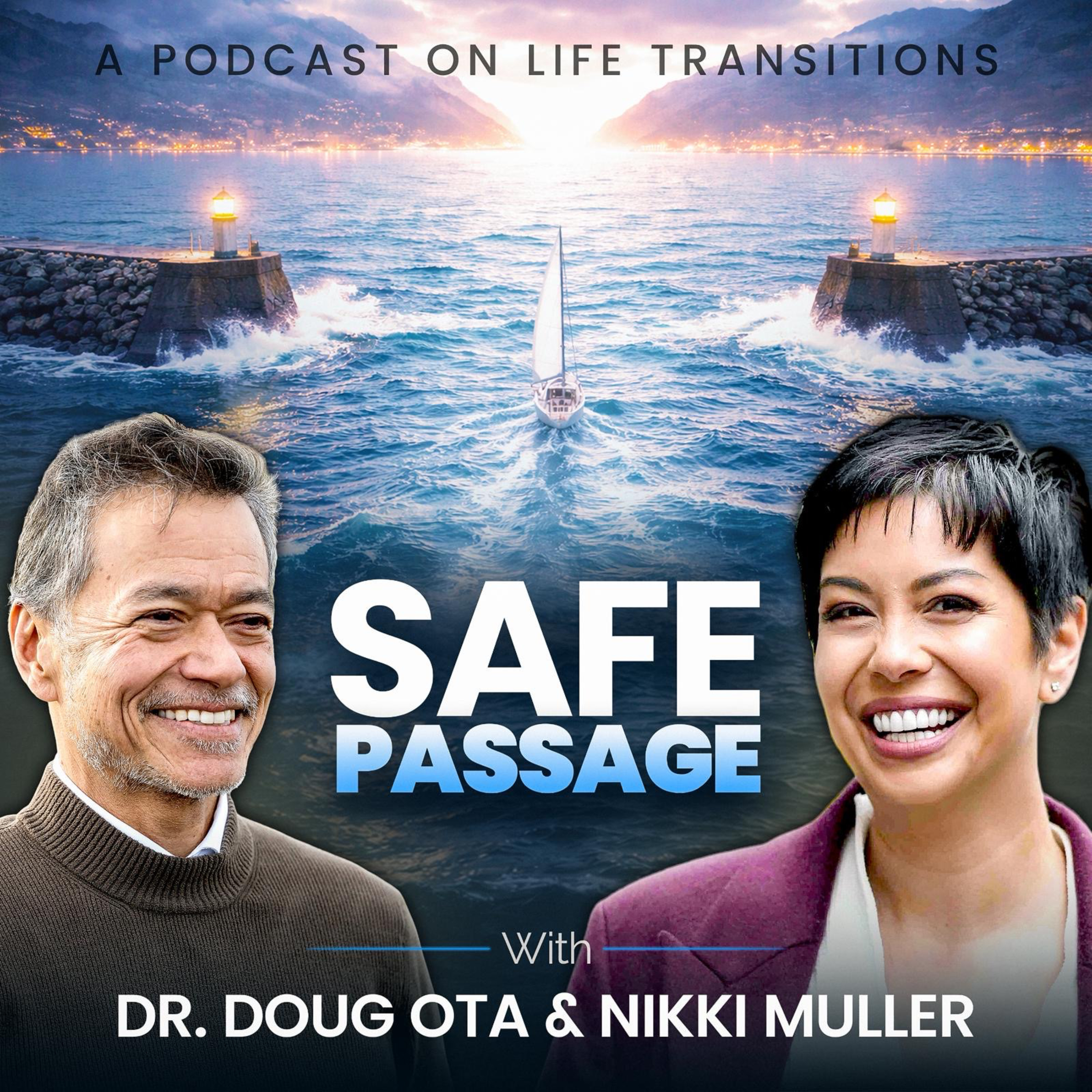
Safe Passage
by Dr. Doug Ota and Nikki Muller
The Safe Passage Podcast is a thoughtful conversation about the emotional side of life transitions. Hosted by Dr. Doug Ota and Nikki Muller, the show explores how change affects identity, relationships, grief, belonging, mobility, and our need for safe connection. Through clinical insight, lived experience, and warm, human conversation, the podcast helps listeners better understand what they are going through and what helps people find steadiness on the other side.
-
2
Ep 5 | Why Relocating Abroad Can Trigger Stress, Grief, and Loss of Confidence
Moving abroad can look exciting from the outside while quietly creating stress, grief, disorientation, and a loss of confidence underneath.In this episode, Nikki Muller shares a deeply personal story about a simple mistake with a new car in Switzerland that became a window into the much larger emotional reality of leaving behind fifteen years of life in Singapore.Together, Nikki and Dr. Doug Ota unpack what happens when relocation overloads the nervous system, how attachment security and belonging shape our experience of change, and why even chosen transitions can leave us feeling disconnected from ourselves. Through stories, practical reflections, and compassionate insight, they explore the hidden emotional cost of starting over and what helps people feel supported during seasons of uncertainty.Listeners will leave with a clearer understanding of why major moves can feel so overwhelming and how safe connection helps make change easier to carry.Things You Will LearnWhy a move you chose can still trigger grief, stress, and emotional disorientationHow our attachment behavioral system gets activiated during major life transitionsWhat support, connection, and emotional safety look like when confidence feels shakenTools & Frameworks CoveredAttachment behavioral system — this is an evolved behavioral system that aided survival and is activated by threats such as transition stress. Security Priming — using trusted relationships to help regulate the nervous systemTransition Overload Framework — recognizing how multiple life changes can overwhelm confidence and decision-makingShare this episode with someone navigating a season of change.#LifeTransitions #RelocationStress #Belonging #EmotionalSafety #SafePassagePodcast🎙️ Join The Safe Passage Podcast for thoughtful conversations on life transitions, grief, identity, belonging, and the human need for safe connection.Spotify: https://open.spotify.com/show/033jTOnkE1euwu4JiImyovApple Podcasts: https://podcasts.apple.com/ch/podcast/safe-passage/id1896787362?l=en-GBYouTube: https://www.youtube.com/@TheSafePassagePodcastWebsite: https://www.thesafepassagepodcast.com/
-
1
Ep 4 | Why Unacknowledged Goodbyes Get Stored in the Body and How to Finally Let Them Go
Every transition begins with an ending, and most of us have been trained to move through that ending as quickly as possible. In this episode, Dr. Doug Ota and Nikki Muller explore what actually happens when we don't say a proper goodbye: how unacknowledged loss gets stored in the body, how the inner self quietly stops reaching out as far as it once did, and why the capacity to grieve well is the foundation of every genuine new beginning.Drawing on their own histories, Nikki's loss of two aunts to suicide and the twenty years she stopped saying goodbye, Doug's brother's death, and a father who refused to attend the funeral, they make the case that effective goodbyes are not sentimental gestures. They are an emotional skill, and one that can be learned at any age.Things You Will Learn:Why unresolved grief doesn't disappear, but it accumulates in the body, often long before the mind is ready to acknowledge it, and eventually surfaces as physical or psychological symptoms.How the inner self learns to stop reaching toward new connections when goodbyes consistently go unhonored and what it takes to rebuild that openness.What a genuinely intentional goodbye can look like in practice: specific, somatic, creative, and grounded in gratitude rather than just sentiment.Tools & Frameworks Covered:Grief is a necklace: every loss connects to every other loss. When one bead is touched, the whole necklace moves. Transitions that seem unrelated to past grief can activate everything that came before.The bank of the body: unresolved feelings don't disappear; they accumulate. The body is a vast reservoir that keeps lending until it can't, and when it reaches its limit, a symptom appears.You have to grieve well to leave well: the quality of the next beginning is directly shaped by the quality of the goodbye that preceded it. This is not poetic. It is practical.#GriefInsideTransition #EffectiveGoodbyes #UnresolvedGrief #AttachmentAndBelonging #GloballyMobileFamilies🎙️ Join The Safe Passage Podcast for thoughtful conversations on life transitions, grief, identity, belonging, and the human need for safe connection.Spotify: https://open.spotify.com/show/033jTOnkE1euwu4JiImyovApple Podcasts: https://podcasts.apple.com/ch/podcast/safe-passage/id1896787362?l=en-GBYouTube: https://www.youtube.com/@TheSafePassagePodcast
-
0
Ep 3 | Why Belonging Feels So Hard to Rebuild After Every Move
Moving to a new place can look fine on the outside, while something much harder is happening underneath. In this episode of Safe Passage, Dr. Doug Ota and Nikki Muller explore belonging as a biological need, not a social nicety, and what it costs people when that need goes unmet during transition.Drawing on decades of research and their own lived experience as mixed-race, globally mobile individuals, they unpack why starting over again and again doesn't just feel lonely, but it registers in the body as real pain. Using the language of roots and capillaries, attachment bonds, and belonging uncertainty, they give listeners a framework for understanding what is actually happening when a new place doesn't yet feel like home, and why that feeling takes longer than anyone expects.Things You Will Learn:Why the absence of belonging activates the same neural pathways as physical pain, and what that means for people in transition.How mobility affects the tightening and loosening of affectional bonds, and why the timing of that process matters for mental and relational health.What belonging uncertainty is, why it runs especially deep for mixed-race and third-culture individuals, and how it shapes the experience of never quite fitting into a single category.Tools & Frameworks Covered:Roots and capillaries: belonging isn't just built through close friendships; it depends on thousands of small, seemingly trivial connections. When those disappear in transition, the loss is felt even when it can't be named.Tightening and loosening affectional bonds: moving requires grief, and grief requires attachment security. The capacity to say goodbye well is an emotional skill, not a personality trait.Belonging uncertainty: the persistent, low-level doubt about whether you are truly accepted in a given space. For people who are highly mobile, mixed-race, or both, this uncertainty is not occasional. It is structural.Share this with someone who's in the middle of a move, a return, or a season where belonging feels out of reach.#BelongingAndTransition #GloballyMobileFamilies #AttachmentAndBelonging #ThirdCultureKid #GriefInsideTransition🎙️ Join The Safe Passage Podcast for thoughtful conversations on life transitions, grief, identity, belonging, and the human need for safe connection.Spotify: https://open.spotify.com/show/033jTOnkE1euwu4JiImyovApple Podcasts: https://podcasts.apple.com/ch/podcast/safe-passage/id1896787362?l=en-GBYouTube: https://www.youtube.com/@TheSafePassagePodcast
-
-1
Ep 2 | How Families and Schools Can Better Support Children Through Major Life Transitions
Children going through a move, a divorce, or a change of school often look like they're coping, and that appearance is exactly what makes the hidden distress so easy to miss. In this episode, Dr. Doug Ota and Nikki Muller explore what is actually happening inside children and families during transition, and why the adults around them are so often carrying unprocessed grief of their own.Drawing from Dr. Doug’s work as the Founder of SPAN (Safe Passage Across Networks) supporting international schools and highly mobile communities, his research into John Hattie's landmark meta-study on learning outcomes, and his own experience of family rupture in childhood, they make the case that it is not mobility itself that causes harm; it is mobility that goes unseen, unnamed, and unsupported. Nikki brings her own story as a Third Culture Kid (TCK) and child of divorce, opening the space for the kind of honest, emotionally precise conversation that this topic rarely receives.Things You Will Learn:Why children who appear resilient after a move or family change may still be carrying unanswered questions that no one has helped them name.What John Hattie's largest-ever study of educational factors revealed about the impact of moving on children's learning, and why the real finding is about support, not the move itself.How the attachment system activates during transition, and what it looks like in children who don't yet have language for what they're feeling.Tools & Frameworks Covered:The story no one is reading: when people move, the readers of their life story disappear. Children feel this acutely, even when they can't articulate it.Unmanaged mobility: it is not moving that damages learning outcomes or emotional health. It is moving without support. That distinction changes everything about how families, schools, and educators should respond.Resilience as a demand versus resilience as an outcome: when adults need children to be resilient, they are often asking them to suppress. True resilience emerges from support, not from pressure to move on.#UnmanagedMobility #ChildrenAndTransition #AttachmentAndEmotionalSafety #GloballyMobileFamilies #GriefInsideTransition🎙️ Join The Safe Passage Podcast for thoughtful conversations on life transitions, grief, identity, belonging, and the human need for safe connection.Spotify: https://open.spotify.com/show/033jTOnkE1euwu4JiImyovApple Podcasts: https://podcasts.apple.com/ch/podcast/safe-passage/id1896787362?l=en-GBYouTube: https://www.youtube.com/@TheSafePassagePodcast
-
-2
Ep 1 | Why the Emotional Weight of Life Transitions Doesn't Run on Your Schedule
Change is an event. Transition is everything happening underneath it, and it runs on its own schedule, not yours. In this episode, Dr. Doug Ota and Nikki Muller do something unusual: they show up in their own transitions rather than above them.Dr. Doug is at the tail end of the most demanding season of his life, emerging from eight years of doctoral work and the emotional reckoning that followed. Nikki is at the raw front end, freshly relocated to Switzerland, alone in an empty apartment, rebuilding from scratch.Together they explore what transition actually costs when you try to push through it too quickly, why our biology resists the myth of self-sufficiency, and what it looks like to let feelings move through rather than pile up. This is not a conversation about resilience. It is a conversation about what it actually requires to pass through change honestly.Things You Will Learn:Why change and transition are not the same thing, and why that distinction matters for how you treat yourself during difficult seasons.What happens physically and emotionally when people suppress or rush through the internal experience of change.Why the belief that we should be able to handle transition alone is a grave violation of our biology.Tools & Frameworks Covered:Change vs. transition: change is the event; transition is the internal process that follows. It begins with an ending, does not run on a timeline, and cannot be bypassed without cost.The wave form: feelings have a crest and a trough, and you cannot flatten one without flattening the other. Pushing through the hard parts does not eliminate them; it defers them.The biology of co-regulation: the body responds to isolation with measurable stress. We are not wired to carry transition alone, and the research on shared difficulty shows what happens when we don't have to.#ChangeVsTransition #LifeTransitionSupport #GriefInsideTransition #AttachmentAndBelonging #ThirdCultureKid🎙️ Join The Safe Passage Podcast for thoughtful conversations on life transitions, grief, identity, belonging, and the human need for safe connection.Spotify: https://open.spotify.com/show/033jTOnkE1euwu4JiImyovApple Podcasts: https://podcasts.apple.com/ch/podcast/safe-passage/id1896787362?l=en-GBYouTube: https://www.youtube.com/@TheSafePassagePodcast
-
-3
Welcome to Safe Passage
Hear it for yourself.This is The Safe Passage Podcast, a show about the transitions we move through, the belonging we search for, and the quiet courage it takes to begin again.Press play.This is what the conversation sounds like.If it speaks to something in you, visit our website and join the email list.We launch soon, and we want you there.https://thesafepassagepodcast.com/#SafePassagePodcast #Transitions #Belonging #HumanConnection #LifeTransitions #Mobility #EmotionalWellbeing #IdentityAndBelonging
-
-4
Track
Testing.
We're indexing this podcast's transcripts for the first time — this can take a minute or two. We'll show results as soon as they're ready.
No matches for "" in this podcast's transcripts.
No topics indexed yet for this podcast.
Loading reviews...
ABOUT THIS SHOW
The Safe Passage Podcast is a thoughtful conversation about the emotional side of life transitions. Hosted by Dr. Doug Ota and Nikki Muller, the show explores how change affects identity, relationships, grief, belonging, mobility, and our need for safe connection. Through clinical insight, lived experience, and warm, human conversation, the podcast helps listeners better understand what they are going through and what helps people find steadiness on the other side.
HOSTED BY
Dr. Doug Ota and Nikki Muller
Loading similar podcasts...
Frequently Asked Questions
How many episodes does Safe Passage have?
Safe Passage currently has 7 episodes available on PodParley. New episodes are automatically indexed when they're published to the podcast feed.
What is Safe Passage about?
The Safe Passage Podcast is a thoughtful conversation about the emotional side of life transitions. Hosted by Dr. Doug Ota and Nikki Muller, the show explores how change affects identity, relationships, grief, belonging, mobility, and our need for safe connection. Through clinical insight, lived...
How often does Safe Passage release new episodes?
Safe Passage has 7 episodes. Check the episode list to see recent publication dates and frequency.
Where can I listen to Safe Passage?
You can listen to Safe Passage on PodParley by clicking any episode. We provide an embedded audio player for direct listening, and you can also subscribe via your preferred podcast app using the RSS feed.
Who hosts Safe Passage?
Safe Passage is created and hosted by Dr. Doug Ota and Nikki Muller.
URL copied to clipboard!