
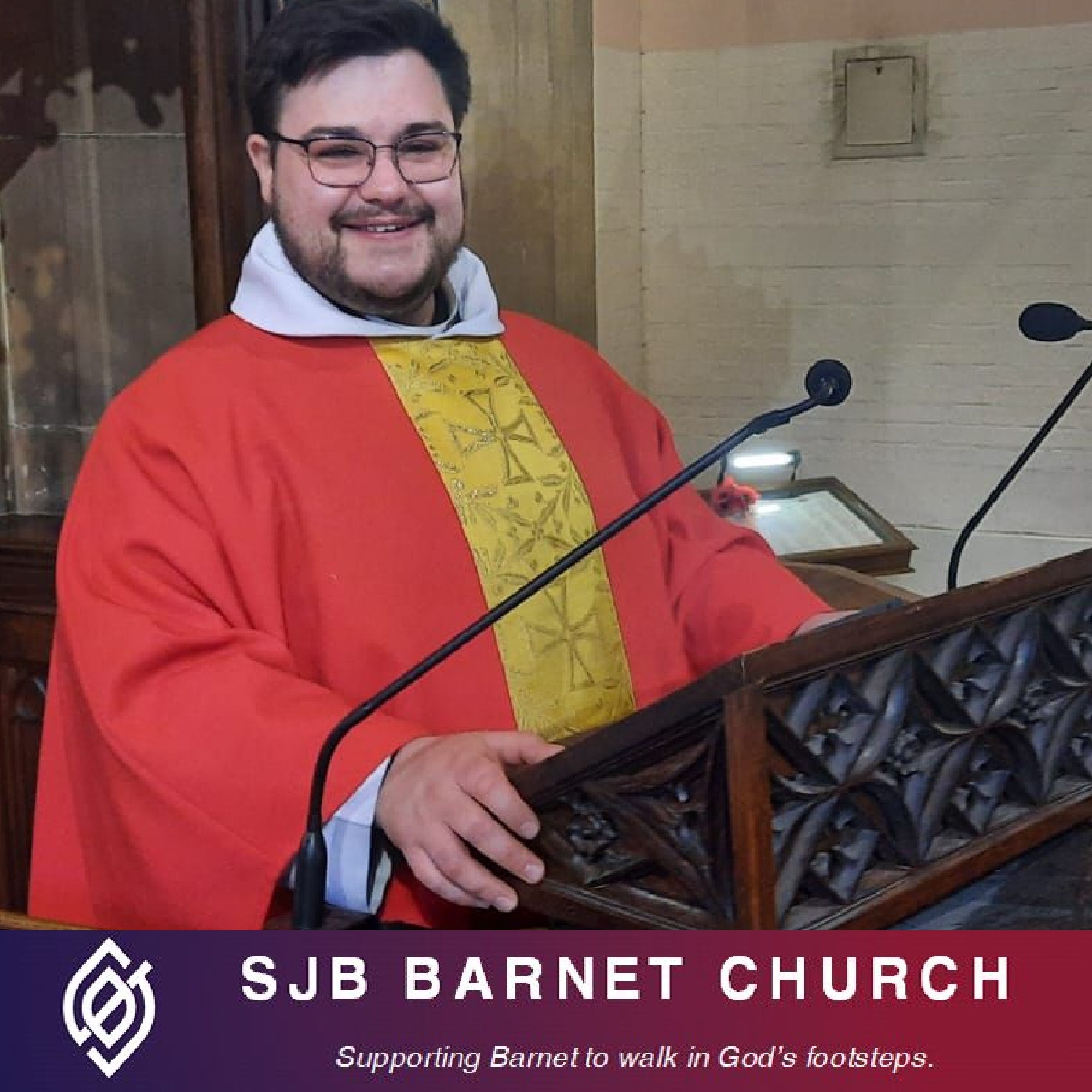
PODCAST · religion
Saint John the Baptist Church - Chipping Barnet - Sermons
by Fr Sam Rossiter-Peters
Each week we update this podcast with messages from Fr Sam Rossiter-Peters, Team Vicar of St John the Baptist Church. Our vision is to support Barnet to walk in God’s footsteps. We hope you are encouraged by this podcast. For more information about Saint John the Baptist church, please visit us at https://www.barnetparishchurch.org.uk/.
-
46
Sermon on The Second Sunday of Lent - Fr Sam Rossiter
On the Second Sunday of Lent, Fr Sam reflects on one of the most beloved verses in Scripture — “For God so loved the world…”, and invites us to see it not as a slogan, but as a revelation of relationship. Drawing on the intimate imagery of the Son resting “at the Father’s breast,” this episode explores how God’s very nature is love, a love so complete that it overflows into creation and into the giving of the Son.Lent becomes a season not of condemnation, but of restoration. In Christ, the distance we created between ourselves and God is carried and undone. Faith, then, is not about mastering ideas about God, but trusting the One whose love is the deepest truth of reality, and rediscovering that we were made for relationship with Him.
-
45
Sermon on The First Sunday of Lent - Fr Sam Rossiter
On the First Sunday of Lent, Fr Sam reframes Lent not as a season of gloom, but as a path to deeper joy. Reflecting on the wilderness temptations of Christ, he explores how Jesus reversed the pattern of Eden, resisting the temptations of appetite, power, and control where humanity had failed.Lent, then, becomes a season of abundance. Through fasting, prayer, and generosity, we are not punishing ourselves but retraining our hearts, turning away from self-reliance and back toward the loving relationship with God for which we were created. True joy, the sermon reminds us, is not fleeting happiness but flourishing in communion with the Trinity, made possible through Christ’s victory in the wilderness.
-
44
Sermon on The Last Sunday of Epiphany - Fr Sam Rossiter
On the Last Sunday of Epiphany, Fr Sam reflects on the competing pressures that crowd God out of our lives, busyness, noise, and a culture unsure of truth itself. Drawing on the Transfiguration of Christ and St Peter’s insistence that the apostles were “eyewitnesses of his majesty,” this episode calls listeners back to Jesus as the firm foundation of truth in a confusing world.In a time of overload and uncertainty, the sermon reminds us that faith is sustained not by clever ideas or shifting priorities, but by returning again and again to the revealed glory of Christ, making space for prayer, worship, and truth amid the noise.
-
43
Sermon on The Second Sunday of Epiphany - Fr Sam Rossiter
On the Second Sunday of Epiphany, Fr Sam reflects on the difference between seeking explanations about God and receiving revelation from God. Centered on John the Baptist’s declaration, “Here is the Lamb of God who takes away the sin of the world,” this episode explores how God reveals Himself most fully not through ideas, but through the cross.Epiphany, we are reminded, reaches its deepest expression in Christ’s self-giving love — where human brokenness meets divine forgiveness. The sermon invites listeners to approach faith not as something to be fully explained, but as a mystery to be encountered, participated in, and lived through repentance, grace, and sacramental life.
-
42
Sermon on The Baptism of Christ - Fr Sam Rossiter
On the Feast of the Baptism of Christ, Fr Sam reflects on baptism as a gift, not an achievement. Using the image of baptism as a spiritual birthday, this episode explores how our deepest identity is revealed, not earned in God’s love. Just as Jesus is named “Beloved” at the Jordan before he does anything to prove himself, so too we are claimed, welcomed, and loved before all action or effort.Baptism and Eucharist together remind us that our worth rests in grace alone, calling us to live not from comparison or striving, but from the secure knowledge that we are God’s beloved children.
-
41
Sermon on The Epiphany - Fr Sam Rossiter
As the new year begins, Fr Sam reflects on Epiphany as a story of insiders and outsiders, and God’s deliberate choice to reveal Himself beyond boundaries. Set against a world marked by fear, conflict, and division, this sermon explores how Jesus was born into political instability, poverty, and displacement, and how the first to worship Him were foreigners and immigrants.Epiphany reveals a kingdom not built by exclusion, but by welcome. It reminds us that most Christians were once “outsiders” themselves welcomed only by grace and calls us to live that same grace today by building bridges, not walls, and making room for those the world is quick to reject.
-
40
Sermon on Midnight Mass and Christmas Day - Fr Sam Rossiter
On Midnight Mass and Christmas Day, Fr Sam reflects on the power of names and what they reveal about who we are — and who God is. Drawing from St John’s Gospel, he explores Jesus as the Logos: the meaning at the heart of reality who became flesh and lived among us.This episode traces the names of God through Scripture, the God who sees, the God who sustains, and the God who saves revealing a God who knows us fully and comes close to carry what we cannot.Christmas, then, is not about having life figured out or being “good enough,” but about discovering what it means to be known, forgiven, and loved by the God who calls us by name.
-
39
Sermon on Third Sunday of Advent - Fr Sam Rossiter
On the Third Sunday of Advent, Fr Sam reflects on the doubt and confusion of John the Baptist as he waits in prison and questions whether Jesus truly is the Messiah. Through Jesus’ response “Blessed is anyone who takes no offence in me” this episode explores how faith can be tested when God’s work doesn’t match our expectations.Rather than bringing judgement and power, Jesus reveals a kingdom marked by mercy, healing, and grace. The sermon invites listeners to trust God’s purposes even when the path feels unclear, and to remain faithful without stumbling over the unexpected ways Christ brings redemption.
-
38
Sermon on Second Sunday of Advent - Fr Sam Rossiter
In this powerful Second Sunday of Advent reflection, Fr Sam asks a deeply searching question: Why does the Church exist? As St John the Baptist Church prepares to welcome hundreds of people through its doors for the Barnet Christmas Fair, this sermon reframes community activity not as tradition or visibility but as mission.Drawing on the fierce preaching of John the Baptist and the theology of St Paul in Romans, Sam challenges the danger of religious complacency. Just as the crowds at the Jordan assumed their birthright as children of Abraham made them secure, we too can fall into the trap of believing that history, culture, or status make us the Church. But John’s warning is clear: belonging to God is not about heritage it is about faith and relationship.Through the story of Abraham, Sam traces the widening circle of God’s covenant: from one man, to a family, to a nation, and ultimately to the whole world. Faith, not background, is the true foundation of righteousness. This means that anyone with even the smallest spark of belief belongs and the Church exists for precisely those people who think they might be on the outside.The Barnet Christmas Fair becomes a living parable of this truth: the Church does not exist for itself, its building, its history, or even its traditions it exists to make Christ known, to make people feel they belong, and to make strangers feel like family.This episode is a stirring reminder that Advent is not only about preparation for Christmas, it is about recommitting to the mission of welcome, grace, and outward-looking love.
-
37
Sermon on Advent Sunday - Fr Sam Rossiter
In this Advent Sunday episode, Fr Sam invites us to rediscover the season not as a gentle lead-up to Christmas, but as a wake-up call. While we may picture the nativity as a comforting scene with children’s costumes and soft candlelight, Sam reminds us that the real story was anything but safe or sentimental. God entered the world through poverty, scandal, political oppression, and refugee displacement — and this shocking reality shapes what Advent truly means.Drawing on Matthew 24, Isaiah’s prophecy, and Paul’s exhortation in Romans, Sam explains that Advent begins not in the manger but with urgency: “Be ready.” Jesus’ title “Son of Man” ties His birth to ancient prophecy, reminding us that God’s work in the world is always bigger, more surprising, and more disruptive than our expectations.Through this sermon, we’re confronted with a three-fold Advent calling:Be ready for God’s new, unexpected work — in refugees, the poor, the overlooked, and the places we least expect to find Him.Live differently because Christ entered our world — letting the nativity reshape our actions, words, priorities, and compassion.Rely on grace, not self-reliance — trusting God to clothe us with righteousness rather than trying to earn it.Advent becomes a season of awakening — a summons to look for God among the vulnerable in our own community, to embody hope for the hurting, and to join the Holy Spirit’s work of drawing all people into God’s peace.
-
36
Sermon on Second Sunday Before Advent - Fr Sam
In this deeply honest and pastoral reflection, Fr Sam unpacks one of Jesus’ most challenging teachings, forgiveness without limit. Drawing from Matthew 18, where Peter asks how many times he must forgive, Fr Sam explores what it really means to live out forgiveness “seventy times seven.”Through a powerful personal story of betrayal and hurt from his time as a pastoral assistant, Fr Sam illustrates how forgiveness is not about ignoring pain or pretending everything is fine. Instead, it begins at the altar,“Drown them in the chalice,” his priest once told him, meaning that true forgiveness starts in the presence and grace of Jesus.Fr Sam reminds us that forgiveness is not weakness, denial, or instant healing. It’s a journey of grace, often slow and painful, where we bring our hurt to God again and again until mercy begins to reshape us. Forgiveness, he says, is not something we manufacture; it is something God does within us.In a world where many wounds run deep, in relationships, communities, and faith, this episode invites us to rediscover forgiveness not as obligation, but as the path to freedom and peace.
-
35
Sermon on Remembrance Sunday - Fr Sam Rossiter
In this moving Remembrance Sunday reflection, Fr Sam challenges how we imagine heaven and the life to come. Too often, he observes, we picture heaven as “earth but a bit better”. A continuation of our current joys without the pain. But, as Fr Sam powerfully reminds us, that vision cannot hold for those who have seen or suffered the worst that humanity can do. For them, heaven must be something entirely new and not an extension of this world, but its transformation.Drawing from Jesus’ exchange with the Sadducees about marriage and resurrection, Fr Sam shows how Christ reveals heaven not as a continuation of earthly relationships, but as a perfected network of love, where all are united in and through the Holy Trinity. Using vivid imagery and honest theological reflection, he weaves together the themes of war, suffering, love, and divine relationship, reminding us that we were created for connection with God, with each other, and with creation itself.Remembrance Sunday, then, becomes more than a moment to mourn the fallen. It becomes a symbol in need of fulfilment: a call to live differently now, to build peace, and to embody the divine love that heaven promises.
-
34
Sermon on Last Sunday after Trinity - Fr Sam Rossiter
In this reflective episode, Fr Sam explores one of the most profound dimensions of faith — the kind of faith that we can hold for others. Drawing from the Gospel story of friends bringing a paralysed man to Jesus, Fr Sam challenges listeners to see evangelism not as a performance or a pressure, but as an act of love, hope, and quiet courage.He begins with a candid question: “Is there any point in telling people about Jesus?” In a world that’s indifferent or even apathetic toward faith, sharing what we believe can feel daunting. Yet, as Fr Sam reminds us, faith is not about results — it’s about bringing people to Jesus and trusting Him to do the rest.Through this sermon, Sam paints a vivid picture of what it means to be a “city on a hill” and “a light in the darkness.” Like the friends who carried their companion through a crowded house just for the chance that Jesus might heal him, we too are called to carry others to Christ through our prayers, presence, and love — even when we don’t know how He’ll respond.The message is both liberating and empowering: our role isn’t to convert, convince, or control outcomes. It’s simply to make the introduction — to believe that the meeting itself can change everything.
-
33
Sermon on 18th Sunday after Trinity - Fr Sam Rossiter-Peters
In this sermon for the 18th Sunday after Trinity, Fr. Sam Rossiter-Peters invites us to a deeper, more courageous engagement with Scripture. Rather than reading the Bible in black and white, we are called to wrestle with it — to question, to study, and to seek God’s living truth within its complexities. Drawing from passages that challenge our understanding and our times, Fr. Sam reminds us that faithful interpretation means holding Scripture, tradition, reason, and experience together — trusting the Holy Spirit to guide us into a fuller vision of God’s justice and love.
-
32
Sermon on 17th Sunday after Trinity - Cyril Awere
Cyril Awere shares his story as part of celebrations of Black History Month at St. John the Baptist Church, Chipping Barnet.
-
31
Sermon on 16th Sunday after Trinity - Fr Sam Rossiter
In this episode, we reflect on what it truly means to be satisfied — not just physically, but spiritually. Drawing from John 6:25–35 and the story of the feeding of the 5,000, Fr Sam explores how Jesus invites us to move from seeking mere provision to encountering the Provider Himself.Using the relatable story of his young daughter learning to communicate her needs, Fr Sam illustrates how, like children, we often sense our hunger or longing but misdiagnose what we truly need. The crowds following Jesus wanted more bread, but Jesus offered something far greater — Himself, the Bread of Life.As we celebrate Harvest Thanksgiving, this message reminds us that gratitude for our “daily bread” is only the beginning. We are called to move from thanksgiving to transformation — to receive the Bread of Life in the Eucharist, and then to give back our first fruits in worship, generosity, and service.Fr Sam invites us to see giving not as an obligation, but as an act of worship. Whether through money, time, kindness, or prayer, every offering is a response to God’s abundant grace.
-
30
Sermon on 15th Sunday after Trinity - Fr Sam Rossiter
Whilst Christianity is often thought of as a dualistic religion which says that the spiritual is Godly, and the world of matter evil, in fact God cares a lot about the material world. In this sermon for the 14th Sunday after Trinity, Fr. Sam Rossiter-Peters narrates how Jesus and St Paul simply advise us to orientate our concerns properly, putting God before the world.
-
29
Sermon on 14th Sunday after Trinity - Fr Sam Rossiter
In this sermon for the 14th Sunday after Trinity, Fr. Sam Rossiter-Peters reflects on the difference between knowledge and wisdom, drawing from the insights of philosophers like Socrates and Aristotle, and the deeper call of Christian faith. Through the story of Matthew the tax collector, we see how true wisdom begins with recognising our need for God and seeking Christ the Physician, who welcomes, heals, and transforms all who come to Him with humility.
-
28
Sermon on 5th Sunday of Easter - Fr Sam Rossiter
If our foundations of faith are built in a way that allows for questions, which embraces the challenges of faith, which has room for mystery and the unknown, then when the inevitable period of exploration comes there's a well-worn roadmap to follow. Young people who are taught to question and to think for themselves can use the time of exploration when they're older to establish an adult faith which puts into practice those tools of questioning that they've learned through childhood. And even if their faith tradition then comes to be very different from what they had as a child this is usually an exciting time of growth.Fr Sam Rossiter-Peters explains the importance of us to begin by questioning ourselves, by wrestling with our assumptions, and asking if what we believe about the church and about God is really because God has led us there, or because we're a bit personally uncomfortable with the alternative. Of course, we want to be faithful to Scripture and theology, but faithfulness means probing, challenging, examining, not just the words, but the spirit behind what we're reading. Because although it sounds straightforward, love one another as I have loved you, can be taken in lots of different ways.
-
27
Sermon on 3rd Sunday of Easter - Fr Sam Rossiter-Peters
I realise that I've said to enough of you enough times, this is probably my favourite piece of scripture, that this sentence has lost any kind of meaning. That said, this morning's gospel is my favourite piece of scripture. I love it, because of how tender Jesus is with the disciples.That phrase, children, you have no fish, do you? Always sounds in my head, like a gentle and loving parent, lamenting with their child over a hurt, like a scraped knee. Since becoming a parent myself, that tone, which Jesus uses a few times throughout the Gospel of John, making it probably my favourite gospel, apart from the other three, means even more to me. It reminds me of the tone that I use, particularly with my daughter when I go into her room during the wee hours of the night, because she's woken up crying.Fr Sam Rossiter-Peters explains the Easter message, that there is redemption even through the worst moments of our lives, the worst mistakes we've made. As with Peter, Jesus doesn't deny that bad things happen and he doesn't need us to either. To be redeemed, we need to have something to be redeemed from.
-
26
Sermon on 2nd Sunday of Easter - Fr Sam Rossiter-Peters
This idea that in the face of guilt and despair we can look to Jesus for hope is the very heart of the Easter message. We don't usually, or often at least, attribute despair to Satan, but most of us have known that sense of crushing weight, the weight of realising that we've done something wrong. We've felt that moment at some point in our lives, the rising tide when an old mistake comes back and the guilt fills us. Fr Sam Rossiter-Peters explains that Jesus has won forgiveness for us in his wounds of crucifixion, so we don’t need to stand accused of our guilt. The disciples may have felt shame when they first met Jesus after the resurrection because they had run away, but his first words to them were ‘peace be with you.’
-
25
Sermon on Easter Sunday - Fr Sam Rossiter-Peters
How would you go about calculating the value of a human life? How about the value of your life? That's a hard question to answer. We all assume that we're valuable, but are you valuable because of how much money you make or what you contribute to society through your job? Are you valuable because of how many people consider you a friend? Are you valuable because you have a family? The question makes us feel uncomfortable and the answer's even more, because if our worth is calculable in those ways, we could easily find ourselves worth not very much. Money, jobs, friends, even family can come and go.Fr Sam Rossiter-Peters explains you are worthy. You are valuable, not because of what you do, or how much money you make, or who loves you, or what relationships you have. In fact, your worthiness, your value is totally out of your hands, just like the worthiness of the person sat next to you. For you and for them and for all people everywhere, Jesus has looked at you in your totality and decided that you are worth his life. How you respond is up to you.
-
24
Sermon on Good Friday - Fr Sam Rossiter-Peters
My God, my God, why have you forsaken me? My God, my God, why have you forsaken me? These words echo through Good Friday. They're raw, violent, terrible.They're the silence which follows a question everyone was too afraid to ask. The heartbreak of a child crying in fear and pain. The wailing of a bereaved parent.Fr Sam Rossiter-Peters explains the events that occurred in the lead up to the crucifixion of Jesus Christ and that those who followed him until this day and through all days would be able to know the fullness of joy of being in the presence of the Father, led by Jesus the Son, empowered by the Spirit. In the hope that overcame his fear, our fear was saved. His fear gave way to the surety of the life of the Trinity, the goodness of the Father, the power of the Spirit.In him our fear gives way to him. He who has gone before us has proven himself our good shepherd. And now, even when our path leads through the valley of the shadow of death, we will fear no evil, because his rod and his staff will guide us where he has already gone.We are sure that goodness and mercy shall follow us all the days of our life, and we will dwell in the house of the Lord forever. Thanks be to Jesus that he was afraid for us.
-
23
Sermon on Maunday Sunday - Fr Sam Rossiter-Peters
Yet when they made beings in the universe who could choose to reciprocate that love, those beings chose not to. We humans chose and continue to choose selfishness more than love, power more than generosity, riches more than contentment, the ability to dominate more than the ability to serve. Of course it would be easy to lay these traits at the doors of people like President Trump but truthfully they lie within all of us.Fr Sam Rossiter-Peters invites each of us to love one another as Jesus has loved us. This is to dedicate ourselves to love so much that we have to share it. We have to share it with people who don't understand it, don't appreciate us, don't thank us for it, even hate us for it, but who need it just like we do. This Maundy Thursday as we prepare to walk with Jesus through the valley of the shadow of death, knowing that he goes in our stead, may we ask for his grace to love as he loved, to love so abundantly that kings and emperors are shamed by it.
-
22
Sermon on the Fifth Sunday of Lent - Fr Sam Rossiter-Peters
I regard everything as loss, because of the surpassing value of knowing Christ Jesus my Lord.For his sake I have suffered the loss of all things, and I regard them as rubbish, in order that Imay gain Christ. In the name of the Father, and of the Son, and of the Holy Spirit.Fr Sam Rossiter-Peters invites each of us to ask ourselves the all important question as we approach Holy Week. How do you give urgently as part of this community? What gifts do you give so that this body can worship at all times and in all places as it is called to do? How do you work so that other people can live their lives just as they work so that you can live yours? Because together we give the most costly thing we have.Together we spread the message to the ends of the earth.Together we are St. Paul. Together we are Mary of Bethany. Together we worship God Almightyalways and everywhere as urgently as he requires.
-
21
Sermon on the Fourth Sunday of Lent - Fr Sam Rossiter-Peters
There are a few days in the year which are a joy to very many people but a challenge to some.Christmas especially can be difficult after the loss of a loved one and it can feel very lonely.Valentine's Day for those who yearn for a relationship but haven't found their right person canbe likewise.Mothering Sunday also very much falls within this category. For many, Mother's Day, as it'scalled outside this building, is a lovely day. It's a day of flowers and cards and cake and a veryearly morning if you're in the rectory.Today isn't Mother's Day at St John the Baptist. It's Mothering Sunday, as Laurie told me whenhe looked at the cards I produced for the children and got very grumpy at me about the factthat they said Mother's Day. The words Mother's Day and Mothering Sunday might soundfamiliar but the meanings definitely aren't.Fr Sam Rossiter-Peters explains that every person in this room is called to be a spiritual mother, to love as Christ the mother hen has loved us, just as I have loved you, so you also must love one another.
-
20
Sermon on the Third Sunday of Lent - Fr Sam Rossiter-Peters
As a Christian, as well as as a priest, it has been my experience that one of the biggest barriers to people coming to faith, or even exploring relationship with the church, is the fear that they aren't and can't be good enough. People who don't have much familiarity with Christianity often assume that Christians live by some impossibly high moral standard, one that they expect not just of themselves but of everyone else. I've lost count, for example, of the number of times I've gone into the local pub in my dog collar only to be asked if I'm even allowed to be in there and whether I'm allowed to drink alcohol.Fr Sam Rossiter-Peters explains that Paul was no stranger to sin. Before he came to Christ, he was a violent man persecuting the foundling church. It was he that stood by holding the coats as the crowd lynched St Stephen. He knew that he was sinful. St Paul knew that he was saved by grace. He knew that he owed everything to Jesus because Jesus forgave him. And so he knew that the Christian community was and still is full of people who make mistakes and need forgiveness. He, as he called himself, the chief amongst sinners, led a community of sinners forgiven. St Paul also knew that following Jesus meant being transformed.He knew that Jesus wasn't harshly judgmental but nor did he ignore sin. He called people to repentance. Repentance, that Greek word metanoia, which means not saying sorry but turning around and going in the opposite direction, embracing a new kind of life. Christianity is not about adhering to some impossible moral standard and holding everyone else to that same impossible moral standard. It's about accepting that none of us are worthy, but we are loved, and that love changes us into worthiness. And so, as we travel through this season of Lent, ask yourself, am I one of those people that is guilty of making the church an impossible place to be? Where in my life am I lifting others up? Where am I tearing them down? Am I helping others to grow in faith, or am I standing in the way of their transformation, perhaps even without realising it? Where am I holding myself to an impossible moral standard? Where am I expecting it of others? Where am I shaped by God's love? Where am I sharing that love? St. Paul's transformation reminds us that no one is beyond God's reach.
-
19
Sermon on the Second Sunday of Lent - Fr Sam Rossiter-Peters
There can be something greatly troubling about the reality of the human heart. Human beings are, of course, capable of love, justice, and acts of great self-sacrifice. And yet there seems to remain within us a deep-seated inclination to turn away from the path of life and flourishing that God has set before us.Fr Sam Rossiter-Peters explains how in scripture the Israelites in the wilderness had seen firsthand the miraculous works of God. They had seen the plagues.The question this Lent is, will we allow him to do his work within us? Will we admit that we do create idols all the time of power or of wealth or of self-will? And will we submit to the love which has the power to change us? Or will we hear Jesus's words of lament spoken over us as they were spoken over Jerusalem? Let us not be a people who had the chance to be healed but refused because of our stubborn hearts. This Lent, let us grasp our fresh chance to decide. Let us be gathered under his wings as a hen gathers her brood.
-
18
Sermon on the First Sunday of Lent - Fr Sam Rossiter-Peters
Will you take the path that Christ has already opened for you? Will you begin by admitting that you do sin? You have made mistakes as Adam and Eve made mistakes. Will you ask Christ to help you resist temptation because he beat temptation in the wilderness? And then will you follow the path that he laid for you? Yes, a difficult path, but one which leads to the joy of complete freedom.Fr Sam Rossiter-Peters explains that Lent is not about misery, but rather freedom. Because although we know these temptations and although we fall to them time and again, in fact, they have already been beaten in Jesus. And Lent is our opportunity to realise the victory, to realise the freedom that is already ours in him.The practices of Lent aren't rules for their own sake. They are a path into the joyous freedom that Jesus won in the wilderness, into relationship with God, Father, Son and Holy Spirit.
-
17
Sermon on Ash Wednesday - Fr Sam Rossiter-Peters
Do you often hear preaching about loosing the bonds of injustice, undoing the thongs of the yoke, letting the oppressed go free or breaking every yoke?In this episode Fr Sam Rossiter-Peters invites us to ponder on the question for us today is, will our fasting, our prayers, our rituals do anything to us? Will they shape us into people who have stones in their hands, ready to judge? Or will they strip us of our self-righteousness and make us people of grace? Because let me be clear, if you're fasting, and the ashes that you're about to receive don't change your heart, if you're not willing to change, then you might as well leave. This has nothing for you. To loose the bonds of injustice, to undo the thongs of the yoke, to let the oppressed go free, and to break every yoke.
-
16
Sermon on the Third Sunday before Lent Sermon - Fr Sam Rossiter-Peters
Woe to you who are rich, for you have received your consolation. Woe to you who are full now, for you will be hungry. Woe to you who are laughing now, for you will mourn and weep. Where to you, when all speak well of you, for that is what their ancestors did to the false prophets. The Beatitudes, the list in which Jesus declares that those who are poor, hungry, weeping and hated for his sake makes for challenging reading.Fr Sam Rossiter-Peters encourages us to trust that the one who is God will bring about the future he said he would, no matter how impossible that future seems, because God is God and you are not. If you don't trust that Jesus was who he said he was, then the question is, "How surely?" because the Beatitudes place across roads in front of each one of us. They say, there is a hard road and it will lead to God. And there's an easy route and it will lead nowhere. One way or another you've got to decide.
-
15
Sermon on the Feast of The Presentation of Christ in the Temple Sermon - Fr Sam Rossiter-Peters
For this sermon we celebrate the feast of the presentation of Christ in the temple and in so doing, we close our celebrations of Christmas and Epiphany.Fr Sam Rossiter-Peters reminds us that God is our perfect heavenly Father. He's not a supermarket. May we have this strength and trust to follow the plan that he has laid out for us, to hear the answers that he has for us, even when they're no and not yet. Whether he has plans to do this year a continuation of what he has done last year in our years past. Or whether he plans to do a totally new thing amongst us and in your life. May we have the strength and wisdom to greet his plans with gratitude.
-
14
Sermon on The Second Sunday of Epiphany Sermon - Fr Sam Rossiter-Peters
Have you ever loudly walked into a room only to realise that everyone there was silent and had to back away in embarrassment?Sam Rossiter-Peters explains that when we break God's expectations by acting without love, we distance ourselves from him. That's not because he stops loving us. In fact, it's the opposite. Acting without love is the choice to walk away from God, to put ourselves before Him. And God loves us enough that he honours our choice.It feels impossible when we stare into those empty vessels, our lack of resources. When we know that we just don't have the strength to be the people that he calls us to be. But Cana is a promise. It isn't our job to provide the wine. We just provide what we have. Insubstantial as it is. And then he takes it and he turns it to abundance.
-
13
Sermon on The Feast of the Epiphany Sermon - Fr Sam Rossiter-Peters
Are you aware of what it feels like to be left out?Fr Sam Rossiter-Peters explains why the feast of the Epiphany is so important because today God chose to bring outsiders in. As we start 2025, if you have ever felt unloved, if you've ever wondered whether you in fact you do matter to God, whether you've ever wondered whether you in fact do matter to God, whether you've ever wondered whether you have a place in this church or any church, if you've ever worried that you don't belong because you don't believe or think the right things or you don't know as much as the next person in the pew, if you've ever worried that you look or feel or act differently to other people in church, Epiphany is your answer.
-
12
Sermon on Third Sunday of Advent- Fr Sam Rossiter-Peters
The scriptures are so wonderfully alive. You can read the same passage repeatedly and through the Holy Spirit they speak to you in new ways on your Christian journey.Fr Sam Rossiter-Peters explains that costly grace is the incarnation of God. This event we are invited to ask, are we ready to stand before Jesus when he comes tomorrow? Have we been pursuing cheap or costly grace? If ready means living that life of costly grace, may we all have the strength to say, "Yes, I am ready." But the road carries on.
-
11
Sermon on First Sunday of Advent- Fr Sam Rossiter-Peters
If you knew that his Majesty the King was coming to a dinner party sometime in the next month, but you didn't know when. How would you prepare?Jesus’s apocalyptic sayings like the ones we heard in our Gospel reading are some of his most difficult sayings to understand, like the first disciples we sometimes wish that he'd made them either easier to understand, like the first disciples, we sometimes wish that he'd made them either easier to understand, or else that he'd just chosen a different topic.Fr Sam Rossiter-Peter explains that as an audience, we are pretty much guilty of the same lack of insight. We see, for example, how nations have largely ignored the warnings about the crisis of global warming. Even when we see the scientific prophecies coming true, errant weather patterns rising sea levels are more toxic atmosphere. We still can't bring ourselves as an audience to these modern-day prophecies to act as we need to. They're talking about something terrible happening in the future and we'd rather not hear it and so we don't believe it. He reminds us that Jesus Christ will come again and that we be encouraged in that knowledge. Let us work together and encourage one another and restore whatever is lacking in our faith.
-
10
Sermon on Remembrance Sunday - Fr Sam Rossiter-Peters
What does Remembrance Sunday feel like for you? Fr Sam Rossiter-Peters invites us as Christians to bring together those difficult realities of remembrance, mourning and hope together. Because we're expert at bringing mourning and hope together, because we do it every time we come to the Eucharist. So, as Christians, this remembrance Sunday, let us do more than just recall. Let us hold intention, loss and hope, thankfulness and despair, death and life and proclaim with confidence that darkness does not overcome the light. Let us participate in making the past a present reality which has the power to shape the future. Let us lead the way in looking back on the road that we have walked as a community as a world. great miracle of the Eucharist in that Jesus gives everything of himself to us when we come to receive him.
-
9
Sermon on The Eucharist as a place to bring our Weaknesses as well as our Sin - Fr Sam Rossiter-Peters
What are the things that keep us far from God and what are the remedies? We're in a liminal space, a space between places where we move from slavery to our selfish incarnations to the freedom of love for God ourselves and others. It will only be when we see Jesus face to face that we know fully the reality of the resurrection which he won for us. Fr Sam Rossiter-Peters emphasises the great miracle of the Eucharist in that Jesus gives everything of himself to us when we come to receive him.
-
8
Sermon on The Feast Day of the Blessed Virgin Mary - Fr Sam Rossiter-Peters
The Magnificat, a song of liberation by Mary, addresses social injustices by highlighting how the rich have exploited and oppressed the poor. Jesus' teachings and actions continued this song of liberation, emphasising radical inclusivity and generosity. Fr Sam Rossiter-Peters emphasises the song's continued relevance today, encouraging listeners to take action to demand better for the marginalised.
-
7
Sermon on the The Transfiguration of Our Lord - Fr Sam Rossiter-Peters
Today, we ask ourselves, Who is God to us. Fr Sam focuses on a truth which my Pentecostal charismatic upbringing taught him. Fr Sam speaks about the notion that God's nature is infinite and so we tend to focus on the elements of that nature which makes the most sense to us. our starting point must not be our prejudices and our desires. We must start each day by laying aside who we want God to be and ask Jesus to show us who he actually is.
-
6
Sermon on the The Feast of St Mary Magdalene - Fr Sam Rossiter-Peters
Today, we remember St Mary Magdalene, Fr Sam focuses on a truth which my Pentecostal charismatic upbringing taught him. Fr Sam speaks about the fact there is no relationship without emotion. Whilst it might be comfortable for us who prefer a more contemplative Anglican approach to worship to consider our type of worship the norm, Worship of our Gods throughout the ages has in fact tended to be much more lively and much more emotive.
-
5
Sermon on the Seventh Sunday After Trinity - Fr Sam Rossiter-Peters
Do we have the strength to speak truth to power? Speaking truth to power is risky, because it means boldly proclaiming uncomfortable truths to people with power over you. Fr Sam speaks about account of the beheading of Saint John the Baptist and the consequences that he faced prior to his death.
-
4
Sermon on the Sixth Sunday After Trinity - Fr Sam Rossiter-Peters
This sermon touches on Saint Mark's account of Jesus healing people, noting the tone of benign indifference in the passage. This tone may be due to the Messianic secret principle in St. Mark's gospel, where Jesus asks healed people to keep quiet about their miracles. Theologians debate why Jesus asked people not to mention the miracles he performed, suggesting it may have been an early example of reverse psychology. Fr Sam speaks about as despite having enough reasons to be famous, Jesus insisted on secrecy, which some speculate was to make him more famous through reverse psychology.
-
3
Sermon on the birth of John the Baptist Patronal Festival - Fr Sam Rossiter-Peters
The best public servants are rarely completely popular. Could it be that as human beings we tend to demand a just world, particularly of our public servants, of our leaders, even though we find out that the unjust world unjustly benefits us. In his sermon today, Fr Sam speaks about as how as a people we can choose to serve others and follow the call of Jesus Christ, who is the true servant.
-
2
Sermons on the Visit of The Blessed Virgin Mary to Elizabeth - Fr Sam Rossiter-Peters
Do you consider yourself a just person? Injustice anywhere is a threat to justice everywhere. In his sermon today, Fr Sam speaks about how we can leverage our Christian faith to address injustice in our world.
We're indexing this podcast's transcripts for the first time — this can take a minute or two. We'll show results as soon as they're ready.
No matches for "" in this podcast's transcripts.
No topics indexed yet for this podcast.
Loading reviews...
ABOUT THIS SHOW
Each week we update this podcast with messages from Fr Sam Rossiter-Peters, Team Vicar of St John the Baptist Church. Our vision is to support Barnet to walk in God’s footsteps. We hope you are encouraged by this podcast. For more information about Saint John the Baptist church, please visit us at https://www.barnetparishchurch.org.uk/.
HOSTED BY
Fr Sam Rossiter-Peters
CATEGORIES
Loading similar podcasts...
Frequently Asked Questions
How many episodes does Saint John the Baptist Church - Chipping Barnet - Sermons have?
Saint John the Baptist Church - Chipping Barnet - Sermons currently has 45 episodes available on PodParley. New episodes are automatically indexed when they're published to the podcast feed.
What is Saint John the Baptist Church - Chipping Barnet - Sermons about?
Each week we update this podcast with messages from Fr Sam Rossiter-Peters, Team Vicar of St John the Baptist Church. Our vision is to support Barnet to walk in God’s footsteps. We hope you are encouraged by this podcast. For more information about Saint John the Baptist church, please visit us at...
How often does Saint John the Baptist Church - Chipping Barnet - Sermons release new episodes?
Saint John the Baptist Church - Chipping Barnet - Sermons has 45 episodes. Check the episode list to see recent publication dates and frequency.
Where can I listen to Saint John the Baptist Church - Chipping Barnet - Sermons?
You can listen to Saint John the Baptist Church - Chipping Barnet - Sermons on PodParley by clicking any episode. We provide an embedded audio player for direct listening, and you can also subscribe via your preferred podcast app using the RSS feed.
Who hosts Saint John the Baptist Church - Chipping Barnet - Sermons?
Saint John the Baptist Church - Chipping Barnet - Sermons is created and hosted by Fr Sam Rossiter-Peters.
URL copied to clipboard!