
PODCAST · science
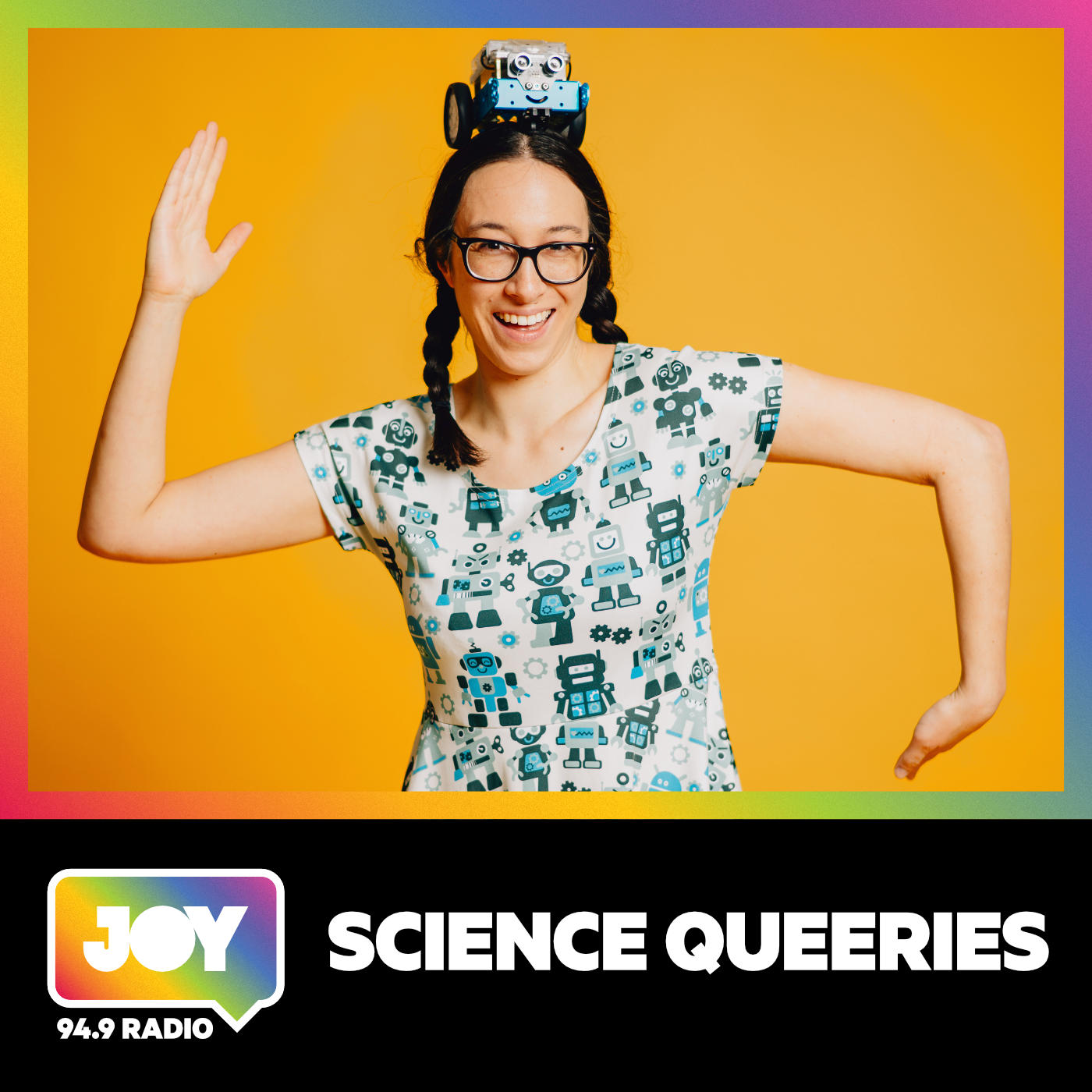
Science Queeries
by JOY 94.9 - Rainbow Community Podcasts for our LGBTI, LGBTIQA+, LGBTQIA+, LGBT, LGBTQ, LGB, Gay, Lesbian, Trans, Intersex, Queer Communities
Delve into the world of science with Cat
Episodes
-
Sharks in hot water
Sharks are fin-credible creatures. They have survived for over 450 million years – but they’re now facing unprecedented challenges. Sharks are essential to ocean ecosystems. They’re apex in every sense: apex predators, apex indicators of ocean health, apex examples of why we need to act now....
-
High time for space plants: cannabis clocks and trusty tomato
Branch into the world of high‑stakes horticulture. There’s no room to waste space – literally. Laura Steel is a post-doctoral researcher with the Australian Research Council Centre of Excellence for Plants for Space at La Trobe University. She is a plant scientist who has helped cannabis tell…
more -
Understanding pain and feeling heard
Pain is something we all feel – but for young people with cerebral palsy, it’s a daily reality that remains poorly understood. In fact, some don’t even register “pain”, because it’s simply the norm. Aayushi Khillan is a medical student and PhD researcher who’s mapping out chronic pain in cerebral...
-
Neutron stars and the universe’s pulse
The universe is spinning with mysteries – and we’re tuning in to hear them. Pulsars are neutron stars so dense that a teaspoon of their material would weigh as much as Mt Everest. They spin hundreds of times per second, emitting beams of radio waves like cosmic lighthouses sweeping across space.…
more -
Scales of climate change: the hiss-story and future of reptiles
Australia is the land of lizards and snakes – with over 1,000 species. But they’re in trouble. Here’s a cold (blooded) hard truth*: reptiles can’t regulate their body temperature, which makes them incredibly vulnerable to climate change. Dr Jane Melville is Senior Curator, Terrestrial Vertebrates...
-
Rooting for the Future: Tales from the Seedbank
Over 2,330 native Victorian plant seeds and fungal spores are frozen in time. They are quietly waiting as time capsules that sprout hope for our future landscapes. We’re digging into the world of plants with Alastair Robinson, Manager of Biodiversity Services at Royal Botanic Gardens Victoria. He...
-
Writing the future with Postcards from Antarctica
What happens when 124 women and non-binary STEMM leaders, 132 postcards and one very ice-solated continent come together? You get Postcards from Antarctica, a collaborative artwork created aboard the final Homeward Bound Antarctic voyage in 2025. Each postcard captures something meaningful about...
-
Shift Happens: Understanding AI and Change
Everyone’s talking about AI. But many people don’t fully understand what AI means for them and their future. What’s actually changing – beyond the hype? Conversations around AI are often missing something crucial: the human perspective. This week, we’re exploring why the human lens matters.…
more -
Drawing blood cancer diagnoses when resources are scarce
How can you treat a disease that you don’t know you have? You can’t. Blood cancers like leukaemia and lymphoma account for one in every 10 cancers diagnosed. In children, it drops to one in every two. These cancers are treatable if caught early. But in some parts of the world – including within...
-
100 Queeries and Novel Science Ideas
Can great stories predict great science? For the 100th episode and 2nd birthday of Science Queeries, we’re reading between the lines of literature. Just how much science is hiding on the page of our favourite sci-fi books? From Frankenstein to Jurassic Park, and 1984 to War of the Worlds, Dr Cat…
more -
Star-crossed Lovers of the Cosmos
Constellations of the night sky carry both science and story. Science Queeries teams up with Big Bi Questions to share cosmic love stories and sky knowledge. Two bisexual presenters – Dr Cat bringing astronomy and Greek mythology, and Little Jase sharing First Peoples lore – sit under the same…
more -
Glasses Half Full: Seeing the Future with JOY
Strap on your smartwatches and adjust your metaphorical lab goggles. This Radiothon episode is all about the speculative future of wearable tech and dramatic science explainers. From continuous glucose monitors quietly live‑streaming blood sugar, to speculative glasses that let us see UV patterns...
-
Navi-gay-ting the Winter Solstice
Having just passed the longest night/the winter solstice, we’re looking at the cosmic choreography that shapes our whole year. We’ll talk about why the winter solstice is the ultimate dark night of the soul-ar system. Dr Cat untangles the tilt that gives Earth its seasons, and explains why the...
-
Hop to It: Saving Australian Marsupials
Australia’s iconic marsupials are going extinct at an alarming rate. But innovative science is offering hope. One in six human couples rely on assisted reproduction technologies like IVF…and marsupials may need to rely on these technologies too – it’s just that we can’t use the exact same tools...
-
Bug Appetite for Sustainable Food
Would you snack on some insects? What if they were blended into your chocolate mousse and you couldn’t even tell? The human population is heading toward 9 billion and traditional livestock farming can’t sustainably feed our hungry world. We need new solutions – fast. The answer may be crawling...
-
Brain-storming Solutions for Neurological Disorders
The brain is complex – billions of neurons, trillions of connections, and countless ways things can go wrong. Brain malformations and severe epilepsies can derail development, disrupt learning, and change lives forever. And sometimes, the cause remains a mystery. Until now. Genetic testing is...
-
Ovary-coming obstacles for ovarian cancer treatment
Ovarian cancer is a disease that’s often invisible, often deadly, and often overlooked. Over 1900 estimated new cases of ovarian cancer were diagnosed last year, and women diagnosed have been stuck with limited options…but that may be changing. Cancer is cunning. It hides and our immune cells…
more -
Digging up Dirt on Soil Ecotoxicology
Soil is often overlooked – we walk on it, we grow food in it, but we rarely think about what’s actually in it. Yet soil is one of the most important ecosystems on Earth. And it’s under siege. From traditional pollutants like heavy metals and petroleum compounds to emerging threats like PFAS and...
-
Mould Matters & Future Fungicides
Fungi aren’t all bad. They’ve given us penicillin – one of the most important medicines ever discovered. But they can also rot our crops, threaten food security, and spread resistance to our best fungicides. Climate change is introducing fungal diseases where they previously didn’t exist. And as...
-
B Positive: Immune Cell-ebrating Immunity
Every day, we encounter tens of thousands of microbes. Our antibodies are our anti-buddies, protecting us from infection. The Day of Immunology is the perfect day to immune cell-ebrate this biology that keeps us alive. We also celebrate a literally life-saving change to blood donation eligibility...
-
Clits, Tits and Science Bits
What do clitoral erections, lesbian co‑lactation and bimbo branding have in common? Dr Naomi Koh Belic. Bedazzled with hot‑pink and glam, Dr Naomi Koh Belic is rewriting what science education looks like. In this episode, the biracial, bisexual, bimbo biologist joins Dr Cat to unpack the...
-
Sperm-ission Impossible: Male Contraceptives
For so long, contraception has been a woman’s burden. The pill. The IUD. The implant. The patch. While condoms and vasectomies exist for people who produce sperm, the responsibility for preventing pregnancy has overwhelmingly fallen on those with ovaries. But what if that changed? Luke Baz at The...
-
Infection Inspection
Pathogens are everywhere. They’re invisible to our eyes, but they’re not invincible. This week, we’re diving deep into three very different infections: Talaromyces marneffei – a fungus that’s thriving in South-East Asia and emerging as a serious threat, tuberculosis – a bacterial infection that’s...
-
Reef-ormation Through Crab-servation
Seventy percent of Australians live within 50 kilometres of the Great Southern Reef. Yet many of us have never heard of it. This reef is home to species found nowhere else on Earth. It’s a place where cuttlefish perform spectacular mating displays, where giant spider crabs gather in their tens of...
-
Baked In: how racism shows up in food & STEM
In this well-seasoned conversation, we’re after a recipe for change. Food racism isn’t just about ingredients. It’s about whose knowledge counts as science, whose culture gets celebrated, and whose gets criminalised. Myths around the harms of MSG, the flavour enhancer, is a perfect case study....
-
Innately You: Depathologising Being Intersex
Around 1.7% of babies born in Australia have innate variations in sex characteristics. That’s roughly one in 60 babies. For decades…and to this day, intersex people have been treated as medical problems that need solving. Doctors make decisions about their bodies – often surgical decisions –…
more -
One Planet, Three Crises
We are facing a triple planetary crisis. Climate change, biodiversity loss, and pollution aren’t separate problems – they’re interconnected threats that are unravelling our world. This week, we’re exploring how these three crises collide through the lens of three seemingly different stories…
more -
Skull and Crossbones: Brains, Bones & Teeth
Let’s get into the marrow of bone structure and its link to osteoporosis, learn about some un-nerve-ing mutations that can spark brain tumours and epilepsy, and crown our conversation with cutting-edge dental solutions that are changing lives. Caitlyn Tan, Nuthara Manuwelge, and Majella Warpenius...
-
Toad-ally Thirsty: Going Out with a Bang
When frogs face a life-threatening disease, you’d expect them to hunker down and focus on survival. But nature sometimes has other plans. A deadly disease caused by a chytrid fungus has decimated 500+ amphibian species. Over 90 are already extinct because of it. The green and golden bell frog has...
-
Good Moon Rising: The Science of Lunar New Year
Chúc mừng năm mới! 恭喜发财! 새해 복 많이 받으세요! Happy New Year! Lunar New Year is celebrated by millions of people around the world. The celebration isn’t just cultural — it’s also astronomical. It’s tied to the night sky and is shaped by observations of celestial objects that stretch thousands of years....
-
Sea-ing Change in Sydney Harbour
Sydney Harbour is one of the most iconic waterways in the world — but beneath the postcard views lies a complex ecological story of sea-rious degradation, recovery, and renewal. In this episode of Science Queeries, we honour the late Professor Emma Johnston — marine ecologist, champion for equity...
-
Slay the Binary: Inside the Animal Queendom
Biological sex in nature is far from simple – and the animal queendom proves it. From fish that change sex, to intersex whales, to species that reproduce without males at all, this episode dives into the wonderfully non-binary reality of animal anatomy and reproduction. Some animals are born one...
-
Waddle We Know About Penguins?
Penguins may live at the bottom of the world, but they’ve risen to the very top of our hearts. For Penguin Awareness Day, Dr Cat and archeologist Dr Wenjing Yu are sliding onto the Antarctic ice to celebrate these iconic birds. Having voyaged to Antartica as part of Homeward Bound, a leadership...
-
Paws for Thought: Are Dogs Happy?
We spend over $20 billion a year on our dogs in Australia — but are our dogs actually happy, or just very well accessorised? This week on Science Queeries, Dr Cat is sniffing out the science of dog happiness with interdisciplinary researcher at the University of Melbourne, Dr Mia Cobb. While…
more -
Past Weather, Future Problems
What if the key to Australia’s climate future is hidden in its past? When we talk about climate change, we often picture satellites, supercomputers, and graphs stretching into the future. But this week on Science Queeries, we’re turning back the clock, digging into dusty data, early thermometers...
-
Culture Shock
This week, we cell-ebrate how far biomedical science has come. We start with the basics: why scientists grow cells in labs, how they do it, and why sometimes a cell line is better than borrowing cells from a real human. Then, we sit with the story of Henrietta Lacks and the immortal HeLa cells…
more -
T-cell-ebrating Progress: HIV, Immunity & Hope
HIV targets the very immune cells meant to protect us. But science – and community – keep fighting back. This World AIDS Day, Dr Cat and Dr Jen Juno chat about how HIV infects CD4 T cells and can lead to AIDS, and how ART and PrEP have transformed lives, empowering HIV+ people to thrive, to build...
-
Stuffed With Science
Before you check out at the Black Friday sales… check this Science Queeries episode out. Why do we fall into a festive food coma after a big Christmas or Thanksgiving feast? Is it the turkey, the carbs, or just the emotional aftermath of spending too many hours with relatives? Dr Cat is serving…
more -
Cloudy With a Chance of Bias
Ever wondered how much of you is floating around in the cloud? We dive into the world of big data: who gets counted, who gets mis-categorised, and who gets left buffering forever. From algorithmic bias to the very real land and water swallowed up by data centres, we’re unpacking the hidden costs…
more -
Mind the gap: from science capital to “gendered” brains
We’re getting very meta: communicating about science communication. Why do some people have more of a “head start” when it comes to pursuing STEM? Shanii Phillips teaches us how to make some serious capital gains – science capital gains that is – and boost your interest in STEM. Shanii is a PhD...
-
Spooktacular Science
Who you gonna call? Ghost Busters! For Halloween, the Ghost Buster is Dr Cat. She talks about the history of Halloween and Día de los Muertos, sheds some light on glowing will-o’-the-wisps, de-spookifies ghosts, and gets all tangled up in the fang-tastic science of spiders.From mysterious ghost...
-
A Bee-nomenal Theorem
Around one third of the food on your plate is there thanks to the hard work of bees. We’re buzzing with excitement to chat about bees! Thanks to Clancy Lester, aka the Bee Man of “Bees and Blossoms”, for bee-ing on the show this week. Dr Cat chats with ecologist Clancy about his research with the...
-
First Rule of Bite Club: Buzz Off Malaria
How does the immune system bite back against malaria? Malaria is caused by parasites that are transmitted to humans through the bites of infected mosquitoes. The parasites travel to the liver and then infect red blood cells, leading to symptoms. Malaria has been bugging humanity for centuries.…
more -
Sussing out Sustainability
What do you think of when you think “renewable energy”? What is one change we can make to drastically reduce our individual impact on the planet? What should we be planting in our gardens if we’re rooting for the planet? It’s a takeover! Dr Cat sits back from the microphones this week to let…
more -
Thy of the tiger
We’re bringing science back from the dead — almost literally! Dr Cat chats to Professor Andrew Pask, who is developing tools and resources to de-extinct the Tasmanian tiger (thylacine) – which could help save endangered marsupials before they vanish for good. They explore how gene editing, stem...
-
Over the Moon
We’re over the Moon about science, cultural stories, and celebration! Perhaps you caught the recent total lunar eclipse, or you’re looking forward to the next Full Moon, which is when we celebrate the Mid-Autumn Festival. Quoc Viet Tran, a volunteer for the Vietnamese Museum Australia, reminisces...
-
Alyssa to this
The early Earth was quite different to the world we know of today. What creatures lurked in the oceans 500 million years ago? Dr Cat describes the evolution of life on Earth from the very beginning. Then, palaeontologist Alyssa Fjeld comes onto the arthropod-cast to chat about ancient bugs that...
-
This week’s guest makes a splash
Want to be dam well-informed about floods and dams? How do we protect our homes and communities from disastrous floods? Why do insurance companies seem to know more about whether your house is at risk than you do? Water engineer Erin Hughes helps us wade through the world of floods and dams. Erin...
-
Entanglement in conversation
Is all that talk of “quantum” in the movies legit? Dr Cat asks Professor Nick Menicucci about what quantum is, how close we are to getting quantum tech in our pockets, and whether its representation in movies is accurate. They collapse this complex topic of conversation into one very enlightening...
-
Take me to a Fungi Town
No detail is spored in this episode with a really fun-gal. When we think of infectious diseases, we often think of bacterial infections like pneumonia and tuberculosis, or viral ones like flu and COVID. Fungi often don’t come to mind – yet collectively, fungal infections surpass any other...
We're indexing this podcast's transcripts for the first time — this can take a minute or two. We'll show results as soon as they're ready.
No matches for "" in this podcast's transcripts.
No topics indexed yet for this podcast.
Loading reviews...
Loading similar podcasts...
Frequently Asked Questions
How many episodes does Science Queeries have?
Science Queeries currently has 50 episodes available on PodParley. New episodes are automatically indexed when they're published to the podcast feed.
What is Science Queeries about?
Delve into the world of science with Cat
How often does Science Queeries release new episodes?
Science Queeries has 50 episodes. Check the episode list to see recent publication dates and frequency.
Where can I listen to Science Queeries?
You can listen to Science Queeries on PodParley by clicking any episode. We provide an embedded audio player for direct listening, and you can also subscribe via your preferred podcast app using the RSS feed.
Who hosts Science Queeries?
Science Queeries is created and hosted by JOY 94.9 - Rainbow Community Podcasts for our LGBTI, LGBTIQA+, LGBTQIA+, LGBT, LGBTQ, LGB, Gay, Lesbian, Trans, Intersex, Queer Communities.
URL copied to clipboard!