
PODCAST · science
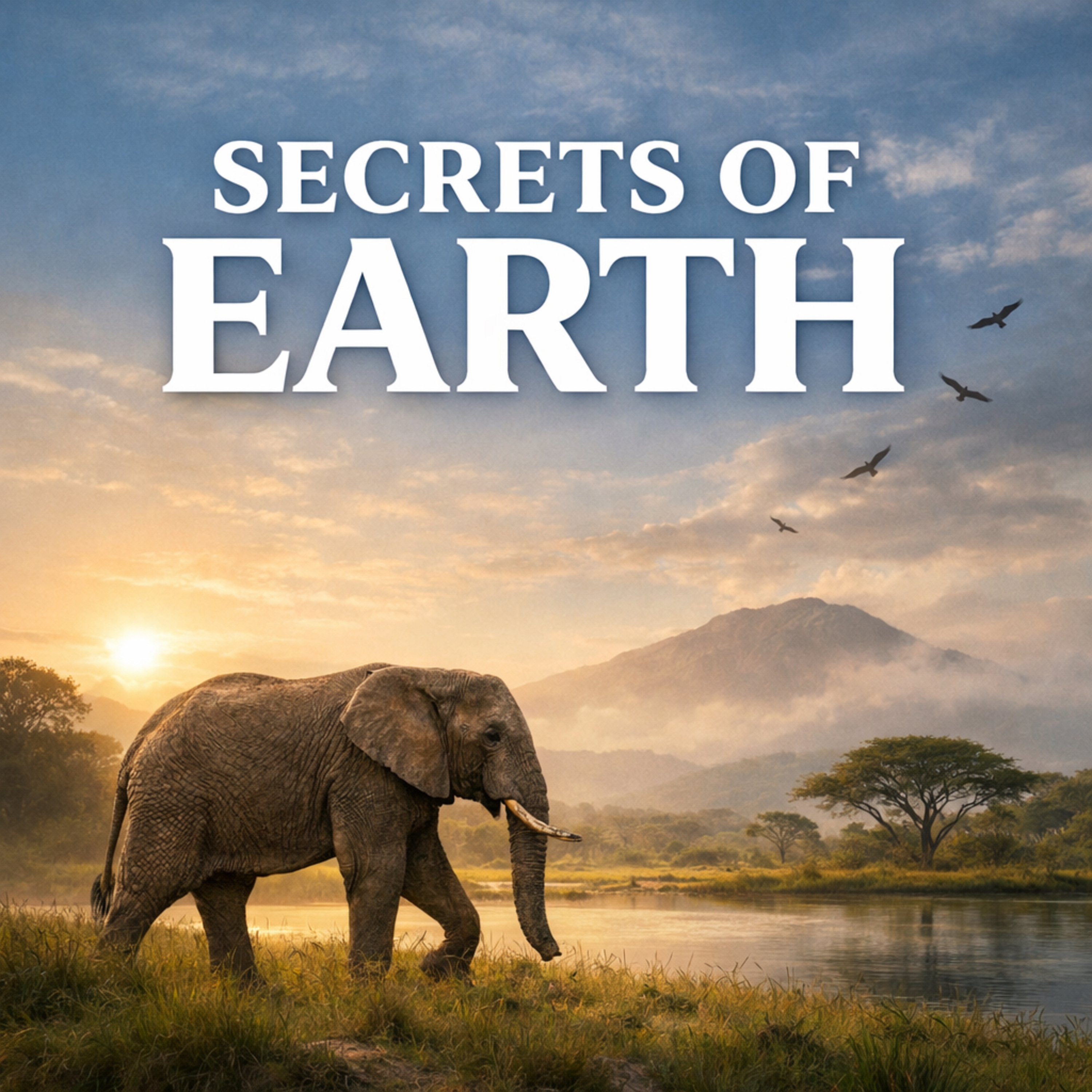
Secrets of Earth: An Audio Nature Documentary
by The Apex Sciences Network
Secrets of Earth is a premium, immersive audio documentary series exploring the untamed wonders of our planet. Moving beyond traditional nature shows, each episode dives into the "why" behind the wild—uncovering the staggering biological engineering of apex predators, the secrets of ancient ecosystems, and the physics of the natural world.Narrated by voice actor Patrick Vierzba and produced by The Apex Sciences Network, Secrets of Earth offers a sophisticated, all-ages cinematic journey into the universe's greatest environmental enigmas.
-
10
Seven Miles Down | Mariana Trench – The Season Finale
This is as far down as we go.Nearly seven miles below the surface of the Pacific Ocean, in a place named after the god of the underworld, lies the deepest point on Earth. The pressure at the bottom of Challenger Deep is more than 1,000 times what you feel on a normal day — enough to crush the air from human lungs in a fraction of a second. For most of human history, we assumed nothing could survive here.We were wrong. And in this season finale, we go all the way to the bottom to find out what's there.First, we meet the hadal snailfish — a pale, translucent, gelatinous fish that looks like it's falling apart, and is in fact one of the most sophisticated pressure-adapted organisms ever discovered. We break down the molecular secret that keeps its proteins from deforming under crushing weight, why that secret has a hard biological limit at 8,000 meters, and why that limit means even this fish can't reach the very bottom.Then we look at what feeds a world with no sunlight. The answer is a perpetual slow-motion blizzard — marine snow, falling every second of every day from the world above — funneled by the trench's steep walls into a thick, ancient ooze at the bottom. And we meet the creatures that live in that ooze: including the xenophyophore, the largest single-celled organism on Earth, the size of a mango, absorbing toxic heavy metals from the sediment and hosting an entire microbiome inside and around a single cell.And then, the hardest part. In 2019, the first person to reach the deepest measured point in Challenger Deep photographed a plastic bag in the sediment. A 2019 study found that 100 percent of amphipods sampled from the Mariana Trench contained plastic fibers in their digestive systems. Industrial chemicals banned in the 1980s are accumulating in trench animals at concentrations comparable to some of the most polluted coastal waters on Earth.The depth that took machines, engineering, and enormous courage to reach has been reached by a candy wrapper. Effortlessly. Simply by sinking.This episode ends where the season began: with the question of what life is, and where it ends. The Mariana Trench has an answer. There is no edge. There is no bottom. There is only what we choose to send there.Secrets of Earth is a nature documentary podcast for all ages, exploring the why and how behind the planet's most extraordinary life.
-
9
The Forest That Grows a Foot a Day | Kelp, Sea Otters & the Thread That Holds It Together
It grows up to 18 inches in a single day. It reaches 100 feet tall with no wood, no roots, and no rigid structure — held upright by thousands of tiny gas-filled balloons and anchored to the rock below by a grip stronger than its own stem. And it can assemble an entire ecosystem in a matter of weeks — or lose it in months.In this episode, we descend into the Giant Kelp forest of the Pacific coast to understand one of the most productive and precarious ecosystems on Earth. We start with the engineering: the pneumatocysts that inflate with oxygen-rich gas to pull the fronds toward the light, the flexible stipe that survives Pacific storm swells by dancing with them rather than fighting them, and the holdfast — a knot of golden biological cement at the base of every kelp that hosts more species diversity in a space the size of a human head than in a square kilometer of the surrounding sand.Then we follow the chain of dependency that holds the whole thing together — and the single weak link that can bring it down. Sea urchins, in a balanced ecosystem, are the forest's decomposers. But remove their predator, and they transform. They form a grazing front — a slow-motion army of purple spines — and they cut the kelp at its base, holdfast by holdfast, until the cathedral is gone and nothing remains but a barren expanse of rock.That predator is a 70-pound mammal with no blubber, the densest fur on Earth, and a habit of floating on its back eating shellfish. We explain the trophic cascade — why areas with sea otters have twenty times more kelp than areas without them — and then we slow down for something quieter: a mother otter wrapping her pup in a kelp frond before diving to hunt, using the living forest as a cradle.And then we look at what happened between 1741 and 1911, when the pelt trade reduced the global sea otter population from 300,000 to fewer than 2,000 — and the kelp forests collapsed into barrens behind them.This is a story about what happens when you pull one thread.Secrets of Earth is a nature documentary podcast for all ages, exploring the why and how behind the planet's most extraordinary life.
-
8
The Farmer of the Abyss | Yeti Crab – Dancing for Food at the Edge of the World
In March 2005, a submersible gliding along the Pacific-Antarctic Ridge — 1,500 kilometers south of Easter Island, 2,200 meters below the surface — found something crawling across volcanic rock near a hydrothermal vent. It was pale white, roughly six inches long, and its claws were covered in flowing, silk-like filaments. It was unlike anything in the scientific record. It wasn't just a new species. It was a new biological family — a lineage with no known living relatives.They named it Kiwa hirsuta. The world called it the Yeti Crab.In this episode, we descend into the volcanic underworld of the deep ocean to understand what this creature is actually doing — and why it matters far beyond the seafloor of Earth. The Yeti Crab lives in a thermal corridor measured in centimeters, between superheated vent fluid that would kill it instantly and near-freezing seawater that would do the same. It has no functional eyes. No sunlight has ever touched it. And yet it has built, on its own hairy claws, a fully operational bacterial farm.We break down the episymbiosis — the living crop of chemosynthetic bacteria cultivated on the crab's setae — and explain the behavior that gave scientists pause: the slow, deliberate, hypnotic waving of the claws through the vent current, for hours, every day. This is not communication. It is agriculture. The crab is ventilating its crop, stripping away boundary layers, maximizing bacterial growth through the physics of fluid dynamics. It dances to eat. And it does it at densities of 700 individuals per square meter, thriving in what we once assumed was a void.Then we pull back to the scale of the solar system. Because hydrothermal vents are now believed to exist beneath the ice of Europa and Enceladus — and if a crab can build a farm in the volcanic dark of Earth's ocean floor, the question of what might be farming in those distant seas becomes impossible to dismiss.And finally: the same mineral-rich vents that feed the Yeti Crab are also sitting on concentrated deposits of copper, gold, and silver. The mining industry has noticed. The Yeti Crab cannot move. It has no contingency for this.Secrets of Earth is a nature documentary podcast for all ages, exploring the why and how behind the planet's most extraordinary life.
-
7
The Devil Fish | Giant Manta Ray – Wings, Intelligence & the Cyclone of the Deep
They were once called Devil Fish — massive, dark shadows that sailors believed could drag ships to the bottom of the sea. The truth is far stranger, and far more beautiful.In this episode, we follow the Giant Oceanic Manta Ray into the open blue to uncover what may be the ocean's most elegant design. With a wingspan wider than a small aircraft and a skeleton made entirely of cartilage, the Manta doesn't swim — it flies. We break down the hydrofoil physics that allow a 5,000-pound animal to glide for miles on almost no energy, and the retractable cephalic fins that transform it from a streamlined traveler into a living vacuum in seconds.But the Manta's body is only half the story. We examine the remarkable brain — the largest relative to body size of any fish on Earth, physically heated to run faster than the cold water around it — and what happened when two Mantas were placed in front of a mirror. We explore the Cleaning Stations, where apex predators queue patiently to receive a service they seem to understand and value. And we witness the Cyclone: a formation of up to 150 Mantas rotating in an anticlockwise vortex, using the physics of fluid dynamics to concentrate prey that no individual animal could catch alone.This is a creature that cooperates, plays, and may recognize itself. And it is endangered.Secrets of Earth is a nature documentary podcast for all ages, exploring the why and how behind the planet's most extraordinary life.
-
6
The Animal That Cheats Death | The Immortal Jellyfish & the Science of the Reset
Every living thing on Earth follows the same rule: you are born, you age, and you die. It is the Grand Bargain of biology — written into the telomeres at the tips of your DNA, honored by every king, every redwood, every creature that has ever existed.Except one.Turritopsis dohrnii is smaller than your fingernail. It has no brain, no heart, no skeleton. To the naked eye it looks like a drifting scrap of cellophane. But when it is injured, starved, or pushed past its limits — when, by every rule of biology, it should simply dissolve into the sea — it does something no other complex animal on Earth is confirmed to do. Its cells abandon their adult identities, collapse inward, and the creature that was dying becomes, within 24 to 72 hours, a creature that is just beginning.In this episode, we trace the full mechanics of this biological miracle. We explain transdifferentiation — the process by which muscle cells become nerve cells, stinging cells become reproductive cells, and an entire adult life stage is dismantled and rebuilt from scratch, without the intermediary of a stem cell. We look at the genetic archive repair that happens during the reset — the jellyfish doesn't just rebuild itself younger, it rebuilds itself clean. And we follow it into the void of starvation, where rather than weakening and dying, it simply absorbs itself down to its essential code and waits.Then we look at what immortality does to a species when you give it access to the world's shipping lanes. And finally, the question that has driven researchers from Kyoto to California for decades: if a jellyfish can instruct its cells to forget their age and start again, what does that mean for a damaged human heart? For an Alzheimer's-riddled brain?But the episode ends somewhere unexpected — with a philosophical question that the jellyfish itself has already answered, in its own way. It chose permanence over memory. We chose differently.Secrets of Earth is a nature documentary podcast for all ages, exploring the why and how behind the planet's most extraordinary life.
-
5
The City Beneath the Waves | Great Barrier Reef – Solar Bargains, Sand Factories & the Sound of Home
It's the only living structure large enough to be photographed from the International Space Station. It stretches further than the distance from London to Moscow. It has been under construction, without interruption, for 6,000 to 8,000 years. And right now, it is losing.In this episode, we stop calling the Great Barrier Reef a reef — and start calling it what it actually is: a city. A biological metropolis with a foundation, an energy grid, a sanitation department, a diplomatic corps, and a communications network. And like every city, it only works because of the relationships between its residents.We start at the bottom, with the coral polyp — a creature barely visible to the naked eye that has spent thousands of years extracting calcium from seawater and depositing it as limestone, one molecule at a time. Inside its tissue, a hidden partnership with microscopic algae provides up to 90 percent of the polyp's energy. We explain exactly what bleaching is, why it's happening six times per generation, and why the reef has lost more than half its coral cover since 1985.Then we meet the maintenance crew: the parrotfish, whose fused beak grinds through solid limestone and whose excretions are — literally — the white sand beaches of the tropical Pacific. We visit the cleaning stations, where sharks and barracudas queue patiently to let a fish the size of your hand swim inside their mouths. And we follow the sound of the reef itself — the crackling, snapping, drumming acoustic signature that travels for kilometers through the water column and guides the larvae of the next generation home to a place they have never seen.A silent reef, it turns out, is invisible to its own future.The biology of the Great Barrier Reef knows exactly what to do. The question is what we choose to do with the land and atmosphere around it.Secrets of Earth is a nature documentary podcast for all ages, exploring the why and how behind the planet's most extraordinary life.
-
4
The Ocean's Greatest Actor | Mimic Octopus – 16 Disguises, 9 Months, No Second Chances
It hunts in broad daylight, in the open, on a featureless stretch of volcanic sand with nowhere to hide. It has no shell, no venom, no speed. And it has been doing this, successfully, for millions of years.The Mimic Octopus was unknown to science until 1998. When divers finally found it off the coast of Sulawesi, Indonesia, what they were watching didn't look like camouflage — it looked like acting. This creature doesn't match its background. It becomes other animals. Flatfish. Sea snake. Lionfish. Stingray. At least sixteen confirmed species, each rendered not just visually but behaviorally — the right posture, the right movement pattern, the right speed. And it chooses which one to use based on who's watching.In this episode, we break down how it works. We start with the skin — a living high-definition display of stacked chromatophores, iridophores, and leucophores that can replicate the optical texture of scales, slime, and spines in milliseconds. Then we go deeper, into the distributed nervous system: 500 million neurons, two-thirds of them living in the arms, giving each limb a processing center of its own. We watch the most famous moment in cephalopod research — six arms shoved into a burrow, two waving in opposite directions — and explain exactly why the damselfish ran.Then comes the fact that reframes everything. This animal — with its 16-species disguise catalogue, its tactical decision-making, its real-time behavioral assessment of predator identity — lives for approximately nine months. It is born with no parents to learn from. It arrives already knowing what it knows, or figures it out fast enough that the difference barely matters.Secrets of Earth is a nature documentary podcast for all ages, exploring the why and how behind the planet's most extraordinary life.
-
3
The Largest Animal That Has Ever Lived | Blue Whale – Heart, Voice & the Whale Pump
Bigger than any dinosaur. Bigger than anything that has ever walked, swum, or existed on this planet. The Blue Whale is not just the largest animal alive today — it is the largest animal in the entire history of complex life on Earth. And it is running on krill.In this episode, we take the Blue Whale apart, system by system, to understand how something this size actually works. We start in the engine room: a heart the size of a golf cart, beating twice a minute, driving 58 gallons of blood per contraction through an aorta wide enough for a child to crawl through — and an elastic aortic arch that acts as a second pump, keeping circulation running between beats. We follow the whale on a lunge feed, where a 200-ton animal opens its jaw to 90 degrees and inhales a volume of water equal to its own body weight, then filters the krill through curtains of baleen. We go deeper still, to where the lungs collapse completely by design, and the whale breathes through its muscles instead.Then we pull back — far back — to the scale of the ocean itself. The Blue Whale is not just living in the sea. It is helping to run it. Every time a whale dives to feed and resurfaces to breathe, it carries deep-ocean nutrients to the sunlit surface, fertilizing the phytoplankton that produce half the oxygen in Earth's atmosphere. The Whale Pump is real — and when we hunted Blue Whales to near-extinction, we didn't just lose animals. We disrupted a planetary system.And finally, the voice: 188 decibels, below the range of human hearing, traveling over 1,000 miles through the SOFAR channel. A sound that is felt, not heard. A call that crossed entire oceans for millions of years — until we filled those oceans with shipping noise and nearly silenced it forever.The giants are coming back. This is their story.Secrets of Earth is a nature documentary podcast for all ages, exploring the why and how behind the planet's most extraordinary life.
-
2
Thought Extinct for 40 Million Years | The Glass Sponge Reefs of the Deep
For most of the 20th century, science believed they were gone. Glass sponge reefs were known only from fossils — ancient structures from the Jurassic, extinct for 40 million years. Then, in 1987, a Canadian research team mapping the seafloor off British Columbia pointed a camera at an acoustic anomaly — and found a city made of glass.In this episode, we descend to 200 meters into the cold darkness of the Pacific Northwest to explore one of the most extraordinary rediscoveries in natural history. The Glass Sponge Reefs have been growing in unbroken darkness for 9,000 years, building eight-story structures from silica extracted molecule by molecule from the seawater itself. We break down the biology of an animal with no brain, no nervous system, and no individual cells — a creature that is, in a literal sense, one giant living fabric — and explain how it communicates and responds as a single organism without any of the machinery we associate with awareness.We follow the Venus Flower Basket to its strangest secret: the pair of shrimp that enter it as juveniles, grow too large to leave, and spend their entire lives together inside a glass cage — a relationship so perfectly mutual that the Japanese have given its skeleton as a wedding gift for centuries.And then we look at what happened when fishing nets reached the deep shelf. A sponge that takes 200 years to grow one meter tall. A trawl net that erases it in seconds.This is the story of something we almost destroyed before we knew it existed — and what it tells us about everything else we still haven't found.Secrets of Earth is a nature documentary podcast for all ages, exploring the why and how behind the planet's most extraordinary life.
-
1
Beyond the Teeth | Great White Shark – The Sixth Sense & the Secret Café
You already know the teeth. You already know the fear. But the Great White Shark has been keeping secrets from us for 400 million years — and this episode is about what lives behind the cinema.We begin with a sense you don't have. Scattered across the Great White's snout are hundreds of gel-filled pores called the Ampullae of Lorenzini — biological sensors so precise they can detect the electrical pulse of a heartbeat from fifty yards away, through solid water, in total darkness. We break down how this "sixth sense" works, why the shark can hunt blind at the moment of the strike, and how a biological heat exchanger buried in its body keeps its brain running at full speed in water cold enough to slow every other predator in the sea.Then we follow the sharks somewhere no one expected them to go. Every winter, the Great Whites of California don't move up the coast — they swim thousands of miles into the middle of the Pacific Ocean, to a featureless biological desert halfway to Hawaii. Scientists named it the White Shark Café. Here, the males begin diving to 1,400 feet and back — over 120 times a day. We still don't fully know why.And finally, we slow down. We sit with the animal. We look at what Great Whites actually are when the fear is removed — curious, socially complex, ancient, and quietly fragile.This is the episode that started it all. The one that asks you to look past the jaw, and into the machine behind it.Secrets of Earth is a nature documentary podcast for all ages, exploring the why and how behind the planet's most extraordinary life.
We're indexing this podcast's transcripts for the first time — this can take a minute or two. We'll show results as soon as they're ready.
No matches for "" in this podcast's transcripts.
No topics indexed yet for this podcast.
Loading reviews...
ABOUT THIS SHOW
Secrets of Earth is a premium, immersive audio documentary series exploring the untamed wonders of our planet. Moving beyond traditional nature shows, each episode dives into the "why" behind the wild—uncovering the staggering biological engineering of apex predators, the secrets of ancient ecosystems, and the physics of the natural world.Narrated by voice actor Patrick Vierzba and produced by The Apex Sciences Network, Secrets of Earth offers a sophisticated, all-ages cinematic journey into the universe's greatest environmental enigmas.
HOSTED BY
The Apex Sciences Network
Loading similar podcasts...
Frequently Asked Questions
How many episodes does Secrets of Earth: An Audio Nature Documentary have?
Secrets of Earth: An Audio Nature Documentary currently has 10 episodes available on PodParley. New episodes are automatically indexed when they're published to the podcast feed.
What is Secrets of Earth: An Audio Nature Documentary about?
Secrets of Earth is a premium, immersive audio documentary series exploring the untamed wonders of our planet. Moving beyond traditional nature shows, each episode dives into the "why" behind the wild—uncovering the staggering biological engineering of apex predators, the secrets of ancient...
How often does Secrets of Earth: An Audio Nature Documentary release new episodes?
Secrets of Earth: An Audio Nature Documentary has 10 episodes. Check the episode list to see recent publication dates and frequency.
Where can I listen to Secrets of Earth: An Audio Nature Documentary?
You can listen to Secrets of Earth: An Audio Nature Documentary on PodParley by clicking any episode. We provide an embedded audio player for direct listening, and you can also subscribe via your preferred podcast app using the RSS feed.
Who hosts Secrets of Earth: An Audio Nature Documentary?
Secrets of Earth: An Audio Nature Documentary is created and hosted by The Apex Sciences Network.
URL copied to clipboard!