
PODCAST · education
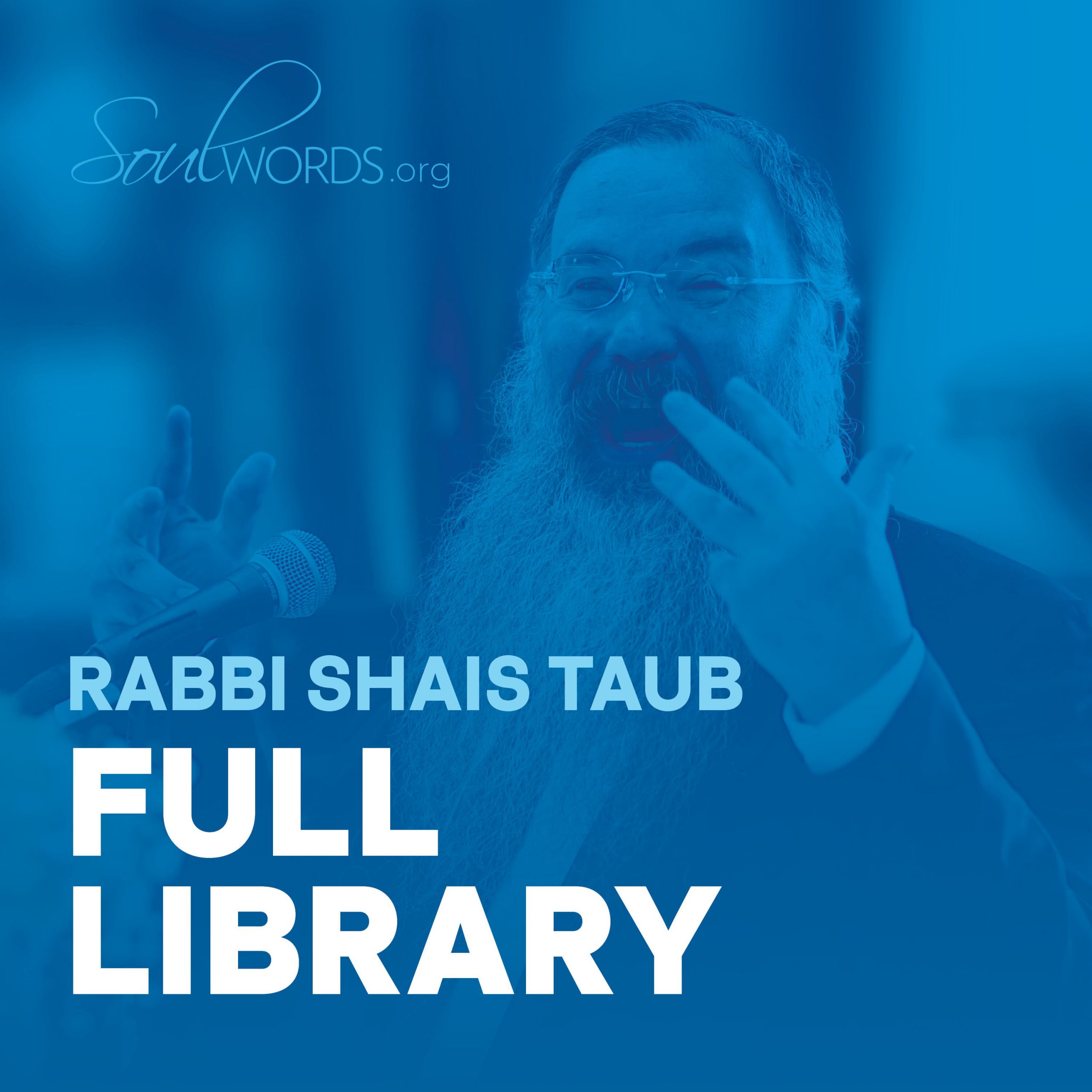
SoulWords- Full Library
by Rabbi Shais Taub
SoulWords provides Torah classes and lectures from renowned teacher, Rabbi Shais Taub, on a wide range of spiritual topics.
Episodes
-
Noah Building the Ark | Beyond the Story: Noach (Ep. 2)
Why did Noach spend 120 years building the teivah and work around the clock feeding its animals while so much of his mission unfolded miraculously? Understanding when Hashem requires human effort and when He provides without it reveals the true relationship between hishtadlus and bitachon: our…
more -
Adam Naming the Animals | Beyond the Story: Bereishis (Ep. 1)
Why was Adam’s ability to name the animals proof that his wisdom surpassed that of the angels? In the first episode of BEYOND the STORY, Rabbi Shais Taub explores the deeper meaning of this familiar Torah story—and what it reveals about our ability to recognize the Divine within physical life....
-
Likkutei Sichos: Simchas Torah
Shemini Atzeres reveals the essential unity of the Jewish people that endures beyond Yom Tov. Dancing with our feet and a closed Torah scroll expresses an unlimited connection to Hashem that transcends intellect. Connecting the Torah’s end, “l’einei kol Yisrael,” back to its beginning, “B’reishis...
-
Likkutei Sichos: Sukkos
The festival of Sukkos is named after the sukkah because it is the mitzvah that encompasses the entire person from the very start of Yom Tov, enabling us to elevate even our most ordinary activities into Divine service throughout the year. True joy comes from drawing on the infinite Source…
more -
Likkutei Sichos: Haazinu
When the Jewish people align their will with Hashem's will through good resolutions during the Ten Days of Repentance, heaven and earth yield to them so they can elevate abundant material blessings into spiritual purpose. By examining why Moshe and Yeshayahu used inverted expressions of closeness...
-
Likkutei Sichos: Vayeilech
The presence of both the engraved Tablets and the written Torah scroll in the Holy of Holies illustrates how the transcendent, beyond-logic self-nullification of Rosh Hashanah bridges into our daily, rational lives to draw spiritual blessings down into tangible, material reality. The words…
more -
Pre-Selichos Farbrengen
Gathering near the Ohel ahead of the first Selichos, this farbrengen cuts through the traditional heaviness of Elul with a refreshing, empowering Chassidic truth: the path into the New Year is paved not with dread and rebuke, but with radical unity and clarity of purpose. Drawing from classic...
-
Likkutei Sichos: Rosh Hashanah
The wordless cry of the shofar expresses every Jew’s essential bond with Hashem, eliciting His promise of a good and sweet year as we recommit ourselves to living according to His will. This class, taught by Rabbi Shais Taub, is based on Rosh Hashana in Likkutei Sichos Vol. 2. Support our work....
-
Likkutei Sichos: Nitzavim
The covenant between the Jewish people and Hashem confirms the essential unity of every Jew—from the “heads” to the “feet”—which requires looking honestly at oneself before judging others. Both physical and spiritual tzedakah must be given with humility and equality, and by helping another Jew…
more -
Likkutei Sichos: Ki Savo
Offering bikkurim teaches both that all success comes from Hashem and that one can sanctify material life itself by using worldly possessions in His service. The rebuke read before Rosh Hashanah is not punishment but a cleansing that prepares us to receive an even greater revelation of divine...
-
Likkutei Sichos: Ki Seitzei
Engaging in the spiritual battle to refine the animal soul guarantees divine assistance and enables one to transform worldly energy into spiritual gain. Constructing a ma'akeh (guardrail) is an independent mitzvah requiring a blessing, teaching that whenever one embarks on a new endeavor or a new...
-
Likkutei Sichos: Shoftim
The month of Elul is a “city of refuge” in time—a period of honest self-examination and teshuvah, in which each person is given the opportunity to redirect his life-force toward holiness by taking refuge in Torah study. This class, taught by Rabbi Shais Taub, is based on Shoftim in Likkutei…
more -
Likkutei Sichos: Re'eh
The signs of a kosher animal—split hooves and chewing the cud—represent the spiritual balance and continual self-examination necessary to elevate one’s involvement with the physical world. The King’s accessibility in Elul is not permission to remain comfortably “in the field,” but an invitation…
more -
His Father’s Shoes—20 Av Farbrengen
In accordance with the Rebbe’s request that gatherings be held on his father’s yahrzeit to study his teachings, this Chof Av farbrengen explores the life and Torah of Harav Levi Yitzchok Schneerson—from his heroic leadership under Soviet persecution to newly revealed documents surrounding a 1937...
-
Likkutei Sichos: Eikev
Just as recognizing the symptoms of an illness brings us halfway to the cure, understanding the stages that lead to exile enables us to begin bringing about redemption. 📄 PDF of Sicha: https://heyzine.com/flip-book/e15f4f3... 📄 PDF of Sicha in English by SIE:...
-
Likkutei Sichos: Va'eschanan
The cities of refuge teach that Torah provides a clear path to safety and that every Jew must become a living signpost, actively guiding others toward Torah even when the results of those efforts remain unseen. This class, taught by Rabbi Shais Taub, is based on Va'eschanan in Likkutei Sichos…
more -
Likkutei Sichos: Devarim
Just as Parshas Devarim marks the Jewish people's descent from the miraculous existence of the wilderness into ordinary life in the Land, Shabbos Chazon teaches that every descent into physicality is ultimately for the sake of a greater ascent and a more permanent dwelling place for Hashem. The...
-
Likkutei Sichos: Matos-Masei
The 42 wilderness journeys represent the continuous human obligation to treat yesterday's spiritual plateaus as today's limitations and to constantly move forward, whether climbing to higher spiritual rungs or breaking out of a low state with a single step.This class, taught by Rabbi Shais Taub…
more -
Likkutei Sichos: Pinchas
Sometimes leadership remains silent because a particular individual is destined to step forward and do something great, as Pinchas did. Moments of spiritual crisis demand that we leave our comfort zones and speak heartfelt words that awaken another Jew's soul without endless calculations, just as...
-
Likkutei Sichos: Balak
The crouching stance of the lion in Bilaam's prophecy demonstrates that even when subjected to the physical constraints of exile, the Jewish people maintain an untamed, independent spiritual nature that is periodically reinforced by unmistakable, nature-shattering miracles. The deceptive…
more -
Likkutei Sichos: Chukas
The three wilderness miracles correspond to three modes of spiritual influence—internalized growth, transcendent empowerment, and accessible transmission—and teach that every Jew carries a spark of Moshe, empowering us to take responsibility for the spiritual wellbeing of others. This class…
more -
Likkutei Sichos: Korach
The priestly gifts teach that holiness must receive the first and finest portions of our lives, and when we dedicate our best time, energy, and resources to Hashem rather than our leftovers, we create a vessel for both spiritual and material blessing. This class, taught by Rabbi Shais Taub, is...
-
Likkutei Sichos: Shlach
True Jewish leadership, exemplified by Moshe and Yehoshua, means embracing and uplifting every Jew, even when doing so requires self-sacrifice. Tzitzis must be attached to a tallis because while the tzitzis represent the individual mitzvos, the tallis represents their transcendent source…
more -
Likkutei Sichos: Behaaloscha
The Menorah reflects both the diversity and unity of the Jewish people—many distinct paths joined in a single mission to radiate divine light and revealed love into the world. From the laws of the Menorah we learn that every Jew has a role in igniting the flame of other Jews, but the method must...
-
Likkutei Sichos: Naso
The Sotah serves as the archetype for understanding the soul’s relationship with Hashem: even when there is distance or straying, the bond itself remains unbroken, and through teshuvah the rupture can become the source of even deeper connection. This class, taught by Rabbi Shais Taub, is based on...
-
Likkutei Sichos: Shavuos
True oneness is achieved not by avoiding multiplicity, but by harmonizing seemingly opposite forces under a single, divine reality. Torah study possesses an intrinsic, boundless value that transcends practical application, serving as the ultimate unifier between a Jew and the Creator. Shavuos is…
more -
Franz Kafka Yahrzeit
Live from the SoulWords House on Rosh Chodesh Sivan, Rabbi Shais Taub, Rabbi Dovid Bashevkin, and Bruce Backman come together for a raw and wide-ranging conversation honoring the yahrzeit of Franz Kafka. Why does Kafka continue to speak so powerfully to the Jewish soul?What is the spiritual root…
more -
Likkutei Sichos: Bamidbar
Counting reveals the paradox that in holiness, quantity itself leads to quality. Even in a spiritual wilderness, we are meant to live a fully holy life—especially in the home and in the earliest stages of a child’s education. True Jewish unity means uniting around Torah and mitzvos. Ahavas…
more -
Likkutei Sichos: Bechukosai
Parshas Bechukosai contains a rebuke of seemingly harsh curses which are actually the loftiest Divine blessings in a hidden form; similarly, Rabbi Shimon bar Yochai, whose yahrzeit is Lag B’Omer, possesses the unique power through the inner dimension of Torah to decode this reality and reveal…
more -
Likkutei Sichos: Behar
Shmita teaches us that Torah is not about escaping the physical world, but sanctifying it so completely that even our engagement with nature becomes an act of transcendence. Har Sinai shows us that true greatness requires the paradox of standing tall with absolute confidence while remaining...
-
Likkutei Sichos: Emor
The month of Iyar is uniquely defined by the mitzvah of counting the Omer, which creates a state of total alignment where every day becomes equally holy. Spiritual growth moves through three phases—initial rescue from above (Nissan), active refinement of the animal soul’s passions (Iyar), and...
-
Likkutei Sichos: Kedoshim
Kedusha means living with a distinct Jewish identity in every aspect of life, transforming the mundane into a dwelling place for Hashem. True readiness for Moshiach comes from sanctifying even the permissible, reaching a deeper bittul that reveals the essence of the soul and of Hashem. Torah...
-
Likkutei Sichos: Acharei
The Torah’s command to “make a safeguard for My safeguards” teaches that protective boundaries are not additions to Torah but part of its design—provided they are kept with clarity, distinguishing between obligation and voluntary devotion in a world that requires such protection. This class…
more -
Likkutei Sichos: Pesach
The order of the four questions highlights the importance of minhagim. The story of R' Elazar ben Azarya leads us to appreciate how past reincarnations can help us practically. The proximity of the chacham and rasha shows us the importance of bringing every Jew close. This class, taught by Rabbi...
-
Likkutei Sichos: Metzora
True faith is a mode of perception that reveals Hashem as completely beyond nature, allowing even "negative" occurrences to be seen as purposeful, miraculous messages of hidden good. Hashem deliberately leaves aspects of creation and our personal lives incomplete to teach us that true...
-
Likkutei Sichos: Tazria
Nissan represents a mode of serving Hashem that draws down the infinite beyond nature, where joy and divine choice override the limits of cause and effect. The Jewish soul is essentially bound to Hashem Himself, and expresses that bond by transforming the world through mitzvos in a way that…
more -
Use Your Influence
In this famous letter to Israeli President Yitzchak Ben-Tzvi, the Rebbe explains that wealth and influence are divinely entrusted responsibilities, obligating one to actively strengthen Torah and Jewish identity. Beyond this, the letter offers a rare personal glimpse, as the Rebbe shares his...
-
Likkutei Sichos: Shemini
The signs of a kosher animal serve as spiritual benchmarks to ensure our physical involvements remain refined. The juxtaposition of the Mishkan’s inauguration with prohibitions against eating insects teaches that even the most spiritually exalted individual requires the discipline of divine…
more -
Don't Cut Off Your Source of Blessing
The Rebbe acknowledges the writer’s improved health but challenges his confusion about priorities. Despite clear guidance, he is misreading his situation and considering reducing his involvement in Chabad. The Rebbe insists his true purpose is to focus on spiritual work in his current place, not...
-
Too Busy For Your Purpose? / Take Care of Your Body
In the first letter, the Rebbe responds to someone overwhelmed by a new position, claiming he has no time for learning, serving Hashem, or helping others. The Rebbe firmly rejects this, reminding him that a Jew’s purpose is to serve his Creator. In the second letter, the Rebbe discourages the...
-
Helping Others Strengthens Your Own Home
Addressing the letter writer's concerns about balancing outreach with his own son’s education, the Rebbe emphasizes that fulfilling the mitzvah of influencing others will not harm his child’s chinuch—on the contrary, it will enhance it through the principle of mitzvah goreres mitzvah. PDF Link:...
-
Preparing for Pesach with Your Complex Kid
Pesach is supposed to be a time of freedom—but for many parents raising sensitive or easily overwhelmed children, it can feel like anything but. In this webinar, Rabbi Shais Taub and Dr. Ilyssa Bass address the real challenges of preparing for Pesach with a “complex child”—kids who feel things…
more -
Don’t Lower Standards for Students
The Rebbe responds regarding a Chabad-affiliated agricultural school, emphasizing that its standards and spirit must fully align with Chabad values without compromise. The institution should not lower its standards for students who do not adhere to them. However, guidance should be given...
-
Working for the Rebbe is Privilege
One must recognize that involvement in the Rebbe’s work is a personal merit, not a favor being done. As long as one feels otherwise, no persuasion will help. Honest reflection and humility will lead to clarity, cooperation, and a more peaceful, productive path. PDF Link:...
-
The Real Way to Bring Moshiach
In response to a letter proposing that identifying certain nations as lost tribes could hasten Moshiach, the Rebbe emphasizes that our direction must come from Torah and its clear guidance. Rather than pursuing speculative approaches, our focus should be on what Chazal teach—that redemption…
more -
Likkutei Sichos: Tzav
Jewish security is not determined by political reality but by spiritual alignment. A Jew’s passion for Yiddishkeit must remain constant—both in inspiration and in struggle. Our finite effort awakens an infinite response from above that creates real success. Redemption follows a process…
more -
Supporting Sephardic Jews in Crisis
The Rebbe writes to Rabbi Yitzchak Isaac Small, acknowledging his longstanding connection to Chabad and asking him to support relief efforts for Sephardic Jews in crisis. Beyond the immediate need, the Rebbe emphasizes a broader principle: in matters of ahavas Yisrael, there is no concern for...
-
Stop Analyzing, Start Doing / Seeing Good Strengthens Good
The first letter addresses a man overwhelmed by overthinking. The Rebbe urges him to stop analyzing his inner state and instead live simply: care for the body, act with sincerity, and begin without overplanning. The second letter teaches that how we look at others shapes them—seeing with a…
more -
A Bachur Does Not Decide for Himself
A young man asks if he should follow his own preference as to where to study and is gently but firmly redirected: a yeshiva bachur is not guided by personal will, but by the guidance of his teachers. PDF Link: https://www.soulwords.org/wp-content/uploads/2026/03/30-letters-30-days-19.pdf
-
Chasidus Must Be Lived
In this letter, the Rebbe thanks the noted Hebrew author Eliezer Steinman for writing about Chabad Chassidus—but then adds a deeper point. To write about something truthfully, it’s not enough to understand it intellectually. You have to live it. Only when an idea becomes part of your own…
more
We're indexing this podcast's transcripts for the first time — this can take a minute or two. We'll show results as soon as they're ready.
No matches for "" in this podcast's transcripts.
No topics indexed yet for this podcast.
Loading reviews...
Loading similar podcasts...
Frequently Asked Questions
How many episodes does SoulWords- Full Library have?
SoulWords- Full Library currently has 300 episodes available on PodParley. New episodes are automatically indexed when they're published to the podcast feed.
What is SoulWords- Full Library about?
SoulWords provides Torah classes and lectures from renowned teacher, Rabbi Shais Taub, on a wide range of spiritual topics.
How often does SoulWords- Full Library release new episodes?
SoulWords- Full Library publishes regularly with 300 episodes available. Check the episode list for the typical release schedule.
Where can I listen to SoulWords- Full Library?
You can listen to SoulWords- Full Library on PodParley by clicking any episode. We provide an embedded audio player for direct listening, and you can also subscribe via your preferred podcast app using the RSS feed.
Who hosts SoulWords- Full Library?
SoulWords- Full Library is created and hosted by Rabbi Shais Taub.
URL copied to clipboard!