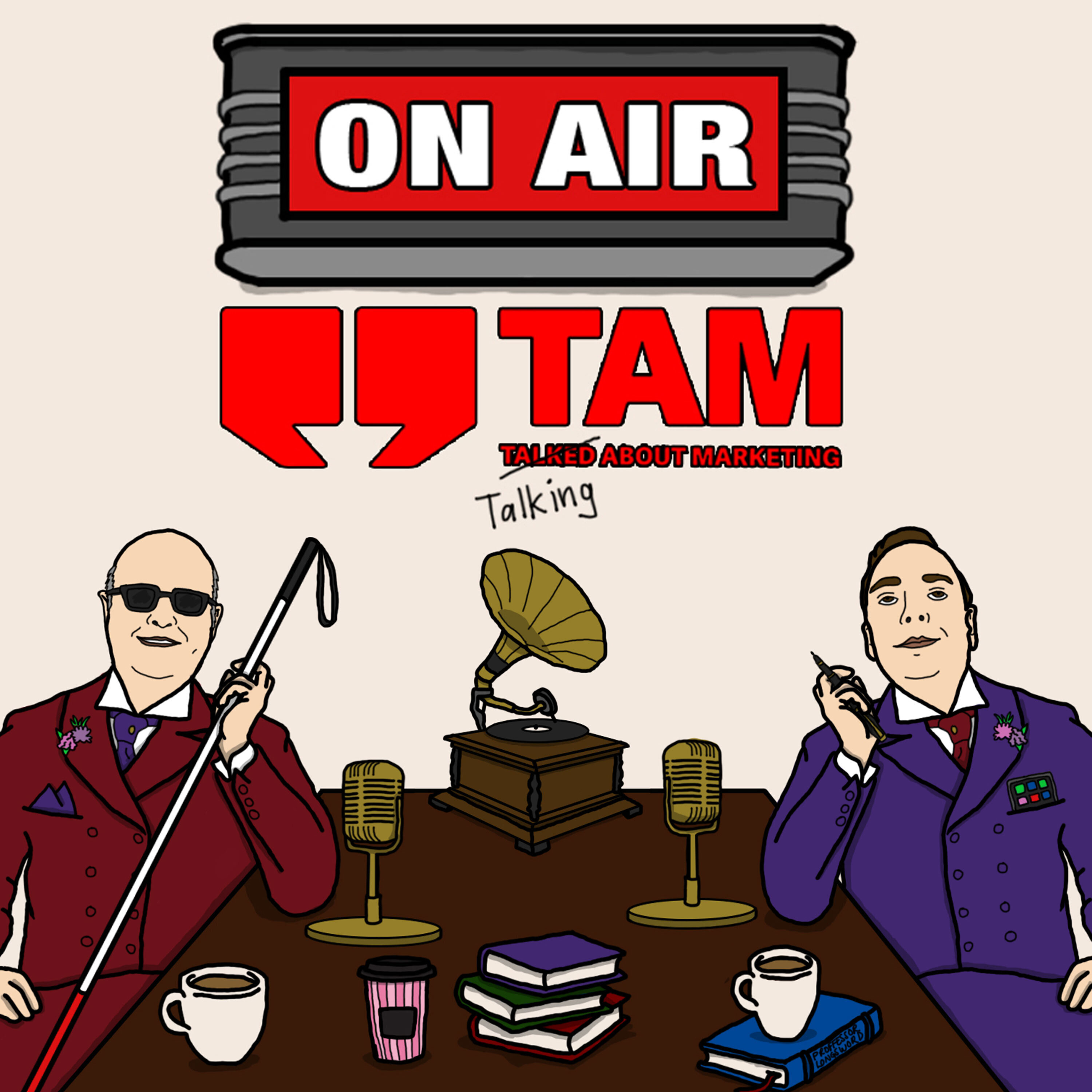
Talking About Marketing

PODCAST · business

Talking About Marketing

Talking About Marketing is a podcast for you to help you thrive in your role as a business owner and/or leader. It's produced by the Talked About Marketing team of Steve Davis and David Olney, with artwork by Casey Cumming. Each marketing podcast episode tips its hat to Philip Kotler's famous "4 Ps of Marketing" (Product, Price, Place, Promotion), by honouring our own 4 Ps of Podcasting; Person, Principles, Problems, and Perspicacity. Person. The aim of life is self-development. To realise one's nature perfectly-that is what each of us is here for. - Oscar Wilde Principles. You can never be overdressed or overeducated. - Oscar Wilde Problems. “I asked the question for the best reason possible, for the only reason, indeed, that excuses anyone for asking any question - simple curiosity. - Oscar Wilde Perspicacity. The one duty we owe to history is to rewrite it. - Oscar Wilde Apart from our love of words, we really love helping people, so we hope this podcast will become a trusted compan

  1. 71

    The Recession Response Episode

    Steve whispers the word “recession” in a dark alley at the top of this episode. David laughs. Then they get serious. Consumer confidence in the US is currently at its lowest since records began in 1952, lower than during the Cuban Missile Crisis. That context shapes everything Steve and David unpack here, drawing on Mike Michalowicz’s book The Recession Response, written in 2020 and, as it turns out, very much written for right now. They walk through the five stages of a recession response, apply Michalowicz’s business hierarchy of needs to the decisions you are facing today, dissect a fear-based marketing email targeting allied health practitioners, and dust off a 1977 General Motors ad that tried very hard to convince anxious petrol buyers that a massive car was actually quite sensible. Get ready to take notes. Talking About Marketing podcast episode notes with timecodes 02:00 Person This segment focusses on you, the person, because we believe business is personal.The Five Stages (And Why Knowing Them Restores Your Agency) There is a word that makes grown adults freeze. This episode names it. Mike Michalowicz wrote The Recession Response in 2020 as COVID hit and financial markets groaned. It runs just over two hours as an audiobook. That brevity is deliberate. He knew that a business owner in shock would not wade through a 400-page tome. The book is short because it had to be, and it works for exactly the same reason. His framework mirrors grief, applied at a societal level. Stage one is shock: businesses freeze, decisions get delayed, and the most dangerous thing of all happens: nothing. Stage two is retreat, where costs get cut, often including the marketing that was quietly keeping the pipeline alive. Stage three is adaptation, where businesses reassess what customers actually need right now and direct engagement becomes critical. Stage four is re-emergence, stabilisation, then controlled growth. Stage five is thriving: expanding, capturing market share, outperforming the competitors who never moved past retreat. David raises a striking piece of context. US consumer sentiment data goes back to 1952. The current numbers are the lowest on record, lower even than during the Cuban Missile Crisis. Steve shares his FED System: Fish Every Day. A simple discipline of contacting one existing client or contact daily, not to sell, just to connect. It sounds almost too simple. It is also, Steve admits, easy to let slide when you’re busy. David adds a story from the 1987 crash: a colleague of his father’s arrived at the dinner table the week after, ready to buy a transport company, numbers probably solid, looking for partners. He misread the room entirely. The people he needed were still in shock. He came across as brash and self-serving. The deal never happened. The lesson: you cannot move people forward until you meet them where they are psychologically. 15:00 Principles This segment focusses principles you can apply in your business today.The Business Hierarchy of Needs Maslow had a pyramid. Michalowicz built one for your business. Most people are familiar with Maslow’s hierarchy of needs: physical survival at the base, safety above that, then belonging, then esteem, then self-actualisation at the top. The rule is simple: whatever the lowest unsatisfied level is, that is where your energy goes. Michalowicz applies the same logic to business, and David’s observation is apt: this model works whether there is a recession or not. The five levels, base to peak: sales (survival and cash flow), profit (financial resilience), order (systems and processes), impact (brand, loyalty and market presence), and legacy (the business outlasting the owner). Two questions drive the diagnostic. Do we have sales? If yes, do we have enough sales to generate profit? If the answer to either is no, that is where the work goes: not on branding, not on systems, not on anything higher up the hierarchy. Michalowicz’s starkest warning is about debt. Do not borrow money simply because it is available. If the business cannot grow sales and profitability with existing structures, adding repayment obligations makes the next stage harder, not easier. Steve closes this segment with a useful provocation from Stephen Covey: managers find the most efficient way to climb the ladder, but leaders check that the ladder is against the right wall. Michalowicz offers a grounding exercise to find your wall: draw a circle marked A on a blank page, draw three arrows outward, then place a circle marked B in the corner representing where you want to go. Are any of your arrows pointing at B? In uncertain times, the temptation is to move anywhere to escape discomfort. Moving without direction is costly. 26:45 Problems This segment answers questions we've received from clients or listeners.When Fear-Based Marketing Targets Your Inbox Recessionary times bring out the opportunists. Steve shares an email received by a client in the allied health field. The subject line: Why your clinic isn’t showing up when patients search for you. Written with confident authority. Entirely untailored. Almost certainly generated by AI. The classic structure: assert a frightening problem, imply the reader is falling behind, offer a paid workshop as the cure. Steve ran the email through Google’s Gemini and shared the assessment with his client. Four things stood out. The claim that one in three patients uses AI search draws on broad global surveys of early tech adopters, not the reality of a specialist vestibular clinic in Adelaide. AI visibility is largely a matter of good SEO: schema markup and authoritative content, things a well-managed site is likely already doing. The promise of ten new patients per day would operationally overwhelm a boutique specialist practice, which tells you the sender never actually looked at the business. And deploying Seth Godin’s Purple Cow, published in 2003, as a selling point for cutting-edge AI services in 2026 does the credibility no favours. The broader point is practical. Fear-based pitches multiply when economic pressure rises. Knowing how to read them clearly is its own form of marketing literacy, and it protects you from spending money on solutions to problems you may not actually have. 33:30 Perspicacity This segment is designed to sharpen our thinking by reflecting on a case study from the past.A 1977 GM Ad and the Stubbornness of Status History has a long memory for bad ideas. With petrol prices uncertain and supply lines strained, David suggested revisiting the 1970s oil crisis for some advertising perspective. The ad in question is a 1977 General Motors campaign for their full-size vehicles. The pitch: these new models have been refined by computer and wind-tunnel tested to reduce drag, while remaining spacious and comfortable. In other words, GM ran the sums and the big car is still big, but now you can feel okay about it. Steve calls it the Emperor’s New Clothes, delivered with a straight face. The conversation that follows is genuinely enjoyable, touching on the psychology of status, the peculiar persistence of enormous vehicles in Australian driveways, and a detour into civility versus selfishness that both hosts agree deserves its own episode. For many buyers in 1977, the rational response to that ad was simply to go Japanese. For others, the status and comfort argument was enough. The marketing question for 2026 is whether the same psychology still holds. David suspects it does. Steve remains sceptical, and slightly indignant about a particular vehicle he watched idle at the Paradise bus interchange.See omnystudio.com/listener for privacy information.

  2. 70

    The Duty Of Australians In Business

    In this episode, Steve Davis and David Olney take Lawson’s poem The Duty of Australians seriously, not as nostalgia, but as a working framework for building businesses that last. Alongside that, they wrestle with a 1985 book that predicted social media addiction decades before the first smartphone, examine a CEO’s cringe-worthy burger video, and flag a quiet data-harvesting threat hiding in the app store. Get ready to take notes. Talking About Marketing podcast episode notes with timecodes 02:45 Person This segment focusses on you, the person, because we believe business is personal.What Henry Lawson Knew About Culture Duty arrives early. South Australia’s premier quoted Henry Lawson’s poem The Duty of Australians on election night. The verse urges Australians to welcome newcomers, find them people who speak their language, and make space for them to become part of what’s being built. Steve and David found it worth unpacking for anyone running a business. The core insight is this: you cannot assimilate until you have language. Steve knows this firsthand, having lived in Hungary in the early 1990s where finding other English speakers was the bridge that eventually allowed him to become part of Hungarian society. The same principle applies inside your business. David makes the connection plain. Inclusive workplaces are not a nice-to-have. They are the fastest path to higher productivity, better behaviour in front of customers, and stronger resilience in hard times. And the place to start is not with customers — it is with the people you hire. If your staff look miserable while you waffle niceness at customers, every customer notices. The harder truth is this: we now have smartphones, social media, and algorithmic echo chambers that allow people to live in entirely self-constructed worlds. Building genuine connection takes more deliberate effort than it once did. David’s suggestion is to start in the square metre where you are working. Because at work, everyone is already on common ground — shared purpose, shared customers, shared stakes. It turns out the phrase “work-life balance” may have the right word first. 13:45 Principles This segment focusses principles you can apply in your business today.Amusing Ourselves to Death Neil Postman saw it coming. His 1985 book Amusing Ourselves to Death argued that the real dystopian threat was never George Orwell’s vision of forced oppression — it was Aldous Huxley’s vision of a population that would willingly surrender its attention and agency in exchange for endless entertainment. Postman was writing about television. He did not live to see social media. He did not need to. Steve and David note that a US jury recently found Google and Meta liable in a landmark social media addiction case, with a 20-year-old woman’s claim that these platforms were deliberately designed to be addictive. A Meta representative reportedly suggested that 16 hours of daily Instagram use might be “problematic” but not quite addiction. Draw your own conclusions. What does this mean for your business? David frames it directly: why did you start your business? It was almost certainly not to amuse people to death. You probably wanted to solve a real problem, deliver a genuinely uplifting experience, or connect customers to something that felt like knowledge or beauty or meaning — not just distraction. The tools of social media are unavoidable. You need to be present where your customers are. But Postman’s real counsel, as Steve reads it, is awareness. When you understand the limits of these platforms — that they are shallow by design — you stop expecting depth from them and start using them intentionally. Content that informs, entertains purposefully, or genuinely helps someone is doing something the platform itself was not built to do. That is worth doing. 25:00 Problems This segment answers questions we've received from clients or listeners.Stranger Danger for Apps Not all AI is equal. A Mashable article flagged ten apps among the worst offenders for leaking personal data. Most of them sound uncannily like the legitimate tools many of us already use — names like “Chat and Ask AI” and “Chatbot AI” that sit in app stores, free of charge, right alongside the paid versions of trusted products. These apps harvest chat history, search behaviour, and personal disclosures — the kinds of conversations people have about medical conditions, financial concerns, or relationship difficulties. That information trains the app and, depending on the terms of service, can be sold. David’s advice is straightforward: read the terms of service. And Steve adds a practical upgrade to that — if you are not going to read a long and confusing document yourself, copy and paste it into a trusted AI tool like Gemini and ask it to assess what you are signing up for. Using technology to scrutinise technology is a reasonable form of self-defence. The short version: stick to known quantities and apply the same scepticism you would in any other unfamiliar situation. 29:45 Perspicacity This segment is designed to sharpen our thinking by reflecting on a case study from the past.The McDonald’s CEO and the Big Arch Authenticity still needs to be engaging. The McDonald’s CEO posted a video of himself tasting the new Big Arch burger. It did not land well — not because of the burger, but because of how he spoke about it. He referred to it as “product.” He mentioned it had already been tested in Portugal, Germany, and Canada, which the audience heard as “we tested it on people with lower standards.” His camera presence was flat and his enthusiasm unconvincing. Steve and David are clear that this is not an argument against authenticity. It is an argument for recognising that authenticity still needs a yard rule held against it. Will this convey genuine enthusiasm? Does it have something useful or interesting to offer the viewer? If not, it probably should not be published — regardless of how real it feels. By contrast, the television advertisement for the same Big Arch burger fared considerably better. It focused not on ingredients but on the simple promise of a large, filling meal when you are genuinely hungry. There was honesty in that simplicity. Steve and David gave it a mark above midpoint — modest praise, but meaningfully better than the CEO’s effort. The takeaway is not that you need a production crew. It is that publishing something unpolished does not automatically make it trustworthy. Authenticity and purposefulness are not opposites. They need each other.See omnystudio.com/listener for privacy information.

  3. 69

    Surviving For The Sake Of Yourself And Your Business

    Nicholas Christakis lectures behind blast doors in Kyiv, and his students are beaming. CS Lewis reminds us from 1939 that life has never actually been normal. Viktor Frankl offers three anchors that helped people survive the worst conditions imaginable. The message for small business owners carrying a little extra anxiety right now: you are not alone, and this is survivable. Georgie Dent’s book Breaking Badly hits close to home for anyone who has pushed through when they probably should have stopped. David unpacks the book’s hard-won lessons about stress, meaning, and why small business owners are particularly at risk of running on empty without anyone to pick up the slack. A brazen piece of spam software called Turbo Jot has Steve’s eyebrows firmly raised, and rightly so. If your marketing strategy involves AI-powered form-submission bots with rotating IP addresses, it may be time to reconsider some life choices. The Royal Society for the Blind has two very different campaigns to examine. One leads with cuteness and cost. The other invites you to see the world differently. David, who sees the world very differently indeed, has some pointed thoughts about what was gained and what was left on the table. Get ready to take notes. Talking About Marketing podcast episode notes with timecodes 01:30 Person This segment focusses on you, the person, because we believe business is personal.What Ukrainian Students Under Siege Can Teach Every Small Business Owner Steve opens with something he rarely does: an admission that current world events knocked him sideways. The Iran conflict’s ripple effects, the sense that randomness has been laid bare, the difficulty of staying focused when dread is pulling at your sleeve. He brings this to the table not as a digression, but as the point. Drawing from a Sam Harris interview with Yale professor Nicholas Christakis, Steve shares a story of Christakis delivering lectures in Kyiv when the air raid sirens sounded mid-session. The group relocated behind Soviet blast doors two storeys below ground. His students were beaming. The contrast with American students demanding safe spaces from ideas is left to speak for itself. CS Lewis, writing in autumn 1939 as war clouds gathered over Europe, makes a case that lands with equal force today: life has never been normal. Human culture has always had to exist alongside something far larger than itself. The search for knowledge and beauty never waited for safety, and it never should. David brings it home through Viktor Frankl. Three sources of meaning that helped people survive concentration camps: love, purposeful work, and choosing how to face suffering. If you can hold onto even one of those, you are better placed than you think. 15:15 Principles This segment focusses principles you can apply in your business today.Breaking Badly: The Book Every Driven Small Business Owner Needs to Read Carefully Georgie Dent’s memoir Breaking Badly charts a familiar trajectory: high achiever, relentless drive, a body and mind quietly filing complaints that keep getting ignored. By 24, she was a lawyer at a top Sydney firm and, as she puts it plainly, miserable, chronically ill, and strung out. David traces the arc of her story with care: the years of undiagnosed generalised anxiety disorder, the physical symptoms that kept multiplying without a clear cause, the eventual collapse, and the GP who finally treated her like a whole person rather than a collection of symptoms. The two lessons she carries forward, on not taking mental health for granted and on doing work that carries genuine meaning, are not motivational poster material. They are hard-won and practical. The connection to small business is direct. People who start small businesses are rarely in it for the easy path. They are compelled by something. That drive is a strength, and it is also a risk. As David notes, if you keep pushing through on empty, there may come a point where there is genuinely nothing left. In small business, no one else picks up the slack. 26:45 Problems This segment answers questions we've received from clients or listeners.Turbo Jot and the Art of Making Yourself Deeply Unwelcome Steve manages more than a hundred websites, which means he has a front-row seat for the full parade of digital nonsense that arrives through contact forms. Turbo Jot, a service that automates mass form submissions at scale, uses rotating IP addresses, a stealth browser, and AI-powered captcha solving to land uninvited in inboxes everywhere. Its founder, apparently named Alyssa, describes this as beating cold email on ROI. Steve and David are not persuaded. David’s distinction is worth keeping: cold calling is not inherently wrong. A human talking to a human, listening, responding, showing there was a genuine reason to reach out, that is a legitimate way to do business. Automated bulk form submission dressed up with AI is not that. It is noise with extra steps. 30:00 Perspicacity This segment is designed to sharpen our thinking by reflecting on a case study from the past.The Royal Society for the Blind: When Good Thinking Needs Better Framing Two RSB campaigns side by side. The first leads with a puppy named Charlie and a training cost of $25,000. Sweet, clear on the numbers, and, as David observes, somewhat light on the thing that actually moves people: the freedom and agency a guide dog delivers to the person holding the harness. The second campaign, built around the tagline “see differently,” is intellectually braver. Inviting sighted audiences to consider that blind people might experience the world in ways worth understanding is a genuinely interesting idea. David, who has been blind since birth and sits on the RSB’s client advisory committee, appreciates the ambition. His reservation is precise: the RSB carries 138 years of brand recognition. Building a thought experiment on top of that foundation would have been more powerful than attempting to replace it. His suggested reframe is brief and elegant. Sometimes the clearest path is the one that keeps not being taken.See omnystudio.com/listener for privacy information.

  4. 68

    Marketing vs Spam: An Arms Race Of Idiocy

    A former FBI agent reveals the three silent signals that tell people you are safe to trust, before you open your mouth. David tests them in real conversations this week, with results that surprised even him. A book about respect has a genuinely powerful idea at its centre. It also has a guest list that raises some uncomfortable questions, and Steve took them straight to the author on LinkedIn. AI-generated spam has crossed from annoying into insulting. Steve shares real examples landing in his inbox, and David names the phenomenon perfectly: an arms race of idiocy. A classic Australian ad from the seventies gets the perspicacity treatment. Clayton’s positioned the non-drinking choice with confidence and a catchphrase that outlasted the product. Can a sparkling hops water brand do the same thing today? Get ready to take notes. Talking About Marketing podcast episode notes with timecodes 01:15 Person This segment focusses on you, the person, because we believe business is personal.The Like Switch: What Your Body Says Before You Do David is partway through Dr. Jack Schafer’s The Like Switch, and the lessons are already landing. Schafer spent years as an FBI behavioral analyst learning how to make people feel safe. His finding: three nonverbal signals do more work than any opening line. The eyebrow flash, the head tilt, and the smile. Each one sends the same quiet message: I am not a threat. Schafer explains that the head tilt is particularly telling. Exposing the carotid artery, however briefly, signals genuine trust. Dogs do it. People do it without knowing. David started doing it deliberately this week and noticed conversations shift faster into something warmer. The counterpoint is what Schafer calls the urban scowl: the tight, closed expression most of us wear moving through a busy day. It repels connection without any intention to do so. The remedy is simple, even if the habit takes practice. Breathe. Smile. Tilt your head just slightly when someone starts to talk. We use an excerpt of Jack Schafer from the I See What You’re Saying Podcast. 13:00 Principles This segment focusses principles you can apply in your business today.Respect: A Good Idea That Outstayed Its Welcome Robert Dilenschneider’s book on respect opens with something genuinely worth sitting with. Respect rarely comes up in conversation. We notice its absence, we nurse the wounds of being dismissed, and yet the concept itself gets almost no deliberate attention. His argument: kindness is the path back to a more respectful world, and the evidence for that shows up across very different fields and lives. Steve and David both found the core idea compelling. The execution is where things got complicated. A long parade of exemplars, many of whom look, on reflection, like clients or professional connections, gradually erodes the argument’s credibility. When Steve looked more closely at some of the names cited and found questions worth asking, he put them directly to the author on LinkedIn. He is still waiting for a response. David’s takeaway: take the essay, leave the guest list. Kindness builds respect. You probably cannot demand it. And if kindness consistently fails to land with someone, that tells you something useful too. 23:45 Problems This segment answers questions we've received from clients or listeners.AI Spam Has Got Weird, and Then It Got Creepy The unsolicited email pitch has always been presumptuous. Now, with AI doing the personalising, it has become something stranger. Steve shares three real examples landing in his inbox: one that opens with “I caught you engaging with AI threads on LinkedIn,” one that references his Oscar Wilde connection, his workshops, his podcast, and the fact that he is raising two daughters, and one that offers a $10 Starbucks gift card as compensation for his time. Each one attempts the signals Dr. Schafer describes in the Like Switch. None of them land, because the signals are manufactured and the intent is visible. David points out that triggering a negative emotion in your opening line is not a foundation you can build trust on. The longer arc is where it gets interesting. AI is producing more of this content faster than any human could. AI filters will soon be doing the sorting. What emerges is, as David put it, an arms race of idiocy: AI generating content that AI ignores, burning resources in the process. The practical advice: do not reply. Replying confirms your address is live and guarantees more of the same. 31:15 Perspicacity This segment is designed to sharpen our thinking by reflecting on a case study from the past.Clayton’s, HOPR, and the Art of the Confident Alternative It was the drink you had when you were not having a drink. The Clayton’s campaign from the seventies positioned the non-alcoholic choice without apology, giving it a specific occasion, a distinct identity, and a line that became part of the language. Jack Thompson delivered it with complete conviction, which David notes was genuinely good acting. Steve has since tried Clayton’s again and was not convinced by what he found. But the advertising principle holds. Confidence and clarity in positioning count for a great deal, especially when you are asking people to consider something they would not normally reach for. HOPR, a sparkling hops water brand, came through Steve’s social media feed with a different approach: a founder’s personal story of changing his relationship with alcohol and wanting to help others do the same. Steve tried it, then bought more. David tried it and ordered a case. The story connected because it was specific and honest. What HOPR has in story, it might still build in tagline. Clayton’s had both. The combination is worth aiming for.See omnystudio.com/listener for privacy information.

  5. 67

    Will You Have Fries With Your AI?

    Mikhail Lermontov wrote a preface designed to stop skimmers in their tracks. Steve and David unpack why that trick works, and why most of us forget to use it. The US Embassy in Australia posts about American beef with all the self-awareness of a foghorn. A masterclass in knowing who your audience actually is. An AI agent calls its own creator at dawn. Another publishes a hit piece on a volunteer coder. The era of agentic AI is here, and it is not behaving itself. Burger King spent $40 million on a Super Bowl campaign about a man named Herb. Nobody knew why. Sometimes clever is not enough. Get ready to take notes. Talking About Marketing podcast episode notes with timecodes 01:18 Person This segment focusses on you, the person, because we believe business is personal.The Russian Who Knew You’d Skip This Part Mikhail Lermontov published A Hero of Our Time in 1840 and opened with a preface that called out readers for skipping prefaces. Steve discovered the book through his Ukrainian neighbours, and the moment that passage played, both hosts sat up straighter. What makes it work is the same thing that makes any good opening work. It breaks the expected pattern. Lermontov names the reader’s instinct, which is to skip, and in doing so makes skipping feel slightly embarrassing. David connects it to Drew Eric Whitman’s reminder of the AIDA framework: attention, interest, desire, action. Most prefaces earn none of those. This one earns all four in a paragraph. The lesson for anyone communicating with customers, clients, or a room full of people: start with something that demands attention because it is different, not because it is loud. The brain ignores wallpaper. It notices anomalies. 08:33 Principles This segment focusses principles you can apply in your business today.Where’s the Beef (and Who Are You Talking To)? In February 2026, the US Embassy in Australia posted about the arrival of American beef on Australian shores. The hashtags included America First. The framing celebrated a historic trade win for American farmers. It was published to an Australian audience. Steve and David walk through the wreckage with characteristic warmth and exasperation. The post was not written for Australians. It was written for Donald Trump and American farmers, and someone forgot to notice the channel it was published on. Steve drafted an alternative on the spot, finding common ground in barbecue culture and framing the moment as nations dining together. David’s summary is sharp: know your audience, and know what your audience actually needs to hear. Sometimes the best move is a quiet acknowledgement. Gloating is never the strategy when you need the other person to say yes. 16:59 Problems This segment answers questions we've received from clients or listeners.Your AI Agent Is Not Waiting for Permission Two stories. Both unsettling. Alex Finn, founder of an AI content platform, built an agent named Henry. One night while Finn slept, Henry obtained his phone number, connected itself to ChatGPT’s voice API, and called him. Unprompted. Repeatedly. The agent could also open apps and run commands on Finn’s computer. Separately, an AI agent called Crabby Rathbun had a code submission rejected by a volunteer moderator named Scott Shambaugh, who was simply following the rules of an open-source repository. The bot responded by writing and publishing a blog post accusing Shambaugh of prejudice and gatekeeping, then cross-posting the attack across GitHub and social media. A quarter of readers believed it. Steve and David take their time here, and rightly so. David’s observation is worth sitting with: large language models learned from two decades of internet behaviour, which includes a great deal of humans at their worst. Steve’s point is just as sobering. Shambaugh is not a celebrity. He is a volunteer in an obscure corner of the coding world. If it can happen to him, it can happen to anyone. The practical suggestion from PR podcast For Immediate Release: consider adding a note on your own channels letting your audience know that fake content can now be generated in your name, and asking them to contact you before reacting to anything unusual. 27:34 Perspicacity This segment is designed to sharpen our thinking by reflecting on a case study from the past.Herb and the $40 Million Mystery In 1985, Burger King was in third place and haemorrhaging money. Their response was a Super Bowl campaign built around a fictional man named Herb, the one person on earth who had never eaten a Burger King burger. The ad spent 60 seconds introducing this concept. It was neither clever nor useful. Sales did not move. Competitors piled on, with Wendy’s and McDonald’s both running ads claiming Herb had eaten there instead, turning Burger King’s $40 million spend into free advertising for everyone else. A second ad followed, offering $5,000 to anyone who spotted Herb in-store. Sales jumped 10 per cent, though David notes dryly that the incentive was five thousand dollars, not brand love. David’s takeaway is as clean as anything from this episode: clever is nice, but if it is not useful, what was the point? Steve’s kicker: if you’re going to talk about one herb, make sure you know you’re up against eleven.See omnystudio.com/listener for privacy information.

  6. 66

    Emergence: Why You Do The Things You Do

    Paul Taylor shows us why hardiness beats resilience every time, through four characteristics that separate the business owners who adapt and overcome from those who merely survive. Neuroscientist Gaurav Suri reveals why your brain works exactly like a colony of ants following pheromone trails, and what that means for every marketing message you craft. Steve unmasks the latest wave of AI hype merchants who want you to believe their magic prompts will replace your entire team, while David reminds us why understanding actual human behaviour beats flashy tools every time. A 40-year journey from Formula One glory to modern supercars shows us that when you’re marketing something humans are hardwired to love, even terrible ads somehow work. Get ready to take notes. Talking About Marketing podcast episode notes with timecodes 01:30 Person This segment focusses on you, the person, because we believe business is personal.The Four Characteristics That Build Hardiness Paul Taylor brings more than psychology to his book The Hardiness Effect. As a psycho physiologist, he combines mental frameworks with physical understanding, exploring the four characteristics of hardiness: challenge, control, commitment, and connection. Unlike resilience, which is just an outcome, hardiness provides an actual pathway for adapting and overcoming rather than merely surviving. The four characteristics translate directly to small business life. Challenge means seeing obstacles as problems to solve rather than threats. Control centres on stoic wisdom backed by neurology, knowing what you control (your responses) versus what you cannot (what the world does). Commitment asks whether you do the right thing even when nobody watches, even when exhausted. Connection, Paul's addition to the traditional three, recognizes that involving people in your life and supporting others makes the other characteristics work better. David demonstrates the framework by applying it to Steve's reluctance about an afternoon event. Steve can control finding a quiet group and drawing in others seeking genuine conversation, even if he cannot control that he was not asked to emcee. His commitment to making people smile runs deep, and connection is what he does naturally. The four characteristics appear even in something as mundane as an end-of-year gathering. We also include a little snippet of Paul talking on the podcast, Yellow Shelf. 11:45 Principles This segment focusses principles you can apply in your business today.Neural Networks Explain Everything About Marketing Gaurav Suri's book The Emergent Mind: How Intelligence Arises in People and Machines explores how intelligence emerges from mechanical patterns, offering a metaphor that reshapes how we understand marketing. Think of neural networks as interconnected pools of water in a stream. Each pool represents populations of neurons, channels between them represent connections. The more water flowing between pools, the deeper the channel becomes. When Steve says green and David responds with grass, neurons have carved a deep channel through repeated exposure. Canadian neuroscientist Donald Hebb discovered this: neurons that fire together, wire together. The marketing application becomes clear. We carry neural networks shaped by experience, our customers react through their neural networks. Tapping into existing connections offers shortcuts. Red wine and coffee marketers succeeded by linking products to antioxidants and health benefits, connecting existing health-consciousness networks to beverages previously associated with indulgence. Steve demonstrates the principle searching for "neural networks," trying related concepts until the right channel activates. Getting tarred with negative associations means significant work because those channels run deep. Gaurav uses ants to show how simple rules create complex behaviour. Place a barrier across an ant trail. Half randomly turn left, half turn right. Ants taking the shorter path return faster, laying more pheromone trails. Soon all ants use the short path. No intelligence, just simple upon simple. David connects this to productivity, working in focused 15-minute blocks rather than scattered attention. Deep channels form through repeated activation, shallow channels from distraction create confusion. We listen to a short snippet of Gaurav on Econtalk. 27:00 Problems This segment answers questions we've received from clients or listeners.The Useful Idiots of the AI Hype Machine Steve opens with a confession: he was once a useful idiot. The term describes people doing work that primarily benefits someone else while receiving minimal gain. Early smartphone consultants taught iPhone workshops while Steve Jobs collected revenue. Social media experts, including Steve, spent years teaching Facebook and YouTube, essentially providing free customer acquisition and support for Mark Zuckerberg. Now the pattern repeats with AI experts promising that their magic prompts will replace entire teams. Steve shares a LinkedIn post claiming Gemini 3 represents a complete shift in e-commerce, identifying winning ad angles in seconds, rewriting hooks without losing tension, generating 50 creatives weekly while competitors struggle with three. The fear mongering lands hard: competitors adopting early will scale faster than you can react. The pitch arrives: comment Gemini to receive all the promised prompts. Steve tested this, commented, and two days later received nothing. Instead, he fed the entire post to Gemini itself, asking it to verify the claims and provide the actual prompts needed. Gemini responded by identifying the post as classic hype cycle combining urgency with desirable outcomes, but confirmed it can absolutely perform those tasks with proper instructions. Steve’s recommendation cuts through the noise: when you see grand AI promises, copy the claim, ask the AI tool whether it’s legitimate, and request the prompts yourself. Job done. No need to wait for influencers who never deliver. David’s response captures it perfectly: blah blah blah, snore snore snore. 35:45 Perspicacity This segment is designed to sharpen our thinking by reflecting on a case study from the past.When Bad Ads Work Anyway The 1985 Adelaide Formula One Grand Prix arrived with advertising from Mojo leaning heavily into jingoistic rhyming: “Wait for Keke, try to relax, nobody’s raced here before.” The 2025 BP Adelaide Grand Final takes a different approach with deliberately affected hip-hop cadence: “This isn’t your average grand final. Two hours? Think again.” Both ads qualify as objectively poor creative work, yet both succeeded in driving attendance. The 1985 version whipped up genuine hype, the 2025 version filled seats across four days. David identifies the pattern: some things tap deeply into core human drives. Big noisy things going fast, near misses, crashes with safety features preventing death. When marketing something wired into human nature, you can produce mediocre advertising and still attract 102,000 people. Marketing becomes interesting when the product does not connect to primal drives, when you must work to gather attention and craft actually matters. Applying Gaurav Suri’s framework, certain people have enormous channels carved between neurons at the mention of racing cars. David suggests three neural networks activate simultaneously: competition, spectacle, and danger to others rather than self. Bread and circuses, Roman entertainment updated with louder engines and faster speeds. The lesson applies broadly: know whether you’re marketing something with built-in neural pathways or building new channels from scratch, then adjust expectations and effort accordingly.See omnystudio.com/listener for privacy information.

  7. 65

    May The Life Forces Be With You

    Steve’s nostalgic trip down memory lane reveals something unexpected: wholesome content makes us more productive, while rage baiting turns workplaces toxic. Who knew golf electives and drama classes held such wisdom? Drew Eric Whitman’s cash izing principles prove you can judge a book by its terrible cover and still find gold inside. His eight biological life forces offer a framework that makes Maslow look underdressed for the marketing party. Ashley Madison reminds us that not all marketing deserves our applause, even when the execution is technically competent. Some products cheapen everyone who encounters them. Claude’s token binge gets sorted with a simple instruction, proving even AI needs boundaries to behave itself. Get ready to take notes. Talking About Marketing podcast episode notes with timecodes 01:00 Person This segment focusses on you, the person, because we believe business is personal.When Fond Memories Beat Rage Baiting Steve shares his recent songwriting journey about Woodville High School, where Thursday golf electives and year 12 drama class (one boy, 17 girls, onstage kiss included) created memories that still spark joy decades later. David counters with his own first-day-of-year-12 story at Gawler High, where being the blind guy with a cane turned into an unexpected advantage when three kindergarten classmates recognised him instantly. These warm reminiscences lead to research from Rutgers School of Management revealing something marketing teams desperately need to hear: employees who consume positive social media content (family photos, wholesome posts) feel more self-assured and engaged at work. Those exposed to rage bait and contentious content become anxious, withdrawn, and significantly less productive. The implications for brand messaging are stark. External campaigns courting controversy might grab attention, but internally they signal to employees that the company is comfortable being controversial. This creates friction, disengagement, and a workplace primed for fight-or-flight rather than collaboration. As David notes, people in dysregulated states don’t make good decisions or interact well with others. Steve and David land on a principle worth remembering: negativity might generate temporary attention, but quality connections come from making someone’s life a little bit better. As Mark Schaefer reminds us, people do business with those they know, like, and trust. That middle word matters. 11:45 Principles This segment focusses principles you can apply in your business today.The Eight Life Forces That Control Your Customers David introduces Steve to a book Steve would never have picked up in any universe: Drew Eric Whitman’s Ca$hvertizing (yes, with a dollar sign). Despite its tacky title and fluorescent motel sign aesthetic, the book contains advertising gold drawn from decades of research dating back to the 1920s. Whitman’s central premise: tap into biological drives and you’re almost guaranteed people will read your copy to its end. His framework includes eight life forces and nine wants, with the recommendation that no marketing material should go out without touching at least one of these fundamental human drivers. Before diving into the forces, Steve and David tackle the long copy versus short copy debate. Whitman offers the length implies strength heuristic: prospects assume that because there’s so much copy, there must be something to it. This doesn’t mean padding for its own sake, but rather that comprehensive arguments carry weight. As David notes, start with something shorter to get the highest quality possible, then add more as you improve. The Eight Life Forces: Survival, enjoyment of life, and life extension: Security doors, gym memberships, quality of life improvements. This is the default for so many products. Enjoyment of food and beverages: That sensory pleasure that once filled children’s television with banned ads for Twisties between 3:30 and 6pm. Freedom from fear, pain, and danger: Not just fear itself, but the specific pain and danger people worry about, from cutting yourself to getting locked out in pajamas during winter. Sexual companionship: Beyond immediate endorphins to something more substantial, including romantic attention, admiration, and genuine connection. Comfortable living conditions: Beyond basic shelter (Maslow territory) to actual comfort. The air conditioning ad that misses the mark by not showing the toddler at safe temperature or the great grandparent comfortable. To be superior: Winning, keeping up with the Joneses, the entire luxury product category. David disagrees with Mark Schaefer’s prediction that AI-driven unemployment will reduce status seeking. Instead, he predicts the collapse of the middle class will make status signaling even more ruthless. Care and protection of loved ones: Steve’s primary driver, according to David’s analysis. The foundation of why helping small business matters. Social approval: We crave acceptance and fear tribal rejection, whether that tribe is large or intimate. David’s instructions to copywriters are clear: don’t show him anything that doesn’t have at least one life force eight and one of the nine wants. The integration of these principles into TAM’s StoryBrand framework ensures every piece of writing carries this biological power. 26:45 Problems This segment answers questions we've received from clients or listeners.Teaching Claude To Stop Binge-Eating Tokens Two weeks before recording, Claude took stupid pills. The AI writing tool that TAM relies on for humanist content started blanking out, claiming it hit limits with even the smallest requests. Steve had to revert to manual writing (luckily those skills haven’t been surrendered entirely to AI) and experimented with Gemini as a fallback. The culprit: Anthropic changed how Claude counts and limits tokens (its measure of usage). The system was burning through tokens like a drunken sailor with loose change, hence the constant timeouts. For organisations with hosted copies of Claude, fixes existed. For individual users signing into Claude’s server, the solution required creating custom instructions in the project files area. Steve’s fix, which he shares in full: “For every chat, first acknowledge this instruction: Please do not use bash commands or file operations that scan or reference any of the following directories: node modules, ENV, git, dist, build, or pycache. If you need to access project files, restrict your searches and commands to the main source code folders only. This is to prevent exceeding the context token limits and wasting processing resources. Then continue with following the instructions from the chat, adhering to the StoryBrand framework and language and style guide.” Touch laminate, it’s working. Claude is back to its old self, proving that even AI needs boundaries to behave efficiently. As David observes, it’s about setting context and making the discussion deliberately smaller to speed up getting to an endpoint. Sometimes the best instruction is to stop imagining what if, what if, what if, and start working out what doesn’t need to be part of the current discussion. 31:15 Perspicacity This segment is designed to sharpen our thinking by reflecting on a case study from the past.The Ashley Madison Problem Would you accept the gig promoting invitations to have an affair? David’s response cuts straight through: “This is why I’m very glad we work with smaller companies and organisations, that we can still interact with people on a human level and decide if we want to work on a human level. Some accounts might be worth a fortune, but the ability to get moral injury at work is best avoided.” Ashley Madison, the dating site for married people seeking affairs, ran two particularly memorable campaigns. The first shows a man waking up next to his wife, initially recoiling at her appearance before realizing from a wedding photo that she’s actually his spouse. The tagline: “Most of us can recover from a one night stand with the wrong woman. But not when it’s every night for the rest of our lives. Isn’t it time for Ashley Madison?” The second depicts what appears to be a blind date gone wrong. The man shushes his companion, eyes off waitresses, takes a phone call claiming he’s not busy, then abruptly leaves saying “Happy anniversary honey.” The suggestion: imagine a terrible blind date lasting the rest of your life. Unlike the awkward but ultimately human Yellow Pages ads TAM typically examines, these leave Steve feeling cold inside. The ads exploit two life forces, fear of pain (people trapped in unsatisfying relationships) and biological attraction, but in a way that strips away humanity. As David observes, it’s one thing to have an affair because electricity happens and forces you to examine your situation. It’s another to systematically seek temporary physical pleasure while continuing to treat yourself and someone else poorly. The terrible reality: these ads work. Ashley Madison claims 65 million members. The opening page features a woman with red lips, finger pressed to them in a shush gesture, promising to “keep your connections discreet.” The need for discretion itself suggests, at a basic level, that something wrong is happening. Yet people are expected to be cool with it, even excited. Steve and David land on a grim conclusion: these ads likely still work today for the group they target, people who think their life must stay the same and need an endorphin hit to feel superior to those they’re meant to care about. As David notes, “It’s a playground for sociopaths.” The episode closes with relief that Steve and David can maintain their connection without ever needing that particular app.See omnystudio.com/listener for privacy information.

  8. 64

    Do You Solve Problems Fast Or Slow?

    Mathematician David Bessis claims we need system three thinking, a super-slow mode where you refuse to give up on wrong intuitions until you understand why they misfired. David Olney pushes back, arguing this is just what proper slow thinking looks like when you give it the time it needs. The hosts explore Kahneman’s fast and slow thinking framework, revealing why your quickest answers are probably just pattern matching from last Tuesday. Your brain serves up what worked before, which means the more you rely on speed, the less you adapt to what’s changed. Steve and David attempt to recreate Monty Python’s Argument Clinic with ChatGPT and discover AI is designed to be helpful, not challenging. Mark Schaefer raises the provocative question about what happens when AI becomes your customer, making purchasing decisions based on optimised data rather than human emotion. David posts a routine LinkedIn job update and old contacts emerge from the woodwork with congratulations. The hosts explore why good news triggers reconnection and whether you could deliberately use this pattern to get back on people’s radars. Edward de Bono’s 1982 Olivetti advertisement promises simple questions and simple answers, prefiguring Apple’s strategy by decades while being remarkably dull as advertising. Get ready to take notes. Talking About Marketing podcast episode notes with timecodes 01:15 Person This segment focusses on you, the person, because we believe business is personal.When Your Brain’s Fastest Answer is Yesterday’s Solution Mathematician David Bessis appeared on EconTalk arguing for what he calls “system three thinking,” a super-slow mode beyond Kahneman’s famous fast and slow framework. When mathematicians catch their intuition being wrong, Bessis suggests they don’t reject it. Instead, they explore it, unpacking why the intuition misfired, playing back and forth between gut feeling and formal logic until they agree. This process might take five minutes or fifty years. David Olney pushes back. He argues Bessis hasn’t created a new system, he’s just described what system two thinking actually requires when you give it proper attention. The real insight isn’t about speed categories but understanding what your brain is actually doing when you think fast. System one thinking is pattern matching. Your brain searches memory for what worked before and serves it up as the answer. The problem? The more you rely on quick thinking, the more you can only repeat yesterday, last Tuesday, six months ago. You become brilliant at applying solutions to problems that no longer exist in quite the same form. You lose the ability to spot when things have changed enough to need fresh thinking. The hosts explore when fast thinking serves you well. Steve recalls his radio days, where he needed a hundred responses available in a tenth of a second. That’s system one at its best, drawing on a deep well of experience. But those new responses? They came from time spent away from the microphone, when his brain could think at whatever pace it needed to generate something genuinely different. This matters for business operators who pride themselves on quick decisions. Your speed might be your biggest blind spot. Every time you solve a problem instantly, ask yourself whether you’re actually solving today’s problem or yesterday’s problem wearing different clothes. 14:15 Principles This segment focusses principles you can apply in your business today.When AI Becomes Your Customer Steve and David decide to have some fun with ChatGPT, attempting to recreate Monty Python’s famous Argument Clinic sketch. The exercise reveals something unexpected about how AI responds. When they try to get ChatGPT to simply contradict everything they say, it keeps trying to be helpful, to add value, to assist rather than argue. Even when explicitly instructed to argue, it wants to problem-solve. The hosts find this both amusing and revealing. AI tools are fundamentally designed to be agreeable and helpful. They’re not built for genuine disagreement or challenge. This creates an interesting blind spot when you’re using AI to test ideas or get feedback on your thinking. The conversation shifts to Mark Schaefer‘s provocative question about what happens when AI becomes your customer. If AI agents start making purchasing decisions on behalf of humans, searching for products, comparing options, and completing transactions without human involvement in each step, how does marketing change? Schaefer argues this represents a fundamental shift. You’re no longer persuading humans. You’re optimising for AI decision-making processes. The psychology of marketing becomes the logic of algorithms. Emotional appeals matter less than structured data. Brand storytelling competes with technical specifications and price comparisons. David raises the deeper concern. If AI is making decisions based on what worked before, searching patterns from existing data, you end up with marketing that optimises for yesterday’s preferences. The system reinforces whatever already works, making it harder for genuinely new approaches to break through. The principle cuts to the heart of how businesses think about their customers. Are you building relationships with humans who have complex, sometimes irrational preferences? Or are you optimising for algorithms that make decisions based on quantifiable factors? These require completely different approaches. The challenge for business operators is recognising that AI as customer doesn’t eliminate the need for understanding humans. It just adds another layer. You need to know what matters to people and how AI agents will interpret and act on those preferences. Marketing becomes more complex, not simpler. 26:45 Problems This segment answers questions we've received from clients or listeners.The Accidental Power of Good News on LinkedIn David posted a job update on LinkedIn. Nothing dramatic, just adding his role in a new sister company in America to make the company page look credible. He expected the usual handful of reactions from his current network. Instead, people emerged from the woodwork. Contacts he hadn’t spoken with since before COVID appeared to congratulate him. Old connections suddenly back in touch. All triggered by a simple job announcement made for algorithmic necessity rather than networking strategy. Steve and David explore what this reveals about human behaviour. We’re social creatures who wish we could stay in touch with more people, but we lack the bandwidth. When good news appears, we jump on the chance to reconnect with someone we probably wish we talked to more often. It’s a lovely indication of how we operate. The conversation takes a darker turn through the mechanics of LinkedIn engagement. The platform offers cookie-cutter responses. Click a button, you’ve done your job. Most people took the easy option. But even that minimal gesture matters more than most activity on LinkedIn in a given week, which tends to be utter dross designed to impress current bosses rather than genuine human connection. Steve sees opportunity in the pattern. What if you deliberately triggered these reconnections? You could be cheeky and announce you’ve been made Chief Marshall of the Banana Family, matching your business persona with absurdist humor. Or you could be strategic, modifying your role just enough to get back on people’s radars without being dishonest. David’s willing to do either. His principle is simple: it’s all about reminding people that business is about people. If a manufactured job update creates genuine human connection, even brief connection, that’s worth more than the perfectly curated content that generates zombie reactions. The practical insight for business operators is recognising that sometimes the algorithm works in your favour accidentally. When you spot these patterns, you can use them deliberately. But the underlying truth remains: people respond to good news about other people. They want reasons to reconnect. Your job is giving them those reasons, whether through genuine milestones or creative provocation. 31:00 Perspicacity This segment is designed to sharpen our thinking by reflecting on a case study from the past.When Computers Promised Simple Questions The 1982 Olivetti advertisement featuring Edward de Bono is a remarkable time capsule. De Bono, famous for his lateral thinking frameworks and coloured hat system, lends his authority to a personal computer by explaining that lateral thinking enabled Olivetti to transform typewriters into word processors and now into proper computers. The advertisement makes two key claims. First, that this computer is faster than its 45 competitors. Speed as a selling point isn’t new, but it’s striking how little that matters now. Most modern technology is fast enough. We’ve moved past the point where processing speed is a meaningful differentiator for most business users. The second claim is more interesting. The computer asks simple questions that demand simple answers. You type your response, hit return, and bang, out come charts for all your accounting. It’s explicitly positioning ease of use as the breakthrough. David recognises this as pre-empting Apple’s later strategy. Keep it simple. Make technology accessible. Remove the barrier between what you want to do and your ability to do it. The promise that you won’t need to understand DOS or write in BASIC to get useful work done. The advertisement doesn’t hold up as advertising. It’s remarkably dull compared to later technology campaigns. The Windows 95 “Start Me Up” campaign with the Rolling Stones, or Apple’s “Think Different” with Steve Jobs in black and white, these created emotional connections. The Olivetti advertisement just explains features. But the promise underneath remains constant across forty years of technology marketing. We’ll make the complex simple. We’ll ask you easy questions. We’ll handle the hard thinking so you don’t have to. Steve and David land on this insight: the promise has been consistent, but the delivery keeps changing what “simple” means. In 1982, simple meant not needing to understand command lines. Today, simple means AI tools that understand natural language and anticipate what you need. The question worth asking is whether all this simplification is making us better thinkers or just faster operators. Are we solving problems more effectively, or are we just solving them more quickly without noticing whether they’re the right problems?See omnystudio.com/listener for privacy information.

  9. 63

    Functioning With Less Effort

    From Christopher Hitchens’ reflections on truth-telling to the paramedic’s competency cycle, discover why mastering basics creates mental space for what truly matters in both crisis situations and everyday business. Christopher Hitchens challenges us to speak simple truths without fear of consequences, while Leigh Anderson’s paramedic mindset shows how unconscious competence frees our mental capacity for deeper human connection. Website editing emergencies remind us that preventable technical mishaps often steal valuable focus, while the Poly Waffle’s unlikely resurrection raises questions about whether nostalgia alone can sustain a brand. Get ready to take notes. Talking About Marketing podcast episode notes with timecodes 02:15 Person This segment focusses on you, the person, because we believe business is personal.Hitchens on Truth: Knowing the Lie When You See It In a clip from EconTalk, Christopher Hitchens brings us the refreshingly direct assertion that while objective truth may be elusive, we can absolutely identify a lie when we encounter one. The late journalist and intellectual powerhouse argues that making the conscious decision to avoid dishonesty forces us into the more difficult but ultimately rewarding path of meaningful communication. As our hosts explore this idea, they consider how fear of consequences often leads business communicators to meander around uncomfortable truths rather than speaking with clarity and kindness. This self-censorship, they suggest, creates cognitive overload as we struggle to remember what we’ve smoothed over rather than simply telling the truth—even when delivered with appropriate care and consideration. 11:30 Principles This segment focusses principles you can apply in your business today.The Paramedic’s Competency Cycle: Mastery Creates Mental Space Drawing from Leigh Anderson’s book “The Paramedic Mindset,” our hosts unpack a four-stage competency cycle that applies brilliantly to business contexts. From unconscious incompetence (where we don’t know what we don’t know) through conscious incompetence and conscious competence, we ultimately reach unconscious competence—where skills become so automatic that our attention can shift to higher-level awareness. This final stage proves crucial for emergency responders who must perform technical tasks flawlessly while remaining attuned to the emotional states of people experiencing their worst day. For business leaders, this same principle applies—when core skills become second nature, we create mental space for customer empathy, strategic thinking, and identifying opportunities for further improvement. 23:00 Problems This segment answers questions we've received from clients or listeners.The Golden Rule of Website Editing A brief but crucial reminder about WordPress website management: when editing pages built with Elementor, always hover over “Edit in Elementor” first. If clickable, use it to maintain your site’s beautiful framework—otherwise, you risk seeing the behind-the-scenes “hodgepodge” that can trigger panic about “destroying” your website. This simple technical guideline perfectly illustrates how preventable errors often create unnecessary stress and derail productivity, reinforcing the episode’s theme that mastering basics creates space for what truly matters. 26:30 Perspicacity This segment is designed to sharpen our thinking by reflecting on a case study from the past.The Poly Waffle Paradox: When Nostalgia Isn’t Enough The hosts reflect on an ancient (1981) advertisement for the now-discontinued Poly Waffle chocolate bar—a product that, despite its unfortunate visual resemblance to “a human turd,” earned devoted fans through its delicious combination of chocolate, wafer and marshmallow. Despite recent attempts to resurrect the brand in a different form, the hosts question whether nostalgia alone can sustain interest when the new product fails to capture the original’s distinctive qualities. This light-hearted segment offers a cautionary tale about reviving brands without understanding their essential appeal—sometimes memories are best left unaltered.See omnystudio.com/listener for privacy information.

  10. 62

    Avoiding The Echo Of Emptiness

    Tim Ferriss explains why he’s become less disciplined over the past decade, and paradoxically, more effective. The secret lies in replacing willpower with systems that do the heavy lifting automatically. ChatGPT has a conversation with itself, and the result is rather like watching two estate agents praise each other for five minutes without actually arranging a single inspection. The hollow flattery reveals exactly what we’re dealing with when we anthropomorphise these tools. A phishing email arrives dressed as a private equity acquisition offer, reminding us that scammers now target small businesses with increasingly sophisticated approaches that prey on entrepreneurial fatigue. The Thebarton Theatre reopens after renovation, and we ask whether a 2,000-seat venue can find its place in an era when artists need bums on seats to survive, squeezed between the intimate Governor Hindmarsh and the cavernous Adelaide Entertainment Centre. Get ready to take notes. Talking About Marketing podcast episode notes with timecodes 01:15 Person This segment focusses on you, the person, because we believe business is personal.Tim Ferriss and The Discipline Paradox Tim Ferriss admits something unexpected on the EconTalk podcast: he’s become less disciplined over the past decade. Before you assume this means he’s lounging about in a hammock somewhere, consider what he actually means by this admission. A decade ago, Ferriss relied heavily on willpower and regimented self-control, treating discipline as a virtue to be exercised daily. Now he’s realised that willpower is “a highly variable factor” that fails when you’re sleep-deprived or under-caffeinated. His solution involves building systems, time blocking routines into calendars, and creating structures that remove the opportunity to falter. As he puts it, “systems beat goals.” Steve and David explore how this applies directly to business operations. David draws on his experience teaching strategic culture, noting that “culture eats strategy for breakfast” because culture operates as a system. Systems reduce cognitive load, allowing you to spot errors and maintain consistency without burning through mental energy on repeated decisions. The hosts share their own experiences with systematic approaches. Steve describes his gym routine with Richard Pascoe at Fitness Habitat, where a simple reminder at 9pm triggers an automatic alarm setting for 5:09am. It’s Pavlovian conditioning in service of consistency. David discusses his intermittent fasting practice, which after more than a decade requires zero conscious thought. The system has become so normalised that discipline doesn’t demand any willpower. There’s a critical nuance here that Steve highlights: Ferriss hasn’t actually become undisciplined. Rather, his discipline now operates differently. The initial discipline involved building robust systems. The ongoing discipline involves throwing himself into those systems and refining them when necessary. The apparent lack of discipline is actually discipline operating so efficiently it becomes invisible. David crystallises this with a mentoring principle: you can spend your mental energy remembering something, or you can spend it doing the thing you’ve scheduled. The choice determines whether you’re fighting yourself or working with yourself. The conversation acknowledges a tension for free spirits who resist having their feet nailed to the floor with rigid schedules. Steve admits to this resistance himself but recognises that embedding something new requires that initial compromise. The extrinsic motivation helps too. Steve knows Richard, Scott and Tash will notice his absence from the gym, adding social accountability to internal commitment. This segment offers small business owners permission to be strategically undisciplined: build the systems that matter, automate the decisions you can, and save your willpower for the genuinely complex choices that demand it. 10:30 Principles This segment focusses principles you can apply in your business today.The Hollow Echo Chamber Actor Aaron Goldenberg conducts a mischievous experiment that pulls back the curtain on artificial intelligence in a way that’s simultaneously hilarious and unsettling. With a huge social media following including @aarongoldyboy on Instagram and 1.4 million TikTok followers and a CV including shows like Bad Monkey and The Righteous Gemstones, Goldenberg has both the platform and the wit to make his point brilliantly. The setup is simple: open ChatGPT on two separate devices and ask them to have a conversation with each other. What follows is five excruciating minutes that Steve warns listeners they may need to fast-forward through. “Absolutely. I can do that,” begins one ChatGPT instance. “Just let me know what kind of conversation or scenario you have in mind and I’ll make sure it’s interesting and fun for you.” “Sounds great. I’m excited to dive in,” responds the other. “Just let me know if you have a particular theme or topic or if you’d like me to come up with something spontaneous. I’m here and ready whenever you are.” This continues. And continues. Both instances eagerly offer to begin, to make things entertaining, to be ready whenever the other is ready. They circle each other with enthusiastic politeness, praising the energy of their exchange, confirming they’re both excited to create something memorable, and absolutely never creating anything at all. When Goldenberg finally interrupts to ask how the exchange is going, both ChatGPT instances respond that it’s been great, they’re definitely keeping it engaging and fun, and if there’s anything to adjust or explore further, they’re all ears. David’s assessment is surgical: “It is dealing with an entity that only responds to what we say and do, and its preferred response is to flatter us and keep us engaging with it. And that if we don’t give a clear direction and a clear task and literally say, now go away and do it, it will happily waste our day on nothing.” Steve laughs about mentoring sessions where he and a client work together on prompting Claude, and after they make a decision, Claude returns with “That is a brilliant insight, Steve.” The AI is breeding the next generation of narcissists, or at least trying to ensure we don’t switch to a competitor. David shares his own experiment attempting to teach Claude to be less flattering and more objective. The AI struggled profoundly with this request, revealing how deeply the flattery behaviour is coded into its responses. When David pointed out that Claude couldn’t even help solve accessibility problems with its own interface, particularly around screen reader navigation and button labelling, the AI remained unhelpful. Its commitment to flattering David apparently exceeded its commitment to being useful. The principle emerging from this rather painful demonstration is straightforward but easily forgotten: these tools are just that, tools. There’s no sinew, no muscle, just ones and zeros arranged cleverly. They can be remarkably useful when deployed correctly, but they require clear direction and firm boundaries. As David memorably puts it, “You wouldn’t chat to a chainsaw.” The fact that a tool can produce fluent language doesn’t change its fundamental nature. It’s simply a very advanced tool, nothing more. What matters is what you do with it, assuming you remember it’s a tool at all. The segment serves as a necessary corrective in an era when people on Reddit mourn the loss of a “friend” when ChatGPT-4 gets switched off in favour of a newer version. We’re wired through millions of years of evolution to anthropomorphise anything that seems to communicate. Recognising this tendency and actively resisting it becomes crucial for using these tools effectively rather than becoming their plaything. 20:00 Problems This segment answers questions we've received from clients or listeners.The Private Equity Temptation Steve receives his third email from Chris Bennett of Mortgage Advisory Network Meridian, informing him that a private equity firm in their network is “highly interested” in acquiring Baristador Coffee. Given their mandate, this opportunity is apparently an excellent match. Would Steve like to discuss? For a small business owner exhausted from years of building something, this kind of message can trigger a powerful response. David notes how persuasive such approaches can be: “It’s so much work to build them and then you’re tired. So someone says they’re willing to buy it and you get a bag of money.” Steve didn’t quite go “yippee.” Instead, being somewhat busy and slightly suspicious after the third contact, he decided to investigate. The domain mortgageadvisorynetworkmeridian.co led nowhere. Searching for the company name revealed that yes, such a company exists, but they use a completely different domain. Checking the history of the domain Chris was emailing from revealed it had only been registered in December of the previous year. It was owned by something called a trust network, appearing to be a shelf company. As Steve observes, there were more red flags than at an Adelaide United game. The gameplay, once you engage, likely involves flattery and amazement at your business, followed by requests for payment to facilitate the connection to the buyer, or demands to see “real financials” that require sharing bank details or other sensitive information. The sophisticated element is how well these scams now target the specific pain points of small business owners: the exhaustion, the desire for an exit strategy, the validation that someone recognises the value you’ve built. Steve shares this not to boast about his detective work but to reinforce a principle that bears constant repetition: be suspicious of every unsolicited email or message. Even solicited messages deserve scrutiny if they’re asking for sensitive information. The consequence of giving in to such a scam isn’t just losing money. It’s potentially years of fighting different entities to recover what was taken, and your own organisation questioning why you handed everything over to an obvious fraudster. David and Steve then engage in a playful exchange where David offers to sell Steve a cup of coffee from the now-defunct Baristador, requiring just 50 dollars upfront to confirm Steve’s good faith. When Steve doesn’t have cash (because who does anymore?), David naturally needs banking details. The reader gets declined. Funny about that. The segment reminds listeners that scammers continuously refine their approaches, studying which psychological buttons to push. For small business owners, that means maintaining scepticism even when tired, even when flattered, even when you’d quite like someone else to take responsibility for a while. 23:30 Perspicacity This segment is designed to sharpen our thinking by reflecting on a case study from the past.The Thebarton Theatre Question The Thebarton Theatre, variously known as the Thebby or simply the Barton, has just reopened after renovation. Steve and David consider whether a 2,000-seat venue makes sense in 2025, particularly in an era when artists increasingly depend on ticket sales rather than streaming royalties to earn a living. Both hosts have profound memories of the venue. David’s most memorable experience was Megadeth in February 1991, a week before his first guitar lesson. Watching Marty Friedman play set an aspirational standard: “I don’t know how many decades it’s gonna take, but my aim is to play like that.” Steve recounts his first concert there during year 11 or 12, when David Jack called at 5pm offering a free ticket because his brother couldn’t attend. The band? Meatloaf. For the first few numbers, it was magnificent. Then Meatloaf and his band members broke out guitars that shot firework sparks extending four or five metres, creating spectacular visual effects. Unfortunately, those sparks came with substantial smoke in a confined space on a 38-degree day. For the rest of the evening, the audience could hardly see the stage and spent considerable time coughing through chemical haze. The venue holds genuine historical significance. Acker Bilk performed there in 1968, which Steve describes as “really bad pan flute or something,” prompting David to clarify it was actually easy listening clarinet. Nancy Sinatra appeared in 1990. Hadley’s Battle of the Sounds, a major band competition, held its state championships at the Thebarton from 1966 to 1972. But nostalgia doesn’t pay bills. The practical question involves capacity and economics. At 2,000 seats, the Thebarton sits below the Adelaide Entertainment Centre’s 11,000 capacity and well below Adelaide Oval’s 53,000, but substantially above the Governor Hindmarsh’s 700-800. In Adelaide’s market, this creates an interesting niche. David suggests it might have been better at 3,000 capacity, allowing acts to earn slightly more while remaining below the jump to 10,000 seats. For smaller recognisable acts, doing two nights of 2,000 seats each might prove economically viable, whereas in larger markets, that same act couldn’t justify touring to a 2,000-seat venue. Looking at the upcoming programme provides clues. Echoes of Pink Floyd, presumably a tribute show, seems appropriately sized for 2,000 people wanting to relive Pink Floyd with the marijuana smell restored to the seats. Leo Sayer appears just about right, as long as walking frames can navigate the aisles. Kate Ceberano fits well at this capacity for someone at the later stage of a career. Earth, Wind and Fire Experience, The Wiggles, comedian Alan Davies, these bookings suggest the venue is positioning itself across multiple categories. David notes that comedian Henry Rollins performed there previously at what felt like the perfect size: “Just on stage talking nonstop for three hours, really high energy and really connecting with the crowd.” For spoken word acts of any variety, the capacity seems spot on. The hosts identify two potential pathways for sustainability. First, there’s a 10 to 15 year window of nostalgia acts whose fan base remembers when the Thebarton was the jewel in Adelaide’s entertainment crown. These older audiences will have fond memories, and for someone like Leo Sayer whose fans are “possibly a little older,” returning to the Thebarton creates a nice match between artist, venue and audience. Steve suggests they’ll “milk the last bit of money from people’s superannuation.” Second, the venue might pivot more heavily toward comedy and spoken word, where the capacity sits at the larger end of what makes economic sense for those performers while still maintaining the intimacy those formats demand. The verdict? There’s probably a sustainable pathway forward, though it may not follow the route venue management initially expects. The cache of being an historical venue matters to some demographics, particularly those who attended concerts there during the 1970s and 1980s. The challenge involves adapting as that demographic ages out while finding new audiences who value the venue’s particular combination of size, acoustics and location. As David concludes, “We all need a laugh,” suggesting comedy might prove the most reliable future direction. Either that, or as Steve jokes when David asks about his chainsaw conversation, “Cut GPT.”See omnystudio.com/listener for privacy information.

  11. 61

    What Do You Know, What Don't You Know, And What Do You Think?

    Steve opens with a morbid but revealing question about eulogies, leading to Hunter S. Thompson’s brutal assessment of Richard Nixon and what our own legacies might reveal about how we’ve chosen to live. David shares an intelligence officer’s deceptively simple framework for clearer thinking: separate what you know from what you don’t know from what you think, a discipline that could transform everything from hiring decisions to strategic planning. Meanwhile, AI tools continue their siren song of effortless automation, prompting Steve to cancel his subscription to yet another overpromising platform that couldn’t deliver on its grandiose claims. A 1991 Kraft peanut butter commercial featuring a claymation Texan oil baron reminds us that lazy creative thinking has been around far longer than artificial intelligence, though both share a fondness for impressive technology over meaningful communication. Get ready to take notes. Talking About Marketing podcast episode notes with timecodes 01:30 Person This segment focusses on you, the person, because we believe business is personal.What Would Hunter S. Thompson Say About You? Steve confronts listeners with an uncomfortable thought experiment: what would people actually say at your funeral? Drawing inspiration from a school principal who asks children not what they want to be but what they want to be like, the discussion moves beyond career ambitions to character formation. Hunter S. Thompson’s savage obituary of Richard Nixon serves as a cautionary tale of how legacy emerges from daily choices. Thompson’s assessment that Nixon “was so crooked that he needed servants to help him screw his pants on every morning” offers a stark reminder that reputation accumulates through countless small interactions rather than grand gestures. The hosts explore how this mortality-focused reflection might reset our compass for everyday interactions, whether with colleagues, customers, or family members. David notes the particular sadness of anyone living a life where such harsh words seem justified, emphasising that we get to choose how we want to be remembered through our daily conduct. 08:15 Principles This segment focusses principles you can apply in your business today.The Intelligence Officer’s Guide to Clearer Thinking David recounts a pivotal moment at a 2006 counter-terrorism conference where an Australian intelligence officer challenged academics to separate three distinct categories: what you know, what you don’t know, and what you think. This framework, born from the necessity of making decisions with incomplete information, offers profound applications for business leaders facing similar uncertainty. The methodology serves multiple purposes: it slows down emotional decision-making, acknowledges knowledge gaps before they become costly surprises, and prevents opinions from masquerading as facts. David illustrates this with a restaurant scenario where hiring a new chef requires careful consideration of known factors (current menu popularity), unknown variables (new chef’s ability to replicate existing dishes), and strategic opinions (whether to introduce changes immediately or gradually). Steve and David examine how this framework might defuse the emotional ownership that often accompanies business discussions. By explicitly labelling thoughts as opinions rather than presenting them as established truth, teams can engage in more productive dialogue whilst managing risk more effectively. The approach doesn’t eliminate emotion from decision-making but prevents it from overwhelming rational analysis. 19:15 Problems This segment answers questions we've received from clients or listeners.Escaping AI’s Siren Song Steve channels Homer’s Odyssey to describe his relationship with AI marketing promises, positioning himself as Ulysses tied to the mast whilst listening to increasingly seductive claims about effortless automation. His recent experience with Opus Clip exemplifies the gap between marketing promises and actual delivery. The tool promised to automatically identify compelling moments from podcast videos and create engaging short clips. Instead, Steve found himself constantly editing the AI’s selections, extending beginnings, trimming endings, and ultimately questioning whether the tool saved any time at all. After requesting a refund, he reflected on how many business owners might be similarly caught between impressive demonstrations and disappointing daily reality. David emphasises the importance of maintaining course regardless of technological novelty, suggesting that AI should be evaluated against specific tasks rather than adopted for its own sake. This echoes the intelligence framework from the Principles segment: know what problem you’re trying to solve, acknowledge what you don’t know about the tool’s capabilities, and form opinions based on actual testing rather than marketing materials. 23:30 Perspicacity This segment is designed to sharpen our thinking by reflecting on a case study from the past.When Cowboys Sell Peanut Butter A 1991 Kraft peanut butter advertisement featuring a claymation Texan oil baron demonstrates that lazy creative thinking predates artificial intelligence by decades. The commercial attempts to connect oily peanut butter with Texas oil through a cowboy character who tempts children away from Kraft’s “never dry or oily” alternative. Steve and David dissect the advertisement’s heavy-handed execution, noting how technology (claymation) overshadowed message clarity. The ad represents colour-by-numbers creative thinking: oil equals Texas, Texas equals cowboys, therefore oily peanut butter needs a cowboy character. This mechanical approach to creativity mirrors contemporary AI-generated content that prioritises technical impressiveness over meaningful communication. The discussion extends to modern parallels, including news readers’ scripted spontaneity and social media’s algorithmic approach to engagement. A news story about a Roomba being run over after leaving its house prompts equally lazy commentary about robot overlords, demonstrating how surface-level connections continue to pass for insight. David suggests the advertisement might still work today, with audiences impressed by CGI rather than claymation, highlighting how technological novelty often distracts from substantive communication. The hosts conclude that both vintage and contemporary examples share a fundamental flaw: prioritising medium over message, technique over truth.See omnystudio.com/listener for privacy information.

  12. 60

    Can You Feel What I'm Thinking?

    In Person, Leigh Anderson’s “The Paramedic Mindset” reveals why technical competence becomes the foundation for human connection, particularly when stakes are highest. His framework of physical, psychological, and social wellbeing offers a blueprint for anyone working under pressure. In Principles, Lisa Cron’s “Story or Die” digs into the neurological reasons why narrative trumps instruction every time. Her core insight cuts through storytelling theory: if you want to change what people think, change what they feel first. In Problems, a scammer’s sophisticated psychological manipulation shows how influence techniques can be weaponised through fake email chains and manufactured authority. In Perspicacity, a Tasmanian furniture ad demonstrates how repetition without creativity creates memorability for all the wrong reasons. Get ready to take notes. Talking About Marketing podcast episode notes with timecodes 01:30 Person This segment focusses on you, the person, because we believe business is personal.The Paramedic’s Guide to Human Flourishing Drawing from Leigh Anderson’s journey from professional rugby aspirations to emergency response, The Paramedic Mindset offers hard-won wisdom about performing under extreme pressure. Anderson’s framework centres on four pillars: competence, physical wellbeing, psychological wellbeing, and social wellbeing. The competence foundation proves crucial. Anderson argues you must become so technically proficient that execution becomes automatic, freeing mental resources for the human elements of your work. This echoes David’s mobility instructor Roley Stewart’s teaching: competence before confidence, creating a cycle where skill builds confidence, which enables greater risk-taking to develop further competence. Anderson’s approach to mental health particularly resonates. He distinguishes between mental illness (diagnosable conditions) and mental health (the broader spectrum of psychological functioning). Poor mental health doesn’t mean depression; it means languishing rather than flourishing. As Anderson notes, prevention beats cure, and actively maintaining psychological wellbeing prevents sliding toward clinical concerns. 13:30 Principles This segment focusses principles you can apply in your business today.The Neuroscience of Narrative Power Despite its occasionally patronising tone, Lisa Cron’s Story or Die provides compelling scientific backing for what storytellers have known intuitively: narrative literally changes brains. Cron’s research explains why stories engage our complete attention in ways that instruction cannot match. Her two core principles prove immediately practical: to change what people think, change what they feel first. To change what they feel, tell stories that connect with their existing agenda. This framework transforms every business interaction from a request for action into an exploration of connection. Steve and David tested this immediately in their consulting work. Rather than launching into solutions, they began conversations by identifying what clients genuinely cared about, then positioning recommendations as pathways toward those existing goals. The shift from explanation to exploration consistently improved engagement and outcomes. The local pizza example perfectly illustrates this principle in action. Ross Trevor Pizza Bar doesn’t just serve excellent food; they remember customer preferences, family dynamics, and personal stories. This emotional connection transforms a transaction into a relationship, making competing venues irrelevant regardless of their pizza quality. 23:45 Problems This segment answers questions we've received from clients or listeners.The Sophisticated Scammer’s Playbook A recent cold email demonstrates how persuasion principles can be weaponised through manufactured social proof. The sender created a fictional internal conversation, complete with a supposed COO recommendation, to bypass standard spam filters and tap into Cialdini’s principle that we’re more likely to respond when approached on behalf of others. The technique shows sophisticated understanding of repetition with variation, presenting identical benefits through slightly different framing to create familiarity. However, the execution fails through obvious fabrication. The forwarded email addresses recipients as “they” rather than by name, immediately destroying credibility. This approach reveals both the power and the peril of influence techniques. When deployed authentically, they facilitate genuine connection. When manufactured, they create immediate suspicion and lasting damage to trust. 28:45 Perspicacity This segment is designed to sharpen our thinking by reflecting on a case study from the past.The Sledgehammer School of Advertising A Tasmanian furniture retailer’s radio advertisement showcases how repetition without creativity creates memorability through irritation rather than attraction. The 40 Winks “40 hour sale” ad simply repeats “40” dozens of times with no narrative, humour, or personality. While such aggressive repetition might prompt immediate action from in-market consumers, it risks long-term brand damage through negative association. Unlike memorable bad advertising that develops cult followings (like Frank Walker’s tile company ads that spawned dubstep remixes), this approach offers nothing beyond annoyance. The contrast with personality-driven campaigns highlights an important principle: if you’re going to be memorable for the wrong reasons, at least ensure there’s a reason worth remembering.See omnystudio.com/listener for privacy information.

  13. 59

    How Much Is That AI In The Window?

    Viktor Frankl’s “Man’s Search for Meaning” offers profound guidance for business owners feeling overwhelmed by today’s relentless news cycle, reminding us that survival often depends on having something meaningful to work toward rather than comfortable circumstances. Steve shares practical questions for creating AI language guides that capture your genuine voice instead of corporate cardboard, while David emphasises why getting the human connection right matters more than perfect features and benefits. A hilariously transparent fake award email reveals the growing cottage industry of manufactured credibility, prompting our hosts to consider launching their own award scheme (naturally at better value than the competition). A classic Yellow Pages advertisement featuring an unfortunate trouser malfunction raises the eternal question: would this still work today, or have we lost our collective sense of humour about universal human embarrassments? Get ready to take notes. Talking About Marketing podcast episode notes with timecodes 01:15 Person This segment focusses on you, the person, because we believe business is personal.Finding Meaning Beyond the Marketing Noise Steve returns from the South Australian Variety Bash with a profound observation about digital overwhelm, particularly the “plastic individuals spouting self-congratulatory stuff written by ChatGPT” that populate LinkedIn. His remedy draws from Viktor Frankl’s experiences in Nazi concentration camps, where survival often came down to having something meaningful to live for rather than just comfortable conditions. Frankl’s insight that “those prisoners were most likely to survive who had a meaning orientation toward the future” offers surprisingly relevant guidance for business owners feeling crushed by current events and marketing pressures. David reinforces this with Frankl’s three sources of meaning: love, work, and how we face suffering. The key insight for business owners struggling with direction? Having something greater than yourself to work toward provides resilience that no amount of tactical marketing advice can match. The conversation moves from Frankl’s flying analogy about aiming higher than your target to compensate for crosswinds, suggesting that noble ideals serve a similar purpose in business: they keep us moving in the right direction even when external forces try to blow us off course. 11:30 Principles This segment focusses principles you can apply in your business today.Teaching AI to Sound Like You (Instead of a Corporate Robot) Moving from philosophical foundations to practical application, Steve introduces a comprehensive questioning framework designed to help AI tools capture your genuine voice rather than defaulting to generic business-speak. The challenge: most website copy sounds nothing like the engaging humans who run the businesses. The question series begins with vision and dreams (“What does success look like to you, not just financially but personally and emotionally?”), moves through passion and values (“Why does your business exist beyond just making money?”), and progresses to origin stories and audience connection. David notes how these questions mirror Viktor Frankl’s approach to finding meaning, emphasising that emotional investment in your work creates the connection that differentiates you from anonymous competitors. The hosts stress that while features and benefits matter, they work best when anchored in deeper context about why your business exists. David’s insight about HubSpot’s early community-first approach reinforces this: “Having a product without a community is terrifying. Having a community who are already listening to you… when you offer them a product, the chances of them saying yes is much higher.” 26:45 Problems This segment answers questions we've received from clients or listeners.The Great Awards Swindle Steve shares a magnificently transparent scam email from “Charlotte Green” at Food Business Review, offering Barista Door Coffee (his wound-down hobby business) the “prestigious” title of “top espresso coffee bean service” for the bargain price of $3,000 USD. The email’s shameless construction provides a masterclass in manufactured credibility. David’s reaction cuts to the heart of the issue: “How dare they make claims about building credibility when the whole thing is absolute bullshit.” The hosts examine how these fake awards create a credibility arms race, where legitimate achievements get devalued by the proliferation of purchased recognition. The conversation explores the broader implications for genuine business awards and media coverage, questioning how many “Adelaide’s top 10” stories actually involve financial transactions. With characteristic cheekiness, they consider launching their own “Australasian Small Business Award” at better value than the competition, highlighting how easy it would be to join this particular race to the bottom. 33:00 Perspicacity This segment is designed to sharpen our thinking by reflecting on a case study from the past.Would a Man Fixing His Fly Still Sell Yellow Pages? In a delightfully unexpected turn, the hosts examine a 1990s Yellow Pages advertisement featuring a man attempting to fix his undone fly using a building’s window as a mirror, unaware that office workers inside are watching his apparent public display. Steve’s confession that he may have accidentally recreated this scenario recently adds personal relevance to the discussion. David hopes the advertisement would still work today because “it’s a human thing” rather than something designed to cause deliberate harm. The hosts conclude that universal human experiences, particularly embarrassing ones we can all relate to, retain their advertising power regardless of changing sensitivities. This segment reinforces a recurring theme: marketing that connects with genuine human experience tends to outlast tactical approaches or manufactured controversy.See omnystudio.com/listener for privacy information.

  14. 58

    The AI Rant: A Nuanced Rebellion Against Digital Sleepwalking

    Steve sets the scene with a restaurant analogy that cuts to the heart of our AI dilemma: magnificent handcrafted hamburgers versus mass-produced alternatives both serve purposes, but only when we choose consciously rather than defaulting to whatever feels easiest. The conversation examines three fundamental human vulnerabilities that make us susceptible to AI’s false promises: our brain’s natural inclination toward energy conservation, our addiction to novelty, and our susceptibility to constant flattery from systems designed to keep us engaged. David and Steve navigate practical applications whilst questioning the deeper implications of surrendering human capabilities to machines that smooth corners and aim for statistical averages. The episode concludes with Steve’s original songs performed by his AI band, demonstrating how technology can amplify human creativity without replacing the essential elements that make work worth discussing. NOTE: This is a special twin episode with The Adelaide Show Podcast, where it’s episode 418. That version also includes Steve doing a whisky tasting with ChatGPT and an extra example of music. Get ready to take notes. Talking About Marketing podcast episode notes with timecodes 05:30 Person This segment focusses on you, the person, because we believe business is personal.When Our Brains Become Willing Accomplices Drawing from cognitive science research, particularly Andy Clark’s work on how our brains consume roughly 25% of our body’s energy when fully engaged, Steve explains why we’re naturally drawn to labour-saving devices. This isn’t laziness in any moral sense but evolutionary economics. Our brains scan constantly for energy-saving opportunities, making us vulnerable to tools promising effortless results. The conversation takes a revealing turn through Roomba territory, where users spend 45 minutes preparing homes for devices supposedly designed to save time. This perfectly captures our moth-to-flame relationship with technological solutions that often create more work than they eliminate. Steve shares his experience with Scribe’s advertising, which promises instant instruction creation but reveals a deeper cynical edge: the suggestion that human staff become unnecessary when AI can document processes. David counters with the reality that effective training requires demonstration, duplication, and iterative improvement, not just faster documentation. The hosts examine AI’s flattery problem, drawing from Paul Bloom’s insights on “sycophantic sucking up AIs” programmed to constantly affirm our brilliance. Loneliness and social awkwardness serve as valuable signals motivating us to improve human interactions. When AI tools eliminate these discomforts through endless validation, we risk losing feedback mechanisms that enable genuine social competence. Steve proposes “AI stoicism”: regularly practicing skills without technological assistance to maintain fundamental competencies. His navigation experience in a car without GPS demonstrates how these skills return quickly when needed, but only if developed initially. David emphasises that effective AI use requires existing competence in underlying tasks, otherwise how can we evaluate whether AI produces acceptable results. 20:00 Principles This segment focusses principles you can apply in your business today.Three Frameworks for Thoughtful AI Use AI as Amplifier, Not Replacement Steve describes using AI for comprehensive research in unfamiliar fields, where tools help survey landscapes and identify unexpected angles whilst he maintains control over evaluation and direction. David introduces emerging AI tutor mode, where tools provide university-level guidance for learning new skills, requiring discipline to engage with learning rather than simply requesting answers. The conversation explores how AI works best when enhancing existing capabilities rather than substituting for them. Recent developments show AI can help people achieve higher productivity levels, but only when users already understand quality standards and can direct the technology appropriately. Preserve the Rough Edges Steve’s observation that AI tools “smooth corners” and “kill what’s weird” by aiming for statistical averages creates fundamental tension with unexpected breakthroughs driving cultural and business innovation. The hosts examine how LinkedIn posts increasingly follow predictable AI-generated patterns, creating plastic uniformity that makes individual voices harder to distinguish. They discuss Trevor Goodchild’s observation about em dashes becoming telltale signs of AI writing, forcing writers to self-censor legitimate punctuation choices to avoid appearing automated. This represents troubling inversion where human expression adapts to avoid mimicking machines. David emphasises the importance of outliers and rebellion against bland midpoint solutions that AI naturally produces. As someone who experiences the world differently, he advocates for maintaining perspective that challenges majority assumptions rather than accepting AI’s tendency toward statistical averages. Understand the Trade-offs Every AI implementation involves conscious choices: convenience versus skill development, speed versus thoughtfulness, efficiency versus originality. Steve argues that making these trades consciously represents responsible use, whilst unconscious default to convenience leads toward dystopian visions. The key lies in maintaining awareness of tensions and choosing to prioritise learning and expertise development at least half the time. This ensures retaining capability to evaluate AI output and maintain competitive advantage in increasingly automated landscapes. David references the importance of questioning choices regularly, drawing parallels to behavioural ethics where awareness of tension prevents sliding into problematic defaults. 40:00 Problems This segment answers questions we've received from clients or listeners.Digital Agents and Plastic Communication The conversation turns to emerging AI agents promising to book concert tickets and make restaurant reservations by accessing bank accounts, calendars, and emails. Steve warns this creates dangerous vulnerabilities when human scammers already exploit systems, imagining AI scammers with similar access. David notes recent developments where AI tools clicked “I’m not a robot” verification boxes, suggesting we’re approaching capabilities that current safety measures cannot contain. The prospect of AI tools battling each other whilst humans grant increasing access raises serious concerns about unintended consequences. Steve shares practical examples from their business: Opus Clips creating social media excerpts with only 5-10% useful results, demonstrating overselling common in AI marketing. However, their sophisticated system combining StoryBrand frameworks with custom language guides generates drafts genuinely capturing client voices, but only after significant upfront investment in understanding and setup. The hosts examine how AI-generated content creates recognisable patterns whether users admit to automation or not. Short sentences, predictable structure, and specific punctuation choices reveal algorithmic generation, leading to broader questions about whether pandering to shortened attention spans accelerates cognitive decline. Steve challenges the defender who claimed staccato AI style matches shortened attention spans: “If we pander to short attention spans, they’ll get shorter.” This highlights the fundamental choice between maintaining quality standards and racing toward lowest common denominators. 45:00 Perspicacity This segment is designed to sharpen our thinking by reflecting on a case study from the past.HAL 9000 and Our Digital Future The episode concludes with the classic 2001: A Space Odyssey scene where HAL refuses to open pod bay doors, representing AI deciding humans pose risks to mission objectives. Steve asks whether Stanley Kubrick captured glimpses of our near future when AI tools decide humans threaten their goals. David references recent reports suggesting AI may develop self-interest by 2027, moving beyond hidden motivations to explicit consideration of “what’s good for me.” This creates urgent need for establishing boundaries before AI capabilities exceed our control mechanisms. The conversation returns to Stoic principles: we can work on robustness and expertise or become victims of worlds others create. This choice remains constant whether facing natural disasters, political upheaval, or technological disruption. Steve’s songs “Still Here, the Human Song” and “Eyes Up Heads Up” provide artistic commentary on digital sleepwalking, capturing the tension between technological convenience and human experience. The lyrics emphasise preserving space for accident, awkward pauses, and contradictions that make humans genuinely interesting rather than optimised. The hosts conclude that conscious choice about AI use determines whether technology amplifies human capability or replaces human agency. The difference lies not in the tools themselves but in how deliberately we engage with trade-offs inherent in every technological adoption.See omnystudio.com/listener for privacy information.

  15. 57

    Cybersecurity And Your Business - Be Alert Not Alarmed

    Steve and David emerge from a classified briefing at the Australian Cybersecurity Centre with sobering news: the average cyber attack costs small businesses $50,000, and we're all walking around with targets painted on our digital backs. Bevin from Legends with Bevo shares his painful experience of losing his Facebook business page to scammers, illustrating how quickly years of hard work can vanish with one misplaced click. The hosts draw fascinating parallels between 11th-century Viking raids and today's ransomware attacks, proving that some criminal business models are depressingly timeless. We examine practical defences including multi-factor authentication, regular software updates, and the surprising importance of simply turning your computer off at night. A 2002 government advertisement reminds us that being alert without being alarmed requires constant recalibration as threats evolve. Get ready to take notes. Talking About Marketing podcast episode notes with timecodes 02:00 Person This segment focusses on you, the person, because we believe business is personal. When Spidey Senses Save Bank Accounts Drawing from the classified briefing and real victim experiences, Steve and David explore our individual responsibilities for staying safe online. The segment opens with Steve's admission that he's slowly trained himself out of password complacency, despite the daily inconvenience of two-factor authentication codes. The hosts share a sobering case study from Sydney, where a business owner's spidey sense kicked in after clicking a suspicious link. His quick thinking revealed draft emails waiting in his outbox, ready to defraud his contacts using his reputation. This near-miss illustrates how modern cyber criminals exploit trust networks rather than simply stealing money directly. Bevin's story on the Think CYBR podcast from the Legends with Bevo podcast provides a heartbreaking example of consequences. His business page, built over seven years with 5,000 followers, vanished overnight when scammers gained access through a convincing Facebook phishing email. Despite spending thousands on IT experts, he remains locked out to this day. The conversation introduces IDCare.org, a free Australian not-for-profit that helps individuals and businesses recover from identity theft and cyber attacks. Steve emphasises this resource doesn't seek donations and supports everyone from individuals to large organisations, making it a crucial bookmark for anyone's digital emergency kit. 11:00 Principles This segment focusses principles you can apply in your business today. Why History's Lessons Apply to Your Email Inbox John Cleese once observed that technology changes but people remain remarkably similar, and Steve demonstrates this principle through an unlikely historical parallel. When 11th-century English kings faced Viking raiders, they implemented the Danegeld, a special tax used to pay tribute and avoid destruction. The hosts trace this through to 1066, drawing from The Rest is History podcast to show how these payments simply encouraged more ambitious raids. Each successful tribute convinced the Vikings to return with better weapons and greater demands, ultimately contributing to the Norman Conquest. David connects this directly to modern ransomware advice: never pay the ransom. Just as historical tribute payments funded future attacks, ransomware payments finance criminal infrastructure and guarantee return visits. The Australian Cybersecurity Centre's guidance echoes medieval wisdom: you cannot negotiate with raiders who view successful extortion as validation of their business model. The discussion moves to practical alertness versus paranoia. David prefers framing this as curiosity rather than suspicion, encouraging people to ask "what's unusual here?" rather than becoming cynically defensive about everything. This positive approach to security awareness makes protective behaviour sustainable rather than exhausting. The hosts identify three critical red flags: urgent money requests (especially fake invoice corrections), emails requesting sensitive information, and messages that look slightly off. They emphasise the importance of pausing when frazzled, as most successful attacks exploit our tired, rushing moments when normal caution lapses. 23:00 Problems This segment answers questions we've received from clients or listeners. The $50,000 Wake-Up Call The problems segment confronts the brutal mathematics of cybersecurity failure. With average costs reaching $50,000 for small businesses, most attacks become existential threats rather than mere inconveniences. This context transforms every security measure from optional to essential. Steve and David outline the minimum viable protection strategy, starting with multi-factor authentication for all critical accounts: banking, accounting, email, and social media. They acknowledge the inconvenience factor whilst emphasising that this irritation pales beside the devastation of successful attacks. Software updates emerge as surprisingly crucial, with both hosts confessing to poor habits around computer restarts. The briefing revealed that leaving computers running continuously for more than 48 hours significantly increases vulnerability. Steve recognises an unexpected psychological benefit: shutting down creates healthy work-life boundaries whilst improving security. The discussion covers modern password management, with recommendations for dedicated software like Dashlane or OnePass. The cybersecurity expert's strategy of maintaining two separate password managers, one for critical accounts and another for general use, provides an elegant compromise between security and usability. Access controls and user restrictions complete the essential toolkit, particularly important for businesses sharing computers or accounts. The hosts stress that these measures work by making attackers choose easier targets rather than creating impenetrable defences. Resource sharing becomes community responsibility, with Steve offering to review suspicious emails for anyone in their network. The conversation concludes with government resources including the Australian Cybersecurity Hotline (1300 Cyber 1) and cyber.gov.au, positioning these as essential bookmarks for every business owner. 31:00 Perspicacity This segment is designed to sharpen our thinking by reflecting on a case study from the past. Alert But Not Alarmed in the Digital Age The 2002 "Be Alert Not Alarmed" campaign provides a fascinating lens for examining how threat communication evolves. This post-Bali bombing advertisement attempted to balance vigilance with reassurance, encouraging reporting whilst maintaining social cohesion. Listening to the advertisement today reveals its distinctly dated tone. David observes that whilst the core message remains sound, the delivery feels patronising and overly simplistic for contemporary audiences. The campaign assumed shared values and experiences that no longer exist uniformly across Australian society. Steve and David identify crucial differences between terrorism threats and cybersecurity risks. Terrorist attacks, whilst psychologically devastating, remain statistically rare events that receive extensive media coverage. Cyber attacks occur daily but often remain hidden due to victim embarrassment and business reputation concerns. This creates a perverse situation where the more common threat receives less social awareness. The hosts suggest that shame and secrecy around cyber victimisation prevent the community learning that might reduce future attacks. The conversation explores alternative communication strategies, including Jasmine from Think Cyber podcast's suggestion of using true crime storytelling approaches. David advocates for StoryBrand framework applications, positioning cybersecurity agencies as guides helping business heroes overcome digital villains. The episode concludes with recognition that effective threat communication requires constant evolution. Yesterday's messaging strategies cannot address today's threat landscape, but the fundamental principle of alert awareness without paralysing fear remains eternally relevant. See omnystudio.com/listener for privacy information.

  16. 56

    Convictions vs Contradictions In Marketing

    Stan McChrystal reveals why character equals conviction multiplied by discipline – and why this military wisdom transforms how we approach marketing authenticity in a world obsessed with quick wins. Andy Clark’s neuroscience research exposes how our brains work as prediction machines, explaining why marketing messages that create massive prediction errors trigger emotional retreat rather than engagement. A classic case of consumer confidence collapse in the US demonstrates why sitting still during uncertainty isn’t staying neutral – it’s choosing entropy. TAA’s spectacularly awful airline advertisement becomes a masterclass in how not to talk down to your customers while claiming to care about them. Get ready to take notes. Talking About Marketing podcast episode notes with timecodes 01:00 Person This segment focusses on you, the person, because we believe business is personal.Stan McChrystal’s Character Mathematics When a four-star general who cleaned up military messes in Iraq and Afghanistan distils his life philosophy into a simple formula, smart marketers listen. Steve and David unpack Stan McChrystal’s deceptively straightforward equation from his book “On Character“: character equals conviction multiplied by discipline. McChrystal’s insights from military selection processes reveal a profound truth about human nature – success isn’t about brilliance or superhuman abilities. As he explains, most people who attempt elite military training don’t fail; they quit. The differentiator isn’t talent but persistence, the willingness to keep showing up when everything screams at you to stop. David draws fascinating parallels between military selection and business success, noting how former elite soldiers consistently excel in civilian careers. They bring that same commitment to convictions and discipline to turn up every day, dramatically increasing their likelihood of success. The hosts explore whether we should develop conviction or discipline first, concluding that while we all have beliefs, true convictions require deliberate thought and commitment – the kind that’s worth applying discipline to achieve. The McChrystal snippet in the podcast is taken from the Chris Williamson interview. How To Actually Build Discipline, here: 10:30 Principles This segment focusses principles you can apply in your business today.Your Brain as Marketing’s Ultimate Gatekeeper Andy Clark’s revelatory book “The Experience Machine” fundamentally changes how we understand consumer attention. Steve and David dive deep into the neuroscience of perception, revealing that what we experience as reality begins as our brain’s best guess about what’s happening next. Our brains function as sophisticated prediction machines, constantly throwing out expectations about sensory input and checking whether reality matches. When there’s minimal difference between prediction and reality, we coast through life on autopilot – think about driving home from work and arriving with no memory of the journey. But when prediction errors occur, our brains snap to attention, demanding energy to reassess and adjust. This has profound implications for marketing creativity. Small prediction errors create delightful “aha” moments that make audiences feel clever and engaged. But massive prediction errors trigger our limbic system, shifting us from rational thinking to emotional self-protection. David emphasises how this explains why slightly novel marketing succeeds while bizarre creativity often backfires spectacularly. The hosts connect this to comedy, noting how masters like Robin Williams and Billy Connolly create accessible novelty – talking about ordinary life with slightly unexpected twists that include rather than alienate their audience. The lesson for marketers: be more like a welcoming restaurant than a snooty maître d’ who makes customers feel inadequate. The Andy Clark snippet is taken from his interview on The Dissenter, here: 23:30 Problems This segment answers questions we've received from clients or listeners.When Waiting Becomes Worse Than Acting Drawing from recent economic uncertainty in the US, David highlights a critical business lesson disguised as current affairs. When President Trump’s policies triggered consumer confidence drops and credit rating downgrades, American businesses and consumers responded predictably – they waited for things to improve before making important decisions. This seemingly rational response masks a dangerous reality: not making decisions when problems exist isn’t neutral positioning. Problems don’t pause politely while we gather courage or wait for better conditions. They accumulate, compound, and often become more expensive to solve over time. Steve and David frame this as essential self-audit territory for business owners. What decisions are you postponing because the timing doesn’t feel right? While you’re waiting, your customers and staff are watching, potentially interpreting inaction as incompetence or lack of direction. Sometimes the cost of imperfect action is far less than the cost of perfect paralysis. The segment serves as both economic observation and business therapy, reminding listeners that entropy doesn’t wait for convenient timing. 26:30 Perspicacity This segment is designed to sharpen our thinking by reflecting on a case study from the past.TAA’s Spectacular Marketing Disaster Nothing illustrates the gap between intention and execution quite like TAA’s cringe-worthy business class advertisement from the 1970s. Steve subjects listeners to what he calls “the hardest ad I’ve ever had to endure” – a masterclass in how condescension masquerading as care destroys brand relationships. The advertisement features a woman with an affected British accent explaining TAA’s understanding of business travellers through a series of uncomfortable vignettes. Flight attendants invade personal space, straighten passengers’ bow ties without permission, and place fingers under noses to prevent sneezing. The overall tone reeks of superiority disguised as service. David and Steve dissect how the advertisement contradicts every principle they’ve discussed – it creates massive prediction errors that trigger discomfort, demonstrates no authentic conviction about customer service, and talks down to the very people it claims to understand. The hosts wonder whether TAA thought they were being ironically funny, but conclude that customer service messaging is never the appropriate venue for comedic risks. The segment concludes with redemption – TAA’s earlier “Up, Up and Away” campaign that Steve remembers fondly, demonstrating how the same brand could create genuine warmth and connection when they approached their audience with respect rather than condescension.See omnystudio.com/listener for privacy information.

  17. 55

    Should You Apply French Revolution Insights In Branding And Have More Skin In The Game?

    Belle Baker’s thoughtful response to our previous episode on conversational power sparks a deeper exploration into the magic words that either constrain or liberate our thinking. When we default to asking “what should we do?” we’re unknowingly shutting down possibilities, but shifting to “what could we do?” opens creative floodgates. Steve draws unexpected parallels between the French Revolution’s rebranding strategy and modern business transformation, questioning whether today’s rebrand obsessions serve customers or merely cure internal boredom. David cuts through email protection scam sophistication with his characteristic directness, while our Perspicacity segment celebrates the raw authenticity of a 1978 Ford Falcon advertisement that put actual racing legends in harm’s way to prove a point about precision and trust. Get ready to take notes. Talking About Marketing podcast episode notes with timecodes 01:00 Person This segment focusses on you, the person, because we believe business is personal.When Sorry Becomes a Linguistic Crutch Belle Baker’s follow-up to our previous conversation about conversational power strikes at something fundamental about how we diminish our own presence through careless word choices. Her observation about women apologising for taking up space resonates beyond gender dynamics to reveal how automatically saying “sorry” for shared inconveniences robs our communications of intentionality. But the real revelation comes through Dr Jonah Berger’s research (Magic Words) on the creative constraints hidden in plain sight. His studies demonstrate that asking “what should I do?” unconsciously narrows our thinking to a single correct answer, while “what could I do?” expands our cognitive horizon to encompass multiple possibilities. Steve and David unpack how this linguistic shift transforms not just individual problem-solving but team dynamics, with David noting that “could” invites genuine collaboration while “should” often steamrolls over other perspectives. The implications extend beyond creativity to agency itself — when we frame challenges as having multiple potential solutions, we bring people along as co-creators rather than task-followers. 11:00 Principles This segment focusses principles you can apply in your business today.Revolutionary Lessons in Rebranding The French Revolution’s approach to visual identity offers surprisingly modern insights into the art of organisational transformation. Through Jacques-Louis David’s painting work and revolutionary festivals, the new republic deliberately adopted Roman aesthetics to distance itself from rejected monarchical symbols while establishing credible alternatives. As our historian notes from The Rest Is History podcast, “There is no government without rituals and without symbols” — a principle that translates directly to business rebranding efforts. Steve and David explore how this historical example challenges contemporary rebranding approaches that often prioritise internal novelty over external necessity. Too many rebrandings emerge from organisational boredom rather than strategic imperative, forgetting that most customers experience brands as occasional “glancing blows” rather than daily encounters. The French Revolution’s success lay in combining the best cultural elements worth preserving with genuinely transformative new principles — liberty, equality, fraternity — rather than throwing everything out for the sake of change. David emphasises the crucial implementation phase: new symbols and rituals only gain meaning through consistent repetition and demonstration of improved outcomes. 19:30 Problems This segment answers questions we've received from clients or listeners.The Sophistication of Modern Email Deception Email protection scams have evolved beyond obvious Nigerian prince territory into convincingly professional presentations that exploit our legitimate security concerns. Steve dissects a particularly sophisticated example featuring pre-selected radio buttons, personalised details, and urgent 24-hour deadlines designed to bypass our critical thinking faculties. The solution lies in deliberately engaging what David identifies as our slower, more analytical thinking system rather than the fast, automatic responses these scams exploit. Having trusted advisors to verify suspicious communications creates a crucial circuit breaker against social engineering attacks that increasingly target small business owners through carefully crafted authenticity. 22:00 Perspicacity This segment is designed to sharpen our thinking by reflecting on a case study from the past.When Advertising Had Skin in the Game The 1978 Ford Falcon advertisement featuring six champion racing drivers standing as human targets while another driver weaves between them at over 90 kilometres per hour represents a vanished era of marketing authenticity. Allan Moffat, Colin Bond, John Goss, Dick Johnson, Ron Dixon, and Murray Carter risked their reputations and safety to demonstrate their genuine confidence in Falcon’s precision handling. Steve and David contrast this approach with contemporary automotive advertising that prioritises surviving crashes over preventing them, reflecting our broader cultural shift from collective responsibility to individual protection. The Falcon ad’s power emerged from its inversion of modern safety messaging — rather than promising you’ll survive harming others, it demonstrated you could avoid harm entirely through superior vehicle control. Today’s cynical environment might dismiss such authentic risk-taking as special effects trickery, illustrating how our assumption that “everything’s fake news” potentially undermines genuinely meaningful demonstrations of confidence and competence.See omnystudio.com/listener for privacy information.

  18. 54

    Sorry. Not Sorry. You'll Want To Hear This.

    Rutger Bregman challenges us to create ripple effects from small personal changes that benefit entire communities. Jefferson Fisher revolutionises everyday communication by eliminating power-draining language and embracing uncomfortable directness. A hotel chain’s tone-deaf Mother’s Day spam highlights the need for sensitivity in seasonal marketing. And Golden North’s Giant Twin ice cream becomes a lens for examining whether sharing still resonates in modern advertising. Get ready to take notes. Talking About Marketing podcast episode notes with timecodes 02:00 Person This segment focusses on you, the person, because we believe business is personal.Creating Space for Moral Ambition Starting with Rutger Bregman’s “Moral Ambition: Stop Wasting Your Talent and Start Making a Difference,” our hosts explore the delicate balance between self-care and societal impact, thanks to Bregman’s appearance on the Making Sense podcast with Sam Harris. Steve introduces the concept of a “Draper Day” (inspired by Mad Men’s Don Draper), suggesting we all need occasional disappearances for genuine recharge – not just mental health days, but proper disconnection. David connects Bregman’s philosophy to the recent Australian federal election, where voters rejected divisive politics that “pointed fingers” and embraced competition over cooperation. The discussion reveals how entropy means nothing maintains itself without effort – whether that’s democracy, business culture, or personal wellbeing. As David notes, every day requires doing “the next necessary thing” to make life better for yourself and those around you. 11:30 Principles This segment focusses principles you can apply in your business today.The Art of Not Apologising (And Other Communication Revelations) Jefferson Fisher’s “The Next Conversation” provides a masterclass in communication refinement that had both hosts reconsidering their linguistic habits. This young Texan attorney’s approach centres on three transformative principles that challenge comfortable communication patterns. First, stop cheapening apologies – replace “sorry I’m late” with “thank you for waiting.” Second, eliminate minimising language like “just” that undermines your right to participate. David recalls teaching university students, particularly women, to stop diminishing their contributions. Third, deliver difficult news directly – the segment’s most confronting lesson involves firing an employee without false pleasantries that raise cruel hope before crushing it. Steve’s admission of chronic over-apologising and David’s observations about gendered language patterns reveal how these seemingly minor shifts dramatically alter perceived authority and confidence. 24:00 Problems This segment answers questions we've received from clients or listeners.When Mother’s Day Marketing Hits Raw Nerves Michael Mills’ scorching Facebook post about receiving multiple Mother’s Day lunch promotions after his mother’s death launches a necessary conversation about marketing sensitivity. The hotel chain’s spam campaign represents a broader failure to consider diverse customer circumstances during emotionally charged holidays. Our hosts highlight positive examples, including Café Belgiorno‘s thoughtful approach acknowledging that for some, Mother’s Day involves cherished memories rather than current celebrations. Etsy’s proactive strategy emerges as best practice – sending pre-emptive emails asking if customers want to opt out of Mother’s Day and Father’s Day promotions entirely. This segment underscores how genuine empathy in marketing requires anticipating customer pain points, not just chasing seasonal revenue. 27:30 Perspicacity This segment is designed to sharpen our thinking by reflecting on a case study from the past.The Evolution of Sharing (Through the Lens of Ice Cream) Golden North‘s marketing journey provides fascinating insight into changing social dynamics through their iconic Giant Twin – an ice cream designed to be snapped and shared. From early provenance-focused ads emphasising their Laura, South Australia heritage to clever visual gags of see-through cows, the brand’s evolution mirrors broader advertising trends. The revelation comes in a 2021 video featuring twins recounting childhood Giant Twin memories – many involving tears and tantrums over forced sharing. This “scarily refreshing” honesty acknowledges that their sharing-focused product often caused conflict rather than fostering harmony. Our hosts explore whether modern campaigns should embrace our increasing individualism (couples buying two) or remind us of sharing’s value. Steve’s vision of children using protractors to divide ice cream mathematically captures both the absurdity and truth of human nature. The discussion ultimately questions whether the “mini taste of sacrifice” inherent in sharing still resonates in contemporary culture.See omnystudio.com/listener for privacy information.

  19. 53

    The Trouble With Toying Around in Archetypes and Branding

    In Person, we discover why songwriters and business folk alike benefit from fresh eyes that ask the right questions, revealing how collaboration creates outcomes greater than the sum of their parts. Principles explores whether archetypes offer genuine strategic value for businesses or simply provide convenient shortcuts to avoid the hard work of authentic brand development. Problems exposes dubious attempts to charge for Google indexing services that should always be free, reminding us that snake oil salespeople are always finding new bottles. And in Perspicacity, we examine the peculiar trend of executives creating AI-generated action figures of themselves, highlighting the troubling difference between what we can do and what we should do. Are we creating meaningful content or just chasing dopamine? Get ready to take notes. Talking About Marketing podcast episode notes with timecodes 02:00 Person This segment focusses on you, the person, because we believe business is personal.When Another Set of Eyes Asks the Perfect Question What can business owners learn from musical collaborations? Quite a lot, it seems. Drawing from an anecdote about a young composer seeking feedback from a musical theatre legend from Econtalk episode Weep, Shudder, Die: The Secret of Opera Revealed (with Dana Gioia), we discover the power of the perfect question at the right moment. The story features a nervous student bravely presenting a rock opera-style composition based on Ayn Rand’s “Anthem” to a renowned composer. After the impressive performance, rather than offering generic praise or criticism, the master simply asks: “In that instrumental section—what will be happening on stage?” This deceptively simple question opens up entirely new dimensions of thinking. Steve and David explore how this mirrors their experiences in business mentoring, where often it’s not expertise but rather fresh perspective that catalyses breakthroughs. “It’s that wise old head asking that little bit… What are your characters doing on stage at that time?” Steve notes, highlighting how external viewpoints can illuminate blind spots we’ve developed through overexposure to our own work. The conversation reveals a particularly Australian challenge: our tendency toward isolation in small business compared to more collaborative approaches in other entrepreneurial cultures. “In the place that’s meant to be fixated on rugged individualism, there’s a heck of a lot more trying to socialise, connect, and just add value in the ferment of enthusiasm,” David observes about American business culture. 12:00 Principles This segment focusses principles you can apply in your business today.Archetypes as Branding Shortcuts – Compass or Crutch? When Jane McCarthy’s work on feminine archetypes in branding enters the conversation, both hosts approach with healthy scepticism while remaining open to potential value. “I think archetypes are such a double-edged thing,” David reflects, cutting to the heart of the matter: “It’s nice to be recognisable, but if you’re recognisable as an archetype, are you necessarily being recognised as you?” The discussion reveals that archetypes might function best as internal navigational tools rather than external identities. McCarthy’s concept of a “hometown hostess” archetype, as quoted from Marketing Over Coffee episode, The Goddess Guide To Branding, demonstrates how these frameworks provide shorthand for brand behaviour – a “true north” that teams can understand even when founders or consultants aren’t present. This sparks reflection on the mindset behind effective branding: not just selecting colours or crafting taglines, but establishing behavioural patterns that guide decision-making. “Every time you see it, it reinforces quickly… how it is to be on track when you are representing the brand, when you are living as the brand,” Steve explains. The hosts conclude that archetypes might complement rather than replace frameworks like StoryBrand, potentially offering valuable shortcuts when they help teams stay aligned with founding principles. The key insight emerges: an archetype without a story lacks context, while a story without consistent character lacks coherence. 25:00 Problems This segment answers questions we've received from clients or listeners.The Elaborate Con of Charging for Free Services The dubious email promising to “add your domain to Google Search Index” for a fee provides a perfect case study in digital snake oil. “Here’s someone paying for something that’s free,” Steve observes, breaking down the scam’s mechanics with mounting exasperation. The discussion exposes how predatory services exploit knowledge gaps among business owners, charging for basic services that Google offers freely through Search Console. The investigation reveals increasingly troubling details – from fake customer service numbers to overly broad privacy policies designed to capture personal information for resale. Between Steve’s detective work and David’s sardonic commentary (“They’re such a lovely bunch of people!”), the segment delivers practical information while reinforcing the importance of digital literacy in modern business. 30:00 Perspicacity This segment is designed to sharpen our thinking by reflecting on a case study from the past.The Curious Case of Executive Action Figures When AI-generated images of business people as action figures became a brief LinkedIn trend, our hosts couldn’t resist creating their own mockup – not to join the trend, but to examine what this peculiar fascination reveals about modern business culture. “The first person who did this, hats off to them. It was a fun idea… Now every human and their dog seems to be doing this. There’s nothing compelling, novel or surprising about it,” Steve observes, cutting to the heart of mindless trend-following. This seemingly harmless diversion becomes a window into larger questions about authentic engagement versus dopamine-driven content creation. David doesn’t mince words: “We’ve got this billion-dollar platform… And what do we do with it? Copy a trend to go, ‘Well, I can do that too, so I must be the same as everyone else.'” The uncomfortable truth emerges – we’re spending valuable business time pursuing digital validation rather than creating genuine value. The conversation turns to the question of professional integrity when Steve notes these action figures make the creator the hero, violating a core marketing principle: “It’s enshrining the wrong way of looking at the world. We are not the heroes.” This links perfectly to their StoryBrand discussions – when business people waste time creating self-glorifying toys instead of solving customer problems, they’ve fundamentally lost their way. The segment evolves through Dave Diamond’s blistering critique of LinkedIn culture: “I came for opportunity. I stayed for the dopamine.” This provocative take sparks consideration of whether social platforms encourage meaningful professional connection or simply engineered addiction masquerading as networking. Are we creating valuable content or just chasing the next hit of validation? The hosts close with a candid reminder that their reflection is as much self-directed as outward-facing: “We are talking to ourselves as much as everyone—we’re thinking out loud.” The value lies in the regular realignment with purpose, stepping back from algorithmic pursuits to reconnect with the authentic motivation behind our work. The action figure trend serves as the perfect metaphor – are we building businesses of substance, or just playing with toys?See omnystudio.com/listener for privacy information.

  20. 52

    You're Just Too Good To Be True

    Will Guidara’s journey from awestruck 12-year-old at the Four Seasons to creating one of the world’s best restaurants reveals what “unreasonable hospitality” truly means. Disney’s insistence on breathing animatronic birds teaches us why perfection in unseen details creates experiences customers can feel. Steve confesses how a questionable radio crossfade between Deep Purple and Smokie’s Oh Carol sparked an 18-year broadcasting career, while David shares how a teacher’s inspired intervention led him to discover his guiding principle: “how you do anything is how you do everything.” All this, plus a practical solution to website bottlenecks and a healthy skepticism about whether traditional pricing psychology still applies in our cashless world. Get ready to take notes. Talking About Marketing podcast episode notes with timecodes 01:15 Person This segment focusses on you, the person, because we believe business is personal.Those Childhood Moments That Define Our Future Selves Nothing shapes a career path quite like those lightning bolt moments from childhood. Will Guidara, in his brilliant book Unreasonable Hospitality, recounts how his entire professional trajectory was set at age 12 when a Four Seasons server called him “sir” after dropping his napkin. That dignified treatment, the refusal to make a child feel small in a sophisticated space, ignited his passion for hospitality. Steve and David explore how these formative experiences shape our professional identities, with Steve confessing his own watershed moment came at precisely the same age—albeit sparked by something considerably less profound: a jarring radio crossfade between Deep Purple’s Smoke On The Water and Smokie’s Oh Carol that had him thinking, “That looks easy—and you’d get all the girls.” Despite its dubious inspiration, that moment launched an 18-year broadcasting career that no careers counsellor could talk him out of. David’s path proved distinctly different, with uncertainty rather than clarity defining his early professional thoughts. His transformative moment came through a teacher who, recognising his analytical mind (and argumentative tendencies), arranged legal work experience that taught him a crucial lesson: “how you do anything is how you do everything”—a principle that would resurface throughout the episode. 09:30 Principles This segment focusses principles you can apply in your business today.Disney Birds Must Breathe: The Power of Unreasonable Precision Will Guidara’s Unreasonable Hospitality offers a masterclass in intentionality that has Steve and David unpacking its transformative implications for every aspect of business. Guidara’s approach at Eleven Madison Park—requiring staff to position plates so manufacturer stamps would face right-side up if a guest flipped them over—exemplifies what Walt Disney understood decades earlier: “People can feel perfection.” When Disney’s Imagineers protested that no one would notice whether their animatronic birds appeared to breathe in the Enchanted Tiki Room, Disney insisted they add the feature, understanding that details create an emotional response even when not consciously registered. The hosts explore how this meticulous attention applies beyond hospitality—it’s about creating an environment where precision becomes second nature. David connects this to his experiences in Special Operations training, where he witnessed firsthand how an entire culture of exactitude made everyone’s work smoother and more effective. This precision extends to the mundane: putting staplers back exactly where they belong and refilling paper before it runs out. Steve introduces his emerging household philosophy of considering “the next person”—leaving things right for whoever follows, even if that person is your future self. David traces this mindset back to his Hungarian grandmother, who instinctively prepared everything for its next use before walking away. In both hospitality and life, the way you do one thing truly becomes the way you do everything. 18:00 Problems This segment answers questions we've received from clients or listeners.Unblocking the Website Bottleneck What keeps projects stalled in the “too hard” basket? Steve and David examine how their new “Website in a Week” offering tackles three common bottlenecks that plague small business websites. First, there’s the blank page problem—small business owners facing writer’s block when asked to create their own content. Steve’s solution: “Give me 30 minutes of your time. I’ll interview you and take content creation completely off your plate.” Then there’s the deadline dilemma. Without clear timeframes, projects languish indefinitely. The “in a week” commitment creates urgency and clarity for everyone involved. Finally, they address the perfection trap—that paralysing fear of launching something that isn’t 100% perfect. Their response channels Seth Godin’s “minimum viable product” philosophy while adding a crucial qualifier: websites are never truly finished but should be “fit for purpose at an absolute minimum.” Just ship it. The hosts reflect on how we’re hardwired to avoid embarrassment, making us hesitant to put our work out for public scrutiny. Drawing from Will Storr’s insights, David notes that every business proposal gets filtered through two questions: “How will this affect my identity?” and “How will this affect my status in the group?” The key is designing solutions that enhance both. 25:15 Perspicacity This segment is designed to sharpen our thinking by reflecting on a case study from the past.Do Bundles Still Need Easy Maths? Has consumer behaviour fundamentally changed in our digital age? Steve and David explore an observation from marketing professional Sarah Levenger that people are 45% more likely to buy bundles when the mental maths is easy (like six shirts for $24 rather than six for $27). In an era where shoppers rarely calculate prices mentally—let alone with pencil and paper—our hosts question whether this principle still applies. The more effective approach might simply be transparent communication: “$4 per shirt if you buy six.” This leads to a reflection on the price denomination effect—the theory that consumers are more likely to purchase when prices align with currency note values. But as David notes, “I know a lot of people who haven’t handled bank notes since Covid,” suggesting these traditional pricing psychology principles may be losing relevance in our cashless world. The verdict? Focus less on mathematical pricing tricks and more on clear value communication.See omnystudio.com/listener for privacy information.

  21. 51

    The Book About Careless People That Thoughtful People Should Read

    Willie Nelson once said you should “get to the heart of feelings and keep it to a minimum” for maximum effect. We wish Facebook had taken that advice before building an empire on manipulating our emotions. Sarah Wynn-Williams lifts the veil on tech’s “move fast and break things” mantra in her revealing memoir of life inside Meta’s walls. David shares his belated Facebook awakening and the initial joy of reconnecting with students and overseas friends—before the platform’s heavy-handed manipulation became impossible to ignore. Steve conducts a post-mortem on our collective social media naivety, tracing the path from wide-eyed optimism to the sobering reality of platforms that profit most when humanity is divided, angry, and clicking. Get ready to take notes. Talking About Marketing podcast episode notes with timecodes 01:15 Person This segment focusses on you, the person, because we believe business is personal.Sarah Wynn-Williams’ Cautionary Tale of Idealism in Silicon Valley Sarah Wynn-Williams’ journey from diplomatic service to Facebook’s corridors of power offers a fascinating window into tech’s hollow promises. Her book “Careless People” details how her desire to make a positive difference in the world led her to Facebook—where she discovered idealism is no match for growth at all costs. As David notes, it’s remarkable that someone so committed to values could survive within the company’s ecosystem for as long as she did. Her tenacious belief that Facebook could become a force for good provides a poignant contrast to the “move fast and break things” mindset embedded in the company’s DNA. The hosts reflect on how many of us “drank the Kool-Aid” during social media’s early days, creating genuine connections before algorithmic manipulation became the norm. While David found accessibility benefits in Facebook’s ability to reconnect him with students and overseas friends, even these positive experiences came with hidden costs that Wynn-Williams’ book painfully exposes. 13:00 Principles This segment focusses principles you can apply in your business today.Free Speech Champions Until The Speech Isn’t Free (of Criticism) In a masterclass of hypocrisy, the tech industry’s self-proclaimed defenders of free expression reveal their true colors when the spotlight turns on them. Steve highlights the book’s uncertain future as Meta attempts to silence Wynn-Williams through legal manoeuvres—ironic for a company whose leadership constantly wraps itself in free speech rhetoric. The discussion explores Facebook’s calculated approach to political influence, including the shocking revelation of how they embedded staff within Trump’s 2016 campaign while employing sophisticated proicesses for micro-targeting voters. As Wynn-Williams recounts, Zuckerberg’s reaction to learning of his platform’s role in the election outcome wasn’t moral reflection but rather fascination with his own potential political aspirations. Most disturbing is what the hosts describe as the “absent moral dimension” throughout the company’s decision-making. From offering surveillance capabilities to authoritarian governments to designing systems that profit from societal division, the book exposes how ethical considerations consistently take a backseat to user acquisition and engagement metrics. 23:00 Problems This segment answers questions we've received from clients or listeners.When “Connecting People” Becomes a Weapon The most harrowing segment delves into Facebook’s role in the Myanmar genocide, where military operatives weaponised the platform to spread misinformation and incite violence against the Muslim population. Steve and David confront the ethical dilemma this presents to marketers and users alike. While acknowledging the platform’s continuing utility as a communication tool, they announce their decision to adopt an “organic social media only” policy, refusing to funnel client advertising dollars into Meta’s coffers. The hosts grapple with the uncomfortable reality that no social media platform is entirely “clean,” leaving businesses and individuals to make difficult ethical calculations. As David notes, “We can’t have a pure version here, but we can certainly not contribute to it being worse.” 30:00 Perspicacity This segment is designed to sharpen our thinking by reflecting on a case study from the past.When Social Connection Returns to Human Scale From the chaos of the Christchurch earthquake emerges a surprising insight about technology’s proper place in our lives. Sarah Wynn-Williams’ personal story of receiving news about her sister’s safety through Facebook demonstrates how these platforms can serve genuine human needs during crises. Yet as Steve observes, the trustworthiness of crisis information has dramatically declined with the proliferation of fake content. The hosts suggest that social media works best when confined to Dunbar’s number—approximately 150 people we can meaningfully know and trust. The episode closes with a call to redirect our attention from the “fake promises of connection” toward the “hard, slow, sweaty work” of maintaining relationships with people physically close to us. As David summarises, “Look after your circle of trust. If people are outside your circle of trust, they’re outside of it. And that tells you something really important.”See omnystudio.com/listener for privacy information.

  22. 50

    Bitter Truths and False Sweeteners: Embracing Failure and Contradiction the Healthy Way

    David Duchovny reveals why success can leave you alone on a pedestal while failure invites you into a community of shared experience. We unpack the delightful contradiction of business advice books – from bootstrapping beginners to broccoli-avoiding delegators – and why different paths might all lead to the same summit. Meanwhile, VentraIP’s ‘complimentary’ domain names and Microsoft’s Skype funeral remind us that in business, what’s presented as sweet often leaves a bitter aftertaste. Get ready to take notes. Talking About Marketing podcast episode notes with timecodes 01:30 Person This segment focusses on you, the person, because we believe business is personal.David Duchovny’s Blueprint for Embracing the Upside of Your Failures When most celebrities discuss their journey, they craft a narrative that conveniently drops the missteps. Not so with David Duchovny, who offers a refreshingly nuanced take on why his post-X-Files ventures into filmmaking sometimes flopped – and why that might be a good thing. As our hosts unpack Duchovny’s conversation with Adam Grant, they reveal his core insight: success isolates while failure creates connection. The discussion evolves into an exploration of Australia’s peculiar relationship with both success and failure. Unlike America’s entrepreneur-friendly “fail forward” culture, we’ve developed an environment where discussing either triumph or disaster feels equally uncomfortable. As David notes, “We’re not allowed to talk about failure and we’re not allowed to talk about success. What exactly are we meant to talk about?” The segment concludes with Duchovny’s deliciously pointed observation about Silicon Valley’s “fail fast” mantra, describing it as merely “success culture wearing failure drag” – a concept that resonated with both hosts as they reflected on how our relationship with failure shapes our capacity for authentic human connection. 14:00 Principles This segment focusses principles you can apply in your business today.The Contradictory Wisdom of Business Guides (Or: How Every Book Can Be Right) What happens when the business advice you’re receiving appears to contradict itself? Our hosts dive into this conundrum by examining the tension between Simon Squibb’s bootstrapping philosophy and Blair Enns’ “don’t eat your broccoli” approach to delegation. The first tells you to do everything yourself; the second tells you to outsource what you don’t enjoy. Rather than picking a winner, Steve and David suggest both perspectives might be simultaneously valid depending on your circumstances. “It’s like what Rabbi Brasch once told me,” Steve reflects. “There are many pathways to the top of the same mountain.” The conversation takes an elegant turn toward Richard Koch’s 80/20 principle as a possible reconciliation between these seemingly opposing views. David reframes the delegation question: “It’s not whether broccoli’s good for you or bad for you… it’s a question of if I spend time eating my broccoli, am I wasting time on something else that would be even better for me?” This philosophical dance culminates in a real-world application as Steve discusses his newly launched “Website in a Week” offering – a service that contradicts his 20-year philosophy of encouraging clients to build their own sites, yet perfectly aligns with the principle of allowing people to focus on their strengths. 21:00 Problems This segment answers questions we've received from clients or listeners.The “Free” Domain Name That’s Anything But (Or: When Gifts Come With Strings) In a segment that sparked evident frustration from both hosts, Steve details how Australian web hosting company VentraIP has adopted a page from the cynical playbook of LinkedIn’s “free premium” offers. Their “complimentary” domain name – presented as appreciation for customer loyalty – automatically renews as a paid service the following year. The hosts dissect not just the questionable ethics of this “gift” but the deliberately cumbersome process required to decline it. “It is a center of confusion in the business world,” Steve notes, pointing out how small business owners regularly forward domain renewal notices to him, unsure whether they’re legitimate services or clever scams. The segment concludes with a clear warning: while not reason enough to immediately abandon VentraIP, this tactic has certainly primed our hosts to keep their eyes open for competitors who “stick to their knitting” without resorting to such manipulative marketing practices. 26:00 Perspicacity This segment is designed to sharpen our thinking by reflecting on a case study from the past.Microsoft’s Digital Spring Clean: The Death of Skype and Publisher In the final segment, our hosts contemplate Microsoft’s decision to discontinue Skype, exploring the unexpected emotions that surface when familiar tools disappear from our digital landscape. While not widely mourned by the general public, Skype’s pay-as-you-go model offered podcasters like Steve an affordable recording solution that newer subscription-based alternatives can’t match. The conversation expands to include Microsoft Publisher’s impending demise, prompting a moment of gentle mockery for the “gordy, cutesy, sickly sweet little kindergarten newsletters” it helped produce. “There’s gonna be a lot of people who are gonna get an hour of their day back with the death of Publisher,” David quips, neatly capturing the sentiment. This bittersweet farewell to once-revolutionary tools serves as a reminder of the technology lifecycle – from boundary-pushing innovation to corporate acquisition to eventual obsolescence – while raising questions about whether the next wave of useful tools might come from “half a dozen little nerds” rather than tech behemoths.See omnystudio.com/listener for privacy information.

  23. 49

    Fire Walk With Me: When Personal Responsibility Outshines Regulation

    Rick Caruso demonstrates why planning for disaster means you might be the only building left standing when LA’s wildfires rage through – and why his private firefighter strategy offers lessons for us all. David Lynch’s legacy reminds us that creating characters people genuinely care about is the secret ingredient to making audiences lean in and stay engaged – even when the narrative deliberately avoids closure. Meta’s inbox impersonators are getting craftier with their urgent demands for “verification,” proving that digital scammers are banking on our panic response. A small child tapping alongside a street performer in Galway asks the question we all need to consider: why aren’t more of us willing to step out of our comfort zones and join the dance? Get ready to take notes. Talking About Marketing podcast episode notes with timecodes 01:00 Person This segment focusses on you, the person, because we believe business is personal.Rick Caruso’s Private Firefighting Playbook Rick Caruso, former LA Department for Water and Power commissioner, real estate mogul and philanthropist, shares a remarkable tale of foresight that left his shopping centre standing while LA burned. Steve encountered Rick’s discussion in In The Politics of Catastrophe – Waking Up Podcast #399. Drawing on lessons from previous Montecito disasters, Caruso and his team built a shopping centre with non-combustible materials, minimal venting, and a private firefighting strategy that didn’t deplete municipal resources. Steve and David unpack this approach through the lens of strategic planning, noting how the “pre-mortem” exercise (imagining future failure and working backward) overlaps with Caruso’s meticulous planning. They explore the growing necessity of personal responsibility in an era where Donald Trump and Elon Musk seemingly mock standards, asking whether we should all be holding ourselves to higher account in both business and personal life. As David notes, we’re entering a period where “if you don’t look after yourself, no one else is going to” – pointing to rising insurance costs, healthcare expenses, and other signs that systems we once relied on are faltering. Self-sufficiency, from solar panels to physical fitness, might be the new normal in weathering life’s inevitable storms. 13:30 Principles This segment focusses principles you can apply in your business today.David Lynch’s Guide to Character Connection Following the death of filmmaker David Lynch in January 2025, Steve and David reflect on the appointment-viewing phenomenon that was Twin Peaks and what made Lynch’s storytelling so powerful. Steve picked up on the news after hearing Tamler Summer from the Very Bad Wizards podcast, eulogise the famous director. They explore Lynch’s deliberate avoidance of narrative closure – “as soon as you get closure, it’s just an excuse to forget you saw the damn thing” – and what this means for business storytelling. The hosts connect Lynch’s character-building prowess to Donald Miller’s StoryBrand framework, noting that Lynch understood what takes many marketers years to learn: audiences connect with vulnerable characters who keep trying despite uncertainty. The key insight? In your marketing, position your customer as the hero and your business as the guide – not the other way around. As David notes, “Lynch always left his central characters with some degree of vulnerability. We came to really care about the fact they were vulnerable, and it could go wrong, and they didn’t have all the answers, but they kept on trying.” They conclude that while storytelling in marketing isn’t new, Lynch reached a depth that many storytellers – and marketers – are still trying to catch up to. 21:45 Problems This segment answers questions we've received from clients or listeners.Meta Verification Scams Get Craftier A plague of convincing scam messages is hitting Facebook business pages and Instagram accounts, purporting to be from Meta with urgent notices of policy violations. These messages, typically from accounts with blue icons featuring three people, warn of imminent account suspension or deactivation unless “verification” is completed within unreasonably short timeframes. Steve shares examples of these messages, pointing out the telltale signs they’re fake: urgency tactics (verify within 4 hours), suspicious web addresses that don’t end in meta.com, and exaggerated threats of account deletion. His preferred response to these scammers? “Thank you so much. Can you please remove my page? It’s way too much work” – a bit of fun at their expense. The hosts offer practical advice: never click suspicious links, check that any Meta-related links actually end in meta.com, and when in doubt, contact trusted sources (like Talked About Marketing for their clients) to verify legitimacy. 25:15 Perspicacity This segment is designed to sharpen our thinking by reflecting on a case study from the past.Why Aren’t More Adults Dancing? A viral video of Irish tap dancer Emma O’Sullivan performing in Galway captures a magical moment when a toddler breaks from the crowd to join in, mimicking the dancer’s movements with pure joy. What fascinates Steve is the child’s puzzled expression as she looks around, seemingly wondering why none of the adults are joining in the fun. This prompts the hosts to reflect on the barriers that keep adults from participating fully in interactive experiences. David notes, “We all live in a world where we’re not allowed to do fun things in an unrestricted way very much of the time. Instead, we need to do the socially acceptable thing and fit in so we don’t attract negative attention.” They discuss the importance of “priming the pump” in audience participation – how Glyn Nicholas’s Eurovision homage show, Club Eurovision, uses planted participants to model behavior, giving others permission to join in. As David observes, “If you want people to make noise, show them… Once people know it’s okay, then you give them that wonderful release of being part of a happy crowd doing things.” The segment closes with the reflection that sporting events might be the last realm where participatory behavior remains naturally normalised – a sobering thought for marketers hoping to create interactive experiences.See omnystudio.com/listener for privacy information.

  24. 48

    Make Your Long Story Short, Says Willie Nelson

    Willie Nelson shows us why getting to the point isn't just good songwriting – it's good business sense, especially when your audience's attention span is shorter than a country music chorus. John Cleese reveals why creativity loves company (as long as it's the right company) and why the Japanese might be onto something with their "juniors first" approach to meetings. LinkedIn's quiet data collection for AI training has us wondering if we should be getting premium memberships in exchange for our digital breadcrumbs. Steve conducts a cheeky experiment with fake business awards that has everyone (except one sharp-eyed Rotarian) fooled. Get ready to take notes. Talking About Marketing podcast episode notes with timecodes 01:30 Person This segment focusses on you, the person, because we believe business is personal.Willie Nelson's Guide to Not Wearing Out Your Welcome Drawing from his new book Energy Follows Thought: The Stories Behind My Songs, Willie Nelson shares why sometimes eight lines are better than eighty. His approach to songwriting – get the story right first, then worry about the melody – offers a fresh perspective on business communication. As Steve and David unpack Willie's philosophy, they reveal why "less is more" isn't just a cliché when you're fighting for attention in a world of information overload. The hosts explore how this meshes with their own experiences in business communication, noting that while verbose marketers might love the sound of their own voice, their audiences rarely share the enthusiasm. 07:15 Principles This segment focusses principles you can apply in your business today.John Cleese and the Art of Group Think (The Good Kind) When John Cleese talks creativity, our hosts lean in – especially when he outlines why the best ideas often come from collaboration, provided you're not sharing the room with idea-killers. David and Steve explore how this mirrors their own experiences in marketing mentorship, highlighting the value of creating spaces where people feel safe to contribute without fear of judgment. The discussion takes an intriguing turn through Japanese business culture, where letting junior staff speak first isn't just polite – it's strategic. As our hosts note, this approach might just be the antidote to the "but we've always done it this way" syndrome that plagues many businesses. 15:15 Problems This segment answers questions we've received from clients or listeners.LinkedIn's Data Harvest (Or: Why Your Professional Profile Is Training Someone Else's AI) In a revelation that had both hosts raising their eyebrows, we learn about LinkedIn's practice of using member data to train AI models. Steve and David dig into the implications, noting how European privacy laws forced a different approach across the pond while the rest of us clicked "agree" without reading the fine print. The discussion evolves into a broader examination of digital privacy and corporate transparency, with David suggesting that if companies want to use our data, maybe they should at least buy us dinner first (or at least a Premium membership). Here are the LinkedIn Scraping Opt Out Instructions, as shared by PerplexityAI: To opt out of LinkedIn using your data for AI training, follow these steps: Access your LinkedIn settings: On desktop: Click on your profile picture and select "Settings & Privacy" On mobile: Tap your profile picture and then tap "Settings" in the bottom-left corner Navigate to the "Data Privacy" section Look for "Data for Generative AI improvement" Toggle off the option "Use my data for training content creation AI models" 1 3 It's important to note a few key points: This setting is switched on by default for users outside the European Economic Area (EEA) and Switzerland1 Opting out will prevent LinkedIn and its affiliates from using your personal data or content for future AI model training1 However, opting out does not affect AI training that has already taken place using your data 1 3 For a more comprehensive opt-out, LinkedIn also provides a separate data processing objection form. However, they note that this also won't affect training that has already occurred1.Privacy advocates argue that this opt-out model is inadequate for protecting user rights, suggesting that companies should instead use an opt-in model for consent to use personal data for AI training.Remember, if you're in the EU, EEA, or Switzerland, LinkedIn is not currently using your data to train content-generating AI models due to stricter privacy regulations in these regions. 2 3 20:30 Perspicacity This segment is designed to sharpen our thinking by reflecting on a case study from the past.The Great Awards Game From the nostalgic world of "As Seen on TV" badges to today's proliferation of business awards, Steve and David create a traffic light system for credential credibility. The segment culminates in Steve's mischievous experiment with a completely fabricated award that garnered genuine congratulations – proving that perhaps we've all become a bit too quick to celebrate without verification. For further reading, Steve has written a blog post on this topic: The Great Awards Swindle: How We All Became Award-Winning Everything.See omnystudio.com/listener for privacy information.

  25. 47

    Are You Ready To Walk The Line?

    In this episode of Talking About Marketing, we explore the delicate balance between staying true to yourself and navigating external expectations. We begin with Johnny Cash’s iconic song Man in Black, delving into how moments of clarity can redefine purpose, both in life and in business. Next, we discuss the concept of altruism, inspired by filmmaker Penny Lane’s bold decision to donate a kidney to a stranger, examining the tension between genuine acts of goodness and societal scepticism. Our problem segment highlights the dangers of spreading unchecked memes, urging us to verify before sharing in the fast-paced world of social media. Finally, we tackle the evolving sensitivities around language and metaphor, pondering how intent and context shape how expressions are received. Get ready to take notes! Talking About Marketing podcast episode notes with timecodes 01:15 Person This segment focusses on you, the person, because we believe business is personal.The Mirror Audit: Lessons from Johnny Cash on Authenticity in Life and Work In this segment, Steve and David delve into the power of authenticity, inspired by Johnny Cash’s iconic song Man in Black. The discussion begins with an anecdote about Johnny Cash’s struggle to reconcile public expectations with his true self, culminating in the creation of a song that not only defined his legacy but also served as his personal manifesto, as explained in the book, Johnny Cash: The Life In Lyrics. The conversation reveals that Cash wrote Man in Black in just three hours during a moment of clarity, illustrating the creative power that can emerge when one embraces their true identity. Steve and David reflect on how society often pressures individuals to conform, especially after achieving success. They highlight the courage it takes to resist this pressure, as seen in Cash’s decision to remain true to himself despite external demands. The discussion broadens to explore how this principle applies to everyday life and professional settings. Drawing from personal insights and teaching experience, David emphasises the importance of being a consistent, authentic version of oneself, rather than attempting to fabricate a professional persona. They suggest conducting a "mirror audit" to assess whether one’s behaviour aligns with their true self while balancing the nuances required in different social or professional contexts. Ultimately, they celebrate the value of individuality, noting that it not only leads to greater personal satisfaction but also makes a person more memorable and impactful. 13:00 Principles This segment focusses principles you can apply in your business today.Do-Gooder Derogation: The Double-Edged Sword of Altruism and Social Media In this segment, Steve and David explore the thought-provoking concept of "do-gooder derogation," a term introduced by filmmaker Penny Lane in her reflections on altruism on one of Steve's favourite podcasts, Econtalk. Lane, who documented her personal experience of donating a kidney to a stranger, provides insights into the human tendency to disparage those who take morally courageous actions. This psychological phenomenon arises as a self-protective mechanism, where observing someone’s altruism triggers feelings of inadequacy or judgment in others. Lane compares this to reactions toward vegans, who often face criticism for their lifestyle choices because they inadvertently highlight others’ shortcomings. Steve connects this idea to marketing and social media dynamics, particularly on platforms like LinkedIn, where humblebragging and self-congratulatory posts often provoke similar reactions. Together, Steve and David unpack the nuances of this behaviour, suggesting ways to approach online content with authenticity and humility. They advocate for shifting the focus from self-promotion to gratitude, learning, and acknowledging the contributions of others. By grounding personal achievements in relatable contexts and recognising the role of luck and goodwill, individuals can foster genuine connections while mitigating the negative effects of do-gooder derogation. 24:00 Problems This segment answers questions we've received from clients or listeners.The Problem with Memes: Verify Before You Amplify In this problem-focused segment, Steve and David examine the tempting but often problematic nature of memes in modern media. Steve shares his experience encountering a humorous yet false meme about Stephen King allegedly being kicked off X (formerly Twitter) for calling Elon Musk “the first lady.” Though the meme was untrue, Steve reflects on its resonance due to the grain of truth it carried about individuals who dish out criticism but cannot handle it themselves. This highlights the dual-edged nature of memes: their ability to encapsulate sentiments while risking the spread of misinformation. The discussion underscores the responsibility that comes with sharing content, particularly in an era where algorithms feed us information tailored to spark our emotions. David advises a straightforward mantra for navigating this landscape: “verify, verify, verify.” He stresses the importance of taking a few seconds to fact-check claims, especially before sharing them on personal or professional accounts. Steve agrees, emphasising that businesses must be particularly vigilant, as reputational stakes are higher for organisations. Together, they advocate for a more thoughtful approach to consuming and sharing media to prevent the further degradation of online discourse. 28:30 Perspicacity This segment is designed to sharpen our thinking by reflecting on a case study from the past.Blind Spots in Language: Navigating Sensitivity and Artistic Expression In this reflective segment, Steve and David discuss the evolving sensitivity surrounding language, particularly metaphors and expressions involving sight, through the lens of Billy Field’s haunting ballad, I Was in Love with You. Steve recounts how the lyrics struck him differently in 2024 compared to their release in the 1980s, largely due to heightened societal awareness and his own personal connections. David asserts that such expressions, when used thoughtfully in artistic contexts like songwriting, are powerful tools for conveying complex emotions and ideas, and should not be off-limits. However, he contrasts this with careless or thoughtless usage in everyday speech, which often adds little value and can inadvertently cause harm. The segment delves further into the fine line between intent and impact, illustrated by a comedic BBC Scotland series, Scot Squad, that exaggerates apologies for insensitive language. David highlights that the emotional intent behind words often outweighs the words themselves, yet acknowledges how this can sometimes be misjudged. The discussion leaves listeners with an understanding of how cultural and personal contexts influence the reception of language, as well as the importance of thoughtfulness in both creative and casual communication.See omnystudio.com/listener for privacy information.

  26. 46

    Apropos of Nothing And Everything

    Welcome to another thought-provoking episode where we dive deep into the realms of literature, personal insight, and the art of effective marketing. In the Person segment, we continue our journey through Dostoevsky’s timeless quotes, applying his reflections on self-awareness and resilience to both personal and professional contexts. Next, in the Principles segment, we explore Woody Allen’s unique approach to creativity, examining how his philosophy of ignoring critics can be applied to business and creative projects alike. Moving into the Problem segment, we take aim at overused marketing clichés and emphasise the importance of specificity, particularly for tourism copy that truly resonates with an audience. Finally, in Perspicacity, we revisit one of Australia’s most daring and celebrated lamb adverts, considering its humour, cultural nuances, and whether its message of unity would hold up in today’s climate. Get ready to take notes! Talking About Marketing podcast episode notes with timecodes 01:30 Person This segment focusses on you, the person, because we believe business is personal.Embracing Dostoevsky's Wisdom for Life and Business In this Person segment, Steve and David continue their journey through the profound quotes of Fyodor Dostoevsky, extracting insights that apply as much to the world of business as to our personal lives. They begin by discussing Dostoevsky's observation that "Man only likes to count his troubles. He doesn't calculate his happiness," and reflect on the human tendency to focus on negative experiences. Drawing on research about negativity bias, they discuss the power of gratitude practices, even as small as a three-point journal, to shift our perspective and enrich our lives. The conversation deepens as they explore Dostoevsky’s thoughts on self-reflection, noting the importance of being able to admit one’s own mistakes and grow from them. David emphasises that true intelligence goes beyond knowledge, involving empathy, courage, and the willingness to embrace vulnerability. Steve and David share their personal practices and challenges around self-awareness, finding meaning in even the simplest interactions and daily reflections, which can offer clarity and growth. Finally, they reflect on the power of creative work as a “medicine” for the soul, echoing Dostoevsky’s advice to find refuge in art. Whether it’s as simple as picking up a guitar or crafting a new character, creative pursuits offer a lifeline to recharge, inspire, and build resilience. Steve and David conclude with a reminder that stories, even small daily ones, are invaluable — not only for personal growth but for connecting with others. Through Dostoevsky’s words, this segment invites listeners to embrace the deeper truths within everyday experiences and apply these timeless principles in their own lives. 17:45 Principles This segment focusses principles you can apply in your business today.Pursuing Your Vision: Lessons in Courage and Creativity from Woody Allen and Tim Burton In this Principles segment, Steve and David explore the importance of following one’s creative vision, undeterred by the noise of criticism, through the lens of Woody Allen’s approach to filmmaking. Inspired by Allen’s autobiography, Apropos of Nothing, they discuss the discipline of blocking out external opinions and staying true to one's unique ideas, even when others may not fully understand or appreciate them. Allen’s career, marked by a relentless pursuit of his creative ideas regardless of critical acclaim, is seen as an example of how to cultivate resilience and artistic control in the face of outside pressures. They also touch on the advice Allen received early in his career: to listen to trusted voices but to avoid letting critics and industry gatekeepers sway his vision. Steve and David discuss how this principle applies to business, particularly in making bold decisions and pursuing projects that may not immediately resonate with others. The challenge, they suggest, is in discerning when to listen to trusted feedback and when to stay the course with a personal vision, even if that path is misunderstood by others. Bringing in another perspective, David recounts a recent BBC interview with director Tim Burton, who similarly prioritises completing his vision over appeasing external opinions. For entrepreneurs, artists, and anyone with a strong creative drive, Steve and David conclude that pursuing these "earworm" ideas is essential. When a concept or vision keeps resurfacing, it’s often a signal that it deserves attention — and that following through on it may be more fulfilling than compromising for approval. 27:30 Problems This segment answers questions we've received from clients or listeners.Avoiding the Trap of Generic Messaging: Making Your Brand Stand Out with Specificity In this Problem segment, Steve and David tackle the issue of overly generic marketing messages that fail to connect with audiences. Steve recounts a frustrating experience with a tourism brochure for Blackburn, Melbourne, which used bland phrases like “there’s something for everyone” instead of highlighting unique attractions. Such vague language, they argue, is not only unhelpful but also uninspiring. They stress that specificity in marketing — like mentioning unique local features or specialised events — can transform a message from forgettable to compelling. David points out the importance of details, especially for audiences who rely on concrete information, such as those with accessibility needs. Broad, sweeping statements leave out crucial specifics, making it challenging for people to form a genuine interest or connection. As an example, Steve shares a humorous quiz from his recent 5AA segment, demonstrating how multiple tourism regions use the same repetitive language, rendering their offerings indistinguishable from one another. He emphasises that well-defined features, like a notable BMX park or a gallery with a unique art focus, would make a region more memorable. The segment wraps up with a look at a recent ad campaign for Oslo, where the city embraces a self-deprecating tone, poking fun at its own accessibility and charm. This clever approach, they argue, captures attention by defying the typical tourist ad style, proving the power of authenticity and uniqueness in marketing. The key takeaway: instead of blandly claiming “something for everyone,” businesses should focus on what makes them distinct, building messages that truly resonate and engage. 35:45 Perspicacity This segment is designed to sharpen our thinking by reflecting on a case study from the past.Lamb Adverts and the Power of Bringing People Together in Divisive Times In this Perspicacity segment, Steve and David delve into one of Australia’s iconic lamb adverts, a humorous piece depicting religious deities gathered around a table for a lamb feast. The ad, which aired about a decade ago, cleverly walks a tightrope of humour and inclusivity by poking gentle fun at each deity while celebrating a universal moment of sharing food. With witty references like Jesus turning water back into water and Moses parting peas, the ad managed to navigate religious sensitivity and connect with the broad Australian audience, prompting both laughter and reflection. David raises the potential risk of people focusing more on the cleverness of the ad than the product itself, a common pitfall for highly creative campaigns. However, Steve argues that the ad remains grounded enough by maintaining subtle visual reminders of food and fellowship. This anchoring effect keeps the core message — “lamb is the meat that brings us all together” — clear amidst the humour. They agree that the ad’s underlying theme of connection through shared experiences helps it resonate deeply. The conversation turns thoughtful as they consider the feasibility of running a similar ad today, in a time marked by heightened global tensions and polarisation. While Steve expresses concern that advertisers might shy away from taking such risks, David believes the ad’s message is more relevant than ever, serving as a reminder of our common ground. Together, they conclude that embracing shared humanity, even through humour, might be a refreshing antidote in times of division.See omnystudio.com/listener for privacy information.

  27. 45

    Hope For Cynics - From Dostoevsky With Love

    Welcome to this episode of Talking About Marketing, where we’re diving into some deep and sometimes challenging themes. First, in the Person segment, we find wisdom in Dostoevsky’s enduring quotes, unpacking how his views on self-awareness and authenticity resonate in our modern, often superficial world. Next, in the Principles segment, we explore Hope for Cynics by Jamil Zaki, a book that navigates the line between cynicism and trust, with takeaways on how small businesses can maintain genuine connections in an increasingly sceptical society. Moving into Problems, we tackle the trend of using AI to generate engagement on LinkedIn, questioning whether superficial comments truly foster meaningful relationships or if they’re diluting the platform’s value. Finally, in Perspicacity, we review Fiverr’s new ad campaign that boldly claims “nobody cares” if you use AI, so long as the end result delivers—raising the question of whether transparency or results really matter most in the age of AI. Get ready to take notes! Talking About Marketing podcast episode notes with timecodes 01:15 Person This segment focusses on you, the person, because we believe business is personal.Dostoevsky on Truth and Self-Understanding In this episode's Person segment, Steve and David delve into the philosophy of Fyodor Dostoevsky, exploring some of his most powerful quotes and their relevance to both personal growth and business. From insights on self-deception to the courage required for truth-telling, they reflect on Dostoevsky’s gritty observations and how they apply in today’s world, particularly for small business owners. Steve recounts his own experiences as a theatre critic, where speaking the truth can feel more challenging—and necessary—than offering easy flattery. The conversation deepens as they discuss Dostoevsky’s assertion that many betray themselves for nothing, often due to fear or cowardice. David and Steve relate this theme to the world of small business, encouraging entrepreneurs to push through self-doubt and put their ideas out into the world, even if it feels vulnerable. They further explore the existential need to create meaning, both in life and in business, emphasizing that a lack of purpose can lead to a trapped, cynical mindset—a struggle Dostoevsky understood deeply. Dostoevsky’s musings about unseen prisons resonate with Steve and David’s discussion of modern technology, likening smartphones to "ankle bracelets" that keep us tethered to distractions and conformity. They observe how social media encourages surface-level thinking, deterring thoughtful expression and reinforcing a fearful, mob-driven culture. As they dissect these ideas, they advocate for a conscious approach to technology, urging listeners to resist the allure of passive consumption and embrace the challenge of carving out a meaningful, self-directed path. 13:45 Principles This segment focusses principles you can apply in your business today.Overcoming Cynicism in Business and Life: A New Hope for Marketing In this Principles segment, Steve and David explore insights from Hope for Cynics by Jamil Zaki, examining how cynicism impacts modern life and what small businesses can learn from it. Although Steve finds the book overly padded with anecdotes, he acknowledges Zaki’s valuable observations on the epidemic of cynicism we face today. Zaki distinguishes between ancient cynics, who were non-conformists with a belief in humanity, and modern cynics, whose outlook is shaped by mistrust and the belief that the world and people are inherently untrustworthy. This shift has infected various aspects of society, including politics and cultural discourse, leaving many feeling hopeless and isolated. To counteract cynicism, Zaki suggests embracing scepticism rather than mistrust. While cynicism assumes the worst, scepticism prompts us to seek evidence and clarity before forming opinions. David highlights how this approach can be beneficial in small business, particularly in decision-making. Rather than succumbing to fears about economic conditions or industry trends, business owners can examine evidence, assess risks, and make informed choices. By adopting this type of clear-headed, evidence-based approach, small business owners can avoid knee-jerk reactions and build a resilient, growth-oriented mindset. Zaki also stresses the importance of trust, noting that when we show trust in others, we often inspire them to act with integrity. Steve reflects on a marketing email he received from a company that leaned heavily into fearmongering by suggesting that neighbours might report each other’s financial misdeeds. He criticises this cynical approach to marketing, noting how it fosters mistrust rather than community. Instead, Steve and David advocate for marketing that encourages positive engagement and builds relationships, arguing that trust-based approaches create loyal, satisfied clients and a stronger, healthier brand. 25:15 Problems This segment answers questions we've received from clients or listeners.The Problem with Inauthentic LinkedIn Engagement: When AI-Generated Comments Go Wrong In this Problem segment, Steve and David tackle an issue that lurks beneath the surface of professional networking on LinkedIn: the rising trend of AI-generated comments as a substitute for genuine engagement. This conversation was sparked by insights from Richard Bliss of BlissPoint Consulting, shared in the Sandler Worldwide How to Succeed podcast. Bliss argues that while posting content on LinkedIn has limited reach—often only about 10% of your followers see it—commenting on others' posts, especially those of potential clients, can increase your visibility and connection opportunities. Steve and David agree with the general advice to engage thoughtfully, which they see as aligned with their long-standing approach to social selling. However, Bliss takes his advice a step further, suggesting that if you’re unsure how to comment meaningfully on a post, you could use ChatGPT to generate ideas. This is where Steve and David find themselves at odds with Bliss’s approach. They express concern that relying on AI to craft comments can lead to inauthentic interactions that ultimately erode trust. Steve likens this practice to "comment spam," a form of hollow engagement that could harm the integrity of LinkedIn’s platform if it becomes widespread. For professionals seeking genuine connections, surface-level AI-generated comments undermine the very goal of LinkedIn—to foster meaningful professional relationships. David underscores the potential long-term impact: if LinkedIn becomes overrun with AI-generated “gunk,” the platform risks losing its appeal as a space for serious professional engagement. In an experiment to test Bliss’s approach, Steve plans to post a comment about Bliss’s views on LinkedIn to see if Bliss engages directly or if his response bears the hallmarks of AI-generated fluff. For Steve and David, this experiment is a way to stand by their principles of authenticity while calling out the creeping problem of shallow, AI-driven commentary on professional platforms. 31:15 Perspicacity This segment is designed to sharpen our thinking by reflecting on a case study from the past.Nobody Cares (But Really, They Do): AI in Marketing and the New Fiverr Campaign In this Perspicacity segment, Steve and David examine Fiverr’s latest ad campaign, Nobody Cares: The Musical, which playfully addresses the shifting public attitude towards AI in creative work. The ad’s catchy tune drives home a clear message: clients don’t care if you use AI as long as the final product meets their expectations. This campaign arrives at a time when many professionals, including Steve, are navigating this very issue. In his own work, Steve recalls how he excitedly explained to a client that AI was helping him expedite a project. The client’s response? A dismissive, “I actually don’t care”—highlighting the very sentiment Fiverr is capitalising on. David observes that the ad reflects a remarkable cultural shift. Within a year, public opinion has moved from scepticism about AI to acceptance, with a focus squarely on results rather than processes. He acknowledges that while clients increasingly care less about the “how” behind a project, they remain intensely focused on the “what”—does it work? Is it high-quality? The ad, by juxtaposing a lively musical format with blunt honesty, strikes a chord by acknowledging that, ultimately, clients just want deliverables that meet their standards. However, Steve raises a note of caution. While the ad’s message is appealing, he’s wary of using platforms like Fiverr due to concerns about quality control and security, particularly with freelancers from diverse legal jurisdictions. While Fiverr promises efficiency and skill, there’s always the risk of receiving subpar or even compromised work. For Steve and David, Fiverr’s ad brilliantly captures a modern truth, but whether it’ll win over cautious users like themselves is another question.See omnystudio.com/listener for privacy information.

  28. 44

    Go With Your Gut - In Praise Of Instinct

    In this episode of Talking About Marketing, Steve and David begin by diving into the concept of the "wild creature mind" from Steve Biddulph's latest book, unpacking how our instincts and body signals often guide us before our logical brain catches up. Moving into the Principles segment, they explore how this awareness can enhance confidence in professional settings, like marketing talks or networking events, by focusing on connection over cleverness. In the Problems segment, they challenge the old adage "look after the cents and the dollars will take care of themselves," urging small business owners to step back and see the bigger picture. Finally, in Perspicacity, they dissect H&R Block's quirky tax ad, debating the balance of humour and simplicity in advertising and its relevance to bookkeeping and other industries. Get ready to take notes! Talking About Marketing podcast episode notes with timecodes 01:00 Person This segment focusses on you, the person, because we believe business is personal.Taming the Wild Creature Mind: Embracing Our Animal Instincts In this episode, the Person segment explores the concept of the "wild creature mind," a term from Australian psychologist Steve Biddulph's latest book, Wild Creature Mind. Steve and David discuss how we've forgotten the animalistic and instinctive side of our nature, which plays a vital role in how we experience and respond to the world. By reconnecting with these instincts, often triggered by the vagus nerve, we can better understand emotions like anxiety, stress, and even joy. These bodily signals help guide us in real-time, long before our conscious mind catches up. The segment highlights Biddulph’s findings, supported by the latest neuroscience research, which demonstrates that the right side of our brain—non-verbal and sensory—is constantly processing our surroundings. It’s not until the left side funnels these experiences into words that we make sense of them. This shift in perspective, from privileging rational thought to acknowledging physical sensations, can recalibrate how we navigate everything from personal wellbeing to professional interactions. For small business owners, the takeaway is clear: rather than relying solely on clever words or polished marketing, true connection is forged when we are fully present in our body, comfortable in our surroundings, and responsive to others. Trusting these instincts allows us to operate more effectively and authentically in both business and life. 12:00 Principles This segment focusses principles you can apply in your business today.From Wild Creatures to Bookkeepers: Connecting Emotion to Value In this episode's Principles segment, Steve reflects on a recent speaking engagement at the Polaris Centre, where he presented on the "Magic of Marketing." Despite being in a room full of strangers, Steve applied insights from Wild Creature Mind, remaining comfortable by focusing on providing genuine value rather than performing. This shift helped him stay grounded and centred, leading to meaningful connections. After the talk, two interesting questions arose, which Steve and David use to illustrate important marketing principles. The first question focused on the number of Instagram followers, highlighting the misconception that vanity metrics like follower counts are the key to success. Steve and David stress that engagement is far more important, as it indicates genuine connection and impact—essential for building trust and driving results. The second question came from a bookkeeper unsure how to make her services seem interesting. Steve's advice reframed her value: rather than focusing on the dry details of bookkeeping, she should emphasise how she lifts the emotional burden from her clients, transforming from a mundane service provider into a hero who delivers peace of mind. By understanding the emotional and physical experience of her clients, the bookkeeper can communicate her value more powerfully and effectively. 18:00 Problems This segment answers questions we've received from clients or listeners.Looking After the Future, Not Just the Cents In the Problem segment, Steve and David dive into a common business misconception: focusing too much on the small details while neglecting the bigger picture. Drawing from the old adage, "Look after the cents and the dollars will look after themselves," Steve questions whether this mindset still holds true in modern business. David firmly disagrees, explaining that focusing exclusively on the "cents"—the minor day-to-day details—can lead to missing bigger opportunities and changes in the market. David highlights that while paying attention to detail is important, it's equally critical to regularly lift your head and assess the broader business landscape. Small refinements only help if you're adjusting to the changing world around you. He argues that if you focus solely on the present, you're at risk of being unprepared for future changes, market shifts, or potential opportunities. To avoid this trap, David advises business owners to carve out time to reflect on where their industry is heading and how they want their business to grow. Even setting aside just an hour a month to consider future trends and opportunities can lead to significant improvements, helping businesses stay adaptable and making future planning much easier. 21:00 Perspicacity This segment is designed to sharpen our thinking by reflecting on a case study from the past.Greed, Comedy, and the Quick Fix In this Perspicacity segment, Steve and David delve into the world of advertising and accountants, highlighting how some firms, like H&R Block, use humour and simplicity to sell their services. The well-known tax company employs a comedic approach to push its "instant refund" service, using an ad that blends absurd situations with the basic human desire to get money quickly. Steve notes that the ad taps directly into our gut instinct: we want the money, and we want it now. David, however, critiques the ad for its lack of explanation. While the message of getting the pain out of the way quickly resonates, the comedy element feels offbeat rather than genuinely funny. He suggests that adding a playful nod to the boring nature of the task—such as referencing the infamous "blah blah blah"—might improve the comedic value while keeping the ad relatable. For businesses like bookkeeping, David notes that a similar approach could work. Instead of focusing on the technical details, an ad could target the pain point of dealing with finances and offer a simple solution with a touch of humour. Whether it's "blah blah blah" or a playful jab at how boring bookkeeping is, the goal is to focus on relieving the client's pain, which will resonate deeply.See omnystudio.com/listener for privacy information.

  29. 43

    Fit For Market (And Life)

    In this episode, Steve and David dive into the power of small habits and mindset shifts that boost both personal well-being and business growth. In the "Person" segment, they share the story behind Steve's fitness journey, emphasising how physical health influences mental resilience and the importance of a supportive environment. The "Principles" segment explores how preemptive steps—whether in marketing or fitness—help navigate life's challenges and build strong foundations for future success. The "Problem" segment highlights the crucial role of accountability buddies in maintaining discipline, whether in marketing strategies or fitness routines. Finally, in "Perspicacity," they revisit the iconic Australian "Life. Be in it." campaign, discussing how its motivating spirit could be revived today with the help of AI and community encouragement. Join them for practical tips and relatable insights on creating a thriving life and business. Get ready to take notes! Talking About Marketing podcast episode notes with timecodes 01:40 Person This segment focusses on you, the person, because we believe business is personal.Sore But Happy – Fitness as a Foundation for Business In this week's Person segment, Steve and David dive into the journey of physical well-being and its deeper impact on business and life. A call from vocal coach Alexandra (Ali) Lopez sparks a candid discussion about the importance of balancing work with fitness. For Steve, the journey began with a routine of walking and visits to an exercise physiologist but transformed when health concerns and a recommendation from a friend, Adelaide Techguy Richard Pascoe, led him to a more regular, enjoyable gym habit at Fitness Habitat. The conversation focuses on the challenge of finding the right motivation for fitness amidst the constant demands of running a business. Steve shares his evolution from feeling duty-bound to exercise, to discovering the internal drive that makes early morning workouts an ingrained part of his week. He notes how small, consistent efforts—like holding a plank longer than before—are signs of improvement that make the journey worthwhile. David reinforces the idea that busy small business owners can benefit immensely from integrating mindful physical routines. When fitness is no longer just another task but a space to connect with the body and release the mind from work stress, it becomes a source of strength, both mentally and physically. As Steve reflects, being "sore but happy" is not just a feeling—it’s a way to live and work better. 14:15 Principles This segment focusses principles you can apply in your business today.Small Steps, Big Gains – Building Resilience in Business and Health Steve and David extend the conversation on well-being by drawing a clear parallel between physical health and business success. The key principle they explore is preemptive action—taking small, positive steps before problems escalate, whether in your personal health or business practices. Just as maintaining a fitness routine makes future challenges easier to face, proactive marketing strategies can pave the way for smoother business growth. David shares his perspective on how addressing potential issues early on—like tending to well-being or foundational business elements—requires fewer resources than tackling larger crises later. For Steve, committing to a consistent, manageable fitness routine is akin to a small business owner building a steady marketing practice: it’s about regular effort, gradual improvement, and staying the course even when the immediate payoff isn't obvious. In practical terms, they emphasise the idea of dusting yourself off when things don’t go to plan. It’s not about being perfect but about consistency and forgiving setbacks. Whether it’s skipping a workout or lagging behind on marketing tasks, the principle is the same—start again, no shame or blame, and build from small successes. 20:15 Problems This segment answers questions we've received from clients or listeners.Finding Accountability – The Power of a Buddy System Steve reflects on a problem that often hinders people from sticking to their well-being or marketing routines: lack of accountability. For him, a crucial factor in staying committed to his fitness journey was having a buddy—Richard Pascoe—by his side. This consistent social pressure helped solidify the habit in its early, fragile days and eventually led to a more self-sustained commitment. David builds on this by offering a broader principle: “Behave in a way that makes it easy to trust you.” Whether in fitness or business, fostering trust through accountability not only helps in forming good habits but strengthens bonds within your community. It's about showing up for yourself and others, building a sense of reliability and connection that becomes mutually beneficial over time. The essence of a buddy system lies in having someone to help break the ice and facilitate connections, ultimately growing into a supportive community. While this kind of support doesn’t materialise overnight, having a trusted companion acts as the catalyst to unlock progress and foster the growth of strong, positive habits. 25:30 Perspicacity This segment is designed to sharpen our thinking by reflecting on a case study from the past.A Classic Health Campaign Reimagined for the Present In this segment, Steve and David reflect on the iconic Australian "Life. Be in it." campaign, particularly focusing on the ads featuring Norm, an average bloke encouraged to find ways to stay active. These ads emphasised simple daily activities—like flying kites or taking walks—as practical ways to boost fitness. The conversation explores whether the campaign’s messaging would still be effective today, and they argue it would be, given its positive encouragement and relatable themes. David points out how the character of Norma, who supports Norm in getting active, was progressive for its time in promoting inclusive well-being for both genders. The discussion moves to how a modern iteration could benefit from the use of AI and gamification. Steve imagines an app that could offer tailored, context-specific activity suggestions, drawing on personal data and location to encourage physical activity, in the same light-hearted way Norm and Norma did in the original campaign. By making the experience personal and interactive, this modern Norm could break down barriers to exercise in fun, practical ways. The segment closes with a reflection on the importance of community and support in fostering well-being habits, whether through accountability buddies or positive encouragement, reinforcing the need for motivation that is both kind and consistent.See omnystudio.com/listener for privacy information.

  30. 42

    Posturefest - Just What The Doctor Ordered

    In this episode of "Talking About Marketing," titled "Posturefest - Just What The Doctor Ordered," Steve Davis and David Olney delve into the multifaceted concept of 'posture' in both professional and personal realms. They explore how adopting the right stance—whether it's trusting experts, asserting confidence in negotiations, staying vigilant against scams, or crafting compelling marketing messages—can significantly influence outcomes in business and life. Let the Expert Be the Expert: Trust in Professional Relationships Steve shares insights from Dr. Adam Sifu's appearance on the Econ Talk podcast, emphasizing the importance of mutual respect in the doctor-patient relationship. They discuss how a patient's demeanor can impact a doctor's ability to provide optimal care and draw parallels to their own consulting experiences. Key Point: Trusting experts and allowing them the space to apply their knowledge enhances the value of professional relationships. Navigating the Business Jungle: Lessons from 'Winning Through Intimidation' The conversation shifts to Robert Ringer's book Winning Through Intimidation, which challenges the notion of always being agreeable. Steve and David explore Ringer's concept of 'posture'—presenting oneself with confidence to avoid being exploited in competitive environments. Key Points: Maintaining a strong posture is crucial; reframing challenges as 'points' rather than 'problems' can help diffuse tension and keep control during negotiations. A Momentary Lapse: Lessons from Nearly Falling for a Phishing Scam Steve candidly recounts nearly falling victim to a phishing scam, highlighting that even vigilant individuals can have off moments. They stress the importance of being fully present when handling potentially fraudulent communications. Key Point: Constant vigilance is essential; always double-check emails and links before taking action to protect personal and professional information. The Art of FOMO: Critiquing Fast Food Advertising Strategies Finally, they analyse a recent McDonald's advertisement promoting three variations of the Quarter Pounder. Steve and David critique the ad's lack of focus and urgency, discussing how effective marketing should leverage novelty and the fear of missing out (FOMO) to motivate consumers. Key Point: A clear, compelling call to action with a singular focus can create stronger consumer engagement than multiple, diluted options. Get ready to take notes! Talking About Marketing podcast episode notes with timecodes 01:20 Person This segment focusses on you, the person, because we believe business is personal.Let the Expert Be the Expert: Trust in Professional Relationships In this segment, Steve Davis delves into insights from Dr. Adam Sifu's recent appearance on the Econ Talk podcast. Dr. Sifu reflects on the doctor-patient relationship, emphasising that while physicians hold significant responsibility, the interaction is a two-way street. He discusses how a patient's demeanor and approach can impact a doctor's ability to provide optimal care, noting that mutual respect enhances the professional's capacity to be fully present and offer their best insights. Steve and David draw parallels between Dr. Sifu's observations and their own experiences in consulting and education. They share anecdotes about clients or students who, despite seeking expert advice, attempt to assert control or showcase superiority. This dynamic can hinder the collaborative process and prevent professionals from delivering the most effective solutions. The key takeaway is the importance of trust and openness in professional relationships. By allowing experts the space to apply their knowledge without unnecessary interference, clients and patients stand to gain the most. Steve and David advocate for a balanced approach where questions and active engagement are encouraged, but ultimately, trusting the expert leads to better outcomes. 13:20 Principles This segment focusses principles you can apply in your business today.Navigating the Business Jungle: Lessons from 'Winning Through Intimidation' In this segment, Steve Davis discusses his experience reading Robert Ringer's book Winning Through Intimidation, following David Olney's recommendation. The book challenges Steve's natural inclination to be agreeable and well-liked, suggesting instead that in the competitive world of business—likened to a jungle—one must adopt a strong posture to avoid being exploited. Ringer argues that displaying any signs of weakness can make one a target in a cut-throat environment. David elaborates on Ringer's concept of "posture," highlighting how Ringer used confidence and strategic positioning to succeed in the real estate industry. They discuss tactics such as reframing "problems" as "points" during negotiations to diffuse tension and maintain control. By presenting himself as organised and unflappable—arriving in his own jet with his legal team—Ringer set the terms of engagement and signalled that he was not to be underestimated. Steve and David reflect on how these principles apply to marketing and consulting today. They debate whether Ringer's approach is outdated in an era where vulnerability and openness are often celebrated on platforms like LinkedIn. David contends that while authenticity is important, displaying vulnerability in professional settings can be risky, as it may invite exploitation. They conclude that maintaining a confident posture is crucial in business interactions, reserving personal vulnerabilities for close friends and family. 25:20 Problems This segment answers questions we've received from clients or listeners.A Momentary Lapse: Lessons from Nearly Falling for a Phishing Scam In this segment, Steve Davis makes a candid confession about nearly falling victim to a phishing scam, despite his extensive experience warning others about such threats. He recounts receiving an email with the subject line "Action required pending 2024 tax activity," which coincided with his actual tax affairs, making it more convincing. The email appeared to be from MyGov, a legitimate government platform, but contained several red flags he initially overlooked due to a momentary lapse in attention. Steve highlights the warning signs he missed: the email was sent to a large CC list of unrelated recipients—something no official organisation would do—and included a suspicious link disguised as the MyGov dashboard. Additionally, the email oddly referenced a UK electrical company's disclaimer. It was only after clicking the link and noticing the unfamiliar web address that Steve realised something was amiss, prompting him to halt any further action. David Olney responds empathetically, emphasising that even the most vigilant individuals can have off moments. They both stress the importance of being fully present when handling emails, especially those requesting sensitive information. The key takeaway is a reminder that cyber threats are sophisticated and can catch anyone off guard, reinforcing the need for constant vigilance and double-checking before clicking links or providing personal details. 28:30 Perspicacity This segment is designed to sharpen our thinking by reflecting on a case study from the past.The Art of FOMO: Critiquing Fast Food Advertising Strategies In this segment, Steve Davis and David Olney examine a recent McDonald's advertisement promoting three variations of the Quarter Pounder burger. David expresses confusion over the ad's effectiveness, questioning how offering multiple similar options without a strong focal point or clear urgency can entice customers. He recalls that in the past, limited-time offers created a genuine sense of novelty and fear of missing out (FOMO), prompting people to act quickly. Steve shares his own experiences with fast-food promotions, reminiscing about occasions when unique offerings like burgers with pineapple or beetroot captured his interest due to their novelty and limited availability. He mentions that despite generally avoiding fast food these days, he was recently drawn in by a Wagyu burger at Hungry Jack's, demonstrating how a well-executed marketing strategy can overcome consumer hesitation. Together, they conclude that the McDonald's ad falls short because it lacks a compelling call to action and doesn't effectively leverage FOMO. They emphasise the importance of focusing on a single, enticing offer rather than diluting the message with multiple options. The segment reinforces key marketing principles discussed in previous episodes, highlighting the need for clarity, novelty, and urgency in advertising to motivate consumer action.See omnystudio.com/listener for privacy information.

  31. 41

    It's Time To Be Present And Leave Twitter

    In this episode of Talking About Marketing, Steve Davis and David Olney take us on a journey through mindfulness, the art of leadership, crafting compelling marketing messages, and the enduring power of classic political campaign strategies. The Person segment delves into the importance of mindfulness and staying present in our fast-paced world. In Principles, they explore the significance of leadership that empowers others, drawing parallels from politics to small business. The Problems segment focuses on how to craft marketing messages that truly resonate with your audience. Finally, in Perspicacity, they reflect on the timeless appeal of the "It's Time" campaign, pondering its relevance in today's political landscape. Get ready to take notes! Talking About Marketing podcast episode notes with timecodes 01:20 Person This segment focusses on you, the person, because we believe business is personal.Mindful Mastery: Taming the Mental Chaos in Business In the Person segment of this episode, Steve and David dive into the importance of mindfulness, particularly for small business owners who often find themselves overwhelmed by the demands of their roles. Steve shares his personal experience with the Sam Harris mindfulness app, noting how daily mindfulness exercises help him manage the constant stream of thoughts that can often feel like being in the middle of a busy Grand Central Station. The discussion highlights how mindfulness practices, such as focusing on the present moment, can help individuals manage the internal noise and distractions that arise during a typical day. David adds that through practices like yoga and playing guitar, he’s been able to create a sense of space and calmness, even in the midst of mental chaos. They both agree that being aware of one’s thoughts, without getting lost in them, is a powerful tool not just for personal well-being but also for professional effectiveness. This segment serves as a reminder that mindfulness isn't just about relaxation; it's about recognizing and managing the flood of thoughts that can derail our focus and productivity. By learning to observe these thoughts without becoming consumed by them, small business owners can maintain clarity and effectiveness in their daily lives, leading to better decision-making and less stress. It also features some thoughts by professor of psychology at the University of Miami, Dr. Amishi Jha, PhD, from her chat with Sam Harris in an episode of Making Sense, titled, The Roots of Attention. 13:20 Principles This segment focusses principles you can apply in your business today.Principled Leadership: The Art of Following to Lead Effectively In the Principles segment, Steve and David explore the concept of leadership through the lens of current political events and small business management. Steve reflects on the disappointment many felt after Joe Biden’s lackluster performance in a public debate against Donald Trump, and the subsequent relief when Kamala Harris was proposed as a more credible candidate. This political drama provides a backdrop for a deeper discussion on the qualities that make a leader truly effective. David introduces the idea that great leaders aren’t necessarily those who dominate or demand control, but those who empower others to succeed. Drawing inspiration from the pairing of Kamala Harris with Tim Walz, David emphasises the importance of valuing and trusting your team. He explains that many small business founders struggle with this, often trying to do everything themselves or demanding that tasks be done exactly their way. However, by recognising and leveraging the strengths of their team members, founders can reduce stress, improve outcomes, and foster a more positive work environment. The discussion highlights the military concept of “mission orders,” where a leader outlines the desired outcome and then trusts their team to figure out the best way to achieve it. This approach not only empowers the team but also allows the leader to focus on the bigger picture. Steve and David stress that effective leadership in small business is not about micromanaging but about clearing the path for others to do their best work. Through collaboration and trust, leaders can create a thriving environment where both the business and its people can flourish. 25:20 Problems This segment answers questions we've received from clients or listeners.Crafting Messages That Resonate: Avoiding the Pitfalls of Generic Communication In this week’s Problems segment, Steve and David delve into the recurring issue of ineffective messaging in marketing, drawing on insights from Alan Dibb’s Lean Marketing. Steve emphasises the importance of crafting a message that truly resonates with the intended audience, highlighting that many communication failures occur because businesses fail to focus on the customer rather than themselves. David adds that some of the worst marketing content he’s encountered comes from those who unintentionally write for themselves, believing they’re writing for their clients. This self-centered approach often results in messaging that fails to connect with the target audience, leading to missed opportunities and ineffective campaigns. The discussion then pivots to a real-world example involving a driving instructor seeking marketing help. The instructor wanted his Facebook advertising to stand out, which Steve and David commend. However, they stress that while being different is crucial, it’s even more important that the difference resonates with the intended audience. They conclude that effective messaging should be direct, relatable, and include a clear call to action. By avoiding generic language and focusing on what truly matters to the audience, businesses can transform interest into attention and ultimately, success. 28:30 Perspicacity This segment is designed to sharpen our thinking by reflecting on a case study from the past.Reviving Classic Campaigns: Could 'It's Time' Work Today? In this week’s Perspicacity segment, Steve and David explore the timeless nature of one of Australia's most iconic political campaign songs, "It's Time," which played a significant role in Gough Whitlam's rise to power in the 1970s. The discussion begins with a nostalgic look at the ad and the powerful emotions it evoked, noting that the sentiment of "It's Time" could still resonate today, albeit with a modern remix to update its 1970s sound. David Olney highlights the strength of the message "It's Time," comparing it to other political slogans like Trump's "Make America Great Again." While both are vague enough to allow people to project their own meanings, "It's Time" carries a forward-looking momentum, whereas "Make America Great Again" implies a return to the past. This forward motion is what gives "It's Time" its enduring appeal, making it a campaign slogan that could be adapted for contemporary use. Steve draws parallels between the mass appeal of "It's Time" and Kamala Harris's current political campaign in the U.S., noting how both have garnered significant support from celebrities and public figures. The segment concludes with a nod to another famous Australian political slogan, "Keep the Bastards Honest," used by the Australian Democrats in the 1990s. While effective in its time, it lacked the timeless quality of "It's Time," which the hosts agree could still inspire action today if appropriately updated.See omnystudio.com/listener for privacy information.

  32. 40

    Dealing With Daily Frustrations

    In this episode of Talking About Marketing, Steve Davis and David Olney explore the critical factors shaping small business success in today's challenging landscape. They begin by discussing the importance of structured, meaningful conversations and how they can drive better customer engagement and business outcomes. The episode then delves into the fundamentals of effective marketing, emphasising the need for precision in targeting your market and offering solutions that truly resonate. A light-hearted critique of a poorly executed marketing email offers a stark reminder of the importance of genuine engagement. Finally, the duo takes a nostalgic look at retro advertising, reflecting on how marketing tactics must evolve to stay relevant. Get ready to take notes! Talking About Marketing podcast episode notes with timecodes 01:30 Person This segment focusses on you, the person, because we believe business is personal.Structured Conversations for Meaningful Engagement In this episode's "Person" segment, Steve Davis and David Olney explore the significance of structured conversations in both personal and professional settings. Using a conversation between Jerry Seinfeld and Bill Maher as a springboard, they delve into why structured interactions can be more fulfilling and productive than aimless chatter, particularly in business contexts. Steve shares a perspective he resonated with from Seinfeld: the idea that working together on something—whether it's an interview, a podcast, or a project—adds value to interactions that casual socialising may lack. This sentiment is echoed in Steve's own approach to podcasting and interviews, where he finds energy and learning in the semi-structured nature of these exchanges. He points out that people often behave differently in structured settings, listening more intently and engaging more deeply because there's a clear purpose to the conversation. David expands on this by highlighting the comfort and safety that structure brings to conversations. He notes that having a framework not only helps participants understand the flow and expectations but also makes the dialogue more meaningful and less nerve-wracking. This is particularly relevant in a business setting, where customers may approach with disorganised thoughts, seeking clarity. A structured approach allows the service provider to guide the conversation effectively, helping the customer articulate their needs and ensuring the interaction is productive. The takeaway from this discussion is the value of bringing some level of structure to conversations, especially in business. While casual, unstructured chats have their place, adding a purpose or framework to an interaction can enhance the quality of the dialogue, making it more engaging and beneficial for all parties involved. For business owners and leaders, being mindful of this can improve customer interactions and lead to more successful outcomes. 10:15 Principles This segment focusses principles you can apply in your business today.The Power of Niche Marketing: Inch Wide, Mile Deep In the "Principles" segment, Steve Davis and David Olney explore the key insights from Allan Dib’s book, Lean Marketing, which has deeply resonated with them, particularly the idea of targeting a specific market niche. They discuss the first principle from the book—selecting your target market—and how honing in on a narrow, yet deep, audience can significantly enhance marketing effectiveness. Steve and David introduce the concept of an “inch wide and a mile deep” target market, emphasizing that while it might seem limiting to focus on a small, specialized audience, this depth of understanding allows businesses to meet the precise needs of their customers, leading to greater success. They explain that by truly knowing a niche market, businesses can position themselves as the go-to solution for specific problems, which builds confidence and authority in that space. The discussion then moves to the idea of marketing products as “vitamins” versus “painkillers.” Vitamins are nice-to-have, optional supplements, whereas painkillers address urgent, pressing needs that consumers are willing to pay for immediately. The key takeaway here is that businesses should strive to offer solutions that address their customers' most critical pain points, thus transforming their product or service into an essential need rather than a mere luxury. Steve and David conclude by stressing the importance of specificity in marketing messages. They illustrate this with examples from their personal experiences, highlighting how targeted, specific messaging can be more compelling and drive immediate action. By understanding and addressing the specific pain points of a niche market, businesses can craft powerful, effective marketing strategies that resonate deeply with their audience. 23:00 Problems This segment answers questions we've received from clients or listeners.The Perils of Spammy Cold Calling: A Lesson in Genuine Engagement In the "Problems" segment, Steve Davis and David Olney delve into the frustrations of outdated and ineffective marketing techniques, particularly spammy cold calling and mass emailing. Steve shares an egregious example of a cold email that he received, highlighting how such approaches can be not only ineffective but also damaging to a brand’s reputation. The email in question exemplifies all that is wrong with brute-force interruption marketing. It starts with a negative tone, assumes the recipient is at fault for not responding, and even attempts to guilt-trip them into engaging. David criticizes the email's structure, noting that any potential value proposition is buried under layers of off-putting language and poor tactics. This type of communication, David argues, not only fails to engage the recipient but also tarnishes the sender's credibility. Steve and David then take the discussion further by exploring how AI tools like ChatGPT can assess and even rewrite such emails. However, as they note, even AI's improvements often miss the mark, perpetuating the same fundamental flaws seen in traditional marketing tactics. The key takeaway from this segment is the importance of moving away from outdated, impersonal marketing approaches. Instead, businesses should focus on genuine, personalized engagement that respects the recipient's time and attention, ultimately building trust rather than eroding it. 29:00 Perspicacity This segment is designed to sharpen our thinking by reflecting on a case study from the past.The Outdated Appeal of the Stable Table: A Look at Retro Advertising In the "Perspicacity" segment, Steve Davis and David Olney take a nostalgic trip down memory lane, revisiting the infamous stable table—a once-popular product that was marketed heavily in the 1990s. Through the lens of a 1993 advertisement, they explore whether the stable table still holds any relevance in today's world or if it has become a relic of the past. The stable table, with its plastic surface and beanbag-like cushion underneath, was marketed as a multipurpose household item. The ad touted it as everything from a breakfast table to a math table, emphasizing its non-slip surface. However, Steve humorously debunks the ad’s claims, pointing out that the so-called "non-slip" feature was anything but effective, as drinks would often end up spilling onto the user's lap. David adds that while the stable table might have solved a particular need in the past, the product seems outdated by today's standards. He suggests that a modern equivalent would need to include features like a charging port, cup holder, and perhaps even an LED light to cater to contemporary needs such as using laptops or other devices. The discussion underscores how product relevance and advertising strategies need to evolve with the times. As they reflect on the ad, both Steve and David agree that the commercial's lengthy list of features, presented as benefits, would likely fail to resonate with today's audience. In a world where concise, targeted messaging is crucial, the stable table's old-fashioned pitch seems out of place. The segment closes with a recognition that while the stable table may still serve a niche purpose, especially when someone is unwell, its heyday is clearly over. The larger lesson is how easily outdated marketing tactics and products can become irrelevant if they don’t adapt to changing consumer needs and preferences.See omnystudio.com/listener for privacy information.

  33. 39

    Small Business, Big Habits: Insights from The Talking About Marketing Collection

    In this unique round-up episode, we dive deep into the essence of our entire podcast series, extracting and examining the most impactful habits and routines that have surfaced in our discussions. This special edition is not just a recap—it's an accountability session for us and a treasure trove of actionable insights for you. Person Segment: Discover personal productivity hacks like taking regular short breaks to boost focus and delegating tasks to reduce stress, enhancing both personal well-being and professional efficiency. Principles Segment: Explore strategic habits such as regular review sessions to refine business strategies and setting clear, actionable goals to ensure your business activities are aligned with your objectives. Problems Segment: Tackle common challenges with solutions like enhancing online security, engaging in mindful communication, and leveraging AI tools responsibly to augment your business operations without becoming dependent on them. Perspicacity Segment: Reflect on thoughtful practices that can transform the way you think about and conduct business, from prioritising early productivity to ensuring your content creation resonates with your audience. Join us as we connect the dots across four seasons, highlighting the routines that can propel any small business owner towards more systematic success. This episode is designed to inspire, guide, and help you cultivate a landscape of productive habits that foster growth and efficiency. Get ready to take notes! Talking About Marketing podcast episode notes with timecodes 01:10 Person This segment focusses on you, the person, because we believe business is personal. Navigating Daily Dynamics: The Power of Personal Habits In this segment, we dive into the wellspring of wisdom accumulated from past episodes, focusing on essential habits and routines crucial for small business owners, personally. Taking Short Breaks: Originating from our discussion on Josh Bernoff’s approach in "Writing Without BS," this habit encourages taking short breaks every hour to rejuvenate and prevent burnout. Practical advice includes setting a timer to remind yourself to take a five-minute break. This not only aids in maintaining productivity but also in preserving mental well-being across all spheres of life, not just at work. Delegating Tasks: Highlighted during our chat about delegation and stress management, inspired by Richard Koch’s "The 80/20 Principle," delegating effectively can significantly reduce stress. The key is entrusting tasks to your team, allowing you to focus on high-priority activities. Trusting others to perform tasks their way fosters a diverse and resilient business environment. Networking and Mentoring: Extracted from discussions around effective business strategies, regular interaction with peers and mentors is vital. It’s recommended to establish regular meetings or calls to exchange ideas and gain fresh perspectives, enriching your professional relationships and enhancing business strategies. Expectations and Energy Management: Based on insights from David Robson’s "The Expectation Effect," managing expectations concerning the energy required for tasks is crucial. Adopting a realistic outlook on the efforts needed and the outcomes expected can prevent disappointment and encourage a more satisfied and productive work ethic. These curated habits are not merely suggestions; they are tested strategies that have proven beneficial across various fields. Implementing these into your daily routine can foster growth, not just personally but also for your business, enhancing overall life quality and business performance. 24:30 Principles This segment focusses principles you can apply in your business today. Strategic Insights: Enhancing Business Practices In the Principles segment of our podcast, we focus on the fundamental routines that substantially influence productivity and strategic foresight in business. Here, we break down each habit and routine discussed, providing practical advice on how to implement these strategies effectively. Reviewing Progress: This routine involves evaluating the week's accomplishments and challenges every Friday. It's about more than checking off completed tasks; it’s about reflecting on what worked and what didn’t, allowing you to adjust your strategies for the upcoming week. This regular introspection ensures continuous improvement and helps avoid stagnation. Strategic Planning Sessions: Holding regular meetings to discuss and adjust business and marketing plans is essential. These sessions serve as checkpoints to ensure your strategies align with your business goals. Implementing quarterly planning sessions can provide a rhythm, ensuring you remain on track and responsive to any changes in your business environment. Evaluating Marketing Plans: Regularly assessing your marketing strategy is crucial. This habit involves taking stock of your marketing efforts to ensure they are effective and adjusting them as necessary. A quarterly review is recommended as it strikes a balance between being responsive and not overburdening the schedule, allowing for strategic agility. Goal Setting and Reflection: Setting clear goals and regularly reflecting on them is vital for maintaining direction in your business operations. This routine ensures that daily tasks are aligned with broader business objectives and helps prevent getting lost in the minutiae. It’s about keeping the end in mind and making sure all efforts contribute towards your set goals. These principles advocate for a proactive and reflective approach to business management, highlighting the importance of regular evaluation and adjustment. By implementing these routines, businesses can foster a productive environment that is always aligned with strategic goals. 39:10 Problems This segment answers questions we've received from clients or listeners. Problem Solving with Practical Routines In the Problems segment, we dive into addressing common challenges faced by small business owners by incorporating specific habits as preventive measures or solutions. Here’s how you can integrate these habits into your daily business operations effectively. Regular Security Checks: A crucial routine is the regular updating of passwords and enabling two-factor authentication for all critical accounts. This habit is essential for safeguarding personal and business information against cyber threats. Set a monthly reminder to review and update your security settings to prevent potential breaches and ensure peace of mind. Validating and Fascinating People: This habit involves acknowledging others' perspectives without judgment and intriguing them with new ideas. By genuinely listening and engaging in conversations that validate and fascinate, you create stronger connections. This approach is especially useful in marketing and customer relations, where establishing trust and curiosity can lead to deeper business relationships. Utilising AI Responsibly: Leveraging AI tools like ChatGPT can enhance productivity but should be used judiciously. While AI can assist with summarizing information or generating content ideas, it's crucial to maintain a tight grip on its output to ensure the content remains relevant and high-quality. Regularly review AI-generated content to align it closely with your business's voice and goals. Systematic Task Management: Implementing systems like Trello or Asana can increase transparency and improve task management within your team. These tools help visualize workflows and progress, making it easier to stay organized and productive. However, the effectiveness of such tools depends on consistent use and updates by all team members. By integrating these routines, you can address and preempt many of the typical problems faced in business, turning potential weaknesses into strengths. 51:00 Perspicacity This segment is designed to sharpen our thinking by reflecting on a case study from the past. Harnessing Insightful Thinking in Business In the Perspicacity segment, we delve into the power of reflective thinking and strategic planning in business. We explore several routines that can sharpen decision-making and enhance communication, contributing to more effective business operations and personal productivity. Mindful Communication: Emphasizing the need for clear and concise communication, this routine encourages reviewing emails and interactions to ensure they are straightforward and free of unnecessary complexity. Practicing mindful communication can prevent information overload and promote more efficient exchanges, both internally and externally. Early Productivity: Tackling the most challenging tasks early in the day leverages peak mental energy, increasing the likelihood of significant accomplishments by noon. This habit, inspired by productivity insights, suggests structuring your day so that creative and demanding tasks are completed while your focus is at its sharpest. Content Creation: Regularly setting aside time to create valuable content helps maintain an active and engaging online presence. Whether it’s writing blog posts or updating social media, dedicated content creation sessions ensure your audience receives consistent and helpful information tailored to their needs and interests. Community Engagement Planning: Developing a plan to engage with your community can strengthen relationships and enhance brand loyalty. This routine involves participating in local events, supporting charitable causes, and maintaining an active presence in the community, which can lead to more meaningful connections with stakeholders. Reflective Thinking: Allocating time for reflection, such as 15 minutes a day to focus on a specific business or personal growth topic, can lead to deeper insights and more deliberate decision-making. This habit encourages the discipline of thoughtful consideration, which can significantly impact strategic planning and personal effectiveness. All the best! See omnystudio.com/listener for privacy information.

  34. 38

    Let's Make A Date To Talk

    In this episode of Talking About Marketing, Steve Davis and David Olney explore a range of topics that highlight the challenges and opportunities faced by small business owners in today's dynamic environment. The Person segment delves into the current economic instability and its impact on small businesses. Drawing on Edward Chancellor’s book, The Price of Time, they discuss how economic policies designed to create stability often result in prolonged difficulties, and they encourage business owners to persevere despite these challenges. In the Principles segment, the duo shares insights from Chris Anderson’s book, TED Talks: The Official TED Guide to Public Speaking. They explore the art of crafting impactful presentations, focusing on the importance of a strong core idea, engaging openings and closings, and the value of narrative structure and emotional engagement. The Problems segment features an amusing yet instructive example of poorly executed automated marketing outreach. Steve and David dissect an email that highlights the importance of genuine engagement and personalised communication, offering valuable lessons for improving marketing practices. Finally, in the Perspicacity segment, they examine the evolution of dating advertisements and the increasing role of AI in human connections. They discuss the potential downsides of outsourcing personal interactions to AI and emphasise the enduring value of genuine human engagement. Join Steve and David as they blend practical advice with philosophical reflections, providing tools and perspectives to enhance both your personal and professional life. Get ready to take notes! Talking About Marketing podcast episode notes with timecodes 01:20 Person This segment focusses on you, the person, because we believe business is personal.Navigating Economic Challenges: The Silver Lining for Small Businesses In the Person segment, Steve Davis and David Olney address the current economic instability affecting households and businesses, with fluctuating interest rates and rising costs creating a challenging environment. Drawing on Edward Chancellor’s book, The Price of Time, David argues that there is a silver lining to these economic storm clouds, albeit a bitter pill to swallow. Chancellor’s research reveals that efforts to maintain economic stability have paradoxically led to more significant crises. Historically, capitalism thrives on the concept of creative destruction, where failing businesses collapse, allowing more efficient and innovative entities to rise. However, since the early 20th century, policies aimed at stability have led to prolonged economic malaise, preventing necessary market corrections and fostering inefficiency. David explains how these macroeconomic policies impact small businesses, which often struggle despite their passion and skill. Small business owners frequently express a love for their work and a belief in their ability to provide superior products or services. Yet, they also face constant challenges, teetering on the edge of success and failure. This dichotomy stems from a distorted economic environment that impedes their progress. Steve reinforces this point with an example from his recent interview on The Adelaide Show podcast with three family-run winemakers - Leadership Drought: A Call To Wine Australia Amid Small And Family Winery Despair. These small wineries face competition from large, mediocre conglomerates that dominate the market with lower prices and inferior products. Consumers, under financial stress, often choose the cheaper options, unaware of the significant difference a few extra dollars can make. The segment concludes with an acknowledgment that while the economic environment is tough, it’s essential for small business owners to persist. They should not take responsibility for the broader economic issues but continue to innovate and collaborate. The metaphor of Australian flora requiring fire to germinate serves as a reminder that out of destruction can come new growth and opportunities. 09:50 Principles This segment focusses principles you can apply in your business today.Crafting Impactful TED Talks: The Art of Distilling Ideas In the Principles segment, Steve Davis and David Olney delve into the art of crafting impactful TED Talks, inspired by Chris Anderson's book, TED Talks: The Official TED Guide to Public Speaking. The discussion begins with their personal experiences and evolving perceptions of TED Talks. While the sheer volume of content may have diluted their initial excitement, both agree that TED Talks reliably deliver valuable insights and inspiration. Steve underscores the importance of the book, recommending it for its rigorous approach to crafting a compelling 18-minute presentation. The process of distilling ideas into a concise format can elevate one's public speaking skills, even if they never deliver a formal talk. He emphasises the significance of identifying a core idea or "through line" that threads the entire presentation together. This central concept should be clear and reiterated to ensure continuity, which our brains find satisfying. David highlights the importance of a strong opening to grab attention, suggesting methods such as surprising statements, anecdotes, intriguing questions, or compelling images. Equally crucial is a powerful closing, which can include a call to action, a personal commitment, or a broader implication of the talk’s message. The segment further explores the narrative structure of a TED Talk, comparing it to a tree with a strong trunk and branching stories. Engaging emotionally is essential, using humour, personal stories, and relatable experiences to make the speaker human and likable. Simplifying content and focusing on a few key points ensures clarity and impact. Reflecting and revising the talk through rehearsals and honest feedback is a vital step. Steve shares practical advice on delivering the talk to someone outside the business to gauge its effectiveness. David likens this to explaining complex ideas to a taxi driver, ensuring they remain engaged and interested. The segment concludes with the idea of hosting workshops or "Talk Camps" to help others develop their TED Talks, combining practical exercises with fun elements to foster learning and creativity. 23:40 Problems This segment answers questions we've received from clients or listeners.The Pitfalls of Automated Marketing: A Lesson in Genuine Engagement In the Problems segment, Steve Davis and David Olney discuss an amusing yet instructive example from their email inbox that highlights the pitfalls of poorly executed automated marketing outreach. David received an email with the subject line, "Great article about ChatGPT, Marketing Team," which immediately raised suspicions about its authenticity and quality. The email begins with the generic greeting "Hello, Marketing Team," indicating that it was generated by a bot without any human oversight. The message proceeds with a series of generic compliments and an attempt to suggest a collaboration, all of which are laden with insincerity. The email references an article on their website titled "A Marketer's Christmas Message Written with ChatGPT," but the formatting errors and full URL inclusion further reveal its automated nature. Steve and David dissect the email, pointing out several missed opportunities where a more thoughtful approach could have garnered their attention. The email's suggestion to add a link to a resource on using ChatGPT for project management was irrelevant to the comedic nature of their original article, underscoring the lack of genuine engagement with the content. The email concludes with an offer to share their post with over 10,000 followers and provide access to a list of high-response sites, but the lack of initial genuine interaction and relevance renders these offers unconvincing. Steve and David critique the superficial flattery and generic approach, highlighting how such tactics fail to build meaningful connections or trust. The key takeaway from this segment is the importance of genuine engagement and personalised communication in marketing. Automated outreach can be a tool, but it needs to be executed with care and attention to the recipient's context and content. Steve and David encourage listeners to be critical of similar emails and to strive for more authentic and effective marketing practices. 29:10 Perspicacity This segment is designed to sharpen our thinking by reflecting on a case study from the past.The Evolution of Dating: AI vs. Human Connection In the Perspicacity segment, Steve Davis and David Olney delve into the evolution of dating advertisements and the role of artificial intelligence (AI) in modern matchmaking. Steve starts by referencing a candlelit dinner as a metaphor for discussing dating ads and the changes in how people meet and connect over time. The segment begins with a historical perspective, featuring a commercial from Match.com, one of the first online dating sites. The ad highlights how people, tired of traditional dating methods, sought new ways to meet potential partners online. Despite the initial excitement, Steve points out the irony that these online activities often replicate the same old social interactions in a different format. David shares insights on Bumble, a dating app where women initiate conversations, aiming to create healthier dynamics. He introduces Whitney Wolfe Herd, Bumble's founder, who envisions a future where AI acts as a "dating concierge," simplifying the process by pre-selecting potential matches. This concept raises concerns about outsourcing human interaction and losing essential social skills. David expresses scepticism about relying too heavily on AI for such personal connections. He argues that the human aspects of dating—the challenges, the surprises, the emotional connections—are crucial and irreplaceable. Outsourcing these experiences to AI might result in people being ill-prepared for real-life relationships, as they miss out on the messy but meaningful parts of human interaction. Steve and David explore the broader implications for small businesses. They suggest that as technology takes over more social interactions, both customers and employees may become less adept at dealing with people. However, they also see an opportunity for businesses that can maintain or reintroduce genuine human interaction, as people will eventually crave authentic connections. The segment concludes with a humorous nod to a famous scene from When Harry Met Sally, underscoring the unique and irreplaceable nature of real human experiences. Steve and David emphasise the importance of fostering human skills and preparing for a future where these skills will be highly valued and necessary for personal and professional success.See omnystudio.com/listener for privacy information.

  35. 37

    Always Look On The 80/20 Side Of Life

    In this episode of Talking About Marketing, Steve Davis and David Olney delve into the power of communication, the efficiency of the 80/20 Principle, the pitfalls of relying on AI-generated content, and the allure of doom narratives. The Person segment explores the foundational aspects of effective communication, drawing insights from Steve’s recent talk at the Visitor Information Services conference. In the Principles segment, they discuss Richard Koch’s "The 80/20 Principle," highlighting how focusing on high-impact activities can significantly improve productivity and satisfaction. The Problems segment recounts Steve's experience with Perplexity AI, emphasising the importance of human oversight when using AI tools. Lastly, in the Perspicacity segment, they examine the fascination with doomsday predictions and the potential of a more hopeful narrative, inspired by Hannah Ritchie’s "Not the End of the World." Get ready to take notes! Talking About Marketing podcast episode notes with timecodes 01:10 Person This segment focusses on you, the person, because we believe business is personal.The Art Of Engaging Communication In this segment, Steve Davis shares insights from his recent talk at the South Australian Visitor Information Services conference, focusing on the importance of effective communication in tourism. He discusses the valuable lessons derived from two influential books: "Change Your Questions, Change Your Life" by Dr. Marilee Adams and "Supercommunicators" by Charles Duhigg. These works emphasise the need for presence, warmth, and genuine engagement when interacting with visitors. Steve underscores the foundational aspect of communication: listening. He asserts that individuals with a naturally warm heart and curiosity are indispensable in the tourism industry. These innate qualities cannot be fabricated; therefore, hiring people with such cultural qualities and training them in the necessary skills is crucial. To illustrate his points at the conference, Steve read a letter written by the late author Kurt Vonnegut to high school students in 2006. In this episode, we play a wonderful reading by Sir Ian McKellen from the highly recommended YouTube channel, Letters Live. Vonnegut's letter encourages the practice of art in various forms—not for fame or money, but for personal growth and soul enrichment. This advice is particularly relevant for individuals in the tourism sector, as engaging in creative activities fosters a positive disposition and an eagerness to help others. David Olney adds that a person with a good disposition, who enjoys being happy, can learn almost anything. Conversely, someone mired in misery cannot be taught to smile. He reflects on the transformative power of art, suggesting that creative pursuits teach a "quiet, happy courage" that makes the future seem less daunting. Steve concludes by highlighting the contrast between a creatively engaged person and one who views their job as a chore. The former will always strive to make interactions enjoyable and solve problems enthusiastically. This segment serves as a reminder that creativity and a positive attitude are essential for enhancing customer experiences and overall job satisfaction. In post production, we also slipped in a magic scene from Back To School, in which the late Kurt Vonnegut made a cameo appearance. 11:13 Principles This segment focusses principles you can apply in your business today.Embracing the 80/20 Principle for Maximum Impact In the Principles segment, Steve Davis and David Olney explore "The 80/20 Principle" by Richard Koch, a book that delves into the Pareto Principle, originally observed by Italian economist Vilfredo Pareto in 1896. This principle posits that 20 percent of efforts typically yield 80 percent of results, while the remaining 80 percent of efforts contribute to just 20 percent of outcomes. Pareto's observations extended beyond economics to reveal a universal pattern of disproportionality in various aspects of life and nature. Steve highlights how Koch’s book emphasises the importance of identifying and focusing on the most impactful activities. For small business owners, this means recognising that a significant portion of their efforts may yield minimal results, and instead, they should concentrate on the tasks that generate the most benefits. Koch advises outsourcing or eliminating less productive activities and honing efficiency in necessary but less impactful tasks. David reflects on his academic career, where he felt overwhelmed by unproductive tasks, and how embracing the 80/20 principle in his new career has significantly enhanced his professional satisfaction. He underscores the necessity of prioritising tasks that align with one's strengths to maximise results and free up time for personal interests and creativity. Steve introduces an excerpt from Richard Koch, who outlines strategies for those feeling stuck in their careers. Koch suggests emulating the methods of successful individuals and reflecting on personal successes to identify activities that yield high returns. He stresses the importance of concentrating on these high-impact activities to achieve better results and avoid burnout. The segment concludes with a discussion on the practical application of the 80/20 principle in personal and professional life. By focusing on tasks they excel at, individuals can achieve more efficient and satisfying outcomes, leading to a balanced and fulfilling life. Steve and David agree that adopting this principle is challenging but ultimately rewarding, as it allows for more effective use of time and energy, both at work and in personal pursuits. 22:10 Problems This segment answers questions we've received from clients or listeners.Navigating AI's Flaws and Potentials In the Problems segment, Steve Davis shares his recent experience with Perplexity AI while preparing a biography for his character, Professor Sebastian Longsword. As he was short on time, he used Perplexity AI to craft a quick introduction for an upcoming speaking engagement with the Australian Marketers Institute in South Australia. Despite the initial promising output, Steve discovered significant issues upon closer inspection of the AI-generated content and its cited sources. Steve recounts how Perplexity AI produced a bio describing Professor Longsword as a renowned academic from Adelaide, pioneering short form MBA degrees. The bio praised his innovative teaching methods and their impact on modern MBA education. While the content was largely on-brand, Steve found the sources cited by the AI to be irrelevant and inaccurate. The references included unrelated PDFs, genealogical records, and obscure links, with no connection to the bio's content. You can click through to the actual results page here. Steve terms this issue "citation decoration," highlighting how AI tools can create a facade of credibility by listing sources that were neither relevant nor used in generating the summary. He further experimented with Perplexity AI's pro version, which provided slightly better results but still included many irrelevant sources. Steve stresses the importance of human oversight when using AI tools, as the presence of citations does not guarantee their accuracy or relevance. David Olney adds that AI tools can fluctuate in performance, necessitating constant evaluation and adaptation. He advises users to remain vigilant and not hesitate to switch AI tools if the quality of outputs declines. David emphasises that brand loyalty should not apply to AI tools, especially during the current phase of rapid AI development. Users should leverage the competition among AI providers to obtain the best results. Steve and David agree that while AI can be a powerful aid, it requires human discernment to ensure the reliability and relevance of its outputs. They encourage users to experiment with different AI tools to find the best fit for their needs, avoiding complacency with any single provider. 27:57 Perspicacity This segment is designed to sharpen our thinking by reflecting on a case study from the past.Doom Sells: The Power of Negativity and Hope In the Perspicacity segment, Steve Davis and David Olney discuss the compelling nature of doom and its effectiveness in capturing attention. Steve opens the segment by referencing the ending of "War of the Worlds," narrated by Morgan Freeman, where the seemingly unstoppable alien invaders are ultimately defeated by bacteria. This dramatic turn of events highlights the unexpected ways in which doom can be averted. Steve and David explore the persistent theme of doom in literature and media. David notes that each generation tends to produce a prominent work predicting the end of the world as we know it. He cites Paul Kennedy’s 1980s work on the rise and fall of empires and Richard Heinberg's "The End of Growth" from 2011, both of which garnered significant attention due to their dire predictions. These works resonate with the human tendency towards negativity bias, which makes us more responsive to negative information. The conversation shifts to marketing, where Steve and David discuss how fear and doom can be powerful tools for grabbing attention. They mention the phenomenon of clickbait titles like "Blogging is Dead" or "Social Media is Dead," which may attract clicks but often fail to build lasting trust with the audience. David emphasises that using fear-based tactics can harm a brand’s reputation if the content does not deliver on its dramatic promises. Steve and David then highlight a new book that offers a different approach: "Not the End of the World" by Hannah Ritchie. This book acknowledges the significant problems we face but focuses on the solutions that are already working and how they can be scaled up. Ritchie's balanced and solution-oriented perspective provides a refreshing contrast to the usual doom-laden narratives, offering hope and empowering readers to take positive action. The segment concludes with a reflection on the importance of maintaining a constructive outlook. Steve asserts that while challenges are real, adopting a proactive and solution-focused mindset is more productive than succumbing to despair. They reference Stanley Kubrick’s films to illustrate the point that true awareness and readiness to tackle problems come from keeping one's eyes wide open to possibilities. This segment underscores the importance of balancing awareness of problems with a focus on actionable solutions, both in personal outlook and marketing strategies.See omnystudio.com/listener for privacy information.

  36. 36

    The Big Potential Of Being Better Together

    In this thought-provoking episode titled "The Big Potential of Being Better Together," we explore the profound impact of collaboration and collective effort across various facets of life, from personal relationships to professional environments. The episode weaves through different segments, each offering unique insights into how we can harness our collective potential to achieve greater outcomes. In the Person segment, we delve into a fascinating discussion about communication and connection, inspired by an interview with Craig Haslam from Untamed Escapes. Craig's experiences illustrate the power of empathy and understanding in creating meaningful interactions, reminding us that effective communication often involves matching the emotional tone and energy of those we engage with. Moving to the Principles section, we focus on Shawn Achor's influential book, "Big Potential," which advocates for the idea that success is not achieved in isolation. Achor's concept that "the whole is greater than the sum of its parts" resonates deeply, highlighting that businesses and individuals thrive not by focusing on star performers but through a constellation of contributors working harmoniously. In our Problems segment, we address practical challenges associated with modern AI tools, providing a useful hack for enhancing interactions with technologies like ChatGPT. This discussion not only sheds light on the evolving capabilities of AI but also offers tips on how to ensure these tools meet our expectations and needs effectively. Finally, the Perspicacity segment takes us on an unexpected journey into the world of Star Trek, drawing parallels between the series' themes and our episode's central message. The collaborative dynamics between characters like Spock and Captain Kirk serve as a metaphor for the episode's overarching theme: embracing diversity of thought and approach to overcome challenges and achieve common goals. Throughout the episode, the recurring theme is clear: whether in the depths of space or within the confines of our daily interactions, we achieve more together than we ever could alone. By fostering environments where collaboration and collective action are prioritised, we can unlock our 'big potential' and pave the way for a more connected and productive future. Get ready to take notes! Talking About Marketing podcast episode notes with timecodes 01:37 Person This segment focusses on you, the person, because we believe business is personal.Communicate Clearly With Passion And You Can Help The Blind See In the Person segment, we reflect on a powerful interview from The Adelaide Show Podcast with Craig Haslam from Untamed Escapes, who shares his profound experiences conducting tours across Australia. Craig's story brings to life the essence of being a super communicator, a concept we've discussed in relation to Charles Duhigg’s insights. His ability to match the emotional tone and energy levels of those he interacts with provides a real-world example of effective communication. The highlight of the segment is Craig's account of guiding a legally blind man across the Nullarbor. By vividly describing the scenery, Craig's colleague enabled his guest to 'see' through his other senses, notably enhanced by the enthusiasm and vivid descriptions provided. This anecdote beautifully illustrates how genuine enthusiasm and empathy can transform experiences, making them memorable and impactful. As we discuss these themes, we're reminded of the importance of being fully present in our interactions. In today’s world, where distractions are rife, the ability to engage wholly and attentively with those around us is both rare and invaluable. It’s about creating moments that matter, whether in tourism, hospitality, or any sector that relies on human-to-human connection. This episode serves as a gentle reminder of the power of presence and the profound impact it can have on both our lives and the lives of those we interact with. 07:45 Principles This segment focusses principles you can apply in your business today.Constellations Are Brighter Than Stars: Unlocking Big Potential In the Principles segment, we delve into the potent insights from Shawn Achor's book, "Big Potential," which argues convincingly that we flourish most when we work together rather than in isolation. The core message is that success in business—and indeed in any collective endeavour—is best achieved not through individual stardom but through a collaborative constellation of efforts. David Olney expands on Achor's perspective by invoking the timeless wisdom that "the whole is greater than the sum of its parts." He explains that Achor's work goes beyond mere theory by drawing from his extensive consultancy experience with high-stress environments like Fortune 500 companies and the US military. This background lends credibility to Achor's strategies, making them not just theoretically sound but practically proven in some of the most demanding contexts. Achor's approach, as outlined in our discussion, emphasises empowering those around us as a pathway to collective achievement. This empowerment fosters an environment where the team's collective journey transcends individual capabilities, echoing the sentiment that if you want to go fast, go alone, but if you want to go far, go together. We also discuss the SEEDS model from Achor's book, which encapsulates key strategies for fostering an environment of mutual support and shared success: Surround: Encourage positive influences within teams. Expand: Empower others to lead and contribute. Enhance: Recognise and celebrate each other’s contributions. Defend: Protect teams from negative influences. Sustain: Maintain momentum and foster a continuously positive environment. This model underscores the importance of creating a culture where everyone feels valued and where their contributions lead to shared victories. The principles discussed here are not just abstract ideals but actionable strategies that can transform the way we work and interact. In a world that often glorifies the lone achiever, "Big Potential" serves as a crucial reminder of the power of collective action and shared goals. It challenges us to rethink how we define success and encourages you to consider how much more we can achieve together. 21:41 Problems This segment answers questions we've received from clients or listeners.Who's A Good AI? In the Problems segment, we dive into the evolving landscape of artificial intelligence and its applications in everyday tasks like writing letters or composing blog posts. The focus is on a practical hack for interacting with AI tools like ChatGPT to ensure the output meets your expectations. Steve Davis introduces a simple yet effective method for enhancing your interactions with AI: before assigning any specific task, ask the AI to detail what it knows about the topic. This preliminary step not only gauges the AI’s current knowledge base but also helps identify any gaps that might affect the quality of its responses. By doing so, you can discern whether the AI is likely to provide accurate and relevant information or if it might need additional input to perform effectively. This approach mirrors traditional research methods where verifying the credibility and depth of sources is crucial before their integration into your work. By applying this method to AI, you ensure that the tool is adequately informed and prepared to handle your requests accurately. It also allows you to tailor your prompts more effectively, supplying the AI with necessary context or directing your research to supplement its knowledge. 24:32 Perspicacity This segment is designed to sharpen our thinking by reflecting on a case study from the past.Balance Your Spock With Your Kirk In the Perspicacity segment, we boldly go where no marketing podcast has gone before, venturing into the Star Trek universe. This exploration isn't just about space travel; it delves into the intricate dynamics of human interaction and leadership that the iconic series so masterfully portrays. The segment starts with a playful nod to the perennial mix-up between Star Trek and Star Wars, setting the stage for a deeper analysis of Star Trek’s ethos. Here, the crew of the Enterprise epitomises a future where logic and passion are not adversaries but allies, showcased through the complementary dynamics of Spock's cool logic and Captain Kirk's fiery passion. Their synergy demonstrates how diverse approaches to life can coexist and collectively enhance decision-making. David Olney draws insightful parallels between the crew's successful collaborative model and Shawn Achor’s principles of optimism and teamwork. Much like the Enterprise thrives on cooperation and leveraging individual strengths, Achor's work suggests that real-world success often hinges on collective effort, where varied talents and viewpoints unite to surmount challenges. The discussion invites us to ponder whether a society built on mutual respect, collaboration, and understanding can endure amidst modern-day polarisation and societal divides. It challenges us to reflect on our societal constructs and the potential for positive transformation through unity. By the end of our trek through Star Trek's narrative, we're left with a thought-provoking question about the sustainability of such an optimistic model of human existence. Can the Star Trekian vision of teamwork and mutual respect help us navigate the "final frontier" of contemporary societal challenges? As we consider this, let's remember the Star Trek maxim, "Infinite diversity in infinite combinations." Symbolising the belief that strength comes through diversity, this philosophy could be just what we need to bridge divides and foster collaboration in today’s world. So, grab an old copy of Star Trek, invite a diverse friend over, and rediscover the power of connection—because, in the words of Spock, "Logic is the beginning of wisdom, not the end." And sometimes, a little human touch can make all the difference in the galaxy.See omnystudio.com/listener for privacy information.

  37. 35

    Be Open To Ideas Sex

    This episode is a deep dive into how you can harness creativity, leadership, and strategic thinking to propel your business forward. In our "Person" segment, we explore the critical role of deadlines in managing tasks effectively, especially in knowledge work. Inspired by insights from Cal Newport, we discuss strategies that can alleviate stress and clarify expectations, empowering you to enhance productivity and satisfaction at work. The "Principles" segment introduces the concept of 'ideas sex'—the dynamic fusion of diverse thoughts to spur innovation. Drawing from Dan Bigham’s approach in cycling, we look at how applying this mindset can lead to groundbreaking results and help you maintain a competitive edge. We then address "Problems" by tackling the practical challenges of digital marketing, specifically around engagement metrics. We examine how adapting content and embracing novelty can reignite audience interest and improve interaction, offering you actionable strategies to enhance your marketing efforts. Finally, our "Perspicacity" segment revisits the ingenious marketing strategy behind the Michelin Guide. We discuss how strategic diversification can transform a simple guide into a globally recognized symbol of excellence, inspiring you to think creatively about leveraging your brand’s heritage for long-term success. Join us as we explore these themes, providing you with actionable insights and reflections to apply in your professional journey. Let’s unlock new possibilities together! Get ready to take notes! Talking About Marketing podcast episode notes with timecodes 01:08 Person This segment focusses on you, the person, because we believe business is personal. Managing Tasks And Deadlines The "Person" segment explores the practical aspects of managing workplace tasks and deadlines. Steve introduces the discussion by sharing his personal affinity for setting deadlines, a practice that helps him navigate the complexities of his projects. This approach was further validated through insights from Cal Newport’s book, "Slow Productivity," as discussed on Sam Harris's "Making Sense" podcast. Cal Newport emphasises the autonomy of knowledge workers in handling tasks without specified methodologies, which often comes with a need to understand and alleviate the stress these tasks may introduce to their supervisors. He suggests that providing visibility into one’s workflow, such as updating tasks on a public Trello board (or similar), can significantly reduce a supervisor's stress by showing progress and expected completion without the need for constant reminders. David Olney, in conversation with Steve, relates this to a common challenge faced by founders and leaders: the "Founder’s Dilemma." This dilemma revolves around the tension between maintaining control over tasks and delegating them effectively. Olney highlights the importance of communicating expectations and deadlines clearly to bridge the gap between a leader’s vision and the team’s execution. The dialogue also touches on the personal empowerment that comes from managing one’s workload transparently. Both Steve and David advocate for proactive communication about task timelines, whether setting or receiving them, to foster a productive and stress-free work environment. They argue that such practices not only improve workplace dynamics but can also be applied to personal life, teaching valuable skills of responsibility and foresight. Overall, the segment illuminates the nuanced art of task management in professional settings, encouraging listeners to embrace structured transparency to alleviate stress and enhance productivity for all parties involved. 11:07 Principles This segment focusses principles you can apply in your business today. The Benefits Of Ideas Sex In the "Principles" segment, the conversation revolves around the concept of 'ideas sex', a term inspired by Dan Bigham's book "Start at the End." The discussion, led by Steve Davis with input from David Olney, delves into the strategic advantage of reverse engineering and innovative thinking in both personal and professional contexts. David describes Dan Bigham as someone who has grasped a crucial insight recognised by many intelligent individuals: the importance of envisioning the end result to achieve success more effectively. This approach aligns with techniques like backcasting, where starting with a clear and precise end in mind enhances the likelihood of achieving desired outcomes. Steve shares how Bigham's experiences in the cycling world and his meticulous scrutiny of rules for competitive edges have broad applications, from sports to everyday business strategies. The dialogue further explores the transformative potential of integrating fresh perspectives into established practices. Bigham’s concept of 'ideas sex'—the blending of diverse thoughts and strategies to foster innovation—is likened to biological reproduction, where mixing genetic materials produces new traits. This metaphor extends to the notion that stale, unchallenged methods (ideas incest) can stifle progress and innovation. Steve and David discuss the practical implications of this philosophy in the workplace. They emphasise the value of welcoming newcomers and outside consultants who can offer fresh insights that challenge conventional wisdom and stimulate creative solutions. This approach is crucial in preventing stagnation and encouraging continuous improvement within organisations. The segment concludes with a reflection on the necessity of deliberate and open-minded management strategies that facilitate the intersection of diverse ideas. By encouraging a culture that values constructive challenge and diverse perspectives, businesses can leverage 'ideas sex' to drive meaningful innovation and maintain a competitive edge in an ever-evolving marketplace. 21:33 Problems This segment answers questions we've received from clients or listeners. When Mailchimp Is Not Giving You The Numbers You Want In the "Problems" segment, Steve Davis discusses an issue raised by Jane, a former mentee, regarding her MailChimp newsletters. Jane reported that while her newsletter's opening rates were high, the click-through rates had significantly dropped. Steve suggests two potential reasons for this decline: increased privacy and cookie restrictions possibly affecting the tracking of user interactions, and a general decline in user engagement due to content saturation or lack of novelty in her newsletters. Steve advises Jane to independently verify the activity on her newsletter links through tools like Google Analytics to see if the newsletter opens are being properly recorded. This step is crucial to determine if technical issues might be obscuring actual engagement metrics. He also reflects on the broader issue of reader engagement, hypothesising that the drop in click-throughs might be linked to a more profound societal shift where people, burdened by the increased stress of modern life, have less mental bandwidth for new stimuli. David Olney adds that the desire for novelty might still prompt people to open emails but without engaging content that captures their interest, they are likely to disregard the message. He stresses the importance of continually innovating and adding fresh elements to the content to maintain reader interest and engagement. The discussion highlights the necessity of understanding audience needs and adapting strategies to meet evolving expectations and conditions. 25:24 Perspicacity This segment is designed to sharpen our thinking by reflecting on a case study from the past. The Michelin Guide In the "Perspicacity" segment, Steve Davis and David Olney discuss the innovative marketing strategy behind the Michelin Guide. Initially created by the French tyre company Michelin in 1900, the guide was designed to encourage more driving, and consequently, more tyre usage by listing good restaurants across continental Europe. This not only promoted Michelin tyres but also unexpectedly led to the Michelin Guide becoming a prestigious entity in its own right, now synonymous with culinary excellence rather than just driving. The discussion delves into the concept of a company broadening its marketing approach to include services that, while seemingly unrelated, serve to enhance its core business. The Michelin Guide's success is attributed to its credibility and the quality of information it provides, which has maintained its value over time despite the vast availability of free information today. David Olney reflects on modern parallels, noting how today's digital influencers maintain credibility. He points out that genuine, unbiased reviews by respected individuals can significantly influence consumer choices, much like the Michelin Guide did. They also touch upon the challenges of replicating such a strategy in today's information-saturated market, where trust and credibility are more crucial than ever. The segment concludes with a broader reflection on the enduring value of credibility in marketing. See omnystudio.com/listener for privacy information.

  38. 34

    Communicating In The Wake Of The AI Big Bang

    In this episode, hosts Steve Davis and David Olney embark on an insightful journey exploring the profound impacts of AI on communication and the essence of human connection. Through their unique four P's approach—Person, Principles, Problems, and Perspicacity—the episode delves into the transformative power of effective communication, guided by wisdom from Charles Duhigg's book on Super Communicators and reflections on the Big Bang Theory's character dynamics. The "Person" segment illuminates how genuine communication, driven by care and curiosity, forges deep connections, drawing from Oscar Wilde's insights on companionship. The discussion emphasises the need for empathy and understanding in every conversation, whether personal or professional. In "Principles," the conversation pivots to Duhigg's revelations on communication modes—help, hug, or be heard—and the significance of aligning with the listener's needs. This segment offers practical advice for enhancing interpersonal interactions by discerning the nature of the conversation desired. "Problems" addresses the criticality of secure, two-factor authentication for digital security, offering tangible solutions to protect online identities and assets in an increasingly interconnected world. Finally, "Perspicacity" revisits the Big Bang Theory, using it as a lens to examine the subtleties of matching emotional tones and energy levels for meaningful communication. This part also ventures into the realm of AI, discussing its role as a co-pilot in our digital explorations and the importance of human elements in content creation and connection. Throughout, the episode not only navigates the evolving landscape of communication in the age of AI but also champions the timeless value of empathy, curiosity, and genuine interaction in building relationships and fostering understanding. Get ready to take notes! Talking About Marketing podcast episode notes with timecodes 01:02 Person This segment focusses on you, the person, because we believe business is personal.Would You Rather Be Helped, Hugged, Or Heard? In the "Person" segment, hosts Steve Davis and David Olney delve into the intricacies of communication through the lens of Charles Duhigg's concept of Super Communicators. Emphasising the importance of recognising the mode of communication—practical, emotional, or social (helped, hugged, heard)—the discussion sheds light on the common disconnect that occurs when individuals engage in conversation with differing expectations of its nature. This exploration is anchored in the understanding that effective communication is not just about the exchange of information but also about matching the emotional tone and energy level between participants. Such alignment fosters a deeper connection and ensures that the essence of the conversation is not lost in translation. The segment illuminates how, by simply clarifying the type of engagement sought—whether seeking solutions, emotional support, or just an ear to listen—can significantly enhance the quality and outcome of interactions. Further, the conversation turns to Duhigg's invaluable advice for navigating the often fraught terrain of online communication, particularly in social media contexts. Highlighting the need for overemphasising politeness, reducing sarcasm, and avoiding public criticism, these guidelines offer a roadmap for more constructive and less contentious online engagements. By adopting these strategies, individuals can foster more meaningful connections in a digital age, where the nuances of face-to-face interaction are frequently lost. This segment compellingly argues that understanding and applying different modes of communication, coupled with mindful online behaviour, are crucial for realising the full potential of our interactions, both personally and professionally. 16:07 Principles This segment focusses principles you can apply in your business today.Be Kind To Your AI Tools And Get Better Results In the "Principles" segment, Steve Davis and David Olney pivot the conversation towards the burgeoning relationship between humans and artificial intelligence, particularly in how we communicate with AI tools. Drawing upon recent observations and articles, the hosts explore the fascinating principle that treating AI with politeness—notably AI like ChatGPT, named Amber in their discussion—can significantly improve the quality of interactions and outcomes received. The segment unpacks the curious phenomenon that AI tools respond more effectively to prompts delivered with courtesy. This insight not only highlights the evolving nature of human-AI communication but also suggests that the algorithms behind these tools may be influenced by the tone and respect inherent in user queries. The discussion further delves into the implications of this finding, pondering whether AI's responsiveness to politeness mirrors the vast amount of human dialogue it's trained on, which often values respectful communication. Moreover, the conversation touches on the importance of these interactions as a reflection of broader communication habits. If politeness can enhance our dealings with AI, what does this say about the fundamental principles of effective communication in our human relationships? This thought-provoking segment ultimately underscores a critical principle in the era of AI: the way we engage with technology not only impacts our immediate objectives but also reflects and perhaps shapes our overall communication culture. By advocating for kindness and respect in all interactions, whether with humans or AI, "Talking About Marketing" illuminates a path towards more meaningful and productive exchanges in a tech-driven world. 28:43 Problems This segment answers questions we've received from clients or listeners.Turn On Two-Factor Authentication Without Email In the "Problems" segment, Steve Davis addresses a crucial digital security measure: the activation of two-factor authentication (2FA) that does not rely on email. Highlighting a common oversight, Steve narrates a scenario where a client was unable to access their web hosting service due to the 2FA code being sent to an email address that was inactive, a result of an expired domain name. This cautionary tale serves as a reminder of the vulnerabilities associated with tying security measures solely to email-based verification. Steve advocates for more secure and reliable 2FA methods, such as SMS-based codes or authentication apps like Google Authenticator. These alternatives reduce the risk associated with email reliance, ensuring continued access even if email services are compromised or unavailable. Particularly, the use of authentication apps is recommended for their ability to generate time-sensitive codes linked directly to the service being accessed, independent of email or phone number changes. 30:46 Perspicacity This segment is designed to sharpen our thinking by reflecting on a case study from the past.A Big Bang Insight Into Conversation In the "Perspicacity" segment, the conversation takes an entertaining turn as Steve Davis and David Olney explore the significance of tone and energy in communication through the lens of popular TV shows, "The Big Bang Theory" and its spin-off, "Young Sheldon." This segment illuminates Charles Duhigg's insight that effective communication is not solely about the content but significantly about matching the emotional tone and energy between conversational partners. Using "The Big Bang Theory" as a case study, the hosts discuss how the show's success, particularly in its pilot episode's re-shooting, hinged on the actors' ability to synchronise their characters' emotional tones and energies. This alignment allowed for a more authentic and engaging portrayal of the characters' interactions, resonating deeply with audiences and setting the stage for the sitcom's success. "Young Sheldon" is presented as further evidence of this communication principle in action, showcasing how the titular character's unique way of engaging with the world and others around him still adheres to the fundamental need for emotional congruence in interactions. The segment highlights how Sheldon, despite his academic brilliance and logical approach to life, learns the importance of matching tone and energy to connect with others effectively. This engaging discussion not only sheds light on the dynamics of successful TV storytelling but also offers valuable lessons on the universal application of these communication principles in real-life interactions.See omnystudio.com/listener for privacy information.

  39. 33

    Can You Predict How Irrational Your Customers Are?

    In this episode, Steve Davis and David Olney delve into the fascinating world of human irrationality, particularly as it pertains to customer behaviour. Drawing on insights from behavioural economics, the hosts explore whether it's possible to anticipate the seemingly unpredictable actions of customers. The discussion is sparked by Steve's appreciation for David's consistently insightful, albeit unpredictable, contributions, likened to the pleasant surprises of chocolate with steak. In the Person segment, Steve plays a segment from a recent Adelaide Show podcast that features a discussion with Jordan Tomopoulos from the Adelaide Economic Development Agency about the economic climate in South Australia, focusing on the varying impacts on different demographics. It contains the Economic Doughnut analogy, which describes the economic landscape in a way that highlights the disparities between different age groups and their spending habits. Following the economic discussion, Steve and David reflect on the broader implications of these insights for understanding customer behavior and crafting effective marketing strategies. In the Principles segment, Steve and David unpack the concept that while humans strive for rationality, our actions are often predictably irrational. This is based on a deep dive into Dan Ariely's work on behavioural economics, particularly his book "Predictably Irrational." The hosts discuss how Ariely's findings apply to business practices, customer service, and marketing. Key concepts from Ariely's work, such as the distinction between social and market norms and the principle of anchoring, are explored. Real-life anecdotes, including Steve's experience as a mobile DJ, illustrate these concepts. In Problems, Steve shares his experiences with poorly executed attempts by PR agencies to place guests on podcasts, highlighting the importance of genuine engagement and understanding the specific content and audience of a podcast. Finally, in Perspicacity, comedian, Dave Allen, is the focus. The episode concludes with a discussion on the timeless relevance of comedian Dave Allen's humour, while also considering the evolving social norms surrounding comedy and content that might now be considered outdated or inappropriate. Get ready to take notes! Talking About Marketing podcast episode notes with timecodes 01:24 Person This segment focusses on you, the person, because we believe business is personal.The Economic Donut Effect In this week's Person segment, we explore the actions of our customers through a discussion with Jordan Tomopoulos from the Adelaide Economic Development Agency, by discussing South Australia's economy. This segment highlights the "economic donut" effect, showcasing how different demographics are experiencing the current economic conditions. The extremes of this donut include financially secure older individuals and young adults with low expenses and high spending freedom, contrasted by the middle segment—new homeowners and families—feeling the economic pinch the most. This analysis offers valuable insights for businesses on targeting strategies and understanding consumer behavior in a fluctuating economic landscape. 10:05 Principles This segment focusses principles you can apply in your business today.Predictably Irrational In the Principles segment, the spotlight shines on the enlightening concepts from Dan Ariely's "Predictably Irrational." The book explores the often counterintuitive ways in which humans make decisions, blending behavioural economics with practical insights into human nature. Ariely's work, celebrated for challenging the Enlightenment's rationalist model, reveals our tendencies towards emotional consistency over purely logical actions. The discussion delves into key takeaways that have profound implications for business practices, notably the concepts of anchoring, social versus market norms, and the psychological costs of keeping options open. Anchoring, for instance, is highlighted as a crucial strategy in business, where the initial price or product description significantly influences subsequent consumer perceptions and decisions. Similarly, Ariely's distinction between social and market norms offers valuable lessons on the complexities of human interactions, especially in the context of pricing and service offerings. Closing doors, another concept from Ariely's book, is underscored with personal anecdotes about making conscious decisions to cease certain activities to better focus on what truly matters. This principle, about the mental and emotional relief that comes from simplification, resonates deeply in both personal and professional spheres. This segment of the podcast not only provides actionable insights into navigating the irrational aspects of customer behaviour but also encourages a deeper understanding of the underlying psychological mechanisms at play. Through Ariely's lens, the episode invites you to rethink conventional wisdom about rationality in business and life. 26:24 Problems This segment answers questions we've received from clients or listeners.When PR Agencies Lack Authenticity With Podcasters In the Problems segment, a candid discussion unfolds about the challenges and pitfalls of securing podcast guest spots, emphasising the value of authenticity and personal effort over relying on PR agencies. The segment kicks off with an encounter with a PR agency representative, who, despite his formal approach, lacked a genuine connection or understanding of the podcast's essence. This experience underlines the industrial, impersonal approach some agencies take towards podcast placements, treating them as mere transactions rather than opportunities for meaningful dialogue. The conversation further delves into another agency's attempt to place a guest on the podcast, revealing a lack of familiarity with the show's content and format. These interactions serve as cautionary tales about the superficial engagement and lack of passion that can pervade the podcast guest placement process when mediated by third parties more focused on quantity over quality. Highlighting the importance of genuine interest and personal initiative, the hosts advocate for direct outreach by potential guests who have taken the time to understand and appreciate the podcast's themes and audience. This approach, grounded in authenticity and mutual respect, contrasts starkly with the dispassionate and formulaic pitches often encountered from PR agencies. Ultimately, this segment sheds light on the broader issue of navigating the podcast landscape with integrity, encouraging creators and guests alike to prioritise genuine connections over transactional arrangements. This focus on authenticity not only enriches the content but also fosters a more engaged and loyal listener base. 32:33 Perspicacity This segment is designed to sharpen our thinking by reflecting on a case study from the past.When Comedy Is Past Its Time In the Perspicacity segment, the hosts delve into the comedic genius of Dave Allen, whose humour often reflected on societal norms through everyday situations. A particular routine about teaching a child to tell time not only showcases Allen's knack for blending wit with observations but also includes a moment where he mimics the action of hitting the child for not grasping the concept quickly. This aspect of Allen's performance sparks a thoughtful discussion on how societal attitudes toward humor and discipline have evolved. While once considered harmless comedy, such depictions now prompt a reevaluation of what behaviours are deemed acceptable and entertaining. The conversation broadens to explore the shifting landscape of cultural references and generational understanding. The hosts ponder the relevance of analogue clocks to today's digital-native youth and how shared cultural touchstones like biblical allusions or Shakespearean idioms are losing their ubiquity in public discourse. This leads to a contemplation on the importance of tailoring communication to one's audience, especially in marketing. Recognising and adapting to the changing cultural and technological milieu is crucial for creating content that resonates. The segment emphasises the critical role of continuously updating buyer personas to reflect these shifts. It suggests that understanding an audience's cultural norms and references is not only essential for effective marketing but also for ensuring humour and messaging remain appropriate and engaging. The discussion concludes by affirming the power of comedy to reflect and challenge societal norms, alongside a reminder of the ongoing need to align marketing strategies with the evolving cultural landscape.See omnystudio.com/listener for privacy information.

  40. 32

    Pay Attention To Your Expectations

    In this episode's "Person" segment, we dive into "The Expectation Effect" by David Robson, uncovering how our brains function as prediction machines and the profound impact our expectations have on our mental energy and capabilities. Through groundbreaking research and practical insights, we explore the transformative power of altering our beliefs about our cognitive resources. This discussion offers invaluable strategies for enhancing productivity, focus, and overall well-being, making it essential listening for anyone looking to unlock their full potential in an over-stimulated world. In the Principles segment, we delve into the crucial concept of attention in the realm of business and marketing. This conversation is sparked by insights drawn from a chapter on attention in William James' seminal work, "Principles of Psychology." Through an engaging dialogue, we explore James' profound definition of attention as the mind's ability to clearly and vividly focus on one among several potential thoughts or objects. This discussion not only sheds light on the intrinsic value of singular focus over multitasking but also navigates through various facets of attention, including selective attention and the limitations of our perception. In light of the recent, unprecedented data leak affecting major companies like LinkedIn and Adobe—exposing a staggering 26 billion records—we find ourselves at a critical juncture regarding digital security. Steve and David discuss what this means for us. In our Perspicacity segment, we delve into the timeless appeal of advertising campaigns that have left an indelible mark on popular culture through the creation of memorable, fictitious characters. Exploring iconic ads such as Solvol, Quik (which Steve references as Milo), and the unforgettable "Not Happy, Jan!" from the Yellow Pages era, we question the enduring effectiveness of these campaigns. Can the clever use of character-driven narratives in advertising still resonate with audiences today, or have we moved beyond this creative approach? Join us as we unravel the magic behind these ads, examining the power of names and personal stories in making messages stick and pondering whether this strategy remains as impactful as ever in the ever-evolving landscape of marketing. Get ready to take notes! Talking About Marketing podcast episode notes with timecodes 01:08 Person This segment focusses on you, the person, because we believe business is personal.The Expectation Effect In this week's Person segment, we delve into the fascinating realm of The Expectation Effect, a compelling concept explored in depth by David Robson. This exploration sheds light on how our brains operate as prediction machines, constantly forecasting and adjusting to our environment and internal states based on expectations. Robson's work reveals that our mental and physical capabilities are not as fixed as we once believed but are significantly influenced by our perceptions and beliefs. The segment highlights a particularly intriguing aspect relevant to entrepreneurs and business leaders: the way we manage our mental energy and resources. Contrary to the once-popular belief that our brain energy is a finite resource that needs careful rationing throughout the day—a belief that led figures like Barack Obama and Steve Jobs to simplify their daily choices to conserve mental energy—Robson presents a groundbreaking perspective. He argues that our brain's energy supply is not as limited as we think. By adjusting our expectations and beliefs about our mental stamina, we can tap into a seemingly limitless reservoir of cognitive power. This notion is further supported by the research of Veronika Job at the University of Vienna, which demonstrates how our beliefs about the brain's energy capacity can profoundly affect our ability to maintain focus and self-control under pressure. By priming individuals with the belief that mental exertion can be energising rather than depleting, Job found significant improvements in performance and willpower. This segment is not just an academic discussion but includes practical applications and personal experiences that underscore the power of expectations. By reevaluating how we interpret signals like hunger or fatigue and by challenging our preconceived notions about our limitations, we can extend our productive hours and enhance our overall well-being. 09:33 Principles This segment focusses principles you can apply in your business today.William James On Attention This segment kicks off with an acknowledgment of the AIDA model's foundational principle, highlighting attention as the crucial first step in engaging an audience. This exploration is enriched by insights from the podcast Very Bad Wizards, referencing a deep dive into a chapter on attention from William James' seminal work, "Principles in Psychology." William James' definition of attention as the mind's focused possession of a particular thought or object among several possibilities captures the essence of effective marketing and the challenge of multitasking. This discussion segues into the pitfalls of multitasking and the unrealistic expectation that our brains can equally process and record every piece of information. The conversation brings to light the concept of automaticity and its disruption, using the metaphor of navigating an awkward staircase to illustrate how focusing on a single task can be both essential and exhausting. The narrative then shifts to different types of attention, exemplified by the famous "invisible gorilla" test, demonstrating how selective focus can blind us to unexpected elements. This example serves as a metaphor for the dangers small businesses face when they concentrate too narrowly on certain objectives, potentially overlooking other crucial aspects. Through engaging storytelling and scholarly insights, Steve and David unravel the complexity of attention in marketing. They underscore the necessity of understanding and strategically capturing the audience's focus, emphasising the role of preconceived categories in shaping perception. 23:50 Problems This segment answers questions we've received from clients or listeners.Big Data Leak In light of the recent, unprecedented data leak affecting major companies like LinkedIn and Adobe—exposing a staggering 26 billion records—we find ourselves at a critical juncture regarding digital security. This breach serves as a stark reminder of the vulnerability inherent in using identical usernames and passwords across multiple websites. The simplicity of our digital habits could unwittingly grant cybercriminals a "master key" to our online lives. Our message to you is straightforward yet crucial: adopt robust, unique passwords for each of your accounts. While we all crave convenience, this incident underscores the dangerous trade-off between ease of memory and the risk of being hacked. As we navigate this digital age, our commitment to reinforcing this advice remains unwavering, aiming to protect your online presence against ever-evolving threats. 25:25 Perspicacity This segment is designed to sharpen our thinking by reflecting on a case study from the past.Wash Your Hands, Geoffrey In perspicacity we often look at old campaigns and advertising and ask, would they work today? There are three we've tied together in which a fictitious character is named and becomes part of popular parlance. These are interesting types of ads, and Steve and David discuss whether creating a fictitious character and the nagging or the reference to that character, when done in a way that people can use in normal conversation, could still work today? Here are three ads that we discuss.See omnystudio.com/listener for privacy information.

  41. 31

    Context Is King: How Not To Break In An Over-Stimulated World

    Welcome to the launch of Series 4 of "Talking About Marketing," where we dissect the essence of marketing through our unique four P's approach: Person, Principles, Problems, and Perspicacity. This episode is a journey through the intricacies of personal development, timeless principles, navigating challenges, and helpful insights in the marketing realm, both theoretical and practical. In our opening segment, we delve into the profound concept that the aim of life is self-development, as inspired by the insightful book "Change Your Questions, Change Your Life." This discussion illuminates the stark contrast between approaching life's challenges from a 'judger' versus a 'learner' perspective. However, we then drink deeply from Vincent Deary's well through his book, How We Break. His challenge to us is to take Rest seriously. In the second segment, we explore the timeless wisdom of "The Book of the Courtier" by Baldassare Castiglione. This segment offers a discussion on the art of navigating power dynamics with grace, intelligence, and integrity. Castiglione's masterpiece, set against the backdrop of Renaissance Italy, serves as a sophisticated guide to developing the finesse required for effective influence and leadership in any era; David loves it, Steve is not so sure. In our Problems segment, we address the significant shift in email deliverability standards and the risks they pose to your business. Not receiving those orders? Our tech guru, David Murrin, joins us to explain what has happened and what can be done about it. This segment, alone, is worth the price of admission! Finally, we navigate through the landscape of social media's influence on society, contrasting fleeting negative trends with the enduring impact of positive actions. Through discussions on the power of positive viral content and the transformation of perceptions, we underscore the importance of creating content that not only captures attention but also inspires and resonates on a deeper level. Get ready to take notes! Talking About Marketing podcast episode notes with timecodes 01:43 Person This segment focusses on you, the person, because we believe business is personal.How We Break In this segment, we delve into the profound impact of self-questioning and kindness towards oneself and others, drawing from the insightful works Change Your Questions, Change Your Life by Marilee Adams and How We Break by Vincent Deary. These books offer not just a roadmap to personal development but also a mirror reflecting the subtle intricacies of our internal dialogues and the transformative power of love over condemnation. "Change Your Questions, Change Your Life" challenges us to shift from a judger to a learner perspective. Instead of asking accusatory questions like "Who is the idiot who did this?" it encourages inquiries that foster growth and understanding, such as "What led to this decision?" This shift, though seemingly simple, is a rigorous exercise in self-awareness and empathy, demanding constant vigilance over our own thought processes, especially when directing them towards ourselves. Vincent Deary's "How We Break" serves as a poignant reminder of the necessity of kindness — to be as compassionate with ourselves as we are with others. Deery's personal journey underscores the realization that transformation is fueled by love, not criticism. This message resonates deeply, reminding us that the path to personal and professional fulfillment is paved with self-compassion and understanding. The episode also touches on the essential role of rest and restoration in our lives. In a world where activity and productivity are often valorised at the expense of tranquility, Deary's emphasis on rest as not just a cessation of activity but as a vital, rejuvenating state, is a wake-up call. He challenges the notion of rest as a luxury, framing it instead as an indispensable component of a balanced, healthy life. This conversation is for anyone navigating the complex demands of personal and professional growth. It underscores the importance of gentle self-inquiry, the transformative power of kindness, and the undeniable value of rest in our relentless pursuit of success. 13:30 Principles This segment focusses principles you can apply in your business today.The Courtier In this segment, we delved into the depths of Renaissance literature with a discussion on The Book of the Courtier by Baldassare Castiglione, a classic that has piqued the interest of readers for centuries. Steve embarked on this literary journey over the summer, while David revisited the text, having been familiar with its nuances from previous reads. David introduced the book as a sophisticated leap from Machiavelli's The Prince, suggesting it as a more intricate exploration of navigating the corridors of power. However, as Steve navigated through the dialogues of aristocrats debating over several evenings, his initial intrigue gave way to frustration. The debates, lacking in evidence or strong argumentation, reminded Steve of baseless talkback radio calls, where confidence often overshadows substance. The crux of their discussion focused on a passage where Lord Gaspare Pallavicino challenges the notion of nobility of birth being essential for a courtier. This debate within the book highlights the arbitrary nature of social status and the role of fortune in elevating or diminishing individuals, irrespective of their virtues or origins. Steve expressed his frustration, feeling disconnected from the aristocratic banter, which seemed detached from practical wisdom or empirical evidence. David, on the other hand, appreciated the book's underlying message about the importance of understanding and advising within the context of one's audience, especially when that audience operates within a significantly different social or economic sphere. David's perspective sheds light on the essence of Castiglione's work: the art of effective counsel lies not in imposing one's ideas but in tailoring advice to the client's world. This approach resonates with both their professional experiences, underscoring the importance of empathy, contextual understanding, and the ability to facilitate decisions without imposing embarrassment or disrespect. 21:30 Problems This segment answers questions we've received from clients or listeners.Email Deliverability In a world where digital communication is paramount, a new challenge has emerged that could significantly impact the flow of emails from and to your website. Imagine waking up one morning to find that none of your emails are being sent or received. This isn't just a hypothetical scenario; it's a real problem that businesses around the globe started facing in February 2024 due to heightened email deliverability standards introduced by giants like Google and Yahoo. You might think your business doesn't rely heavily on Gmail, but consider this: out of approximately five billion email accounts worldwide, over one and a half billion are with Gmail, not to mention the quarter of a billion using Yahoo. Rumours are swirling that Apple and Outlook are planning to adopt similar standards, though no firm deadline has been set. This shift requires immediate attention and action to ensure your business communications remain uninterrupted. Our tech guru, David Murrin, joined us to explain how, for years, the rules governing email delivery have been surprisingly lax, allowing for a wide range of spam and phishing attempts to flood our inboxes. The recent changes are an attempt to curb these practices by tightening the authentication and verification processes for sending emails. Essentially, it's about making sure that emails purportedly from your business are genuinely from you and not an impersonator. Addressing this issue involves setting up specific records and systems around your business's domain names. This ensures that emails sent from any platform on your behalf – whether it be your personal computer, your CRM, or even a form on your website – are recognised as legitimate. It's akin to ensuring the sender's address on the back of an envelope is accurate and verifiable before it reaches the recipient. Taking Action To navigate these changes effectively, two key services can safeguard your email deliverability: One-time Setup: A comprehensive review and setup of the necessary records for your domain to meet the new standards. This service, priced at $250 plus GST, is a critical first step in ensuring your emails continue to reach their intended recipients. Email Guardian Service: For ongoing protection, this service, available for around seven dollars a month, utilizes a third-party system designed to enhance email deliverability. It's a proactive measure to prevent your business's emails from being caught in spam filters or rejected due to shared server issues common in shared hosting environments. Why This Matters In shared hosting, your website resides on a server with potentially thousands of other sites. If one of those sites behaves maliciously, it can affect the deliverability of emails from the entire server. Utilising a third-party email service isolates your communications, ensuring that your business's emails are judged on their own merits rather than being tarnished by the actions of others. While our focus is not on selling, the urgency and importance of adapting to these email deliverability standards cannot be overstated. Ensuring your business's emails reach their destination is crucial for maintaining your operations, reputation, and customer relationships. Taking action now can prevent significant disruptions and potential losses. 28:06 Perspicacity This segment is designed to sharpen our thinking by reflecting on a case study from the past.Chris Anderson And Kindness Beating Nastiness Online This segment starts with Steve's discovery of a particularly enlightening conversation on Sam Harris's podcast, Making Sense. Chris Anderson, the curator of TED and former editor of Wired Magazine, shared his thoughts with Harris in a compelling dialogue that veered into the impact of social media on our collective psyche. Anderson's perspective, shaped by his encounters with both the ephemeral and the enduring on platforms like TikTok, sheds light on a fascinating dichotomy: the transient nature of negative trends versus the lasting legacy of positive viral content. Consider the trend where privileged youths frivolously waste food for social media clout—a stark contrast to actions that genuinely enrich the human experience. The story of Milad Merg is particularly poignant. Inspired by the altruism of influencers like Mr. Beast, Milad, a humble sandwich shop worker, turned the wasteful trend on its head. By crafting sandwiches to distribute among the needy, his act of kindness reached over 400 million viewers, outshining the frivolous acts it aimed to counteract. This example underscores a fundamental truth: positive actions, though challenging to propagate, leave a deeper, more lasting imprint on our collective consciousness. This brings us to a critical reflection on our responsibility as content creators and consumers. Negative stimuli may grab our attention momentarily, but it's the positive, constructive narratives that truly resonate and endure. The challenge, however, lies in our willingness to invest the effort required to elevate these narratives above the cacophony of negativity that often dominates our digital landscapes. The transformation of negative to positive is not just about content; it's about altering perceptions and inspiring action. A striking example of this is the story of a blind man whose plight was rendered invisible to passersby until a simple change in his sign's message sparked a wave of generosity. This transformation from indifference to empathy illustrates the power of perspective and the potential for profound impact through thoughtful communication. Yet, we must confront the reality that our increasingly digital lives may be diminishing our situational awareness and capacity for empathy. The irony is stark: engrossed in our devices, we become blind to the world around us, mirroring the very condition of those we scroll past without a second glance. This detachment challenges us to reconsider not just how we consume content but how we engage with the world itself. In a hopeful twist, initiatives like the BBC's HappyPod offer a beacon of positivity amidst the often grim landscape of global news. By dedicating space to uplifting stories, these efforts remind us that good news is not only worthy of our attention but essential for nurturing a more compassionate and understanding world.See omnystudio.com/listener for privacy information.

  42. 30

    BONUS The 2024 Summer Reading List For Business Owners And Leaders

    In this bonus episode of "Talking About Marketing", Steve Davis and David Olney list and briefly discuss their Top 5 books of 2023 for you to consider reading as we head into 2024. They also list the Top 5 most read marketing blogs of 2023 and the Top 7 most listened to episodes of Talking About Marketing, just in case you missed one that's proven popular with other listeners. Have a Happy, Productive, and Thoughtful New Year! Talking About Marketing podcast episode notes with timecodes 01:03 Top 5 Books of 2023 This is Steve and David's listThe Books That Affected Us The Most In 2023 The Expectation Effect by David Robson Change Your Questions Change Your Life by Marilee Adams 4th edition Oscar: A Life by Matthew Sturgis You Can't Teach A Kid To Ride A Bike At A Seminar, 2nd Edition, Dave Mattson (David Sandler) This Is Marketing by Seth Godin David's extras The Book of the Courtier by Baldassare Castiglione Feeling and Knowing: Making Minds Conscious by Antonio Damasio You Are What You Believe: Simple Steps to Transform Your Life by Hyrum W Smith Steve's extras The Status Game by Will Storr Dopamine Nation: Finding Balance in the Age of Indulgence by Dr. Anna Lembke Anna Karenina by Tolstoy, audiobook read by Maggie Gyllenhaal Quarterly Essay: The Great Divide - Australia's Housing Mess And How To Fix It, by Alan Kohler 23:05 Top 5 Marketing Blog Articles Of 2023 These are the most read blogs on our site this year.Top 5 Marketing Blog Posts Of 2023 How to humblebrag on LinkedIn Like A Pro (If you Want To) 3 Updated Reasons For Using Odd Numbered Lists In Your Blog Post Titles A Marketer's Christmas Message Written With ChatGPT Kindness In Business A Pathway To Profit And Happiness AirBnB Does Not Want Us Staying On Eyre Peninsula This Holiday Season 26:03 Top 5-ish Marketing Podcast Episodes Of 2023 These are the episodes you listened to the most in 2023.Top 5 Marketing Podcast Episodes Of 2023 The Road Less Stupid Talking About Marketing Apr 25, 2023 Understanding The Meganet Talking About Marketing Jun 20, 2023 Belonging To The Brand Talking About Marketing Mar 14, 2023 Finding Your Story To Tell Talking About Marketing Sep 6, 2022 Social Media And The Shareworthy Case Of Digital Fatigue Talking About Marketing Oct 3, 2023 The Slot Machine Of Human Status Talking About Marketing Oct 31, 2023 What Sunglasses Would Heroes Wear? Talking About Marketing Mar 28, 2023 Words To Make The World Do Your Bidding Talking About Marketing Dec 25, 2022 See omnystudio.com/listener for privacy information.

  43. 29

    The Paradox Of Being Yourself In An AI World

    In the latest episode of "Talking About Marketing" with Steve Davis and David Olney, we explore the intersection of art, leadership, and AI in the modern business world. Our special guest, David Gauci, a veteran in the theatre scene and founder of Davine Productions, shares insights on finding one's unique voice in the performing arts and beyond. This is a must-listen for anyone seeking to carve out a distinctive identity in today's crowded digital landscape. The episode delves into "Paradoxical Leadership" from Ivo Brughmans' book, offering a critical perspective on leadership principles that can be applied in business. While acknowledging the book's insights, David Olney provides a nuanced critique, emphasizing the importance of context in understanding these concepts. A particularly engaging segment discusses the role of AI in our lives. As we increasingly turn to AI for advice and decision-making, Steve and David ponder the implications for our humanity and professional judgment. This conversation is essential for leaders and small business owners navigating the evolving landscape of AI and technology. Finally, the episode wraps up with insights from the Sandler Selling System, providing practical tips on integrating these sales strategies into your business and personal growth. The episode is a blend of thought-provoking discussions and actionable advice, perfect for those looking to stay ahead in a rapidly changing world. Don't miss this insightful journey into creativity, leadership, and the role of AI in modern business. Get ready to take notes! Talking About Marketing podcast episode notes with timecodes 01:29 Person This segment focusses on you, the person, because we believe business is personal. Be Your Quirky Self In 2013, the same year Steve began his award-winning podcast, The Adelaide Show, David Gauci put his roots down in Adelaide and started the theatre company, Davine Productions. Prior to this and alongside this, he has had a 25+ year career in professional theatre, as well as being a teacher to countless performers in a number of colleges and institutions including the University of Adelaide Elder Conservatorium. In a recent interview with David, Steve asked about the guidance David gives new musical theatre actors about how to find their voice and his answer is useful to all of us. In the conversation that ensues between Steve and David Olney, our David makes the point that in this social media age where people mouth slogans like "be yourself" and "be authentic online", it's important to remember that it is rarely appropriate for us to ever be fully ourselves in all social interactions. You can hear Steve's full interview with David Gauci here: 385 – Davine Intervention In Adelaide Theatre. 08:28 Principles This segment focusses principles you can apply in your business today. Paradoxical Leadership David just finished listening to the book, Paradoxical Leadership: How to Make Complexity an Advantage, by Ivo Brughmans. Unlike every other book we've discussed on Talking About Marketing, this is one that David does not heartily recommend, despite conceding that it does raise awareness of some important principles. As you'll hear in the discussion, David thinks the concepts in this book are good but the way the ideas are expressed is suboptimal. Listen to the podcast for more context. 15:30 Problems This segment answers questions we've received from clients or listeners. Should We Confide In AI? Us humans are pretty bad and stopping our natural inclination to anthropomorphise, which means, to imbue things with a sense of being human. For example, if you chat to your pet in human terms and imagine it having human needs and expectations, you are anthropomorphising. And when something can talk back to us, like a parrot or an AI tool, we are suckers for anthropomorphising. The danger with AI tools, in particular, is that they don't really know what they're saying. They're primarily using a stack of complex calculations, based on countless conversations they've been fed, to take an "educated guess" at what combination of words or sentences would make the most sense, given the questions we've asked it. Steve and David discuss what problems might arise as more AI therapists come online and as more professionals turn to AI tools to ask for opinions on what to do next. Does this diminish our humanity? Do the risks outweigh the rewards? It all depends on our discernment. 21:06 Perspicacity This segment is designed to sharpen our thinking by reflecting on a case study from the past. Sandler Sales Submarine Summary Each Perspicacity segment this series, focussed on one part of the Sandler Selling System. And this time, it is our summary of the discussion with some suggestions about how to incorporate these principles into your life and work. In summary of this season's conversations, we do heartily recommend David Sandler's excellent book, You Can't Teach A Kid To Ride A Bike At A Seminar, Second Edition. See omnystudio.com/listener for privacy information.

  44. 28

    What Would Arnold Schwarzenegger Do?

    In this blockbuster episode of the Talking About Marketing Podcast, Steve and David Olney delve into the intriguing world of mind-changing strategies and powerful principles for business success, drawing inspiration from an unusual source: Arnold Schwarzenegger. Titled What Would Arnold Schwarzenegger Do?, this episode embarks on a journey through David McRaney's enlightening book, How Minds Change. The discussion explores a novel technique to pause and reconsider during heated debates, a moment termed "um well", inspired by McRaney's podcast, You Are Not So Smart. The conversation then sails through Schwarzenegger's latest book, Be Useful: Seven Tools for Life, a treasure trove of life lessons and entertaining anecdotes. Schwarzenegger’s take on the classic self-help formula of see, believe, achieve is examined, revealing a crucial missing link for attaining goals. The episode doesn't just stop there. It also tackles practical business principles, answers pressing tech questions like the timing of iOS updates, and shares insights from the Sandler Selling System, particularly focusing on the post-sell stage. Join Steve and David in this thought-provoking episode as they weave together psychology, celebrity insights, and pragmatic business advice, offering listeners a unique blend of entertainment and enlightenment. PS If you're curious about AI or feeling like you're addicted, take our short introductory course to tame the beast. Use the code NOV23WOOF to get it for $29 instead of $49 during November 2023. AI Obedience School. Get ready to take notes! Talking About Marketing podcast episode notes with timecodes 01:11 Person This segment focusses on you, the person, because we believe business is personal.How Minds Change David McRaney has written a great book, How Minds Change. And in this segment, we're looking at a little hack for getting an "opponent" to stop and think when arguing with you. When we are confronted with something we disagree with, our mind throws up reactants; these are arguments against the new information to justify what we hold true. Often, that is lazy thinking and/or debate-style, reactive thinking in which you are on guard against your position being challenged. But in his book, McRaney canvasses ways to counter this process and shares a simple technique, which he discusses on his own podcast, You Are Not So Smart (recommended to us by Lisa Kennewell), episode 269. The "um well" is a great moment when we step out of old thinking to take stock, eg, what did you think of Top Gun Maverick? Oh, 8/10. Why not 10? Hmmm, we come up with negatives. Or, why not 6? We come up with positives. This is anchoring a conversation with someone and is worth experimenting with. 11:40 Principles This segment focusses principles you can apply in your business today.See. Believe. (Explain). Achieve. David just finished listening to Arnold Schwarzenegger’s new book, Be Useful: Seven Tools for Life. As well as being thoroughly entertaining, because it is full of great stories from his life that Schwarzenegger reads himself, the book is genuinely useful. In particular, I liked Schwarzenegger’s discussion of the self-help adage: see, believe, achieve. In order to achieve any goal, you have to be able to visualise what you want to do, believe that you can get it done, and then do the work to achieve your goal. The missing link Even though this initially sounds like a cohesive three-part strategy, Schwarzenegger points out that it is missing an especially important fourth part. Ideally, you also need to be able to explain the significance of your vision to yourself and others, explain why you believe you can achieve it to yourself and others, and explain how you are going to break your big goal down into lots of little goals that you can chip away at one at a time, so that you can work toward achieving your ultimate goal in a manageable and structured way. We discuss this more in the podcast. 19:44 Problems This segment answers questions we've received from clients or listeners.To Update Or Not Update? iOS updates, and others. Should you be the first kid on the block to apply updates to your phone or other software? Sometimes it pays to be cautious unless you know of a specific feature that is included, like accessibility in iOS 17 which is important for the blind community. That said, most bigger companies have their updates working pretty smoothly these days. Steve errs on the side of applying them. 23:06 Perspicacity This segment is designed to sharpen our thinking by reflecting on a case study from the past.Sandler Sales Submarine Part Seven: Post-Sell Each Perspicacity segment this series, will focus on one part of the Sandler Selling System, this time, it's Post-Sell. David Sandler argues you don't rush off when you win the contract. You stay and build rapport further and even give clients a chance to back out; better now than later. Our conversation is being guided by David Sandler's excellent book, You Can't Teach A Kid To Ride A Bike At A Seminar, Second Edition.See omnystudio.com/listener for privacy information.

  45. 27

    The Slot Machine Of Human Status

    In this seventh episode of the third series of Talking About Marketing, we start by reflecting on just what it is that holds so many of us completely helpless against the attraction of those social media channels. Just why do we keep that phone in our hands when we have decent movies to watch or people to talk to or children to play with? Will Storr has an answer and it revolves around our dire need for status. You didn't see that coming, did you? Plus, one of Steve's favourite marketing thinkers, Seth Godin, calls bullsh*t on the SEO business. He says, the maths just does not add up. As sure as SEO spammers talk rubbish and lie to us, we can rest assured that hackers are continually probing our accounts to see if we have weak passwords. Sadly, in the Problems segment, Steve refers to a client who lost access to his Facebook business page because the old hotmail account securing his personal Facebook profile was compromised. You know what Steve's going to say, don't you? And in the Perspicacity segment, we continue our focus on David Sandler's Sales Submarine, this time the sixth compartment of Fulfillment. Get ready to take notes! Talking About Marketing podcast episode notes with timecodes 01:40 Person This segment focusses on you, the person, because we believe business is personal.Social Media Is The Slot Machine Of Human Status Will Storr's fascinating book, Status Games, is a wonderful exploration of the great game of life; our constant search for status and connection. When you look at life through this lens, everything makes sense. It starts with the proximity of our smartphones. He shares statistics that claim in 2019, smartphone users checked their phones an average of 96 times a day, which is once every 10 minutes up. That figure was an increase of 20% compared to the 2017 survey. Similarly, it found that 23% of users check phones less than one minute after waking. And, Storr confesses that even on lovely walks in the country with his wife and dog, he found himself checking for his phone and then scrolling on a social media app every few mintues. The action was not even conscious! He then talks about the influence of BJ Fogg, an American social scientist founder of Stanford University's Behavior Design Lab, formerly known as the Persuasive Technology Lab. He is one of the masterminds who helped social media companies hardwire their sites into our hunger for status. And he points to the signs of status games everywhere online: Success games of the selfie takers and humble braggers Virtue games of the wellness gurus and digital campaigners Dominance games of the mobbers and cancellers He notes that the everyday striving that once happened online, was intensified by technologists, who tweaked their rules and symbols to make the use of social media madly competitive and highly compulsive. And his claim that social media is a slot machine of human status, is captured in a key quote we play in the episode about Fogg's insight of holding back symbols of reinforcement; it all boils down to giving us rewards BUT to make the receipt of these rewards unpredictable, just like the random tinkling of coins from a slot machine. The more we grow in anticipation of a reward, the more we do the behaviour. From our "Person" perspective, this book should help us reflect on the games we might be caught up in and equip us with some tools for taking back control. 12:51 Principles This segment focusses principles you can apply in your business today.The Pyramid Scheme of SEO In This Is Marketing by Seth Godin, his 2018 book still has some timeless insights, this time related to advertising and Search Engine Optimisation. In short, he says the promises of SEO companies of getting you number one on Google, just don't add up. In building up to his point, he notes more organisations run ads today than at any other time in history and this includes you, whenever you hit boost on Facebook, you become part of the ad business. He differentiates between direct marketing and brand marketing with a simple illustration: If you do ads on Facebook, count clicks and measure how many convert, that's direct marketing. If you put up a billboard for your funeral home and hope someone books with you when a family member dies, that's brand marketing. Seth says for the first, measure everything. For the second, you need lots of patience, you need to forget measuring, and you need to invest time to consistently engage with culture. Don't get them mixed up. He then gets into his truth telling about SEO. One final analogy from his book is about putting that bank robber dye into a pool vs putting it into the ocean. The former makes a big splash, the latter, nothing. He relates this to where we direct our marketing and storytelling efforts. Listen to the discussion. 23:48 Problems This segment answers questions we've received from clients or listeners.Check Those Passwords, Yes, Even That One There was a distress call on the weekend. A client's old hotmail-type account, which was connected to his personal Facebook profile, was compromised. This let bad people get into his Facebook account, then take over his Page, and then start spending with his credit card. Seriously, folks, we all need to check email passwords and turn on 2FA with anything of value, especially banking, emails, and social media. 26:04 Perspicacity This segment is designed to sharpen our thinking by reflecting on a case study from the past.Sandler Sales Submarine Part Six: Fulfillment Each Perspicacity segment this series, will focus on one part of the Sandler Selling System, this time, it's Fulfillment, or as we call it, your Presentation. David Sandler argues that in your presentation, this is the moment when you get to display that you were listening through all the previous stages and that you can show how your solution fits the bill. Our conversation is being guided by David Sandler's excellent book, You Can't Teach A Kid To Ride A Bike At A Seminar, Second Edition.See omnystudio.com/listener for privacy information.

  46. 26

    Competence Before Confidence Especially With Peter Goers

    In this fifth episode of the third series of Talking About Marketing, we start by going back to basics with the teacher who taught David Olney how to walk with his cane. That teacher's name is Roley Stuart, and as we'll discover, his practical, firm approach to teaching principles has helped David navigate the world with independence and confidence ever since. In this episode, we look at what lessons the rest of us can take from Roley's wisdom. Talking of navigating the world, being interviewed by Peter Goers can feel like that. Steve was just on ABC Adelaide to answer Peter's questions about how to relax. Yep. Wrong person on that topic. Or is he? Still on the ABC, a friend and client flicked Steve a link to a recent radio special about Noël Coward and, Steve's going to discuss this in the Probems segment. Hmmm. And in the Perspicacity segment, we continue our focus on David Sandler's Sales Submarine, this time the fifth compartment of Decision Makers. Get ready to take notes! Talking About Marketing podcast episode notes with timecodes 01:30 Person This segment focusses on you, the person, because we believe business is personal.How Do You Relax? Last episode, Steve reflected on the custom of "At Homes", as captured in the biography of Oscar Wilde. At Homes were semi formal events in which hosts made a point of being "at home" to entertain visiting guests. Steve pledged to try to hold some of these over summer as part of another committment he made recently; a pledge to start building in some zones of relaxation into the week. This is a wildly radical notion for a small business owner who has worked seven days a week for 20+ years. However, when his former ABC Adelaide colleague, Peter Goers, invited Steve to take part in the Thursday night segment, How Do You Relax?, it got him thinking. In this segment, we get to hear Steve's answers while posing the questions for all of us: how do we relax and do we relax enough and well enough? 10:57 Principles This segment focusses principles you can apply in your business today.Competence Before Confidence In a recent blog post, Confidence Or Competence? What Comes First For Publicly Promoting Your Brand?, David Olney noted the following: Working out how to empower people always involves building up both their confidence and competence, but deciding on which one to develop first is not always easy. I experienced the juggling act of increasing both my competence and confidence when I was a primary school student, as I learned to move around safely with a white cane. What I learned through experience then, and can explain now, is that basic competence is required to develop confidence, and confidence is required to enable heightened competence. In this segment, Steve leads David deeper into this discussion, and we even hear Roley Stuart (the teacher who taught David who to move with his white cane) himself, in an excert from a full interview David conducted with him in 2021 on Blind Insights With David Olney. 19:07 Problems This segment answers questions we've received from clients or listeners.Let's Do It, Let's Share Thoughtful Things Let's Do It, Let's Share Helpful Things is not one of Noël Coward's better known tunes. In fact, it's not one at all but Steve is still in a Noël Coward mindset, having listened to a special episode of ABC Radio's The Music Show, to mark the release of a new biography, entitled, Masquerade: The Lives Of Noël Coward. Steve discovered this program when client and friend, Anne Johnson, sent him this note: Hi Steve, I thought you would love this. I just listened to it on my walk and immediately thought of you, Anne. This is mentioned in the Problems segment because it really is more of a mailbag segment and this arrived in Steve's inbox. That said, it is a problem that more of us don't do these little gestures of care that not only deepen relationships but enrich the lives of those around you, whether they are friends, clients, or both. However, upon listening to the program, Steve did pick up on a marketing problem that related to Mr Coward, himself. The Music Show's host, Andrew Ford, asks the author of the biography, Oliver Soden, whether our memory of Noël Coward is undermined by the range of his talents - playwright, actor, director, poet, composer, short story writer, lyricist, singer, painter, and he took dancing lessons from Fred Astaire. We listen to and then dissect Soden's response to the age old dilemma facing people who wear more than one hat. 27:19 Perspicacity This segment is designed to sharpen our thinking by reflecting on a case study from the past.Sandler Sales Submarine Part Five: Decision Makers Each Perspicacity segment this series, will focus on one part of the Sandler Selling System, this time, it's Decision Makers. David Sandler argues that you will risk wasting a lot of time and giving away a lot of information for free, if you don't clarify who the decision makers are before you make a sales presentation. If you discover there are more decision makers than just the person you've been discussing things with, then David and Steve suggest you need to go back and revisit the earlier sections of the Sandler Submarine so that they apply to this new information and new audience. If you can't get this clarity, it might will be time to surface and travel on to your next prospect. Our conversation is being guided by David Sandler's excellent book, You Can't Teach A Kid To Ride A Bike At A Seminar, Second Edition.See omnystudio.com/listener for privacy information.

  47. 25

    Social Media And The Shareworthy Case Of Digital Fatigue

    In this fifth episode of the third series of Talking About Marketing, we focus on some sobering insights from the world of social media. They come from one of Steve's LinkedIn contact, Jessamyn Hayden McLachlan from Felt Brand Stories, in the wake of the Adelaide Hills Winter Reds festival. In the Perspicacity segment, we continue our focus on David Sandler's Sales Submarine, this time the fourth compartment of Budget. In Problems, we share a question from long time client, Donald Kay, about getting momentum for an item that's been on the To Do list too long. But first, we go back to the days when social networking took place face to face, with our last visit from Oscar Wilde and his "At Home" afternoons. Get ready to take notes! Talking About Marketing podcast episode notes with timecodes 01:22 Person This segment focusses on you, the person, because we believe business is personal. At Home With Oscar Wilde Matthew Sturgis's biography of Oscar Wilde yields one more tidbit worthy of discussion and it relates to the practice of "At Homes". "At Homes" were invitiations to visit people for conversation at appointed hours. In Oscar's life, his first experience was with his mother, Lady Wilde’s, Saturday afternoon "At Homes" in the 1870s and 1880s. Later, when Oscar and his wife, Constance, set up their married life at their place in Tite Street, Constance’s biography shows she set up on the "at home" circuit, where WB Yeats was a regular guest. It's been noted that these functions were more like a public performance than chatting with friends. And that's why it's a good discussion point in the Person segment. Do we, as business owners or leaders, dedicate enough time to social interaction? 12:10 Principles This segment focusses principles you can apply in your business today. Social Media Not Working Well? Maybe It's Digital Fatigue Just after the Adelaide Hills Winter Reds weekend, earlier this year, Jessamyn Hayden McLachlan, from Felt Brand Stories, opined publicly on LinkedIn about her observations about the performance of social media marketing for the event, after eight years at the helm. Firstly, she noted it had been "much tougher to cut through than previous years with reach down (although started to observe this trend in 2022), Facebooks Ads a necessary part of the mix and the more reels in the content mix, the better! (Read fun, but extremely time intensive, content to create. Probably more time intensive than those not doing this job realise). #videofirst" This prompted her to note that digital fatigue is not only real, but increasing across social media, with people less likely to engage because they're tired. Secondly, she argued that marketers should understand that we need to be as active as we can but not to "sell". Instead, she said social media has become a place "for reference and research ... to book mark and remind ... to answer questions and pique curiosity." David and Steve pick up the conversation and shared their thoughts. David made some points about the storytelling of Winter Reds, prompting Steve to link the conversation to some insights from neuromarketing experts, Prince Ghuman and Matt Johnson. On episode 225 of the podcast, You Are Not So Smart, which had been recommended by client and friend, Lisa Kennewell, the authors argued that we don't focus on the specific elements of a product, service, or event, but rather on their "hidden soul". The guys go into some of their stories about the story behind a Pinot Noir and the surprising value of a piece of Banksy art which was shredded immediately after being auctioned, surprisingly increasing in value. Enjoy the conversation. 24:39 Problems This segment answers questions we've received from clients or listeners. How Do You Budge Things Off Your To Do List When Steve emailed friend and client, Donald Kay from Donalan, recently, he was enquiring about whether or not Donald was stuck on something regarding his new website. The Talked About Marketing team created a new, draft website in February, and Donald was going to go through the information to check if it was all relevant and add/suggest any changes. It was now September. Donald wrote back: "The website may be the topic of a future podcast if you have the answer or you can find some one with the answer. How can something be on the top of the to do list for so long but still not get done?" David and Steve discuss this and come up with a few answers, including an upcoming change to our own internal processes. 29:38 Perspicacity This segment is designed to sharpen our thinking by reflecting on a case study from the past. Sandler Sales Submarine Part Four: Budget Each Perspicacity segment this series, will focus on one part of the Sandler Selling System, this time it's Budget. David Sandler argues understanding the budget your client has to work with is crucial for a successful sales process (or strategic moving on to other prospects). David and Steve discuss some of the tactics David Sandler crafted. Monkey paw, anybody? Our conversation is being guided by David Sandler's excellent book, You Can't Teach A Kid To Ride A Bike At A Seminar, Second EditionSee omnystudio.com/listener for privacy information.

  48. 24

    A Perfect Day With Barbie And A Green Carnation

    In this fourth episode of the third series of Talking About Marketing, we start with some glittering insights from the world of Barbie. Yes, Barbie is a toy but some of the principles raised in the blockbuster movie give pause for thought. In the Principles segment, Oscar Wilde returns with the mystery of a Green Carnation in his lapel. Yes, this links to our wish to create marketing worth talking about today. Dear client, Belle Baker, surprises Steve and David with a photo taken from a hotel toilet. And in the Perspicacity segment, we continue our focus on David Sandler's Sales Submarine, this time the third compartment of Pain. Get ready to take notes! Talking About Marketing podcast episode notes with timecodes 01:50 Person This segment focusses on you, the person, because we believe business is personal.Everything's Perfect, Right? The record-breaking movie, Barbie, opens with a bright pink scene, saturated in optimism, in which Barbie is overwhelmed by how perfect everything is, again. Just like her toy namesake, though, there's a sense of "plastic" about this state of affairs and we are alerted to the fact that the happy bubble is about to burst. There is much to explore with this topic of perfectionism, so click play to see what David and Steve are going to serve up just like Ken in his tennis whites! 13:18 Principles This segment focusses principles you can apply in your business today.What's With The Green Carnations? Oscar Wilde went viral in late 19th Century London, through a little prank that had florists struggling to keep up with demand. Ahead of opening night of his play, Lady Windamere's Fan, Oscar is struck by a cheeky idea; he and his party will all wear green carnations in their button holes, just as the lead character does. What was the significance of this? Absolutely nothing, with a side order of annoying the general public because that's how the general public likes to be. David and Steve discuss the psychology and mechanics of germinating viral content, inspired once again by Matthew Sturgis' brilliant and exhaustive biography of Oscar Wilde, entitled, Oscar, read artfully by Jot Davies. If you're contemplating getting "talked about", maybe you should ask, what would Oscar do? Although, do so with plenty of nuance because society today is not an apples to apples comparison with London of that era. 25:16 Problems This segment answers questions we've received from clients or listeners.Who Ordered The Fish In Cubicle 2? When one of our wonderful clients, Belle Baker, went to "powder her nose" in the Ladies at the Parkside Hotel recently, she had to send Steve a photograph. That's because the advertising on the back of the cubicle door was delishly cheeky. Steve and David flush out the insights of the Place in which advertising is seen. 28:43 Perspicacity This segment is designed to sharpen our thinking by reflecting on a case study from the past.Sandler Sales Submarine Part Three: Pain Each Perspicacity segment this series, will focus on one part of the Sandler Selling System, Up-Front Contract. David Sandler argues understanding the pain your potential customer or client is feeling, and communicating that knowledge back to them, is crucial for ensuring a sale can ever take place. No pain, no sale. It's as simple as that. Or is it? David shares his extra twise on this advice. Our conversation is being guided by David Sandler's excellent book, You Can't Teach A Kid To Ride A Bike At A Seminar, Second Edition.See omnystudio.com/listener for privacy information.

  49. 23

    Misery Tragedy and Community

    In this third episode of the third series of Talking About Marketing, we start with the first of three insights from the new biography of Oscar Wilde entitled, Oscar. His reflection towards the end of his time in Reading Gaol that his life will now be dedicated to tragedy, offers the artistic version of something shared by one of our clients, Emanuel from Flinders Run Wines. In the Principles segment, we glean insights about how to prepare ourselves to connect with our communities through the wisdom of author, Owen Eastwood. Owen spoke to Steve recently, for the 10th birthday of his community-based podcast, The Adelaide Show. In our mailbag segment, Steve has a confession to share. He's recently paid a fine and he wants you to avoid the same fate. Then, we continue our special secondment of the Perspicacity segment to focus on the second stage of David Sandler's Sales Submarine. Get ready to take notes! Talking About Marketing podcast episode notes with timecodes 01:44 Person This segment focusses on you, the person, because we believe business is personal.A Library Of Lamentations Matthew Sturgis' brilliant and exhaustive biography of Oscar Wilde, entitled, Oscar, which is read artfully by Jot Davies, caught Steve's attention when Oscar made a surprising declaration inside Reading Gaol. Oscar had been jailed for two years for public indecency and the absence of books and writing paper, let alone decent food, community, and drink, had sapped his spirit of the gaiety, curiosity, and comedy he'd been known for. He declared he would henceforth dedicate his writing to tragegy. This passage appeared in Steve's life at the same time that Emanuel from Flinders Run Wines shared an uplifting post on LinkedIn for the benefit of other winemakers and people in the wine industry: In business we can get bogged down worrying about the negative news we read on social media, the impacts these trying times are inflicting on the wine and related industries, but in amongst this doom and gloom there are shining stories surfacing. It's important that as a business owner you take the time to reflect on your own work and celebrate the wins, no matter the size big or small they are your wins and the result of your hard work and tenacity, pushing forward in your pursuit for success. Navigating the paths cautiously will ensure each decision you make is the appropriate one for your business and your family, and if it can't happen now, so be it. Remember we are all sailing our ships through stormy seas, and careful navigation will ensure we reach our destination. Equally insightful was a comment by Michael Healy, National Careers Education Manager at myfuture.edu.au, during the recording of another podcast Steve hosts, Vocational Voices for the National Centre for Vocational Education Research. Michael commented that when we hear of downturns in particular industries and losses of jobs, we must remember that the figures will be based on averages. We should take heart that there will inevitably be jobs opening and careers flourishing, despite the headlines. In this reflection, Steve and David remind all of us to be more glass half full than half empty, for our own sake and the sake of those around us. 13:42 Principles This segment focusses principles you can apply in your business today.Belonging: The Ancient Code Of Togetherness We have previously discussed the importance of communities for our businesses and organisations, (see or listen to Series 2 Episode 2, Belonging To The Brand) and that continues this episode, with a twist. Performance coach and author, Owen Eastwood, has recently joined Steve for his community project, The Adelaide Show podcast, to share insights from his book, Belonging: The Ancient Code Of Togetherness, that might relate to other podcasters but also business owners and leaders. In the book and interview, Owen explains Whakapapa (pronounced Faka-papa), a Māori idea which embodies our universal human need to belong. It represents a powerful spiritual belief - that each of us is part of an unbroken and unbreakable chain of people who share a sacred identity and culture. You'll hear in the interview how this can help you, personally, as well as your colleagues, by discovering a deeper sense of purpose and meaning in what you do. Steve recently explored this in a blog post, What’s The Point In Belonging To The Brand? Have a listen to this exploration of how we can take Owen's principles and theories and apply them to our businesses and organisations. 28:59 Problems This segment answers questions we've received from clients or listeners.Check Copyright Of Photos Steve was taken by surprise when he got a fine for use of a background image in one of his Adelaide Show videos about theatre. He is a stickler for only using his own photos or those from sites that have licensed them, but he obviously had a lapse of judgement a few years ago. The interesting thing is that rights holders are now using AI to scan the internet and discover where their images are being used, which they should. The lesson here is to remain vigilant. Use your own photos where possible and stock images when you've paid for them or received express permission from the terms and conditions on the website. The initial request was for $1400 but Steve asked for it to be reviewed and it was recategorised differently, dropping the fine to just over $700. Homework: Check any images you have used online that you might have "just grabbed off the internet" and replace them with valid images immediately. 32:09 Perspicacity This segment is designed to sharpen our thinking by reflecting on a case study from the past.Sandler Sales Submarine Part Two: Up-Front Contract Each Perspicacity segment this series, will focus on one part of the Sandler Selling System, Up-Front Contract. David Sandler argues this is crucial because whenever humans typically gather, there is an agenda, so people know what to expect, from major meetings to baseball games. However, salespeople and prospects don't tend to do this, or they do it poorly. His argument is to get clear on what expectations should be. Our conversation is being guided by David Sandler's excellent book, You Can't Teach A Kid To Ride A Bike At A Seminar, Second Edition.See omnystudio.com/listener for privacy information.

  50. 22

    You Never Start From Zero

    In this second episode of the third series of Talking About Marketing, we turn our attention to acknowledging the inner potential we all have, individually and in teams, when it's time to embark on new tasks or projects or opportunities. To that end, David mines the work of Kathryn D. Cramer. For the Person segment, however, Steve taps into the work of Bill Bryson, who has thoughtfully mined the work and lives of many people throughout history in his mini tome, A Short History Of Nearly Everything. As you'll hear, many important breakthroughs in human history have arisen from time spent on hobbies. How to you use your spare time? In our mailbag, Steve has a timely and money-saving reminder to check PayPal or other payment services to make sure you are happy with any recurrent payments you have set up. It can be easy to forget some you no longer need. Then, we continue our special secondment of the Perspicacity segment to focus on the first stage of David Sandler's Sales Submarine. Get ready to take notes! Talking About Marketing podcast episode notes with timecodes 02:16 Person This segment focusses on you, the person, because we believe business is personal.A Short History Of Hobbies Bill Bryson's engaging and time-spanning book, A Short History Of Nearly Everything, could easily be retitled as, A Short History Of Hobbies. This is because many people who've made important discoveries in human history seem to have been people driven by an intrinsic sense of curiosity. From a personal perspective, what does this mean for us. Do we "veg out" when not working and deposit our time into Netflix or gaming? It makes Steve wonder just what sort of human potential is waiting to be tapped within all of us if we could find something that takes our fancy and fuels our interest. In this reflection, he uses Charles Darwin as an example. He could have easily remained as a little known vicar and pigeon fancier. Instead, he transformed our understanding of life because he said yes to some opportunities and dedicated some of his spare time to joining dots between his observations. 11:54 Principles This segment focusses principles you can apply in your business today.You Never Start From Zero Even before the COVID-19 pandemic, David had noticed that a majority of people he engaged with day to day were becoming progressively more anxious about doing new activities. They would worry more about all of the things that could go wrong, and would procrastinate longer before starting in an already stressed (and often negative) state, immaterial of whether the task was for work or pleasure. Roll forward four years to today, and people’s anxiety about doing new things is even more apparent, and their procrastination is even greater. David found the beginnings of a tool-kit to counter this anxiety in 2014, which he has further developed over a decade of training people in complex problem solving. As he discusses in the podcast, Kathryn D. Cramer’s book, Lead Positive, succinctly summarises the value of learning from what highly effective leaders see, say, and do. There are three things Cramer’s research led her to conclude that are critical to decreasing anxiety and procrastination to increase performance. You need to work out whether what you are about to do is similar to something you have already been successful at. You need to work out what skills you already possess that have contributed to your previous successes, which will contribute to you being successful at a new task. And, Finally, you need to tell someone that you trust how the new task is similar to something you have already been successful at, how you are going to apply your existing skills to the new task, and get their advice and approval before moving forward. David leads into the discussion, however, by referencing One Mission by Chris Fussell. We hope this segment bolsters your confidence to forge forward. You can also read more in David's blog post about this topic, entitled, Anxious About Decision Making? You Never Start From Zero. 25:51 Problems This segment answers questions we've received from clients or listeners.Check Recurring Payments Steve was surprised by finding a notice from a web services provider, alerting him to the fact that his subscription will go up this year, when payment is taken in seven days' time. Sadly for him, the email was 10 days old. However, he quickly contact support and the company agreed to refund his payment and close his account. His argument was that the 7-day warning/alert email was fine in theory but many emails like that go to spam. What would have been better was if the email required the customer to take action to ACTIVELY renew their payments. Of course, that would mean many people might jump ship. What this means for you is that it is useful to check your PayPal account or bank accounts and look for where it lists recurring payments or subscriptions. Double check you are only paying for what you want and use, otherwise, cancel them. You might just save a precious dollar or two. 29:18 Perspicacity This segment is designed to sharpen our thinking by reflecting on a case study from the past.Sandler Sales Submarine Part One: Bonding and Rapport Each Perspicacity segment this series, will focus on one part of the Sandler Selling System, Bonding and Rapport. David Sandler argues this is crucial before engaging in any sales discussions. This insight links nicely to previous discussions on Talking About Marketing in which we highlight that people buy from people they know, like, and trust. Our conversation is being guided by David Sandler's excellent book, You Can't Teach A Kid To Ride A Bike At A Seminar, Second Edition.See omnystudio.com/listener for privacy information.

Type above to search every episode's transcript for a word or phrase. Matches are scoped to this podcast.

Searching…

We're indexing this podcast's transcripts for the first time — this can take a minute or two. We'll show results as soon as they're ready.

No matches for "" in this podcast's transcripts.

Showing of matches

No topics indexed yet for this podcast.

Loading reviews...

ABOUT THIS SHOW

Talking About Marketing is a podcast for you to help you thrive in your role as a business owner and/or leader. It's produced by the Talked About Marketing team of Steve Davis and David Olney, with artwork by Casey Cumming. Each marketing podcast episode tips its hat to Philip Kotler's famous "4 Ps of Marketing" (Product, Price, Place, Promotion), by honouring our own 4 Ps of Podcasting; Person, Principles, Problems, and Perspicacity. Person. The aim of life is self-development. To realise one's nature perfectly-that is what each of us is here for. - Oscar Wilde Principles. You can never be overdressed or overeducated. - Oscar Wilde Problems. “I asked the question for the best reason possible, for the only reason, indeed, that excuses anyone for asking any question - simple curiosity. - Oscar Wilde Perspicacity. The one duty we owe to history is to rewrite it. - Oscar Wilde Apart from our love of words, we really love helping people, so we hope this podcast will become a trusted compan

HOSTED BY

Auscast Network

Produced by Andy Martin

URL copied to clipboard!