
PODCAST · kids
Teens: No Cap
by Teens Uncharted
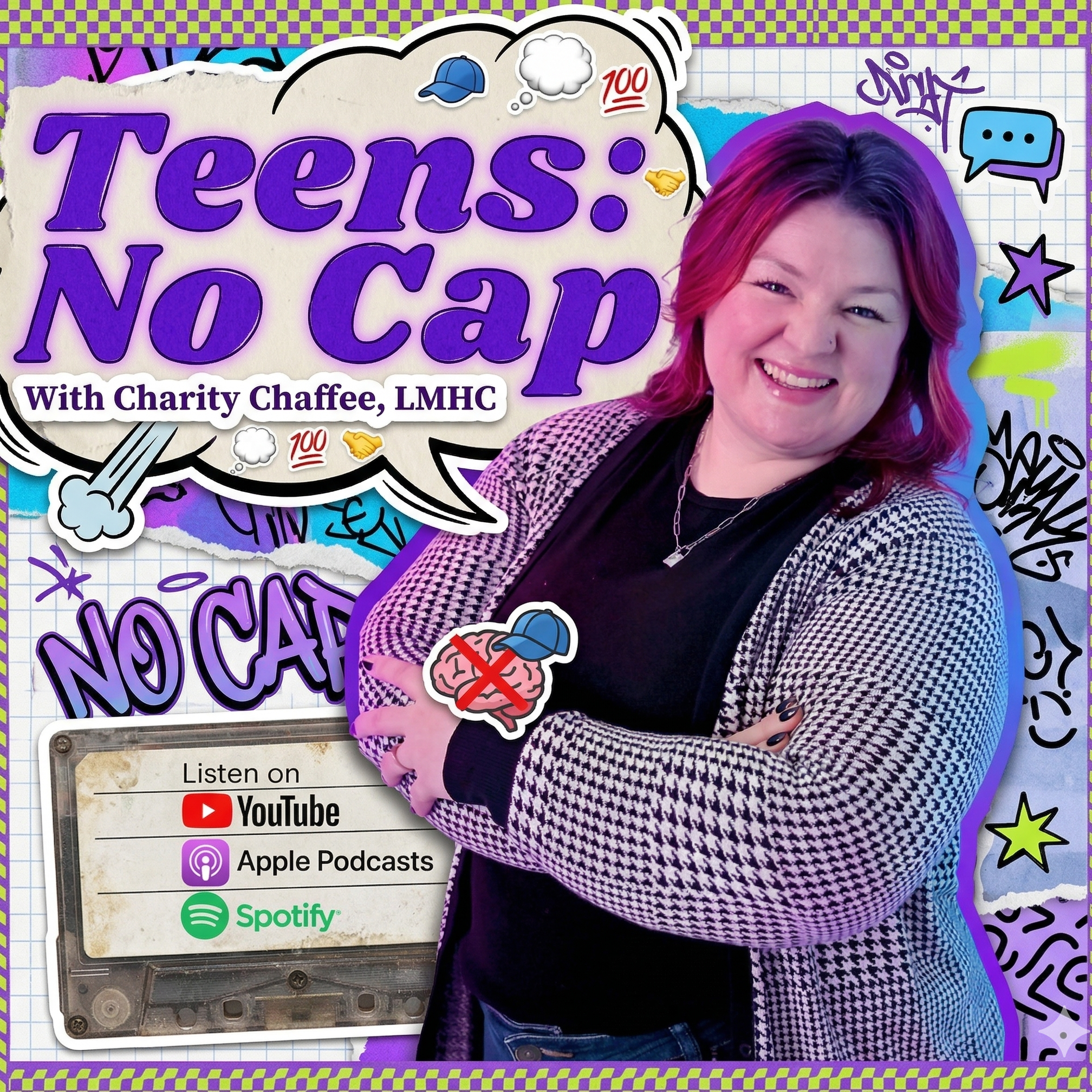
Teens: No Cap (Presented by Teens Uncharted)Being a teenager today is messy, and we aren’t going to lie about it. Welcome to Teens: No Cap, the podcast where we drop the filters and talk about what’s actually going on. Hosted by Charity, this show bridges the gap between teens and parents. From mental health and school struggles (yes, even IEPs) to high-risk behaviors and finding real connection, we tackle the hard stuff with zero judgment and total honesty. Whether you’re a teen trying to figure it out or a parent trying to understand, you're in the right place. Watch the video episodes on Spotify and YouTube, or listen anywhere you get your podcasts.
-
50
Understanding BFRBs (Skin Picking & Hair Pulling) in Teens with Laura Chackes | Teens: No Cap Ep. 51
Welcome back to another episode of the Teens: No Cap! In Episode 51, host Charity Chaffee sits down with Laura Chackes, a psychologist and owner of the Center for Mindfulness and CBT in St. Louis, Missouri. Laura specializes in treating anxiety, OCD, and Body-Focused Repetitive Behaviors (BFRBs).In this important conversation, we explore the heavily stigmatized and under-recognized world of BFRBs. Laura sheds light on how parents and clinicians can identify these conditions, reduce client shame, and implement effective, compassionate treatment strategies.Key Takeaways from this Episode:✨What are BFRBs?: Body-Focused Repetitive Behaviors include hair pulling (trichotillomania), skin picking (excoriation disorder), and other behaviors like cheek or nail biting.✨The Hidden Struggle: Teens often experience intense shame and go to great lengths to hide their BFRBs using clothing, makeup, or fake eyelashes.✨BFRBs vs. Self-Harm: While self-harm generally involves an intent to cause pain to regulate emotions, BFRBs are typically self-soothing or stimulating behaviors where the harm caused is unintentional.✨What Not to Say: Telling a teen to simply "stop" their behavior is entirely ineffective and will likely only increase defensiveness or secrecy.✨Approaching Treatment: Effective therapy starts with mindfulness and self-compassion to manage the shame before trying to change the behavior itself.✨Redefining Recovery: The goal of BFRB treatment is not necessarily complete cessation of the behavior, but rather managing it so it no longer disrupts the teen's life.Connect with Laura Chackes:https://www.psychologytoday.com/us/therapists/laura-chackes-saint-louis-mo/66259https://www.instagram.com/laurachackes/Facebook Support Group: Search for "Overcoming Skin Picking and Hair Pulling Help for BFRBs".Join the Teens Uncharted Community:Clinicians: https://www.facebook.com/share/g/1BHi1bkcXZ/Parents: https://www.facebook.com/share/g/1CLjk1359K/Like our Facebook Page: https://www.facebook.com/profile.php?id=61575657270757Join us in Skool: https://www.skool.com/teens-uncharted/aboutFollow us on Instagram: https://www.instagram.com/teens.uncharted/#TeensNoCap #LauraChackes #BFRB #SkinPicking #HairPulling #Trichotillomania #Dermatillomania #TeenMentalHealth #TherapistResources #ParentingTeens #SelfCompassion
-
49
Breaking Generational Trauma: Why Your Teen Won't Talk To You | Teens: No Cap Ep. 50
Are you struggling to connect with your teenager, or wondering why they seem totally shut down? In Episode 50 of Teens: No Cap, we dive deep into the unfiltered reality of teen mental health and how families can break cycles of generational trauma.Episode Summary:In this episode, we sit down with licensed social worker Tatyana White to explore what really goes on in therapy sessions with kids ages nine and up. She shares her authentic approach as a queer person of color and mom , explaining why being a "yes person" simply doesn't work with teenagers. We tackle heavy topics like the compound stress placed on parentified children , the importance of holding parents accountable for behavior changes , and why "radical acceptance" is sometimes the only way forward in difficult environments. Plus, you'll hear practical tips for building communication, like using Disney movies to talk about feelings and creating a "Dictionary of Me" with your kids.Connect with Tatyana White:Psychology Today: https://www.psychologytoday.com/us/therapists/tatyana-white-moorestown-nj/1447705Instagram: @thrivingwithtatyJoin the Teens Uncharted Community:Clinicians Facebook Group: https://www.facebook.com/share/g/1BHi1bkcXZ/Parents Facebook Group: https://www.facebook.com/share/g/1CLjk1359K/Facebook Page: Like Us on Facebook https://www.facebook.com/profile.php?id=61575657270757Skool Community: Join us in Skool https://www.skool.com/teens-uncharted/aboutInstagram: Follow us @teens.uncharted https://www.instagram.com/teens.uncharted/#TeensUncharted #TeenMentalHealth #ParentingTeens #GenerationalTrauma #Parentification #FamilyBoundaries #TeenTherapy #ParentingAdvice
-
48
The Wild World of Teen Therapy: Mustangs, Playlists & Harm Reduction | Teens: No Cap Ep. 49
Welcome back to another episode of Teens: No Cap! In Episode 49, host Charity Chaffee, LMHC, sits down with Sarah Evert, LICSW, a clinical social worker and private practice owner based in Minnetonka, MN. Both Charity and Sarah are fiercely passionate about specializing exclusively in adolescents, and they break down exactly why teens require a completely different therapeutic approach than adults or younger children.In this episode, we dive into:🎧Why traditional 9-to-5 therapy scheduling doesn't work for busy, burnt-out high schoolers balancing sports, jobs, and AP classes.🎧How the "pressure and release" method of training wild Mustangs perfectly mirrors the journey of parenting and building trust with teenagers.🎧The importance of collaborating with parents instead of treating therapy like an "us vs. them" battle.🎧Why practicing unconditional positive regard—and allowing teens to unmask, even if it means swearing in session—builds essential trust.🎧Charity’s signature "-10 to +10" scale for harm reduction and helping high-risk teens shed shame around their choices.🎧Sarah's creative interventions, including using customized music playlists to help teens process messy breakups and grief.🎧Reframing the pressure of "practice makes perfect" for students, because perfection is just an opinion.Connect with our Guest:Sarah Evert operates her private practice in Minnetonka and maintains a thoroughly vetted mental health provider referral list for families in Minnesota. https://www.instagram.com/s.e.e.psychotherapy/https://seepsychotherapy.com/Join the Community:Clinicians: https://www.facebook.com/share/g/1BHi1bkcXZ/Parents: https://www.facebook.com/share/g/1CLjk1359K/Like our Facebook Page: https://www.facebook.com/profile.php?id=61575657270757Join us in Skool: https://www.skool.com/teens-uncharted/aboutFollow us on Instagram: https://www.instagram.com/teens.uncharted/#TeenTherapy #MentalHealthPodcast #TeensNoCap #ParentingTeens #HarmReduction #SocialWork #AdolescentTherapy #LICSW #LMHC #MentalHealthAwareness
-
47
Using Art & Play in Therapy with High-Risk Teens | Teens: No Cap Ep. 48
In this episode of Teens: No Cap, host Charity Chaffee, LMHC, sits down with board-certified art therapist and licensed counselor Lindsey Jonin to break down the transformative power of creativity in therapy.Many parents and even clinicians wonder: What is the actual difference between a certified art therapist and someone who just uses art activities in a session? Lindsey unpacks this hot topic, explains why there are no "universal meanings" for colors, and shares how to avoid assumption traps when looking at a teen's creative work.We also dive into:✅Process over Product: Why your teen doesn't need to be a "fine artist" to benefit from art therapy.✅Handling Pushback: How to talk to parents who think doing art in session isn't "real therapy".✅Therapeutic Materials: Why fluid mediums like watercolor can actually cause dysregulation, and what to use instead.✅Altered Books & Blackout Poetry: Cheap, accessible ways to introduce tactile creativity to teens.✅Lindsey’s Journey: From struggling academically in high school to owning a successful private practice.Whether you are a provider looking to expand your toolkit, a parent trying to connect with your teenager, or a student interested in the field of art therapy, this conversation is packed with authentic, actionable insights.🔗 Connect with Lindsey Jonin:🙌Workshops & Consultation: http://abstractandaligned.com/🙌Clinical Practice & Supervision: Lilly Counseling and Art Therapy (Bordentown, NJ) 🙌Email: [email protected] the Community:🔗Clinicians: https://www.facebook.com/share/g/1BHi1bkcXZ/🔗Parents: https://www.facebook.com/share/g/1CLjk1359K/🔗Like our Facebok Page: https://www.facebook.com/profile.php?id=61575657270757🔗Join us in Skool: https://www.skool.com/teens-uncharted/about🔗Follow us on Instagram: https://www.instagram.com/teens.uncharted/ #arttherapy #TeenMentalHealth #TherapistPodcast #ParentingTeens #CreativeHealing #MentalHealthMatters
-
46
Do Coping Skills Actually Work? Harm Reduction & Self-Harm in Teens | Teens: No Cap Ep. 47
In episode 47 of Teens: No Cap, host and licensed Massachusetts mental health counselor Charity Chaffee tackles some of the most complex questions surrounding teen mental health. When dealing with high-risk behaviors, do coping skills actually work?Designed as a resource for both clinicians and parents, this episode dives deep into effective strategies for supporting treatment-resistant teenagers who have already been through various treatment facilities. Charity challenges the traditional approach of simply handing out a list of coping skills to "fix" a problem. Instead, she introduces her "negative 10 to positive 10" scale—where a negative 10 represents death—to help contextualize and understand the full range of teen coping mechanisms.Key Topics Covered in This Episode:🚨Why stripping away a teen's existing coping mechanisms without understanding the root cause can be detrimental.🚨How adults and professionals should react with curiosity instead of panic or shame when a teenager discloses self-harm.🚨Applying a harm reduction philosophy to high-risk behaviors by focusing on making a situation just 1% better.🚨Why natural hobbies, such as playing an instrument or joining a sports team, are fundamentally powerful coping skills.🚨The importance of reframing relapse as a vital learning opportunity rather than a personal failure.Join the Teens Uncharted Community:🔗Website & Mailing List: Visit https://www.teensuncharted.com/ to stay updated on new recordings and announcements.🔗For Parents: Join our free Facebook group [ https://www.facebook.com/share/g/1CLjk1359K/ ] to access parent get-togethers, support, and trainings.🔗For Therapists: Connect with our specialized Facebook community [ https://www.facebook.com/share/g/1BHi1bkcXZ/ ] for clinicians working with teenagers.🔗Like our Facebook Page: https://www.facebook.com/profile.php?id=61575657270757🔗Join us in Skool: https://www.skool.com/teens-uncharted/aboutDon't forget to like, follow, and subscribe for more insights into navigating the teen years!#teenmentalhealth #SelfHarmAwareness #HarmReduction #ParentingTeens #TherapistTips #CopingSkills #TeensNoCap #TeenTherapy #MentalHealthPodcast #TreatmentResistantTeens
-
45
Deployment, Reintegration, & Masking: Inside the Minds of Military Kids | Teens: No Cap Ep. 46
Welcome back to another episode of Teens No Cap with your host, Charity Chaffee! In this episode, we sit down with Jason Kelley, a Licensed Clinical Social Worker, to discuss the unique experiences and mental health challenges faced by teenagers in military families.Jason brings an incredible blend of lived and professional experience to our coffee chat. After serving in the military for 17 years and working in mental health for the latter half of his career, Jason opened his own practice, Your Way Therapy, where he focuses on military members, veterans, and their families. Today, we unpack the realities behind the "resilient military brat" stereotype, the hurdles of deployment and reintegration, and how to best support military families.In this episode, we discuss:✨The Cost of Resiliency: While military children are known for being resilient, they often mask their true emotions or act as overachievers to keep their family stable during difficult times. ✨The Complexities of Deployment: Beyond just deployments, military kids face the stress of constant relocations, long hours, and temporary duty assignments (TDYs) that frequently disrupt their lives and friendships. ✨The "Reintegration" Phase: Jason explains that a deployed parent returning home is often harder on the family than the deployment itself, as everyone must adjust to shifted routines and changing family dynamics. ✨Parental Shame: The stay-at-home caregivers often struggle with feelings of shame or inadequacy when they can't manage their child's severe mental health issues on their own. ✨Advice for Therapists: Providers must take the time to understand military culture and avoid putting the service member on a pedestal, ensuring they equally recognize the profound sacrifices made by the family at home. Jason Kelley's Practice: https://ywtherapy.clientsecure.me/#home Join the Teens Uncharted Community:Clinicians: https://www.facebook.com/share/g/1BHi1bkcXZ/Parents: https://www.facebook.com/share/g/1CLjk1359K/Like our Facebok Page: https://www.facebook.com/profile.php?id=61575657270757Join us in Skool: https://www.skool.com/teens-uncharted/aboutFollow us on Instagram: https://www.instagram.com/teens.uncharted/#MilitaryTeens #TeenMentalHealth #MilitaryFamilies #TeensNoCap #DeploymentSupport #MilitarySpouse #TherapistTips #MentalHealthAwareness #MilitaryBrat #ChildPsychology
We're indexing this podcast's transcripts for the first time — this can take a minute or two. We'll show results as soon as they're ready.
No matches for "" in this podcast's transcripts.
No topics indexed yet for this podcast.
Loading reviews...
ABOUT THIS SHOW
Teens: No Cap (Presented by Teens Uncharted)Being a teenager today is messy, and we aren’t going to lie about it. Welcome to Teens: No Cap, the podcast where we drop the filters and talk about what’s actually going on. Hosted by Charity, this show bridges the gap between teens and parents. From mental health and school struggles (yes, even IEPs) to high-risk behaviors and finding real connection, we tackle the hard stuff with zero judgment and total honesty. Whether you’re a teen trying to figure it out or a parent trying to understand, you're in the right place. Watch the video episodes on Spotify and YouTube, or listen anywhere you get your podcasts.
HOSTED BY
Teens Uncharted
Loading similar podcasts...
Frequently Asked Questions
How many episodes does Teens: No Cap have?
Teens: No Cap currently has 6 episodes available on PodParley. New episodes are automatically indexed when they're published to the podcast feed.
What is Teens: No Cap about?
Teens: No Cap (Presented by Teens Uncharted)Being a teenager today is messy, and we aren’t going to lie about it. Welcome to Teens: No Cap, the podcast where we drop the filters and talk about what’s actually going on. Hosted by Charity, this show bridges the gap between teens and parents. From...
How often does Teens: No Cap release new episodes?
Teens: No Cap has 6 episodes. Check the episode list to see recent publication dates and frequency.
Where can I listen to Teens: No Cap?
You can listen to Teens: No Cap on PodParley by clicking any episode. We provide an embedded audio player for direct listening, and you can also subscribe via your preferred podcast app using the RSS feed.
Who hosts Teens: No Cap?
Teens: No Cap is created and hosted by Teens Uncharted.
URL copied to clipboard!