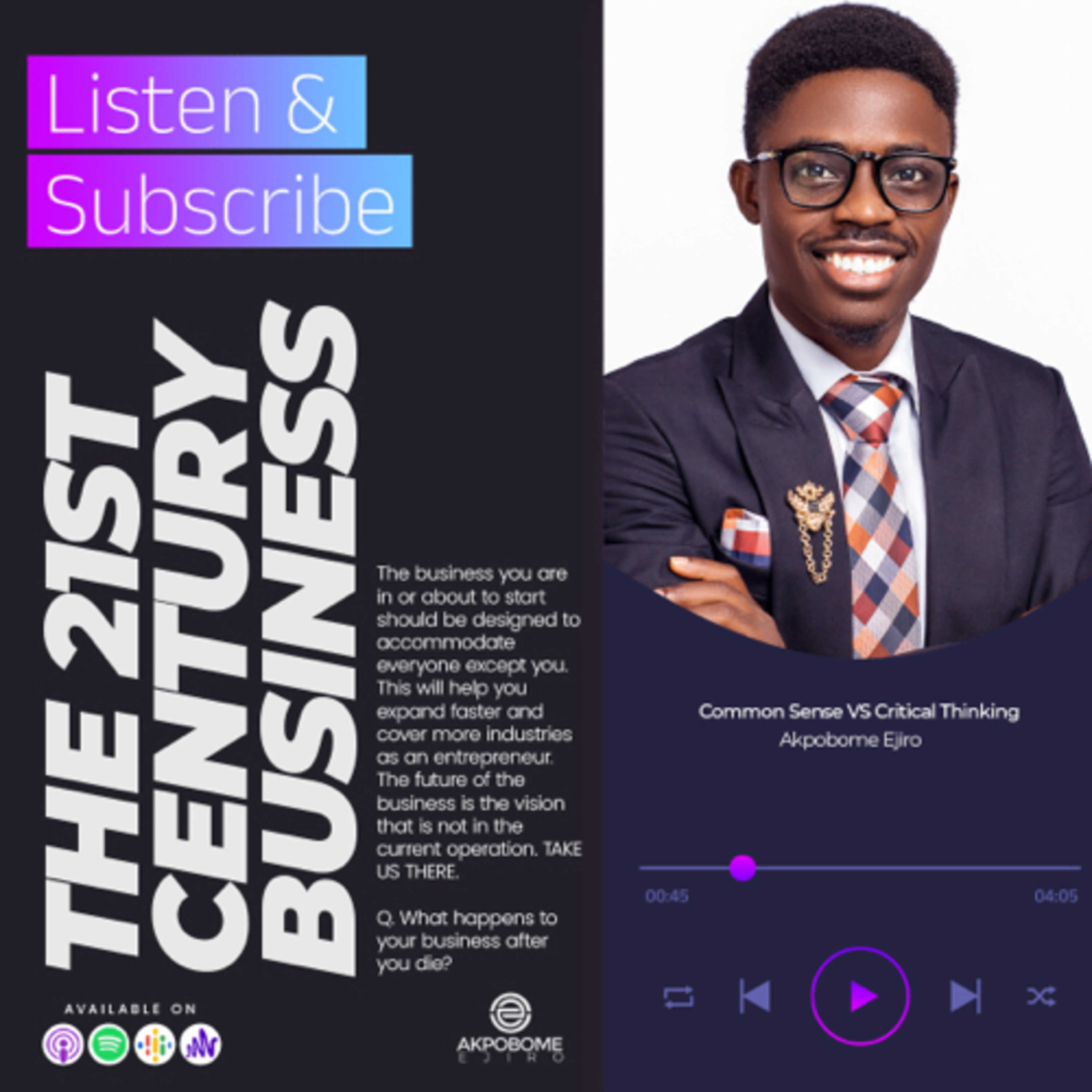
The 21st Century Business
by Akpobome Ejiro
Business has become more of a routine than an evolving reality. This has created more failed businesses than successful ones. Thinking about the rate of social changes in relation to technology, taste, location etc. entrepreneurs has found it more challenging to keep up. However business is not about the work rather the system. It should be designed for self sustainability. My goal is simply to create sustainability in businesses and creating values that has the capacity to grow, expand and remain innovative to meet the need of any generation.
Episodes
-
What if You Are Solving The Wrong Problem?
As founders, we have to resist the temptation to fall in love with solutions. We need to fall in love with understanding the problem because the quality of your solution will never exceed the quality of your diagnosis. Before investing more money, hiring another employee, launching another…
more -
The Invincible CEO
The statement "We can't do anything until the boss arrives." It sounds like respect, importance, leadership. But beneath those words is a dangerous reality. Your business has become dependent on your presence. Many founders wear this dependence like a badge of honour. They proudly say, "Nothing...
-
You Won't Be Here Always
One of the greatest misconceptions in entrepreneurship is believing that because a company is registered, it automatically becomes a business. It doesn't. A registered company is simply a legal structure. A business is a system that consistently creates value regardless of who is physically...
-
The Founder's Mortality
IF YOU DIED TODAY, WHAT HAPPENS TO YOUR BUSINESS TOMORROW? Many businesses are not businesses. They are talented people operating under a registered company name. The founder is the strategist, the salesperson, the finance director, the operations manager, the negotiator, the customer service...
-
Productivity is not discipline
Modern work culture often glorifies struggle. Long hours. Constant availability. Endless hustle. But struggle is not the same as effectiveness, and burnout is not proof of commitment. The strongest organizations understand something important: Sustainable productivity is designed intentionally.…
more -
The Modern Business Crisis
We are entering an era where information is abundant. Which means the competitive advantage is no longer access to data. It is the ability to interpret it wisely. Because businesses do not succeed simply because they measure more. They succeed because they understand better. And the leaders who...
-
The Real Cost of Ignoring Systems Thinking
Many organizations try to solve problems individually without understanding how everything is connected. A problem appears, a solution is introduced, things improve briefly and then… the same issue returns...Different quarter, different department, same underlying problem, at that point, leaders...
-
Legacy Is a Strategy, Not an Outcome
Legacy is not just about reputation. It is about what remains when you are no longer in control. The systems you build, the culture you shape, the standards you enforce, the decisions you normalize. It answers a critical question: What continues without you? And that’s where legacy moves from...
-
Why Most Growth Strategies Are Just Expensive Distractions
In many organizations, "growth” becomes a label…A justification for new initiatives, new hires, new markets, new products, and once that label is applied, it becomes very difficult to challenge...who wants to argue against growth? But here’s the reality: Some growth strategies are not expanding…
more -
Your Business Is Not Competing
You are not in a competition, you are in a comparison and the interesting part is that it is with standards that exist even outside your industry...its is about your customers experiences/exposure everywhere else they have been. And that changes the standard. It raises the bar. It forces...
-
The Responsibility of Power in Business
The moment you hold significant authority in an organization, something shifts. People become more careful, feedback becomes more filtered, disagreement becomes less direct. Not because people suddenly stopped thinking critically… But because power changes risk, and this is where leadership…
more -
Profit vs Purpose- A False Debate
Should we focus on profit… or purpose? It sounds like a valid question but it contains a hidden flaw. It is assumed that these two things are in conflict... if you pursue purpose, you must sacrifice profit and if you pursue profit, purpose becomes secondary, but here’s the uncomfortable truth…
more -
Sustainability Is Not a CSR Strategy
Sustainability is not just about environmental responsibility. It is about long-term viability. The ability of a business to operate, grow, and remain relevant over time. It touches everything: How resources are used, how products are designed, how supply chains operate, how people are treated.…
more -
What Will Leadership Look Like in 2050?
Leadership in 2050 will not suddenly appear. It is already being shaped… right now by the decisions we make, the systems we build, the habits leaders practice daily. Here’s the challenge; Most leaders are still operating with models designed for the past. So the question is not whether leadership...
-
The Leadership Skill of Asking Better Questions
Great leadership is not defined by having the best answers. It is defined by asking the right questions, but in most organizations, leaders feel pressure to provide answers quickly, to sound decisive, to appear knowledgeable, to move things forward, and over time, something subtle…
more -
The Discipline of Strategic Thinking
Most leaders don’t actually spend enough time thinking. They spend time reacting, responding to emails, attending meetings, solving immediate problems, and because they are constantly engaged, it feels like they are thinking., but activity is not the same as strategic thinking. Book a Consultation
-
How Organizations Drift Into Inefficiency
Inefficiency rarely looks like failure. It doesn’t show up as a crisis on day one. It doesn’t immediately break the business. Instead, it appears quietly, more meetings than necessary, slower decision-making, repeated work, delayed execution, and because nothing is collapsing, it’s easy to…
more -
The Next Era of Responsible Capitalism
For decades, the primary goal of business was clear: Maximize profit, increase shareholder value, drive growth. For a long time, that model worked. Today, something is changing, customers are asking harder questions, employees are choosing companies more carefully, investors are paying attention…
more -
Management Is Not Leadership
Management is not leadership yet in most organizations, the two are used interchangeably. Someone gets promoted they are now a leader. They manage a team, they are now leading people but here’s the problem, you can manage effectively without ever truly leading and you can lead powerfully without...
-
Strategy is not Planning
Many organizations every year organize strategy retreat, slides are prepared, goals are defined, initiatives are listed but at the end of it all, there’s a document, detailed, structured, impressive and everyone leaves feeling like the company now has a strategy but a few months later, something...
-
The Myth of People Person Leader
When organizations describe someone as a “people person,” they usually mean: They communicate easily, they build relationships quickly, they create a positive atmosphere. While these are valuable traits, they help teams collaborate, they improve morale, they reduce tension, but leadership…
more -
Corporate Suicide
Growth can be dangerous. In most organizations, growth is celebrated without question. More revenue, More customers, More expansion, More visibility; and on the surface, all of this looks like success but here’s the reality many leaders don’t confront early enough: Not all growth is progress....
-
Why Leaders Must Learn To Disappoint People
Most leaders want to be liked. They want their teams to respect them. They want to be seen as fair, approachable, supportive. And there’s nothing wrong with that but here’s where the problem begins, the desire to be liked can quietly turn into a fear of disappointing people and when that fear…
more -
Charisma is Overrated; The Quiet Leadership
Charismatic leaders command attention. They energize rooms. They inspire belief. And because of that, many organizations unconsciously equate charisma with capability. But here’s the uncomfortable truth: Some of the most charismatic leaders build the most fragile organizations. And some of the…
more -
Why Most Leaders Should Not Be in Leadership
What if many of the people in leadership positions today should not actually be leading? Not because they are unintelligent. Not because they are unqualified on paper. But because leadership requires something deeper than competence. In most organizations, people are promoted for performance. Top...
-
Leadership is not about inspiration rather responsibility
If you listen to most leadership conversations today, inspiration seems to be the central theme. Motivational speeches, charismatic communication, visionary storytelling. These things have their place. But they can also create a dangerous misunderstanding of what leadership actually requires....
-
Leading Businesses in Unstable Economic Environment.
Most business strategies are built for stable environments. Stable inflation, Predictable currency, Reliable supply chains, Consistent consumer behavior. But in many parts of the world especially across emerging markets stability is not the default condition. Exchange rates fluctuate…
more -
Scaling African Brands for Global Market
There’s a conversation happening across Africa right now. Entrepreneurs are building stronger companies. Startups are attracting global attention. African creativity is influencing culture worldwide. Yet when it comes to scaling African brands globally, many founders still ask the same question:...
-
Executive Power and Responsible Leadership
When you walk into a meeting as the most senior person, something subtle happens. People become more careful with their words. Disagreement becomes softer. Silence becomes more common. Not because people suddenly lost their opinions. But because your power changes the consequences of speaking...
-
Transparency VS Confidentiality
On one side, modern leadership culture demands transparency. People want openness. They want honesty. They want to know what’s happening. On the other side sits responsibility. Because what they are asking about…you cannot yet discuss. Not because you want to hide information. But because sharing...
-
The Role of the Board in Strategic Growth
Ask most founders or CEOs what the board does, and you’ll hear one of two answers: “They approve things.” Or… “They ask hard questions.” Both are true. Neither is complete. Because when properly engaged, a board is not just an oversight body. It’s a strategic multiplier. The problem is, many...
-
Leadership Loneliness
There’s a side of leadership that doesn’t make it to conferences. It’s not the strategy, Not the wins, Not the applause. It’s the silence. The silence after a difficult decision. The silence when you can’t fully share your doubts. The silence when everyone looks to you for certainty and you’re...
-
Trust in Absence
Anyone can lead when they’re in the room. The real test is: What happens when you’re not? Do decisions slow? Does politics rise? Does confidence drop? Or does the organization move with clarity? If your presence is required for performance, you’re still central to the system. But if trust endures...
-
Power, Authority & Influence
Having authority no longer guarantees influence. Having power no longer ensures obedience. And having influence doesn’t always come with a title. Yet many leaders still operate as if these three things are the same. They’re not. In today’s organizations, confusing power, influence, and authority...
-
Talent Retention
Many leaders still default to the same playbook: Increase compensation Add perks Improve office aesthetics And when people still leave, they’re confused. Here’s the reality. Money keeps people comfortable. It doesn’t keep them committed. Perks create convenience. They don’t create meaning....
-
Psychological Safety VS Accountability
There’s a quiet debate happening in many executive teams. Some leaders say: “We need more psychological safety.” Others respond: “No, we need stronger accountability.” And what often follows is tension, confusion, and subtle power struggles. At the executive level, psychological safety without...
-
Leading Leaders; Managing Senior Executives and Partners
Senior leaders don’t need instructions. They need direction. They don’t respond well to micromanagement, vague encouragement, public correction rather they respond to clarity of intent, respect for autonomy, private principled challenge. When leaders treat senior executives like junior managers,...
-
Boardroom Thinking For Startup Founders
Many startup founders are brilliant builders…but poor boardroom thinkers. They know how to hustle. They know how to sell. They know how to survive. But when the conversation shifts from building the company to governing the company, they struggle. And that gap between founder thinking and…
more -
When to Pivot VS When to Stay the Course
The most expensive decision is knowing when to change direction and knowing when not to. Some leaders pivot too early. They chase every signal, every trend, every loud opinion. Others stay the course too long. They confuse loyalty to the past with discipline. Both mistakes look like confidence…
more -
Competitive Advantage in a Crowded Market
Most leaders say "our market is too crowded" and almost never question the reality of the statement. Crowded doesn’t mean competitive. It usually means undifferentiated. Too many companies doing roughly the same thing, in roughly the same way, hoping marketing will do the heavy lifting.…
more -
High Performance Teams; What Executives Get Wrong
Most executives say they want high-performance teams. What they actually want is high output with low friction. They want speed without tension. Alignment without disagreement. Results without discomfort. But high-performance teams don’t feel smooth. They feel alive. Would you want to be an...
-
Managing Scaling, Growth and Culture
Is your company actually growing… or is it just getting bigger? Because size and strength are not the same thing. Revenue can go up while clarity goes down. Headcount can increase while accountability disappears. And culture can look “fine” right up until pressure reveals the cracks. In this...
-
Building Companies That Outlive Their Founders
The more successful a founder becomes, the harder it is to let go. Because success reinforces the belief: “My way works.” And it probably does for but longevity requires a different mindset which is “My way worked now it needs to evolve beyond me.” Founders who fail at this often confuse control...
-
Strategy is a choice; Don’t confuse planning with strategy
Strategy is not a document. It’s a decision. A decision to prioritize one path over another. A decision to invest here and not there. A decision to accept certain risks and reject others. When leaders say, “Our strategy is to grow, innovate, and expand,” they’re not making a choice. They’re…
more -
Why Experience is not enough for Leadership
In fact, in fast-changing environments, experience can quietly become a liability. Not because it’s wrong but because it can convince leaders they’ve already learned what they need to know. Experience gives you patterns. But experience doesn’t automatically teach you whether those patterns still...
-
The Art of Saying NO
As leaders rise, saying YES becomes easier and saying NO becomes harder. Not because leaders lose authority, but because the consequences of NO become more visible. People are watching. Opportunities are attractive. Momentum feels fragile. So leaders say YES to projects, partnerships, meetings,...
-
Cognitive Bias
The more experienced you are, the more vulnerable you may be to certain biases. Experience builds patterns. Patterns create confidence. Confidence reduces questioning. Over time, leaders stop asking, Is this still true? and start assuming or this has always worked. That’s not stupidity. That’s…
more -
Leading with clarity in Ambiguous Market
Markets shift faster than forecasts. Customers change behavior without warning. Regulations, technology, and competition move at the same time and yet, leaders are still expected to sound confident, decisive and certain. So many leaders don’t struggle because they lack intelligence. They struggle...
-
Executive Judgement; Is data ever enough?
Data is very good at measuring revenue, costs, conversion, efficiency among other things however, there are things it struggles to capture such as trust, momentum, cultural fatigue, moral alignment, emerging risk. As a leader, you need to feel these before you can measure them. Experienced...
-
Shift from Operator to Strategist
The habits that made you successful early on in business are often the same habits that quietly limit you later. Being hands-on, solving problems fast, knowing every detail, being “the one” people come to... At the beginning, that’s leadership but later, it becomes a ceiling. The hardest shift in...
About this show
Business has become more of a routine than an evolving reality. This has created more failed businesses than successful ones. Thinking about the rate of social changes in relation to technology, taste, location etc. entrepreneurs has found it more challenging to keep up. However business is not about the work rather the system. It should be designed for self sustainability. My goal is simply to create sustainability in businesses and creating values that has the capacity to grow, expand and remain innovative to meet the need of any generation.
Hosted by
Akpobome Ejiro
Categories