
PODCAST · education
The American Presidents
by Selenius Media
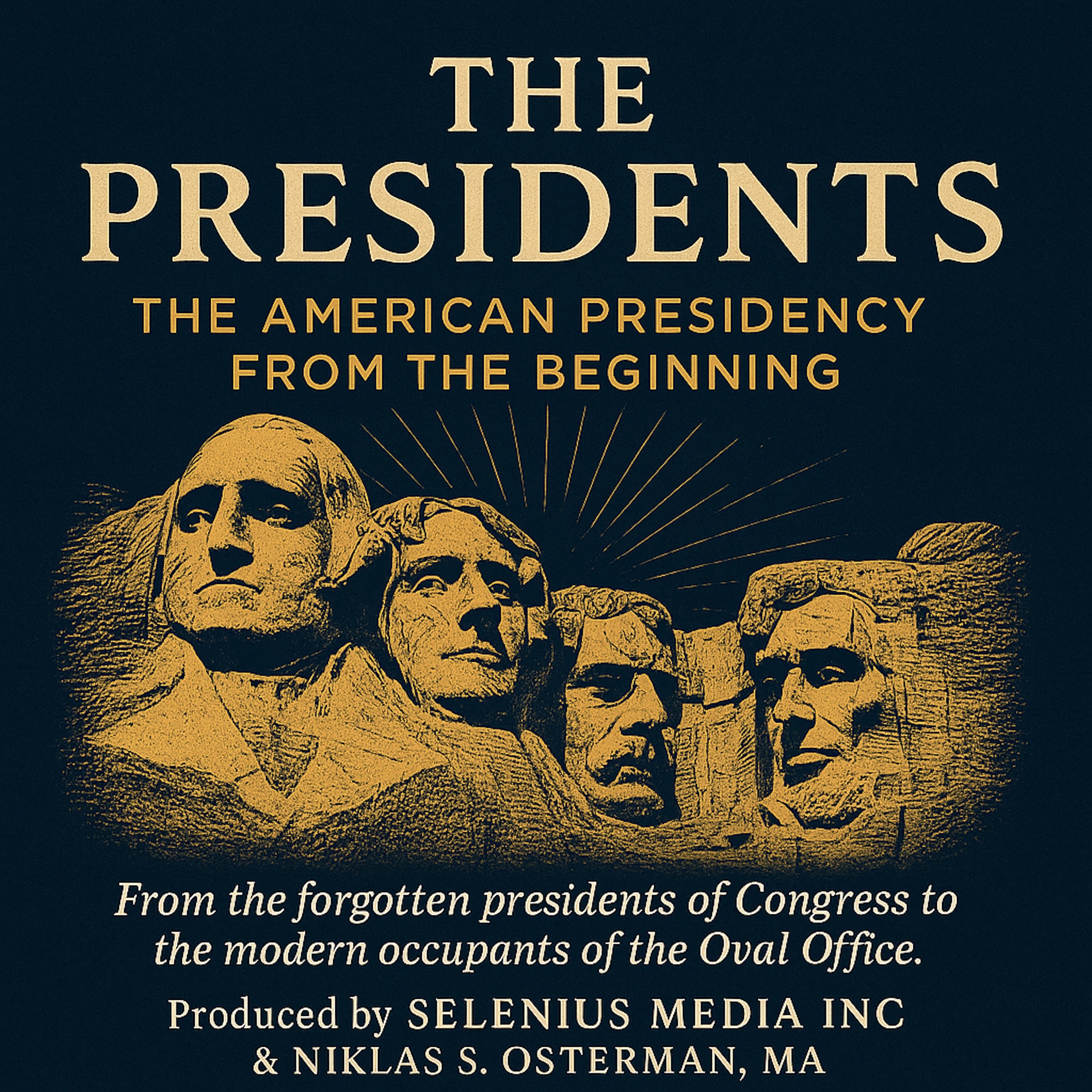
“The Presidents” is a long-form narrative project that tells the American story through the people who carried its executive power before it had a president and after the office had a name. We start where most textbooks don’t—inside the dim rooms of the Continental Congress—then move through the Articles era and into the modern Oval Office, treating each figure not as a bust on a mantel but as a decision-maker inside a living system. Every chapter asks the same unforgiving questions: What did this person actually do? What did they refuse to do? Who paid for their choices, and who prospered because of them? We separate campaign mythology from archival fact, trace how ideas turned into institutions, and watch the office grow teeth, rituals, and limits. The famous are made specific; the forgotten are restored to the map. It’s the republic told in scenes—treaties negotiated, vetoes drafted, wars averted or invited, roads and schools imagined into being, rights opened and closed—so liste
Episodes
-
President Joseph R. Biden Jr
President Joseph R. Biden Jr On a chilly January afternoon in 2021, amidst profound national turmoil, Joseph R. Biden Jr. stood on the West Front of the U.S. Capitol, placed his hand on a hefty family Bible held by his wife Jill, and took the oath of office to become the 46th President of the...
-
President Donald J Trump
President Donald J Trump On the evening of November 8, 2016, Americans and the world looked on in astonishment as the election results defied almost all expectations. Donald J. Trump—a billionaire real estate mogul and reality television star with no prior political office—was declared the winner...
-
President Barack Obama
President Barack Obama On the night of November 4, 2008, tens of thousands of people gathered in Chicago’s Grant Park, their breath visible in the crisp autumn air, united by a shared moment of history. Barack Obama—son of a Kenyan father and a Kansan mother—walked onto the stage, having just…
more -
President George W Bush
President George W Bush George W. Bush had been President of the United States for less than a year when the course of his tenure was transformed in a single morning. On September 11, 2001, as the sun rose into a clear blue sky, Bush found himself confronting the worst terrorist attack in…
more -
President Bill Clinton
President Bill Clinton On a humid August night in 1963, a teenage boy from Hope, Arkansas, stood in the East Room of the White House and shook hands with the President of the United States. John F. Kennedy looked thinner and more fragile than he did on television, but to the seventeen-year-old…
more -
President George H. Walker
President George H. Walker On a cold January morning in 1989, as Marine One skimmed low over the Potomac River and settled onto the South Lawn for the last time of Ronald Reagan’s presidency, George Herbert Walker Bush stepped out into the crisp winter air and paused. For eight years he had been...
-
President Ronald Reagan
President Ronald Reagan On a cold January afternoon in 1981, as the temperature hovered below freezing and a sharp winter wind cut across the National Mall, millions of Americans watched a moment that felt like the breaking of a long fever. The country had endured years of inflation, oil shocks,...
-
President Jimmy Carter
President Jimmy Carter On a warm January afternoon in 1977, as the inaugural procession wound slowly along Pennsylvania Avenue, a new president broke with decades of tradition. Instead of riding in the armored limousine provided for him, he stepped out with his wife Rosalynn, took her hand, and...
-
President Gerald Ford
President Gerald Ford In that moment, many Americans saw Ford for what he essentially was: not a visionary or an ideologue, but a decent, straightforward man who had been dropped into the presidency almost by accident and was now trying to steady a battered system. To understand who he was and…
more -
President Richard M. Nixon
President Richard M. Nixon Richard Nixon’s presidency begins, in most people’s minds, with an ending: a man in a dark suit stepping onto a helicopter on an August morning in 1974, giving a stiff, awkward double V-sign, and flying away from the White House he had just resigned in disgrace. The…
more -
President Lyndon Baines Johnson
President Lyndon Baines Johnson On the afternoon of November 22, 1963, aboard Air Force One on the tarmac in Dallas, a heavyset man in a dark suit raised his right hand while his left rested on a small Bible. His face was set, grave, exhausted. Beside him stood Jacqueline Kennedy, still wearing…
more -
President John F. Kennedy
President John F. Kennedy On a bright November morning in 1963, the motorcade moved slowly through downtown Dallas. The sky was clear, the air crisp, and the crowds thick along the sidewalks. People leaned out of office windows, waved small flags, and craned for a glimpse of the young president...
-
President Dwight Eisenhower
President Dwight Eisenhower On a raw January morning in 1953, as a cold wind cut across the National Mall, a former five-star general stood on the podium of the Capitol, hand on a Bible, about to become president of the United States. Dwight David Eisenhower—“Ike” to practically everyone—was...
-
President Herbert Hoover
President Herbert Hoover On the night of March 4, 1929, as the festivities of Inauguration Day faded and Washington’s elite drifted from ballroom to ballroom, Herbert Clark Hoover sat for a quiet moment in the Red Room of the White House, staring into a vase of white roses. The celebrations had...
-
President Calvin Coolidge
President Calvin Coolidge In the summer of 1923, a small, spare bedroom in a Vermont farmhouse filled with the soft, uneven glow of lamplight. Outside, the village of Plymouth Notch slept under a sky pricked with stars. Inside, a middle-aged man in a simple nightshirt stood at attention beside…
more -
President Warren G. Harding
President Warren G. Harding On a humid July evening in 1921, the new President of the United States leaned back in the upholstered seat of a White House car rolling slowly up Pennsylvania Avenue. Warren Gamaliel Harding had just delivered a speech titled “Not Heroes, but Partners,” praising the...
-
President Woodrow Wilson
Woodrow Wilson was born into a world divided and left it even more fractured, yet forever changed by his vision. Few American presidents are as contradictory, as intensely moral and yet as blinkered, as the twenty-eighth president. He was a Presbyterian minister’s son who preached politics as if…
more -
President William Howard Taft
President William Howard Taft William Howard Taft moves across the American story like a large, courteous ship that prefers deep water to spectacle. He is remembered in cartoons as girth and in footnotes as an asterisk—only man to be both president and chief justice—but the truth is more…
more -
President Theodore Roosevelt
President Theodore Roosevelt He begins as a small boy fighting air and time. The asthma comes at night like a thief and sits on his chest; the child hears the rattle of his own breathing and learns, much earlier than most, that life does not hand out strength—it must be built. In a brownstone on...
-
William McKinley
William McKinley William McKinley enters American history with the light behind him rather than in his face: a small-town son with a soldier’s steadiness, a lawyer’s patience, and a politician’s ear tuned not for applause but for the faint crackle that runs through a country when prosperity is...
-
Stephen Grover Cleveland
Stephen Grover Cleveland Grover Cleveland’s reputation begins with a sentence he repeats so often it stops sounding like a slogan and starts sounding like a moral reflex: public office is a public trust. The phrase is spare, almost severe, and it reflects a sensibility forged not in salons or at...
-
Benjamin Harrison
Benjamin Harrison Benjamin Harrison arrives in American history with a paradox stitched neatly to the inside of his coat: a quiet man descended from noise. He is the grandson of a war hero president who died too soon to do much harm or much good, the son of a congressman with a frontier’s sense…
more -
Stephen Grover Cleveland
Grover Cleveland’s reputation begins with a sentence he repeats so often it stops sounding like a slogan and starts sounding like a moral reflex: public office is a public trust. The phrase is spare, almost severe, and it reflects a sensibility forged not in salons or at universities, but in...
-
Rutherford B. Hayes
Rutherford B. Hayes enters national memory under gaslight—calm voice, careful eyes, a lawyer’s temper tucked into a soldier’s frame—and for more than a century the shorthand that follows his name is a quarrel about legitimacy. The most contested election in American history lifted him into the...
-
Ulysses S. Grant
Ulysses S. Grant enters American life as a contradiction that grows truer the closer one looks: shy but unflinching, ordinary in bearing yet relentless in execution, a man who disliked blood and became the general who ended the bloodiest American war, a president whose name is still dragged…
more -
President Harry S. Truman
President Harry S. Truman On an April evening in 1945, a clerk from the White House hurried up the marble stairs of the Capitol and down a dim corridor toward the office of the vice president. Inside, Harry S. Truman was sitting with House Speaker Sam Rayburn, sharing a drink and the easy, almost...
-
President Franklin D. Roosevelt
President Franklin D. Roosevelt On a gray March afternoon in 1933, as a cold rain fell on Washington and banks failed across the country in a kind of slow-motion collapse, Franklin Delano Roosevelt rode in an open car toward the Capitol, his head high, his jaw set in that familiar, confident…
more -
Andrew Johnson
because of bad carpentry when, in truth, the frame has shifted with the building. He is not a creature of salons or law schools; he is a tailor from Raleigh, apprenticed at ten, run away at sixteen, a self-taught reader who learned syllables from a wife who had more book in her fingers than in…
more -
Abraham Lincoln
Abraham Lincoln enters the American story as a silhouette before he becomes a figure—long-limbed, awkward, moving through a world of stumps and distances, carrying books as if they were tools and ideas as if they were debts. He is born in a Kentucky cabin that later generations will remake into a...
-
Chester A. Arthur
Chester A. Arthur Chester Alan Arthur enters the American imagination as a contradiction that slowly resolves into character: a genial machine man who becomes a gentleman reformer, a collector of customs turned collector of virtues, a vice president chosen to keep spoils flowing who ends up…
more -
James Buchanan
James Buchanan enters the presidency like a lawyer walking into a burning building with a leather briefcase and a belief that precedent can outshout fire. He is, by the time the oath touches his lips in March 1857, the most experienced public servant in the country: state legislator, congressman,...
-
James A. Garfield
James A. Garfield James A. Garfield steps onto the national stage with the air of someone who has already worn half a dozen lives and is suspicious of fame because it looks too much like a costume. He is born in a one-room cabin in Orange Township, Ohio, the last child of a widowed mother who has...
-
Franklin Pierce
Franklin Pierce enters the presidency like a man who has already used up his share of good fortune and would spend his mandate trying to keep the country from noticing the same thing about itself. He is small-boned, soft-spoken, vain about a certain smoothness that reads, to friendly eyes, as…
more -
Millard Fillmore
Millard Fillmore enters the record without the thunder that posterity likes to lend its protagonists. He is the kind of American the nineteenth century produced in bulk and then too often forgot: a boy born in a cabin on land not yet steady in title, apprenticed to a cloth-dresser who worked the...
-
Zachary Taylor
Zachary Taylor enters the American story as a paradox—an unpolished professional, a planter who lived most of his life in tents, a man of few public sentences who nonetheless became, by sheer steadiness under fire, one of the most quoted names in the country. He did not seek office with…
more -
James K. Polk
James K. Polk steps onto the national stage the way a man steps into a room where the argument has already begun and the hours are numbered. He is not the loudest voice in the party nor the most beloved figure in the country. He does not look like a romance. He looks like a ledger brought to...
-
John Tyler
John Tyler enters the line of presidents like a quiet hinge that suddenly bears the weight of a door no one expected to open. He is there in the background of the parade—Virginia lawyer, legislator, gentleman of the Tidewater—until the nation’s most theatrical campaign puts him in the second…
more -
William Henry Harrison
William Henry Harrison enters the line of presidents like a figure carved from the timber of the Old Northwest—raw-edged, weather-tested, built more out of marching orders than out of pamphlets. He is not the architect of a doctrine; he is an officer trained to turn geography into sentences that...
-
James A. Garfield
James A. Garfield steps onto the national stage with the air of someone who has already worn half a dozen lives and is suspicious of fame because it looks too much like a costume. He is born in a one-room cabin in Orange Township, Ohio, the last child of a widowed mother who has nothing to offer...
-
Martin Van Buren
Martin Van Buren enters the American story not as a battlefield silhouette or a thunderous orator, but as a tactician born to a borderland of languages, a boy of Kinderhook whose first music was Dutch and whose adulthood would be devoted to translating popular feeling into the grammar of power.…
more -
Andrew Jackson
Andrew Jackson enters the American chronicle as a refusal that never cooled. A teen in a war, ordered by an enemy officer to polish a pair of boots, he answered with a no that earned steel across his face and set the pitch of his life. The slash did not create his temper; it certified it.…
more -
John Quincy Adams
He first steps into the American narrative not as a veteran of a field but as a boy of a household calibrated to history. He watches Bunker Hill’s smoke from the ridge near his father’s farm and feels the country’s lungs fill with a new kind of breath. Before he is old enough to vote he is old...
-
James Monroe
James Monroe begins not as a doctrine but as a boy with a musket, a student who left his books at Williamsburg to follow a general across a dark river toward an impossible dawn. Before he was the last of the Virginia dynasty, before editorialists softened the weather of his years into the easy...
-
James Madison
James Madison enters the scene not with the thunder of a soldier’s drum or the roar of a crowd but with the modest scrape of a chair in a quiet room, a notebook open, and a mind intent on turning friction into form. He is small in stature and huge in gravity, frail in appearance and relentless in...
-
Nathaniel Gorham – Acting President of Congress (1785–1786)
Nathaniel Gorham’s turn in the chair began not with trumpets but with the small, exacting necessities that keep a weak government from collapsing into embarrassment. The famous man elected to preside—John Hancock, emblem of independence, governor of Massachusetts, a name large enough to be a...
-
Richard Henry Lee – President of Congress (1784–1785)
Richard Henry Lee’s tenure in the chair arrives in the afterglow of a miracle and the onset of a long migraine. The miracle was the war’s end—Washington’s graceful bow at Annapolis, the definitive treaty now in hand, the last redcoats filing onto ships. The migraine was everything that followed:...
-
Thomas Mifflin – President of Congress (1783–1784)
Thomas Mifflin – President of Congress (1783–1784) Thomas Mifflin’s year in the chair belongs to the narrow space where performance and contrition meet: a politician and soldier with a reputation dinged by whispers from the coldest winter of the war, returned to preside over its official ending…
more -
Elias Boudinot – President of Congress (1782–1783)
Elias Boudinot – President of Congress (1782–1783) In the last hard winter of the war, when rumors of peace traveled faster than pay and slower than hunger, a compact, careful New Jersey lawyer with a Huguenot name took the chair of Congress and tried to carry a country across the narrow bridge...
-
John Hanson – Often mythologized as “first president under the Articles” (1781–1782)
John Hanson – Often mythologized as “first president under the Articles” (1781–1782) The story most people hear about John Hanson arrives as a neat provocation: before George Washington there was another “first president,” a dignified Marylander who held the office under the Articles of...
-
Samuel Huntington – Last Continental Congress president / first under Articles in practice (1779–1781)
Samuel Huntington – Last Continental Congress president / first under Articles in practice (1779–1781)
We're indexing this podcast's transcripts for the first time — this can take a minute or two. We'll show results as soon as they're ready.
No matches for "" in this podcast's transcripts.
No topics indexed yet for this podcast.
Loading reviews...
ABOUT THIS SHOW
“The Presidents” is a long-form narrative project that tells the American story through the people who carried its executive power before it had a president and after the office had a name. We start where most textbooks don’t—inside the dim rooms of the Continental Congress—then move through the Articles era and into the modern Oval Office, treating each figure not as a bust on a mantel but as a decision-maker inside a living system. Every chapter asks the same unforgiving questions: What did this person actually do? What did they refuse to do? Who paid for their choices, and who prospered because of them? We separate campaign mythology from archival fact, trace how ideas turned into institutions, and watch the office grow teeth, rituals, and limits. The famous are made specific; the forgotten are restored to the map. It’s the republic told in scenes—treaties negotiated, vetoes drafted, wars averted or invited, roads and schools imagined into being, rights opened and closed—so liste
HOSTED BY
Selenius Media
CATEGORIES
Loading similar podcasts...
Frequently Asked Questions
How many episodes does The American Presidents have?
The American Presidents currently has 62 episodes available on PodParley. New episodes are automatically indexed when they're published to the podcast feed.
What is The American Presidents about?
“The Presidents” is a long-form narrative project that tells the American story through the people who carried its executive power before it had a president and after the office had a name. We start where most textbooks don’t—inside the dim rooms of the Continental Congress—then move through the...
How often does The American Presidents release new episodes?
The American Presidents has 62 episodes. Check the episode list to see recent publication dates and frequency.
Where can I listen to The American Presidents?
You can listen to The American Presidents on PodParley by clicking any episode. We provide an embedded audio player for direct listening, and you can also subscribe via your preferred podcast app using the RSS feed.
Who hosts The American Presidents?
The American Presidents is created and hosted by Selenius Media.
URL copied to clipboard!