
PODCAST · government
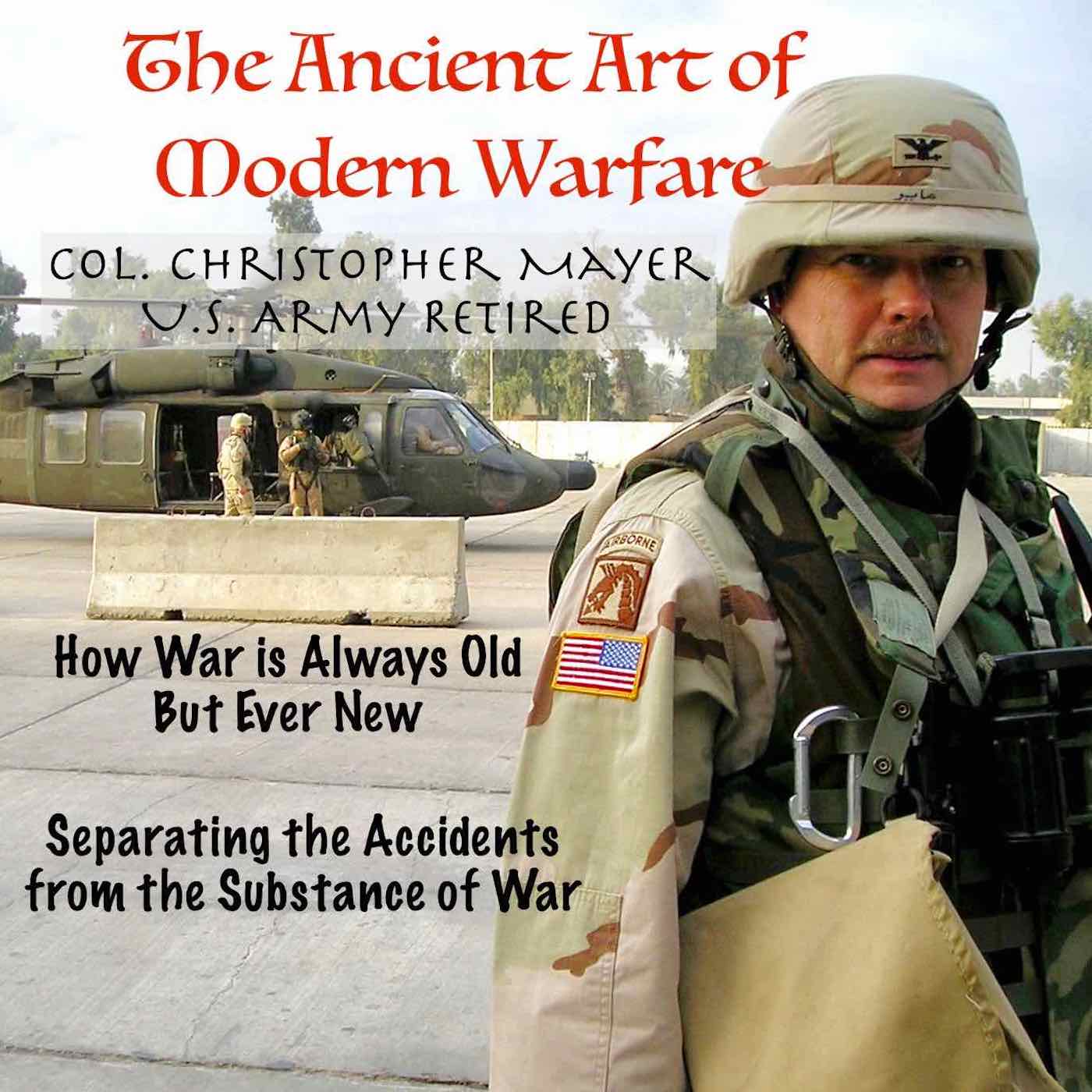
The Ancient Art of Modern Warfare
by Chris Mayer National Security and Strategy Consultant
Exploring how the practice of war changes while the fundamental nature and principles of war are unchanging. Host is COL Chris Mayer, USA RET, former member of the Advance Warfighting Working Group and the U.S. Government's expert on Private Military Companies. Includes Strategy, Revolution in Military Affairs, Hybrid Warfare, Cyber warfare, mercenaries, PMSC, Laws and Customs of War
-
100
Is Hizballah a Mercenary Organization (E141)
The common definition of a mercenary is a soldier paid to fight in an armed conflict for a country that is not his or her own. The terrorist organization Hizballah operates in Lebanon, fighting against Israel, with financial, material and organizational support from Iran, and frequently under the direction of the Iranian Revolutionary Guard Corps. Under the common definition, could Hizballah be considered mercenaries fighting for Iran? Royce de Melo, Doug Brooks, and I discuss this question in this episode of the Ancient Art of Modern Warfare. References: Hague 1907: Convention (IV) respecting the Laws and Customs of War on Land and its annex: Regulations concerning the Laws and Customs of War on Land. The Hague, 18 October 1907. (definition of lawful combatant) https://ihl-databases.icrc.org/en/ihl-treaties/hague-conv-iv-1907 Article 47, Additional Protocol (I) to the Geneva Conventions, 1977 (definition of mercenary) (The United States is not a party to this Protocol) https://ihl-databases.icrc.org/en/ihl-treaties/api-1977?activeTab=1949GCs-APs-and-commentaries United Nations Mercenary Convention: International Convention against the Recruitment, Use, Financing and Training of Mercenaries https://www.google.com/url?sa=t&source=web&rct=j&opi=89978449&url=https://www.ohchr.org/en/instruments-mechanisms/instruments/international-convention-against-recruitment-use-financing-and&ved=2ahUKEwi47cCQ6M-VAxV4M1kFHX_OGsAQFnoECA0QAQ&usg=AOvVaw1fCthlNI1AV0DjEGZmeTVl (As of the date of this episode, only 38 governments had ratified this treaty. Only two NATO countries are parties to the convention.) Music: Liszt, F., and the USMC Band, Les Preludes. Public Domain Kiilstofte, P. Mercenaries, Machinamasound (Licensed)
-
99
War Is Irrational (E140)
Is war rational? The great philosopher of war, Carl von Clausewitz, was a product of three schools of education: the classical tradition of Aristotle, the enlightenment philosophers such as Kant, and the practical experience of Napoleon. Each of these three challenged and opposed the other two. His work, On War expresses this tension and opposition. In his effort to develop a comprehensive theory of war, he had to deal with the many instances where the reality of war seemed to defy any coherent framework, where the things which should happen in war are contradicted by what actually happens. (This fits with his assigning the element of probability and chance to the military leg of his famous triad.) “Consequently,” he wrote, “it would be an obvious fallacy to imagine war between civilized peoples as resulting merely from a rational act on the part of their governments…” If it did, he concluded, then in the end, war would never need to be fought. But wars are fought. Is war itself then, irrational? Music: Traditional, The Army Strings, Garryowen (Public Domain) Copland, A. & United States Marine Band. (2000) Fanfare for the Common Man. unpublished, Washington, DC. [Audio] Retrieved from the Library of Congress, (Fair use for educational purposes.)
-
98
The Rational Actor Model (E139)
Since at least the 1940’s, policy and strategic thinking uses the so-called rational actor model in determining what competitors and partners may do, how to respond to them, and how they may react in return. Even considering variations to that model to explain less than optimal choices by these actors, there appears to be enough irrationality by state and non-state actors to call into question whether continued use of the rational actor model is itself rational. Music: Traditional, The Army Strings, Garryowen (Public Domain) Copland, A. & United States Marine Band. (2000) Fanfare for the Common Man. unpublished, Washington, DC. [Audio] Retrieved from the Library of Congress, (Fair use for educational purposes.)
-
97
Wars of Choice? (E138)
I haven’t posted for a few weeks mostly because the current armed conflict with Iran poses a lot of questions that I don’t have answers for. One thing I might have an answer for is the question about wars of choice. Recently, this term is used in a way that implies that this armed conflict is illegitimate or unethical. Like many terms used by any faction with intended political impact, the term is left undefined. Without defining terms there can be no logical argument. Rather, the intent is an appeal to emotion, rather than reason. In this episode of the Ancient Art of Modern Warfare, I take on the challenge of defining that term and applying it to modern conflicts. Music: Traditional, The Army Strings, Garryowen (Public Domain) Holst, G. The Planets: Mars Bringer of War, downloaded from Internet Archive
-
96
Cyber-Mercenaries (E136)
Any quick net search for the term “cyber mercenary” will result in dozens, if not hundreds of entries. These concerns largely focus on the effect these persons or entities have on personal freedoms, economic activity, and the ability of hackers and States can work together to undermine human rights. What about cyber mercenaries and warfare? Can – or do – real mercenaries of the cyber domain of warfare actively participate in combat? If so, how can they disrupt armed conflict or undermine whatever humanitarian principles still exist in warfare? It took the international community years to catch up on the use of private military and security companies in armed conflict and we are still struggling with State-run quasi-mercenary organizations. We need to get ahead of cyberwarfare domain mercenaries now, while the genie is still peeking out from the bottle. References: Convention (IV) respecting the Laws and Customs of War on Land and its annex: Regulations concerning the Laws and Customs of War on Land. The Hague, 18 October 1907 International Committee of the Red Cross (2008) The Montreux Document On pertinent international legal obligations and good practices for States related to operations of private military and security companies during armed conflict. Geneve: International Committee of the Red Cross / Swiss Federal Department of Foreign Affairs Melzer, Nils, Interpretive Guidance on the Notion of Direct Participation in Hostilities under International Humanitarian Law, International Committee of the Red Cross, Geneva, 2009. Music: Kiilstofte, P. Mercenaries, Machinamasound (Licensed)
-
95
Ceasefire? (E136)
As I post this, the cease-fires in Lebanon and Iran are still holding, and much longer than I expected. We usually think of cease fires as a good thing, enabling humanitarian activity and at least pause the death and destruction. That is not, however, the purpose behind any suspension in fighting a war. In this episode I examine the real reasons for most truces or cease fires, explore probable motivations for the current cease fires, and ask whether all cease fires are inherently good. Disclaimer: These podcasts are not monetized or subsidized in any way, nor do they represent anyone’s opinion but my own. Reference: Clausewitz, C. On War, Book One, Chapter One Music: Copland, A. & United States Marine Band. (2000) Fanfare for the Common Man. unpublished, Washington, DC. [Audio] Retrieved from the Library of Congress, (Fair use for educational purposes.)
We're indexing this podcast's transcripts for the first time — this can take a minute or two. We'll show results as soon as they're ready.
No matches for "" in this podcast's transcripts.
No topics indexed yet for this podcast.
Loading reviews...
ABOUT THIS SHOW
Exploring how the practice of war changes while the fundamental nature and principles of war are unchanging. Host is COL Chris Mayer, USA RET, former member of the Advance Warfighting Working Group and the U.S. Government's expert on Private Military Companies. Includes Strategy, Revolution in Military Affairs, Hybrid Warfare, Cyber warfare, mercenaries, PMSC, Laws and Customs of War
HOSTED BY
Chris Mayer National Security and Strategy Consultant
CATEGORIES
Loading similar podcasts...
Frequently Asked Questions
How many episodes does The Ancient Art of Modern Warfare have?
The Ancient Art of Modern Warfare currently has 6 episodes available on PodParley. New episodes are automatically indexed when they're published to the podcast feed.
What is The Ancient Art of Modern Warfare about?
Exploring how the practice of war changes while the fundamental nature and principles of war are unchanging. Host is COL Chris Mayer, USA RET, former member of the Advance Warfighting Working Group and the U.S. Government's expert on Private Military Companies. Includes Strategy, Revolution in...
How often does The Ancient Art of Modern Warfare release new episodes?
The Ancient Art of Modern Warfare has 6 episodes. Check the episode list to see recent publication dates and frequency.
Where can I listen to The Ancient Art of Modern Warfare?
You can listen to The Ancient Art of Modern Warfare on PodParley by clicking any episode. We provide an embedded audio player for direct listening, and you can also subscribe via your preferred podcast app using the RSS feed.
Who hosts The Ancient Art of Modern Warfare?
The Ancient Art of Modern Warfare is created and hosted by Chris Mayer National Security and Strategy Consultant.
URL copied to clipboard!