
PODCAST · history
The Ancient City, by Fustel de Coulanges
by Christopher Anadale
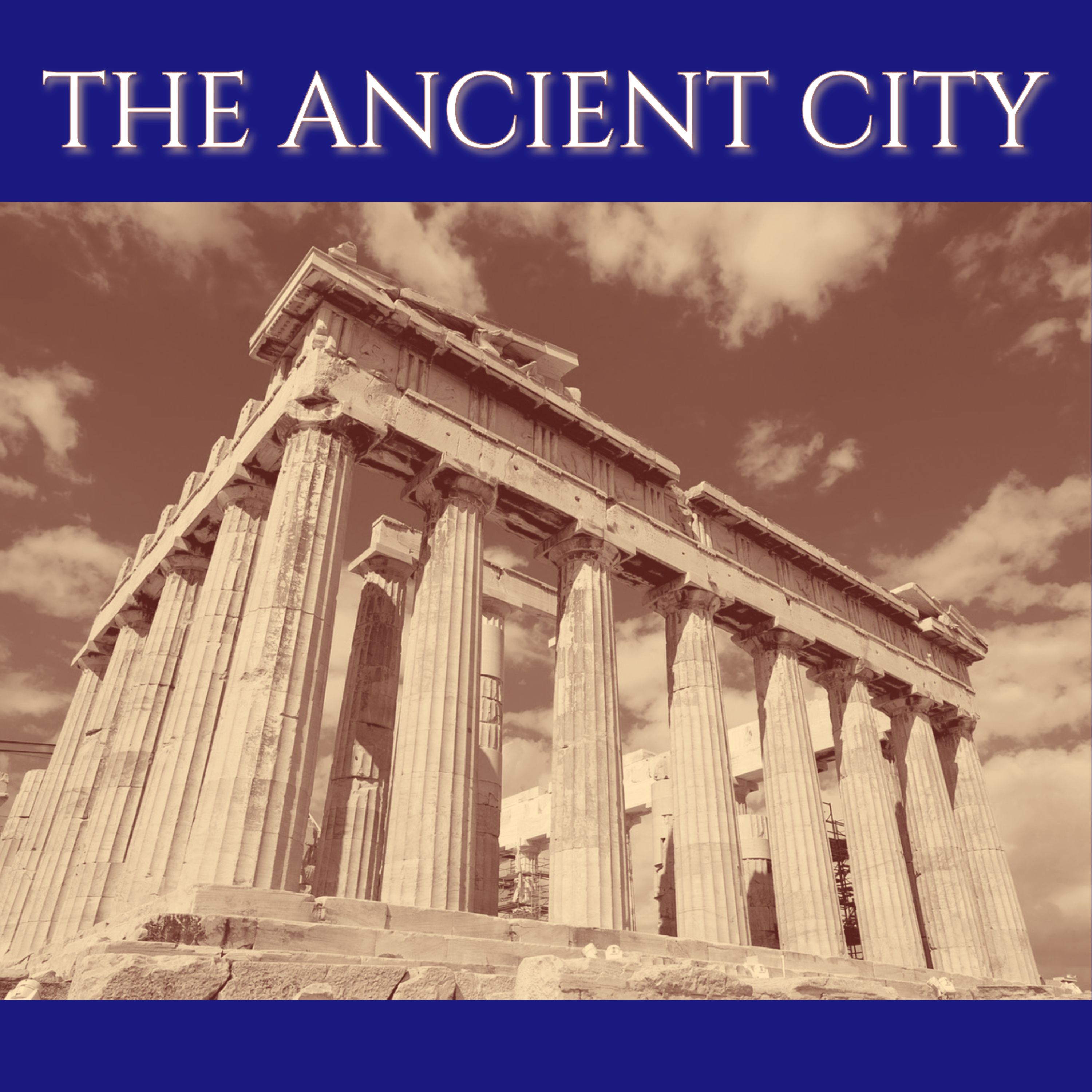
Audiobook of Fustel de Coulanges' The Ancient City (1864). Chapters read, with brief introductions, by Christopher Anadale.Adapted from videos on my YouTube channel: https://www.youtube.com/playlist?list=PLPCGA67J8M2JVoH7M4ayFTRDuLteRhL0p Music: Into Oblivion, by Darren CurtisThumbnail Image: Parthenon. Image by nonbirinonko from Pixabay, https://pixabay.com/photos/greece-parthenon-temple-ruins-1594689/
-
50
Book 5 Chapter 3: Christianity Changes the Conditions of Government
The rise of Christianity completed the destruction of the social order based on the ancient religion of ancestor worship.In this final chapter of the book, Fustel catalogs the changes in politics, in worship, in law, and in self-understanding that the new religion produced.---Based on: https://youtu.be/cEx0tT0jHb4
-
49
Book 5 Chapter 2: The Roman Conquest
In this long chapter Fustel tells the stages of Rome's conquest of the ancient cities.In every city they conquered, the Romans destroyed whatever remained of the municipal system connected to the old religion.---Based on: https://youtu.be/4YQKkJTnNPM https://youtu.be/U6IMsJWKbI8 https://youtu.be/mKlhPB8S7BQ https://youtu.be/s-sRs_720QI
-
48
Book 5 Chapter 1: New Beliefs. Philosophy Changes the Principles and Rules of Politics.
Book 5, The Municipal Regime Disappears, begins with this chapter on the role philosophy played in social change.With Anaxagoras and others came new ideas of divinity, and new principles and rules for political life.---Based on: https://youtu.be/78LOM37iv0s
-
47
Book 4 Chapter 13: Revolutions of Sparta
Book 4 ends with Fustel's account of the path Sparta took through oligarchy and democracy.In all of Greece, Sparta was the city most torn by revolutions.---Based on: https://youtu.be/lYR1_CsZpjM
-
46
Book 4 Chapter 12: Rich and Poor. The Democracy Falls. Popular Tyrants.
Democracy and equality made the gap between wealth and poverty more noticeable, without redressing it.The conflict between rich and poor ended in the seizure of property by popular tyrants.---Based on: https://youtu.be/X71ZKp9eGuk
-
45
Book 4 Chapter 11: Rules of Democratic Government. Examples of Athenian Democracy.
In this chapter Fustel examines steps the new Athenian democracy took to protect against innovations in the law.Democracy was a very demanding and time consuming practice as well. ---Based on: https://youtu.be/1Vp1ieC6hJ8
-
44
Book 4 Chapter 10: An Aristocracy of Wealth Attempts to Establish Itself. Establishment of Democracy. Fourth Revolution.
An interim stage between the old order and democracy, Fustel says, was the attempt by the wealthy class to rule the cities.Weakened by war, this new aristocracy fell to the fourth revolution and democracy.---Based on: https://youtu.be/wIqCDqOnZ_Y
-
43
Book 4 Chapter 9: The New Principle of Government. The Public Interest and the Suffrage.
Fustel relates the social reconstruction that followed the overthrow of the old religion and its laws.Religious sanction for authority was replaced by the new principle of the public interest, and the end of government changed from performing of religious duties to securing peace and order.---Based on: https://youtu.be/dw2UIbFxkzY
-
42
Book 4 Chapter 8: Changes in Private Law. The Code of the Twelve Tables. The Code of Solon.
The plebians' victory over the old religion led to changes in the definition of law itself.Law went from being a religious institution, revealed and commanded by the gods, to a human institution, serving human ends.---Based on: https://youtu.be/aTZbHoc6fBE
-
41
Book 4 Chapter 7: Third Revolution. The Plebs Enter the City.
This chapter about the third wave of revolutions is by far the longest chapter in the book. Fustel first tells the general history of this drive for civic recognition, and then the specific histories of Athens and of Rome.---Based on: https://youtu.be/kW1rECKL7SQhttps://youtu.be/EXPWjg8w11U https://youtu.be/kNwsLiFj0Ks
-
40
Book 4 Chapter 6: The Clients Become Free
In this chapter, Fustel describes the process that led to freedom for the client classes at Athens and at Rome.When the masters ceased to see their authority as just, he says, they defended it badly, or ended by renouncing it.---Based on: https://youtu.be/9xE8I2yLYGs
-
39
Book 4 Chapter 5: Second Revolution. Changes in the Constitution of the Family. The Right of Primogeniture Disappears. The Gens is Dismembered.
Aristocrats worked a political revolution in order to prevent a social revolution, Fustel tells us.But aristocratic rule was undermined by the gradual decline of the family. ---Based on: https://youtu.be/IpA-dVFO50A
-
38
Book 4 Chapter 4: The Aristocracy Governs the Cities
Political royalty was suppressed while religious royalty continued. Family chiefs ruled, drawing their power and legitimacy from the same religious source.---Based on: https://youtu.be/rQYQQyBTg9g
-
37
Book 4 Chapter 3: First Revolution
In the first wave of revolutions in ancient cities, aristocrats gradually limited and replaced their kings. Fustel walks us through this process at Sparta, Athens, and Rome.---Based on: https://youtu.be/kE0Zne3vQIU
-
36
Book 4 Chapter 2: The Plebians
In this chapter, Fustel begins to describe another inferior class that helped to advance the revolutions that eventually overturned this social and religious order of the ancient cities, the plebians.What characterizes plebeians especially is that they are completely outside of the civic and domestic religion, this religion of ancestor worship at the sacred fire.---Based on: https://youtu.be/acvrH4NM9PA
-
35
Book 4 Chapter 1: Patricians and Clients
Having described the ancient religion and how it structured family and political life, Fustel turns in Book 4 to describing the revolutions that over a period of centuries overturned and destroyed this civic order.In this first chapter, he notes the two causes of revolution: the natural progression of ideas, and the emergence of a social group who were hostile to the existing social order, the clients.---Based on: https://youtu.be/gtzx6dc5eEY
-
34
Book 3 Chapter 17: The Omnipotence of the State. The Ancients Knew Nothing of Individual Liberty.
Individual liberty was unknown in the ancient cities. The religious roots of the state gave it absolute authority over all areas of life.---Based on: https://youtu.be/9SgQR6dBURs
-
33
Book 3 Chapter 16: The Roman. The Athenian.
Fustel walks us through the daily religious life of a Roman and of an Athenian. Both lived lives permeated by religious ceremony and duty at every moment.---Based on: https://youtu.be/y0AMSKcyC_w
-
32
Book 3 Chapter 15: Relations Between the Cities. War. Peace. The Alliance of the Gods.
The ancient religion meant that war between cities was always religious war, war between the gods.And so peace treaties were religious ceremonies as well.---Based on: https://youtu.be/Q0bGveGsc5w
-
31
Book 3 Chapter 14: The Municipal Spirit
Religion separated cities absolutely, and made a union of cities not merely difficult but impossible.Conquered cities might face enslavement or extermination, but never annexation.---Based on: https://youtu.be/WNOX11ngxA4
-
30
Book 3 Chapter 13: Patriotism. Exile.
The ancient man's country was his sacred fatherland, Fustel tells us, and so his patriotism reflected his total devotion to his religion. Exile was the interdiction of worship, and involved far greater loss than just physical exclusion.---Based on: https://youtu.be/8buzXg-y9Z4
-
29
Book 3 Chapter 12: The Citizen and the Stranger
Citizenship was defined by participation in the religion of the city. All political and civil rights followed from this religious practice, and those outside the religion could not claim its rights.---Based on: https://youtu.be/oMxM5bREmos
-
28
Book 3 Chapter 11: The Law
For the ancients, Fustel says, the institution of law was part of religion, and of divine origin.Thus, law was sacred and immutable, and governed relations only between co-religionists.---Based on: https://youtu.be/RP-UgVVniPY
-
27
Book 3 Chapter 10: The Magistracy
The union of political authority and religious priesthood was reflected in the office of magistrate as well.Recounting this institution's history, Fustel warns us not to suspect insincerity or manipulation on the part of the aristocrats.---Based on: https://youtu.be/wlULQbE3FIQ
-
26
Book 3 Chapter 9: Government of the City. The King.
Ancient political authority flowed from religion, not material force. The king's power and authority came from his sacred role as high priest. ---Based on: https://youtu.be/pFSmWZnlfMw
-
25
Book 3 Chapter 8: The Rituals and the Annals
Fustel contrasts ancient with modern religion: the former was about ritual, not doctrine.It was secretive and fearful.---Based on: https://youtu.be/-AcMLqaSF6I
-
24
Book 3 Chapter 7: The Religion of the City
In this long chapter, Fustel catalogs the roles religion played in the institutions of the ancient city in its prime.These include the sharing of meals prepared on the altar, the festivals and calendar, the census, and the military.---Based on: https://youtu.be/ZgwkGNLlby0https://youtu.be/-D8qdPAKMAE https://youtu.be/NgCMOvR1n50 https://youtu.be/lN-ti_HfSyI
-
23
Book 3 Chapter 6: The Gods of the City
Each city was held together by common worship of its particular gods.Different cities worshipped their unique gods under the same names: thus there were many Athenas, many Jupiters, et cetera.---Based on: https://youtu.be/XgKCJJeP4fc
-
22
Book 3 Chapter 5: Worship of the Founder. The Legend of Aeneas.
Each city worshipped its founder as the man who had called down the gods to dwell in the new city.The dominant virtue of a founder, says Fustel, is piety. ---Based on: https://youtu.be/aiWiU0Qi9uw
-
21
Book 3 Chapter 4: The City
Ancient cities were very unlike ours.A city was not built up in stages, but founded all at once in a solemn religious ritual.---Based on: https://youtu.be/MQdkIaLTEw8
-
20
Book 3 Chapter 3: The City is Formed
An ancient city was not an association of individuals, writes Fustel. It was a confederation of several pre-established societies, which continued to exist in the city.---Based on: https://youtu.be/b8E4p7a7dPw
-
19
Book 3 Chapter 2: New Religious Beliefs
In this chapter Fustel describes the twofold nature of ancient religious sentiment.Some gods were drawn from human intelligence and experience of the soul, and other gods were identified in external objects and physical forces in nature.---Based on: https://youtu.be/jeDpijYOdUI
-
18
Book 3 Chapter 1: The Phratry and the Cury. The Tribe.
Book 3, The City, begins by tracing the expansion of religious ideas and rituals from the family level to larger social groups.The phratry, the cury, and the tribe each had their own altar, their own priests, and their own sacred meals.---Based on: https://youtu.be/dUbmzIR1DHk
-
17
Book 2 Chapter 10: The Gens at Rome and in Greece
In this long final chapter of Book 2, Fustel addresses the historical problem of the gens, its character and foundation.The gens, he tells us, was not an association of families; it WAS the family. ---Based on: https://youtu.be/YydNy__d3U4
-
16
Book 2 Chapter 9: Morals of the Ancient Family
The ancient religion fortified man's moral sentiments and gave them greater authority. In this chapter, Fustel describes the religious roots of chastity, love of home, and other domestic virtues. ---Based on: https://youtu.be/3-V94JUlDS0
-
15
Book 2 Chapter 8: Authority in the Family
In this chapter Fustel describes the nature of the paternal power: the authority of the father and of religious law in the household.At first, all law was private and familial -- not arbitrary, but rather structured by and in support of the family's religious worship.---Based on: https://youtu.be/3Mat18OAgmA
-
14
Book 2 Chapter 7: The Right of Succession
Because worship of the ancestors must never end, property rights naturally led to religious laws of succession and inheritance. Fustel describes how property was entailed from father to eldest son, along with the priestly office.Based on: https://youtu.be/H9b-zbL-YQk
-
13
Book 2 Chapter 6: The Right of Property
The institution of private property was founded, not by labor or by common consent, but by religion. In this chapter Fustel details how the sacred nature of the hearth spread to include the house and the land, which resulted in familial property rights that were sacred and inviolable.---Based on: https://youtu.be/_Yp1glXSRjY
-
12
Book 2 Chapter 5: Kinship. What the Romans Called Agnation.
Kinship in the ancient religion was governed by common worship, and so extended family relationships were traced through fathers and male cousins only. Recognition of relationship by birth, Fustel says, arose later and coexisted in tension with this system. ---Based on: https://youtu.be/LlVoHu-ELV0
-
11
Book 2 Chapter 4: Adoption and Emancipation
In this short chapter Fustel connects his picture of the ancient religion to the institutions of adoption and emancipation.Due to the family's religious character, certain rituals must be carefully performed to admit or expel a family member.---Based on: https://youtu.be/jeSFknIXgI8
-
10
Book 2 Chapter 3: The Continuity of the Family. Celibacy Forbidden. Divorce in the Case of Sterility. Inequality between the Son and the Daughter.
Fustel describes various practices ensuring the continued existence of the family, and so the perpetuation of the sacred worship. Among these are celibacy, divorce, and the importance of sons.---Based on: https://youtu.be/9GJdUaKwHb8
-
9
Book 2 Chapter 2: Marriage Among the Greeks and Romans
Marriage was one of the first institutions of the ancient religion. In this chapter Fustel reconstructs how women took part in the worship of their father's ancestors, and then in that of their husband's ancestors.---Based on: https://youtu.be/h9BMJqsRJeo
-
8
Book 2 Chapter 1: Religion Was the Constituent Principle of the Ancient Family
Fustel begins Book 2, The Family, by arguing that the domestic religion of ancestor worship and the sacred fire established the ancient family order. Families were made not by generation, nor by affection, nor by force, but by sharing in a common worship.---Based on: https://youtu.be/T2Lbi_4b-ZM
-
7
Book 1 Chapter 4: The Domestic Religion
Because worship of particular ancestors was confined to their family alone, families were religiously independent of each other, and were firmly attached the soil where their dead ancestors lived.Worship was hereditary through the male line, from father to son, which made the priesthood of the father a defining feature of the ancient family. ---Based on: https://youtu.be/HtSZCRdQpFs
-
6
Book 1 Chapter 3: The Sacred Fire
Fustel describes the practices surrounding the sacred hearth fire: its purity and its importance as a locus of worship, meals, thanksgiving, and pleas for help. He notes similar practices in India and Central Asia, and connects worship of the sacred fire with worship of the subterranean dead. ---Based on: https://youtu.be/2K0GY5mlV9k Music: Into Oblivion, by Darren CurtisThumbnail Image: Parthenon. Image by nonbirinonko from Pixabay, https://pixabay.com/photos/greece-parthenon-temple-ruins-1594689/
-
5
Book 1 Chapter 2: The Worship of the Dead
The souls of the dead became the first gods, whose happiness depended on regular offerings from the living. Fustel speculates that this ancestor worship was the European peoples' first inkling of the supernatural.---Based on: https://youtu.be/VJ2TDGG4ibY Music: Into Oblivion, by Darren CurtisThumbnail Image: Parthenon. Image by nonbirinonko from Pixabay, https://pixabay.com/photos/greece-parthenon-temple-ruins-1594689/
-
4
Book 1 Chapter 1: Notions About the Soul and Death
Fustel begins by introducing the key doctrine of the ancient religion: that the souls of the dead continue to exist after death, and live under the ground. This belief helps explain the ancients' burial rites, and their intense fear of being denied a proper burial.---Based on: https://youtu.be/em7ruK_mCOc Music: Into Oblivion, by Darren CurtisThumbnail Image: Parthenon. Image by nonbirinonko from Pixabay, https://pixabay.com/photos/greece-parthenon-temple-ruins-1594689/
-
3
Introduction: Necessity of Studying the Oldest Beliefs of the Ancients in Order to Understand Their Institutions
In his Introduction, Fustel describes the errors modern historians have made in studying ancient European peoples, and the harmful consequences of these mistakes. He will reconstruct the key religious beliefs of the ancients, from which all their familial and legal institutions follow. ---Based on: https://youtu.be/CT3oRQszbcY Music: Into Oblivion, by Darren CurtisThumbnail Image: Parthenon. Image by nonbirinonko from Pixabay, https://pixabay.com/photos/greece-parthenon-temple-ruins-1594689/
-
2
Title Page & Introductory Note
The title page reads The Ancient City: A Study on the Religion, Laws, and Institutions of Greece and Rome. By Numa Denis Fustel de Coulanges.There is an unsigned two page Introductory Note to the Anchor Doubleday edition.---Based on: https://youtu.be/CAY3yj6xXUU Music: Into Oblivion, by Darren CurtisThumbnail Image: Parthenon. Image by nonbirinonko from Pixabay, https://pixabay.com/photos/greece-parthenon-temple-ruins-1594689/
-
1
The Ancient City Podcast (trailer)
The Ancient City: A Study of the Religion Laws and Institutions of Greece and Rome by the French historian Fustel de Coulanges is a book a lot of people are talking about.In recent years scholars and public intellectuals have praised its insights and encouraged people to read it.The Ancient City Podcast contains every chapter of Fustel's book, with brief introductions.It's perfect for anyone who wants to read this important book but hasn't found time yet.Each episode will take you deeper into Fustel's reconstruction of the forgotten religion that shaped the civilizations of Greece and Rome, and through them, all of western civilization.Subscribe today to move his book from your TO READ pile to your READ AGAIN pile.Available on Spotify, Apple, Overcast, and other platforms. We'll begin with "The Worship of the Dead."I'm Christopher Anadale, and I'm looking forward to sharing this work with you.Here's an excerpt.---Based on: https://www.youtube.com/playlist?list=PLPCGA67J8M2JVoH7M4ayFTRDuLteRhL0p Music: Into Oblivion, by Darren CurtisThumbnail Image: Parthenon. Image by nonbirinonko from Pixabay, https://pixabay.com/photos/greece-parthenon-temple-ruins-1594689/
We're indexing this podcast's transcripts for the first time — this can take a minute or two. We'll show results as soon as they're ready.
No matches for "" in this podcast's transcripts.
No topics indexed yet for this podcast.
Loading reviews...
ABOUT THIS SHOW
Audiobook of Fustel de Coulanges' The Ancient City (1864). Chapters read, with brief introductions, by Christopher Anadale.Adapted from videos on my YouTube channel: https://www.youtube.com/playlist?list=PLPCGA67J8M2JVoH7M4ayFTRDuLteRhL0p Music: Into Oblivion, by Darren CurtisThumbnail Image: Parthenon. Image by nonbirinonko from Pixabay, https://pixabay.com/photos/greece-parthenon-temple-ruins-1594689/
HOSTED BY
Christopher Anadale
CATEGORIES
Loading similar podcasts...
Frequently Asked Questions
How many episodes does The Ancient City, by Fustel de Coulanges have?
The Ancient City, by Fustel de Coulanges currently has 50 episodes available on PodParley. New episodes are automatically indexed when they're published to the podcast feed.
What is The Ancient City, by Fustel de Coulanges about?
Audiobook of Fustel de Coulanges' The Ancient City (1864). Chapters read, with brief introductions, by Christopher Anadale.Adapted from videos on my YouTube channel: https://www.youtube.com/playlist?list=PLPCGA67J8M2JVoH7M4ayFTRDuLteRhL0p Music: Into Oblivion, by Darren CurtisThumbnail Image:...
How often does The Ancient City, by Fustel de Coulanges release new episodes?
The Ancient City, by Fustel de Coulanges has 50 episodes. Check the episode list to see recent publication dates and frequency.
Where can I listen to The Ancient City, by Fustel de Coulanges?
You can listen to The Ancient City, by Fustel de Coulanges on PodParley by clicking any episode. We provide an embedded audio player for direct listening, and you can also subscribe via your preferred podcast app using the RSS feed.
Who hosts The Ancient City, by Fustel de Coulanges?
The Ancient City, by Fustel de Coulanges is created and hosted by Christopher Anadale.
URL copied to clipboard!