
PODCAST · education
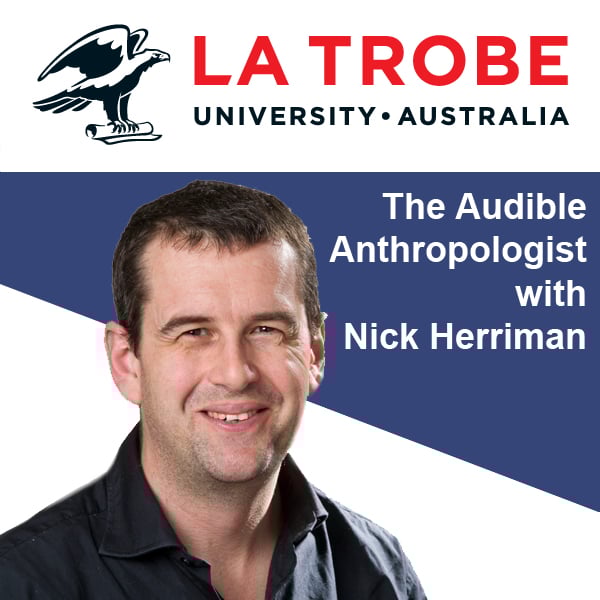
The Audible Anthropologist
by Dr Nicholas Herriman
Anthropologists study human culture and society. They ask “what it is to be human?”. Anthropologists answer this question by analysing diverse societies to find out what all humans have in common. To undertake this study, anthropologists have a ‘kit’ full of conceptual tools. Join the Audible Anthropologist (aka La Trobe University’s Nicholas Herriman) as we describe some of these tools and put them to use.
Episodes
-
Life and Death
Some of the West biggest moral disputes, such as abortion, life support, and euthanasia, centre on defining life and death. Anthropology shows us that while the definition of “alive” is culturally specific, one commonality many cultures appear to share is two concepts. Biological life consists in...
-
Mind and Matter
According to a modern world view, things exist which can be measured in terms of weight, length, volume, time, temperature, etc.. A spoon or a stone has all these qualities. We call such things “matter” and we have made “science” the proper study of them. The other kind of thing that exists...
-
Modernity
Some would argue that 'modernity' encapsulates your and my experience of being alive now, in the 21st century. So what is 'modernity'? In this episode, we cover the basics. I divide the modern era into three periods: mercantile (or early modern); modern; and late-modern (or post-modern).…
more -
Nation and Nationalism
Many of us, whether from Macedonia or Malaysia, Mexico or Madagascar, identify strongly with our nation. Implicitly, we understand the nation as a group of citizens whose rights and responsibilities are mediated by state. This idea emerged from France and the US in the late 1700s, replacing the...
-
The Unconscious Mind
The ideas associated with Freud have impacted strongly on anthropology. The main point is that we have an unconscious mind. Further, the experiences of socialisation and especially childhood dominate this. These experiences relate mostly to trauma and unresolved conflict of our infancy. Such...
-
Human Rights
According to 1948 UN declaration all humans have rights to life, liberty and security, law and trial, asylum etc. This created a new kind of right. Formerly, rights used to be through contracts or arrangements. Now you could have rights without this—just by being human. How does an anthropologist...
-
Patron and Client
In parts of Indonesia, a fishing boat owner will provide a large loan to the captain and crew of his boat. Remaining chronically indebted, the captain and crew should never repay the loan; rather they continue to provide the boat owner with a share of each catch. The boat owner gets a reliable...
-
Life Cycle
Life cycle is the process of change and development of a person. These are often marked by rituals (such as “baby shower” and birthday parties) or rites-of-passage (such as a stags’/bucks’ night). The experience of life stages, even the conception of what constitutes a life stage, differ. Thus,...
-
Community and Society
What is the difference between England 1200 and England 1900? Tonnies’ made the most basic distinction in sociology and anthropology; between community (Gemeinschaft) and society (Gesselschaft). Community is based around traditions, mores, kinship and locality, religion, personal bonds; and,...
-
Social Construction
The idea of social construction is scary. It implies you don’t own your own experience—it is determined by society/the system. We can never be fully in charge of defining who we are. For instance, most people define themselves in relation to what it is to be a mother—they have one and they might…
more -
Moral Economy
The concept of "moral economy" describes our perception of how people in our economy should behave. "Riots" in 1700s England, historian EP Thompson explains, were only partly caused by a lack of food. More important for the rioters was that farmers sold their products to ‘scalpers’. These...
-
Structure
“Structure” refers to the way humans organise themselves economically, socially, and politically. It also refers to the way language and thought is organised. Obvious examples of social structures can be found in the organisation of class (upper/middle/lower), gender (male/female), race...
-
History
Although the past is something we often take for granted, in fact the past is understood differently in different cultures. Anthropologists studying history, typically analyse the way a culture generally makes sense of the past. In the Western Desert of Australia, for example, the past is…
more -
Syncretism
When we talk about the spread of world religions, like Christianity or Islam, we tend to assume a one-way process: the world religions simply replace indigenous religions. In fact, the process is often more interesting. Indigenous people often respond to the introduction of a world religion by...
-
Gender
Notions of gender are culturally specific. Until recently, at least, Western societies tended to define sexuality (ie. homo-, bi-, and hetero-sexuals) in terms of sexual orientation or attraction. In Western understandings of rape, women’s genitalia and sexuality were frequently understood as...
-
Culture
Of all the living organisms in the world, plant and animal, humans start life least equipped. We have almost no instincts for survival, such that most of what we know and do, we need to learn. That stuff which we learn and share is culture. Most of it we also take for granted. And that's where...
-
Rationality - What it is to be Modern
What is rationality and why is it important? According to Weber, the most rational actions are scientific ways of achieving scientific ends. You and I act according to scientific means and ends, and this defines us as modern. As such, our guiding principles for action are general, universal and...
-
Commodity, Use and Sentimental Value
Commodity value is the most beautiful and metaphysical product of the capitalist market and our imagination. Few things could be more supernatural than this value; it makes a pound of gold appear ‘naturally’ more valuable than a pound of steel. And the day gold stops appearing naturally more...
-
The Symbols of Christmas, Part 2
What is the hold that Christmas has on so many people? Maybe we all share an unconscious symbol of two births—spirit and body. Perhaps the nativity and passion story follows a set of universal structures. Or, do the symbols provide us with a model of the world and for how to behave? In this...
-
The Symbols of Christmas, Part 1
I Googled “Christmas” plus “time of reflection” and got literally hundreds of direct hits. We all know the internet can’t be wrong, so I guess for many of us, Christmas is a time of reflection; reflection, I would add, about what is most important in our lives. Anthropologists are particularly...
-
Reciprocity - When a Gift Isn't a Gift
We often take the way we live for granted. Living in a home with our family and working for a salary can seem like the normal way to do things. Anthropology teaches us that this arrangement is the exception, rather than the rule. In fact this ‘mode of adaptation’, as we call it, is a recent...
-
Modes of Adaptation
We often take the way we live for granted. Living in a home with our family and working for a salary can seem like the normal way to do things. Anthropology teaches us that this arrangement is the exception, rather than the rule. In fact this ‘mode of adaptation’, as we call it, is a recent...
-
Rites of Passage
Rites of passages are a form of ritual: they are a ritual process which initiate a person into a new position in society, such as “married”, “adult”, “club member” etc.. Involving pain, fear and, humiliation, rites of passage are often intentionally brutal. Profound anthropological analysis shows...
-
Ritual
What is difference between drinking to a toast (say, to the bride’s health at a wedding) and drinking a Coke in McDonald’s? If you deliberately and openly do not drink to the bride’s health, you are effectively saying “I do not wish the bride a long and healthy life”. It’s possible, but extremely...
-
Magic
Belief and practices associated with “magic” conjure up, for some people, images of backward tribal peoples or kooky contemporary eccentrics. For anthropologists, magic is neither. It is a feature of almost all societies, it flourishes among the educated and wealthy, and rather than dying out, it...
-
What is Anthropology?
Anthropology is the study of human culture and society. It asks what it is to be human? Socio-Cultural Anthropology, the approach of this lecture series, studies different contemporary societies to answer this question. Anthropologists have a ‘kit’ full of conceptual tools they bring to this…
more
We're indexing this podcast's transcripts for the first time — this can take a minute or two. We'll show results as soon as they're ready.
No matches for "" in this podcast's transcripts.
No topics indexed yet for this podcast.
Loading reviews...
ABOUT THIS SHOW
Anthropologists study human culture and society. They ask “what it is to be human?”. Anthropologists answer this question by analysing diverse societies to find out what all humans have in common. To undertake this study, anthropologists have a ‘kit’ full of conceptual tools. Join the Audible Anthropologist (aka La Trobe University’s Nicholas Herriman) as we describe some of these tools and put them to use.
HOSTED BY
Dr Nicholas Herriman
CATEGORIES
Loading similar podcasts...
Frequently Asked Questions
How many episodes does The Audible Anthropologist have?
The Audible Anthropologist currently has 26 episodes available on PodParley. New episodes are automatically indexed when they're published to the podcast feed.
What is The Audible Anthropologist about?
Anthropologists study human culture and society. They ask “what it is to be human?”. Anthropologists answer this question by analysing diverse societies to find out what all humans have in common. To undertake this study, anthropologists have a ‘kit’ full of conceptual tools. Join the Audible...
How often does The Audible Anthropologist release new episodes?
The Audible Anthropologist has 26 episodes. Check the episode list to see recent publication dates and frequency.
Where can I listen to The Audible Anthropologist?
You can listen to The Audible Anthropologist on PodParley by clicking any episode. We provide an embedded audio player for direct listening, and you can also subscribe via your preferred podcast app using the RSS feed.
Who hosts The Audible Anthropologist?
The Audible Anthropologist is created and hosted by Dr Nicholas Herriman.
URL copied to clipboard!