
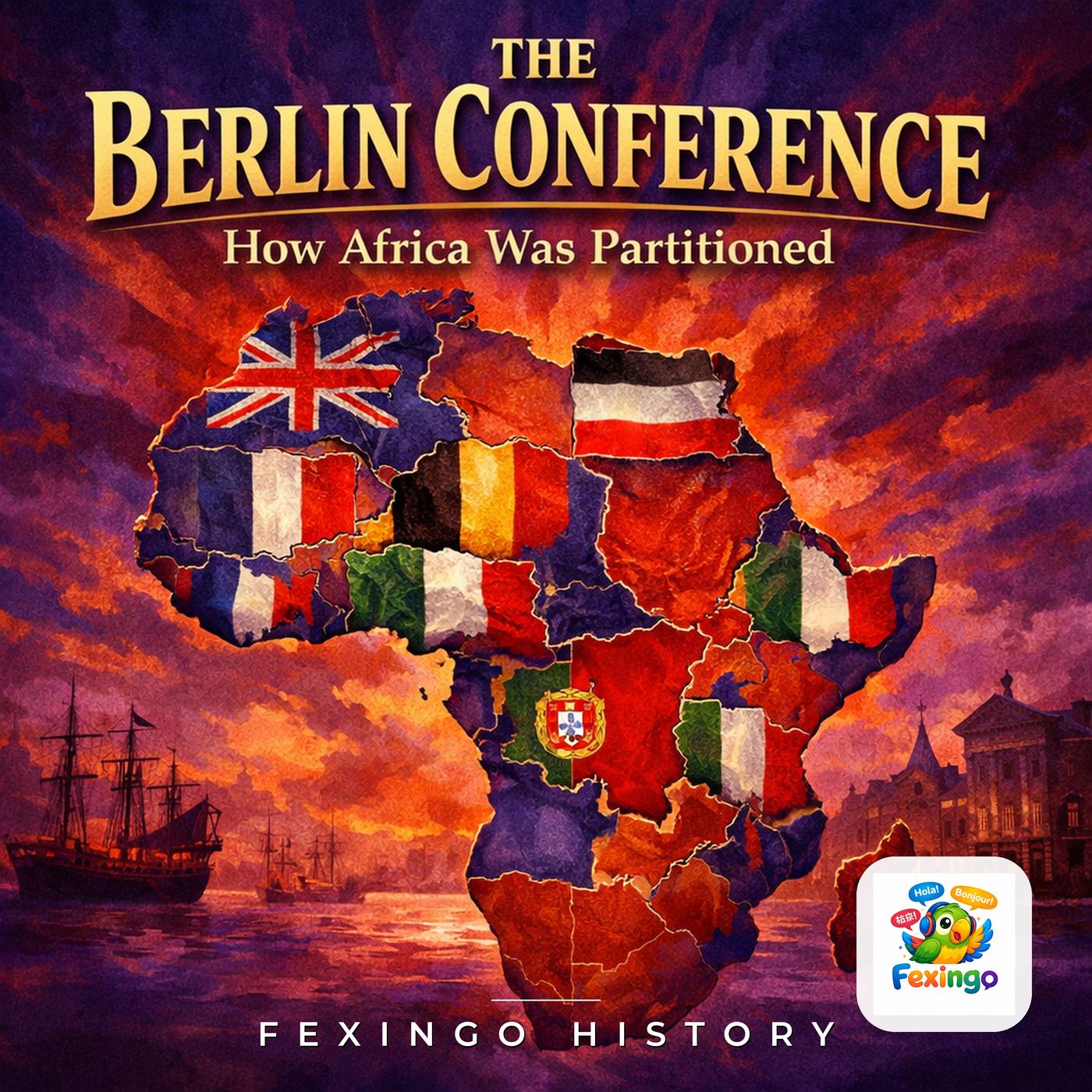
PODCAST · history
The Berlin Conference: How Africa Was Partitioned — Fexingo History
by Fexingo
In 1884-85, European powers convened in Berlin to carve up Africa without a single African present. This show examines the Berlin Conference as the catalyst for the Scramble for Africa — a brutal division that redrew the continent's political map, imposed colonial rule, and set the stage for a century of exploitation, resistance, and enduring trauma. Lucas and Luna guide listeners through the conference's key figures like Otto von Bismarck and King Leopold II of Belgium, whose personal ambitions turned the Congo into a private horror. They explore the 'General Act' that established 'effective occupation' as the legal pretext for colonization, the arbitrary borders that still fuel conflicts today, and the resistance leaders such as Samori Ture and Menelik II who fought back. The show also delves into the economic drivers — rubber, ivory, gold, and diamonds — and the ideological justifications of 'civilizing mission' and Social Darwinism. Each episode peels back a layer of this pivotal m
-
34
King Leopold's Ghost: The Congo Reform Movement and E.D. Morel
In this episode of The Berlin Conference: How Africa Was Partitioned, hosts Lucas and Luna explore the global humanitarian movement that rose up in response to King Leopold II's atrocities in the Congo Free State. They focus on the unlikely figure of E.D. Morel, a former shipping clerk who became the whistleblower that exposed the brutal rubber and ivory regime. The conversation covers the role of the Force Publique, the chicotte whip, the system of forced labor and hostage-taking, and the alliance Morel formed with Roger Casement and the British government. They discuss the Congo Reform Association, the 1908 transfer of the Congo to Belgian rule, and the long shadow these events cast on modern human rights advocacy. This episode also touches on the Berlin Conference's principle of 'effective occupation' and how Leopold exploited it to create a personal fiefdom. A nuanced look at one of history's first great humanitarian campaigns. #CongoFreeState #KingLeopoldII #EDMorel #CongoReformAssociation #RogerCasement #ForcePublique #Chicotte #RubberHorror #BerlinConference #ScrambleForAfrica #BelgianCongo #HumanRights #HannahArendt #JosephConrad #HeartOfDarkness #19thCentury #History #FexingoHistory Keep every episode free: buymeacoffee.com/fexingo
-
33
The Berlin Conference and the Rise of Ethiopian Empire under Menelik II
In this episode of The Berlin Conference: How Africa Was Partitioned, Lucas and Luna explore how Ethiopia under Emperor Menelik II became the only African nation to successfully resist European colonization during the Scramble for Africa. They discuss Menelik's shrewd diplomacy, his massive military modernization using imported firearms, the pivotal Battle of Adwa in 1896 where Ethiopian forces decisively defeated Italy, and the subsequent Treaty of Addis Ababa that secured Ethiopian sovereignty. The episode also touches on Menelik's expansionist policies, the role of Russian and French support, and the lasting legacy of Adwa as a symbol of African resistance. This fresh angle covers a major topic not yet addressed in previous episodes, focusing on a key African victory that reshaped colonial borders. #Ethiopia #MenelikII #BattleOfAdwa #ScrambleForAfrica #ItalianColonialism #AddisAbaba #EmperorMenelik #AfricanResistance #19thCentury #ColonialHistory #TreatyOfWichale #RasMakonnen #TaytuBetul #OresteBaratieri #EuropeanImperialism #AfricanHistory #History #FexingoHistory Keep every episode free: buymeacoffee.com/fexingo
-
32
The Berlin Conference and the Herero-German War of 1904
In this episode, Lucas and Luna explore the Herero-German War of 1904 in German South West Africa, a brutal conflict that foreshadowed 20th-century atrocities. They discuss the roots of the war in land dispossession and cattle theft, the Battle of Waterberg, General Lothar von Trotha's extermination order, and the devastating retreat into the Omaheke desert. The episode also covers the Herero's skilled marksmanship, the role of the Schutztruppe, and the post-war concentration camps on Shark Island. This is a story of colonial violence, broken treaties, and resilience that remains a painful chapter in Namibian and German history. #Herero #GermanSouthWestAfrica #LotharVonTrotha #BattleOfWaterberg #OmahekeDesert #SharkIsland #Schutztruppe #SamuelMaharero #Nama #HendrikWitbooi #Genocide #Colonialism #History #FexingoHistory #BerlinConference #ScrambleForAfrica #Namibia #1904 Keep every episode free: buymeacoffee.com/fexingo
-
31
King Leopold's Rubber Terror: The Congo Free State Atrocities
In this episode, Lucas and Luna delve into the brutal regime of King Leopold II of Belgium in the Congo Free State. They explore the forced labor system for rubber extraction, the violent methods of the Force Publique, and the role of figures like Léon Rom. The discussion covers the chicotte whip, hostage-taking, and the international outcry led by E.D. Morel and Roger Casement. The episode also touches on the economic drivers behind the atrocities and the legacy of Leopold's rule in the Congo. #CongoFreeState #KingLeopoldII #RubberTerror #ForcePublique #LéonRom #Chicotte #EDMorel #RogerCasement #BerlinConference #ScrambleForAfrica #BelgianColonialism #Atrocities #HumanRights #ColonialHistory #19thCentury #Africa #History #FexingoHistory Keep every episode free: buymeacoffee.com/fexingo
-
30
The Berlin Conference and the Bombardment of Algiers
In this episode, Lucas and Luna explore the 1816 Bombardment of Algiers by a combined British and Dutch fleet under Lord Exmouth. They discuss the context of Barbary corsairs and their state-sponsored piracy and enslavement of Europeans, the failure of earlier treaties and a previous bombardment in 1815, and the brutal efficiency of the 1816 attack. The episode covers the Dey of Algiers, Omar Agha, his refusal to release Christian slaves, and the aftermath where the Dey was forced to abolish slavery of Europeans and free over three thousand captives. The conversation also touches on the Bight of Bombardment, the sheer scale of the naval assault, and the long-term decline of the Barbary states. #BarbaryCorsairs #BombardmentOfAlgiers #LordExmouth #DeyOmarAgha #RoyalNavy #Slavery #Piracy #MediterraneanHistory #1816 #Algiers #BritishHistory #DutchNavy #NavalWarfare #History #FexingoHistory #NorthAfricanHistory #OttomanEmpire #ChristianSlaves Keep every episode free: buymeacoffee.com/fexingo
-
29
The Bombali Bombali Incident and the Limits of Effective Occupation
In this episode, we revisit the Bombali Bombali incident—a pivotal moment in the partition of West Africa that exposes the fiction of ‘effective occupation.’ We follow Almamy Sullimani, a Limba ruler who defied French and British claims to his land between Sierra Leone and Guinea. By mobilizing his people and leveraging the ambiguous borders drawn at Berlin, Sullimani forced European powers to negotiate rather than conquer. We explore the incident’s details: the Bombali Bombali plain, the Limba’s decentralized political structure, and the diplomatic showdowns in Freetown and Conakry. The story reveals how African agency shaped colonial boundaries, even as the Berlin Conference’s paper partition ignored local realities. We also reflect on how the Bombali Bombali incident prefigured later resistances and border disputes in sub-Saharan Africa. Join Lucas and Luna for a look at one man’s stand against the scramble for Africa. #BombaliBombali #AlmamySullimani #Limba #EffectiveOccupation #BerlinConference #ScrambleForAfrica #SierraLeone #Guinea #WestAfrica #ColonialResistance #AfricanAgency #BorderDisputes #19thCentury #1880s #Colonialism #History #FexingoHistory #PartitionOfAfrica #KingLeopold #OttoVonBismarck Keep every episode free: buymeacoffee.com/fexingo
-
28
The Berlin Conference's Paper Partition of West Africa
This episode explores how the Berlin Conference of 1884–85 carved up West Africa on paper long before European boots touched the ground. Focusing on the Anglo-French rivalry along the Gold Coast and the Niger River, Lucas and Luna examine the treaties, boundary commissions, and diplomatic maneuvers that created artificial borders like the Franco-British Convention of 1889. They discuss the role of African signatories, the use of geographical features as borders, and the lasting impact on ethnic groups like the Ewe and the Mande. The episode highlights the clash between European cartographic ambitions and African political realities, including the confrontation at Say on the Niger. #BerlinConference #WestAfrica #GoldCoast #NigerRiver #AngloFrenchRivalry #ScrambleForAfrica #PartitionOfAfrica #FrancoBritishConvention #ArtificialBorders #EwePeople #MandePeople #SayNiger #BoundaryCommissions #ColonialCartography #EffectiveOccupation #Imperialism #History #FexingoHistory #Colonialism #KingLeopold Keep every episode free: buymeacoffee.com/fexingo
-
27
The Bombali Bombali Incident: Almamy Sullimani's Defiance
In the aftermath of the Berlin Conference, European powers rushed to claim African territory through 'effective occupation.' But one man, Almamy Sullimani of the Limba people in what is now Sierra Leone, challenged this system head-on. In 1890, he wrote a letter to the German and British authorities, asserting his sovereignty over the Bombali Bombali region and refusing to recognize any European claims. This episode dives into the details of the Bombali Bombali incident, exploring how Sullimani used diplomacy, local alliances, and a deep understanding of European legal language to resist colonization. We examine the British response, the role of the Limba and neighboring Temne and Loko peoples, and how this small-scale defiance fit into the larger pattern of African resistance after the Berlin Conference. Discover how one man's stand became a symbol of resistance and a rare case where African legal arguments were taken seriously by European powers. #BombaliBombali #AlmamySullimani #Limba #SierraLeone #BerlinConference #EffectiveOccupation #AfricanResistance #ColonialHistory #19thCentury #Diplomacy #Sovereignty #BritishEmpire #GermanEmpire #Temne #Loko #Kambia #Freetown #History #ScrambleForAfrica #Colonialism Keep every episode free: buymeacoffee.com/fexingo
-
26
The Bombali Bombali Incident: How One Man Defied the Berlin Conference
In this episode, Lucas and Luna explore the Bombali Bombali Incident, a little-known but revealing confrontation at the border of Sierra Leone and French Guinea (now Guinea) in the 1890s. They focus on Almamy Sullimani, a Limba ruler who refused to accept the artificial boundaries drawn at the Berlin Conference. Sullimani's armed resistance against British and French colonial forces, his use of diplomacy and warfare, and his ultimate exile to Sierra Leone are discussed. The episode uses Sullimani's story to examine the personal and local impacts of the Scramble for Africa, highlighting how individuals navigated imposed borders and challenged European claims of 'effective occupation.' The conversation also touches on the Bombali region's geography, the Limba people's social structure, and the legacy of Sullimani's defiance in anti-colonial movements. #BombaliBombali #AlmamySullimani #Limba #SierraLeone #Guinea #BerlinConference #ScrambleForAfrica #EffectiveOccupation #Resistance #Colonialism #Bombali #Kambia #Conakry #Freetown #19thCentury #AfricanHistory #History #FexingoHistory #KingLeopold #OttoVonBismarck Keep every episode free: buymeacoffee.com/fexingo
-
25
Maji Maji: The Rebellion That Shook German East Africa
In 1905, a mystical water ritual ignited the largest rebellion against German colonial rule in East Africa. The Maji Maji uprising swept across what is now Tanzania, uniting over a dozen ethnic groups from the Matumbi Hills to the banks of the Rufiji River. This episode follows the rebellion from its spark with the prophet Kinjeketile Ngwale, who promised his followers that magic water—'maji'—would turn German bullets into water. We trace the rebels' initial successes, the brutal German counterattack led by Governor Gustav Adolf von Götzen, and the scorched-earth tactics that led to a devastating famine. By the rebellion's end in 1907, an estimated 200,000 to 300,000 Africans had died, mostly from starvation. We also examine the rebellion's long shadow: how it reshaped German colonial policy, the role of African collaboration, and why the uprising remains a powerful symbol of resistance in modern Tanzania. Along the way, we cover key figures like the Yao leader Machemba, the Ngoni chief Chabruma, and the German commander Kurt von Schleinitz. #MajiMaji #KinjeketileNgwale #GermanEastAfrica #GustavAdolfvonGTzen #Rufiji #Matumbi #Ngoni #Yao #Machemba #Chabruma #ScorchedEarth #Famine #Resistance #Colonialism #Tanzania #History #FexingoHistory #AfricanHistory #BerlinConference #ScrambleForAfrica Keep every episode free: buymeacoffee.com/fexingo
-
24
The Berlin Conference: The Bombali Bombali Incident Revisited
In this episode, Lucas and Luna explore the Bombali Bombali incident, a lesser-known but revealing moment in the partition of West Africa. They delve into the conflict between the Limba chiefdom of Bombali Bombali and the British colonial authorities in Sierra Leone, around 1889. The discussion covers the Limba resistance led by Almamy Sullimani, the British strategy of 'effective occupation', and the broader context of the Berlin Conference's impact on local African polities. Lucas explains how the incident exemplifies the clash between European imperial claims and existing African sovereignty, highlighting the Limba's diplomatic and military efforts to maintain independence. The episode also touches on the legacy of such small-scale resistances in shaping colonial borders. #BombaliBombali #Limba #AlmamySullimani #SierraLeone #WestAfrica #BerlinConference #EffectiveOccupation #ColonialResistance #Freetown #Kambia #Conakry #Guinea #BritishEmpire #Imperialism #History #FexingoHistory #Podcast #ScrambleForAfrica #Colonialism #KingLeopold Keep every episode free: buymeacoffee.com/fexingo
-
23
The Berlin Conference: The Forgotten Treaty of Algeciras
In 1906, a crisis in Morocco brought Europe to the brink of war, testing the very principles set by the Berlin Conference twenty years earlier. Lucas and Luna explore the First Moroccan Crisis and the Algeciras Conference, where Germany and France clashed over influence in North Africa. They discuss Sultan Abdelaziz, the Kaiser's provocative visit to Tangier, the role of Britain and the Entente Cordiale, and how a single diplomatic standoff reshaped colonial politics—paving the way for World War I. Learn about the Act of Algeciras, the policing of Moroccan ports, and the fate of the sultanate. A story of brinkmanship, treaties, and the fragile balance of power. #Morocco #AlgecirasConference #FirstMoroccanCrisis #SultanAbdelaziz #KaiserWilhelmII #Tangier #EntenteCordiale #TheodorRoosevelt #BerlinConference #ScrambleForAfrica #Diplomacy #WorldWarIOrigins #Colonialism #NorthAfrica #France #Germany #History #FexingoHistory #KingLeopold #OttoVonBismarck Keep every episode free: buymeacoffee.com/fexingo
-
22
The Berlin Conference: The Bombali Bombali Incident
In this episode of The Berlin Conference: How Africa Was Partitioned, we delve into the fascinating story of the Bombali Bombali incident—a forgotten border dispute that almost sparked a war between Britain and France in West Africa. Set in the early 1890s, the episode follows the enigmatic figure of Bombali Bombali, a local leader in the Limba country who played the European powers against each other, exploiting the vague borders drawn at Berlin. We explore the chaos of the Scramble, as French and British officials, guided by the principle of 'effective occupation,' scrambled to claim territory that neither fully controlled. Amidst the diplomatic maneuvering, Bombali Bombali's defiance and clever diplomacy forced the colonial powers to the negotiating table, ultimately shaping the modern borders of Sierra Leone and Guinea. This episode reveals how local actors, not just European statesmen, influenced the partition of Africa, and how the Berlin Conference's legacy of arbitrary borders continues to affect the region today. #BombaliBombali #Limba #SierraLeone #Guinea #BerlinConference #ScrambleForAfrica #EffectiveOccupation #ColonialBorders #WestAfrica #BritishEmpire #FrenchColonial #FexingoHistory #History #ColonialHistory #AfricanHistory #19thCentury #BorderDispute #Diplomacy #Colonialism #KingLeopold Keep every episode free: buymeacoffee.com/fexingo
-
21
The Berlin Conference: The Partition of the Swahili Coast
Episode 15 of The Berlin Conference series zooms in on the Swahili Coast, a region that was not officially partitioned at Berlin but was profoundly reshaped by its aftermath. Hosts Lucas and Luna explore how Zanzibar lost its mainland holdings to Germany and Britain, the decline of the Sultanate of Zanzibar, and the imposition of colonial borders that split the Swahili people between German East Africa and British East Africa. They discuss the key figures involved, including Sultan Barghash bin Said, and the Heligoland-Zanzibar Treaty of 1890, which ceded Heligoland to Germany and finalized British control over Zanzibar. The episode also examines the economic shifts from clove and ivory trades to colonial extraction, and the cultural legacy of the Swahili language and city-states like Kilwa and Mombasa. Lucas and Luna trace how the Berlin Conference's principles of 'effective occupation' played out on the ground, often ignoring pre-existing trade networks and cultural ties. The conversation highlights the artificiality of colonial borders and their lasting impact on East African geopolitics, including the modern-day tensions between Tanzania and Kenya over maritime boundaries. This is a deep dive into a region often overlooked in the wider narrative of the Scramble for Africa, filled with specifics about treaties, towns, and the people who lived through this transformative period. #SwahiliCoast #Zanzibar #HeligolandZanzibarTreaty #SultanBarghash #GermanEastAfrica #BritishEastAfrica #Kilwa #Mombasa #CloveTrade #IvoryTrade #ScrambleForAfrica #ColonialBorders #EffectiveOccupation #BerlinConference #EastAfrica #History #FexingoHistory #Podcast #Colonialism #KingLeopold Keep every episode free: buymeacoffee.com/fexingo
-
20
The Berlin Conference: The Bombali Bombali Incident
In 1889, a minor skirmish in the Sierra Leone hinterland nearly reshaped West Africa's borders. This episode explores the Bombali Bombali incident: a clash between the British-allied Limba chief Almamy Sullimani and French forces advancing from Guinea. We examine how the Berlin Conference's 'effective occupation' doctrine played out in the remote Bombali region, the role of the Limba people in resisting colonial encroachment, and the diplomatic crisis that followed. Learn about the Bombali Bombali, the 1896 Anglo-French boundary agreement that settled the dispute, and how this forgotten episode influenced the final partition of the Sierra Leone-Guinea border. Featuring details on the Limba social structure, the Kambia district, and the broader context of the Scramble for West Africa. #BombaliBombali #Limba #AlmamySullimani #SierraLeone #Guinea #BerlinConference #ScrambleForAfrica #EffectiveOccupation #AngloFrenchBoundary #Kambia #WestAfrica #ColonialHistory #19thCentury #FexingoHistory #History #Podcast #Africa #Imperialism #Colonialism #KingLeopold Keep every episode free: buymeacoffee.com/fexingo
-
19
The Berlin Conference: The Mfecane and the Making of Southern Africa
In this episode, Lucas and Luna explore how the Mfecane—the violent upheaval and state-building period in early 19th-century southern Africa—intersected with the later Berlin Conference and European colonization. They trace the rise of Shaka Zulu and the Zulu Kingdom, the expansion of the Mthethwa and Ndwandwe, and the ripple effects that created refugees like the Kololo and the Ndebele. The conversation examines how European powers exploited these disruptions, using the Mfecane to justify land seizures and impose borders that ignored complex African polities. Lucas explains how the British, Boers, and Portuguese carved up the region after Berlin, often pitting African groups against each other. The episode also touches on the controversial historian's debate about the Mfecane's scale and causes, and how modern scholarship reinterprets it. Key figures include Shaka, Dingane, Moshoeshoe, Mzilikazi, and Piet Retief. Specific locations: Zululand, Natal, Lesotho, the Drakensberg, the Limpopo River. This is a fresh angle for listeners familiar with the conference's diplomatic narrative. #Mfecane #ShakaZulu #ZuluKingdom #BerlinConference #SouthernAfrica #Colonialism #Moshoeshoe #Mzilikazi #Ndebele #Lesotho #Natal #Boers #Dingane #Kololo #Limpopo #AfricanHistory #History #FexingoHistory #ScrambleForAfrica #KingLeopold Keep every episode free: buymeacoffee.com/fexingo
-
18
The Berlin Conference: The Falafel Border and the Sykes-Picot Afterlife
In this episode, Lucas and Luna explore how the Berlin Conference's principles of effective occupation and artificial borders continued to shape the Middle East after World War I — focusing on the 1916 Sykes-Picot Agreement and its aftermath. They discuss how European diplomats, like Sir Mark Sykes and François Georges-Picot, drew lines across the Ottoman Empire that ignored ethnic and sectarian realities, creating states like Iraq, Syria, Lebanon, and Jordan. The conversation highlights the continuity between Berlin's partition of Africa and the post-war division of the Arab world, touching on the 1920 Iraqi revolt, the role of T.E. Lawrence, and the fate of the Kurdish people. Lucas explains how the Mandate system and the 1917 Balfour Declaration set the stage for decades of conflict, and how the Berlin Conference's legacy of arbitrary borders survived into the 20th century and beyond. #SykesPicot #BerlinConference #MiddleEast #WWI #Mandates #Iraq #Syria #Lebanon #Jordan #Palestine #Kurds #BalfourDeclaration #MarkSykes #FrancoisGeorgesPicot #SaudiArabia #Colonialism #History #FexingoHistory #ScrambleForAfrica #KingLeopold Keep every episode free: buymeacoffee.com/fexingo
-
17
The Berlin Conference: The Unseen Borders of the Sahara
In this episode, Lucas and Luna explore how the Berlin Conference of 1884-1885 carved up the Sahara Desert, drawing lines through one of the most inhospitable and sparsely populated regions on Earth. They examine the role of the Central Sudan, the Tuareg confederations, and the Sanusiyya Sufi order, and how the arbitrary borders created by European powers — such as the boundary between French Algeria and Spanish Río de Oro — ignored centuries-old trade routes and tribal territories. The discussion covers the impact on the trans-Saharan slave trade, the rise of the Sanusiyya as a resistance movement, and the long-term consequences for modern states like Libya, Chad, Niger, and Mali. Listeners will learn about specific figures like al-Mahdi al-Sanusi, the Oasis of Kufra, and the Battle of Bir al-Atash, as well as the concept of 'effective occupation' in the context of desert geography. #BerlinConference #Sahara #ScrambleForAfrica #Sanusiyya #Tuareg #TransSaharanTrade #OasisOfKufra #EffectiveOccupation #AlMahdiAlSanusi #CentralSudan #SpanishRODeOro #FrenchAlgeria #ColonialBorders #BirAlAtash #LibyaHistory #ChadHistory #History #FexingoHistory #Colonialism #KingLeopold Keep every episode free: buymeacoffee.com/fexingo
-
16
Mahafaly and the Madagascar Border
This episode explores the little-known story of the Mahafaly people of southwestern Madagascar and how the Berlin Conference's partition of Africa nearly swallowed them whole. We follow the machinations of French colonial ambitions, the role of Queen Ranavalona III's resistance, and the peculiar legal status of Madagascar as a protectorate that never quite became a colony. Lucas and Luna discuss the Menabe region, the Sakalava kingdoms, and the 1896 French annexation that finally extinguished Malagasy sovereignty. They also touch on the island's unique cultural blend of Austronesian and African traditions, the persistence of local chieftaincies, and the Mahafaly's famed carved aloalo funerary posts. A fresh angle on the scramble for Africa that reveals how continental decisions rippled across the Indian Ocean. #Mahafaly #Madagascar #BerlinConference #ScrambleForAfrica #FrenchColonialism #QueenRanavalonaIII #Sakalava #Menabe #Aloalo #MadagascarHistory #ColonialPartition #Protectorate #1896Annexation #IndianOcean #Austronesian #AfricanHistory #History #FexingoHistory #Colonialism #KingLeopold Keep every episode free: buymeacoffee.com/fexingo
-
15
Wituland: Germany's Forgotten East African Colony
When the Berlin Conference sliced up Africa, one tiny territory on the Swahili coast fell into German hands almost by accident: Wituland, a 1,300-square-kilometer protectorate that lasted just 33 years. This episode traces the unlikely story of how a group of exiled Zanzibari aristocrats, led by the crafty Sultan Ahmad ibn Fumo Bakari, carved out their own mini-state in the Witu region of present-day Kenya — and how Germany used them as a pawn against British imperial ambitions. We explore the sultanate's Bantu elite, the bustling port of Lamu, the infamous slave trade that kept the region alive, and the 1890 Heligoland-Zanzibar Treaty that sealed Wituland's fate. Listeners will encounter the fascinating figure of Clemens Denhardt, the German explorer who brokered the protectorate, and learn how Wituland became a haven for escaped slaves until its bitter annexation by Britain in 1923. This is a story of diplomacy, survival, and the human cost of colonial cartography. #Wituland #GermanEastAfrica #SwahiliCoast #SultanAhmad #ClemensDenhardt #HeligolandZanzibarTreaty #SlaveTrade #Lamu #BerlinConference #Colonialism #BritishEmpire #GermanColonies #EastAfrica #Imperialism #19thCentury #Kenya #Zanzibar #FexingoHistory #ScrambleForAfrica #KingLeopold Keep every episode free: buymeacoffee.com/fexingo
-
14
The Berlin Conference: The Partition's Legal Aftermath
In this episode, Lucas and Luna explore the legal and diplomatic legacy of the Berlin Conference of 1884-1885. They discuss how the General Act established the principle of 'effective occupation', which European powers used to justify colonial claims, and how this legal framework was manipulated by figures like King Leopold II. The conversation covers the origins of international humanitarian law in the conference's Article 6, which aimed to protect African populations but was largely ignored. They also delve into the Congo Free State's legal status as a private colony, the role of the Association Internationale Africaine, and the eventual annexation of the Congo by Belgium in 1908. The episode examines the legal arguments used to partition Africa, the Berlin Act's provisions on free trade in the Congo Basin, and the long-term impact on African sovereignty. Key figures include Leopold II, Bismarck, and the British explorer Henry Morton Stanley. The episode concludes by reflecting on how the conference's legal structures perpetuated colonialism into the 20th century. #BerlinConference #EffectiveOccupation #ColonialLaw #LeopoldII #CongoFreeState #GeneralAct #InternationalHumanitarianLaw #FreeTradeCongo #Bismarck #HenryMortonStanley #1885 #ScrambleForAfrica #Colonialism #LegalHistory #BelgianCongo #AfricanSovereignty #FexingoHistory #History #KingLeopold #OttoVonBismarck Keep every episode free: buymeacoffee.com/fexingo
-
13
The Berlin Conference: King Leopold's Ghost
In this episode, Lucas and Luna continue their exploration of the Berlin Conference's aftermath, focusing on the Congo Free State under King Leopold II. They discuss the brutal rubber regime, the Force Publique's atrocities, and the international outcry led by figures like E.D. Morel and Roger Casement. The episode covers the system of quotas, hostage-taking, and mutilation that characterized Leopold's rule, as well as the Congo Reform Association's campaign that eventually forced Leopold to cede the Congo to Belgium. Listeners will learn about the 'red rubber' system, the role of the 'chicotte' whip, and the legacy of this dark chapter in African history. #BerlinConference #CongoFreeState #KingLeopoldII #RubberTerror #ForcePublique #EDMorel #RogerCasement #CongoReformAssociation #Chicotte #RedRubber #BelgianCongo #Atrocities #19thCentury #Colonialism #Africa #History #FexingoHistory #Imperialism #ScrambleForAfrica #KingLeopold Keep every episode free: buymeacoffee.com/fexingo
-
12
Tippu Tip: The Zanzibari Slave Trader Who Shaped the Congo
In this episode of The Berlin Conference series, Lucas and Luna explore the life and legacy of Tippu Tip, a Zanzibari trader who built a vast commercial empire in the eastern Congo during the 1870s and 1880s. Operating from his base in Kasongo, Tippu Tip controlled ivory and slave caravans between the Great Lakes and the Indian Ocean coast. He collaborated with European explorers like Henry Morton Stanley and later became a governor under King Leopold II's Congo Free State. However, his rule was marked by brutal raids against local communities, including the Songye and Luba peoples, to capture slaves and harvest ivory. The discussion highlights the complexities of African agency during the Scramble, as Tippu Tip both resisted and collaborated with colonial powers. It also examines the Zanzibari slave trade's role in destabilizing the region long before Leopold's atrocities. The episode sheds light on a figure often overlooked in standard Berlin Conference narratives, revealing how internal African dynamics intertwined with European imperialism. #TippuTip #Zanzibar #Congo #SlaveTrade #Ivory #Kasongo #Songye #Luba #HenryMortonStanley #LeopoldII #CongoFreeState #ScrambleForAfrica #EastAfrica #19thCentury #AfricanHistory #Imperialism #History #FexingoHistory #BerlinConference #Colonialism Keep every episode free: buymeacoffee.com/fexingo
-
11
The Berlin Conference: The Congo Free State's Rubber Terror
In this episode, Lucas and Luna delve into the brutal reality of King Leopold II's Congo Free State, a direct outcome of the Berlin Conference. They explore how the demand for rubber fueled a system of forced labor, mutilation, and murder that killed millions. Lucas recounts the role of the Force Publique, the infamous 'chicotte' whip, and the testimony of witnesses like Roger Casement and E.D. Morel. The episode examines the economic machinery of the concession companies, the use of hostage-taking and village destruction, and the international outrage that eventually led to the end of Leopold's personal rule. Figures like the missionary John Harris and the African translator Lusambo are highlighted. The conversation also touches on the legacy of this period in the Democratic Republic of the Congo today, connecting historical exploitation to modern conflicts. #CongoFreeState #KingLeopoldII #RubberTerror #BerlinConference #ForcePublique #Chicotte #RogerCasement #EDMorel #JohnHarris #Lusambo #CongoHistory #Colonialism #19thCentury #Imperialism #BelgianColonies #AfricaHistory #History #FexingoHistory #ScrambleForAfrica #KingLeopold Keep every episode free: buymeacoffee.com/fexingo
-
10
Germany's Bloody War Against the Herero and Nama (1904-1908)
In this episode of The Berlin Conference, Lucas and Luna delve into the brutal colonial war waged by Imperial Germany against the Herero and Nama peoples in German South-West Africa (modern-day Namibia). Drawing on earlier discussions of the conference's legacy, they explore the roots of the conflict, the devastating Battle of Waterberg, General Lothar von Trotha's infamous extermination order, and the systematic violence that scholars now widely recognize as the 20th century's first genocide. The conversation covers key figures like Samuel Maharero and Hendrik Witbooi, the roles of concentration camps and scientific racism, and the long shadow this genocide cast over later German history. It's a sobering, deeply researched look at how the partition of Africa led to direct, catastrophic violence against indigenous populations. #Herero #Nama #Genocide #GermanSouthWestAfrica #Namibia #SamuelMaharero #HendrikWitbooi #LotharVonTrotha #Waterberg #ScrambleForAfrica #Colonialism #WarOfExtermination #ConcentrationCamps #20thCenturyGenocide #ImperialGermany #AfricanHistory #History #FexingoHistory #BerlinConference #KingLeopold Keep every episode free: buymeacoffee.com/fexingo
-
9
Resistance and Revolt: African Responses to the Berlin Conference
In Episode 3 of our Berlin Conference series, we move beyond the European negotiating table to explore the African resistance that followed. Hosts Lucas and Luna dive into the stories of figures like Menelik II of Ethiopia, who famously defeated Italian forces at Adwa in 1896 using artillery and strategy. We discuss the Maji Maji Rebellion in German East Africa, where the Kinjeketile Ngwale led a spiritual uprising against German rule. The episode also covers the Herero and Nama genocide in German South-West Africa, the first genocide of the 20th century, and the clever diplomacy of the Asante Empire in preserving the Golden Stool. From military battles to cultural defiance, this episode examines how African peoples fought back against colonization, often with surprising success. We also touch on the technological and logistical challenges Europeans faced, including malaria and unfamiliar terrain, and how African resistance shaped subsequent colonial policies. #BerlinConference #MenelikII #Adwa #MajiMaji #HereroGenocide #Nama #KinjeketileNgwale #AsanteEmpire #GoldenStool #AfricanResistance #Colonialism #Ethiopia #GermanEastAfrica #GermanSouthWestAfrica #19thCentury #ScrambleForAfrica #Resistance #FexingoHistory #KingLeopold #OttoVonBismarck Keep every episode free: buymeacoffee.com/fexingo
-
8
The Berlin Conference: The Scramble for African Souls
In this episode of Fexingo History, Lucas and Luna move beyond the map-drawing of the Berlin Conference to explore what the partition actually meant for the people of Africa. Instead of focusing on borders, they turn to the Berlin Conference's General Act of 1885—its clauses on free trade, navigation, and most importantly, the principle of 'effective occupation.' How did European powers justify their claims? What happened to African sovereignty? Lucas dives into the story of one kingdom that refused to bow: the Samori Ture's Wassoulou Empire in West Africa. We follow Samori's rise, his military reforms using captured European weapons, and his long war against the French that lasted nearly two decades. This episode also touches on the Berlin Act's article on the suppression of the slave trade—and the hypocrisy behind it. A must-listen for anyone who wants to understand how Europe's carve-up of Africa wasn't just lines on a map, but a lived reality of resistance and resilience. #BerlinConference #ScrambleForAfrica #SamoriTure #WassoulouEmpire #EffectiveOccupation #GeneralAct1885 #Colonialism #AfricanResistance #FrenchColonialEmpire #WestAfrica #SlaveTrade #FreeTrade #CongoRiver #NigerRiver #19thCentury #AfricaHistory #History #FexingoHistory #KingLeopold #OttoVonBismarck Keep every episode free: buymeacoffee.com/fexingo
-
7
The Berlin Conference: How Europe Carved Up Africa
In 1884, a group of European diplomats gathered in Berlin to draw borders on a continent they had barely explored. Over 90 days, they carved Africa into colonies, sparking a scramble that redrew the map forever. Lucas and Luna explore the conference's key players—Otto von Bismarck, King Leopold II of Belgium—and the cynical 'principle of effective occupation' that sparked land grabs across the continent. They unpack the economic drivers: rubber, ivory, gold, and the palm oil that greased industrial Europe's gears. And they ask: can you own a land you've never seen? This episode sets the stage for a series that will trace how those arbitrary lines created lasting trauma—and why the echoes of Berlin still shape Africa today. #BerlinConference #ScrambleForAfrica #OttoVonBismarck #KingLeopoldII #Colonialism #Imperialism #Africa #1884 #1885 #CongoFreeState #PartitionOfAfrica #EuropeanHistory #Rubber #Ivory #Exploration #History #FexingoHistory #Podcast #KingLeopold #GeneralAct Keep every episode free: buymeacoffee.com/fexingo
We're indexing this podcast's transcripts for the first time — this can take a minute or two. We'll show results as soon as they're ready.
No matches for "" in this podcast's transcripts.
No topics indexed yet for this podcast.
Loading reviews...
ABOUT THIS SHOW
In 1884-85, European powers convened in Berlin to carve up Africa without a single African present. This show examines the Berlin Conference as the catalyst for the Scramble for Africa — a brutal division that redrew the continent's political map, imposed colonial rule, and set the stage for a century of exploitation, resistance, and enduring trauma. Lucas and Luna guide listeners through the conference's key figures like Otto von Bismarck and King Leopold II of Belgium, whose personal ambitions turned the Congo into a private horror. They explore the 'General Act' that established 'effective occupation' as the legal pretext for colonization, the arbitrary borders that still fuel conflicts today, and the resistance leaders such as Samori Ture and Menelik II who fought back. The show also delves into the economic drivers — rubber, ivory, gold, and diamonds — and the ideological justifications of 'civilizing mission' and Social Darwinism. Each episode peels back a layer of this pivotal m
HOSTED BY
Fexingo
Loading similar podcasts...
Frequently Asked Questions
How many episodes does The Berlin Conference: How Africa Was Partitioned — Fexingo History have?
The Berlin Conference: How Africa Was Partitioned — Fexingo History currently has 28 episodes available on PodParley. New episodes are automatically indexed when they're published to the podcast feed.
What is The Berlin Conference: How Africa Was Partitioned — Fexingo History about?
In 1884-85, European powers convened in Berlin to carve up Africa without a single African present. This show examines the Berlin Conference as the catalyst for the Scramble for Africa — a brutal division that redrew the continent's political map, imposed colonial rule, and set the stage for a...
How often does The Berlin Conference: How Africa Was Partitioned — Fexingo History release new episodes?
The Berlin Conference: How Africa Was Partitioned — Fexingo History has 28 episodes. Check the episode list to see recent publication dates and frequency.
Where can I listen to The Berlin Conference: How Africa Was Partitioned — Fexingo History?
You can listen to The Berlin Conference: How Africa Was Partitioned — Fexingo History on PodParley by clicking any episode. We provide an embedded audio player for direct listening, and you can also subscribe via your preferred podcast app using the RSS feed.
Who hosts The Berlin Conference: How Africa Was Partitioned — Fexingo History?
The Berlin Conference: How Africa Was Partitioned — Fexingo History is created and hosted by Fexingo.
URL copied to clipboard!