
PODCAST · health
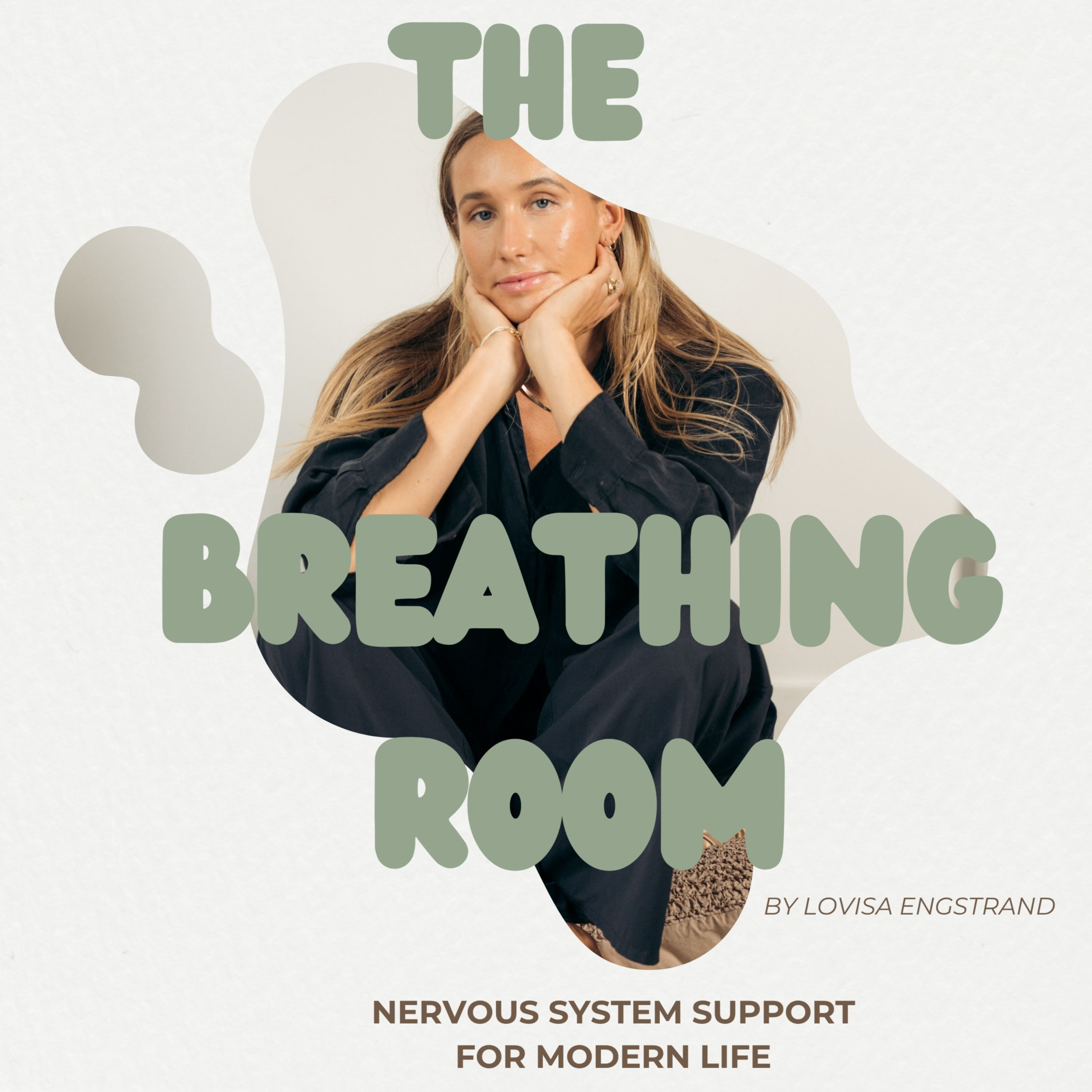
The Breathing Room
by Lovisa Engstrand
The Breathing Room is for high‑functioning women who do “all the right things” and still feel tired, anxious, or disconnected. I’m Lovisa Engstrand - a nervous system and stress specialist, and each episode translates modern science into bit-sized, practical steps that actually work. We name the patterns, explain what’s happening in your body, and teach small, repeatable practices that rebuild safety and capacity. No moralising, no quick-fix hype - just clear education, compassionate truth, ancient wisdom, and usable tools so you can sleep deeper, feel calmer, & feel save in your body.
Episodes
-
Calm Is Not the Goal — What the Wellness Industry Got Wrong About Your Nervous System
You've done the meditation. The breathwork. The journalling. And you're still getting triggered — still reactive, still emotional, still not arriving at the unruffled calm you were promised. Here's what nobody told you: that calm you've been chasing might not be regulation at all. It might be…
more -
Your Brain Is Addicted to Your Problems — And How I Manifested My Husband
You know that feeling of being stuck — not failing, not falling apart, just... not quite arriving? Like the version of your life you can almost picture keeps not becoming real? That's not a motivation problem. It's not a mindset problem. It's a brain chemistry problem. And once you understand...
-
Stress Isn't the Problem. Your Response to It Is. — The Window of Tolerance Explained
You've tried to stress less. You've cut back, slowed down, said no more often. And you're still wired, still exhausted, still one email away from unravelling. Here's what nobody told you: the goal was never to have less stress. The goal is to get better at coming back from it. And those two…
more -
What Your Brain Is Looking For (And How to Change It) — The Neuroscience of Mindset, RAS, and Why Breathwork Is the Missing Piece
You've tried thinking more positively. Maybe you've journalled, reframed, done the affirmations. And it works — for about twenty minutes. Then the same thoughts come back, and you're back where you started, wondering why mindset work never quite sticks for you. It's not because you're too…
more -
Beyond the Business: I Don't Know Where We'll Be in Two Weeks. I'm Not Anxious About It. Here's Why.
EPISODE QUOTE EARTH TO GRANDMA!!!! HELLOO!! OFC I WANT TO BUY FURNITURE! IN THIS EPISODE Everyone keeps asking what the plan is. The honest answer is: there isn't one. We just moved to Seattle — temporarily, we think. Joel's second surgery might be March, might be later. I'm applying for a work...
-
GUIDED PRACTICE: The Breathing Technique That Trains Your Nervous System to Stay Calm Under Pressure
Most people think breath holding is for free divers and extreme athletes. This six-minute practice is the opposite of that. It is quiet, accessible, and one of the most underused stress regulation tools available — because it trains the exact same neural pathway you need when anxiety arrives in...
-
Your Evening Routine Starts in the Morning - Episode 3 of 5: Sleep - Regulate & Restore Series
My husband Joel got diagnosed with sleep apnea. He had a solution, technically, to the thing that was interrupting his breathing at night. He still woke up at 3am. He still had almost no deep sleep on his tracker. He still moved through his days with the low-grade heaviness of someone who has not...
-
A 15-Minute Breathwork & Yoga Nidra Class for Your Nervous System — Lie Down, Close Your Eyes, and Actually Do This One
This week's episode is a little different. This is not one to listen to on your commute or while folding laundry. This one requires you to lie down, close your eyes, and give yourself 15 minutes of uninterrupted time. What you get at the end of it is a nervous system that has genuinely shifted.…
more -
GUIDED PRACTICE: A 45-Minute Breathwork Class for Your Nervous System — Lie Down, Close Your Eyes, and Actually Do This One
This week's episode is a little different. This is not one to listen to on your commute or while folding laundry. This one requires you to lie down, close your eyes, and give yourself forty-five minutes of uninterrupted time. What you get at the end of it is a nervous system that has genuinely...
-
He Ran Five Days a Week, Never Trained His Legs, and Wondered Why His Knees Hurt and Nothing Changed. Here Is What Actually Fixed It.
Why Running Five Days a Week and Never Lifting Made Everything Worse My husband Joel had a very firm belief that if he trained his legs in the gym, his running would suffer. He also had tight hips, unhappy knees, and a body swimming in cortisol — because he was using high-intensity cardio as his...
-
He Thought He Ate Well. He Was Eating Sweetgreen Salads With No Protein and Calling a Philly Cheesesteak a Home-Cooked Meal. This Is What Changed.
You Cannot Nourish a Body You Don't Understand My husband Joel, before we started working on his health together, genuinely believed he ate well. He was eating salads. Drinking protein shakes. Avoiding fried food. By every conventional standard, he was doing the right things. He also had almost…
more -
Why You Can Be Completely Exhausted and Still Not Be Able to Sleep — And What to Do About It
You are tired in a way that makes you fantasise about a week in bed. And then you actually lie down and your mind will not stop. You cannot nap even when you are desperate for one. You either lie awake for an hour waiting for sleep to arrive, or you fall asleep and wake at 3am — wide awake, heart...
-
The Seven Things That Actually Determine How Long You Live (None of Them Are a Supplement)
There is a pill that improves your muscle mass, regulates your blood sugar, protects your independence into your eighties, and lowers your risk of nearly every major chronic disease. It is called resistance training. And most of us are not taking it consistently. This episode is about longevity —...
-
I Spent My First Year of Marriage Sniffing My Husband's Surgical Stitches With My Mother-In-Law. Here Is What It Taught Me About Love.
It is a Tuesday morning. I am crouched over my husband's crotch, reading glasses on, my mother-in-law leaning over my shoulder for a better look. I am sniffing his surgical wound to check for infection. She is comparing today's photographs to yesterday's with the focused attention of someone at a...
-
How to Plan a Wedding Without Burning Out — And Actually Remember the Day
Three days. Two countries' worth of guests. Fourteen best friends in the ceremony. A live band, a DJ, arm wrestling at the cocktail hour, Swedish lawn games, five-plus hours of dancing. By most standards, that is a lot of wedding. It was also one of the most regulated, intentional, genuinely...
-
You Know Exactly Why You Are the Way You Are. Your Body Didn't Get the Memo.
She has been in therapy for eight years. She can map her attachment patterns with precision. She understands, in impressive detail, exactly why she does what she does. She also cried in her car on the way home from work three times last week. If you have done the work, have the insights…
more -
Bloated, Exhausted, and Snapping at Everyone — This Is What Nervous System Dysregulation Actually Looks Like
You have done the fiber. You have cut the dairy. You made the lentil stew your mother suggested and woke up the next morning looking seven months pregnant despite eating nothing suspicious. You are also exhausted in a way sleep is not touching, and you snapped at someone yesterday over something...
-
Why You Fall For The People You Do (and How to Change It) - Attachment Styles, Relationships & Your Nervous System
*Bonus Episode* Do you get intense with closeness, or you pull away and feel guilty later - and you keep asking, “Why am I like this?” Discover how attachment styles are nervous system adaptations. Learn why you get reactive in relationships and 4 practical steps to begin earning security. If…
more -
If You Think You're Enlightened, Go Home for a Week (What My First Four Days Back in My Childhood Bedroom Taught Me About My Nervous System)
She has navigated visas, long-distance relationships, international moves, and a complex two-stage surgery on her husband's manhood. She is sitting at the kitchen table feeling fourteen years old and gets reactive because her mother asked if she wants hard-boiled eggs. This is episode eight. And...
-
You Are Still Showing Up. You Have Also Quietly Stopped Feeling Anything. This Is High-Functioning Burnout.
You made it to the gym. You answered the emails. You remembered the birthday, sent the flowers, and showed up to everything you said you would show up to. You are also running on empty in a way you cannot explain, cannot name, and cannot seem to fix — no matter how many weekends away you take or...
-
She Was Doing Everything Right and Still Couldn't Get Out of the Car. Here Is What Nobody Had Told Her Yet.
She had the training schedule, the supplements, the early bedtime, and the carefully curated diet. On paper, she was the picture of someone who had their health together. She was also sitting in a supermarket car park for eleven minutes, watching the clock, unable to make herself get out of the…
more -
Why Stress Is Causing Your Bloating - And Why Fiber Alone Will Never Fix It
You have tried the fiber. You have cut out dairy, then gluten, then eggs, then anything remotely fun. You have the supplements, you have the elimination diet, you possibly have a de-bloat pill from some actress's Instagram that did absolutely nothing. And you are still bloated. If you are…
more -
You Don't Have Bad Taste In Men. It's Biology: What Attachment Theory Actually Explains About Your Love Life
He has a different name this time. Different haircut, different city, different elaborate reason why he's emotionally unavailable right now. And yet. Somehow. The same man. If you could pick him out of a lineup blindfolded - if you're honest, you basically have - this episode is for you WHAT THIS...
-
You Will Not Believe How Magical Your Life Is: My Husband Joel on Trauma, Survival Mode, and Coming Back to Himself
For most of his twenties, my husband Joel didn't think he'd live a long life. Not because he planned anything - but because in his mind, there was simply no future after the surgery he'd been dreading since childhood. So he stopped looking forward. And he found other ways to survive. This episode...
-
Why You’re Doing “Everything Right” and Still Feel Exhausted - The Nervous System Explanation (With Causes & Fixes)
You do the right habits and the tiredness stays. This episode explains how nervous system dysregulation drives exhaustion, poor sleep, gut issues and low libido - and what to try first. You’ve tried the usual fixes - earlier bed, less alcohol, more movement - and nothing seems to stick. That…
more -
Why You Feel the Way You Do (And Why You’re Not Broken) - Stress, Safety & the Nervous System
You’re exhausted one week, wired the next, and sometimes you cry at a small thing and wonder - "why am I like this?" If that sentence lands in your chest, this episode was made for you. Your nervous system is the missing piece that finally makes those messy symptoms make sense. The Breathing Room...
We're indexing this podcast's transcripts for the first time — this can take a minute or two. We'll show results as soon as they're ready.
No matches for "" in this podcast's transcripts.
No topics indexed yet for this podcast.
Loading reviews...
ABOUT THIS SHOW
The Breathing Room is for high‑functioning women who do “all the right things” and still feel tired, anxious, or disconnected. I’m Lovisa Engstrand - a nervous system and stress specialist, and each episode translates modern science into bit-sized, practical steps that actually work. We name the patterns, explain what’s happening in your body, and teach small, repeatable practices that rebuild safety and capacity. No moralising, no quick-fix hype - just clear education, compassionate truth, ancient wisdom, and usable tools so you can sleep deeper, feel calmer, & feel save in your body.
HOSTED BY
Lovisa Engstrand
Loading similar podcasts...
Frequently Asked Questions
How many episodes does The Breathing Room have?
The Breathing Room currently has 26 episodes available on PodParley. New episodes are automatically indexed when they're published to the podcast feed.
What is The Breathing Room about?
The Breathing Room is for high‑functioning women who do “all the right things” and still feel tired, anxious, or disconnected. I’m Lovisa Engstrand - a nervous system and stress specialist, and each episode translates modern science into bit-sized, practical steps that actually work. We name the...
How often does The Breathing Room release new episodes?
The Breathing Room has 26 episodes. Check the episode list to see recent publication dates and frequency.
Where can I listen to The Breathing Room?
You can listen to The Breathing Room on PodParley by clicking any episode. We provide an embedded audio player for direct listening, and you can also subscribe via your preferred podcast app using the RSS feed.
Who hosts The Breathing Room?
The Breathing Room is created and hosted by Lovisa Engstrand.
URL copied to clipboard!