
PODCAST · history
The Cold War’s Secret War for the Human
by Tommy
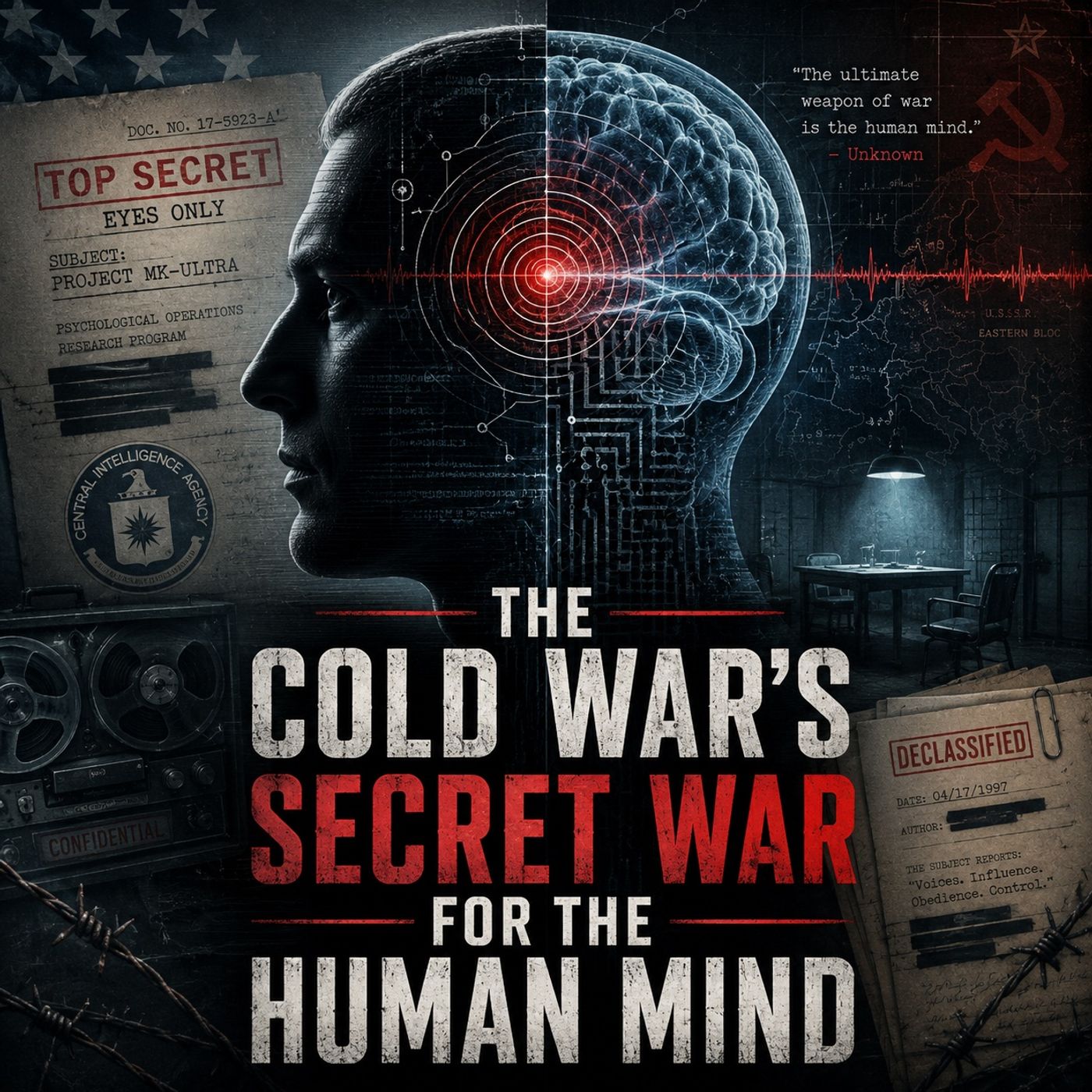
During the Cold War, the battlefield was not only in the skies, oceans, or divided cities. It was also inside the human mind. In the shadows of classified programs, intelligence agencies, military researchers, and prison systems began exploring how fear, isolation, drugs, interrogation, and sensory pressure could weaken, reshape, or control human behavior. Under the language of national security, science crossed into dangerous territory, where vulnerable people could become subjects, data, and secrets buried in sealed files. The Cold War’s Secret War for the Human Mind uncovers the hidden science of psychological warfare, covert experimentation, and ethical collapse in an era ruled by paranoia. It asks how far governments were willing to go in the name of security, and what happens when the pursuit of knowledge forgets the dignity of the person. This is a story of locked rooms, classified documents, broken silence, and the warning history still leaves behind.
-
19
The Hospital Where Patients Became Experiments
This episode returns to the Montreal experiments, one of the most disturbing chapters connected to MKULTRA. At the Allan Memorial Institute, psychiatrist Donald Ewen Cameron used methods including drug-induced sleep, intensive electroshock, sensory deprivation, and repeated recorded messages, while CIA funding moved through secret channels. In under three minutes, the episode asks how a hospital, a place meant for care, became part of a hidden Cold War search for control.SourcesThe Canadian Encyclopedia states that experiments at Montreal’s Allan Memorial Institute took place between 1957 and 1964, possibly beginning earlier, and were linked to CIA-funded MKULTRA research.A 2023 scholarly article in History of Psychiatry describes Cameron’s work from psychic driving to MKULTRA and notes research involving drugs, consciousness, and covert administration.The Guardian’s reporting on the Montreal experiments describes patients being subjected to electroshocks, drug-induced sleep, and large doses of LSD in the 1950s and 1960s.
-
18
The Program Before MKULTRA
This episode explores Project ARTICHOKE, one of the CIA’s early Cold War behavior-control programs before MKULTRA became the better-known name. ARTICHOKE investigated “special interrogation” methods, including drugs, hypnosis, isolation, and other techniques meant to test whether a person’s will could be weakened or controlled. In under three minutes, the episode asks what it means when a government does not simply seek information from a human mind, but begins asking how to enter, bend, and use it.SourcesCIA documents describe ARTICHOKE as the agency cryptonym for the study or use of “special” interrogation methods and techniques.The National Security Archive notes that by 1952, CIA officials discussed ARTICHOKE not merely as interrogation research, but as work aimed at “means of control.”Another National Security Archive document describes an internal memo involving ARTICHOKE interrogation of “an important covert operational asset.”
-
17
The False War They Tried to Write
This episode explores Operation Northwoods, a 1962 U.S. military proposal that suggested manufacturing pretexts to justify an invasion of Cuba. The declassified plan included scenarios involving staged attacks, fake provocations, and even the proposed shootdown of a civilian airliner as a way to create public outrage. In under three minutes, the episode asks how close a government can come to writing a war before the public even knows a script exists.
-
16
The City Used as a Biological Test
This episode tells the dark story of Operation Sea Spray, a secret U.S. military biological warfare test carried out over San Francisco in 1950. Bacteria believed at the time to be harmless were sprayed offshore to study how a biological attack might spread through a major city, without the public’s knowledge or consent. In under three minutes, the episode asks what happens when a government turns its own citizens into an unwitting laboratory.
-
15
The Iran Deal Moment
Today’s brief looks at the uncertain U.S.-Iran ceasefire deal and why the Strait of Hormuz has become the center of the story. The episode explains what is on the table, why the decision matters for energy markets and regional stability, and what to watch next.
-
14
The Three Names That Split One Life Apart
This episode reviews The Names as a debut novel built on a brilliant question: can one name change the course of a life? Florence Knapp follows Cora, a mother trying to name her newborn son while trapped in the shadow of an abusive marriage, then imagines three possible futures through three names: Bear, Julian, and Gordon. In three minutes, the episode asks whether the book’s power comes from fate, from naming, or from the painful truth that even small choices can become acts of resistance.
-
13
A Life Told Through Letters No One Was Supposed to Keep
This episode reviews The Correspondent as a quiet but unexpectedly resonant novel about letters, aging, regret, solitude, and the strange intimacy of written words. Virginia Evans builds the story through Sybil Van Antwerp, a retired lawyer whose sharp, funny, sometimes difficult voice emerges through correspondence with family, friends, enemies, and writers. In three minutes, the episode asks why a book made of letters can feel so alive in an age of instant messages, and whether its old-fashioned form is exactly what makes it feel new.
-
12
The Book That Refuses Comfortable Distance
This episode reviews One Day, Everyone Will Have Always Been Against This as a furious, grieving, and morally direct work of nonfiction. Omar El Akkad writes from the wound of Gaza, but the book widens into a larger indictment of Western liberalism, state violence, selective empathy, and the stories powerful societies tell themselves to remain innocent. In three minutes, the episode asks whether the book’s force comes from its argument, its grief, or from the terrible clarity of a sentence many people may only admit when it is too late.
-
11
The Command Hidden in a Trance
This episode explores the Cold War fascination with hypnosis as a possible tool of control. Intelligence researchers wondered whether a person in a trance could be made more obedient, more suggestible, or even capable of acting against their own will. In three minutes, the episode asks why hypnosis became so tempting to agencies chasing secrets, and what that temptation reveals about power, consent, and the fear of a mind that might not fully belong to itself.
-
10
The Lie Behind Truth Serum
This episode explores the Cold War search for a “truth serum,” a drug that intelligence agencies hoped might force hidden information out of an unwilling mind. The idea sounded clean and almost magical: give someone a substance, lower their defenses, and truth would rise to the surface. In three minutes, the episode asks why that dream was so dangerous, and why the attempt to chemically extract truth often revealed more about power than about honesty.
-
9
The Tapes That Tried to Rewrite a Person
This episode explores psychic driving, one of the most unsettling ideas connected to the Montreal MKULTRA experiments. Instead of using silence, isolation, or a single drug, the method relied on repeated recorded messages played to patients in an attempt to break down and rebuild patterns of thought. In three minutes, the episode asks what happens when language, something usually used to comfort or understand a person, is turned into a tool of pressure, repetition, and control.
-
8
The Silence They Thought Could Break You
This episode explores the Cold War fascination with sensory deprivation, the idea that the mind could be altered not only by adding drugs or commands, but by taking the world away. In dark rooms, quiet spaces, goggles, gloves, and controlled environments, researchers studied what happened when the brain was starved of ordinary signals. In three minutes, the episode asks why silence became a tool of power, and what it reveals about the fragile relationship between the mind and the world that holds it together.
-
7
The Doctor Who Tried to Erase the Self
This episode explores the Montreal experiments led by psychiatrist Donald Ewen Cameron at the Allan Memorial Institute, one of the most disturbing chapters connected to MKULTRA. Cameron believed that damaged minds could be “depatterned” and rebuilt, using methods that included drug-induced sleep, electroshock, sensory deprivation, and repeated recorded messages. In three minutes, the episode asks what happens when medicine forgets the person in front of it, and when healing becomes another name for control.
-
6
The Rooms Where Consent Disappeared
This episode explores Operation Midnight Climax, one of the most disturbing subprojects connected to MKULTRA. In secret apartments, unwitting people were reportedly exposed to LSD and observed as part of the CIA’s search for tools of interrogation, influence, and control. In three minutes, the episode asks what happens when national security turns human beings into instruments, and when the word “research” is used to cover the disappearance of consent.
-
5
The Movie That Made Mind Control Feel Real
This episode explores how The Manchurian Candidate turned Cold War fear into one of cinema’s most unsettling images: a soldier who comes home, but not entirely as himself. The film did not invent America’s fear of brainwashing, but it gave that fear a face, a plot, and a nightmare that audiences could carry out of the theater. In three minutes, the episode asks why a fictional assassin felt so believable in a world already afraid that loyalty, memory, and identity could be rewritten.
-
4
The Voices That Crossed the Iron Curtain
This episode explores how radio became one of the Cold War’s most intimate weapons. Instead of tanks crossing borders, voices crossed them, carrying news, persuasion, hope, and political pressure into homes behind the Iron Curtain. In three minutes, the episode asks what happens when a kitchen radio becomes a battlefield, and when listening itself becomes an act of risk.
-
3
The Word That Frightened America
This episode explores how one word, “brainwashing,” entered Cold War America and changed the way people imagined fear, loyalty, and the human mind. After the Korean War, stories of prisoners, propaganda, and ideological conversion made many Americans believe that identity itself could be taken apart and rebuilt. In three minutes, the episode follows how a word became a weapon, and how public panic helped open the door to secret experiments in control.
-
2
The Cold War’s Secret War for the Human Mind
This episode explores one of the darkest psychological frontiers of the Cold War: the fear that the human mind itself could become a battlefield. From public panic over “brainwashing” to secret CIA programs like MKULTRA, it follows how national security, science, fear, and power blurred into something deeply disturbing. In three minutes, the episode asks a quiet question: what happens when a government begins treating thought, memory, and identity as territory to be conquered?
-
1
The Locked Rooms of the Cold War
Beneath the vibrant surface of the 1960s’ cultural revolution lay a grim and hidden reality. Secret detention camps across Europe and Asia became sites where science was weaponized against political prisoners and marginalized groups. These clandestine experiments, conducted under the veil of Cold War paranoia and regional conflicts, reveal a disturbing intersection of ideology, power, and scientific ambition. This episode uncovers the brutal trials endured behind barbed wire, the silence that concealed them, and the eventual exposure that sparked a global ethical reckoning. As we trace the journey from secrecy to accountability, we confront the lasting legacy of these shadow experiments and the vital lessons they offer for science, human rights, and the moral responsibilities of progress.
We're indexing this podcast's transcripts for the first time — this can take a minute or two. We'll show results as soon as they're ready.
No matches for "" in this podcast's transcripts.
No topics indexed yet for this podcast.
Loading reviews...
ABOUT THIS SHOW
During the Cold War, the battlefield was not only in the skies, oceans, or divided cities. It was also inside the human mind. In the shadows of classified programs, intelligence agencies, military researchers, and prison systems began exploring how fear, isolation, drugs, interrogation, and sensory pressure could weaken, reshape, or control human behavior. Under the language of national security, science crossed into dangerous territory, where vulnerable people could become subjects, data, and secrets buried in sealed files. The Cold War’s Secret War for the Human Mind uncovers the hidden science of psychological warfare, covert experimentation, and ethical collapse in an era ruled by paranoia. It asks how far governments were willing to go in the name of security, and what happens when the pursuit of knowledge forgets the dignity of the person. This is a story of locked rooms, classified documents, broken silence, and the warning history still leaves behind.
HOSTED BY
Tommy
CATEGORIES
Loading similar podcasts...
Frequently Asked Questions
How many episodes does The Cold War’s Secret War for the Human have?
The Cold War’s Secret War for the Human currently has 19 episodes available on PodParley. New episodes are automatically indexed when they're published to the podcast feed.
What is The Cold War’s Secret War for the Human about?
During the Cold War, the battlefield was not only in the skies, oceans, or divided cities. It was also inside the human mind. In the shadows of classified programs, intelligence agencies, military researchers, and prison systems began exploring how fear, isolation, drugs, interrogation, and sensory...
How often does The Cold War’s Secret War for the Human release new episodes?
The Cold War’s Secret War for the Human has 19 episodes. Check the episode list to see recent publication dates and frequency.
Where can I listen to The Cold War’s Secret War for the Human?
You can listen to The Cold War’s Secret War for the Human on PodParley by clicking any episode. We provide an embedded audio player for direct listening, and you can also subscribe via your preferred podcast app using the RSS feed.
Who hosts The Cold War’s Secret War for the Human?
The Cold War’s Secret War for the Human is created and hosted by Tommy.
URL copied to clipboard!