
PODCAST · business
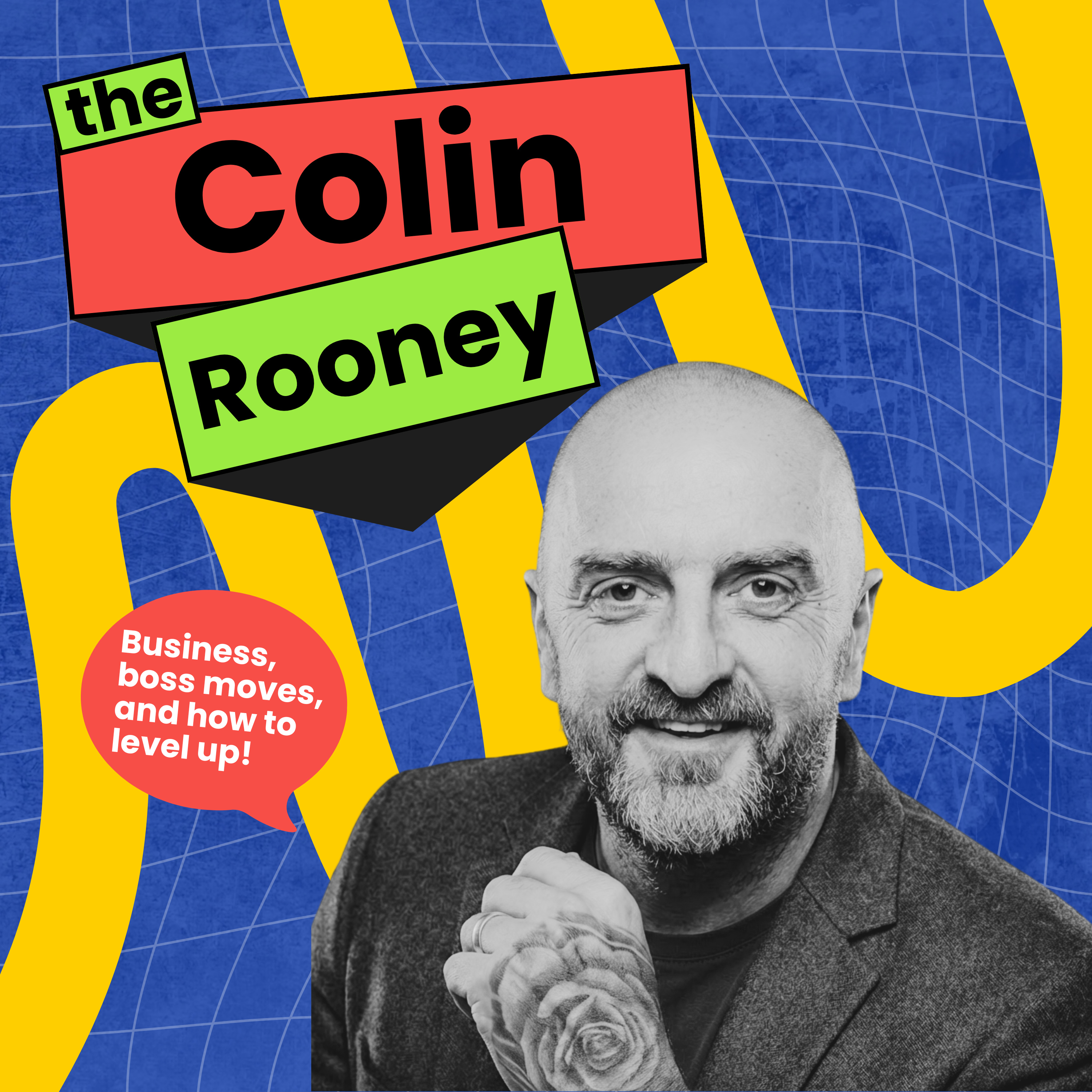
The Colin Rooney Podcast
by Colin Rooney
Honest conversations about the stuff I actually think about — leadership, business, marketing, AI, start-ups, social media, design, motivation, and the harder stuff too: depression, mind management, the things most people won't talk about out loud.I'm Colin Rooney. I run Wonder Works. I'll talk about whatever's worth talking about that week, sometimes deeply researched and evidence-backed, sometimes just me being raw about something I've been through.Each episode is whatever it needs to be. Some short, some long. Pull up a chair. Grab a coffee. Let's get into it.
-
5
Look Where You Want to Go — Episode 5
A few years ago I had one of the best jobs of my life — Head of F&B for Mad Monkey, running hospitality across 20-odd locations in 6 countries. And every Monday there was a group call with the founders and the senior team. The panic would start the night before. By the time it came round to me, my face was so hot you could've fried an egg on it. Pure panic. And it was never about being scared of them — it was the pressure I put on myself to be great, and that pressure is exactly what flattened me. Those calls played a real part in me walking away from a job I loved.This episode is about that. Why it happens. Why trying harder makes it worse. And the fix — which it turns out a good mate handed me years ago on the back of a motorbike, and I never thought to use anywhere else.It's not on a stage. It's the Monday call, the networking pitch, the conversation at the bar where nobody's even watching. If you freeze exactly when you most want to be good — this one's for you.No fluff. Just the research, an honest experiment I'm running on my own life, and a promise to report back.Pull up a chair.— What we get into — Why it's not "too much passion" — it's social perfectionism and self-focus (you're watching yourself instead of being there) Anticipatory anxiety — why the night before is worse than the moment itself The white bear: why "don't freeze" guarantees you freeze "We steer where we stare" — the proven law that your body goes where your eyes go Daryl, the motorbike, and a question I can't stop turning over Why trying harder jams the system (and what happened to Simone Biles) The quiet eye — and the good news that calm is a trainable skill Three things you can actually do: look at them not you, swap "don't" for "do", and stop telling yourself to calm down— The research, the people, the receipts —Ellen Hendriksen — social anxiety, perfectionism, self-focus (How to Be Yourself) https://www.ellenhendriksen.com/Anticipatory anxiety — "bleeding before you are cut," ADAA https://adaa.org/learn-from-us/from-the-experts/blog-posts/consumer/anticipatory-anxiety-bleeding-you-are-cut-0Daniel Wegner et al. (1987), "Paradoxical effects of thought suppression" (the white bear), Journal of Personality and Social Psychology https://dtg.sites.fas.harvard.edu/DANWEGNER/pub/ECS.pdf"We steer where we stare" — driver gaze and steering, ScienceDirect (2024) https://www.sciencedirect.com/science/article/pii/S2590198224000782Keith Code — "look where you want to go," motorcycle riding (A Twist of the Wrist) https://www.revzilla.com/common-tread/one-tip-look-where-you-want-to-goSian Beilock — choking under pressure and working memory (explicit monitoring) https://news.uchicago.edu/story/psychologist-shows-why-we-choke-under-pressure-and-how-avoid-itGabriele Wulf — external vs internal focus of attention (constrained action hypothesis) https://gwulf.faculty.unlv.edu/wp-content/uploads/2021/12/Chua_EF_meta-analyses_PB_2021.pdfSimone Biles & "the twisties" — what it is, Cleveland Clinic via TIME https://time.com/7004666/what-are-the-twisties-gymnastics-cause-treatments-simone-biles-condition/Joan Vickers — the "quiet eye" research https://pmc.ncbi.nlm.nih.gov/articles/PMC3111367/Martin Oscarsson et al. (2020), approach vs avoidance goals (58.9% vs 47.1%), PLOS ONE https://journals.plos.org/plosone/article?id=10.1371/journal.pone.0234097Alison Wood Brooks (2014), "Get Excited: Reappraising pre-performance anxiety as excitement," JEP: General https://www.hbs.edu/ris/download.aspx?name=xge-a0035325 (2).pdf
-
4
My Mentor Is Me — Episode 4
This one was supposed to be about marketing. It's not. I went down a hole researching fear, came out the other side with something better, and I'm doing the whole episode backwards — giving you the answer first, then spending the rest proving I'm not mad.The answer: my mentor is me. Not me now. Future me. The man I want to become. I've made him real, and now when I'm scared, or bored, or stuck, I ask him what to do.I take Simon Sinek's "Start With Why" and flip it to "Start With Me." I dig into the science of why the future versions of us run the show whether we build them on purpose or not. I steal a one-question decision filter off a Formula One legend. I'm honest about exactly where the proven science stops and where I start making it up. And I give my own eulogy, out loud, which was harder than I expected.No fluff. No hacks. Just the research, an honest experiment I'm running on my own life, and a promise to report back on whether it actually works.This is me learning in real time. If you get one thing out of it, that's the win.Pull up a chair.— What we cover — Simon Sinek and the Golden Circle (and why I'm flipping it) "Possible Selves" — the 40-year-old science of your future self Why the gap between who you are and who you want to be is the fuel, not the problem How you act your way into an identity, not think your way into it Frank Williams' one-question filter: "Will it make the car go faster?" Where the real science stops and Colin starts guessing Your own eulogy — the Michael Gerber exercise, flipped Four things you can actually do Monday morning— The research, the people, the receipts —Simon Sinek, Start With Why / The Golden Circle https://simonsinek.com/golden-circleMarkus, H. & Nurius, P. (1986), "Possible Selves," American Psychologist https://psycnet.apa.org/doiLanding?doi=10.1037%2F0003-066X.41.9.954Higgins, E. T. (1987), Self-Discrepancy Theory https://psycnet.apa.org/record/1987-34444-001Daryl Bem, Self-Perception Theory https://thedecisionlab.com/reference-guide/psychology/self-perception-theoryJames Clear, Atomic Habits — Identity-Based Habits https://jamesclear.com/identity-based-habitsFrank Williams, "Will it make the car go faster?" — from Performance at the Limit (Jenkins, Pasternak & West) https://www.cambridge.org/core/books/performance-at-the-limit/enabling-leadership/39CD695E0D36DCE344869A7C077397D2Michael E. Gerber, The E-Myth Revisited — the funeral / Primary Aim exercise https://www.goodreads.com/work/quotes/79122-the-e-myth-revisited-why-most-small-businesses-don-t-work-and-what-to-dBenjamin Hardy, Be Your Future Self Now (the closest thing to what I'm doing) https://www.amazon.com/Your-Future-Self-Now-Transformation/dp/1401967574
-
3
Do as I say, Not as I do
Three thousand years ago, the wisest man who ever lived had seven hundred wives. And three hundred concubines on top of that. The man wrote the book on wisdom and couldn't apply a word of it to himself.His name was Solomon. And he's the reason this episode exists.This one is the most personal one I've done yet. It's about the gap between giving advice and taking it. Between knowing what to do and actually doing it. I'm brilliant at giving advice. Properly. The kind that, if you took it, would change your business and your life. But me taking my own advice? I'm fucking terrible at it. And I wanted to know why.Some of what's in this episode:Why the wisest man in the Bible had a train-wreck personal life, and what that tells us about all of us.Why Steve Jobs refused life-saving surgery for nine months and tried fruit juice cleanses instead. The man who built the most rational company on earth couldn't make a rational decision about his own body.The intention-behaviour gap. The actual data on how often we do the thing we genuinely intended to do. Spoiler, it's a lot lower than you think.Why marriage counsellors have one of the highest divorce rates of any profession.The five real reasons we do this, including the dark one nobody wants to admit. That giving advice itself gives us a dopamine hit, and we get the emotional payoff of progress without ever having to do the thing.My own confession. The advice I give people every day that I don't take myself. Including the fact that episode one of this podcast was me hiding behind an AI voice while preaching the importance of being vulnerable.And three actual fixes that work, according to the research. The Batman Effect. Implementation intentions. And the one nobody wants to hear about because it sounds soft, but the data is undeniable.If you've ever felt like a hypocrite for giving brilliant advice you don't follow yourself, this one's for you. You're not a fraud. You're human. And there might just be a way out.Pull up a chair. Pour yourself something. This one's a long one and it's a personal one.Research Links & References (paste at the bottom of the same description box, leave a blank line first):Igor Grossmann – Solomon's Paradox research, University of Waterloo: https://uwaterloo.ca/wisdom-and-culture-lab/Grossmann & Kross, 2014 – Original Solomon's Paradox study in Psychological Science: https://journals.sagepub.com/doi/10.1177/0956797614535400University of Michigan – How to give ourselves advice as good as we give others: https://news.umich.edu/how-to-give-ourselves-advice-as-good-as-we-give-others/M.D. Faries, 2016 – The Intention-Behaviour Gap meta-analysis (NIH): https://pmc.ncbi.nlm.nih.gov/articles/PMC6125069/The Decision Lab – Intention-Action Gap explained: https://thedecisionlab.com/reference-guide/psychology/intention-action-gapWalter Isaacson – Steve Jobs biography (the cancer treatment chapter): https://www.simonandschuster.com/books/Steve-Jobs/Walter-Isaacson/9781451648539Forbes – Steve Jobs' cancer treatment regrets: https://www.forbes.com/sites/alicegwalton/2011/10/24/steve-jobs-cancer-treatment-regrets/The Guardian – Steve Jobs regretted delaying cancer surgery: https://www.theguardian.com/technology/2011/oct/21/steve-jobs-cancer-surgery-regretJeffrey Pfeffer & Robert Sutton – The Knowing-Doing Gap (Stanford Graduate School of Business): https://www.gsb.stanford.edu/insights/knowing-doing-gapLauren Eskreis-Winkler – University of Chicago research on giving advice and motivation: https://news.uchicago.edu/story/unmotivated-people-benefit-more-giving-advice-receiving-itRoy Baumeister – Ego depletion and willpower research: https://pubmed.ncbi.nlm.nih.gov/39278166/American Psychological Association – The power of self-control: https://www.apa.org/monitor/2012/01/self-controlPeter Gollwitzer – Implementation Intentions ("if-then" planning) research: https://www.tandfonline.com/doi/full/10.1080/10463283.2020.1808936
-
2
I'll Do It Tomorrow
I owe you an apology.Episode one was me hiding behind an AI voice. Eleven Labs, recreating my voice, because I was too scared to sit down and record myself. Funny reasons aside, the real reason was fear. So this time I thought, fuck it, this is me. Like me or not. Here we go.This episode is about procrastination. And I'm qualified to talk about it because I've been one of the worst procrastinators you'll ever meet. Two reasons. One — when I was in heavy depression, which I'll get into properly in a future episode on how I beat it. And two — I get bored. I chase the shiny fun stuff and spend hours putting off the boring shit that actually needs doing.I went deep on the research for this one. Real-world stuff, fun stuff, the science only where it earned its place. What I found surprised me.Some of what I get into:Why procrastination has nothing to do with time management — and what it's actually about (the experts have been getting this wrong for decades)Tim Pychyl and Fuschia Sirois on why we delay things to dodge feelings, not workAdam Grant from Wharton on why moderate procrastination might actually make you more creative (with examples like Da Vinci taking sixteen years on the Mona Lisa)John Perry's "structured procrastination" — the Stanford professor who built a career out of putting things offWhy your brain literally sees your future self as a stranger — and why that's the real reason you skip the gymThe doom-scroll problem and how TikTok is basically a one-armed bandit you carry in your pocketWhy men procrastinate more than women but report being happier about itWhy beating yourself up makes it worse, not betterNotable procrastinators throughout history — Leonardo, Victor Hugo, Margaret Atwood, Mozart, Frank Lloyd Wright — and what they teach usThe Harvard study on how toxic procrastination links to depression, anxiety, and cardiovascular diseaseWhy ADHD procrastination is a different beast entirely (and shouldn't be lumped in with the rest)If you've ever stared at a to-do list and somehow ended up reorganising your sock drawer instead — this one's for you.Pull up a chair. Grab a coffee. Or don't. Do it tomorrow. I'm not your dad.Research Links & References (paste at the bottom of the same description box, leave a blank line first):Tim Pychyl – Carleton University research on procrastination as emotion regulation: https://carleton.ca/psychology/people/tim-pychyl/Fuschia Sirois – Durham University, meta-analysis on procrastination and health: https://www.durham.ac.uk/staff/fuschia-sirois/BBC Worklife – The real reasons you procrastinate: https://www.bbc.com/worklife/article/20200121-why-procrastination-is-about-managing-emotions-not-timeDr. Joseph Ferrari – Procrastination research, DePaul University: https://www.psychologytoday.com/us/blog/dont-delayAdam Grant – NYT Op-Ed, Why I Taught Myself to Procrastinate: https://www.nytimes.com/2016/01/17/opinion/sunday/why-i-taught-myself-to-procrastinate.htmlJohn Perry – Structured Procrastination (Stanford): http://www.structuredprocrastination.com/Hal Hershfield – UCLA research on the future self as stranger: https://www.halhershfield.com/Piers Steel – The Procrastination Equation: https://www.procrastinus.com/Erhan Genç – Brain structure of chronic procrastinators (Ruhr University): https://www.sciencedaily.com/releases/2018/08/180827180917.htmGordon Flett & Paul Hewitt – Perfectionism and procrastination research: https://journals.sagepub.com/doi/10.1177/0146167212445599Baylor University 2025 – TikTok and dopamine: https://news.web.baylor.edu/Jud Brewer – ADHD and procrastination: https://drjud.com/Solving Procrastination – Famous procrastinators through history: https://solvingprocrastination.com/famous-procrastinators/NIH – Sirois & Pychyl meta-analysis on procrastination and well-being: https://pubmed.ncbi.nlm.nih.gov/
-
1
The Title Says, I'm The Boss!
First episode. Here we go.This one's about the gap between being a boss and being a leader — and why most of us, myself included, have been the wrong one at some point without realising it.I talk about where our management style actually comes from (spoiler: usually the boss we hated ten years ago, or a parent), why accountability is the hardest skill nobody teaches you, and what the research actually says about toxic workers, psychological safety, and the cost of bad management.Some of the stuff I get into:Why 89% of new hires fail — and it's almost never about skillsThe Alan Mulally story at Ford and the red slide that changed everythingWhat Google's Project Aristotle found out about high-performing teamsThe Harvard study that put a number on what a toxic employee actually costs youSatya Nadella, Doug Conant, and the quiet power of humilityThe Ted Lasso line that sums up the whole episode in five wordsIf you've ever been given a title and quietly wondered whether you deserve it — this one's for you.Pull up a chair. Grab a coffee. Let's get into it.Research & references mentioned in this episode:Leadership IQ — Why New Hires Fail: https://www.leadershipiq.com/blogs/leadershipiq/35354241-why-new-hires-fail-emotional-intelligence-vs-skillsGallup — State of the American Manager: https://www.gallup.com/services/182138/state-american-manager.aspxGallup — Onboarding & Retention: https://www.gallup.com/workplace/235121/why-onboarding-experience-key-retention.aspxHarvard Business School — Toxic Workers study (Housman & Minor): https://www.hbs.edu/ris/Publication Files/16-057_d45c0b4f-fa19-49de-8f1b-4b12fe054fea.pdfNPR — Coverage of the Toxic Workers study: https://www.npr.org/2015/12/16/460024322/harvard-business-school-study-highlights-costs-of-toxic-workersGoogle re:Work — Project Aristotle: https://rework.withgoogle.com/intl/en/guides/understand-team-effectivenessAlan Mulally at Ford — Harvard Business School case: https://www.hbs.edu/faculty/Pages/item.aspx?num=59955Satya Nadella & Microsoft's growth mindset — Forbes: https://www.forbes.com/sites/tomvanderark/2018/04/18/hit-refresh-how-a-growth-mindset-culture-tripled-microsofts-value/Doug Conant — 30,000 handwritten notes (Forbes): https://www.forbes.com/sites/rodgerdeanduncan/2018/04/06/close-encounters-leadership-and-handwritten-notes/Gallup — Cost of poor mental health at work ($47.6B): https://www.gallup.com/workplace/404174/economic-cost-poor-employee-mental-health.aspxBandura's Social Learning Theory — Simply Psychology: https://www.simplypsychology.org/bandura.htmlSimon Sinek — Leaders Eat Last / Circle of Safety: https://simonsinek.com/stories/the-circle-of-safetyAmy Edmondson — The Fearless Organization: https://fearlessorganizationscan.com/the-fearless-organization
We're indexing this podcast's transcripts for the first time — this can take a minute or two. We'll show results as soon as they're ready.
No matches for "" in this podcast's transcripts.
No topics indexed yet for this podcast.
Loading reviews...
ABOUT THIS SHOW
Honest conversations about the stuff I actually think about — leadership, business, marketing, AI, start-ups, social media, design, motivation, and the harder stuff too: depression, mind management, the things most people won't talk about out loud.I'm Colin Rooney. I run Wonder Works. I'll talk about whatever's worth talking about that week, sometimes deeply researched and evidence-backed, sometimes just me being raw about something I've been through.Each episode is whatever it needs to be. Some short, some long. Pull up a chair. Grab a coffee. Let's get into it.
HOSTED BY
Colin Rooney
CATEGORIES
Loading similar podcasts...
Frequently Asked Questions
How many episodes does The Colin Rooney Podcast have?
The Colin Rooney Podcast currently has 5 episodes available on PodParley. New episodes are automatically indexed when they're published to the podcast feed.
What is The Colin Rooney Podcast about?
Honest conversations about the stuff I actually think about — leadership, business, marketing, AI, start-ups, social media, design, motivation, and the harder stuff too: depression, mind management, the things most people won't talk about out loud.I'm Colin Rooney. I run Wonder Works. I'll talk...
How often does The Colin Rooney Podcast release new episodes?
The Colin Rooney Podcast has 5 episodes. Check the episode list to see recent publication dates and frequency.
Where can I listen to The Colin Rooney Podcast?
You can listen to The Colin Rooney Podcast on PodParley by clicking any episode. We provide an embedded audio player for direct listening, and you can also subscribe via your preferred podcast app using the RSS feed.
Who hosts The Colin Rooney Podcast?
The Colin Rooney Podcast is created and hosted by Colin Rooney.
URL copied to clipboard!