
PODCAST · business
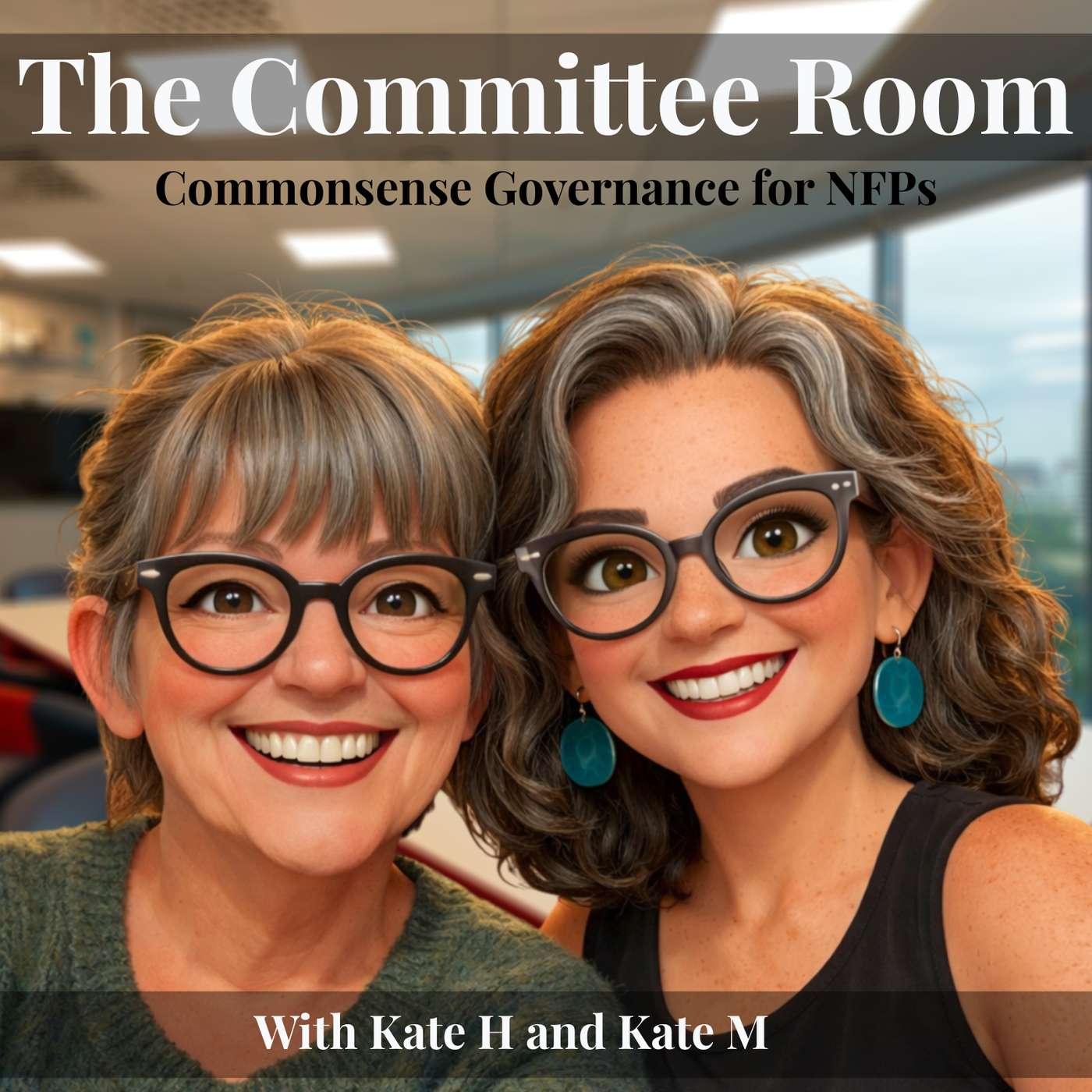
The Committee Room
by Kate Hartwig and Kate McPhee
Practical governance for volunteer committees and not-for-profit organisations. Hosted by governance consultants Kate Hartwig and Kate McPhee, each episode tackles one topic — clearly, honestly, and without the jargon. Short enough to finish before your coffee goes cold.
-
6
Ep 11 Bastille Day Special
It's 1789. The committee has been in power for generations. No succession plan. No performance review. Louis XVI has been in the top job since he was 19. The membership hasn't been consulted on anything. The budget is a disaster. And when the members finally lose confidence in the committee, the feedback mechanism is extremely robust.In this Bastille Day special — recorded live from Central France — Kate M and Kate H use the French Revolution as a case study in what happens when an organisation completely fails at succession planning and performance review. They cover the skills matrix, the cautionary tale of Robespierre, how subcommittees work as a talent pipeline, and a simple three-part performance review process that any committee can use. The governance content is completely serious. The framing is not.Also covered in this episode:What succession planning is — and what it is absolutely notL'État, c'est moi — the fastest route to a committee that has lost touch with its membersThe Committee of Public Safety: 12 members, enormous powers, zero accountability — and what followedThe question every long-serving committee member needs to ask themselves honestlyAnd the compelling case for recruiting firefighters onto your committee 🚒
-
5
Your Questions Answered
Biased minutes. A chair ignoring a committee decision he disagrees with. A treasurer who resigned with no notice and took everything with them. A president who's been in the job for eleven years and nothing ever changes. Real questions from real committee members — and in this first Your Questions Answered special, Kate H and Kate M work through eleven of them in plain English. With the occasional Iced VoVo.Questions covered in this episode:Taking accurate minutes when the secretary is also the most argumentative person in the room?Whether you can require committee members to prepare for meetings?What happens when a chair refuses to act on a decision he disagrees with?Whether decisions made without a quorum are legally valid?What to do when a nominee won't supply a candidate statement?Handling a committee member who's breaching confidentiality?Whether your fundraising raffle needs a licence?Whether the committee can reject a nomination for personal reasons?What to do first when your treasurer resigns without notice and takes everything with them?How to move a club forward without offending the past?How to move on a long-serving president without causing a war?Got a question of your own? Submit it at thecommitteeroom.com.au — your question might shape a future episode.Full show notes and free downloads at The Committee Room
-
4
Who Can Do What?
One subcommittee signs a two-year venue contract nobody authorised. Another finds the perfect venue, waits for committee sign-off, and loses it while they're waiting. Both end badly. Both have the same cause: nobody wrote down who was actually allowed to do what.In this episode Kate H and Kate M make the case for the delegations register — not as dry governance paperwork but as one of the most practically useful documents a committee can have. They cover decision-making authority by role and function, how tiered financial authorities work in practice, who can enter binding contracts and under what circumstances, why listing what can't be delegated matters just as much as listing what can, and how to start from scratch if your committee has nothing written down. Full show notes and free download at The Committee Room.
-
3
Many hands make light work
Seven people trying to run every aspect of their organisation by themselves. Three-hour meetings. The same three people doing all the actual work. Burnout setting in. And meanwhile a significant chunk of the membership — talented, interested, willing to contribute — has never once been asked.In this episode Kate H and Kate M introduce three structures that fix this: portfolios, subcommittees and working groups. They cover how each one works, how to set them up properly, why delegation is not the same as abdication, how terms of reference protect everyone involved, and how to find the hidden gems in your membership who've been waiting to be asked. Free terms of reference template in the show notes.Show notes and free download at The Committee Room.
-
2
Bringing People In
You've just been elected to the committee. Someone slides a 100-page manual across the table and says, read through this when you get a chance. Three months later you're still not sure what your role is, who does what, or why half the things you're voting on are even necessary.In this episode Kate H and Kate M make the case that induction is a process, not a document — and that it starts well before anyone's been elected. They cover what goes in the manual and why each item is there, the nomination checklist that sets expectations before the election, the personal welcome letter that sets the tone, the pre-meeting coffee where induction really comes alive, and the dedicated induction meeting that gives the whole committee a useful annual reset. Free induction checklist and manual contents list in the show notes.Full show notes and free downloads at The Committee Room.
-
1
Questions are Gold
A $14,362 line item in miscellaneous expenses. Budget was $2,000. No explanation. Two committee members noticed it. Nobody said a word. The reports were approved and the meeting moved on. Six months later, the organisation discovered where the money had gone — and the paper trail led straight back to that meeting.In this episode Kate H and Kate M get into why people don't ask the hard questions — and why that silence is never neutral. They cover the four forces that keep committee members quiet, the baseline questions every committee member should feel comfortable asking across finance, risk and strategy, how to frame questions that get you information rather than defensiveness, and why the quiet meeting where nothing is questioned is a warning sign, not an efficiency win. Plus the elephant in the room, the good chairperson, and a free Questions Are Gold checklist in the show notes.Show notes and free download at The Committee Room.
-
0
Choosing your Committee
It's AGM night. Four usual suspects nominate each other. A hand shoots up from someone nobody's seen in two years. Another from the member who's complained loudly at every event for the past twelve months. Seven people are declared elected to stilted applause. Six months later, everyone's wondering why everything has gone sideways.In this episode Kate H and Kate M make the case for ditching nominations from the floor forever — and walk through the eight-step election process that gets the right people in the room. They cover informed candidates, proper voting, returning officers, staggered terms, term limits, and the uncomfortable truth about past presidents who don't know when to let go. Free election checklist and candidate statement template in the show notes.Show notes and free downloads at The Committee Room.
-
-1
Care, Loyalty & Obedience
Every committee member carries three legal duties from the moment they're elected — whether anyone told them about it or not. Care, Loyalty and Obedience. They sound like an old-fashioned wedding vow, and it turns out they're very serious indeed.In this episode Kate H and Kate M explain what each duty actually means in plain English — the duty of care and why 'I assumed someone else had checked it' is not a defence, the duty of loyalty and how to handle conflicts of interest properly, the duty of obedience and what happens when the committee ignores its own rules. Plus the reasonable person test: the standard you're held to, and why it's more reassuring than it sounds. Free three duties summary card in the show notes.Show notes and free resources at The Committee Room
-
-2
What's your job,exactly?
Someone has just been elected to the committee. They turn up to their first meeting excited and ready to contribute. Nobody introduces them. Nobody explains what they're supposed to do. Three months later they're still not sure what their role is or whether they've made any difference at all.In this episode Kate H and Kate M unpack the three dimensions of committee responsibility — organisational, cultural and group dynamics — explain why confidentiality matters more than most people realise, and make the case for job descriptions and a code of conduct that's actually worth having. Plus a free role description template in the show notes.Full show notes and free download at The Committee Room
-
-3
Who's in the Room?
Before you can govern well, you need the right people around the table. But most committees are structured the way they are because that's what the constitution says, or because that's how it's always been done. Neither is a good enough reason.In this episode Kate H and Kate M tackle committee composition from the ground up — the three committee models and when each one makes sense, why seven to nine members is the sweet spot, why odd numbers matter, what genuine diversity of perspective actually looks like, and why a committee where everyone agrees is a warning sign, not a success.Show notes and free resources at The Committee Room
-
-4
Governance - The Big Picture
It's 8pm on a Tuesday. You're in a community hall that smells of burned coffee and the meeting was supposed to start an hour ago. If that sounds familiar, this podcast is for you.Kate Hartwig and Kate McPhee are governance consultants who've spent decades helping volunteer committees stop doing things the hard way. In this first episode they explain what governance actually is, why it matters, and why it doesn't have to be as painful as it usually is. Six words that change everything: doing the right things, and doing things right.Full show notes at The Committee Room
We're indexing this podcast's transcripts for the first time — this can take a minute or two. We'll show results as soon as they're ready.
No matches for "" in this podcast's transcripts.
No topics indexed yet for this podcast.
Loading reviews...
ABOUT THIS SHOW
Practical governance for volunteer committees and not-for-profit organisations. Hosted by governance consultants Kate Hartwig and Kate McPhee, each episode tackles one topic — clearly, honestly, and without the jargon. Short enough to finish before your coffee goes cold.
HOSTED BY
Kate Hartwig and Kate McPhee
CATEGORIES
Loading similar podcasts...
Frequently Asked Questions
How many episodes does The Committee Room have?
The Committee Room currently has 11 episodes available on PodParley. New episodes are automatically indexed when they're published to the podcast feed.
What is The Committee Room about?
Practical governance for volunteer committees and not-for-profit organisations. Hosted by governance consultants Kate Hartwig and Kate McPhee, each episode tackles one topic — clearly, honestly, and without the jargon. Short enough to finish before your coffee goes cold.
How often does The Committee Room release new episodes?
The Committee Room has 11 episodes. Check the episode list to see recent publication dates and frequency.
Where can I listen to The Committee Room?
You can listen to The Committee Room on PodParley by clicking any episode. We provide an embedded audio player for direct listening, and you can also subscribe via your preferred podcast app using the RSS feed.
Who hosts The Committee Room?
The Committee Room is created and hosted by Kate Hartwig and Kate McPhee.
URL copied to clipboard!