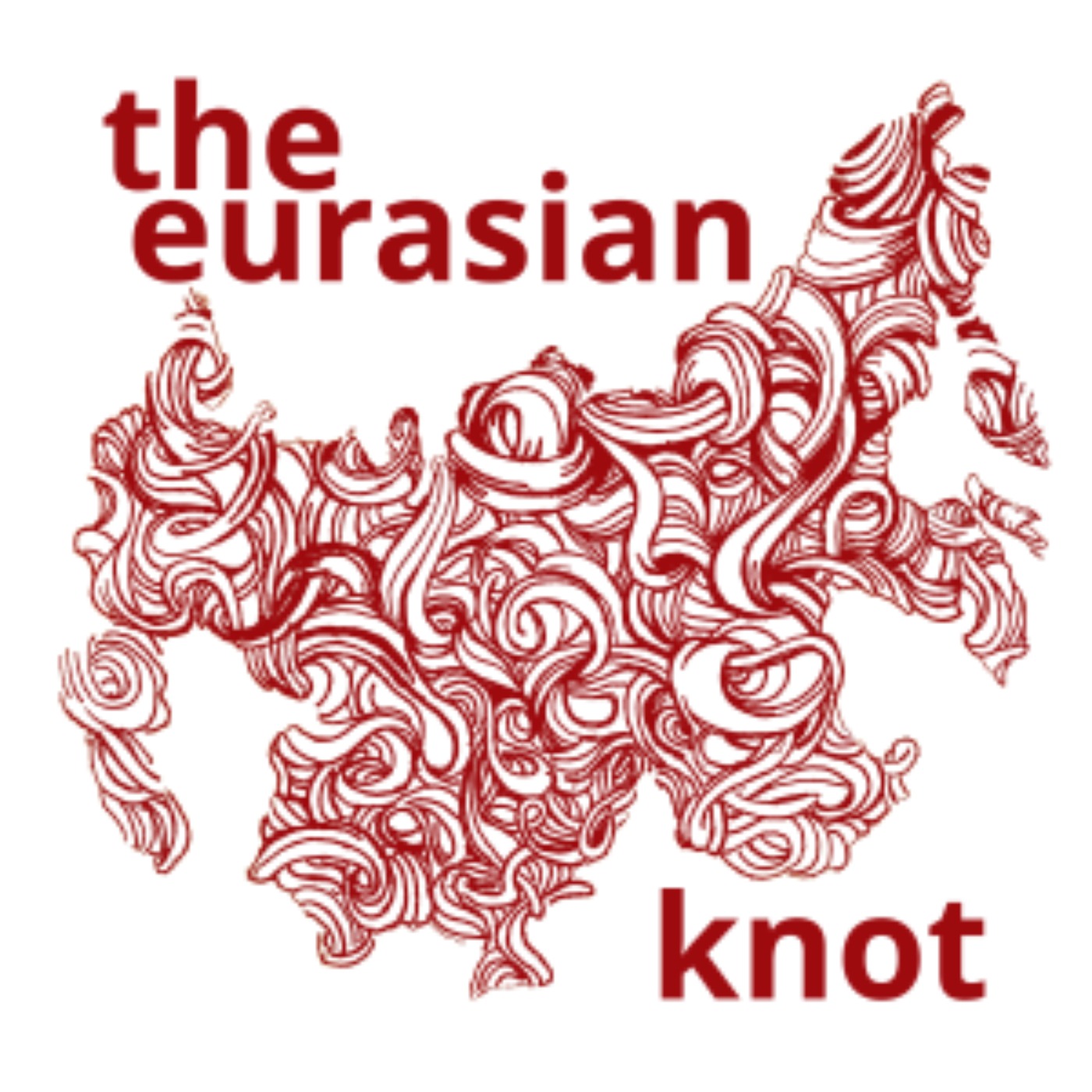
The Eurasian Knot
by The Eurasian Knot
To many, Russia, and the wider Eurasia, is a riddle, wrapped in a mystery, inside an enigma. But it doesn’t have to be. The Eurasian Knot dispels the stereotypes and myths about the region with lively and informative interviews on Eurasia’s complex past, present, and future. New episodes drop weekly with an eclectic mix of topics from punk rock to Putin, and everything in-between. Subscribe on your favorite podcasts app, grab your headphones, hit play, and tune in. Eurasia will never appear the same.
Episodes
-
The Shandeans of the Soviet Union
"I wrote not to be fed but to be famous." This is one of the many, many humorous and whimsical sayings attributed to the writer Laurence Sterne. This Anglican cleric became a sensation in mid-18th century Britain after publishing his irreverent, stream-of-consciousness novel, The Life and…
more -
Dumplings!
They go by many names. Xiao mai. Samosa. Momo. Mani. Pelmeni. Vareniki. Khinkali. That’s right, dumplings! That delicious meat-wrapped-in-dough dish! The dumpling is one of the most transhistorical foods on the planet. Almost every culture has its own taste, shape and tradition. It’s a source of...
-
Marriage and Family in Chechnya
The history of Chechens, or Nokhchi, is defined by war, occupation, and ethnic cleansing. Yet despite these repeated traumas, the Nokhchi have persisted, resisted and survived. But how? Chechens comprise such a relatively small population, almost 2 million today. This is the question Marat…
more -
A Novel of Modern Russia
Maya, the heroine of Svetlana Satchkova’s The Undead: A Novel of Modern Russia, is an aspiring Russian filmmaker. And after fits and starts she finally gets a break when the producer Belov greenlights her project. Maya’s film is an art-house horror flick about a resurrected Lenin who seeks to…
more -
Latvian Soldiers in WWII
World War II casts a long, dark shadow over eastern Europe. Especially in those nations caught between the Wehrmacht and Red Army. Some locals joined the Nazis, others served in the Red Army, and some others fought against both. Many more simply fled or hunkered down hoping just to survive....
-
Los Rusos
An overlooked destination for thousands immigrating out of the Russian Empire and Soviet Union was Mexico. The reasons were many. Jews fled anti-semitic violence. Religious groups like the Molokans left because of persecution. Many more left in the wake of war, revolution, famine, and political...
-
The Origins of the Ukraine War
When did Putin decide to invade Ukraine? Was it shortly after 2012 when he returned as President? In 2014, after the seizure of Crimea and clashes in the Donbas? Or was it when Russian forces began massing at the Ukraine-Russia-Belarus borders for a full-scale assault? The answer to when, Michael...
-
The Soviet Death Penalty
The fact that the USSR executed its citizens with little jurisprudence is well known. The word “troika” is synonymous with Stalinist repressions of the 1930s. What is less known is that the Soviet Union’s death penalty regime changed significantly in the postwar period. After a brief moratorium...
-
Soviet Protestants
We tend to think of the 1990s when it comes to Protestantism in Russia. It was then that evangelicals descended on Russia to shine Jesus’ light into the post-Soviet void. Yet, the Soviet Union, despite its best efforts, was a multiconfessional state. And though officially atheist, religious…
more -
Thresholds Part 7: Olga
Over the last century, tens of millions of people quit Eastern Europe for the United States. The push-pull factors were many—war, poverty, instability, persecution at home and opportunity, refuge, and liberty abroad. But manna didn’t simply fall from the sky in America. Immigrants from Eastern...
-
Thresholds Part 6: Yelena
Over the last century, tens of millions of people quit Eastern Europe for the United States. The push-pull factors were many—war, poverty, instability, persecution at home and opportunity, refuge, and liberty abroad. But manna didn’t simply fall from the sky in America. Immigrants from Eastern...
-
Thresholds Part 5: Julia
Over the last century, tens of millions of people quit Eastern Europe for the United States. The push-pull factors were many—war, poverty, instability, persecution at home and opportunity, refuge, and liberty abroad. But manna didn’t simply fall from the sky in America. Immigrants from Eastern...
-
Thresholds Part 4: New Immigrants
Over the last century, tens of millions of people quit Eastern Europe for the United States. The push-pull factors were many—war, poverty, instability, persecution at home and opportunity, refuge, and liberty abroad. But manna didn’t simply fall from the sky in America. Immigrants from Eastern...
-
Thresholds Part 3: Russians in San Francisco
Over the last century, tens of millions of people quit Eastern Europe for the United States. The push-pull factors were many—war, poverty, instability, persecution at home and opportunity, refuge, and liberty abroad. But manna didn’t simply fall from the sky in America. Immigrants from Eastern...
-
Thresholds Part 2: Becoming White
Over the last century, tens of millions of people quit Eastern Europe for the United States. The push-pull factors were many—war, poverty, instability, persecution at home and opportunity, refuge, and liberty abroad. But manna didn’t simply fall from the sky in America. Immigrants from Eastern...
-
Thresholds Part 1: Leaving the Old Country
Over the last century, tens of millions of people quit Eastern Europe for the United States. The push-pull factors were many—war, poverty, instability, persecution at home and opportunity, refuge, and liberty abroad. But manna didn’t simply fall from the sky in America. Immigrants from Eastern...
-
The Rise and Fall of the Georgian Democratic Republic
The Georgian Democratic Republic lasted a mere three years, from 1918-1921. And though it was viewed as an oddity at the time, many European social democrats marveled at its possibilities. Here was a state committed to social democracy in a mostly backward peasant and multiethnic country. What...
-
The Man Who Knew Russia
Everyone has an opinion about the late Russian historian Richard Pipes. Some loved him. Many hated him. He was a conservative and anti-communist. A hardliner on American policy toward the Soviet Union. Some would even say he was a Russophobe and cultural essentialist. But Pipes was a far more...
-
Reporting Russia's Descent
Marc Bennets has been reporting from Russia for over two decades. He’s covered Putin’s rise and consolidation of power, assassinations of oppositionists, mass protests, daily life, and even Russian football. It’s a storied career filled with zipping back and forth between Moscow and its regions....
-
Boris Nemtsov
On the night of 27 February 2015, assassins gunned down Boris Nemtsov as he crossed the Bolshoi Moskvoretskii Bridge. Shock quickly spread throughout Russia, particularly among its political opposition. Not because Nemtsov was so brazenly gunned down. Such are the risks of being politically…
more -
The Last Soviet Artist
I met the graphic artist, Victoria Lomasko, about 10 years ago when she was a resident at the City of Asylum in Pittsburgh. I emceed an event with her back then. So I was happy when Victoria recently returned to the city to give a few talks at the University of Pittsburgh. Of course, the Eurasian...
-
Remembering Alexander Rabinowitch
When I opened Facebook this morning, as I do every morning, I learned that Alexander Rabinowitch died at 91 years old. Rabinowitch was arguably one of the most important historians of the Russian Revolution. It's hard to state how much Rabinowitch's work influence our understanding of 1917.…
more -
Anastas Mikoyan
How Stalin personally ran the Soviet Union has rightly received much attention. Less discussed is the small group of men that served as his top lieutenants. They carried out his orders, and after his death, were instrumental in establishing the post-Stalin order. This week, the Eurasian Knot...
-
Soviet Holocaust Literature
It has long been assumed that there was no Holocaust memory in the Soviet Union. Official Soviet ideology lumped the 1.5 million Soviet Jews exterminated by the Nazis into the 26 million Soviet war deaths. So, the little Holocaust memory that existed was hidden away in families and communities....
-
The Russian Paradox
Many studies focus on how Russia doesn’t work and why. There’s a laundry list of reasons. Corruption. Autocracy. Imperialism. Exceptionalism. But, how, then, does Russia work? Because there are people, a state, and society. What greases the wheels? Alena Ledeneva has made this question the focus…
more -
Kurt Vonnegut in the USSR
I went through my Kurt Vonnegut phase in my late teens. I read Player Piano, Cat’s Cradle, I think, Deadeye Dick, and of course, Slaughterhouse Five. I can’t say I remember much from those novels. Nor can I recall why Vonnegut connected with me. Perhaps now is a good time to revisit them. Little...
-
The Post-Soviet Human Condition
The Eurasian Knot hasn’t featured many philosophers. So, when Ukrainian political philosopher, Mikhail Minakov, came to the University of Pittsburgh to give a talk, I eagerly pulled him into a studio. The result was a wide-ranging conversation on the collapse of communism, the post-Soviet human,...
-
Bye, Bye Orban
On April 12, 2026, Hungarians overwhelmingly voted Peter Magyar into office ending the sixteen-year rule of Viktor Orban. It was a stunning victory that sent voters into the streets to celebrate. Now, observers are looking to see whether Magyar will roll back Orban’s illiberal system and even...
-
The Georgian August 1924 Uprising
In August 1924, a group of rebels organized by the anti-Bolshevik Committee for the Independence of Georgia and led by the Georgian Social Democratic Party, rose up against Soviet forces in the mining town of Chiatura. The Bolshevik reaction was swift and harsh. The fear of another "Kronstadt”...
-
The Edge of Sports
Spoiler alert. This episode has nothing to do with the Eurasian Knot’s usual fare. Dave Zirin was speaking at the University of Pittsburgh. Zirin is one of the few sports journalists on the political left. I’ve been a long-time fan. I’m also a sports fan, especially basketball. So, when I was...
-
Russian and American Internal Colonization
About eight years ago, I interviewed Steven Sabol about his book, The Touch of Civilization. It was the first book I was aware of that compared the US’ and Russia’s efforts to civilize its colonized people, specifically the Sioux and Kazakhs. Here were two continental empires with two vastly...
-
Everyday Politics in Russia
What do Russians really think? The question is old and elusive. It is also somewhat of a tell–to pose it is to suggest there’s a coherent answer, and more so, that Russians’ collective opinions matter. For the most part, scholars have turned to history, media, opinion polls, and assumptions to...
-
Ukraine's Euromaidan
In the winter of 2013-14, protests erupted in Kyiv, Ukraine. Their goal was to oppose President Viktor Yanukovich’s rejection of the EU Association Agreement. Many protesters saw the Agreement as a meaningful step for Ukraine to enter the European orbit. And the protests might have fizzled. But…
more -
KGB Same-Sex Honey Traps
One of the most salacious and storied methods of KGB spycraft during the Cold War was the honey trap. Agents would get an informant to seduce a target, usually a Westerner deemed important. Then use that encounter as blackmail. We’re all aware of this thanks to movies and television. What we know...
-
The Bolshevik Rank and File
In 1917, the Bolshevik Party had roughly 24,000 members. A decade later, it boasted about 1.2 million. Recruitment came in waves and so did the purges. Still, Party members were found at the top and bottom of the system. In the Kremlin and in the factories. The Party rank and file were vital to…
more -
Stalin's Last Days
Joseph Stalin died today, March 5, seventy-three years ago. So, I thought it would be a good idea to dig out, re-edit and remaster, the interview I did with Joshua Rubenstein back in 2018 about the dictator’s final days. What did Stalin focus on in the final years of his life? How did Soviet...
-
Searching for Belief during the Soviet End Times
When societies are in crisis, people tend to seek alternative belief systems to give them comfort, explain a complex world, or fill a space left vacant by discredited ideologies and faiths. Like the embrace of spiritualism after the mass death during the American Civil War. The growth of...
-
Moscow's Hunt for Olympic Gold
As a Cold War kid, I remember the intense rivalry between the United States and USSR during the Olympics. Of course, we remember the US’ boycott in 1980 because of the Soviet invasion of Afghanistan. And the Soviet boycott in 1984 in response to the American boycott. Who bested who was not just...
-
The Long History of American-Russian Relations
A quick scan of the hundreds of books on US-Russia relations gives the impression that the two countries only met in the 20th century. But relations go back to the early days of the American republic. And, surprisingly, throughout most of the 19th century, the United States and Russia were…
more -
REEES Faculty Spotlight: Gregor Thum
The history of borders and nations in Eastern Europe is fraught. What we even call the region is a site of contestation. Is it “Eastern Europe,” “Central Europe,” or “East Central Europe”? For Pitt historian Gregor Thum, space and how it’s delineated matters. This is especially the case for…
more -
Russia Starts Here
What is Russia? There’s no easy answer. Travelers, scholars, philosophers, and journalists have pondered the question for centuries. And though answers vary, there is one point of consensus–whatever Russia is, you won’t find it in large cities. “Russia” exists out there, deep in the countryside…
more -
The Further Adventures of the Black Russian
A decade ago, Vladimir Alexandrov published an excellent biography, The Black Russian, about an unknown historical figure–Fredrick Bruce Thomas. Thomas was a Black Mississippian who moved to Imperial Russia and became a successful Moscow nightclub owner until Revolution forced him to flee.…
more -
The Great Reforms
Alexander II’s Great Reforms were sweeping. They freed over 22 million serfs, overhauled the judicial, university, and municipal systems, and loosened censorship, among others. It was one of those pivot points in Russian history. If successful, Russia would have charted a more liberal path or…
more -
Post-Soviet Graffiti
I love street art. And I don’t care in what form. Beautifully crafted murals. Spraypainted gang tags. Scrawls on bathroom stalls. Even guerilla sticker mosaics on streetlights. I especially like how street art alters the narrative of a space. So, I was excited when I received a copy of Alexis...
-
The Stiliagi
A new youth subculture emerged in the Soviet Union in the late 1940s and early 1950s–the Stiliagi. Roughly translated as “the stylish,” these youths, the majority of whom were men, wore flashy hairstyles and bright colored clothes, danced to jazz, and were obsessed with Western aesthetics. And of...
-
Fraternization and Survival During WWII
Soviet ideology called for the emancipation of women. Soviet women would be active participants in public life, unburdened by the home, children, and husbands, and serve equally in the building and defense of the Soviet state. Reality, however, was different, especially during WWII. Soviet women...
-
The Art of War
About two years ago, I was brought on to a podcast project started by the Global Studies Center at the University of Pittsburgh. The initial pitch was to produce a student-led podcast featuring two threatened artists that are part of the Pittsburgh Network for Threatened Scholars (PiNTS). I’m…
more -
How Peat Electrified the USSR
What is peat? We had no idea until the Eurasian Knot spoke to Katja Bruisch about how this coal-like soil was an energy source in Russia and the Soviet Union. Found in wetlands, peat is the extracted top soil that is dried and burned for fuel. It was a marginal, but important, energy source in...
-
Murder Mystery in Moscow
I’ve grown to admire historians like Catherine Merridale. You know, those historians who buck academic conventions to write for a non-academic audience. This was quite a change for me since I used to hold such work in contempt (or was it jealousy) when I was a snot-nosed, snobby grad student. So…
more -
How Konigsberg Became Kaliningrad
The Prussian city of Konigsberg is well-known as the birthplace of Immanuel Kant. But in many ways it’s also a microcosm for the twentieth century. Founded in the 13th century by Teutonic knights, the city served as a key trading center for the Prussian Empire until the Polish corridor severed it...
About this show
To many, Russia, and the wider Eurasia, is a riddle, wrapped in a mystery, inside an enigma. But it doesn’t have to be. The Eurasian Knot dispels the stereotypes and myths about the region with lively and informative interviews on Eurasia’s complex past, present, and future. New episodes drop weekly with an eclectic mix of topics from punk rock to Putin, and everything in-between. Subscribe on your favorite podcasts app, grab your headphones, hit play, and tune in. Eurasia will never appear the same.
Hosted by
The Eurasian Knot