The Federalist Papers
by Dick Barr
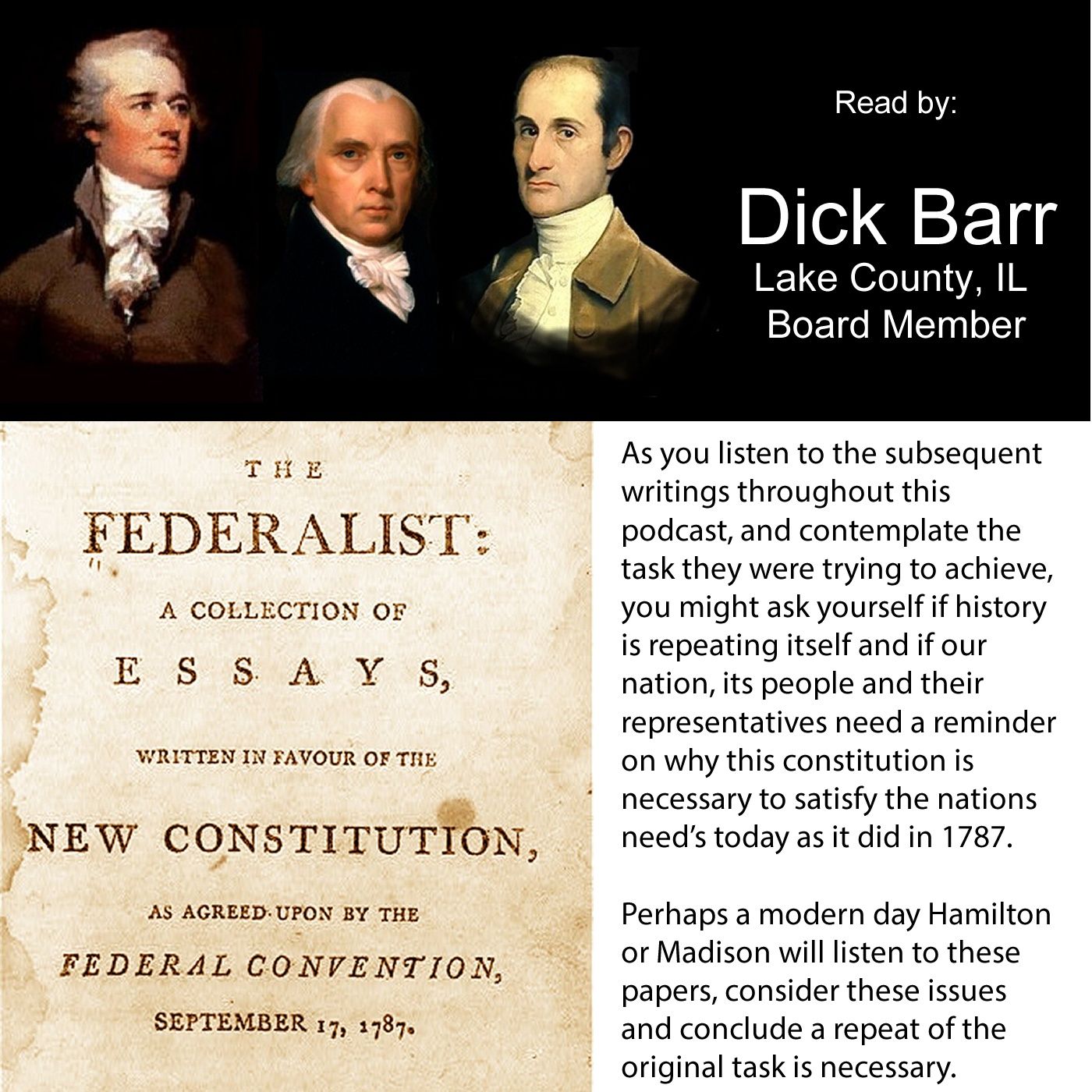
A reintroduction and reading of the Federalist Papers, first penned in 1787-1788, to support and defend the Nation's New Constitution. As you listen to the subsequent writings throughout this podcast, and contemplate the task they were trying to achieve, you might ask yourself if history is repeating itself and if our nation, its people and their representatives need a reminder on why this constitution is necessary to satisfy the nations need’s today as it did in 1787. The ensuing podcasts will be relatively short, typically between 5 and 10 minutes each. They will consist of a brief summary of the Paper Number, followed by a full reading of the text, as originally published.
Episodes
-
Federalist 25 - The Powers Necessary to the Common Defense Further Considered
In Federalist Paper No. 25, Alexander Hamilton continues to make the case for a strong national defense, emphasizing the drawbacks of relying solely on state militias. Hamilton argues that state militias are generally ill-equipped and lack the discipline to effectively defend the nation against...
-
Federalist 24 - The Powers Necessary to the Common Defense Further Considered
Federalist Paper No. 24, authored by Alexander Hamilton, continues the discussion on the need for a robust centralized authority, this time focusing on the necessity of maintaining a standing army. Hamilton argues that local militias alone are insufficient for national defense. He addresses...
-
Federalist 23 - The Necessity of a Government as Energetic as the One Proposed to the Preservation of the Union
Federalist Paper No. 23, written by Alexander Hamilton, addresses the necessity of a strong central government in matters of national defense and security. Hamilton argues that the federal government must be empowered to handle all aspects of national defense, without any significant limitations....
-
Federalist 22 - Other Defects of the Present Confederation
Federalist No. 22, authored by Alexander Hamilton, further critiques the limitations of the Articles of Confederation while advocating for the new U.S. Constitution. This paper specifically focuses on several key issues: the inefficiency of a government that requires unanimity for…
more -
Federalist 21 - Other Defects of the Present Confederation
Federalist No. 21, authored by Alexander Hamilton, focuses on the shortcomings of the Articles of Confederation with respect to the central government's ability to raise revenue, maintain internal order, and enforce laws. The paper serves as a critique of the existing system, laying the…
more -
Federalist 20 - The Insufficiency of the Present Confederation to Preserve the Union
Federalist No. 20, penned by Alexander Hamilton and James Madison, continues the examination of confederate systems of government, which was initiated in Federalist No. 15. This paper focuses particularly on the example of the United Netherlands, a confederation that, while appearing to be...
-
Federalist 19 - The Insufficiency of the Present Confederation to Preserve the Union
Federalist No. 19 delves into the challenges and inefficiencies associated with confederate governments, using historical examples to demonstrate the need for a stronger centralized authority in the United States.Authors Hamilton and Madison start by exploring ancient confederacies, such as the...
-
Federalist 18 - The Same Subject Continued - The Insufficiency of the Present Confederation to Preserve the Union
In this paper, Madison continues to outline the inadequacies of the Articles of Consideration. His core concern in this paper is to establish the fundamental weaknesses inherent in a system of government composed of multiple sovereigns under a relatively powerless central government.Madison uses...
-
Federalist 17 - The Same Subject Continued - The Insufficiency of the Present Confederation to Preserve the Union
Hamilton seeks to address concerns that the proposed Constitution will lead to tyranny at the hands of a power-hungry national government. He argues that it is unlikely that men in national office would even be interested in usurping the powers from the states, which relate to concerns that “can...
-
Federalist 16 -The Same Subject Continued - The Insufficiency of the Present Confederation to Preserve the Union
Federalist 16, Alexander Hamilton the New York Packet: December 4, 1787. Hamilton begins this essay by restating that it is an absolute fact that the present confederation, because of the manner in which it has been set up, is the "parent of anarchy," and that the delinquencies of the states of…
more -
Federalist Papers #15 - The Insufficiency of the Present Confederation to Preserve the Union
Hamilton begins by telling the people that in the previous papers he has tried to convince them of the importance of the Union to "political safety and happiness." In this essay, he changes the theme to the "insufficiency of the present confederation to the preservation of the union." He argues...
-
Federalist Papers #14 - Objections to the Proposed Constitution From Extent of Territory Answered
In this paper, Madison seeks to counter the arguments made by opponents of the Constitution that America is too large a country to be governed as a united republic. He argues that these critics, in arguing that a republic must be confined to a small territory, have confused a republic with a...
-
Federalist Papers #13 - Advantage of the Union in Respect to Economy in Government
IN THIS SHORT PAPER, HAMILTON ARGUES THAT A UNION WILL BE MORE COST EFFECTIVE THAN A SYSTEM OF MULTIPLE AMERICAN SOVEREIGNTIES. IF AMERICA WERE TO BE DIVIDED INTO THIRTEEN INDEPENDENT STATES, OR SOME SMALLER NUMBER OF CONFEDERACIES, EACH POLITY WOULD HAVE TO EMPLOY ITS OWN “CIVIL LIST,” OR...
-
Federalist Papers #12: The utility of the union in Respect to Revenue
In this paper, Hamilton continues his defense of the union provided for by the Constitution by arguing that a single national government will be better able to collect taxes than individual, disunited states. He bases his argument on the assertions that a steady source of revenue is essential to...
-
Federalist Papers #11: The Utility of the Union in Respect to Commercial Relations and a Navy
In this paper, Alexander Hamilton continues the defense of union over disunion by outlining the benefits of the former for American commerce and naval power. He argues that in order for Americans to maintain an active commerce, by which he means the ability to control and shape the terms of its...
-
Federalist Papers #10: The Same Subject Continued
FEDERALIST 10 (AUTHORED BY MADISON WRITING AS PUBLIUS) CLAIMS THAT THE “VIOLENCE OF FACTION” IS THE “MORTAL DISEASE” OF POPULAR GOVERNMENTS. EVEN TODAY, HE SAYS, POINTING TO THE EXPERIENCE OF THE STATES, THE DIVISIONS BETWEEN RIVAL PARTIES TOO OFTEN LEAD NOT TO REASONABLE COMPROMISES BUT TO...
-
Federalist Papers #3: The Same Subject Continued
Domestic tranquillity and common defense, says Jay, are better served under one “cordial union” directed by “temperate and cool” policies, in accordance with the “wisdom and prudence” of one well-administered government, than under three or four confederacies.
-
Federalist Papers #2: Concerning Dangers From Foreign Force And Influence
Jay urges, in the first of four essays, “calm and mature inquiries and reflections” as well as “cool, uninterrupted, and daily consultation.” He supports “sedate and candid consideration” of the Constitution, the product of the “mature deliberation” that took place in the summer of 1787. He…
more -
Federalist Papers #1 - An Introduction
October 27, 1787. The Federalist Papers were originally newspaper essays written by Alexander Hamilton, James Madison, and John Jay under the pseudonym Publius, whose immediate goal was to persuade the people of New York to ratify the Constitution. Hamilton opened The Federalist No. 1 by raising...
-
Federalist Papers Introduction
An introduction to the Federalist Papers. A brief history of of why and how they were anonymously published by the Founding Fathers.
About this show
A reintroduction and reading of the Federalist Papers, first penned in 1787-1788, to support and defend the Nation's New Constitution.
As you listen to the subsequent writings throughout this podcast, and contemplate the task they were trying to achieve, you might ask yourself if history is repeating itself and if our nation, its people and their representatives need a reminder on why this constitution is necessary to satisfy the nations need’s today as it did in 1787.
The ensuing podcasts will be relatively short, typically between 5 and 10 minutes each. They will consist of a brief summary of the Paper Number, followed by a full reading of the text, as originally published.
Hosted by
Dick Barr
Categories