
PODCAST · health
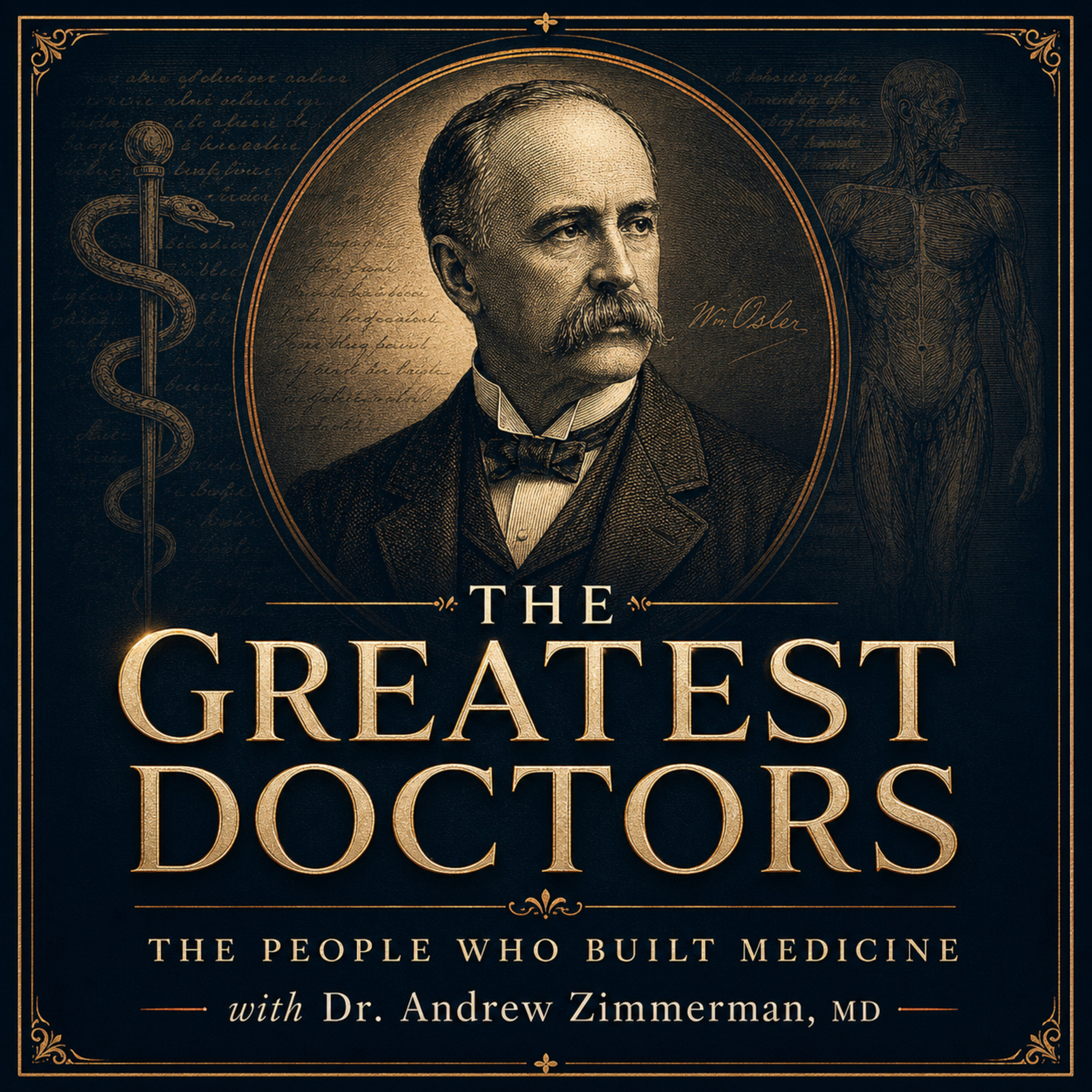
The Greatest Doctors
by Dr. Andrew Zimmerman
Who were the greatest doctors in history, and what can they still teach us today?In each compelling episode, physician Dr. Andrew Zimmerman brings one extraordinary figure from medical history back to life.Discover the breakthroughs, rivalries, failures and acts of courage that transformed medicine, and the lessons modern healthcare may have forgotten along the way.The Greatest Doctors: the people who built medicine, and the lessons they left behind.
-
4
Johannes Culen Interview- The Semmelweiss Foundation
How to Get Healthcare Ideas Funded- What doctors can learn from business
-
3
How NOT to Win Friends and Influence Doctors | Ignaz Semmelweis
Why were women safer giving birth with midwives than with doctors?In 1840s Vienna, Ignaz Semmelweis uncovered a horrifying answer: doctors themselves were carrying deadly infection from the autopsy room to the maternity ward.His solution was astonishingly simple—wash your hands.But being right wasn’t enough.In Episode 2 of The Greatest Doctors, Dr. Andrew Zimmerman travels to Vienna to trace Semmelweis’s story firsthand, including conversations with medical historian Dr. Bernhard Leitner, Austria guide Marieta Teich, and Johannes Culen of the Semmelweis Foundation.It’s a story of discovery, resistance, institutional politics, passion, and the tragic consequences of having the truth but struggling to persuade others to listen.Plus: what Semmelweis taught me about advocating for my own patients when the healthcare system gets in the way.The science has changed. The human problem hasn’t.Further Reading & SourcesFor listeners interested in exploring the history and legacy of Ignaz Semmelweis further:Paul S, et al. Pioneering Hand Hygiene: Ignaz Semmelweis and the Fight Against Puerperal Fever. Cureus. 2024.A review of Semmelweis’s work in Vienna, puerperal fever, mortality in the maternity clinics, and the introduction of chlorinated-lime hand disinfection.Loudon I. Ignaz Phillip Semmelweis’ Studies of Death in Childbirth. Journal of the Royal Society of Medicine. 2013.A historical review of Semmelweis’s investigation of childbed fever and the striking mortality differences between Vienna’s maternity clinics.Jadraque PP, et al. What Happened at Vienna’s Allgemeines Krankenhaus After Semmelweis’s Contract Was Terminated? Epidemiology and Infection. 2017.An examination of Semmelweis’s departure from the Vienna General Hospital and the historical controversy surrounding what happened afterward.World Health Organization. WHO Guidelines on Hand Hygiene in Health Care. 2009.The modern evidence base and international recommendations for hand hygiene and prevention of healthcare-associated infections.Semmelweis Foundation.Information on Semmelweis’s continuing legacy and the Foundation’s modern work in hospital hygiene, infection prevention, education, and awareness.Additional material for this episode came from my trip to Vienna and firsthand interviews and conversations with:• Dr. Bernhard Leitner — medical historian, University of Vienna; interviewed at the Josephinum• Johannes Culen — Secretary General, Semmelweis Foundation• Marieta Teich — Austria Guide, who guided me through the medical history of the Josephinum and University of Viennahttps://see-vienna.com/
-
2
Sir William Osler: The 19th-Century Disruptor Who Rewired Medicine
Sir William Osler transformed medicine—not by inventing a miracle drug, but by changing how physicians think.In the inaugural episode of The Greatest Doctors, Dr. Andrew Zimmerman explores the life, legacy, and enduring influence of Sir William Osler, one of the founders of modern medical education.Discover how Osler revolutionized bedside teaching, helped establish the residency training system, and championed careful observation, clinical reasoning, and compassionate patient care.More than a historical biography, this episode asks an important question:What has modern medicine gained—and what might it have lost?Whether you're a physician, medical student, healthcare professional, or simply fascinated by the history of medicine, this episode offers timeless lessons from one of the profession's greatest minds.Topics discussed:Who was Sir William Osler?The birth of modern medical educationThe importance of bedside medicineClinical judgment in the age of technologyLessons for today's physiciansHost: Andrew Zimmerman, MDMichael Bliss, William Osler: A Life in MedicineSir William Osler, AequanimitasSir William Osler, The Principles and Practice of MedicineJohns Hopkins Medicine historical archivesMcGill University historical resourcesI would also add one sentence at the end that becomes your signature for every episode:The Greatest Doctors explores the lives, ideas, successes, and failures of history's most influential physicians—and what they can still teach us about medicine today.Sources & Further Reading
-
1
Brief intro
Modern medicine has never had more technology.But have we forgotten how to listen?I’m launching a new podcast: The Greatest Doctors, exploring the physicians who shaped medicine, and what their ideas can still teach us today.The first episode begins with Sir William Osler.Coming soon.#BringBackOsler #TheGreatestDoctors #MedicalEducation #Medicine #Healthcare
We're indexing this podcast's transcripts for the first time — this can take a minute or two. We'll show results as soon as they're ready.
No matches for "" in this podcast's transcripts.
No topics indexed yet for this podcast.
Loading reviews...
ABOUT THIS SHOW
Who were the greatest doctors in history, and what can they still teach us today?In each compelling episode, physician Dr. Andrew Zimmerman brings one extraordinary figure from medical history back to life.Discover the breakthroughs, rivalries, failures and acts of courage that transformed medicine, and the lessons modern healthcare may have forgotten along the way.The Greatest Doctors: the people who built medicine, and the lessons they left behind.
HOSTED BY
Dr. Andrew Zimmerman
Loading similar podcasts...
Frequently Asked Questions
How many episodes does The Greatest Doctors have?
The Greatest Doctors currently has 4 episodes available on PodParley. New episodes are automatically indexed when they're published to the podcast feed.
What is The Greatest Doctors about?
Who were the greatest doctors in history, and what can they still teach us today?In each compelling episode, physician Dr. Andrew Zimmerman brings one extraordinary figure from medical history back to life.Discover the breakthroughs, rivalries, failures and acts of courage that transformed...
How often does The Greatest Doctors release new episodes?
The Greatest Doctors has 4 episodes. Check the episode list to see recent publication dates and frequency.
Where can I listen to The Greatest Doctors?
You can listen to The Greatest Doctors on PodParley by clicking any episode. We provide an embedded audio player for direct listening, and you can also subscribe via your preferred podcast app using the RSS feed.
Who hosts The Greatest Doctors?
The Greatest Doctors is created and hosted by Dr. Andrew Zimmerman.
URL copied to clipboard!