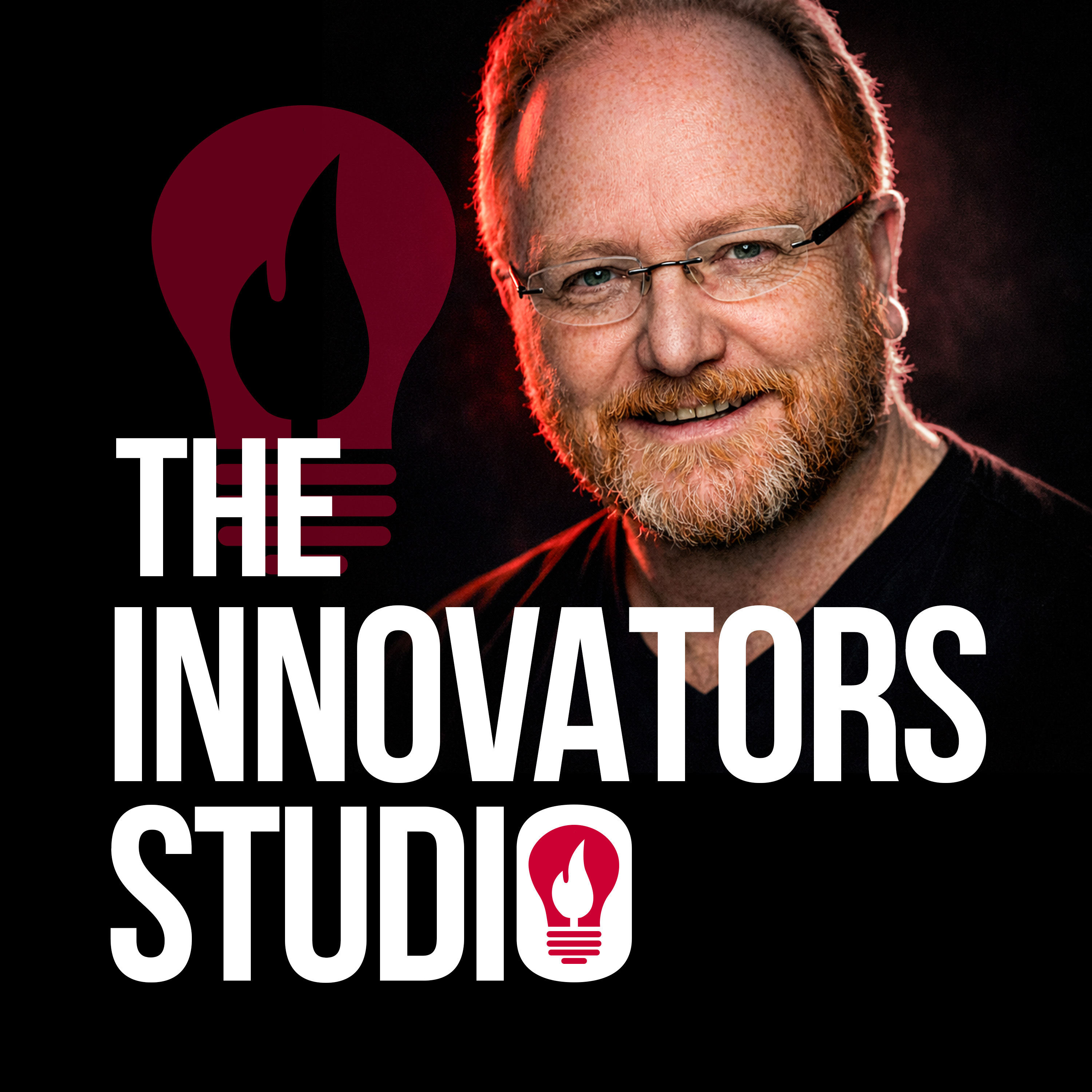
The Innovators Studio with Phil McKinney
by Phil McKinney
Forty years of billion-dollar innovation decisions. The real stories, the hard calls, and the patterns that repeat across every organization that's ever tried to build something new. Phil McKinney shares what those decisions actually look like.Phil was HP's CTO when Fast Company named it one of the most innovative companies in the world three years running. He co-founded a company and took it public. Now he runs CableLabs, the R&D engine behind the global broadband industry.This isn't theory. It's what happened. And what you can see coming if you know what to look for.Running since 2005, originally as The Killer Innovations Show, now The Innovators Studio. Tens of millions of downloads. Full archive at killerinnovations.com. New episodes at philmckinney.com.
Episodes
-
Mastering Critical Thinking in the Age of AI
I asked two AIs one question, and both missed their own future. That's a critical thinking problem for anyone who uses AI. I asked them: "Take a look at consumer electronics and identify the top five unsolved problems that could become disruptions if a solution could be found." Here's what came...
-
Why I Cried on Stage as a CEO
I cried on stage this week, in front of thousands of people. In front of the entire industry. The press in the room wrote about it. I couldn't believe it. Some people will tell you it isn't becoming for a CEO to cry in public, much less in front of the entire industry. They'll tell you it isn't...
-
How To Build Innovation Teams (My Playbook From HP and CableLabs)
Why do people believe you can build an innovation team by hiring a few smart people and giving them a creative space? In my experience, teams built on this false premise die within eighteen months. How do organizations get it so wrong? Innovation consultants have told them, or innovation books…
more -
How to Improve Analytical Thinking Skills
Any team can fill a whiteboard with ideas in an hour. What most teams skip is the analytical thinking that tells them if they're solving the right problem. An idea pointed at the wrong problem is wasted no matter how clever the idea is, and you usually don't discover this mistake for years. By…
more -
How to Recognize Failure Patterns: How HP Quit and Apple Won
Recognizing failure patterns is the closest thing an innovator has to seeing the future. If you can recognize the patterns, you can change the future, because most failures are not original. They repeat, and that repetition is the pattern: the same handful of patterns reappearing in one...
-
How to Improve Your Abductive Reasoning Skills
Sherlock Holmes never once used deduction. Open any of the stories and watch what he actually does. He notices a tan line on a wrist or mud dried on a boot and leaps to the best-fitting explanation. Then he went looking for evidence. Deduction guarantees its conclusions. What Holmes did was…
more -
The Customers Who Walked Away
Think about the last thing you almost bought and did not. You picked it up, you looked at it, you put it back down. You had a reason for choosing one item over its competitors, and you know exactly what it was. Did anybody ever ask you why you didn't choose the loser? Of course not. And somebody...
-
When One Word Steers Your Answer
In 1974, a psychologist named Elizabeth Loftus showed a group of people a film of a car accident. Afterward, she asked half the group one question: how fast were the cars going when they hit each other? The other half got the same question with a single word swapped: smashed instead of hit. The...
-
What Half of 13 Reveals About Your Thinking
What is half of thirteen? Stop. Answer it. Don't think ahead, just answer. You said 6.5. I know you did, because everyone does. Nobody chose to answer that question. Your brain solved it before you decided whether you even wanted to play along. That's the power of a question: whoever hears it...
-
How to Tell a Good Decision From a Lucky One
You trust your gut because it's been right before. But "right" is exactly the thing you've been measuring wrong. A hitter never has this problem. His batting average is honest. It counts hits, nothing else, across a whole season, and he can't argue with the number. Your gut is supposed to work…
more -
How to Improve Weak Signal Judgment
Everyone collects weak signals now. Most of what they collect predicts nothing. A weak signal isn't a thing you spot, it's a prediction you make, and the edge goes to whoever bets on it while being wrong is still cheap. So how do you become the one placing the bet, not the one still collecting...
-
How to Improve Your Second-Order Thinking Skills
In 2000, Toys R Us paid Amazon $50 million a year to sell their toys online. It looked like a great deal. The company that defined toy retail for two generations was solving the internet problem in one move. Four years later they were suing each other. Seventeen years later Toys R Us was gone....
-
How to Improve Your Inversion Thinking Skills
Every playbook, every case study, every innovation workshop is built on the same question: how do you succeed? You map the path forward. You model the upside. Nobody teaches you to ask the harder question. How would you guarantee this fails? That's inversion thinking. Charlie Munger called it one...
-
How to Overcome Expert Bias
Last June, I was on a business trip in Silicon Valley when a second cardiac device failed. Same problem with a second surgical team six months apart. The full story is on philmckinney.com. What changed everything was one doctor who stopped treating what everyone else had diagnosed and asked…
more -
How to Improve Your First Principles Thinking
Most product decisions get made by analogy. Someone says, "This is how we've always done it," or "This is what the market expects," or "This is what the competition is doing." The room nods. The decision gets made. And buried somewhere in the middle of all of it is an assumption nobody checked....
-
How to Overcome Confirmation Bias
Confirmation bias is shaping your decisions right now. Not occasionally. Every day. And the unsettling part is that the smarter you are, the harder it is to see it happening. By the end of this episode you'll know exactly what confirmation bias is. How to recognize when it has taken over a room....
-
Why Most Organizations Aren't Funding Innovation
Twelve official definitions for R&D. Zero agreement. The US government publishes at least a dozen distinct official definitions across agencies, accounting standards, tax authorities, and international bodies. Not one agrees with the others on where research ends and development begins. Trillions...
-
R&D Spending Is the Most Misleading Number in Business
Every public company's R&D number is a lie hiding in plain sight. Not because anyone falsified it. Because the number was never built to tell the truth. It was built to satisfy an accounting standard written in 1974. And for fifty years, boards, analysts, and CEOs have been making billion-dollar...
-
The Innovation Metric Bill Hewlett and Dave Packard Used
Every public company in the technology industry measures innovation spending the same way. R&D as a percentage of revenue. Why? Because Wall Street tracks it. Boards benchmark it. CEOs get fired over it. And it tells you almost nothing about whether the spending is working. Bill Hewlett and Dave...
-
The R&D Metric Mark Hurd and HP Got Wrong
Twenty years. Nearly one thousand episodes on this show. And starting today, we're going to try something a little different this season. Season 21 is about the decisions that actually determine whether innovation lives or dies inside any organization. The real calls. Not the fluff stuff we read…
more -
How to Build a Decision System that Protects Your Thinking
The best decision-makers aren't better at deciding. They're better at controlling when, where, and how they decide. It took me twenty years to figure that out. Most people spend that time trying harder: more discipline, more willpower, more resolve to think clearly under pressure. It doesn't…
more -
How to Quit Defending Decisions You Know are Wrong
Ron Johnson was one of the most successful retail executives in America. He'd made Target hip. He'd built the Apple Store from nothing into a retail phenomenon. So when J.C. Penney hired him as CEO in 2011, expectations were sky-high. Johnson moved fast. He killed the coupons. Eliminated the…
more -
How to Think For Yourself When Everyone Disagrees With You
When neuroscientists scanned the brains of people going along with a group, they expected to find lying. What they found instead was something far stranger. The group wasn't changing people's answers. It was changing what they actually saw. We'll get to that study in a minute. But first, I want…
more -
Better Decisions Under Pressure
"We need an answer by the end of the day." Ten words. And the moment you hear them, something shifts inside your chest. Your pulse ticks up. Your focus narrows. Careful thinking stops. The clock starts. You probably haven't even asked the most important question yet. Is that deadline real? Most…
more -
How to Beat Decision Fatigue
A nurse in Pennsylvania had been on her feet for twelve hours. She was supposed to go home, but the unit was short-staffed, so she stayed. During that overtime, a patient was diagnosed with cancer and needed two chemotherapy doses. She administered the first, placed the second in a drawer, and...
-
How to Stop Overthinking Your Decisions
You've got a decision you've been putting off. Maybe it's a career move. An investment. A difficult conversation you keep rehearsing in your head but never starting. You tell yourself you need more information. More data. More time to think. But you're not gathering information. You're hiding...
-
Mindjacking - When your Opinions are Not Yours
You've built a toolkit over the last several episodes. Logical reasoning. Causal thinking. Mental models. Serious intellectual firepower. Now the uncomfortable question: When's the last time you actually used it to make a decision? Not a decision you think you made. One where you evaluated the...
-
CES 2026 - Battle of the AI Robots
Welcome to this week's show. I'm recording this episode from my hotel room here in Las Vegas, Nevada, at the annual Consumer Electronics Show 2026. If you've been around this channel for long, you know I do this every year. This is 20-plus years I've been coming to the Consumer Electronics Show....
-
Thinking 101: A Pause, A Reflection, And What Might Come Next
Twenty-one years. That's how long I've been doing this. Producing content. Showing up. Week after week, with only a handful of exceptions—most of them involving hospitals and cardiac surgeons, but that's another story. After twenty-one years, you learn what lands and what doesn't. You learn not…
more -
Mental Models - Your Thinking Toolkit
Before the Space Shuttle Challenger exploded in 1986, NASA management officially estimated the probability of catastrophic failure at one in one hundred thousand. That's about the same odds as getting struck by lightning while being attacked by a shark. The engineers working on the actual…
more -
Numerical Thinking: How to Find the Truth When Numbers Lie
Quick—which is more dangerous: the thing that kills 50,000 Americans every year, or the thing that kills 50? Your brain says the first one, obviously. The data says you're dead wrong. Heart disease kills 700,000 people annually, but you're not terrified of cheeseburgers. Shark attacks kill about…
more -
The Clock is Screaming
I stepped out of the shower in March and my chest split open. Not a metaphor. The surgical incision from my cardiac device procedure just… opened. Blood and fluid everywhere. Three bath towels to stop it. My wife—a nurse, the exact person I needed—was in Chicago dealing with her parents' estate....
-
Second-Order Thinking: How to Stop Your Decisions From Creating Bigger Problems (Thinking 101 - Ep 6)
In August 2025, Polish researchers tested something nobody had thought to check: what happens to doctors' skills after they rely on AI assistance? The AI worked perfectly—catching problems during colonoscopies, flagging abnormalities faster than human eyes could. But when researchers pulled the…
more -
Make Better Decisions When Nothing is Certain
You're frozen. The deadline's approaching. You don't have all the data. Everyone wants certainty. You can't give it. Sound familiar? Maybe it's a hiring decision with three qualified candidates and red flags on each one. Or a product launch where the market research is mixed. Or a career pivot...
-
You Think In Analogies and You Are Doing It Wrong
Try to go through a day without using an analogy. I guarantee you'll fail within an hour. Your morning coffee tastes like yesterday's batch. Traffic is moving like molasses. Your boss sounds like a broken record. Every comparison you make—every single one—is your brain's way of understanding the...
-
How To Master Causal Thinking
$37 billion. That's how much gets wasted annually on marketing budgets because of poor attribution and misunderstanding of what actually drives results. Companies' credit campaigns that didn't work. They kill initiatives that were actually succeeding. They double down on coincidences while…
more -
How to Improve Logical Reasoning Skills
You see a headline: "Study Shows Coffee Drinkers Live Longer." You share it in 3 seconds flat. But here's what just happened—you confused correlation with causation, inductive observation with deductive proof, and you just became a vector for misinformation. Right now, millions of people are…
more -
Why Thinking Skills Matter More Than Ever
The Crisis We're Not Talking About We're living through the greatest thinking crisis in human history—and most people don't even realize it's happening. Right now, AI generates your answers before you've finished asking the question. Search engines remember everything so you don't have to....
-
How to Build Innovation Skills Through Daily Journaling
Most innovation leaders are performing someone else's version of innovation thinking. I've spent decades in this field. Worked with Fortune 100 companies. And here's what I see happening everywhere. Brilliant leaders following external frameworks. Copying methodologies from people they admire....
-
The WSJ Got Quarterly Reporting Wrong
Michael Dell and his investors spent twenty-five billion dollars to buy back Dell Technologies. But they weren't really buying a company. They were buying freedom from quarterly earnings pressure. I'm Phil McKinney, former CTO of Hewlett-Packard, and I witnessed how this pressure shaped decisions...
-
How to Get Smarter by Arguing with People who Disagree with You
What if I told you that the people who disagree with you are actually your secret weapon for better thinking? Just last month, my wife and I had a heated argument about studio changes I wanted to make here on the ranch. Her immediate reaction was about cost. Mine was about productivity and...
-
How to See Opportunities Others Miss
In 2005, I had a ten-minute conversation at San Jose Airport that generated billions in revenue for HP. But here's what's fascinating: three other HP executives heard the exact same conversation and saw nothing special about it. If you read Monday's Studio Notes, you know this story from the...
-
5 Questions That Can Spot Breakthrough Innovations Before They Happen
In October 1903, The New York Times published an editorial mocking the idea of human flight, stating that a successful flying machine might take "from one to ten million years" to develop through the efforts of mathematicians and engineers. Eight weeks later, on December 17, 1903, the Wright...
-
I Evaluated over 30000 Innovation Ideas at HP
Your best innovation ideas aren't losing to bad ideas – they're losing to exhaustion. I know that sounds counterintuitive. After 30 years of making billion-dollar innovation decisions at HP and CableLabs, I thought I understood why good ideas failed. Market timing. Technical challenges. Resource...
-
How To Master Lateral Thinking Skills
A software engineer grabbed a random word from a dictionary – "beehive" – and within hours designed an algorithm that saved his company millions. While his colleagues were working harder, he was thinking differently. This breakthrough didn't come from luck. It came from lateral thinking – a...
-
Why Fail Fast Innovation Advice is Wrong
The most popular piece of innovation advice in Silicon Valley is wrong—and it's killing great ideas before they have a chance to succeed. I can prove it with a story about a glass of water that sat perfectly still while a car bounced beneath it. My name is Phil McKinney. I spent decades as HP's…
more -
Innovation Partnership Autopsy: HP, Fossil, and the Smartwatch Market
Innovation partnerships can create breakthrough markets—or hand them to competitors through terrible decisions. I know because I lived through both outcomes. Bill Geiser from Fossil and I had it exactly right. We built the MetaWatch—a smartwatch with week-long battery life, Bluetooth…
more -
Why Great Innovators Read Rooms and not Just Data
You know that moment when you walk into a meeting and immediately sense the mood in the room? Or when a proposal looks perfect on paper, but something feels off? That's your intuition working—and it's more sophisticated than most people realize. Every leader has experienced this: sensing which…
more -
Why Your Best People Give You The Worst Information
The $25 Million Perfect Presentation Picture this: You're in a conference room with 23 executives, everyone has perfect PowerPoint presentations, engineering milestones are ahead of schedule, and you're about to sign off on a $25 million bet that feels like a sure thing. That was the scene at HP...
-
3 Innovation Decision Traps That Kill Breakthrough Ideas (And How to Avoid Them)
Every breakthrough innovation starts the same way: everyone thinks it's a terrible idea. Twitter was dismissed as "breakfast updates." Google looked "too simple." Facebook seemed limited to "just college kids." Yet these "stupid ideas" became some of the biggest winners in tech history. After 30...
About this show
Forty years of billion-dollar innovation decisions. The real stories, the hard calls, and the patterns that repeat across every organization that's ever tried to build something new. Phil McKinney shares what those decisions actually look like.Phil was HP's CTO when Fast Company named it one of the most innovative companies in the world three years running. He co-founded a company and took it public. Now he runs CableLabs, the R&D engine behind the global broadband industry.This isn't theory. It's what happened. And what you can see coming if you know what to look for.Running since 2005, originally as The Killer Innovations Show, now The Innovators Studio. Tens of millions of downloads. Full archive at killerinnovations.com. New episodes at philmckinney.com.
Hosted by
Phil McKinney
Categories