
PODCAST · business
The Lazy Consultant
by Vishwas Maheshwari
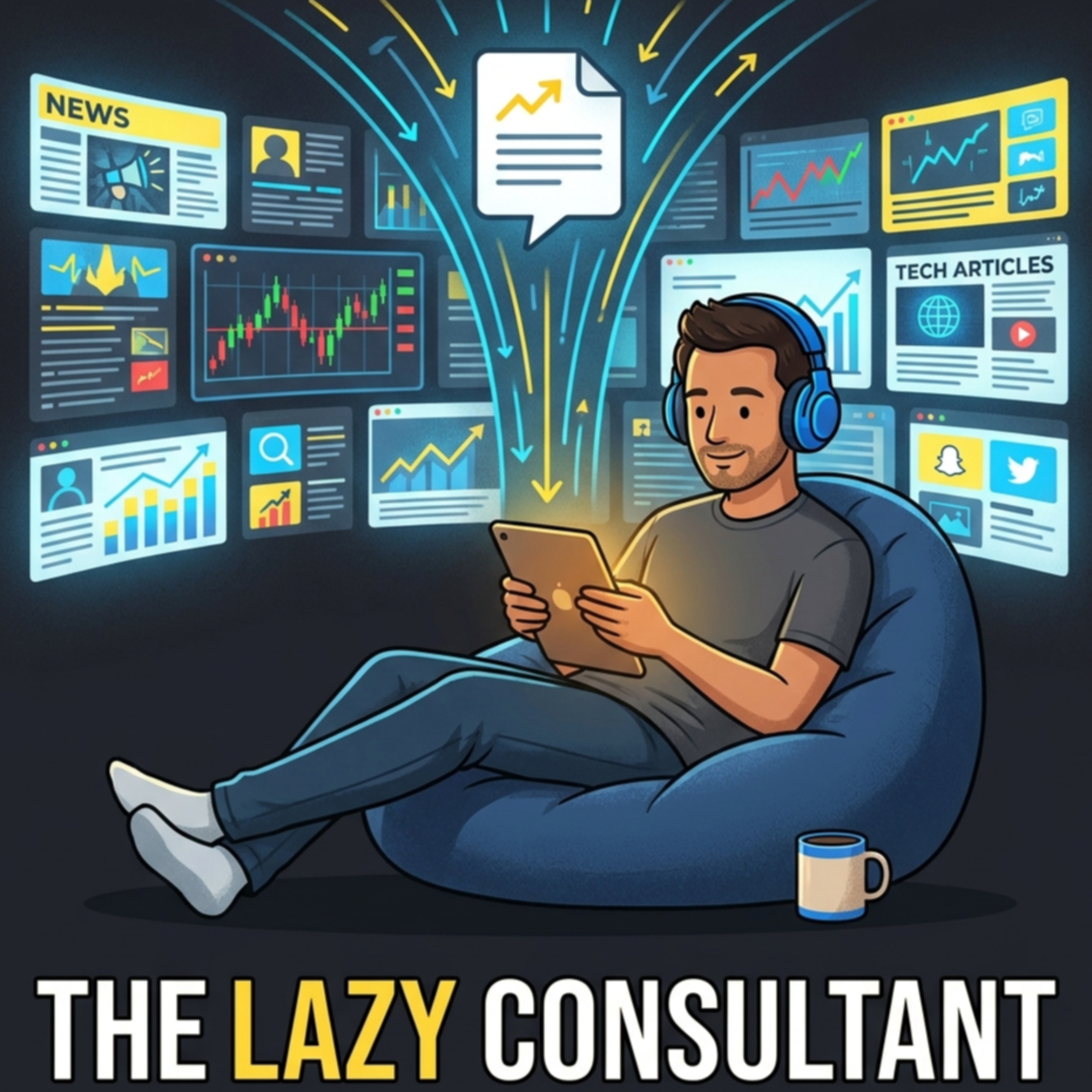
You don't have three hours for a podcast. You barely have twenty minutes. Good — that's all you need.The Lazy Consultant takes the noise — the articles, the announcements, the expert opinions, the hype — and compresses it into sharp, structured briefings you can finish before your coffee gets cold.Here's how it works: we gather the best sources on a topic — podcasts, articles, research, expert takes — run them through a structured analysis process, strip out the filler, the motivational fluff, and the generic advice, and keep only what's specific, sourced, and actually useful.
-
11
Job Hugging: Why People Are Afraid to Leave Their Jobs
I kept noticing something in conversations with people who seemed totally fine at work. They weren't quitting. They weren't even looking. But when I pushed, the real answer was: they were scared to leave, not happy to stay. That distinction matters more than most career content acknowledges.The problem is that most of the coverage around this trend lands in one of two useless places — either "the job market is brutal, stay put" or "bet on yourself, take the leap." Neither of those is actually helpful to someone trying to make a smart decision under real uncertainty.So I went deeper. Emer Moreau at BBC World Service framed job hugging as quiet quitting's sadder cousin — less agency, more dread. ResumeBuilder.com's February 2026 data showed 57% of workers now identify this way, up sharply in just five months. The Conference Board's CEO survey, reported by CNBC, showed more executives plan to cut headcount than grow it — while workers feel increasingly secure. That gap is what this episode sits inside.The takeaway isn't quit or stay. It's: stay alert, stay connected, stay ready.[job hugging, career stagnation, job market 2025, fear-based decisions, workplace trends, upskilling, career development, layoffs, quiet quitting, job security, workforce trends, career preparedness]
-
10
AI and Jobs: What Actually Goes Away and What That Creates
Every time there's a big tech layoff, someone on LinkedIn posts that AI is coming for all of us. Every time the jobs numbers hold, someone else says it's all overblown. I wanted to know what was actually true — not the takes, the evidence.What bothers me about the existing coverage is how much of it is vibes dressed up as analysis. The real story is messier and more specific than either camp admits.Cloudflare hit $639 million in a single quarter — a 16-year high — and cut 20% of its workforce the same week. Tech With Tim tracked what's actually happening to entry-level developer pipelines versus senior roles, and the split is stark. Arvind Narayanan at Bloomberg made the clearest case I've seen for how AI compresses work rather than eliminates it outright. CNBC's reporting on independent and project-based work shows a structural shift that's quieter than the layoff news but probably more important. The WSJ's AWS coverage showed where organizations are actually building new headcount right now.The throughline across all of it: learning AI the way people learned the internet in 1995 is no longer optional. Deep expertise in your domain plus genuine AI fluency is the combination that holds value. Neither one alone is enough anymore.[#AIandJobs #FutureOfWork #Automation #CareerStrategy #AILiteracy #TechLayoffs #DomainExpertise #SoloWork #ProjectBasedWork #SkillsGap #WorkforceTrends #SoftwareEngineering]
-
9
From Prompts to Agents: AI Terms Made Simple
I kept sitting in conversations where people threw around words like "tokens," "agents," and "models" and I realized I was nodding without actually knowing what I was agreeing to. That feeling of almost-understanding is surprisingly hard to shake.The problem is most AI explainers either dumb it down to the point of uselessness or assume you already know half the vocabulary. Neither helps you walk into a real conversation feeling grounded.So this episode goes back to basics. IBM research flagged that demand for AI fluency in job postings has grown sevenfold in two years — which means this isn't trivia. Science Simplified 4 All framed the AI versus machine learning distinction in a way that finally made it stick. The UNESCO AI lexicon gave the precise definitions worth trusting. And the nested-dolls framework from that IBM Think piece made the whole hierarchy click.The goal here is simple. By the end, you should be able to use these words like you own them — because you finally do.[#AIForBeginners #AILiteracy #ArtificialIntelligence #MachineLearning #DeepLearning #Prompts #AIAgents #TechVocabulary #AIExplained #DigitalSkills]
-
8
The New Rules of Content Creation: AI, Virality, and Originality
I kept asking myself why so much content feels hollow right now — even the well-produced stuff. Everyone's posting more, using better tools, moving faster. And somehow it all feels like less.The problem is that most AI content advice skips the foundation entirely. It jumps straight to prompts and workflows without ever asking whether the creator has anything real to say. That's a gap worth sitting with.For this one, I leaned on Neil Patel's research into trust touchpoints — which are actually increasing, not decreasing — and MrBeast's 2024 financials, surfaced in TechCrunch Equity, which quietly revealed that even the most-watched creator on YouTube couldn't sustain a media business on content alone. True Crime Case Files made eighty-two thousand dollars on fabricated content before YouTube banned it. That story matters more than people realize.This episode works through the full arc: what made content work before the algorithm era, which principles never expired, what actually changed when short-form took over, and where AI helps without replacing what only you can bring — taste, experience, and a point of view worth trusting.The speed is real. So is the sameness.[content creation, AI tools, originality, virality, short-form video, founder content, audience trust, storytelling, content strategy, creator economy, AI slop, point of view]
-
7
Procrastination Is Not Laziness: How to Break the Loop
I kept catching myself doing everything except the thing I needed to do. Not scrolling, not sleeping — actually working, just on the wrong things. And I realized I didn't understand what was actually happening.The frustrating part is that most content on procrastination is just repackaged productivity advice. Start earlier. Use a planner. Be more disciplined. None of it touches the actual mechanism, which is emotional, neurological, and self-reinforcing.Professor Fuschia Sirois at the University of Durham has spent twenty years on this and is blunt: there's no convincing evidence procrastination is a time management problem. Dr. Hal Hershfield at UCLA showed through fMRI that your future self registers in your brain like a stranger. Tim Pychyl, who wrote Solving the Procrastination Puzzle, draws a hard line between laziness and blocked desire. Codie Sanchez flagged brain scan data that reframes the whole conversation.This episode maps the loop — why it starts, how to recognize it in yourself, and a step-by-step way to shrink it down until starting feels survivable.The science is clear. The shame isn't helping.[procrastination, behavioral psychology, neuroscience, executive function, dopamine, habit formation, productivity, emotional avoidance, self-compassion, focus, marginal gains, mental health]
-
6
AI for Small Business: What Actually Saves Time and Money
I kept looking at my own overhead and wondering why I was still paying for things AI could clearly handle. Not in a theoretical way — in a very specific, line-item way.The frustration is that most AI content for small business owners is either too abstract or too aspirational. It's all "transform your business" and never "here's what actually runs, what it costs, and what breaks." Nobody talks about the gap between the demo and the deployment.So I went looking for people who'd actually done the math. Intuit's 2026 report across 5.3 million QuickBooks businesses gave me the adoption numbers. Alex Hormozi's walkthrough named the capability shift in a way that finally clicked for me — he calls it "cloud to dirt." Forbes broke down the real cost comparison: $500/month AI stack versus six figures in salaries. Liam Ottley added the reality check about what AI still can't replace. Thryv's survey of 540 small business owners showed the adoption curve accelerating fast.This episode is a working checklist. Not theory. Where to start, what to automate first, and what to leave alone.[small business AI, AI tools for entrepreneurs, solopreneur productivity, AI cost savings, business automation, compete with big companies, AI stack, QuickBooks AI, lean business model, time saving tools, small team operations, AI adoption]
-
5
The AI Shift: What Leaders Know That Most People Don’t
Every time I opened a feed this month, someone was either panicking about AI replacing everything or dismissing it entirely as overblown. I couldn't find anyone actually explaining what's happening at the level where decisions are being made.The frustrating part is that the information exists. The leaders building these systems are talking openly. But the signal keeps getting buried under hot takes and fear content designed to keep you clicking, not thinking.I dug into the primary sources. Sundar Pichai shared token processing numbers at Google I/O that reframe the speed of this entirely. Sam Altman described in February how AI moved from high school math to unsolved research problems in under a year. Andrej Karpathy mapped out three coexisting programming paradigms and why fluency across all three now matters. Dario Amodei gave a two-to-three year window on professional coding. Jensen Huang talked about compute access as the new career advantage.This episode holds the real picture without catastrophizing it. The shift is structural. Your response to it can be too.[AI future of work, AI leadership insights, career and AI, AI literacy, knowledge workers, Sam Altman, Dario Amodei, Andrej Karpathy, AI skills checklist, AI and jobs, tech trends 2026, deep dive tutorial]
-
4
AI Side Hustles: What’s Real, What’s Hype
Someone in my feed quit their job last month because they read that AI makes everything possible now. I wanted to actually look into whether that's true — not to kill the idea, but because the gap between what's being claimed and what's being experienced felt too wide to ignore.The noise is bad in a specific way: it cherry-picks the outlier and presents it as the model. One agent flips $100 into $8,400 a month in 13 days, and suddenly that becomes the pitch. The Census Bureau data on 41 million solopreneurs never makes the thumbnail.Emma Hinchliffe at Fortune reported on the real structural shift in solo business economics. The arXiv research covering 160,000 product launches shows where AI is and isn't moving the needle. Maor Shlomo's deliberate experiment — leaving a scaled company to build alone — tells you more about what leverage actually means than any income claim.What AI genuinely helps with: research, coding support, automation, faster testing. What it doesn't solve: finding a real niche, building trust, getting customers, making judgment calls. This episode is about understanding which category your problem lives in before you hand in your notice.[AI side hustles, solopreneur tools, freelance AI, solo business, AI productivity, independent work, side hustle truth, AI automation, self-employment, AI-native startup, realistic AI use, entrepreneurship]
-
3
Solopreneur Boom Powered by AI: The Real Playbook Behind the Hype
I kept seeing the same headline everywhere — one person, no employees, six figures a month, all thanks to AI. It sounds like a cheat code. I wanted to know if it actually is. So I started pulling apart the claims. The playbooks. The numbers. The parts nobody puts in the thumbnail.I went through Dan Martell on how he launched a company doing $83K/month with one founder and two contractors, Greg Isenberg on why the first solo billion-dollar company is coming but also why most people will plateau at $100K, Yan from Opus Clip on why distribution is now harder than building, Tina Huang on why AI coding tools are transformative only if you already know how to code, Anik Singal's full automation stack from blog post to four platforms with zero manual work, and LinkedIn and Zoom research showing 29.8 million solopreneurs contributing $1.7 trillion to the U.S. economy.The opportunity is real. But so is the gap between the pitch and the grind. This episode covers both — honestly.[solopreneur] [AI business] [one-person company] [automation] [no-code tools] [solo founder] [AI agents] [distribution] [startup playbook] [creator economy]
-
2
Google I/O 2026 Lazy Recap
Google I/O happened this week and within hours my feed was flooded. Every tech YouTuber had a recap. Every newsletter had a hot take. Google themselves published a list of 100 announcements — one hundred. And that is the problem. When a company announces that many things in one keynote, it becomes genuinely hard to figure out what actually matters, what is available right now, and what is just a polished demo that might ship in six months or quietly disappear.So I did what I usually do — I pulled together the sources that actually went deeper than surface-level excitement, filtered out the hype, and built this episode from what survived.I went through the official Google I/O keynote and their published 100-announcement list, the Google Blog's detailed breakdowns on the new models and AI Search changes, Peter Diamandis and the Moonshots podcast panel where Dave, Salim Ismail, and their AI co-host Alex gave one of the most honest independent analyses I found — including calling Gemini Spark a "lazy copycat" while acknowledging Google's distribution advantage is nearly impossible to beat. I pulled from Ishan Sharma's on-the-ground coverage from the event itself, SAMTIME's pointed satirical take that asked the questions most polite reviewers avoided, and the Google Marketing Live recap for the commerce and advertising side that the main keynote glossed over.I stripped out the generic excitement, the sponsor reads, the "this changes everything" filler, and kept only the specifics — model names, benchmark numbers, what is live today versus what is a vague summer promise, where the sources genuinely disagreed with each other, and what you can actually go open on your phone right now and try.This episode breaks down Google I/O 2026 into what you actually need to know. Gemini 3.5 Flash and why the speed and cost story matters more than the benchmarks. Gemini Omni and what it means that Google is now the only major American lab still seriously pursuing video generation. Gemini Spark — Google's new always-on personal agent — and the honest debate about whether it is genuinely innovative or just Google's fast-follow response to OpenAI. Antigravity 2.0 and the 12-hour OS-building demo that was either impressive or terrifying depending on who you ask. The quiet revolution in Google Search that might matter more than any of the flashy announcements. And a clear breakdown of what is available today, what is coming this summer, and what is still a promise.No hype. No "this changes everything." Just what shipped, what it means, and what to do about it.[Google I/O 2026] [Gemini 3.5 Flash] [Gemini Omni] [Gemini Spark] [Antigravity 2.0] [AI Agents] [Google Search AI] [Agentic AI] [AI Mode] [Google AI Studio] [Sundar Pichai] [Demis Hassabis] [Google vs OpenAI] [AI Overview] [NotebookLM] [Universal Cart] [Daily Brief] [Audio Glasses] [Google Flow] [AI Search] [Gemini API] [SynthID] [The Lazy Consultant]What This Episode CoversKeywords
-
1
Psychology, Platforms, and AI: The Social Media Stack That Actually Works
I wanted to understand what actually makes social media content work — not the surface-level tips, the real mechanics. So I started going through everything. Storytelling science, platform algorithms, psychology of persuasion, AI workflows, creator strategies. The problem? There's too much out there. Everybody's an expert now. Hours of content, overlapping advice, contradictions, filler disguised as strategy.So I pulled together the sources that actually said something — David JP Phillips on the neurochemistry of storytelling, Seth Godin on why attention without trust is worthless, Daniel Baton on why scripting is 80% of the work, Modern Millie's breakdown of how Instagram and TikTok algorithms actually differ, Rory Sutherland on why breakthroughs beat daily optimization, and the Big Think neuroscience research showing brand loyalty runs on the same brain circuitry as family bonds. I filtered out the fluff and built this episode from what survived.Three layers. The psychology that hasn't changed in 100,000 years. The platforms that changed last month. And the AI tools that can multiply your output — or hollow it out. This episode connects all three.[social media marketing] [storytelling] [human psychology] [content creation] [platform algorithms] [AI tools for creators] [brand identity] [short-form content] [hooks and retention] [creator economy]
We're indexing this podcast's transcripts for the first time — this can take a minute or two. We'll show results as soon as they're ready.
No matches for "" in this podcast's transcripts.
No topics indexed yet for this podcast.
Loading reviews...
ABOUT THIS SHOW
You don't have three hours for a podcast. You barely have twenty minutes. Good — that's all you need.The Lazy Consultant takes the noise — the articles, the announcements, the expert opinions, the hype — and compresses it into sharp, structured briefings you can finish before your coffee gets cold.Here's how it works: we gather the best sources on a topic — podcasts, articles, research, expert takes — run them through a structured analysis process, strip out the filler, the motivational fluff, and the generic advice, and keep only what's specific, sourced, and actually useful.
HOSTED BY
Vishwas Maheshwari
CATEGORIES
Loading similar podcasts...
Frequently Asked Questions
How many episodes does The Lazy Consultant have?
The Lazy Consultant currently has 11 episodes available on PodParley. New episodes are automatically indexed when they're published to the podcast feed.
What is The Lazy Consultant about?
You don't have three hours for a podcast. You barely have twenty minutes. Good — that's all you need.The Lazy Consultant takes the noise — the articles, the announcements, the expert opinions, the hype — and compresses it into sharp, structured briefings you can finish before your coffee gets...
How often does The Lazy Consultant release new episodes?
The Lazy Consultant has 11 episodes. Check the episode list to see recent publication dates and frequency.
Where can I listen to The Lazy Consultant?
You can listen to The Lazy Consultant on PodParley by clicking any episode. We provide an embedded audio player for direct listening, and you can also subscribe via your preferred podcast app using the RSS feed.
Who hosts The Lazy Consultant?
The Lazy Consultant is created and hosted by Vishwas Maheshwari.
URL copied to clipboard!