
PODCAST · science
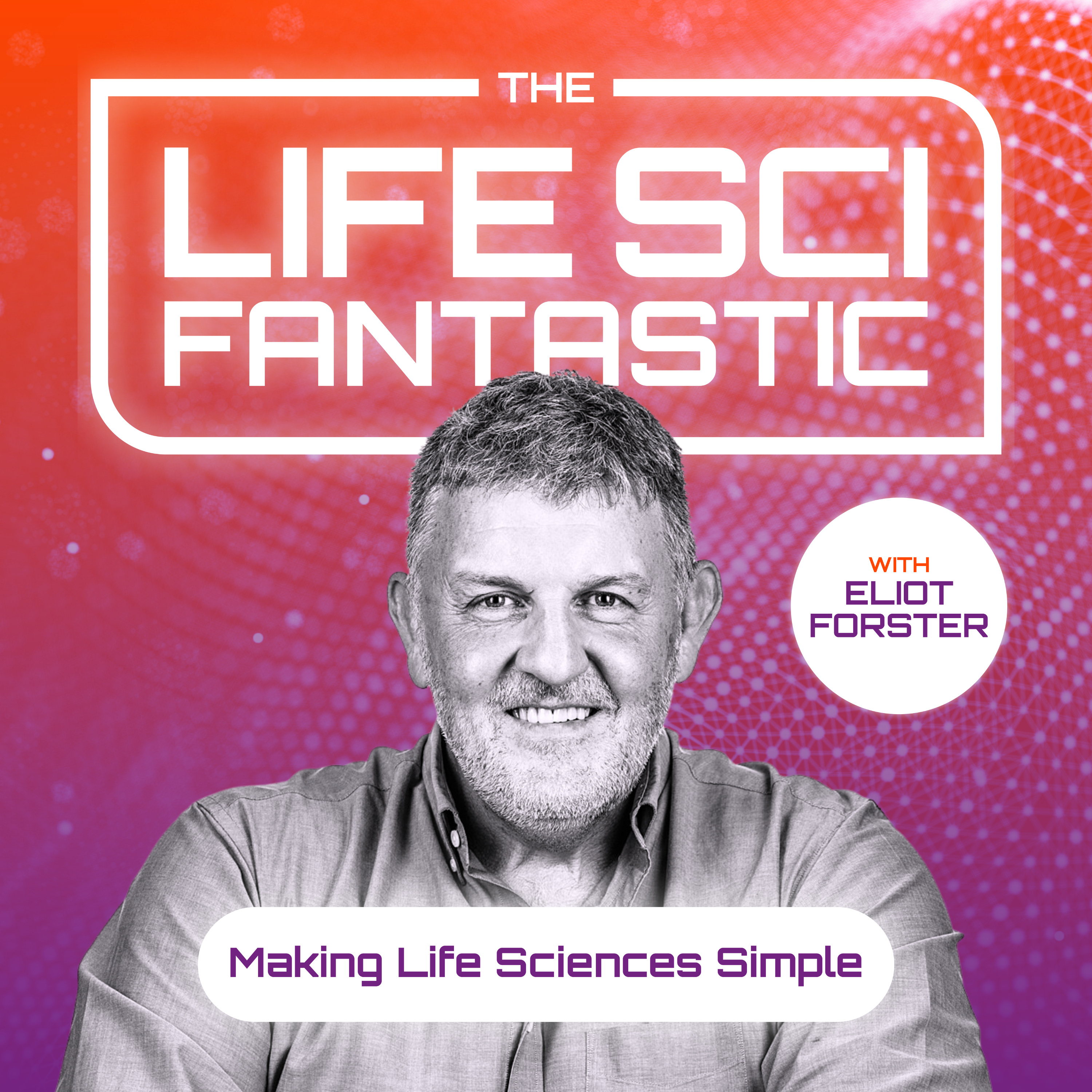
The Life Sci Fantastic
by Eliot Forster
This is the podcast that pulls back the curtain on life sciences – explaining the scientific breakthroughs that are literally changing our lives. Hosted by Eliot Forster, scientist and entrepreneur with more than thirty years’ experience, each episode dives into the science of our bodies and the innovations reshaping modern medicine. With leading experts as his guests, Eliot makes complex discoveries clear, relatable, and inspiring — showing how today’s research is transforming tomorrow’s treatments.
-
18
HEALTHSPAN vs. LIFESPAN: How to live healthier for longer
We have the science, the tools, and the evidence to help people live longer healthier lives. So why do our healthcare systems still spend the vast majority of their money treating rather than preventing disease? In this episode, Eliot sits down with Lord James Bethell – former UK Minister for Life Sciences during COVID, Chair of the BARBARA Alliance dementia registry, and one of the most vocal advocates in Britain for shifting healthcare from sickness service to prevention system.Together, Eliot and James dig into why the diseases killing us today are almost all human-made, what the GLP-1 revolution reveals about a public that has been let down by decades of ineffective interventions, why the UK has ended up privatising prevention while socialising treatment. A clear, urgent, and refreshingly honest conversation for anyone thinking seriously about the future of health – and about who is going to pay for it.CHAPTERS:00:00 – Healthspan vs. lifespan06:21 – The lateral flow test and the cost of leaving good tech on the shelf08:43 – Why today's diseases are human-made, not biological11:29 – The confidence problem: does prevention really work?13:04 – Multi-morbidity: why fixing one disease is not enough13:49 – Statins, GLP-1s, and the science of visible efficacy17:14 – Breaking the convention of symptom-led medicine19:08 – The bad luck fallacy: how much of chronic disease is modifiable?21:32 – Giving people agency without moralising about health24:39 – The economics: why we privatised prevention and socialised acute care29:07 – Why more hospitals and more nurses is not the answerFOLLOW LORD JAMES BETHELL:James Bethell on LinkedIn: www.linkedin.com/in/jamesbethell/Listen to James’s Podcast: https://podcasts.apple.com/gb/podcast/prevention-is-the-new-cure/id1673584286This podcast was produced by Crisis What Crisis ProductionsWith special thanks to Mintz: life sciences lawyers who help turn scientific breakthroughs into reality. https://www.mintz.com
-
17
CAN A SELFIE REPLACE YOUR DOCTOR?
We have spent a century building an extraordinary system to fix people once they are broken. What would it take to build one that stops them breaking in the first place? In this episode, Eliot sits down with George Tomeski, founder and CEO of Helfie AI – a personal health AI designed to put early detection and prevention into the hands of anyone with a mobile phone.George is not a doctor and doesn't pretend to be. He came to this through something painful and personal – his mother's stomach cancer, missed for over a decade despite regular visits to a GP. That experience led him to a bigger question: is her story actually rare, or is it the quiet norm across every healthcare system in the world?Together, Eliot and George explore the difference between healthcare and health, why every system on the planet – free or paid – shares the same structural flaw of engaging only after breakdown, and what becomes possible when a selfie, a cough, or a photograph can be turned into meaningful clinical signal. CHAPTERS:07:16 – The structural flaw in every healthcare system10:10 – Redefining health: detection, prevention, optimisation13:52 – Why the time is now: sensors, AI, and mobile phones15:01 – Human health data as the world's largest data category17:59 – Reaching the four billion people without access to a doctor20:41 – Compute-at-sense: the economics of accessibility21:35 – Inside the Helfie platform: what a selfie can actually detect24:02 – Cardiovascular, respiratory, STIs and cognitive decline25:13 – Photoplethysmography and the science of a phone camera28:23 – Validation, accuracy, and regulatory approval30:00 – Why deviation from baseline matters more than any single reading32:03 – Precision medicine, finally made real34:37 – The behaviour problem: knowing vs. doing37:28 – 6G towers, ambient sensing, and the future of health infrastructure38:44 – Cholera pumps, seatbelts, and the plumbing of human healthFOLLOW GEORGE:George Tomeski: www.linkedin.com/in/gtvs/Healfie AI: www.helfie.ai/This podcast was produced by Crisis What Crisis ProductionsWith special thanks to Mintz: life sciences lawyers who help turn scientific breakthroughs into reality. https://www.mintz.com
-
16
HOW SCIENTIFIC IDEAS BECOME MEDICINES
For an idea to travel from a university laboratory to a patient's bedside is long and difficult. In this special double-header, Eliot sits down with two people who see that journey from opposite ends of the table.First, Professor Chas Bountra, former Pro-Vice-Chancellor for Innovation at the University of Oxford, explains how Oxford rewired its own culture to become the UK's most productive innovation engine. The story includes two unicorn acquisitions, the deliberate equity reform that unlocked academic ambition, and the moonshot question driving the next chapter: when will the UK build its first trillion-pound company?Then, Emma Johnson takes us inside the investor's room. A neuroscientist by training and now a leading UK life sciences venture investor, Emma explains how venture capital actually works, how she decides whether a scientific idea is worth millions, and the single trait she values above all others in a founder.Together, two halves of the same story, and a clear-eyed, hopeful conversation for anyone curious about how science becomes a meaningful impact in the real world.CHAPTERS: 01:56 – Chas Bountra 05:08 – Inside drug discovery at GSK: why 90% of ideas fail 09:30 – Rewiring a university for innovation 11:32 – The equity reform that unlocked academic entrepreneurship 15:00 – Two unicorn exits 16:32 – Building an ecosystem: people, capital, ambition 17:30 – How does the UK compete with the US, China and India? 19:48 – Anti-science, AI, and anticipating the downsides of new tech 24:32 – Emma Johnson 25:44 – From neuroscience to venture capital 27:21 – What "venture" actually means 29:54 – How venture capital funds are structured: LPs, GPs and returns 33:51 – Inside the British Business Bank and the Future Fund: Breakthrough 36:47 – What makes a UK biotech globally competitive 40:39 – How an investor assesses a scientific pitch 48:16 – When investors say no 51:24 – The traits that matter in a biotech founder 54:17 – There is no straight line to success 55:48 – What success really looks like from the investor's seatFOLLOW THE GUESTS:Professor Chas Bountra: https://www.linkedin.com/in/chas-bountra-72b9991/Emma Johnson: https://www.linkedin.com/in/emma-johnson-life-sciences/This podcast was produced by Crisis What Crisis Productions. With special thanks to Mintz: life sciences lawyers who help turn scientific breakthroughs into reality. https://www.mintz.com
-
15
WHAT ACTUALLY HELPS YOU LIVE LONGER?
Most of the advice that genuinely helps you live longer is free, simple, and a little boring. That is probably why so few people follow it.That idea sits at the heart of this episode. Host Dr Eliot Forster sits down with Dr James McIlroy – a qualified medical doctor, founder and CEO of the Aberdeen microbiome company EnteroBiotix, and host of the gut-health podcast Inside Matters.Together they separate the noise from that which is not just useful, but scientifically proven. They start with the fundamentals that almost everyone can act on – sleep, colourful minimally processed food, daily movement, resistance training, and the things worth avoiding, like alcohol. Then they move up the pyramid to the more experimental end: supplements, sauna, heat shock proteins, and what the data does and does not yet support.Whether you are a life sciences student, a curious listener, or someone simply trying to work out which health advice is worth your time, start here.CHAPTERS:05:27 Bryan Johnson, Blueprint and the pyramid of fundamentals.09:00 Diet.11:25 Fermented foods and the gut.12:33 Alcohol.16:30 Exercise.18:04 Resistance training.20:51 Exercise vs. diet.23:00 Supplements: what the evidence actually supports.24:40 Stem cells, peptides and GLP-1s.26:34 Sleep.28:17 What wrecks sleep.30:30 Sauna.33:27 The microbiome.Produced by Crisis What Crisis Productions With special thanks to Mintz – life sciences lawyers who help turn scientific breakthroughs into reality. https://www.mintz.com
-
14
HOW SCREENS HIJACK THE BRAIN
We're not just raising children in a digital world – we're all living in it. In part two of this conversation, Eliot turns the lens around and asks Dr. Michael Rich what a lifetime of screens means for the rest of us: the adults negotiating the relentless pull of smartphones, social media, and now AI companions that tap straight into our emotional circuitry.Dr. Michael Rich – paediatrician at Boston Children's Hospital, Harvard professor, and "The Mediatrician" – argues that no screen problem is ever really an individual one. It's a family system, and increasingly a societal one. They explore why companion AI is a different and more powerful beast than old-fashioned social media, why banning phones is a blunt instrument where a scalpel is needed, and how the slow erosion of everyday human connection may be reshaping society itself.CHAPTERS: 01:24 – What a lifetime of screens does to adults 02:47 – Why screen use is a family system, not an individual failing 05:55 – Modelling and mentoring: keeping up with your kids 08:22 – Vetting the digital babysitter 08:50 – Companion AI and the limbic system 10:30 – Digital literacy vs digital fluency 14:08 – Do social media age bans actually work? 16:39 – Connectivity vs connection 19:23 – Why the scientific method matters more than ever 22:21 – Boredom as the engine of creativity 24:09 – Loneliness, isolation and mental health 25:06 – Mastery: the fifth M 27:00 – Can social media be used authentically? 28:45 – The Inspired Internet Pledge30:50 – What tech can learn from pharma's pre-competitive collaboration 33:35 – A supercomputer, not a telephone FOLLOW DR. MICHAEL RICH: The Mediatrician: https://themediatrician.com/ Digital Wellness Lab: https://digitalwellnesslab.org/BUY MICHAEL'S BOOK: The Mediatrician's Guide: https://www.harpercollinsfocus.com/9780785255727/the-mediatricians-guide/This podcast was produced by Crisis What Crisis Productions With special thanks to Mintz: life sciences lawyers who help turn scientific breakthroughs into reality. https://www.mintz.com
-
13
ARE SMARTPHONES CHANGING OUR CHILDREN’S BRAINS?
What is happening to our children's brains as they grow up with a supercomputer in their pocket?In part one of this two-part conversation, Eliot sits down with Dr. Michael Rich – paediatrician at Boston Children's Hospital, associate professor at Harvard Medical School, and the man known to many as "The Mediatrician."Michael's path is unlike most doctors'. Before medicine, he spent his early career in film, including four years in Japan working as an assistant director to the legendary Akira Kurosawa. Understanding how content for screens is made, and what they are designed to do [to us] has shaped decades of Dr Rich’s research into how digital media is rewiring childhood.CHAPTERS: 02:40 – Why a filmmaker became a paediatrician 05:46 – Screens as an environmental health issue 10:40 – How the brain wires itself to the world 12:45 – Lessons from Romanian orphanages 15:57 – Screens aren't too much, they're too little 17:14 – Dopamine explained 18:08 – What growing up on screens does to attention 20:52 – Bringing back boredom 22:30 – Is it too late for the smartphone generation? 24:36 – The five Ms of digital wellness 29:21 – Monitoring, privacy, and the forbidden fruit 31:31 – Should smartphones be in schools? BUY DR. RICH’S BOOK: The Mediatrician's Guide: A Joyful Approach to Raising Healthy, Smart, Kind Kids in a Screen-Saturated World - https://www.amazon.co.uk/Mediatricians-Guide-Approach-Raising-Screen-Saturated/dp/0785255729MORE FROM DR RICH:Digital Wellness Lab: https://digitalwellnesslab.org/ CIMAID (Clinic for Interactive Media and Internet Disorders): https://www.childrenshospital.org/programs/clinic-for-interactive-media-and-internet-disordersA CRISIS WHAT CRISIS PRODUCTION: This podcast was produced by Crisis What Crisis Productions. https://www.crisiswhatcrisis.com/ POWERED BY MINTZ: With special thanks to Mintz: life sciences lawyers who help turn scientific breakthroughs into reality. https://www.mintz.com
-
12
CAN AI CURE LIVER DISEASE?
What if the next breakthrough in liver disease comes from an algorithm rather than a lab bench? In this episode, Eliot sits down with Dr. Quin Wills, clinician, geneticist, and co-founder and CEO of Ochre Bio, an Oxford-based biotech using AI to tackle chronic liver disease.In this episode we unpack what AI actually is (and isn't), how it's being used to discover new medicines, and why liver disease is one of the biggest health challenges most people have never heard about.Along the way: why fatty liver used to be ignored by doctors, what large language models reveal about human intelligence, and whether AI could ever run a biotech on its own. CHAPTERS: 01:30 – Meet Quin Wills 03:30 – Why genetics led him to AI 04:32 – Liver disease: the myths 06:40 – The obesity wave 08:02 – A short history of AI 11:40 – AI and the scientific method 13:27 – How drugs get discovered 16:21 – AI from lab to clinic 19:29 – Better, cheaper, faster? 22:00 – Why humans still matter 24:46 – Biotech vs big pharma 28:01 – Could AI replace scientists? 30:15 – The chemistry comeback 33:03 – The next frontier: causality 36:15 – Failing forward in drug discovery 37:47 – Treating disease in combination 37:55 – What's next for Ochre Bio 39:06 – Closing thoughtsFOLLOW QUIN: LinkedIn: https://www.linkedin.com/in/quinwills/LEARN MORE ABOUT OCHRE BIO: LinkedIn: https://www.linkedin.com/company/ochre-bio/This podcast was produced by Crisis What Crisis Productions. www.crisiswhatcrisis.comWith special thanks to Mintz: life sciences lawyers who help turn scientific breakthroughs into reality. https://www.mintz.com
We're indexing this podcast's transcripts for the first time — this can take a minute or two. We'll show results as soon as they're ready.
No matches for "" in this podcast's transcripts.
No topics indexed yet for this podcast.
Loading reviews...
ABOUT THIS SHOW
This is the podcast that pulls back the curtain on life sciences – explaining the scientific breakthroughs that are literally changing our lives. Hosted by Eliot Forster, scientist and entrepreneur with more than thirty years’ experience, each episode dives into the science of our bodies and the innovations reshaping modern medicine. With leading experts as his guests, Eliot makes complex discoveries clear, relatable, and inspiring — showing how today’s research is transforming tomorrow’s treatments.
HOSTED BY
Eliot Forster
CATEGORIES
Loading similar podcasts...
Frequently Asked Questions
How many episodes does The Life Sci Fantastic have?
The Life Sci Fantastic currently has 7 episodes available on PodParley. New episodes are automatically indexed when they're published to the podcast feed.
What is The Life Sci Fantastic about?
This is the podcast that pulls back the curtain on life sciences – explaining the scientific breakthroughs that are literally changing our lives. Hosted by Eliot Forster, scientist and entrepreneur with more than thirty years’ experience, each episode dives into the science of our bodies and the...
How often does The Life Sci Fantastic release new episodes?
The Life Sci Fantastic has 7 episodes. Check the episode list to see recent publication dates and frequency.
Where can I listen to The Life Sci Fantastic?
You can listen to The Life Sci Fantastic on PodParley by clicking any episode. We provide an embedded audio player for direct listening, and you can also subscribe via your preferred podcast app using the RSS feed.
Who hosts The Life Sci Fantastic?
The Life Sci Fantastic is created and hosted by Eliot Forster.
URL copied to clipboard!