
PODCAST · business
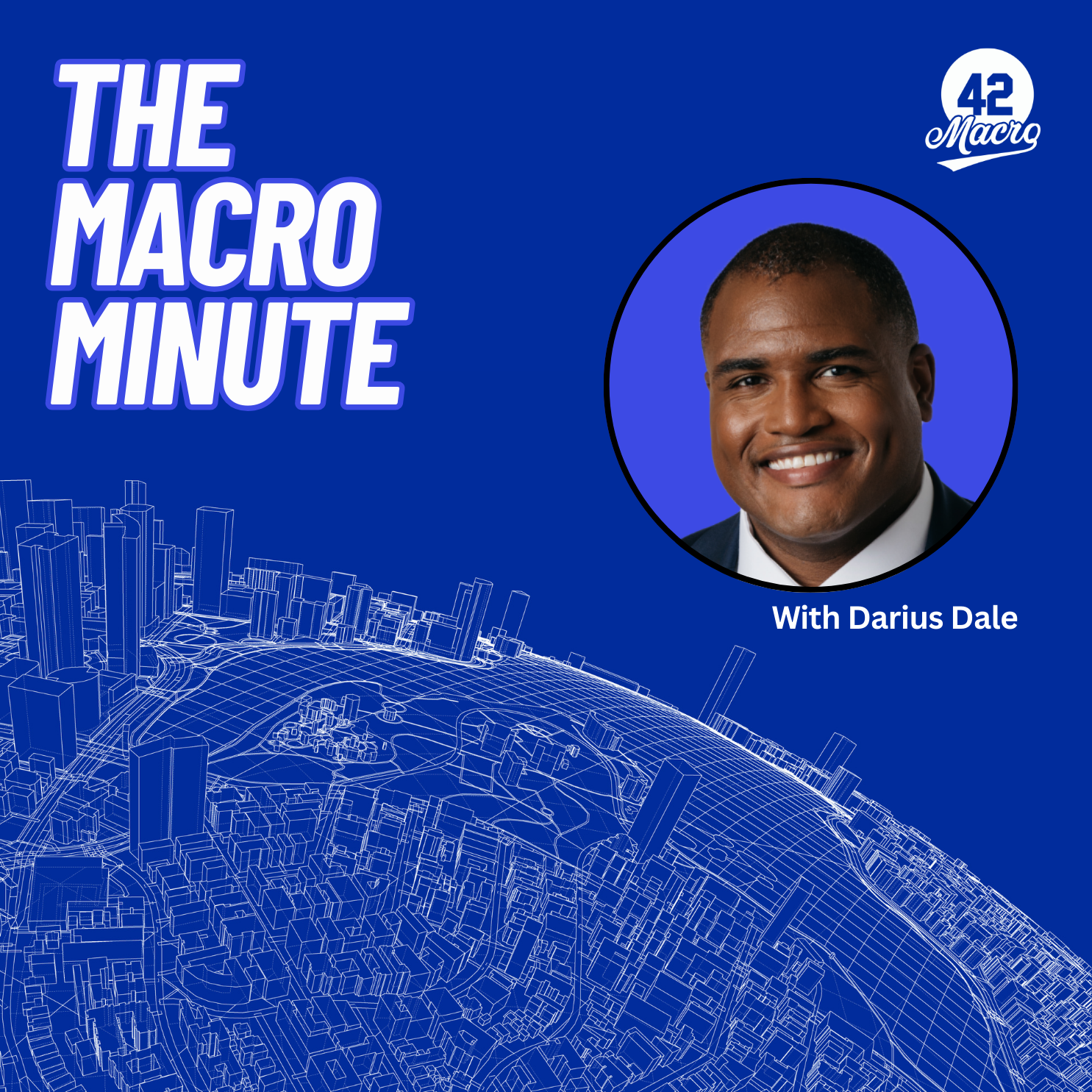
The Macro Minute with Darius Dale
by 42 Macro
The Macro Minute is a daily morning podcast of what 42 Macro Founder & CEO Darius Dale is seeing in the overnight markets and where he/'s focused before the US stock market open.
-
346
Who’s right: Druckenmiller or Bessent?
In this version of the Macro Minute, Darius examines who’s right in the Treasury market debate between Stanley Druckenmiller and Scott Bessent, explaining why recent efforts to manage the bond market may ultimately accelerate the transition toward Paradigm D, or “Control + Print.” He also discusses 42 Macro’s estimate that the 10-year Treasury yield remains well below fair value and why the structural supply-demand imbalance in the Treasury market remains a critical long-term risk for investors.
-
345
Is Bessent’s Bridge long enough to prevent a deep correction in stocks, part III?
Darius explains why “Bessent’s Bridge” appears to be growing longer, with the Global Macro Risk Matrix now assigning a 61% probability to the bullish outcome of avoiding a deep correction in stocks. He also discusses how the administration’s efforts to support the AI CapEx boom, contain bond-market volatility, and bridge markets toward potentially dovish Fed reforms could ultimately require continued financial repression and monetary debasement.
-
344
Will Republicans be forced to "tax the rich"?
We explore why Paradigm D, or “Print the Demand,” remains 42 Macro’s highest-probability long-term outcome as the U.S. confronts a growing Treasury supply-demand imbalance. We also examine Treasury Secretary Scott Bessent’s efforts to contain bond yields and why increasing coordination between the Treasury and Fed could have significant implications for gold, bonds, and monetary policy.
-
343
Will increased competition for capital cause a correction in stocks?
Darius Dale examines whether rising competition for capital could trigger a correction in stocks, as long-duration sovereign yields climb alongside the enormous financing demands of the AI CapEx boom. While the 12-month outlook remains bullish for risk assets, mounting monetary policy, liquidity, and positioning headwinds could make the next few months increasingly volatile.
-
342
Is the cost of capital too cheap?
In today’s Macro Minute, Darius Dale examines whether the cost of capital is becoming too cheap as the AI CapEx boom drives record corporate debt issuance and increasingly competes with sovereign debt—and potentially equities—for investor capital.
-
341
Is the AI capex bubble’s increasing reliance on circular financing bullish or bearish?
Darius explains why the AI CapEx boom’s growing reliance on circular financing is overwhelmingly bullish for now, as institutional capital provides additional runway for AI infrastructure spending and asset valuations. He also examines how rising capital demand is pushing R-star higher and why cyclical Fed tightening could ultimately reduce bond-market volatility, even if it creates some risk for equities.
-
340
Should investors be sanguine amid the transition from earnings season to macro season?
Darius explains why investors can remain sanguine as markets transition from earnings season to macro season. He highlights cooling housing and labor-market dynamics as incremental support for 42 Macro’s Jobless Recovery theme, potentially reducing the need for the Fed to tighten policy before creating room for more substantial easing in 2027 and beyond.
-
339
Will the labor market get left behind by the stock market on a permanent basis?
In this Macro Minute, Darius Dale explains why accelerating AI adoption is creating a growing divide between capital and labor, reinforcing the Paradigm C bull market while increasing the long-term risk of a deeper K-shaped economy and political realignment.
-
338
Is Treasury Secretary Bessent bailing out the market (again)?
In this episode, we explore why the Treasury's latest financing actions reinforce 42 Macro's long-standing thesis of a geopolitically driven supply-demand imbalance in the Treasury bond market. We also discuss how these policy measures are easing pressure on the Federal Reserve, why the Fed may still need to regain credibility with the bond market before pivoting dovish, and what those dynamics mean for investors navigating today's macro regime.
-
337
Is the US Treasury still supporting the 42 Macro Paradigm C Bull Market™?
Darius explains why the Q3 Quarterly Refunding Announcement reinforces 42 Macro's long-term thesis that geopolitical imbalances in the Treasury bond market will require increasingly dovish monetary and financing policy. He also discusses why the bond market is signaling the Fed is falling behind the curve and why delaying cyclical tightening could increase the risk of a more serious structural disruption in the Treasury market.
-
336
Is the US labor market tight or loose?
Today, Darius examines the conflicting signals emerging from the latest JOLTS report, explaining why slowing labor market turnover and shrinking labor supply are creating uncertainty around the Fed's reaction function. He also discusses why monetary policy remains the key macro cycle to watch and how KISS and Dr. Mo can help investors navigate the growing risk of a transition from policy tailwind to headwind.
-
335
Will Japan force the Fed to Ctrl+P?
Darius examines how Japan's evolving reflation agenda and shifting global capital flows are creating structural pressure on the U.S. Treasury market. He also explains why rising global bond yields, growing AI capital demands, and changing foreign investor behavior continue to increase the probability that the Federal Reserve will ultimately be forced to tighten monetary policy.
-
334
Is the US economy running hot or cold?
Darius Dale explains why the underlying economic data continue to support a "Run It Hot" regime despite the market's dovish interpretation of GDP and inflation reports. He also examines the bond market's historic reaction to the latest FOMC decision, why 42 Macro believes the Fed may still need to tighten monetary policy, and what Microsoft's and Meta's latest AI capital spending plans signal for investors.
-
333
Are the hyperscalers too cheap to keep selling?
We examine how the AI investment boom is transforming hyperscalers into increasingly capital-intensive businesses, why investors are becoming less tolerant of rising AI capex, and what that means for market risk. Also, we explain why 42 Macro believes the Fed may be deliberately tightening cyclically to create room for structurally easier monetary policy in the future.
-
332
Does AI have a circular financing problem?
Darius Dale examines the growing financing risks behind the AI infrastructure buildout, why credit markets are beginning to price those risks more aggressively than equities, and how evolving capital market dynamics could shape the next leg of the summer correction thesis. He also explains the asymmetry of percentage-change math and why minimizing downside capture is critical to long-term investment success.
-
331
Is the global cost of capital too low?
We examine why the global cost of capital remains too low despite mounting signs of tightening global liquidity. Darius also explains how structurally elevated nominal GDP growth, depressed global savings growth, and intensifying competition for capital are driving higher global bond yields and increasing the risk of a summer 1998-style correction.
-
330
Why has Q2 earning season been a sell-the-news catalyst for AI stocks?
Today's Macro Minute examines why Q2 earnings season has become a sell-the-news catalyst for AI stocks. Darius explains how rising AI capital expenditures, weakening free cash flow, and intensifying competition for scarce global capital are forcing investors to demand tangible returns on AI investments. He also explores how slowing global savings, higher neutral interest rates, and growing competition between U.S. Treasury financing needs and hyperscaler AI spending could keep upward pressure on the cost of capital and shape market dynamics in the months ahead.
-
329
Does AI have a women and young people problem?
We explore the growing political risks surrounding artificial intelligence as public sentiment continues to shift against the technology. Darius examines why women and younger Americans have become increasingly skeptical of AI, how that could accelerate federal regulation, and what it means for the long-term investment landscape. He also answers a community question on the Strait of Hormuz, explaining why the biggest market risk isn't oil prices or inflation, but the potential disruption to global dollar recycling and liquidity that could ultimately drive a broader risk-off market regime.
-
328
What's more likely: a short squeeze, correction, sustained recovery, or crash?
Darius explores what is most likely for markets next: a short squeeze, correction, sustained recovery, or crash. All four outcomes are possible—in that order—as record bearish positioning could first fuel a short squeeze before elevated leverage and deteriorating credit conditions increase the probability of a more meaningful correction or eventual risk-off regime.
-
327
Will intensifying competition from China's low-cost AI competitors cause US hyperscalers to reassess their capital allocation decisions?
Today's Macro Minute examines the growing risk that China's low-cost AI competitors could eventually force U.S. hyperscalers to reassess their AI capital spending, a development that could challenge the market's elevated earnings expectations. While corporate fundamentals remain strong, Darius notes that investors should closely monitor upcoming Magnificent Seven earnings for any signs of slowing AI CapEx, particularly as positioning remains a meaningful macro headwind.
-
326
Will the Kevin Warsh Fed be friend or foe in the years to come?
Today we examine whether the Kevin Warsh Fed will ultimately be a friend or foe to investors as policymakers work to transition the U.S. economy away from decades of K-shaped monetary policy. Darius explains why 42 Macro believes Chair Warsh will seek to extend Paradigm C through targeted bank deregulation and cyclical policy tightening before easing, while emphasizing the importance of separating fundamental research from systematic risk management.
-
325
Is the Fed done with K-shaped monetary policy?
We examine whether the Federal Reserve is beginning to move away from decades of K-shaped monetary policy following Chair Kevin Warsh's congressional testimony. Darius also explains why 42 Macro believes Warsh is pursuing structural reforms aimed at restoring the Fed's price stability mandate, while highlighting the long-term implications for gold, Bitcoin, Treasury bonds, and broader asset markets.
-
324
Should the Fed tighten monetary policy in 2026?
Today's Macro Minute explores whether the Federal Reserve should tighten monetary policy in 2026 following June's softer-than-expected CPI report. Darius explains why slowing inflation has reduced the probability of near-term Fed tightening, while arguing that policymakers may still choose to tighten cyclically to create scope for more substantial easing in 2027 and 2028.
-
323
Will Q2 earnings season be a sell-the-news catalyst for stocks broadly?
We explore whether Q2 earnings season could become a broader "sell-the-news" catalyst for equities as elevated AI expectations collide with rising risks of downward AI capex revisions and a potentially more hawkish Federal Reserve. Darius also explains why 42 Macro believes the current AI boom exhibits classic bubble characteristics, while emphasizing that the optimal time to reduce risk is when KISS and Dr. Mo begin signaling—not simply because valuations appear stretched.
-
322
Will Japan break the Treasury bond market?
Today's Macro Minute explores why Japan's evolving fiscal and monetary policies could have far-reaching implications for global capital flows and the U.S. Treasury market. Darius explains how Japan's push toward durable reflation, combined with slowing global savings growth and rising U.S. financing needs, reinforces 42 Macro's long-term Paradigm A thesis and why the Fed may ultimately have no choice but to continue monetizing U.S. sovereign debt.
-
321
Should investors stop using the Mag-7 as a Source of Funds?
We explore whether investors should continue using the Mag-7 as a Source of Funds amid rising geopolitical tensions and an increasing probability of a risk-off market regime. Darius also explains why the long-term AI thesis remains intact despite near-term rotation risks, discusses how sticky inflation and Fed Minutes under Chair Kevin Warsh could reshape market expectations, and outlines why NVIDIA's compressed valuation may signal moderation—or even a reversal—of recent Source of Funds flows if the Strait of Hormuz crisis escalates.
-
320
Will Q2 earnings season be a sell-the-news catalyst for AI stocks?
Today's Macro Minute explores whether the upcoming Q2 earnings season could become a "sell the news" catalyst for AI stocks. While 42 Macro remains broadly bullish on risk assets due to supportive macro conditions, Darius explains that expectations for AI leaders have become so elevated that even strong earnings may fail to satisfy investors.
-
319
Will the Fed spoil the good times soon?
Darius explains why markets may be underestimating the risk of tighter Fed balance sheet policy, why sticky inflation remains the more important trade ahead, and how Kevin Warsh's shift away from forward guidance reinforces the importance of data-driven investing and disciplined risk management.
-
318
Should the Fed hike rates in 2026?
Darius Dale explains why the Fed should rely on balance sheet policy—not rate hikes—to address persistent inflationary pressures, while examining what the latest jobs data, labor market trends, and Kevin Warsh's evolving policy framework mean for the path of monetary policy.
-
317
Is Fed Chair Warsh’s sanguine take on US inflation dynamics appropriate?
Is Fed Chair Kevin Warsh too optimistic on inflation? Darius explains why peaking inflation is not the same as sticky inflation, how AI-driven capital spending and a tightening labor market are creating persistent core inflation pressures, and why investors may be underestimating the next major macro trade.
-
316
Why is China not participating in the AI theme?
Today, we examine why markets may be dramatically underestimating China's long-term AI potential, despite its strategic advantages in critical minerals, open-source AI, and political capital. We also explore whether growing signs of excess in the U.S. AI trade—including circular financing, crowded positioning, and delayed IPOs—could signal a deeper correction ahead.
-
315
Will sharp elbows and financing concerns force investors to rotate out of the AI theme?
Darius discusses the BIS's warnings surrounding AI financing, compute capacity constraints, and circular financing risks, while explaining why investors should remain disciplined when managing AI exposure and how 42 Macro's KISS and Dr. Mo frameworks help navigate evolving market conditions.
-
314
Should investors continue to use AI providers as a Source of Funds for AI adopters?
Rising compute costs and slowing returns on AI infrastructure spending may pressure the margins of AI providers while creating opportunities among AI adopters. We also discuss the significance of Micron’s earnings, the recent semiconductor “chip-wreck,” and why the long-term Source of Funds trade could drive a multi-year convergence in productivity, profitability, and valuations across global markets.
-
313
Is it time to take some chips off the AI table, part II?
Darius Dale explains why short- to medium-term investors should prepare for deeper equity volatility as rebalancing flows, crowding signals, and a hotter U.S. economy pressure risk assets. He also discusses why any 1998-style correction should be managed systematically through KISS and Dr. Mo, rather than emotionally, as the broader Paradigm C bull market remains intact.
-
312
Will the disintegrating global economy continue to support the global stock market?
In today’s Macro Minute, Darius Dale explains why the ongoing shift to a multipolar world remains a durable source of demand for AI, defense, and critical resources, while making the case for rotating capital from over-owned U.S. mega-cap technology stocks into undervalued opportunities abroad. He also breaks down the mechanics of the "reverse portfolio substitution effect" and why the Warsh Fed’s expected bank deregulation could reshape Treasury ownership, bond yields, and nominal growth expectations over the coming years.
-
311
How long will the Fed pretend to be hawkish?
Darius breaks down why the current tightening cycle may have a much shorter shelf life than investors expect, how Kevin Warsh’s task forces could reshape monetary policy, and why a dovish Fed may emerge within the next six to nine months.
-
310
Is Kevin Warsh a dove in hawk’s clothing or a hawk in dove’s clothing?
Darius explains why this question represents the biggest known unknown in global markets ahead of Warsh’s first FOMC press conference. He discusses the potential implications for monetary policy, market liquidity, and risk assets, while outlining why Paradigm C and the risk of a late-cycle equity bubble remain firmly intact unless Warsh delivers a meaningful hawkish shift in the Fed’s reaction function.
-
309
When should investors care about the “circular financing” aspects of AI?
When should investors care about the circular financing dynamics of the AI boom? In today's Macro Minute, Darius Dale explains why concerns about AI's increasingly interconnected funding ecosystem are premature as long as global liquidity continues to expand. He also discusses NVIDIA's role at the center of the AI capital cycle, why the current risk-on regime remains intact, and how a future slowdown in liquidity could ultimately mark the beginning of the end for the AI CapEx bubble.
-
308
Did the US government just rubberstamp the AI bubble?
Darius Dale explains why growing government involvement in frontier AI models may reinforce investor confidence in the AI CapEx boom and the broader Paradigm C bull market. He also discusses the surge in equity issuance, the outlook for economic growth, and why 42 Macro's recession indicators continue to point to a resilient U.S. economy despite rising concerns around labor market data.
-
307
Should the Fed “look through” the current bout of accelerating, above-target inflation?
We explain why AI-driven demand, fiscal stimulus, and accelerating monetary dynamics continue to support the Sticky Inflation theme. Darius also discusses why markets may be underestimating the risk of a more hawkish Kevin Warsh Fed and what next week's FOMC meeting could reveal about the future path of monetary policy.
-
306
Is the market’s dovish interpretation of the May CPI data correct?
We discuss why sticky inflation remains intact despite a favorable CPI print, why the Fed may still be one to two rate hikes behind the curve, and how KISS and Dr. Mo are designed to systematically manage risk by focusing on price and volatility rather than trying to predict every macro outcome.
-
305
Should investors chase the pending wave of trillion-dollar IPOs?
In today's Macro Minute, we explore why history suggests patience may be rewarded, as many of the largest tech IPOs experience significant drawdowns within their first year of trading. We also discuss why 42 Macro continues to favor gold and Bitcoin over long-duration bonds as portfolio diversifiers in an era defined by inflation, financial repression, and the reversal of the Great Moderation.
-
304
Is POTUS correct to push back on Fed tightening?
Is President Trump correct to push back on Fed tightening? In today's Macro Minute, Darius Dale explains why both the data and the market suggest the Fed is already behind the curve, as AI-driven capital spending, fiscal stimulus, and slowing labor supply continue to fuel inflationary pressures.
-
303
Should the Fed tighten monetary policy?
In today's Macro Minute, Darius Dale argues the answer is an unequivocal yes, as a resilient economy, persistent inflation pressures, and accelerating AI-driven investment continue to push the U.S. economy beyond trend. He explains why the Fed may need to downgrade the labor market in its reaction function, how Paradigm C remains intact, and why the coming months could represent a critical turning point for monetary policy and asset markets.
-
302
It is time to take some chips off the AI table?
Darius explains why short-term caution may be warranted, but long-term investors should continue buying dips until KISS and Dr. Mo signal a risk-off regime. He also highlights strengthening evidence behind the Resilient U.S. Economy and Paradigm C themes, persistent inflation pressures, and why any summer volatility is likely to resolve positively as the AI-driven bull market continues.
-
301
Are we in an AI stock market bubble?
Are we in an AI stock market bubble? In today's Macro Minute, Darius Dale explains why the answer is likely yes—but why that shouldn't stop investors from participating. He discusses the difference between identifying a bubble and managing risk, outlines the current REFLATION regime supporting risk assets, and explains why KISS and Dr. Mo remain focused on maximizing upside capture while staying prepared for the eventual regime shift.
-
300
Is the US business cycle heating up?
Darius explains why accelerating economic activity continues to support 42 Macro’s bullish outlook, discusses the mechanics behind the upcoming wave of AI-related IPOs, including SpaceX, and highlights how KISS and Dr. Mo help investors maximize upside capture while remaining prepared for future market regime shifts.
-
299
How is the US consumer faring amid the latest adverse policy shock?
Today’s Macro Minute explores why the U.S. consumer continues to defy recession fears despite persistent policy shocks. Darius Dale breaks down 42 Macro’s “West Village-Montauk Effect” thesis, highlighting how elevated household savings continue to support above-trend consumption and economic resilience.
-
298
Will ending the Strait of Hormuz Crisis be a sell-the-news catalyst?
We break down a massive geopolitical development and its surprising market implications. Iranian state television has disclosed an unofficial draft memorandum between Tehran and Washington to end the naval blockade and withdraw U.S. forces from the Strait of Hormuz. While crypto and precious metals are pricing out the conflict premium with sharp sell-offs, the broader stock and bond markets have had a remarkably muted response.
-
297
Should the Fed look through the latest inflationary supply shock?
With the highly anticipated April PCE report dropping this Thursday, all eyes are on how this data will shape the upcoming June FOMC meeting—the very first under incoming Fed Chair Kevin Warsh. Darius explains why investors are falling into a trap of lazy groupthink, assuming current price spikes are entirely due to the US-Israel-Iran conflict. The reality? The US economy is running nominally hot independent of geopolitical energy shocks, and if the Fed looks through these pressures, the risk of a second major policy accident and a second asset bubble in a half-decade is dangerously high.
We're indexing this podcast's transcripts for the first time — this can take a minute or two. We'll show results as soon as they're ready.
No matches for "" in this podcast's transcripts.
No topics indexed yet for this podcast.
Loading reviews...
Loading similar podcasts...
Frequently Asked Questions
How many episodes does The Macro Minute with Darius Dale have?
The Macro Minute with Darius Dale currently has 50 episodes available on PodParley. New episodes are automatically indexed when they're published to the podcast feed.
What is The Macro Minute with Darius Dale about?
The Macro Minute is a daily morning podcast of what 42 Macro Founder & CEO Darius Dale is seeing in the overnight markets and where he/'s focused before the US stock market open.
How often does The Macro Minute with Darius Dale release new episodes?
The Macro Minute with Darius Dale has 50 episodes. Check the episode list to see recent publication dates and frequency.
Where can I listen to The Macro Minute with Darius Dale?
You can listen to The Macro Minute with Darius Dale on PodParley by clicking any episode. We provide an embedded audio player for direct listening, and you can also subscribe via your preferred podcast app using the RSS feed.
Who hosts The Macro Minute with Darius Dale?
The Macro Minute with Darius Dale is created and hosted by 42 Macro.
URL copied to clipboard!