
PODCAST · science
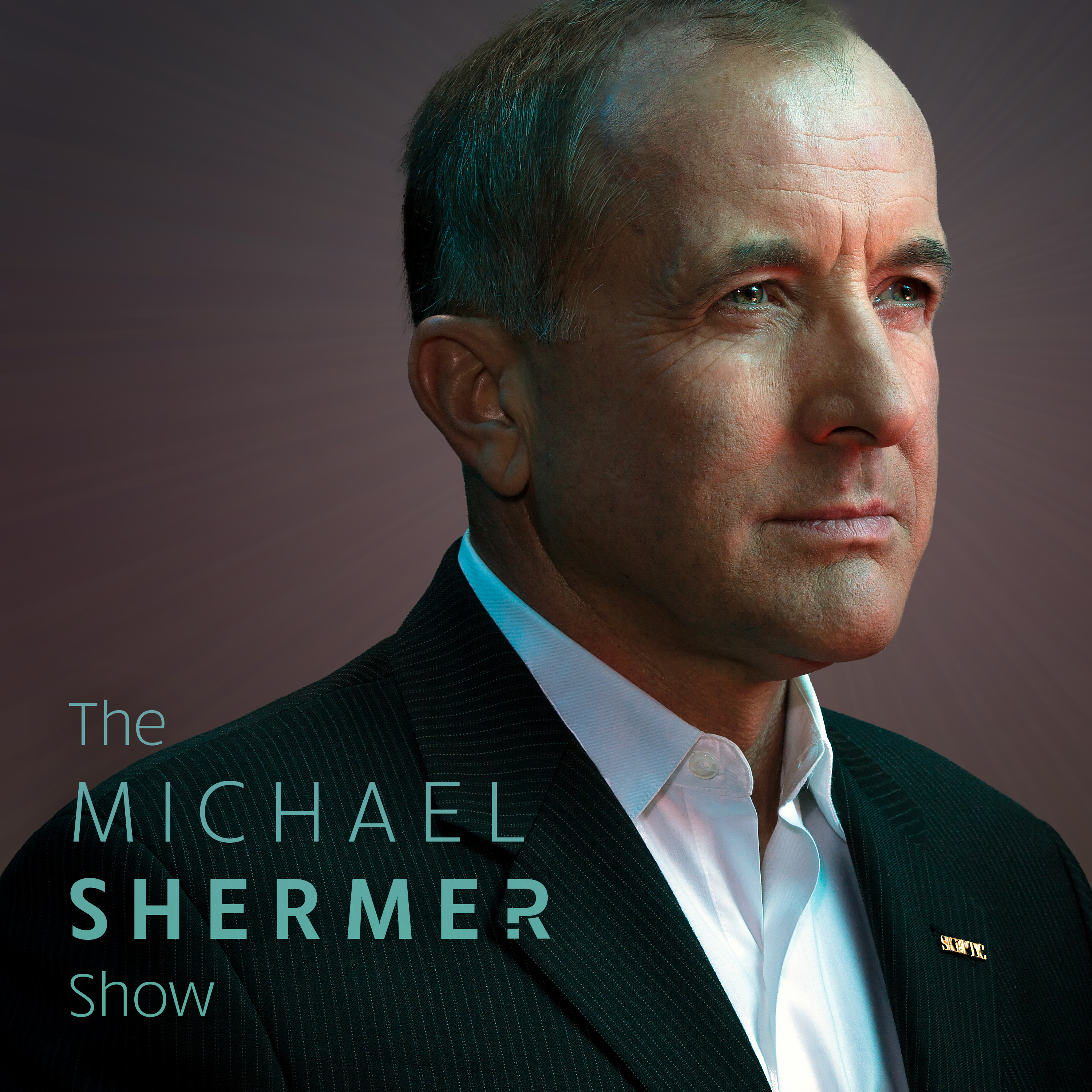
The Michael Shermer Show
by Michael Shermer
The Michael Shermer Show is a series of long-form conversations between Dr. Michael Shermer and leading scientists, philosophers, historians, scholars, writers and thinkers about the most important issues of our time.
Episodes
-
Why Consciousness Needs a Body
Why does being alive feel like something? Neuroscientist Antonio Damasio argues that the answer begins with the body's need to stay alive. Hunger, thirst, pain, and pleasure tell us how we're doing and push us to act. These basic feelings, he says, are the foundation of consciousness. Damasio...
-
Racism and White Guilt: Has America Changed More Than We Admit? | Shelby Steele & Eli Steele
Can fighting racism end up reinforcing it? Shelby Steele grew up under segregation and became a Black militant in the 1960s. Today, he argues that White guilt has created a different racial problem: treating Black Americans as permanent victims who cannot succeed without White help. Shelby and…
more -
Would You Want to Know If You Were Wrong?
What do you make of an experience you can't explain? A strange light in the sky, a book flying off a desk, a coincidence that feels too improbable to be chance? Social psychologist Barry Markovsky joins Michael Shermer to discuss his new book Everyday Extraordinary and the experiences that have...
-
Does Consciousness Break the Laws of Physics?
If we could explain everything happening in your brain, would there still be something left to explain about you? Physicist Avshalom Elitzur thinks so—and argues that accounting for consciousness may require changing the laws of physics. In this lively conversation, Michael Shermer challenges...
-
Jared Diamond: How Much Can One Person Change History?
Would World War II have happened without Hitler? Would someone else have built Apple without Steve Jobs? Jared Diamond joins Michael Shermer to ask how much history depends on particular people. From Darwin's discoveries to the rise of Christianity, Diamond considers when someone is truly...
-
Why America Failed to Stop 9/11 | Gerald Posner & Michael Shermer
How did 19 hijackers evade the world's most advanced intelligence apparatus despite years of warnings? Twenty-five years after 9/11, journalist Gerald Posner joins Michael Shermer to explain the security failures that left America vulnerable. Those failures, compounded by government secrecy, have...
-
Why Be Honest When Cheating Pays?
Most of us think of ourselves as honest. But would we still tell the truth if lying got us what we wanted—and nobody would ever find out? Philosopher Christian Miller joins Michael Shermer to discuss his new book The Honesty Crisis and the uncomfortable gap between having a reputation for honesty...
-
Is the Future Unknowable? Uncertainty, Free Will, and the Limits of Science
What if uncertainty isn't a temporary problem science will eventually solve, but a fundamental feature of reality? Neuroscientist Stuart Firestein joins Michael Shermer to make the case that the universe may be far less deterministic—and the future far less predictable—than we like to imagine....
-
Why We Want to Believe in Aliens and Why We Still Haven't Found Them
UFOs were once the stuff of tabloids and conspiracy theories. Today they're the subject of congressional hearings, Pentagon investigations, mainstream news coverage, and a new wave of claims about government cover-ups and alien technology. Adam Kirsch, senior editor at The Atlantic and author of…
more -
Is There a Second Arrow of Time? A New Law of Evolution, Information, and Complexity
Why does the universe produce ever more elaborate forms, from atoms and minerals to cells, organisms, brains, technology, and civilization? The familiar laws of physics can explain much of what happens in nature, but Robert Hazen and Michael Wong argue that something important has been missing: a...
-
Why Good People Disagree About Right and Wrong
Why do reasonable people disagree so strongly about right and wrong? And why are we so quick to assume that people on the other side of a moral or political issue are irrational, selfish, ignorant, or simply bad? Michael Shermer speaks with Cornell psychologist Audun Dahl, author of Between Fixed...
-
Are We Building a God? AI, Superintelligence, and the Coming Singularity
Robert Wright joins Michael Shermer to discuss his new book, The God Test: Artificial Intelligence and Our Coming Cosmic Reckoning, and why he thinks the AI revolution may be moving much faster than most people realize. Wright argues that deep learning is not just a new way of programming...
-
Can You Trust Wikipedia? Co-Founder Larry Sanger on Wikipedia's Bias and Why He Was Banned
Michael Shermer speaks with Wikipedia co-founder Larry Sanger shortly after Sanger was permanently banned from editing the site he helped create. Sanger tells the story of Wikipedia's founding, how its ideal of open collaboration hardened into a system dominated by a relatively small group of...
-
How to Think Clearly About a World in Crisis: Iran, China, Russia, and the West's Economic Pessimism
Michael Shermer speaks with political scientist Marlene Laruelle about Russia's turbulent transformation during the 1990s and the rise of Vladimir Putin, why the Kremlin so badly misjudged Ukraine, China's rise and its ambitions regarding Taiwan, why killing Iran's Supreme Leader and much of its...
-
The Truth About Sex Differences (Steve Stewart-Williams)
How do men and women differ? Where do the differences come from? And how do they shape modern life? Drawing on a century of research and a billion years of evolution, Steve Stewart-Williams explains why many sex differences appear despite socialization, not because of it; why in our mating and...
-
America at 250: What Did the Founders Get Right?
Michael Shermer makes the case that the U.S. Founding Fathers were not only steeped in Enlightenment values on which the Declaration of Independence was based, but they were also scientists searching to discover moral truths and values on which to base a rational society, which they succeeded in...
-
When History Goes on Trial: Demjanjuk, Eichmann, and Justice After Atrocity
John Demjanjuk lived for decades as a retired autoworker in suburban Cleveland. Then investigators accused him of being "Ivan the Terrible," one of the most notorious guards at Treblinka. What followed was one of the strangest and most troubling Nazi war-crimes cases of the postwar era:...
-
Why I Joined the Government UAP Science Advisory Council
Michael Shermer has been appointed to the newly formed UAP Science Advisory Council, formed at the request of the White House and in coordination with the All-domain Anomaly Resolution Office (AARO), the Office of the Director of National Intelligence (ODNI), the FBI, and other agencies. The...
-
Massimo Pigliucci on Doubt, Moral Courage, and Living Without Illusions
What does it mean to live well when certainty is unavailable? Michael Shermer speaks with Massimo Pigliucci about moral character, ancient philosophy, and the difficult art of making decisions without easy answers. The conversation moves from Cicero and Stoicism to the legacy of the New Atheism,...
-
Cathy Young: Why Free Societies Need Free Speech
Cathy Young returns to the show for a wide-ranging conversation about free speech, institutional trust, and the strange incentives shaping public debate today. What happens when universities, media outlets, political movements, and online personalities trade careful thinking for moral certainty,...
-
The Zodiac Killer Wasn't Real
The Zodiac Killer has been treated for decades as America's ultimate unsolved true crime mystery: one mysterious killer, taunting letters, cryptic ciphers, a strange costume, and a trail of victims across Northern California. Eddie McNamara thinks that story is wrong. The victims were real, the...
-
How Algorithms Use Your Data to Control You
Michael Shermer speaks with Oxford philosopher Carissa Véliz about the long human desire to know the future—from ancient oracles and astrology to AI, surveillance capitalism, predictive policing, and "data-driven" decision-making. Véliz argues that prediction is rarely neutral: the same machinery...
-
Batya Ungar-Sargon: Why the Left Sees Jews Differently Now
Batya Ungar-Sargon joins Michael Shermer for a wide-ranging conversation about the historical relationship between Jews and the American left, and why that relationship has become increasingly strained in recent years. The discussion begins with the reaction to October 7 and the political…
more -
From Equality to Equity: How Social Justice Becomes Ideology
Jon Mills, a philosopher, psychoanalyst, and clinical psychologist, joins Michael Shermer to discuss how social justice ideology has moved from a concern with fairness and equal treatment into a rigid moral framework built around oppressors and victims, privilege and disadvantage, good and evil....
-
Can Science Fix Criminal Justice?
America's criminal justice debate usually gets reduced to two options: abolish the system or lock everyone up forever. Economist Jennifer Doleac thinks the data point somewhere else entirely. In this episode, Michael Shermer speaks with Doleac about what rigorous research can tell us about crime,...
-
Gad Saad: When Empathy Becomes Dangerous
Gad Saad returns to discuss his new book Suicidal Empathy: Dying to Be Kind, a provocative argument that empathy is not a moral trump card. Empathy can illuminate suffering, but it can also distort judgment when it is treated as an unquestionable virtue, applied selectively, or insulated from...
-
Why We Cling to Certainty, Conspiracies, and Bad Predictions
We like to think the future can be figured out if we just gather enough information. Pick the right expert, read the right forecast, find the right framework, and the fog will lift. Simone Stolzoff argues that this impulse often works against us. In his new book How to Not Know, he makes the case...
-
Neil deGrasse Tyson on UFOs, Government Files, and the Physics of Alien Claims
Neil deGrasse Tyson returns to The Michael Shermer Show to talk UFOs, aliens, government files, eyewitness testimony, and his new book Take Me to Your Leader: Perspectives on Your First Alien Encounter. The conversation moves from the limits of eyewitness testimony to why secret military files…
more -
From Newspapers to Influencers: Who Controls Reality Now? (Ashley Rindsberg)
Journalist and author Ashley Rindsberg returns to The Michael Shermer Show for a wide-ranging conversation about the new media world: influencers with audiences larger than cable networks, conspiracy theories built for engagement, and the collapse of trust that followed COVID, censorship, and…
more -
The New War on Free Speech: Why Power Turns Everyone Into a Censor
Free speech was supposed to be the great settled achievement of liberal democracy. Then came social media, cancel culture, campus speech battles, hate-speech laws, authoritarian tech control, and a new era of governments pressuring platforms from every direction. Michael Shermer speaks with free...
-
The UFO Files Were Declassified Today
The long-promised UFO files have finally been released. In this solo commentary, Michael Shermer examines the newly declassified documents, photographs, videos, eyewitness accounts, redactions, and government claims surrounding UFOs and UAPs.
-
Why Everything Falls Apart—And How to Keep It Going (Stewart Brand)
Stewart Brand has spent a lifetime thinking about tools, systems, civilization, and the long future. Best known as the creator of the Whole Earth Catalog and co-founder of the Long Now Foundation, Brand joins Michael Shermer to discuss his new book, Maintenance of Everything, a sweeping look at...
-
The Scientist Who Tried to Prove Reincarnation
Can memories survive death? It sounds like the kind of question skeptics usually dismiss before the conversation even starts. But Ian Stevenson was not a carnival psychic or a late-night ghost hunter. He was a respected psychiatrist at the University of Virginia who spent decades investigating...
-
Why Do We Exist? Hakeem Oluseyi
Astrophysicist Hakeem Oluseyi has lived a life that sounds almost impossible: a childhood marked by poverty, violence, and constant upheaval; a teenage obsession with Einstein; a stint in the Navy; addiction and recovery; work as a janitor; and eventually a PhD in physics from Stanford. In this...
-
Shermer Says 9: The "Dead Scientists," Explained
A viral story is spreading across media: a mysterious string of scientists connected to UFOs, nuclear weapons, aerospace, and defense work have disappeared or died under suspicious circumstances. Politicians are calling it a possible national security threat. Michael Shermer takes a skeptical look.
-
Not Monsters. Not Madmen. Just Men.
What kind of person helps build a regime like the Third Reich? A monster? A madman? Or something far more unsettling? Michael Shermer sits down with author Jack El-Hai to talk about the true story behind Nuremberg. At the center is Dr. Douglas Kelley, the American psychiatrist assigned to…
more -
Flourishing in the Age of Algorithms
What actually makes a life feel meaningful? In this conversation, Daniel Coyle joins Michael Shermer to talk about why fulfillment rarely comes from optimization, status, or trying to "win" at everything. Instead, it grows out of connection, shared effort, curiosity, and the kinds of projects…
more -
What Really Prevents Cognitive Decline
What actually causes cognitive decline, and how much of it can we do something about? In this episode, Michael talks with neurologist and neuroscientist Dr. Majid Fotuhi about dementia, Alzheimer's, memory loss, and the everyday habits that shape brain health over time. They discuss why…
more -
How Christianity Made America—and How America Remade Christianity
Why does religion still dominate American politics when so many other wealthy democracies secularized long ago? In this episode, Michael Shermer talks with historian Matthew Avery Sutton about the long relationship between Christianity and American power. From the Puritans to Lincoln, from the...
-
What Turns Sand Into Cells? How Nonliving Matter Becomes Alive
How does something living emerge from something that isn't? In this episode, Lee Cronin pushes the question back even further: before cells, before DNA, before biology as we usually think of it, what kind of process could make matter start organizing itself into something alive? He and Michael...
-
Shermer Says 8: Easter Without the Miracle
On Easter Sunday, Michael asks whether the resurrection should be understood as history, myth, or something deeper.
-
Debra Soh on Why Men and Women Are Drifting Apart, Dating Apps, and Gen Z
Fewer people are having sex, fewer are forming lasting relationships, and many feel more isolated than ever. Why? Michael Shermer sits down with neuroscientist and author Debra Soh to discuss her new book Sextinction: The Decline of Sex and the Future of Intimacy. They talk about the so-called…
more -
The Psychology of Gaslighting, Bullying, Cults, and Coercion
What do gaslighting, bullying, cults, and coercion have in common? In this episode, Michael Shermer speaks with Jennifer Fraser about the psychology and neuroscience of manipulation, the recurring structure of abuse cultures, and the way authority can distort perception. Their discussion looks at...
-
Did Jesus Really Change Western Morality? Bart Ehrman
How much of what we call "basic morality" is actually inherited from Christianity? Bart Ehrman joins Michael Shermer for a wide-ranging conversation about one of the biggest moral questions in history: why do we feel obligated to care for strangers at all? Drawing from his new book Love Thy...
-
Lionel Shriver on Immigration, Religion, and the Decline of the West
Michael Shermer sits down with novelist and essayist Lionel Shriver for a wide-ranging conversation about what happens when old political labels stop making sense. Shriver reflects on the strange moral and political confusions that now shape debates over immigration, identity, religion, and the...
-
The Biggest Blind Spot of the Climate Movement: Nuclear Energy
Zion Lights used to be deep inside the environmental movement: protests, arrests, road blockades, the whole thing. Then she started looking closely at the evidence around nuclear power and found that much of what she'd been told about energy, risk, and climate solutions didn't hold up. In this...
-
DOGE, Government Fraud, and AI Audits
Jeremy Jones joins Michael Shermer to talk about DOGE AI, government fraud, and the strange reality that some of the biggest problems in public life are both widely known and somehow never fixed. Jones explains how his team uses AI to sort through enormous government datasets, isolate suspicious...
-
Heretics: The Scientists Who Were Mocked But Later Proven Right
Why do some world-changing ideas get ignored, attacked, or buried for years before anyone takes them seriously? Michael Shermer sits down with The Economist science correspondent Matt Kaplan to discuss the scientists who got there first and paid the price. They talk about why institutions resist...
-
Shermer Says 7: Responding to Fan Mail … "Who Was Jesus?"
Michael Shermer responds to a remarkable letter from a group of eighth graders at a Christian school in Texas who say they've been praying for him and want to talk about Christianity, Jesus, and the Bible.
-
Why the Same Childhood Doesn't Affect Everyone the Same Way
For decades, developmental psychologist Jay Belsky has focused on one of the biggest questions in human development: how do early experiences shape the lives we go on to live? In this conversation with Michael Shermer, he explains why childhood adversity can leave deep marks, why some children…
more
We're indexing this podcast's transcripts for the first time — this can take a minute or two. We'll show results as soon as they're ready.
No matches for "" in this podcast's transcripts.
No topics indexed yet for this podcast.
Loading reviews...
Loading similar podcasts...
Frequently Asked Questions
How many episodes does The Michael Shermer Show have?
The Michael Shermer Show currently has 644 episodes available on PodParley. New episodes are automatically indexed when they're published to the podcast feed.
What is The Michael Shermer Show about?
The Michael Shermer Show is a series of long-form conversations between Dr. Michael Shermer and leading scientists, philosophers, historians, scholars, writers and thinkers about the most important issues of our time.
How often does The Michael Shermer Show release new episodes?
The Michael Shermer Show releases new episodes frequently with a large back catalog of 644 episodes. Check the episode list for recent publication dates.
Where can I listen to The Michael Shermer Show?
You can listen to The Michael Shermer Show on PodParley by clicking any episode. We provide an embedded audio player for direct listening, and you can also subscribe via your preferred podcast app using the RSS feed.
Who hosts The Michael Shermer Show?
The Michael Shermer Show is created and hosted by Michael Shermer.
URL copied to clipboard!