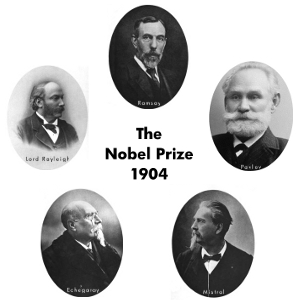
The Nobel Prize in 1904
by Various
The Nobel Prizes are international awards bestowed once a year by Scandinavian committees for cultural and scientific advances. They were established in 1895 by the Swedish chemist Alfred Nobel, the inventor of dynamite. The prizes in Physics, Chemistry, Physiology or Medicine, Literature, and Peace were first awarded in 1901. The Laureats of 1904 were: in Physics: Lord Rayleigh (John William Strutt, 1842 - 1919), "for his investigations of the densities of the most important gases and for his discovery of argon in connection with these studies"; in Chemistry: Sir William Ramsay (1852 - 1916), "for his discovery of the inert gaseous elements in air, and his determination of their place in the periodic system"; in Physiology or Medicine: Ivan Petrovich Pawlow (1849 - 1936), "in recognition of his work on the physiology of digestion, through which knowledge on vital aspects of the subject has been transformed and e
Episodes
About this show
The Nobel Prizes are international awards bestowed once a year by Scandinavian committees for cultural and scientific advances. They were established in 1895 by the Swedish chemist Alfred Nobel, the inventor of dynamite. The prizes in Physics, Chemistry, Physiology or Medicine, Literature, and Peace were first awarded in 1901.
The Laureats of 1904 were: in Physics: Lord Rayleigh (John William Strutt, 1842 - 1919), "for his investigations of the densities of the most important gases and for his discovery of argon in connection with these studies"; in Chemistry: Sir William Ramsay (1852 - 1916), "for his discovery of the inert gaseous elements in air, and his determination of their place in the periodic system"; in Physiology or Medicine: Ivan Petrovich Pawlow (1849 - 1936), "in recognition of his work on the physiology of digestion, through which knowledge on vital aspects of the subject has been transformed and e
Hosted by
Various
Categories