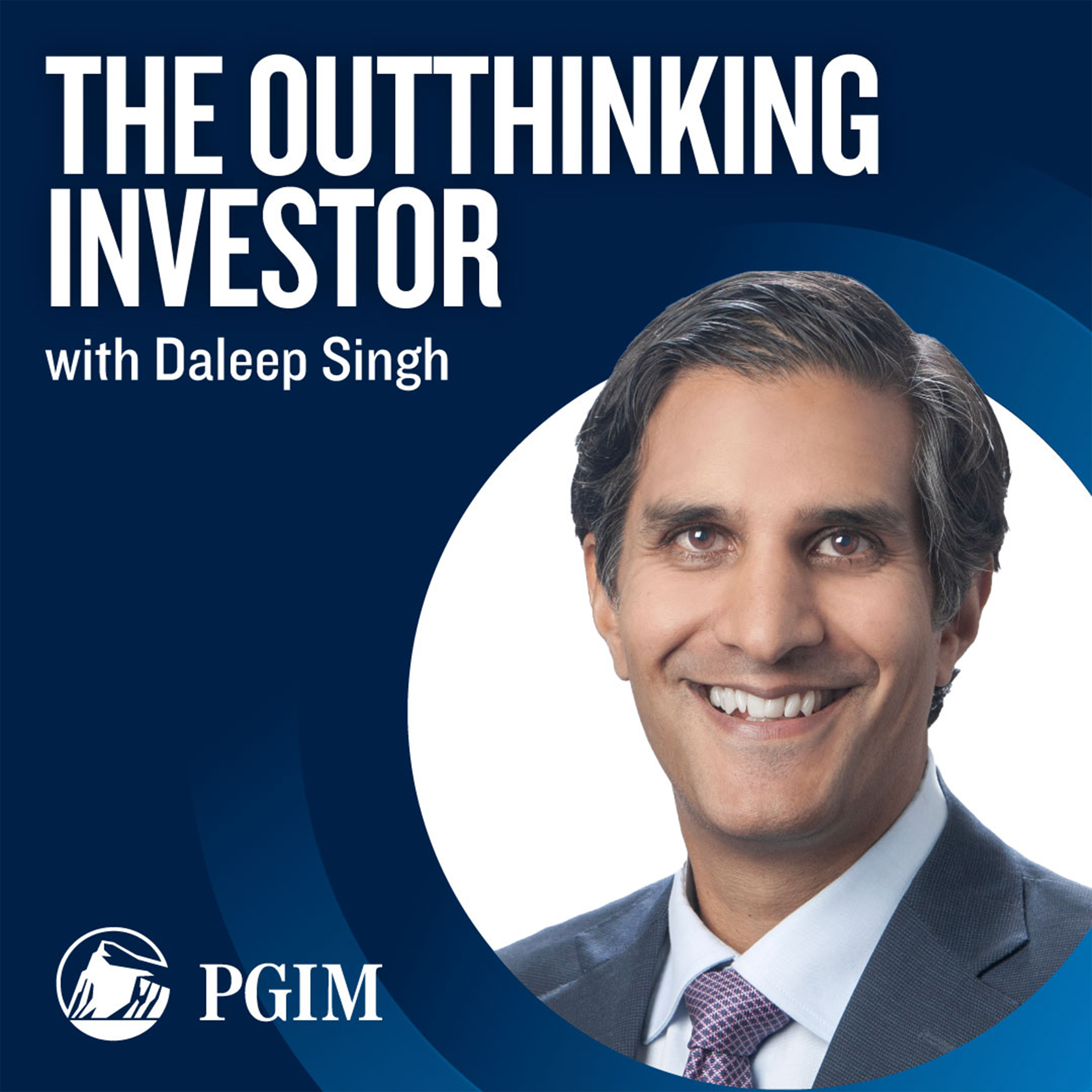
The Outthinking Investor with Daleep Singh
by PGIM
In today's ever-changing world, investors should challenge old assumptions and think outside the box. Markets trade on more than just economic data. They trade on geopolitics, technology, policy, and elections. In a world searching for a new equilibrium, old assumptions are expensive mistakes. Daleep Singh, Vice Chair and Chief Global Economist at PGIM, has spent his career at the intersection of markets and policy, from the U.S. Treasury and Federal Reserve to the White House. Now, Daleep is sharing his perspectives with you. On PGIM's The Outthinking Investor, Daleep sits down with prominent economists, technologists, policymakers, and market veterans to map out the full distribution of what comes next—and why it matters.
Episodes
-
Barry Eichengreen on the Dollar's Privilege: Eroding or Enduring?
Despite speculation over its demise, the U.S. dollar remains the operating system of global finance. No alternative — whether a sovereign currency, cryptocurrency, or gold — offers the same depth or liquidity. However, the dollar's primacy is not a light switch to be turned on or off. It can be...
-
Prediction Markets vs. Political Reality: Henrietta Treyz on the Midterm Elections
From the polls to prediction markets, market participants must look beyond conventional wisdom to identify investable signals across elections, fiscal policy, trade, and regulation. Market implications from the U.S. midterm elections could be profound for the pace of America's data center…
more -
When Nobody's in Control: AI, Cyber Risk, and the Economics of Digital Trust
AI has the potential to bring a host of benefits to society and the global economy. It has fueled optimism around productivity, disinflation, and debt sustainability. But like many innovations that came before it, AI also brings a new set of challenges. The same technology that might boost…
more -
The Visible Hand: Marketcrafting from AI to the Price of Money
Adam Smith introduced his concept of the "invisible hand" in the 18th century, offering a metaphor for how self-interest and competition guide a free-market economy. The case could be made that government policy is an increasingly crucial force in shaping markets today, particularly amid…
more -
Chip Craze: Framing Industrial Policy for the AI Era
The AI-driven capex cycle might be the biggest investment story of the past century. The five largest hyperscalers were on track to spend around $800 billion on AI infrastructure in 2025, and as a share of U.S. GDP, AI capex has already eclipsed the dot-com boom of the 1990s. Chips are at the...
-
The Power Play: Is Fusion Nearing a Kitty Hawk Moment?
In an era of AI, data centers and electrification, rising power demand presents a range of challenges and investment opportunities across the energy sector. Bottlenecks in the supply chain, such as the backlog in gas turbine production, have grabbed headlines while the power-hungry digital...
-
Warsh's Opening Act: Inside the Fed's Regime Shift with James Bullard
The arrival of Kevin Warsh as Chair of the Federal Reserve marked a regime shift. At its June meeting, the Federal Open Market Committee (FOMC) dropped its easing bias, opening the door to interest rate hikes as supply shocks collide with hotter demand. The Fed also announced five new task forces...
-
Strategic Stalemate: What Investors Miss About U.S.-China Competition
The military concept of escalation dominance posits that the side controlling the pace and pain of a conflict determines the outcome. For most of the Cold War era, the U.S. had escalation dominance—militarily, technologically, and economically—but the use of economic statecraft was limited. That...
-
Beyond the Battlefield: Chokepoints in the Age of Economic Warfare
Global conflicts are increasingly playing out in the economic arena, not just on the battlefield. The war in Iran represents a collision of both. Physical and financial chokepoints can be used for strategic leverage; they also raise potential vulnerabilities. To unpack how and why economic…
more -
The Old Normal: Macro Shocks Amid War, AI, and Economic Rivalries
Marc Sumerlin, Managing Partner at Evenflow Macro and former Deputy Director of the White House National Economic Council under President George W. Bush, joins Daleep Singh for a conversation about economic transformation on this episode of PGIM's The Outthinking Investor. Daleep and Marc talk...
-
Second Order Effects – From Iran to China: A Live Conversation with Dr. Kurt Campbell
Daleep welcomed Kurt for an in-depth look at the U.S.-China relationship and the Iran war's implications for Asia-Pacific. Speaking in front of a live audience, they also discussed how geopolitical shifts are reshaping economies, strategic leverage lurking in critical supply chains, and the…
more -
Follow the Money: Inside the World's Financial Plumbing
Daleep Singh catches up with Brad Setser, Whitney Shepardson senior fellow at the Council on Foreign Relations and former senior adviser to the U.S. Trade Representative, to gather his perspectives on how entrenched imbalances are translating into strategic leverage between economic powers. They...
-
Rethinking Risk and Global Power with Jake Sullivan
Daleep Singh welcomes Jake Sullivan, the Kissinger Professor of the Practice of Statecraft and World Order at the Harvard Kennedy School and former U.S. National Security Advisor, for a conversation about the forces reshaping global power and what they mean for markets and investment strategy. In...
-
Trailer: The Outthinking Investor
Markets trade on more than just economic data. They trade on geopolitics, technology, policy, and elections. In a world searching for a new equilibrium, old assumptions are expensive mistakes. Daleep Singh, Vice Chair and Chief Global Economist at PGIM, has spent his career at the intersection of...
-
Cycles, Crises, And the Currency of Change with Ray Dalio
Ray Dalio, founder of one of the world's largest hedge funds, Bridgewater Associates, joins us for a special edition of The Outthinking Investor. Dalio sat down with PGIM's George Patterson, Chief Investment Officer of Quantitative Solutions, for a conversation about anticipating the onset of big...
-
AI Hype or Hazard? The Risks Behind the Acceleration
The technology industry has spent heavily on all things AI, from training large language models (LLMs) to building up the infrastructure required to meet demand. Investments across a range of sectors with exposure to the AI boom, including cloud computing, chips, data centers and the power grid,...
-
Factory Reset: Investing in the Future of Manufacturing
Investors might be witnessing the biggest industrial reshoring effort in more than a generation. The global race for technological superiority—particularly around AI and critical semiconductors—is pushing both private capital and government support into ramping up domestic production. Meanwhile,...
-
The Price of Policy: Taxes, Tariffs, and Capital Flows
Fiscal policy shifts, from taxes to tariffs, are steering global capital and trade flows. The US, for instance, is attracting investments despite the tariff headlines—illustrating how the impact of these policies continues to evolve. In a dynamic policy environment, taxes and tariffs could create...
-
Staying the Course: The Power of Long-Term Thinking in Volatile Markets
Sir Isaac Newton was a legendary physicist and mathematician. But even the man known for developing the theory of gravity failed to time the market. It is said that after cashing in his shares of Britain's South Sea Company, Newton bought back into the stock right before it crashed. Avoiding the...
-
The Rise of Geoeconomics: Power Dynamics Shaping Global Markets
The House of Medici, which ruled over Florence for much of the Renaissance period, established a political dynasty with influence built on successful ventures in commerce and banking. The Medicis predated the concept of geoeconomic power, or governments' ability to wield economic might to achieve...
-
Balancing Growth, Costs, and Geopolitics in Airlines
Airlines represent one of the most challenging and complex industries in today's economy. With thousands of flights moving people and cargo around the world every day, airlines manage a "complicated logistical dance," as Oscar Munoz, United Airlines' former Chairman and CEO, tells us in this...
-
Tariffs, Sanctions & Chokepoints: Investing in an Age of Economic Warfare
Critical shipping routes around the world, from the Panama Canal to the Bosphorus Strait, hold strategic importance for global trade. As a result, these chokepoints are often caught in the crosshairs of geopolitical competition. But in a new age of economic warfare, invisible chokepoints are also...
-
Trading Up: How Active ETFs Revolutionized Investing
Exploring the continued evolution of the ETF landscape, fueled by rapid growth in active ETFs and an expanding universe of investment choices. ETFs, or exchange-traded funds, were born out of a need for greater market liquidity following the 1987 stock market crash known as Black Monday. US...
-
Raising the Stakes: Investing and the Art of Risk Taking
With a standard deck of cards, there are around 2.5 million potential hands at the start of each game of poker. The key to success is in the decision process—determining how to play a hand, and how much to bet, despite not knowing which cards are in another player's hand. Like in poker, every...
-
The New Arms Race: Supply Chains, Data, and National Security
The world's superpowers are engaging in a different type of arms race beyond the battlefield. With technology advancing at a speedy pace, a global competition for all the ingredients necessary to support artificial intelligence—from data centers and semiconductors to the AI models themselves—is...
-
Against the Grain: Challenging Conventional Wisdom for Better Outcomes
Edward Lorenz, a meteorologist and mathematician, formulated a theory called the butterfly effect—based on a hypothetical scenario in which a butterfly, simply by flapping its wings, affects a tornado weeks later. The butterfly effect illustrates how small actions in complex systems can lead to…
more -
Balancing Act: Economic Policy and National Security in a Fragmenting World
Italy surprised much of the world when it became the first—and only—member of the G7 to join China's Belt and Road program in 2019. Just four years later, Italy withdrew from the initiative. The about-face served as a microcosm of the geopolitical landscape's evolution. Policymakers have long...
-
Future-Proofing Portfolios: Taxes, Tariffs, & Government Spending
The use of economic statecraft is on the rise. With rivalries among major economies intensifying, countries are increasingly employing tariffs, sanctions and subsidies, contributing to a global realignment in trade flows. Meanwhile, elections in the US and Europe portend new debates over taxes,...
-
Global Elections in Focus: The Impact on Investors and the World Economy
The "year of democracy" holds the potential to bring profound change to global politics, economic policy, and the investment environment. By the end of 2024, more than five dozen countries, accounting for nearly half of the world's population, will elect new leaders. Elections in Europe…
more -
Investing In Cities: Private Capital's Growing Role In Urban Development
Cities have faced a host of challenges over the course of history, such as affordable housing, transportation, public safety and economic opportunities. In today's rapidly changing global economy, these challenges are becoming increasingly complex, with cities needing to adapt to technological...
-
Retirement at Risk: New Ideas for an Uncertain Future
In the middle of the Great Depression, President Franklin Roosevelt spearheaded the creation of Social Security, forever changing the US retirement system and how Americans think about long-term savings. Only a few pensions existed at the time, and Social Security was the first government-backed...
-
The Paradox of Diversification: The 60-40 Portfolio's Future
Harry Markowitz, the legendary economist and father of modern portfolio theory, has been credited with saying that diversification is the only free lunch in investing. However, his work on the efficient frontier shows that investors give up expected returns to lower expected risk. This may make...
-
A Pension Comeback? The Future of Retirement in a Higher-For-Longer Regime
Millions of college students across the US graduate each spring and enter the workforce. When today's retirees entered the workforce in the early 1980s, pension plans and Social Security benefits were two of the main sources of retirement income. Just a couple decades later, defined benefit (DB)...
-
Minding Your Blind Spots: Investment Strategies for a New Regime
The stock market crash of 1929 was a pivotal event that rippled across the globe. The Great Crash rocked financial markets, not to mention the world economy, and proved to be a precursor to the Great Depression. The sudden selloff wiped out the fortunes of investors who were ill prepared to ride...
-
Healthy Returns: Identifying Future Winners Amid Rapid Medical Innovation
Some medical breakthroughs come from unexpected sources. The origins of new weight-loss drugs such as Ozempic—known in the industry as GLP-1s—can be traced back to 2005, when they were introduced as a treatment for diabetes. Two decades later, these drugs have seemingly burst onto the medical...
-
Forever in Your Debt: Investment Risks in an Era of Big Spending
A storm may be brewing off the coast. It is not a new concern for investors, but its intensity has grown. The US federal government owes more than $34 trillion—and counting. This level of debt has the potential to wreak havoc, even for the world's largest economy. Government debt has grown in…
more -
Industrial Policy's Rebirth Is Reshaping the Economy
Industrial policy is making a comeback in the West. The US, Europe and other governments have introduced new incentives to the private sector in hopes of bringing supply chains closer to home, boosting domestic industries, and building strategic advantages in key technologies such as…
more -
S4 Trailer: The Outthinking Investor
In this environment of uncertainty, it's more important than ever for investors to think outside the box. Welcome to The Outthinking Investor, an award-winning podcast from PGIM that examines past events, present-day opportunities, and future possibilities across global capital markets. In Season...
-
Help Wanted: Four Forces Transforming Labor Markets
The invention of the spinning jenny in 1764 upended the textile industry—and the women who earned a living weaving cotton and preparing fabrics in their homes. Suddenly, these jobs became obsolete. Just as the industrial revolution had a profound impact on how people worked and lived, structural...
-
Risky Business: Taking a Long-Term View on Market Shocks
In one of Rembrandt's famous paintings, Storm on the Sea of Galilee, a ship's crew struggles to navigate through an epic storm thrashing the ship. But toward the stern, Jesus sits calmly. This image graced the cover of Peter Bernstein's classic book, Against the Gods: The Remarkable Story of…
more -
The AI Boom: Investing in a New Age of Tech
Fans of the long-running game show Jeopardy will remember that one famous contestant stood out from the rest. IBM's supercomputer, named Watson, beat two human opponents in a 2011 competition that brought artificial intelligence into the spotlight. More than a decade later, AI has taken a giant...
-
The New Oil: The Geopolitical Battle for Chip Dominance
Ever since the oil crisis of the 1970s and the creation of the Strategic Petroleum Reserve, the United States has held millions of barrels of oil in a stockpile to safeguard the country—and its economy—from future supply shocks. Just as oil has kept the world's economic engine running, a new...
-
Future of Food: Vast Implications for Investors
From growing rice on Mars to developing new farming techniques here on Earth, the future of food is rapidly evolving. The global food system—spanning farms, factories, grocery stores and more—is a complex network that has far-reaching economic implications. It is also inefficient and increasingly...
-
David Rubenstein: Investing with a Purpose
Watch the video version of this episode by visiting www.pgim.com/david-rubenstein. Private markets represent a fast-growing asset class with unique opportunities for investors. The growth of private equity in particular has transformed the investment landscape over the last several decades.…
more -
Pt. 2 - Lessons from the Banking Crisis: What Risks Remain?
This is the final installment of a two-part episode in which we further examine what sparked the latest bank crisis and whether it was a canary in the coal mine. Robert Armstrong, US financial commentator and writer of Unhedged for the Financial Times, and John Cochrane, senior fellow at the…
more -
Pt. 1 - Lessons from the Banking Crisis: What Risks Remain?
Like a lighthouse surveying the waters for signs of distress, investors are challenged to shield their portfolios from potential turmoil in financial markets. But uncovering risks before they reveal themselves is a monumental task—even for the most savvy investors. Fault lines lurking in the...
-
Upside Risk: Uncovering Investment Opportunities in an Uncertain Market
The Hotel Lafayette in downtown Buffalo, New York, was the site of the first-ever meeting of the Optimist Club, which gathered during a tumultuous period for financial markets following the panic of 1910. Research has shown that optimism provides a sense of control. As uncertainty hovers over...
-
Greying and Growing: The Investment Impact of Demographic Changes
Labor markets around the world tightened during the pandemic, contributing to a rapid rise in inflation. Demographic changes could make tight labor markets a lasting characteristic of the global economy. Most of the world's biggest economies are home to an aging citizenry, while their populations...
-
S3 Trailer: The OUTThinking Investor
When the future becomes increasingly uncertain, investors need to cut through the noise and think beyond the obvious answers. In season three of The OUTThinking Investor, an award-winning podcast from PGIM, global thought leaders and PGIM experts will bring their unique perspectives for the year...
-
Tail Risks and Protecting Against the Unknown
Investors are challenged to mitigate the impact of a variety of risks, from rising inflation to a global economic downturn. What about the risks that are harder to imagine? Recent events such as the pandemic and the war in Ukraine have altered the investment outlook in significant ways, turning a...
About this show
In today's ever-changing world, investors should challenge old assumptions and think outside the box. Markets trade on more than just economic data. They trade on geopolitics, technology, policy, and elections. In a world searching for a new equilibrium, old assumptions are expensive mistakes. Daleep Singh, Vice Chair and Chief Global Economist at PGIM, has spent his career at the intersection of markets and policy, from the U.S. Treasury and Federal Reserve to the White House. Now, Daleep is sharing his perspectives with you. On PGIM's The Outthinking Investor, Daleep sits down with prominent economists, technologists, policymakers, and market veterans to map out the full distribution of what comes next—and why it matters.
Hosted by
PGIM