
PODCAST · society
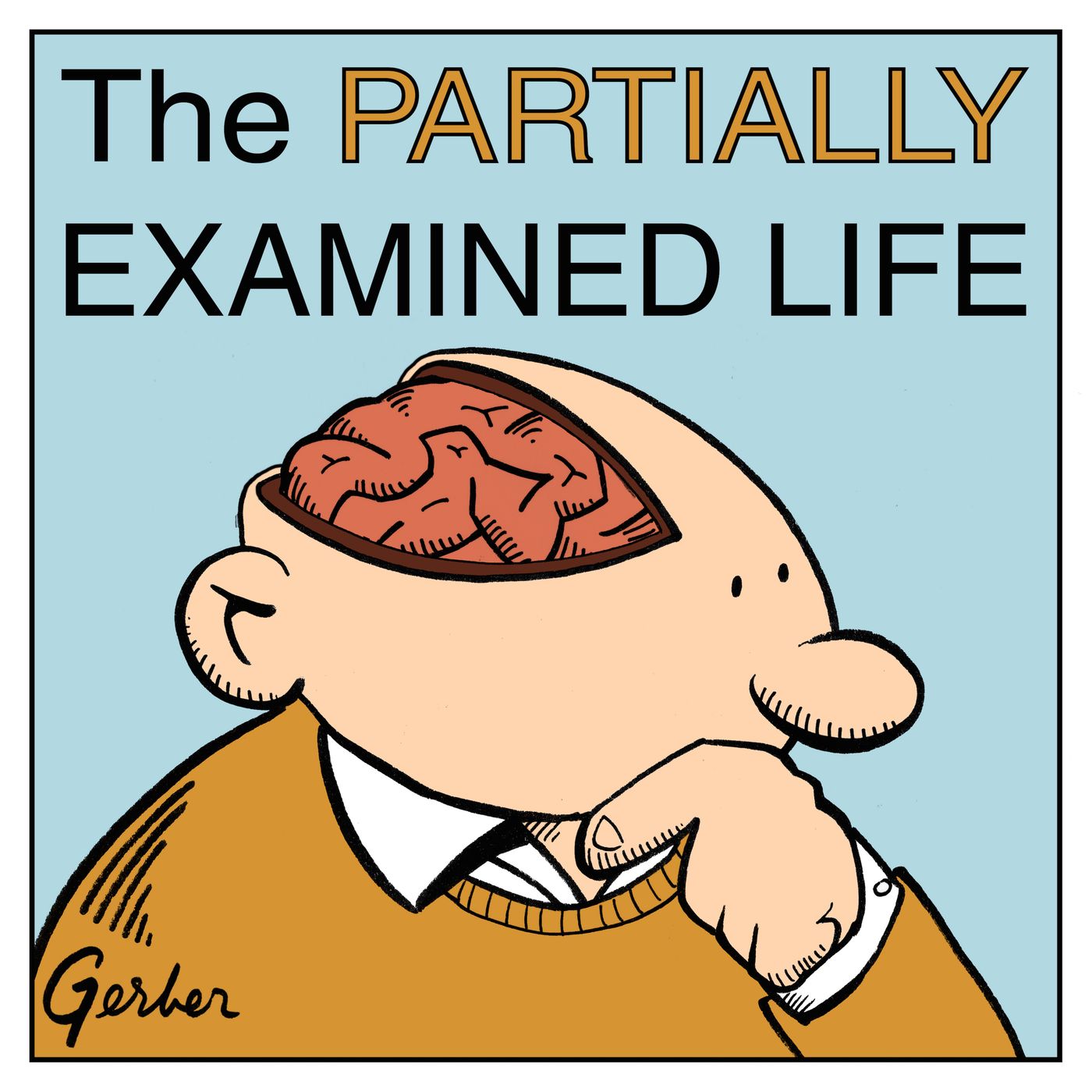
The Partially Examined Life Philosophy Podcast
by Maria
The Partially Examined Life is a podcast by some guys who were at one point set on doing philosophy for a living but then thought better of it. Each episode, we pick a short text and chat about it with some balance between insight and flippancy. You don't have to know any philosophy, or even to have read the text we're talking about to (mostly) follow and (hopefully) enjoy the discussion. For links to the texts we discuss and other info, check out www.partiallyexaminedlife.com. We also feature episodes from other podcasts by our hosts to round out your partially examined life, including Pretty Much Pop (prettymuchpop.com, covering all media), Nakedly Examined Music (nakedlyexaminedmusic.com, deconstructing songs), Philosophy vs. Improv (philosophyimprov.com, fun with performance skills and philosophical ideas), and (sub)Text (subtextpodcast.com, looking deeply at lit and film). Learn about more network podcasts at partiallyexaminedlife.com.
-
919
PEL Presents PvI#124: Navel Evaluation (Our Season 5 Finale)
We wrap up Mary's first year with the podcast, and changes are afoot for our upcoming season, but why? Let's explore to the point of physical discomfort! We act out an odd annual employee review, a dramatic pitch for a new play, and the navel-gazing club. Hear more at philosophyimprov.com. Support the podcast and listen ad-free at patreon.com/philosophyimprov.
-
918
Ep. 399: Dan Dennett's Model of Mind (Part One for Supporters)
On Daniel C. Dennett's Consciousness Explained (Ch. 1, 5), featuring guest Mark, Seth, Dylan, and guest Chris Heath. What is the mind? Dennett puts forth his "multiple drafts" model against the centralization that he characterizes as the "Cartesian Theater." Dennett claims that there is no central place in the brain, or (more controversally) no central processing center in experience, that receives data from the senses and then initiates action (and memory, and other post-experiential processing). How counter-intutitive is this, exactly? Get more at partiallyexaminedlife.com. Visit partiallyexaminedlife.com/support to get ad-free episodes and tons of bonus discussion.
-
917
Ep. 396: Peirce on Knowledge (Part Two for Supporters)
Continuing on "Questions Concerning Certain Faculties Claimed for Man" and "Some Consequences of Four Incapacities." We talk about inference, the self, introspection, willing, the limits on what kinds of terms can have meaning, and more.
-
916
Hegel on Faith vs. The Enlightenment
On Hegel's Phenomenology of Spirit, sec. 551-559, which are sections assigned for but not actually covered on The Partially Examined Life ep. 394. We get more info on how The Enlightenment supposedly mischaracterizes faith, but also how faith sees The Enlightenment and what Hegel considers to be good points coming out of The Enlightenment's critique. Learn more about your ad choices. Visit megaphone.fm/adchoices
-
915
Ep. 394: Hegel on Faith vs. The Enlightenment (Part Two)
We conclude our treatment for the moment of the Spirit section of Hegel's Phenomenology of Spirit, sec. 527-73. Hegel's diagnosis: The Enlightenment and faith only seem to be in conflict because they are two sides of "pure consciousness," i.e. thought as a retreat from the actual world. So yes, if you see faith as mere belief, as a thought about some unprovable matter of fact, that is not going to stand critical scrutiny. Hegel's conception of faith will instead be an involved, behavioral, social engagement with the world. Get more at partiallyexaminedlife.com. Visit partiallyexaminedlife.com/support to get ad-free episodes and tons of bonus discussion. Don't miss the PEL Live show in Madison, WI on Saturday afternoon, July 11. See partiallyexaminedlife.com/live for details. Sponsors: Don't get caught running yesterday';s security on today's web: visit nordlayer.com/browser. Get a $1/month e-commerce trial at shopify.com/pel.
-
914
Ep. 394: Hegel on Faith vs. The Enlightenment (Part Two for Supporters)
We conclude our treatment for the moment of the Spirit section of Hegel's Phenomenology of Spirit, sec. 527-73. Hegel's diagnosis: The Enlightenment and faith only seem to be in conflict because they are two sides of "pure consciousness," i.e. thought as a retreat from the actual world. So yes, if you see faith as mere belief, as a thought about some unprovable matter of fact, that is not going to stand critical scrutiny. Hegel's conception of faith will instead be an involved, behavioral, social engagement with the world. Get more at partiallyexaminedlife.com. Visit partiallyexaminedlife.com/support to get ad-free episodes and tons of bonus discussion.
-
913
Horkheimer & Adorno on The Odyssey (Part One)
We read part of The Dialectic of Enlightenment (1944), specifically the parts about Homer's epic as an allegory for the merely apparent triumph of modernism (capitalism, instrumental reason) over myth (savagery, magical thinking). Homer is odd for H&A because even stylistically, the epics present a mixture of cultures: They glorify violence, but their form is very ordered, and their very popularity makes them the first mass-culture products of the West. Throughout The Odyssey, Odysseus is in effect saying goodbye to the mythical world as he turns each challenge into a tool in his quest to get home. H&A use the episode with the Sirens as an allegory for how the workers are deafened to the call of anti-social myth (they have their work to do!), while the upper class can hear it but is helpless to actually act on it; like Odysseus tied to the mast, they too are strapped into the capitalist machine. Read along with us; Ch. 2, "Odysseus or Myth and Enlightenment," starts on PDF p56 (p35), but we quickly backtrack to the first mention of Odysseus in Ch. 1 (the same essay we began previously) on PDF p46 (p25). Note: This feed is likely going away soon. To keep getting your Closereads, entirely free and now ad-free, go sign up and get your private URL from patreon.com/closereadsphilosophy. You can choose to watch this on unedited video. Learn more about your ad choices. Visit megaphone.fm/adchoices
-
912
Ep. 391: Habermas Defends Modernity (Part One)
On Jürgen Habermas' The Philosophical Discourse of Modernity (1985), featuring guest John Ganz. Habermas defines modernity as Enlightenment ideals, discusses what's wrong with them (subjectivity), how Hegel argues constructively that a social element needs to be added this this, and how many other critics (e.g. Adorno, Nietzsche, and Foucault) instead argue more destructively against Enlightenment values like Truth, liberty, and justice. Get more at partiallyexaminedlife.com. Visit partiallyexaminedlife.com/support to get ad-free episodes and tons of bonus discussion. Sponsors: Check out the Scribe Optimize Workflow AI platform at Scribe.how/PEL. Get a $1/month e-commerce trial at shopify.com/pel.
-
911
Ep. 390: Diderot Debates a Cynic (Part Two)
Continuing on Rameau's Nephew, getting further into Rameau's philosophy and practices and trying to figure out what this anti-hero can tell us about ethics, given that he displays the virtue of being candid about his own vices. We talk about "trade idioms" (unethical practices that we consider normal), education, and music. How does this reading relate to Hegel (who quotes it directly)? Get more at partiallyexaminedlife.com. Visit partiallyexaminedlife.com/support to get ad-free episodes and tons of bonus discussion. Sponsors: Don't get caught running yesterday's security on today's web: visit nordlayer.com/browser. Get a $1/month e-commerce trial at shopify.com/pel.
-
910
Lionel Trilling on Sincerity (Part One)
On Ch. 2 "The Honest Soul and the Disintegrated Consciousness" in Sincerity and Authenticity (1972). This chapter focuses on a reading of Diderot's Rameau's Nephew and what Hegel made of it in the Phenomenology, so it's essentially for us a second opinion re. what we've been talking about on The Partially Examined Life. Read along with us. Watch this as unedited video. To get future parts, subscribe at patreon.com/closereadsphilosophy. Learn more about your ad choices. Visit megaphone.fm/adchoices
-
909
Galen Strawson Against Narrativity (Part One)
On "Against Narrativity" (2004), where Galen (son of P.F.) argues that the prevalent philosophical and cultural camp is wrong. This objectionable camp (the Narratives) says that we understand our lives by telling ourselves a story about ourselves. Moreover, this is how we make meaning out of our lives, and how we thus behave ethically, taking responsibility for our past and future: how we have integrity. Galen rejects both the descriptive claim here (that this is how we all, or at least those of us functioning as designed, process our experience) and the moral claim (that ethical comportment requires that we experience our lives narratively. Read along with us. You can choose to watch this on video. To get future parts, subscribe at patreon.com/closereadsphilosophy. Learn more about your ad choices. Visit megaphone.fm/adchoices
-
908
Kierkegaard on Knowledge (Part Two)
Continuing on Concluding Unscientific Postscript, now beginning the section called "Subjective Truth, Inwardness; Truth Is Subjectivity." K. slowly unravels his thoughts on why objective thought as Hegel (or anyone else) conceives of it is inhuman: We are persons changing over time, trying to know a world that is changing over time, so knowledge claims must not avoid mention of the position of the knowing subject. Read along with us, starting at the bottom of p198 (PDF p3). To get future parts of this discussion, you'll need to support us at patreon.com/closereadsphilosophy. Learn more about your ad choices. Visit megaphone.fm/adchoices
-
907
Kierkegaard on Knowledge (Part One)
On an excerpt from Soren Kierkegaard's Concluding Unscientific Postscript (1846) that critiques Hegel's idea of logic (dialectic) and then argues for his own conception of "truth as subjectivity." In this first part, he's mostly focusing on Hegel. First (along with the rest of the world), K. denies Hegel's idea that logic is equivalent to physics (or biology, or any other analysis of what actually exists). Furthermore, the idea of a "system" is only one that (according to K) makes sense if you're looking down on the universe from God's perspective. Everything else is in progress: the object you're trying to know is changing, and you as subject are changing. Follow along, starting on PDF p. 2 (document p. 196). To get all parts of this discussion, you'll need to support us at patreon.com/closereadsphilosophy. Learn more about your ad choices. Visit megaphone.fm/adchoices
-
906
Hegel's "Unhappy Consciousness" (Part Two)
We're up to sec. 208 in The Phenomenology of Spirit, still trying to figure out how and why individual consciousness is related to "The Unchangeable," which could be the Kantian thing-in-itself, or perhaps specifically the human soul as a thing-in-itself, or maybe Platonic Forms or God or some other Parmenidean One. Because this "part two" discussion was so enthralling, I'm sharing it on this feed, but to get parts 3 and 4, you'll need to sign up to support us: patreon.com/closereadsphilosophy. Learn more about your ad choices. Visit megaphone.fm/adchoices
-
905
Hegel's "Unhappy Consciousness" (Part One)
We're within the Self-Consciousness chapter of The Phenomenology of Spirit, specifically starting at sec. 206, which is the transition between two sections we've already considered on this podcast: Stoicism (and Skepticism) and Reason. The more famous part of the self-consciousness portion of the book is on the Master-Slave conflict, and in this section, we've got a similar dividedness, but it's all within one psyche, like you're being tortured by a voice in your head that you don't realize is just part of you. We go between three different translations here: Pinkard, Inwood, and finally Miller, which is what we normally use and will use going forward. You can choose to watch this on unedited video. To get future parts, subscribe at patreon.com/closereadsphilosophy. Learn more about your ad choices. Visit megaphone.fm/adchoices
-
904
Latour on Materialism
Mark and Wes read and discuss the short 2007 article, "Can We Get Our Materialism Back, Please?" Here Bruno Latour complains that materialism as modern common sense conceives of it is actually idealist: It is a social construction. Instead, a "thick" concept of material things acknowledges and details their historical (i.e. material in the Marxist sense) origins. Read along with us. You can choose to watch this on video. Learn more about your ad choices. Visit megaphone.fm/adchoices
-
903
Fanon on Hegel
On Franz Fanon's Black Skin, White Masks, ch. 7, B. "The Negro and Hegel." Hegel describes the abstract attainment of self-consciousness through recognition, but is this actually how it works in real slavery and its aftermath? Read along with us, p. 216 (PDF p. 234). You can choose to watch this on video. Learn more about your ad choices. Visit megaphone.fm/adchoices
-
902
Aquinas and Scotus on Law (Part One)
While we modern folks have a generally clear distinction between law as in descriptive laws of nature and law as in ethical or civil commandments, these Medieval philosophers saw these as very much related if not actually the same thing, given that humans can ignore the dictates of their nature, i.e. reason, whereas the rest of nature just proceeds according to natural law, which for these theologians means God's dictates. So what actually is the relation, in general, between law and reason? Our text includes Aquinas' presentation of this issue and his near-contemporary Duns Scotus' commentary on it. Read along with us. You can choose to watch this on video. To get future parts, subscribe at patreon.com/closereadsphilosophy. Learn more about your ad choices. Visit megaphone.fm/adchoices
-
901
Josiah Royce on Interpreting Other People
On "The Problem of Christianity," vol. 2, lecture 12, ch. 9, "The Will to Interpret." The point is to help explain Royce's idea of a community of interpretation, and the idea is that in the very act of interpreting a single individual, I'm bringing in some kind of public lexicon, i.e. other people beyond us two. Even though other people are fundamentally separate from us, we make some sort of leap that is the foundation of community: the will to interpret you as if your mind were accessible to mine. Read along with us. You can choose to watch this on video. Learn more about your ad choices. Visit megaphone.fm/adchoices
-
900
Hegel on Reason (Part One)
On Hegel's Phenomenology of Spirit, Part C (AA) Reason, V. The Certainty and Truth of Reason. This section comes right after the self-consciousness sections, and so its big puzzle is why? Why is full recognition by another self-consciousness necessary for Reason, and consequently what is Hegel's conception of Reason? Read along with us, on PDF p. 175, i.e. section 231. You can choose to watch this on YouTube. To get future parts, subscribe at patreon.com/closereadsphilosophy. Learn more about your ad choices. Visit megaphone.fm/adchoices
-
899
Dispute Between a Man and His Ba
In this famous, impossibly ancient (ca. 1900 BC!) Egyptian text, a man negotiations with the part of his soul that's supposed to help him in the afterlife. Can he kill himself now and still get all the benefits of an honorable death? His ba says no. Is this actually philosophy, or just a glimpse into the strangeness of a long-gone culture? You decide! Read along with us. You can choose to watch this on video. Get this ad-free along with every Closereads recording at patreon.com/closereadsphilosophy. Learn more about your ad choices. Visit megaphone.fm/adchoices
-
898
Aquinas and Aristotle on Soul
From Disputed Questions in De Anima (1269) as presented in Thomas Aquinas: Selected Philosophical Writings (Oxford 1993), "Passage 18: Soul in Human Beings." The question is how Aquinas, as an Aristotelian who therefore thinks the mind is the form of the body, can agree with the Christian doctrine that the soul exists after death. The answer is surprisingly weird: The body-less soul is incomplete, so we'd need to have the end-of-times full-bodily-resurrection of all the good people in order to have a truly satisfactory heaven. Read along with us. The Aristotle chapter from "De Anima" (Part III, Ch. 5) is here, PDF p. 41. You can choose to watch this on video. Get this ad-free along with every Closereads recording at patreon.com/closereadsphilosophy. Learn more about your ad choices. Visit megaphone.fm/adchoices
-
897
Hobbes on Liberty
On Leviathan (1651), ch. 21, "On the Liberty of Subjects." Thomas Hobbes is known for defending absolute monarchy, so as you'd predict, he's not going to say we have a lot of "natural" liberties. We do always have the right to self-defense, but that doesn't mean that the sovereign can't with complete justice command you executed (even if you're innocent). Yet Hobbes wants to say that even under a repressive regime we all have lots of liberty, in the sense of no one physically stopping us from doing what we will. And he wants to dismiss as unintelligible any other sense of liberty tied to non-physical obstacles, so this entirely rules out any debate about free will. Read along with us, starting on p. 161 (PDF p. 197). You can choose to watch this on video. Get the ad-free version of this and all of our episodes, including many supporter-exclusive ones, at patreon.com/closereadsphilosophy. Learn more about your ad choices. Visit megaphone.fm/adchoices
-
896
Aristotle on Final Causes
On Aristotle's Physics, book 2, ch. 8 on "final causation," i.e. purposiveness as a natural explanation. Modern science doesn't much like this kind of explanation, but Aristotle found it essential, and here's his argument for it. Read along with us. You can choose to watch this on video. Learn more about your ad choices. Visit megaphone.fm/adchoices
-
895
Horkheimer and Adorno on Enlightenment (Part One)
On "The Concept of Enlightenment" (1944), the first essay in this Frankfurt School book of critical theory, The Dialectic of Enlightenment. Our authors lay out what they take The Enlightenment to consist of, including some quotes from Francis Bacon, and some ultimately fatal tensions within it that make it no longer serve the humanistic purposes it was created for. Read along with us on PDF p. 22. You can choose to watch this on video. To get future parts, subscribe at patreon.com/closereadsphilosophy. Learn more about your ad choices. Visit megaphone.fm/adchoices
-
894
Hegel on Stoicism (Part One)
Discussing the section on Stoicism in Hegel's "Phenomenology of Spirit," which is under "Freedom of Self-Consciousness," "Stoicism, Scepticism, and the Unhappy Consciousness." This comes right after his famous lordship and bondage chapter, and explains how in reaction to being defined by the gaze of another person, we assert our independence, but in an immature and ultimately unsustainable way. So this is not a very charitable take on Stoicism; he's just focusing on this assertion of freedom that's at the heart of the philosophy, and you can think yourself about the degree to which this pollutes more thoughtful, developed versions. Follow along with us. You can choose to watch this on video. To get future parts, subscribe at patreon.com/closereadsphilosophy. Learn more about your ad choices. Visit megaphone.fm/adchoices
-
893
Peter Railton's "Moral Realism" (Wrap Up)
Concluding our treatment of Peter Railton's "Moral Realism" (1984). This is our eighth discussion of this reading, but don't worry if you haven't listened to the paywalled parts. This discussion can serve as a standalone summary of not only Railton's view, but of our efforts to actually figure out what a plausible naturalistic, empirical account of ethics could amount to. Read along with us, starting on PDF p. 42. Learn more about your ad choices. Visit megaphone.fm/adchoices
-
892
Peter Railton's "Moral Realism" (Part Four)
What? Part Four? Yes, we're jumping back into a 1984 paper that we began a couple of years ago in light of our recent PEL activity on contemporary ethics. You should be fine just starting here, but all three previous parts have been made public on our Patreon page, which is where you'll eventually find parts 5, 6, and possibly more. So far, Railton has been giving us an account of our objective individual interests: What you would want for your current you if you had all the relevant knowledge. He had given an example of a dehydrated person who wants and enjoys milk, even though milk does not help with dehydration in the way that water does. If he had the relevant knowledge, he would water. More precisely, he would want his current self in the state of dehydration to want water, because who knows what such an all-knowing person would even be like or what his wants for himself would be? We're still picking at the complexities of this as we resume progress in this essay; it's not until the end of this hour that we can even predict where he's going in terms of setting up actual morality, beyond mere objective self-interest. Read along with us, starting on PDF p. 15. Learn more about your ad choices. Visit megaphone.fm/adchoices
-
891
H.A. Prichard on Ethics (Part One)
On "Does Moral Philosophy Rest on a Mistake?" (1912). Prichard claims that we feel certain actions to be obligatory, and that we have no justification for doubting those raw intuitions. The situation, he claims, is comparable to epistemology: We have no grounds for doubting globally a la Descartes, but only in particular circumstances where science demands we should go back and check again, but more carefully. Likewise, we can be wrong about particular moral judgments, but the process of refining them is just to put ourselves (really or imaginatively) in the ethical situation and gauge the intuitions more carefully. So the only legitimate task of moral philosophy is to establish that global doubt is not warranted, and to get us to observe our intuitions more carefully and discuss them with others. Read along with us. You can choose to watch this on video. To get future parts, subscribe at patreon.com/closereadsphilosophy. Learn more about your ad choices. Visit megaphone.fm/adchoices
-
890
Parfit on Game Theory (Part One)
On Derek Parfit's "Prudence, Morality, and the Prisoner's Dilemma" (1978). What is a "prisoner's dilemma" and what is its relevance to ethics? In general, it's better for me if I break norms so long as others in general follow them, but if we all try to be free riders in this way, then no one gets to ride at all. Parfit considers variations of this situation and lays out legislative and ideological/psychological strategies for addressing them. Read along with us. You can choose to watch this on video. To get future parts, subscribe at patreon.com/closereadsphilosophy. Learn more about your ad choices. Visit megaphone.fm/adchoices
-
889
Spinoza on Emotions (Part One)
On Spinoza's Ethics, Third Part, "Concerning the Origin and Nature of the Emotions." We want to see how emotions ground ethics, but first, we have to explain what emotions are, which means explaining how mind and body (and causality) work together on Spinoza's account. A passion is being affected by something that we don't understand, whereas reason (which will yield ethical behavior) involves grasping a cause clearly and distinctly. The latter means it's in your individual mind, whereas even if you don't understand the cause, it's still in God's mind, which each of us is essentially a part of. Read along with us, starting on p. 83 (PDF p. 129). You can choose to watch this on video. To get future parts, subscribe at patreon.com/closereadsphilosophy. Learn more about your ad choices. Visit megaphone.fm/adchoices
-
888
Scheler on Personhood (Part Three)
On "Formalism in Ethics and Non-Formal Ethics of Values" (1916), Ch. 6 "Formalism and Person," sec. 3, "Person and Act." While you may want to listen to part one, we're more or less starting fresh, as parts one and two (the latter only available to paying supporters at patreon.com/closereadsphilosophy), were mostly about how Scheler rejects Kant's idea of the transcendental ego. We're skipping several pages here to start with section 3 on the recommendation from a member of the International Scheler society, hoping that at least we will find out what makes a person: What makes each of us unique and worthy of moral respect? Read along with us, starting on p. 382 (PDF p. 415). You can choose to watch this on video. Learn more about your ad choices. Visit megaphone.fm/adchoices
-
887
Edith Stein on Self (Part One)
We discuss "On the Problem of Empathy," ch. 4 "Empathy as the Comprehension of Mental Persons," starting with section 2, "The Mental Subject" and into section 3, "The Constitution of the Person in Emotional Experiences." We're trying to figure out what these early 20th century German phenomenologists think a "person" is as someone we're able to empathize or sympathize with and which is morally worthy of respect. Stein does this by saying what the "I" (the self) is. It is the thing that "has" experiences, but also something that we understand in terms of a network of motivations, which are different than mere causes, in that they're supposed to be rational. Our self gains definition, Stein says, when we have emotional experiences, which can of course be shallow and undirected (mere moods) or can be very deep and self-revelatory. Read along with us, starting on p. 87 (PDF p. 107). You can choose to watch this on video. To get future parts, subscribe at patreon.com/closereadsphilosophy. Learn more about your ad choices. Visit megaphone.fm/adchoices
-
886
Scheler on Personhood (Part One)
On Ch. 6 "Formalism and Person," in Max Scheler's most famous work, Formalism in Ethics and Non-Formal Ethics of Values (1916). Ethical Formalism is Kant: What makes something ethically correct is just something about the type of act and willing involved. Non-formalism pays attention to the content, e.g. our sentiments (a la Hume). As we've been studying on The Partially Examined Life, phenomenologists starting with Brentano sought to merge the two: Things in our experience just present themselves as intuitively praiseworthy, and this is sufficient to establish ethical obligations. We have been reading about how Scheler relies in his ethical theorizing on our experiences of sympathy and love, but we wanted to learn more about what it is about particular people that we love and respect: What is it to be a "person" in the moral sense? This book moves very slowly, so in this part he's still just distinguishing himself from Kant when it comes to saying some basic things about your relation to your own selfhood. Read along with us, starting on p. 370 (PDF p. 403). You can choose to watch this on video. To get future parts, subscribe at patreon.com/closereadsphilosophy. Learn more about your ad choices. Visit megaphone.fm/adchoices
-
885
Schopenhauer on Ethics (Part One)
On The Basis of Morality (1840), Part III: "The Founding of Ethics," Ch. 5: "Statement and Proof of the Only True Moral Incentive." Everything up to this point in the book has been negative: Morality can't be founded on pure reason as Kant thinks, or on the idea of the good life (eudaimonia) per Aristotle. Schopenhauer tells us that all actions are motivated by someone's "weal" or "woe." We are naturally self-interested (motivated by own own weal and woe), but such actions will not be moral. So Schopenhauer's puzzle is: How can I be effectively motivated by someone else's weal and woe? I must somehow identify with that person so that the Other's suffering induces my compassion. This is the only source of moral value. Read along with us, starting on p. 165 (PDF p. 193). You can choose to watch this on video. To get future parts, subscribe at patreon.com/closereadsphilosophy. Learn more about your ad choices. Visit megaphone.fm/adchoices
-
884
Husserl on Perceiving Minds
On Edmund Husserl's Ideas, Vol. 2 (1928), Section 3, "The Constitution of the Spiritual World," Ch. 1, "Opposition Between the Naturalistic and Personalistic Worlds." Given Husserl's method of "reduction" whereby he sets aside the metaphysical status of objects in the natural world (are they mind-independent or merely ideas?), we wanted to see how he accounts for our ability to directly perceive other people's minds. We don't just perceive their bodies and our own bodies and deduce that others must be like us, but we perceive both our minds and those of others as strata (aspects) of physical bodies. Read along with us, starting on p. 183 (PDF p. 101). You can choose to watch this unedited on video. Learn more about your ad choices. Visit megaphone.fm/adchoices
-
883
Guattari on Fascism (Part One)
Mark and Wes read through and discuss the beginning of Felix Guattari's "Everybody Wants to Be a Fascist" (1973). Guattari was a Lacanian psychotherapist, and he argues for explaining fascist tendencies via a "micropolitics of desire," i.e. looking at the individual psychology of fascism instead of merely focusing on sociological, material causes of the rise of fascism. Read along with us. You can choose to watch this on video. To get future parts, subscribe at patreon.com/closereadsphilosophy. Learn more about your ad choices. Visit megaphone.fm/adchoices
-
882
Marx on Stirner (Part One)
Mark and Wes read through and discuss Karl Marx's "The German Ideology" (1846), delving deep into the middle of his critique of Max Stirner's "The Ego and Its Own" (recently covered on The Partially Examined Life ep. 358). Marx articulates and criticizes Stirner's attempt to distinguish the mere common egoism of an unthinking person from the enlightened egoism that Stirner is recommending. Read along with us, starting on p. 259 (PDF p. 255). To get future parts, subscribe at patreon.com/closereadsphilosophy. Learn more about your ad choices. Visit megaphone.fm/adchoices
-
881
Husserl on Essences (Part One)
Mark and Wes read through and discuss Edmund Husserl's Ideas (1913), ch. 1, "Matter of Fact and Essence" in First Book, "General Introduction to a Pure Phenomenology," Part One, "Essence and Eidetic Cognition." This is the book that basically designed phenomenology as a movement, and this part of the reading lays some groundwork by describing what these "essences" that phenomenology studies are, and how they differ from matters of fact. Read along with us, starting on p. 5 (PDF p. 14). To get future parts, subscribe at patreon.com/closereadsphilosophy. Learn more about your ad choices. Visit megaphone.fm/adchoices
-
880
Mill on Induction (Part One)
We're discussing John Stuart Mill's A System of Logic (1843), specifically from Book III, "Of Induction," ch. 8, "Of the Four Methods of Experimental Inquiry." What is induction, and why is it part of logic? Science doesn't just observe regularities, but tries to isolate what is connected with what through a combination of experiments and observations. Read along with us, starting on p. 278, i.e. PDF p. 284. To get future parts, subscribe at patreon.com/closereadsphilosophy. Learn more about your ad choices. Visit megaphone.fm/adchoices
-
879
Sartre on Nothingness (Part Two)
We continue reading Part One of Being and Nothingness, with ch. 2, "Negations." We get some context and then jump into the classic question of whether existence in itself is just pure being, such that nothingness is just a result of human judgments on it, or whether nothingness is something objective that we grasp. We end by introducing the famous "absent Pierre in the café" example. Read along with us, starting on p. 36, i.e. PDF p. 87. To get future parts, subscribe at patreon.com/closereadsphilosophy. Learn more about your ad choices. Visit megaphone.fm/adchoices
-
878
Sartre on Nothingness (Part One)
We skip the introduction of Being and Nothingness (1943) and start with Part One, "The Problem of Nothingness," Ch. 1, "The Origin of Negation." Read along with us, starting on p. 33, i.e. PDF p. 84. Learn more about your ad choices. Visit megaphone.fm/adchoices
-
877
F.H. Bradley's "Appearance and Reality" (Part Two)
We begin Bradley's argument for idealism: The world as we perceive it is appearance, not reality. In ch. 1, "Primary and Secondary Qualities," we see him give Locke's arguments for the distinction and Berkeley's response that both alike are in the mind, not the world. We try to make sense of this given our recent reading for The Partially Examined Life of Thomas Reid, who argued for realism against Berkeley and others. Read along with us, starting on p. 17. Learn more about your ad choices. Visit megaphone.fm/adchoices
-
876
F.H. Bradley's "Appearance and Reality" (Part One)
Bradley was a prominent British Hegelian, best known now for being the springboard for Bertrand Russell, who was initially a follower but then rejected idealism entirely to co-create what is now known as analytic philosophy. Today we read just the Introduction to this massive 1893 tome, where Bradley argues that metaphysics is possible and worthwhile. Read along with us, starting on PDF p. 5. Learn more about your ad choices. Visit megaphone.fm/adchoices
-
875
Heidegger on Technology (Part Two)
We move from the discussion of the four types of causes, to "disclosure," to an environmental critique. Read along with us starting on p. 10. To get parts 3-5, subscribe at patreon.com/closereadsphilosophy. Learn more about your ad choices. Visit megaphone.fm/adchoices
-
874
Heidegger on Technology (Part One)
What is technology, REALLY? People think of it as neutral, as something that can be used for good or misused, but what is it really to be a TOOL in such a way? Heidegger analyzes causality itself, arguing that our modern emphasis on the mechanical (efficient) cause of something is impoverished as compared to Aristotle's. Read along with us starting on PDF p. 38: (p. 4 in the text). Learn more about your ad choices. Visit megaphone.fm/adchoices
-
873
William James on Asceticism and Saints (Part One)
On "The Varieties of Religious Experience," the conclusion of lecture 15. Why do some saintly types engage in ascetic practices like voluntary poverty? James thinks we could all do with some self-discipline of this sort, as extreme as the examples of literary saints may be. Self-denial is a less destructive way of expressing a martial character than actually going to war. Read along with us, starting on p. 352 (PDF p. 369). Learn more about your ad choices. Visit megaphone.fm/adchoices
-
872
Plotinus on The Intelligence (Part Two)
On "The Intelligence, The Ideas, and Being," starting on section 6. What is "The Intelligence" anyway? How does its storehouse of Forms get into the material world? Read along with us, starting on p. 51. To get part 3, subscribe at patreon.com/closereadsphilosophy. Learn more about your ad choices. Visit megaphone.fm/adchoices
-
871
Plotinus on The Intelligence (Part One)
On "The Intelligence, The Ideas, and Being" from the Enneads (270 C.E.), about the various elements of Neo-Platonist cosmology: You've got The One, which is so awesome that it has literally no properties (so you can't even say it's awesome), then The Intelligence, which is the repository of the Forms (these first two together serve the same function as Aristotle's Unmoved Mover), then The Soul (the World Soul) that actually exists in time and creates things, then lots of little souls, individual Forms that are transmitted around via "the seminal reasons," and the grubby material world that nonetheless may have received enough Form to make us look up the chain of Being toward its divine elements. Read along with us, starting on p. 46 (PDF p. 48). Learn more about your ad choices. Visit megaphone.fm/adchoices
-
870
Merleau-Ponty on the Body (Part One)
We begin a long series on Maurice Merleau Ponty's "Phenomenology of Perception" (1945), focusing on Part I, "The Body": "Experience and Objective Thought." M-P talks first about what seeing an object (like a house) in the world involves. It pre-supposes a relation to us as perceivers, which involves our situatedness in a body. Yet when we make our own body into an objective object in space and time (like the house), we've shifted it from this primordial center of perception into something described like perception. What is involved in this shift? Read along with us, starting on p. 77 (PDF p. 102). To get the subsequent 4 parts of this series, subscribe at patreon.com/closereadsphilosophy. Learn more about your ad choices. Visit megaphone.fm/adchoices
We're indexing this podcast's transcripts for the first time — this can take a minute or two. We'll show results as soon as they're ready.
No matches for "" in this podcast's transcripts.
No topics indexed yet for this podcast.
Loading reviews...
ABOUT THIS SHOW
The Partially Examined Life is a podcast by some guys who were at one point set on doing philosophy for a living but then thought better of it. Each episode, we pick a short text and chat about it with some balance between insight and flippancy. You don't have to know any philosophy, or even to have read the text we're talking about to (mostly) follow and (hopefully) enjoy the discussion. For links to the texts we discuss and other info, check out www.partiallyexaminedlife.com. We also feature episodes from other podcasts by our hosts to round out your partially examined life, including Pretty Much Pop (prettymuchpop.com, covering all media), Nakedly Examined Music (nakedlyexaminedmusic.com, deconstructing songs), Philosophy vs. Improv (philosophyimprov.com, fun with performance skills and philosophical ideas), and (sub)Text (subtextpodcast.com, looking deeply at lit and film). Learn about more network podcasts at partiallyexaminedlife.com.
HOSTED BY
Maria
CATEGORIES
Loading similar podcasts...
Frequently Asked Questions
How many episodes does The Partially Examined Life Philosophy Podcast have?
The Partially Examined Life Philosophy Podcast currently has 50 episodes available on PodParley. New episodes are automatically indexed when they're published to the podcast feed.
What is The Partially Examined Life Philosophy Podcast about?
The Partially Examined Life is a podcast by some guys who were at one point set on doing philosophy for a living but then thought better of it. Each episode, we pick a short text and chat about it with some balance between insight and flippancy. You don't have to know any philosophy, or even to...
How often does The Partially Examined Life Philosophy Podcast release new episodes?
The Partially Examined Life Philosophy Podcast has 50 episodes. Check the episode list to see recent publication dates and frequency.
Where can I listen to The Partially Examined Life Philosophy Podcast?
You can listen to The Partially Examined Life Philosophy Podcast on PodParley by clicking any episode. We provide an embedded audio player for direct listening, and you can also subscribe via your preferred podcast app using the RSS feed.
Who hosts The Partially Examined Life Philosophy Podcast?
The Partially Examined Life Philosophy Podcast is created and hosted by Maria.
URL copied to clipboard!