
PODCAST · education
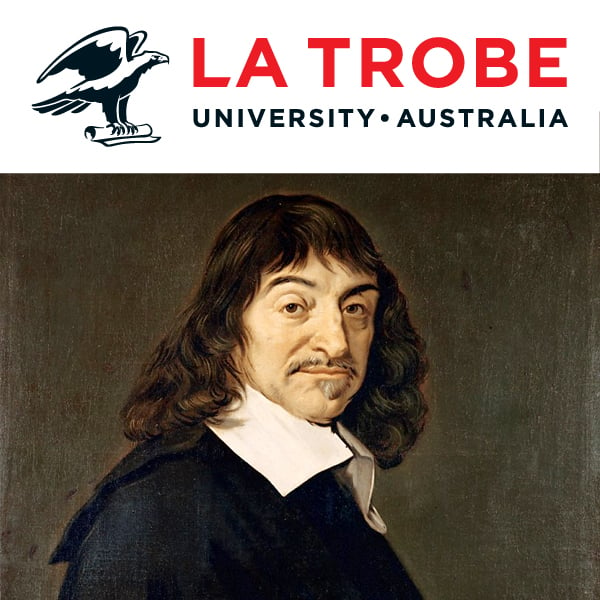
The Philosophy of Descartes
by La Trobe University
René Descartes, the ‘father of modern philosophy’ wrote his essay Meditations (published 1641) not long after Shakespeare published the Sonnets (1609). The change from Shakespeare to Descartes represents the shift from the Renaissance to the era of Modernism. The humanism of the Renaissance gives way to rationalism and a faith in the emerging sciences.
-
12
The Relation of Mind and Body
Descartes' dualism of mind and body is a lasting legacy. Nowadays many people still believe the body is less well-known than the mind and that there is a mystery about how the mental and the physical can interact. His correspondence with Princess Elizabeth of Bohemia prompted him, late in life, to explore the union of mind and body in his last work, The Passions of the Soul. In retrospect, Descartes seems to have had two views of how mind and body might be related, one that the mind interacts with the body via a gland in the brain, the other that mind is spread all the way through body and intermingled with it. While neither view is satisfactory, it is still not clear nowadays how best to think about the relation of the mental to the physical. Copyright 2014 La Trobe University, all rights reserved. Please contact for permissions.
-
11
Last-minute Creation
It might seem that Descartes' appeal to God in Meditation 4 as a guarantee that for the most part our memories can be trusted is not well-founded. By looking at the question of last-minute creation, a solution is proposed. Can we prove that we and our memories did not all come into existence just five minutes ago, or – as creationists have suggested – that the world and all its fossils did not just come into existence in 4004 BCE? Last-minute creation fantasies raise scenarios that are merely logically possible, but are not compatible with our best theories in geology, biology and other sciences. Descartes' appeal to God faces a different challenge, and objections to it are removed once the logic of his argument is made clear. Copyright 2014 La Trobe University, all rights reserved. Please contact for permissions.
-
10
A Secure Foundation for Knowledge?
By the end of the Meditation 2, Descartes is caught in a dilemma. On the one hand, everything can be doubted and so there is no prospect for secure and certain knowledge of the world. On the other hand, pure reasoning shows that he is undoubtedly a thinking thing, and this fact looks like a foundation from which other beliefs can be built. In order to proceed from the subjective certainty of the cogito, Descartes needs some basis on which to say that our memories (of previous investigations, deductions and insights) can generally be trusted. For this task, he introduces the idea of God, a being who has made the natural world and us, and has designed us so that we work well in the world. The lecture argues that nature, through evolution and natural selection, can substitute for God in scientific approach to solving Descartes' problem. Copyright 2014 La Trobe University, all rights reserved. Please contact for permissions.
-
9
The Wax Argument
One of Descartes' most striking arguments is the found in the treatment of a an example where he watches a piece of wax melt as he brings it close to a fire. By reflecting on how the same wax undergoes many changes, in colour, smell, shape, even from solid to liquid, Descartes concludes that it is through the mind, or intellect, not the senses, that we reach the most reliable knowledge of the world. Beliefs derived from the senses all involve inferences and the possibility of making mistakes in reasoning. By systematic use of reason, he hopes, we can start to build a scientific theory of the world that is reliable, and incidentally the search for some basic truth brings him back to the realization that mind is better known than, and separate from, body. Copyright 2014 La Trobe University, all rights reserved. Please contact for permissions.
-
8
Cogito Ergo Sum
The foundation of all science and other knowledge is found, according to Descartes, in the indubitable belief that I exist (the cogito claim). As soon as I have the thought, "I am thinking, so I exist", I realize this thought cannot be doubted: simply to have it, is to see that it is true. The problem is that in the first "Meditation", Descartes had introduced the possibility that even logic and mathematics is dubitable if we imagined our minds might be subject to manipulation by an evil demon or mad scientist. So why should the cogito be excepted? Has Descartes' commitment to hyperbolic doubt undermined his own project? Copyright 2014 La Trobe University, all rights reserved. Please contact for permissions.
-
7
Descartes, the Doubty Philosopher
An introduction to the life and work of Rene Descartes (1596 – 1650). In his collection of essays, called "Meditations", Descartes outlines a modern, rationalist philosophy, one that rejects the help of tradition and earlier theories in order to build a new system of knowledge and science based on only on certainty. Using only the power of reason, Descartes claims, it is possible to establish the sure foundation of all knowledge. Copyright 2014 La Trobe University, all rights reserved. Please contact for permissions.
We're indexing this podcast's transcripts for the first time — this can take a minute or two. We'll show results as soon as they're ready.
No matches for "" in this podcast's transcripts.
No topics indexed yet for this podcast.
Loading reviews...
ABOUT THIS SHOW
René Descartes, the ‘father of modern philosophy’ wrote his essay Meditations (published 1641) not long after Shakespeare published the Sonnets (1609). The change from Shakespeare to Descartes represents the shift from the Renaissance to the era of Modernism. The humanism of the Renaissance gives way to rationalism and a faith in the emerging sciences.
HOSTED BY
La Trobe University
CATEGORIES
Loading similar podcasts...
Frequently Asked Questions
How many episodes does The Philosophy of Descartes have?
The Philosophy of Descartes currently has 6 episodes available on PodParley. New episodes are automatically indexed when they're published to the podcast feed.
What is The Philosophy of Descartes about?
René Descartes, the ‘father of modern philosophy’ wrote his essay Meditations (published 1641) not long after Shakespeare published the Sonnets (1609). The change from Shakespeare to Descartes represents the shift from the Renaissance to the era of Modernism. The humanism of the Renaissance...
How often does The Philosophy of Descartes release new episodes?
The Philosophy of Descartes has 6 episodes. Check the episode list to see recent publication dates and frequency.
Where can I listen to The Philosophy of Descartes?
You can listen to The Philosophy of Descartes on PodParley by clicking any episode. We provide an embedded audio player for direct listening, and you can also subscribe via your preferred podcast app using the RSS feed.
Who hosts The Philosophy of Descartes?
The Philosophy of Descartes is created and hosted by La Trobe University.
URL copied to clipboard!