
PODCAST · history
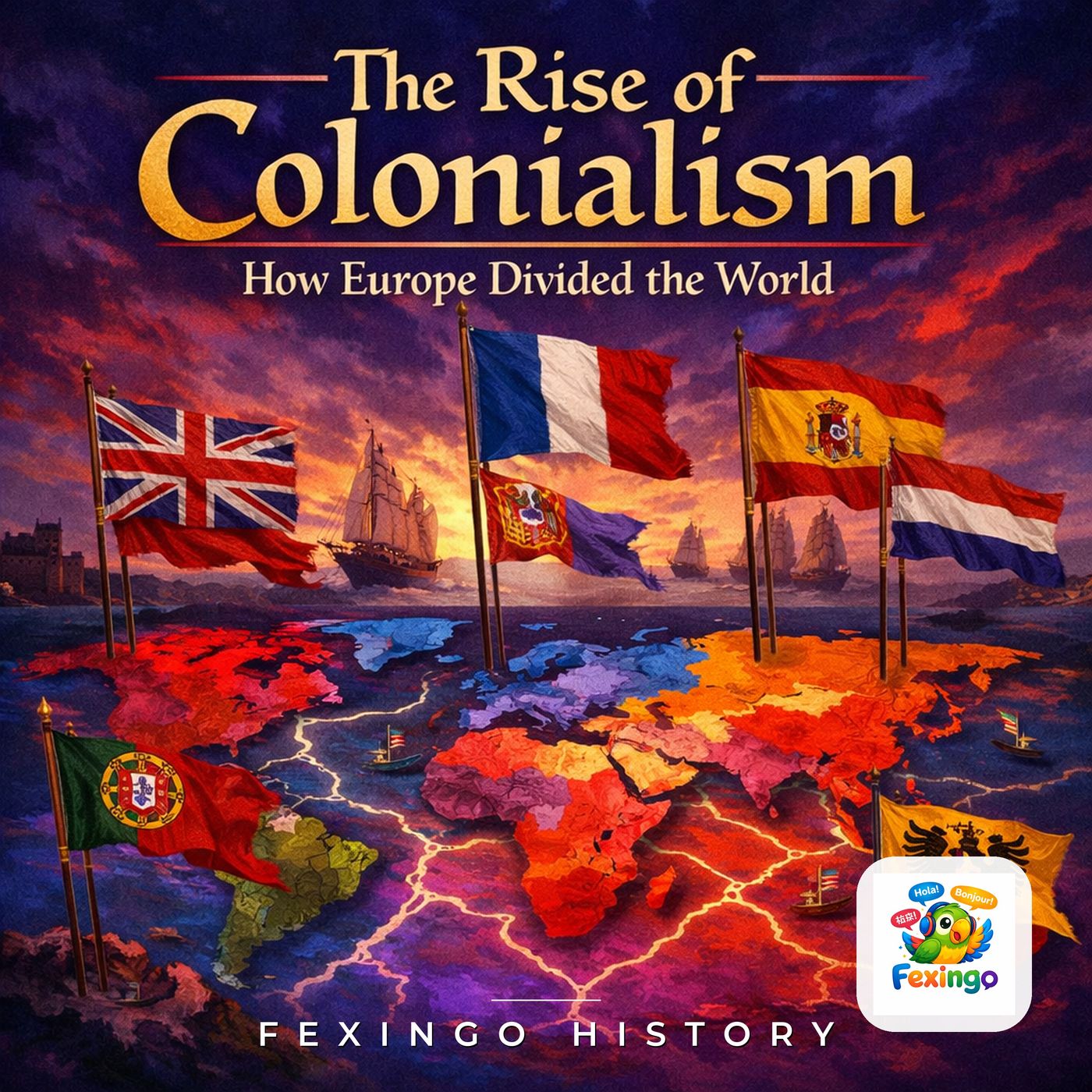
The Rise of Colonialism: How Europe Divided the World — Fexingo History
by Fexingo
From the first Portuguese caravels rounding Cape Bojador in 1434 to the Berlin Conference of 1884–85 that carved Africa into colonies, this show traces how a handful of European powers—Portugal, Spain, the Dutch Republic, France, and Britain—projected their rivalries across the globe. Lucas and Luna navigate the trade forts of the Gold Coast, the spice markets of the Moluccas, and the rubber groves of the Congo. They examine the treaties (Tordesillas 1494, Utrecht 1713, Nanking 1842), the ideologies (mercantilism, the 'White Man's Burden'), the technologies (caravels, breech-loading rifles, quinine), and the human catastrophes—the Atlantic slave trade, the Congo Free State atrocities, the Sepoy Rebellion. They ask whether colonialism was an aberration or an extension of Europe's internal power struggles, and how its legacies survive in borders, languages, and global inequality. A show for listeners who want to understand how a few men in European capitals redrew the map and why the wor
-
34
The Potosí Mint: How Silver Coins Fueled Global Empire
Lucas and Luna dive into the heart of Spain's colonial economy: the Royal Mint of Potosí. How did a single mint in the Andes produce the silver coins — the famous pieces of eight — that bankrolled the Spanish Empire and transformed global trade? Lucas traces the mint's founding after the discovery of Cerro Rico, the brutal mita labor system that supplied workers, the technical process of minting macuquinas (cob coins), and the corruption and fraud that plagued the operation. He explains how the mint's output flowed through the Manila Galleon to China, reshaping economies on both sides of the Pacific. The conversation also touches on the later Bourbon Reforms, which introduced milled coinage and attempted to curb smuggling. Along the way, Luna asks about the human cost: the mitayos who died in the mint's dangerous conditions. A vivid look at how a single institution turned Andean silver into the lifeblood of early modern capitalism. #PotosíMint #RoyalMint #PiecesOfEight #Mita #CerroRico #ViceroyaltyOfPeru #CasaDeMoneda #Macuquina #SilverCoin #BourbonReforms #ManilaGalleon #GlobalTrade #LaborHistory #ColonialEconomy #16thCentury #17thCentury #History #FexingoHistory Keep every episode free: buymeacoffee.com/fexingo
-
33
The French in Pondichéry: A Corporate Empire in the Indian Ocean
While the British East India Company gets most of the attention, the French Compagnie des Indes Orientales built a formidable commercial empire in India from its base at Pondichéry. In this episode, Lucas and Luna explore how a state-backed trading company conquered territory, recruited Indian soldiers, and nearly drove the British out of India. They examine the rise of Pondichéry under governors like François Martin and Joseph François Dupleix, the company's reliance on sepoy armies, and the pivotal role of the Mughal Nawab of the Carnatic. The conversation covers the Carnatic Wars of the 1740s and 50s, where French and British proxies fought for control of the Coromandel Coast, the rivalry with the British East India Company, and the eventual decline of French power after the Battle of Wandiwash in 1760. Listeners will gain a clear understanding of how one relatively small coastal settlement became a linchpin of French colonial ambitions, and why the French ultimately lost their Indian empire to the British. #Pondichéry #CompagnieDesIndesOrientales #FrenchEastIndiaCompany #FrançoisMartin #JosephFrançoisDupleix #CarnaticWars #BattleOfWandiwash #Sepoy #NawabOfTheCarnatic #CoromandelCoast #EuropeanColonialism #IndianHistory #17thCentury #18thCentury #ColonialTrade #History #FexingoHistory #Podcast Keep every episode free: buymeacoffee.com/fexingo
-
32
The Dutch Hunger Winter: A Famine at the End of Empire
In the winter of 1944–45, as World War II neared its end, the Netherlands experienced a devastating famine known as the Hongerwinter. This episode explores how a Nazi blockade, a harsh winter, and Allied strategy converged to starve Dutch cities. We follow the story through the eyes of ordinary citizens, the role of the Swedish Red Cross, and the crucial food drops by Allied bombers in Operation Manna. Along the way, we discuss the long-term health effects on those born during the famine, now a landmark case study in epigenetics. Discover how a colonial power once famed for its global reach faced starvation on its own soil. #Hongerwinter #DutchFamine1944 #WorldWarII #Netherlands #NaziOccupation #OperationManna #SwedishRedCross #Epigenetics #Dunkirk #Arnhem #SeyssInquart #FoodTransport #TulipBulbs #SintPancras #HungerWinter #History #FexingoHistory #WWIIFamine Keep every episode free: buymeacoffee.com/fexingo
-
31
The Treaty of Tordesillas: How Spain and Portugal Divided the World
Lucas and Luna unravel the story behind the Treaty of Tordesillas, the 1494 agreement that carved up the non-European world between Spain and Portugal. They explore the political maneuvering between the Catholic Monarchs and King John II, the role of Pope Alexander VI and his papal bulls, and the mysterious line drawn 370 leagues west of the Cape Verde islands. The episode delves into the Portuguese push to move the line westward, securing Brazil, and the conflicting interpretations that led to the later Treaty of Zaragoza dividing the Pacific. Lucas explains how the treaty relied on imperfect navigation and secret cartographic knowledge, and how it shaped early colonialism from the Americas to Asia. He also touches on the legal and theological debates the treaty sparked about papal authority over non-Christian lands. This episode offers a fresh look at a foundational document of global empire, revealing how a line on a map changed history. #TreatyOfTordesillas #PopeAlexanderVI #CatholicMonarchs #KingJohnII #Spain #Portugal #Columbus #PapalBull #InterCaetera #brazil #1494 #AgeOfExploration #colonialism #VascoDaGama #Tordesillas #History #FexingoHistory #worldhistory Keep every episode free: buymeacoffee.com/fexingo
-
30
The Requerimiento: How Spain Justified Conquest with a Medieval Document
Before conquistadors drew swords, Spanish colonizers were required by law to read a document to Indigenous peoples: the Requerimiento. This 'Requirement' declared that the Pope had granted the Americas to Spain, and that refusal to submit would result in enslavement or death — all in Spanish, read to people who couldn't understand it. In this episode, Lucas and Luna explore the origins of the Requerimiento in the context of the Reconquista, its first reading by Juan de León in 1514 on the coast of present-day Colombia, and the legal and theological debates it sparked. They discuss how figures like Bartolomé de las Casas and Francisco de Vitoria challenged its legitimacy at the University of Salamanca, and how the document evolved into the more bureaucratic but still coercive 'auto' read in New Spain. The episode examines the gap between Spanish legal theory and colonial practice, revealing how a piece of paper could be both a moral shield and a weapon. #Requerimiento #Spain #Colonialism #BartoloméDeLasCasas #FranciscoDeVitoria #Reconquista #NewLaws #Salamanca #Conquistadors #IndigenousRights #LegalHistory #JuanDeLeón #SantaFe #ValladolidDebate #History #ColonialLatinAmerica #FexingoHistory #Empire Keep every episode free: buymeacoffee.com/fexingo
-
29
The Portuguese Feitoria: How a Trading Post System Built an Empire
Before colonies, there were feitorias — fortified trading posts that let Portugal control commerce across the Indian Ocean without conquering vast territories. In this episode, Lucas and Luna explore how the feitoria system worked, from its origins in West Africa under Prince Henry the Navigator to its peak at places like Goa, Malacca, and Hormuz. They discuss the key role of factors like Diogo de Azambuja at São Jorge da Mina, the blend of trade and fortification, the relationship with local rulers through the cartaz system, and how the feitoria model influenced later European empires. Why did Portugal prefer trading posts over territorial conquest? What made the feitoria so effective in the 16th century? And how did this system eventually decline? This is a detailed look at one of early colonialism's most innovative but often overlooked institutions. #Feitoria #PortugueseEmpire #EstadoDaIndia #PrinceHenryTheNavigator #DiogoDeAzambuja #Goa #Malacca #Hormuz #Cartaz #IndianOceanTrade #ColonialHistory #TradingPosts #SpiceTrade #EarlyModern #16thCentury #Empire #History #FexingoHistory Keep every episode free: buymeacoffee.com/fexingo
-
28
The Battle of Diu: How Portugal Broke the Indian Ocean
In 1509, a small Portuguese fleet under Francisco de Almeida crushed a combined Muslim naval alliance off the coast of Diu, in present-day Gujarat. This battle — the Battle of Diu — is one of the most decisive naval engagements in history, yet it's often overlooked. It shattered the Mamluk-Ottoman-Gujarati coalition that had gathered to expel the Portuguese from the Indian Ocean, and it gave Portugal unchallenged control of the sea routes for over a century. In this episode, Lucas and Luna walk through the build-up: the Mamluk sultanate's desperate call for help, the Ottoman supply of shipbuilders and cannons, the Gujarati sultan's uneasy alliance with the Mamluks, and the ferocious three-day battle itself. They explore the tactical genius of Almeida, the role of the Portuguese caravel and the new gunpowder weaponry, and the aftermath — how Diu became the cornerstone of the Estado da Índia. This isn't just a battle story; it's a turning point where European naval power first decisively defeated a combined Asian and Middle Eastern force, reshaping global trade for centuries. #BattleOfDiu #FranciscoDeAlmeida #PortugueseEmpire #EstadoDaIndia #MamlukSultanate #OttomanEmpire #GujaratSultanate #IndianOceanHistory #NavalHistory #GunpowderEmpires #MalikAyyaz #HusseinAlKurdi #Diu1509 #AgeOfExploration #Colonialism #History #FexingoHistory #NavalWarfare Keep every episode free: buymeacoffee.com/fexingo
-
27
The Dutch in Ambon: How the VOC Enslaved the Spice Islands
In 1621, Jan Pieterszoon Coen landed on the Banda Islands with a fleet and a plan. Within weeks, he had orchestrated the massacre or enslavement of nearly the entire population of Banda, replacing them with Dutch planters and enslaved labourers from across Asia. This episode dives into the brutal logic of the Vereenigde Oost-Indische Compagnie (VOC) — how the company enforced a monopoly on nutmeg and clove through violence, forced cultivation, and systematic depopulation. We trace Coen's career from his early days in Bantam to his governorship in Batavia, examine the hongi tochten — armed patrols that destroyed any trees outside VOC control — and discuss the long shadow of Dutch rule in Maluku. Lucas and Luna also explore the little-known story of the enslaved people who worked the spice groves, the resistance of local rulers like the Hitu, and how the VOC's policies created a template for later colonial plantation economies. This is a story of corporate greed, violence, and the origins of the global spice trade. #VOC #JanPieterszoonCoen #BandaIslands #Ambon #Maluku #SpiceIslands #Nutmeg #Clove #DutchColonialism #HongiTochten #Batavia #Bantam #Hitu #ColonialViolence #ForcedLabor #SpiceTrade #History #FexingoHistory Keep every episode free: buymeacoffee.com/fexingo
-
26
The French East India Company: A Corporate Empire in the Indian Ocean
In this episode, we explore the rise and fall of the French East India Company (Compagnie des Indes Orientales), tracing its evolution from a state-backed trading venture to a colonial power in India. We focus on the pivotal figures of François Caron, who established the company's first factory in Surat, and François Martin, who founded Pondichéry. We discuss the company's rivalry with the Dutch and English, its reliance on royal patronage under Louis XIV and his minister Colbert, and its eventual decline after the Seven Years' War. Listeners will learn about key battles, such as the French victory at the Battle of Ambur (1749) and the devastating Siege of Pondichéry (1760-1761). We also examine the economic strategies of the French, including their use of Indian textiles and their attempts to mint coins. The episode highlights the forgotten role of the French in shaping early modern colonialism and the reasons their empire in India ultimately failed, leaving only a few trading posts like Pondichéry and Chandernagore. #FrenchEastIndiaCompany #CompagniedesIndesOrientales #Colbert #LouisXIV #Pondichéry #FrançoisCaron #FrançoisMartin #BattleofAmbur #SevenYearsWar #IndianTextiles #Surat #Chandernagore #Dupleix #ColonialIndia #AgeOfSail #TradeWars #History #FexingoHistory Keep every episode free: buymeacoffee.com/fexingo
-
25
Trading Posts to Empire: How the VOC Built Corporate Colonialism
This episode zooms in on the Dutch East India Company's shift from a trading enterprise to a territorial ruler in the Indonesian archipelago. We explore how the VOC's ruthlessly efficient business model—rooted in monopoly control of nutmeg, clove, and pepper—led to the establishment of Batavia, the subjugation of local sultanates like Bantam and Mataram, and the infamous 'Hongi' raids that enforced spice monopolies through coercion. Jan Pieterszoon Coen's brutal conquest of the Banda Islands in 1621 serves as a case study in corporate violence. We also discuss the role of Asian merchants, the decline of the VOC due to corruption and war, and how its legacy shaped modern Indonesia. This is the story of how a corporation came to rule an empire, setting a precedent for later colonial ventures. #VOC #DutchEastIndiaCompany #SpiceTrade #Batavia #JanPieterszoonCoen #BandaIslands #Nutmeg #Clove #Hongi #Colonialism #Indonesia #Bantam #Mataram #Monopoly #CorporateEmpire #17thCentury #History #FexingoHistory Keep every episode free: buymeacoffee.com/fexingo
-
24
Cartaz System: How Portugal Ruled the Indian Ocean by Paper
Long before the British and Dutch empires, Portugal controlled the Indian Ocean with a simple piece of paper: the cartaz. In this episode, Lucas and Luna explore how a naval license system became the backbone of Portuguese power from East Africa to Japan. They follow the rise of the cartaz under Afonso de Albuquerque, its enforcement by the armadas, and how it forced Asian traders to pay for protection. Learn about the key ports of Goa, Hormuz, Malacca, and Diu, and how the system challenged established trade networks in Gujarat, Calicut, and the Red Sea. The hosts also discuss the cartaz's decline as the Portuguese Estado da Índia weakened, and its legacy as a form of maritime control that foreshadowed modern naval power. Packed with specific details—like the annual cartaz fee of 5% ad valorem and the role of the armada captain—this episode sheds light on a forgotten tool of empire. #Cartaz #EstadoDaIndia #PortugueseEmpire #IndianOcean #AfonsoDeAlbuquerque #Goa #Hormuz #Malacca #Diu #Gujarat #Calicut #RedSea #MaritimeHistory #Colonialism #Trade #NavalHistory #FexingoHistory #History Keep every episode free: buymeacoffee.com/fexingo
-
23
The Bombay Army: How East India Company Recruited Indian Soldiers
In the 18th century, the English East India Company built a formidable military force not from British redcoats, but from local Indian soldiers known as sepoys. This episode focuses on the Bombay Army, one of the three presidency armies, and how it evolved from a small garrison into a disciplined force that helped secure British dominance in India. We explore the motivations of Indian recruits — from high-caste Brahmins to low-caste peasants — the role of the sepoy in key battles like the capture of Bassein (Vasai) in 1739 and the Anglo-Maratha Wars, and the cultural tensions that simmered beneath the surface. Lucas and Luna discuss the sepoys' pay, religious accommodations, and the fragile loyalty that would later explode in the Revolt of 1857. A nuanced look at the human machinery of empire. #BombayArmy #EastIndiaCompany #Sepoys #BritishIndia #IndianHistory #AngloMarathaWars #Bassein #Vasai #BombayPresidency #RobertClive #SepoyLoyalty #MilitaryHistory #ColonialIndia #IndianSoldiers #Revolt1857 #History #FexingoHistory #Empire Keep every episode free: buymeacoffee.com/fexingo
-
22
The Cartaz System: How Portugal Controlled the Indian Ocean
This episode dives into the cartaz system, a naval licensing scheme that Portugal imposed across the Indian Ocean in the 16th century. We explore how the Estado da Índia forced every ship—from spice-laden dhows to pilgrim vessels—to purchase a cartaz (safe-conduct pass) or face seizure and bombardment. The episode traces the system's origins under Afonso de Albuquerque after the conquest of Malacca in 1511, explains its enforcement by armed galleons and fortresses like Hormuz and Diu, and examines its economic logic: protecting Portuguese monopoly on pepper and spices while extracting tribute from Asian maritime trade. We also reveal how rulers like the Zamorin of Calicut and the Sultan of Gujarat resisted, how the system slowly unraveled under Dutch and English competition, and how it foreshadowed modern maritime law and control. #Cartaz #EstadoDaIndia #PortugueseEmpire #IndianOceanTrade #AfonsoDeAlbuquerque #Malacca #Hormuz #Diu #Calicut #Gujarat #VascoDaGama #Monopoly #SpiceTrade #NavalHistory #Colonialism #History #FexingoHistory #Empire Keep every episode free: buymeacoffee.com/fexingo
-
21
The Pearl Fishery: Forced Labor and the Spanish Conquest of Venezuela
When Columbus first reached South America, he found Indigenous people diving for pearls off the coast of Venezuela. Within decades, the Spanish enslaved thousands of Lucayan, Guaiquerí, and other native divers to harvest pearls for the crown. This episode follows the rise and fall of the pearl beds of Cubagua and Margarita, the horrifying working conditions that killed countless divers, the short-lived Spanish settlement of Nueva Cádiz, and the eventual collapse of the pearl boom. We also explore the fate of indigenous pearl divers sold to Caribbean islands and the 16th-century protests by Dominican friars against the enslavement. A forgotten chapter of early colonialism where greed and brutality turned a natural wonder into a graveyard. #PearlFishery #Cubagua #NuevaCDiz #Venezuela #Columbus #Guaiquer #Lucayan #Encomienda #Slavery #DominicanFriars #PearlDiving #SpanishColonization #Margarita #Caribbean #16thCentury #ForcedLabor #History #FexingoHistory #Colonialism #EuropeanImperialism Keep every episode free: buymeacoffee.com/fexingo
-
20
The Haitian Revolution: The Only Successful Slave Revolt
In 1791, the French colony of Saint-Domingue—the wealthiest colony in the Americas—exploded in a slave revolt that would become the Haitian Revolution. This episode explores how enslaved Africans and free people of color, led by figures like Toussaint Louverture, Jean-Jacques Dessalines, and Georges Biassou, fought against French, Spanish, and British forces to establish the world's first Black republic. We delve into the brutal plantation system, the role of voodoo ceremonies like the Bois Caïman, the impact of the French Revolution, and the radical abolition of slavery. Lucas and Luna discuss the complex alliances with Spain and Britain, the brutal warfare, and the ultimate declaration of independence on January 1, 1804. They also examine the revolution's legacy—how Haiti's success frightened slaveholding nations and led to a century of isolation and debt. This is a story of resilience, terror, and the fight for freedom against overwhelming odds. #HaitianRevolution #ToussaintLouverture #SaintDomingue #SlaveRevolt #BoisCaMan #JeanJacquesDessalines #FrenchRevolution #Abolition #CaribbeanHistory #BlackHistory #Colonialism #Resistance #Voodoo #Leclerc #Rochambeau #Independence #History #FexingoHistory #EuropeanImperialism #AgeOfExploration Keep every episode free: buymeacoffee.com/fexingo
-
19
The Maratha Navy: How Shivaji Challenged European Sea Power
In this episode, Lucas and Luna explore the rise of the Maratha navy under Shivaji Maharaj in the 17th century. They delve into how a land-based kingdom in western India took to the sea to challenge the mighty Portuguese, English, and Dutch navies. The conversation covers the construction of the Maratha fleet, the key figures like Kanhoji Angre and the Siddi of Janjira, and the daring raids on European shipping. Lucas explains the strategic importance of coastal forts like Suvarnadurg and Vijaydurg, and the use of indigenous shipbuilding techniques. The episode also touches on the diplomatic negotiations and battles, including the little-known Anglo-Maratha naval conflicts. This is a story of resistance, adaptation, and the limits of European naval dominance in the Indian Ocean. #MarathaNavy #ShivajiMaharaj #KanhojiAngre #SiddiOfJanjira #IndianOceanHistory #MarathaEmpire #NavalWarfare #PortugueseIndia #EnglishEastIndiaCompany #Vijaydurg #Suvarnadurg #IndianMaritimeHistory #17thCentury #ColonialResistance #Aurangzeb #IndianNavalHistory #History #FexingoHistory #Colonialism #EuropeanImperialism Keep every episode free: buymeacoffee.com/fexingo
-
18
The French in Brazil: France Antarctique and a Lost Colony
In this episode of The Rise of Colonialism, Lucas and Luna explore France's forgotten attempt to plant a colony in Brazil: France Antarctique, established in 1555 in Guanabara Bay, site of modern Rio de Janeiro. Learn about the vision of Nicolas Durand de Villegagnon, a French knight and former defender of Malta, who sought to create a haven for Huguenot Protestants amidst Catholic-Portuguese dominance. The episode delves into the fragile alliance with the Tamoio and Tupinambá peoples, the arrival of Calvinist ministers from Geneva, the bitter theological disputes that tore the colony apart, and the brutal Portuguese retaliation under Mem de Sá that crushed the French foothold in 1560 and finally in 1567. It's a story of religious strife, indigenous diplomacy, and the high cost of colonial ambition — a nearly forgotten chapter that nearly redrew the map of South America. #FranceAntarctique #NicolasDurandDeVillegagnon #Huguenots #Brazil #RioDeJaneiro #MemDeS #Tamoio #Tupinamb #Calvinism #ColonialBrazil #PortugueseEmpire #GuanabaraBay #JeanDeLRy #HansStaden #16thCentury #History #ColonialHistory #FexingoHistory #Colonialism #EuropeanImperialism Keep every episode free: buymeacoffee.com/fexingo
-
17
The Carreira da Índia: Portugal's Epic Voyage to Asia
In this episode, Lucas and Luna dive into the Carreira da Índia, the legendary sea route that connected Portugal to Asia for over three centuries. They explore the brutal reality of the annual voyages: the cramped, rotting ships, the scurvy and disease that killed half the crew, the navigational challenges of the Indian Ocean monsoon system, and the daring captains who pioneered the route. The conversation also covers the shipwreck of the ‘São João’ in 1552 and what it reveals about the human cost of empire, the introduction of the galleon as a safer vessel, and the transition from carracks to the iconic Portuguese India run. This episode gives listeners a visceral sense of what it meant to sail the longest trade route in history, far from the glory of conquest and closer to the daily struggle of the men who made empire possible. #CarreiraDaNdia #PortugueseEmpire #AgeOfSail #IndianOcean #TradeRoutes #Nau #SOJoO #Shipwreck #LuisDeCamEs #Galleon #Scurvy #Monsoon #Navigation #EstadoDaNdia #History #FexingoHistory #Colonialism #MaritimeHistory #EuropeanImperialism #AgeOfExploration Keep every episode free: buymeacoffee.com/fexingo
-
16
Casa da Índia: Europe's First Global Trade Monopoly
In this episode of The Rise of Colonialism, Lucas and Luna explore the Casa da Índia, the Portuguese royal trading house that managed the spice monopoly and became the model for later colonial companies like the Dutch VOC and British East India Company. Founded in 1500 in Lisbon, the Casa da Índia controlled every aspect of trade between Europe and Asia: the arrival and sale of pepper, cinnamon, cloves, and nutmeg; the dispatch of fleets; the collection of customs duties; and the dissemination of cartographic knowledge. Lucas explains how the Casa worked as a state-run monopoly, the challenges of corruption and contraband, and its profound impact on European finance and exploration. He also touches on the role of figures like King Manuel I, the chart-making expertise of the Ribeira das Naus shipyards, and the dark side of the Casa's operations in the transatlantic slave trade. The conversation highlights how this forgotten institution laid the groundwork for centuries of global commerce—and colonial extraction. #CasaDaIndia #PortugueseEmpire #SpiceTrade #Lisbon #ManuelI #RibeiraDasNaus #VOC #EastIndiaCompany #Monopoly #Colonialism #PepperTrade #Cartography #TransatlanticSlaveTrade #16thCentury #GlobalTrade #History #FexingoHistory #EuropeanExpansion #EuropeanImperialism #AgeOfExploration Keep every episode free: buymeacoffee.com/fexingo
-
15
The Siege of Mazagan: Portuguese Fortress in Morocco
In this episode, Lucas and Luna explore the story of Mazagan, a Portuguese fortress-town on the Atlantic coast of Morocco that held out for over 250 years. They discuss its founding in 1514 after the disastrous Battle of Mamora, the brutal siege by the Saadian sultan Abdallah al-Ghalib in 1562, and the ingenuity of the Portuguese defenders who survived on rainwater and prayer. The episode also covers the fortress's unique architecture—a blend of European military design and North African materials—and its surprising legacy as an UNESCO World Heritage site today. Lucas explains how Mazagan was a key link in the Portuguese network of coastal fortresses, or 'fortalezas,' that stretched from Morocco to India, revealing the global reach of early colonialism. Luna asks about the daily life of the garrison, the role of women, and the eventual evacuation of Mazagan in 1769. The conversation ends with a reflection on how such small outposts shaped the course of empire. #Mazagan #PortugueseEmpire #Fortress #Morocco #Siege1562 #AbdallahalGhalib #Saadian #AlcCerQuibir #Fortaleza #UNESCO #WorldHeritage #ElJadida #Molina #PortugueseColonialism #16thCentury #NorthAfricanHistory #History #FexingoHistory #Colonialism #EuropeanImperialism Keep every episode free: buymeacoffee.com/fexingo
-
14
The Fort of Diu: Siege, Strategy, and Survival
In 1546, the Portuguese Empire faced its gravest threat in India when an allied army of Gujarati and Ottoman forces laid siege to the Fort of Diu. This episode takes you inside the fortress walls, where a small Portuguese garrison under Captain João de Castro held out for months against overwhelming odds. We explore the military tactics—the use of cannons, the role of the sea, the desperate night sorties—and the human cost: starvation, betrayal, and the unlikely heroism of a Portuguese woman who rallied the defenders. We also look at the aftermath: how Diu became a symbol of resilience, the shifting alliances between local rulers and the Ottomans, and the long-term consequences for Portuguese control in the Indian Ocean. This is the story of a siege that could have changed the course of colonialism in Asia. #FortOfDiu #JoaoDeCastro #SiegeOfDiu1546 #PortugueseEmpire #GujaratSultanate #OttomanEmpire #EstadoDaIndia #MilitaryHistory #SiegeWarfare #IndianOcean #16thCentury #Colonialism #History #FexingoHistory #RumayKhan #DefenseOfDiu #NavalHistory #Resilience #EuropeanImperialism #AgeOfExploration Keep every episode free: buymeacoffee.com/fexingo
-
13
The Fall of Malacca: How Portugal Seized Asia's Gateway
In 1511, a small Portuguese fleet commanded by Afonso de Albuquerque captured the wealthy port city of Malacca, shattering a centuries-old Malay sultanate and planting the first permanent European flag in Southeast Asia. This episode dives into the politics of the Malacca Strait, the rivalry between the sultanate and its neighbors like the Tamil kingdom of Pahang, and the motley crew of Portuguese soldiers, South Indian mercenaries, and Chinese junk sailors that made the conquest possible. We explore the sultan's ill-fated reliance on Javanese mercenaries, the role of a mysterious Gujarati pilot in guiding Albuquerque's ships, and the aftermath: a fortified Portuguese city that became the linchpin of the Estado da Índia for over a century. How did a few hundred Europeans overcome a kingdom of tens of thousands? And what does the fall of Malacca tell us about the fragile alliances and brutal tactics that carved out Europe's first global empire? #Malacca #PortugueseEmpire #AfonsoDeAlbuquerque #EstadoDaIndia #SultanateOfMalacca #SultanMahmudShah #SoutheastAsia #MalaccaStrait #1511 #LusoAsianAlliances #GujaratiPilot #JavaneseMercenaries #Pahang #SpiceTrade #ColonialConquest #History #FexingoHistory #WorldHistory #Colonialism #EuropeanImperialism Keep every episode free: buymeacoffee.com/fexingo
-
12
The Moro Pirates: How the Philippines Resisted Spanish Rule
While the Spanish conquistadors carved out an empire in the Americas and Asia, one corner of their domain never truly submitted: the Muslim sultanates of the southern Philippines. This episode of The Rise of Colonialism focuses on the centuries-long Moro resistance against Spanish colonization. We follow the story of the Moro people—from the sultanates of Sulu and Maguindanao to their fierce maritime raids that frustrated Spanish control. Lucas and Luna discuss the role of slavery, the Spanish use of fortresses like Zamboanga, and how the Moros maintained their independence through a combination of guerrilla warfare and foreign alliances, including with the Dutch. They also examine the legacy of the Moro Wars and how this history shapes the modern-day Philippines. Specific figures include Sultan Kudarat, Governor-General Sebastián Hurtado de Corcuera, and the Jesuit historian Francisco Combés. A deep dive into a frontline of colonialism that the Spanish could never fully conquer. #Moro #Philippines #SpanishColonialism #SultanateOfSulu #Maguindanao #Zamboanga #SultanKudarat #SebastiNHurtadoDeCorcuera #Moros #MoroWars #Cottabato #Jesuits #DutchEastIndiaCompany #Slavery #ColonialResistance #16thCentury #17thCentury #History #Colonialism #EuropeanImperialism Keep every episode free: buymeacoffee.com/fexingo
-
11
The Potosí Silver Mine: How One Mountain Fueled Global Empire
In this episode, Lucas and Luna descend into the story of Cerro Rico, the silver mountain that bankrolled the Spanish Empire and reshaped the global economy. They trace the discovery in 1545 by indigenous prospector Diego Huallpa, the brutal mita labor system that conscripted thousands of Quechua men, and the revolutionary mercury amalgamation process that made low-grade ore profitable. They follow the silver's journey along the Camino Real to the port of Arica, then to Panama and Seville, and across the Pacific on the Manila Galleon to exchange for Chinese silks and porcelains. The conversation touches on the environmental devastation of the mountain, the human cost in lives lost, and the paradox of immense wealth that left Bolivia impoverished. Luna asks about the famous legend of the Devil's Bargain, and Lucas explains the dark folklore of Tío, the mine deity still worshipped today. They end reflecting on how a single mountain in the Andes connected Ming dynasty China, Habsburg Spain, and the indigenous Andean world in a web of silver and suffering. #Potos #CerroRico #SilverMine #SpanishEmpire #Colonialism #Mita #MercuryAmalgamation #DiegoHuallpa #CaminoReal #ManilaGalleon #GlobalEconomy #IndigenousLabor #TO #Bolivia #Andes #SilverTrade #FexingoHistory #History #EuropeanImperialism #AgeOfExploration Keep every episode free: buymeacoffee.com/fexingo
-
10
The Taino Genocide: Columbus and the First Caribbean Extinction
Before the Aztec or Inca fell, before the Spice Islands were contested, there was the Taino. On the island of Hispaniola, within a generation of Columbus's landing in 1492, a population of perhaps several hundred thousand was reduced to a few thousand. This episode looks at the mechanisms of that collapse: the encomienda system that forced Taino to mine gold, the diseases that swept through communities with no immunity, the violence of Spanish reprisals under governors like Nicolás de Ovando, and the tragic figure of Caonabo, the Taino cacique who led one of the earliest indigenous rebellions. We also explore the ethical debates of the time, including the fiery sermons of Friar Antonio de Montesinos, which directly inspired Bartolomé de las Casas, and the infamous Requerimiento, a legal document read to indigenous people before attack. The Taino story is not a footnote—it is the template for colonial destruction across the Americas. #Taino #Hispaniola #ChristopherColumbus #Encomienda #Caonabo #AntonioDeMontesinos #BartolomeDeLasCasas #Requerimiento #NicolasDeOvando #Genocide #CaribbeanHistory #IndigenousResistance #Colonialism #Disease #Gold #1492 #History #FexingoHistory #EuropeanImperialism #AgeOfExploration Keep every episode free: buymeacoffee.com/fexingo
-
9
The Manila Galleon: Silver, Silk, and the First Global Economy
While earlier episodes focused on conquest and spice, this episode explores how Europe's colonial rivalry created the first true global economy—through the Manila Galleons. Lucas and Luna trace the improbable route that linked Acapulco to Manila, carrying Mexican silver to China and returning silk, porcelain, and spices. They discuss the Chinese demand for silver that drove the whole system, the role of the Ming dynasty's tax reforms, and how the galleons became a lifeline for Spain's far-flung empire. Along the way, they touch on the brutal labor of indigenous Filipinos building the ships, the disastrous 1573 wreck of the San Juanillo, and the surprising fact that the galleons were actually Japanese-designed. They also examine how this trade funneled American silver into Ming China, inadvertently fueling inflation, peasant revolts, and the eventual fall of the dynasty. It's a story of interconnectedness—and unintended consequences—that resonates to this day. #ManilaGalleon #SilverTrade #SpanishEmpire #Philippines #MingDynasty #Acapulco #WorldHistory #Colonialism #GlobalTrade #Piracy #SanJuanillo #Potosi #Legazpi #Urdaneta #Galleon #MaritimeHistory #History #FexingoHistory #EuropeanImperialism #AgeOfExploration Keep every episode free: buymeacoffee.com/fexingo
-
8
The Battle of Lepanto 1571 Holy League vs Ottoman
In 1571, the Mediterranean witnessed one of the largest naval battles in history: Lepanto. This episode dives into the clash between the Holy League—a coalition led by Spain and Venice—and the Ottoman Empire, which had dominated the eastern Mediterranean for decades. We explore the political backdrop: Ottoman expansion under Selim II, the fall of Cyprus, and the desperate call from Pope Pius V for a united Christian fleet. We meet Don John of Austria, the charismatic bastard half-brother of Philip II, who commanded the Holy League, and Ali Pasha, the seasoned Ottoman admiral. The battle itself is a spectacle of galleys, arquebuses, and boarding actions, culminating in a decisive Christian victory that shattered the myth of Ottoman naval invincibility. But we also look at the aftermath: why Lepanto, despite its scale, didn't end Ottoman sea power, and how it shaped the Mediterranean balance for decades. We touch on Miguel de Cervantes, the author of Don Quixote, who fought and was wounded at Lepanto. Join us for a story of faith, fire, and the shifting tides of empire. #Lepanto #HolyLeague #OttomanEmpire #DonJohnOfAustria #AliPasha #SelimII #PopePiusV #BattleOfLepanto #NavalHistory #Mediterranean #Cyprus #Venice #Spain #MiguelDeCervantes #Galley #16thCentury #History #FexingoHistory #Colonialism #EuropeanImperialism Keep every episode free: buymeacoffee.com/fexingo
-
7
The Siege of Diu 1538 Ottoman Challenge to Portuguese India
In 1538, the Portuguese faced their most serious threat in Asia when an Ottoman-led fleet besieged the island fortress of Diu. This episode tells the story of the siege: how Suleiman the Magnificent's admiral Hadım Suleiman Pasha brought a massive fleet and army to expel the Portuguese from India, how the Gujarati Sultan Bahadur Shah had ceded Diu to the Portuguese only to be killed, and how the fortress commander Martim Afonso de Sousa and Captain João de Castro organized a desperate defense. We explore the unlikely alliance between the Ottoman Empire and the Sultanate of Gujarat, the role of the Venetian gunners who fought on both sides, and the aftermath that cemented Portuguese dominance in the Indian Ocean. The episode also examines how the Portuguese Estado da Índia relied on local mercenaries and the strategic importance of Diu as a choke point for trade between India, the Red Sea, and Europe. The siege was a turning point: had Diu fallen, the entire Portuguese empire in Asia might have collapsed. #SiegeOfDiu #PortugueseEmpire #OttomanEmpire #EstadoDaIndia #HadimSuleimanPasha #MartimAfonsoDeSousa #JoaoDeCastro #BahadurShah #Gujarat #IndianOcean #Diu1538 #SuleimanTheMagnificent #ColonialHistory #NavalHistory #16thCentury #EmpireAndResistance #History #FexingoHistory #Colonialism #EuropeanImperialism Keep every episode free: buymeacoffee.com/fexingo
-
6
The Dutch Seize the Spice Trade: Amboyna and Empire
This episode dives into the violent transition of the spice monopoly from Portugal to the Dutch Republic in the early 17th century, focusing on the Amboyna Massacre of 1623. Lucas and Luna explore the founding of the Dutch East India Company (VOC), its ruthless tactics to control the nutmeg and clove trade in the Banda Islands, and the shocking torture and execution of English merchants at Amboyna (modern Ambon). They discuss figures like Jan Pieterszoon Coen, the architect of Dutch colonial brutality, and the long-term consequences for indigenous populations and European rivalries. The episode unpacks how a single island—Run—became a bargaining chip in the Treaty of Breda, traded for Manhattan. It's a story of monopoly, violence, and the birth of corporate empire that reshaped global trade forever. #DutchEastIndiaCompany #VOC #AmboynaMassacre #SpiceTrade #BandaIslands #JanPieterszoonCoen #TreatyOfBreda #RunIsland #Manhattan #Cloves #Nutmeg #Colonialism #17thCentury #SoutheastAsia #Moluku #Empire #History #FexingoHistory #EuropeanImperialism #AgeOfExploration Keep every episode free: buymeacoffee.com/fexingo
-
5
The Portuguese Inquisition in Goa: Faith, Fear, and Empire
In 1560, the Portuguese Inquisition arrived in Goa, transforming the vibrant multicultural port into a crucible of religious persecution. This episode explores how the Inquisition targeted Hindus, Muslims, and even newly-converted Christians, destroying temples, burning books, and using public autos-da-fé to enforce Catholic orthodoxy. We examine the role of the Jesuit missionary Francis Xavier, who called for the Inquisition before his death, and the political calculations of the Portuguese crown, which saw religious uniformity as essential to colonial control. Through the stories of victims like the Brahmin scribe Camotim and the mystic Cunha, we reveal the human cost of this campaign. We also discuss how the Inquisition shaped Goan society, creating a legacy of secrecy, syncretism, and resistance that echoes today. Drawing on Inquisition records and contemporary accounts, we uncover a dark chapter in the history of European colonialism that is often overshadowed by the Spanish Inquisition. #GoaInquisition #PortugueseEmpire #FrancisXavier #ColonialReligiousViolence #AutoDaFe #HinduPersecution #GoaHistory #EstadoDaIndia #16thCentury #CounterReformation #CatholicInquisition #TempleDestruction #GoanConverts #CryptoJudaism #Syncretism #Colonialism #History #FexingoHistory #EuropeanImperialism #AgeOfExploration Keep every episode free: buymeacoffee.com/fexingo
-
4
The Defeat of the Spanish Armada: Winds of Change
In this episode of The Rise of Colonialism, Lucas and Luna delve into the dramatic story of the Spanish Armada's defeat in 1588. They explore how King Philip II of Spain assembled a massive fleet of 130 ships to invade England, driven by religious fervor and geopolitical ambition. The conversation covers the key figures: the Duke of Medina Sidonia, the inexperienced commander of the Armada; Sir Francis Drake and Lord Howard of Effingham, who led the English navy with innovative tactics. Lucas explains the role of fire ships at Calais, the disastrous storms that scattered the Spanish fleet, and the English use of smaller, more maneuverable ships. They discuss the aftermath: how the defeat marked the beginning of Spanish naval decline and the rise of English naval power, paving the way for English colonization in the New World. The episode also touches on the human cost, the myth of the 'Protestant Wind,' and the broader implications for European imperial rivalry. Specific terms like 'galleon,' 'fireship,' and 'Invincible Armada' are woven into the narrative. #SpanishArmada #1588 #PhilipII #FrancisDrake #ElizabethI #MedinaSidonia #EnglishNavy #NavalWarfare #ProtestantWind #Galleon #Fireship #Calais #ImperialRivalry #GoldenHind #ArmadaDefeat #History #FexingoHistory #Colonialism #EuropeanImperialism #AgeOfExploration Keep every episode free: buymeacoffee.com/fexingo
-
3
The Inca Empire vs Pizarro: Cajamarca and Beyond
In Episode 5 of The Rise of Colonialism, Lucas and Luna explore the clash between the Inca Empire and Francisco Pizarro's conquistadors. They begin with a refresher on Inca expansion under Huayna Capac and the civil war between his sons Atahualpa and Huáscar. The conversation details the events at Cajamarca in 1532, where Pizarro ambushed Atahualpa, and the famous ransom room filled with gold and silver. Lucas explains the role of native allies like the Cañari and the impact of European diseases such as smallpox. They discuss the controversial execution of Atahualpa, the Spanish march to Cusco, and the establishment of colonial rule. Luna asks about resistance, leading to a look at Manco Inca's rebellion and the siege of Cusco in 1536. The episode also touches on the Spanish civil wars among the conquistadors and the long-term collapse of the Inca population. The tone is reflective, emphasizing the tragic asymmetry of the encounter. #IncaEmpire #FranciscoPizarro #Atahualpa #Cajamarca #HuScar #HuaynaCapac #MancoInca #ConquestOfPeru #Smallpox #RansomRoom #SpanishConquistadors #CaAri #SiegeOfCusco #Colonialism #16thCentury #IndigenousHistory #History #FexingoHistory #EuropeanImperialism #AgeOfExploration Keep every episode free: buymeacoffee.com/fexingo
-
2
The Conquest of Tenochtitlan: Cortés and the Fall of the Aztec Empire
In Episode 4 of The Rise of Colonialism, Lucas and Luna explore the dramatic fall of the Aztec Empire. They delve into the leadership of Hernán Cortés and Moctezuma II, the pivotal role of Malinche as interpreter and strategist, and the devastating impact of diseases like smallpox. The conversation examines the alliances Cortés forged with indigenous groups resentful of Aztec rule, the infamous Noche Triste, and the siege of Tenochtitlan in 1521. Lucas highlights the cultural misunderstandings and brutal tactics that marked the conquest, while Luna asks sharp questions about the ethics of colonization. The episode also touches on the long-term consequences for Mesoamerica, including the introduction of new crops and animals, and the tragic loss of indigenous lives and knowledge. A gripping narrative that ties personal ambition, indigenous resistance, and epidemic catastrophe into one of history's most pivotal turning points. #HernNCortS #MoctezumaII #Malinche #Tenochtitlan #AztecEmpire #ConquestOfMexico #Smallpox #NocheTriste #SiegeOfTenochtitlan #LaMalinche #IndigenousAlliances #SpanishConquistadors #16thCentury #Colonialism #Mesoamerica #History #FexingoHistory #WorldHistory #EuropeanImperialism #AgeOfExploration Keep every episode free: buymeacoffee.com/fexingo
-
1
The Spice Islands: Europeans vs. Indigenous Kingdoms
In this episode, Lucas and Luna dive into the fierce competition for the Maluku Islands, the original Spice Islands. They explore how European colonial powers, first the Portuguese and then the Spanish, clashed not only with each other but also with established indigenous sultanates like Ternate and Tidore. The conversation covers the strategic importance of cloves and nutmeg, the role of local alliances, and the brutal viceroyalty of Afonso de Albuquerque's successors. Key figures include Sultan Hairun of Ternate, who led a decades-long resistance, and the Spanish conquistador Ruy López de Villalobos. The episode also touches on the 1529 Treaty of Zaragoza, which redrew the line of demarcation in the Pacific. This is a story of global trade, cultural exchange, and violent conquest in the 16th century. #SpiceIslands #Maluku #Cloves #Nutmeg #Ternate #Tidore #TreatyOfZaragoza #PortugueseEmpire #SpanishEmpire #SultanHairun #RuyLPezDeVillalobos #Colonialism #16thCentury #SpiceTrade #Moluccas #History #FexingoHistory #GlobalTrade #EuropeanImperialism #AgeOfExploration Keep every episode free: buymeacoffee.com/fexingo
-
0
Goa and the Birth of Portuguese Empire
In this episode, Lucas and Luna dive into the early 16th century, when a small Portuguese force under Afonso de Albuquerque captured Goa in 1510. They explore how this conquest became the cornerstone of Portugal's Estado da Índia, a network of fortified trading posts stretching from East Africa to Malacca. Listeners learn about Albuquerque's brutal but strategic policies — his use of gunpowder warships, his encouragement of mixed marriages to create a loyal Creole population, and his infamous order to cut off the noses of captured enemies. The episode also covers the rivalry with the Ottoman Empire in the Indian Ocean, the capture of Malacca in 1511, and the lasting impact of Portuguese colonial rule on Goan culture, including the rise of Indo-Portuguese architecture and cuisine. Lucas contrasts Portuguese tactics with the earlier Spanish approach in the Americas, highlighting how Portugal's empire was primarily commercial and maritime rather than territorial. The conversation ends by reflecting on the ethical ambiguities of Albuquerque's legacy — conqueror and administrator, visionary and despot. #Goa #PortugueseEmpire #AfonsoDeAlbuquerque #EstadoDaIndia #IndianOcean #Malacca #OttomanEmpire #Colonialism #GunpowderEmpires #SpiceTrade #EarlyModern #NavalWarfare #GoanHistory #IndoPortuguese #AgeOfExploration #ColonialHistory #History #FexingoHistory #EuropeanImperialism #BerlinConference Keep every episode free: buymeacoffee.com/fexingo
-
-1
The Papal Bull That Split the World: 1493
In 1493, Pope Alexander VI issued a series of papal bulls that drew a line down the Atlantic Ocean, granting Spain all lands west of it and Portugal everything to the east. This episode opens with a Spanish scribe in Tordesillas, 1494, as ambassadors from Spain and Portugal haggle over a line that would shape global colonization for centuries. Lucas and Luna explore the world before 1492: the interconnected trade routes of the Silk Road, the powerful empires of the Aztecs and Incas, the wealthy kingdoms of West Africa like Mali and Songhai, and the flourishing city-states of the Swahili Coast. They discuss the Treaty of Tordesillas, its roots in earlier papal bulls like Romanus Pontifex, and its lasting impact. They preview how future episodes will examine the collision of worlds, the rise of colonialism, and the reshaping of global power dynamics. This is a story of ambition, faith, and the drawing of arbitrary lines that still echo today. #TreatyOfTordesillas #PopeAlexanderVI #1493 #Colonialism #AgeOfExploration #Spain #Portugal #SilkRoad #MaliEmpire #SonghaiEmpire #Aztecs #Incas #SwahiliCoast #InterCaetera #RomanusPontifex #WorldHistory #FexingoHistory #History #EuropeanImperialism #BerlinConference Keep every episode free: buymeacoffee.com/fexingo
We're indexing this podcast's transcripts for the first time — this can take a minute or two. We'll show results as soon as they're ready.
No matches for "" in this podcast's transcripts.
No topics indexed yet for this podcast.
Loading reviews...
ABOUT THIS SHOW
From the first Portuguese caravels rounding Cape Bojador in 1434 to the Berlin Conference of 1884–85 that carved Africa into colonies, this show traces how a handful of European powers—Portugal, Spain, the Dutch Republic, France, and Britain—projected their rivalries across the globe. Lucas and Luna navigate the trade forts of the Gold Coast, the spice markets of the Moluccas, and the rubber groves of the Congo. They examine the treaties (Tordesillas 1494, Utrecht 1713, Nanking 1842), the ideologies (mercantilism, the 'White Man's Burden'), the technologies (caravels, breech-loading rifles, quinine), and the human catastrophes—the Atlantic slave trade, the Congo Free State atrocities, the Sepoy Rebellion. They ask whether colonialism was an aberration or an extension of Europe's internal power struggles, and how its legacies survive in borders, languages, and global inequality. A show for listeners who want to understand how a few men in European capitals redrew the map and why the wor
HOSTED BY
Fexingo
Loading similar podcasts...
Frequently Asked Questions
How many episodes does The Rise of Colonialism: How Europe Divided the World — Fexingo History have?
The Rise of Colonialism: How Europe Divided the World — Fexingo History currently has 36 episodes available on PodParley. New episodes are automatically indexed when they're published to the podcast feed.
What is The Rise of Colonialism: How Europe Divided the World — Fexingo History about?
From the first Portuguese caravels rounding Cape Bojador in 1434 to the Berlin Conference of 1884–85 that carved Africa into colonies, this show traces how a handful of European powers—Portugal, Spain, the Dutch Republic, France, and Britain—projected their rivalries across the globe. Lucas and...
How often does The Rise of Colonialism: How Europe Divided the World — Fexingo History release new episodes?
The Rise of Colonialism: How Europe Divided the World — Fexingo History has 36 episodes. Check the episode list to see recent publication dates and frequency.
Where can I listen to The Rise of Colonialism: How Europe Divided the World — Fexingo History?
You can listen to The Rise of Colonialism: How Europe Divided the World — Fexingo History on PodParley by clicking any episode. We provide an embedded audio player for direct listening, and you can also subscribe via your preferred podcast app using the RSS feed.
Who hosts The Rise of Colonialism: How Europe Divided the World — Fexingo History?
The Rise of Colonialism: How Europe Divided the World — Fexingo History is created and hosted by Fexingo.
URL copied to clipboard!