
PODCAST · history
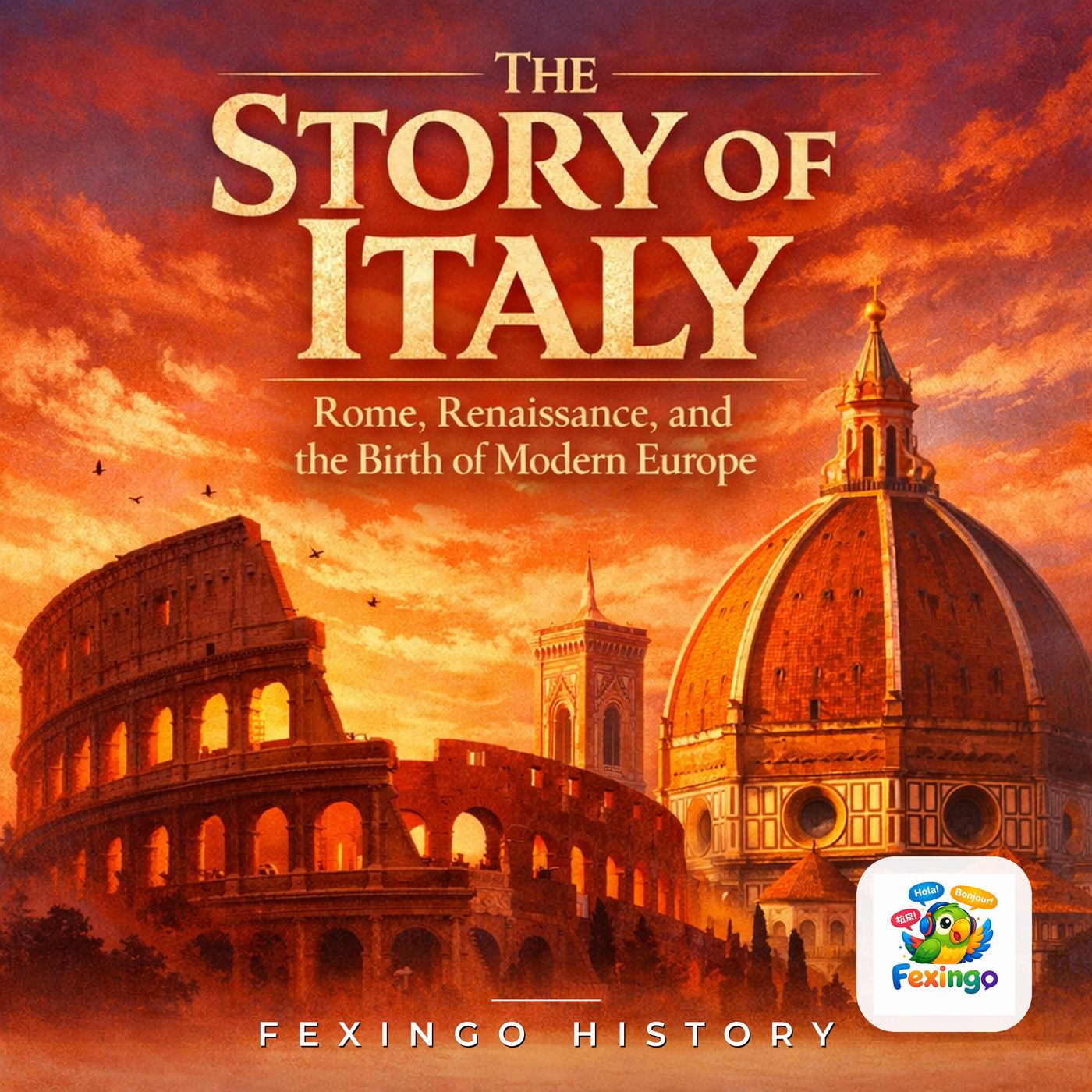
The Story of Italy: Rome, Renaissance, and the Birth of Modern Europe — Fexingo History
by Fexingo
Italy is not a country—it’s a palimpsest. From the Etruscan hill-towns to the Roman Republic’s Forum, from the warring signorie of the Renaissance to the Unification Risorgimento, the Italian peninsula has been the forge of Western civilization. Lucas and Luna guide you through the layers: how a small Latin city-state conquered the Mediterranean, why the fall of the Western Empire gave birth to the Papal States, and how Florence’s Medici bankrolled the artistic explosion that still defines our idea of beauty. They’ll explore the Lombard League, the Norman kingdom of Sicily, the Venetian maritime empire, and the Savoyard march toward unification. Carlo Goldoni’s comedies, Machiavelli’s Prince, the Council of Trent, the Carbonari secret societies—every episode digs into a specific moment or figure. Why does Garibaldi’s redshirt still stir emotion? Why did Dante write in Tuscan vernacular instead of Latin? How did the Mafia emerge from Sicily’s feudal chaos? From the fall of the Western R
-
34
The Holy Roman Empire and the Italian City-States
In this episode of The Story of Italy, Lucas and Luna explore the complex relationship between the Holy Roman Empire and the rising Italian city-states in the 12th and 13th centuries. They focus on the Lombard League, the Battle of Legnano in 1176, and the Peace of Constance in 1183, which granted substantial autonomy to cities like Milan, Bologna, and Verona. The conversation delves into the figure of Frederick Barbarossa, his conflict with Pope Alexander III, and the emergence of the Guelph and Ghibelline factions that would shape Italian politics for centuries. They also discuss the economic and military innovations of the city-state system, including the rise of the podestà and the communal militias. The episode ends by reflecting on how this medieval struggle for independence laid the groundwork for the Renaissance, with cities like Florence and Venice growing into powerful, self-governing republics that defied imperial authority. #HolyRomanEmpire #FrederickBarbarossa #LombardLeague #BattleOfLegnano #PeaceOfConstance #Milan #Bologna #Verona #PopeAlexanderIII #GuelphsAndGhibellines #Podesta #ItalianCityStates #MedievalItaly #RenaissanceOrigins #Communes #History #FexingoHistory #Italy Keep every episode free: buymeacoffee.com/fexingo
-
33
The Battle of the Teutoburg Forest: Rome's Greatest Disaster
In 9 AD, three Roman legions under Publius Quinctilius Varus were ambushed and annihilated in the dense forests of Germania. This episode explores the Battle of the Teutoburg Forest through the eyes of the commander Arminius, a Romanized Cheruscan who turned against his former allies. We examine the political backdrop under Emperor Augustus, the logistical nightmare of the Roman advance, and the ambush's precise tactics—how the Germans used the terrain, weather, and psychological warfare to devastating effect. We also discuss the aftermath: the punitive campaigns of Germanicus, the establishment of the limes Germanicus, and the lasting psychological impact on Rome. Key figures include Varus, Arminius, his father Segimer, and his rival Thusnelda. We draw on archaeological evidence from the Kalkriese site, including the famous 'Varus mask' and coin hoards. The battle ended Roman expansion across the Rhine and shaped the frontier for centuries. #TeutoburgForest #Arminius #Varus #RomanEmpire #Germania #Augustus #LegioXVII #LegioXVIII #LegioXIX #Kalkriese #Germanicus #Thusnelda #AncientRome #MilitaryHistory #Ambush #LimesGermanicus #History #FexingoHistory Keep every episode free: buymeacoffee.com/fexingo
-
32
The Roman Census Counting Souls and Power
This episode of The Story of Italy explores the Roman census — a five-yearly ritual that counted citizens, assessed property, and ranked every free Roman into a social class. Lucas and Luna unpack how the census was more than a headcount: it was a tool of moral regulation, military conscription, and political control. They discuss the censor's power to expel senators for misconduct, the solemn lustrum purification ceremony, and the ingenious system of centuriate voting that tied wealth to influence. Key figures include Servius Tullius, credited with founding the census; Cato the Elder, who used the office to punish rivals; and the statue of Juno Moneta on the Capitoline. The episode also covers the census in the late empire, when it became a tool for tax extraction, and its eventual collapse under the chaos of the third century. A fresh angle for listeners already familiar with consuls, tribunes, and the cursus honorum. #RomanCensus #Censor #Lustrum #ServiusTullius #CatoTheElder #CapitolineHill #JunoMoneta #CenturiateAssembly #RomanRepublic #MoralLegislation #Equites #CensusClass #RomanTaxation #Aerarium #Tributum #AncientRome #History #FexingoHistory Keep every episode free: buymeacoffee.com/fexingo
-
31
The Popes of Avignon: When the Papacy Left Rome
In 1309, Pope Clement V moved the papal seat from Rome to Avignon, a small city on the Rhône. For nearly 70 years, seven popes ruled Christendom from a palace in Provence, never setting foot in St. Peter's. This episode explores why the papacy left, how Avignon became a center of power and art, and the lasting consequences for the Church — including the Great Western Schism. We trace the role of King Philip IV of France, the pressure on the College of Cardinals, the construction of the Palais des Papes, and the return to Rome under Gregory XI. Along the way, we meet figures like Pope John XXII, the Avignonese popes' curia, and the poet Petrarch, who called Avignon a 'sewer of every vice.' This is a story of politics, exile, and the fragile authority of the medieval papacy. #AvignonPapacy #ClementV #PhilipIV #PalaisdesPapes #GreatWesternSchism #GregoryXI #JohnXXII #Petrarch #MedievalPapacy #Avignon #CatholicChurch #PapalHistory #14thCentury #Rhône #CollegeofCardinals #ChurchHistory #History #FexingoHistory Keep every episode free: buymeacoffee.com/fexingo
-
30
The Roman Curia: How the Pope's Court Shaped Medieval Italy
Before the Vatican bureaucracy we know today, the papal court was a sprawling network of cardinals, notaries, and administrators that governed the Church and much of Italy. In this episode, Lucas and Luna explore the origins of the Curia Romana, from its roots in the early Church to its transformation under medieval popes like Innocent III and Boniface VIII. They unpack the titles and roles—vice-chancellor, camerarius, datary—and show how the Curia functioned as a state within a state, collecting taxes, issuing bulls, and sometimes provoking rebellion. Along the way, they touch on the Avignon Papacy, the Great Schism, and the rise of the Roman barons who fought for control of papal elections. This is a story of power, money, and the machinery that made the papacy one of the most durable institutions in European history. #CuriaRomana #PapalCourt #InnocentIII #BonifaceVIII #AvignonPapacy #GreatSchism #Vatican #MedievalItaly #PapalBureaucracy #RomanBarons #Camerarius #ViceChancellor #Datary #Pope #Cardinals #ChurchHistory #History #FexingoHistory Keep every episode free: buymeacoffee.com/fexingo
-
29
The Roman Navy: How a Land Power Dominated the Mediterranean
Rome was not a seafaring nation. In 264 BCE, it had almost no warships, yet within a century it controlled the entire Mediterranean. This episode traces the birth of the Roman navy during the First Punic War, the invention of the corvus boarding bridge, the massive shipbuilding effort that turned farmers into rowers, and the later reliance on provincial fleets at Misenum and Ravenna. We discuss the Battle of Mylae (260 BCE) where consul Gaius Duilius won Rome's first naval triumph, the disaster at Drepana (249 BCE), and the crowning victory at the Aegates Islands (241 BCE) that ended the war. We also cover the naval reforms of Augustus and the classis praetoria, the imperial fleets that protected grain shipments and suppressed piracy. Specific terms: corvus, rostra, classis, duumviri navales, Misenum, Ravenna, liburna, trireme, quinquereme. #RomanNavy #PunicWars #FirstPunicWar #Corvus #BattleOfMylae #AegatesIslands #GaiusDuilius #Classis #Rostra #Misenum #Ravenna #NavalHistory #QuintusValeriusFalto #Hanno #PaxRomana #AncientRome #History #FexingoHistory Keep every episode free: buymeacoffee.com/fexingo
-
28
Ostia Antica: Rome's Port City and the Empire's Lifeline
In this episode, Lucas and Luna explore the rise and fall of Ostia Antica, the ancient port city that fed Rome and connected the empire to the world. From its founding under Ancus Marcius to its heyday as a cosmopolitan hub under Claudius and Trajan, Ostia was the logistical heart of the Roman grain supply. They walk through the city's well-preserved ruins—the massive horrea warehouses, the guilded square of the Piazzale delle Corporazioni, the Mithraeum of the Baths of Mithras, and the haunting House of Diana. They discuss the Annona, the imperial grain dole, and how Ostia's fortunes mirrored Rome's: prosperous under the early empire, declining in the third century as silting and economic shifts turned it into a ghost town. They also touch on the city's multicultural fabric, from Syrian merchants to Jewish communities, and the spread of Eastern cults like Mithraism. Finally, they reflect on why Ostia's ruins offer a more intimate glimpse of Roman daily life than Pompeii or Herculaneum—a city of merchants, slaves, and bureaucrats, not just emperors and elites. #OstiaAntica #AncientRome #RomanPort #Annona #GrainDole #PiazzaledelleCorporazioni #Mithraeum #Claudius #Trajan #RomanLogistics #Portus #RomanHarbor #RomanRuins #DailyLifeInRome #RomanArchitecture #History #FexingoHistory #Italy Keep every episode free: buymeacoffee.com/fexingo
-
27
Augustus and the Fire Brigades: How Rome's First Emperor Tamed the Flames
Rome burned. Again and again. Before Augustus, there was no organized firefighting—just panicked bucket brigades and collapsing insulae. Then, in 6 AD, the emperor created the Vigiles: a corps of 7,000 men who served as both firefighters and night watch. This episode follows the story of Roman firefighting from the great fire of Nero (which destroyed half the city) to the humble sipho (a hand-operated pump). Learn how Augustus reorganized the city into fourteen regiones, each with its own fire station; how the Vigiles recruited from freedmen and slaves; and why the wealthy relied on their own private fire brigades—until they didn't. We also look at the legal side: who was liable when a fire spread? And we ask: was the fire of 64 AD really Nero's fault? With names like Crassus (who had his own private firefighting force), Egnatius Rufus (who became too popular with his fire brigade), and the mysterious Puteoli fire law inscription, this episode dives into a surprisingly modern problem: how do you keep a crowded city from burning down? #RomanFireBrigades #Vigiles #Augustus #Nero #GreatFireOfRome #Crassus #EgnatiusRufus #Puteoli #AncientRome #Firefighting #RomanEngineering #PaxRomana #UrbsRoma #RomanHistory #History #FexingoHistory #Italy #AncientDisasters Keep every episode free: buymeacoffee.com/fexingo
-
26
The Roman Triumph: Parades, Slaves, and the Price of Glory
Lucas and Luna explore the Roman triumph — the most spectacular honor the Republic could bestow. They trace its origins from Romulus to the late Empire, walk through the parade route from the Campus Martius to the Temple of Jupiter Optimus Maximus, and discuss the rules: who qualified, what they wore, what they displayed. They examine the triumph of Scipio Africanus after Zama, Pompey's extravagant celebrations, and the controversial triumph of Caesar. They also uncover the darker side — the enslaved captives marched in chains, the prisoners executed at the end, and how triumphs could make or break a reputation. Along the way, they touch on the cognomen gained from victories, the role of the Senate, and how emperors eventually monopolized the honor. A vivid look at how Rome celebrated — and exploited — its greatest moments. #RomanTriumph #ScipioAfricanus #Pompey #JuliusCaesar #Romulus #CampusMartius #JupiterCapitolinus #SPQR #RomanRepublic #TogaPicta #Fasces #TriumphalArch #PaxDeorum #RomanArmy #TempleOfJupiter #History #FexingoHistory #AncientRome Keep every episode free: buymeacoffee.com/fexingo
-
25
The Battle of Beneventum 1266: How Anjou Conquered the Hohenstaufen
In 1266, the fate of Italy hung on a single battle fought outside Beneventum. Charles of Anjou, brother of King Louis IX of France, led his knights against Manfred of Hohenstaufen, the illegitimate son of Emperor Frederick II. This episode unpacks the politics of the papal-imperial struggle, the role of the Guelphs and Ghibellines, and how the French victory at Beneventum ended the Hohenstaufen dream of ruling Italy. We explore Manfred's tactical mistakes, the devastating charge of the French cavalry, and the brutal aftermath that saw the rise of Angevin power in Naples and Sicily. The battle also marked the end of the Hohenstaufen dynasty and reshaped the balance of power in medieval Italy, setting the stage for the Sicilian Vespers twenty years later. Expect vivid details of medieval warfare, papal politics, and the fall of a dynasty. #BattleOfBeneventum1266 #CharlesOfAnjou #ManfredOfHohenstaufen #Hohenstaufen #Angevin #GuelphsAndGhibellines #MedievalItaly #PapalPolitics #SicilianVespers #FrederickII #Beneventum #ItalianHistory #MedievalWarfare #FrenchCavalry #KingdomOfNaples #Ghibelline #History #FexingoHistory Keep every episode free: buymeacoffee.com/fexingo
-
24
Nero's Golden House: The Domus Aurea and the Making of a Tyrant
When Nero built his Golden House after the Great Fire of 64 AD, he didn't just build a palace — he built a scandal. This episode digs into the Domus Aurea, its octagonal dining room, its 130-room sprawl, and the propaganda that turned Nero into history's favorite villain. We trace the fire's aftermath, the land grabs, the gilded ceilings, and how later emperors literally buried the project. We also look at the Severan marble plan, Suetonius' gossip, and what archaeology actually tells us about Nero's vision. Was he a monster, a megalomaniac, or just a misunderstood builder? The Domus Aurea became a symbol of imperial excess, but its ruins also preserved some of the greatest frescoes of antiquity. A story of fire, gold, and the politics of memory. #Nero #DomusAurea #GoldenHouse #AncientRome #GreatFireOfRome #Suetonius #Tacitus #OctagonalRoom #Frescoes #SeveranMarblePlan #RomanArchitecture #ImperialCult #Propaganda #Colosseum #History #FexingoHistory #Italy #RomanEmpire Keep every episode free: buymeacoffee.com/fexingo
-
23
The Roman Wall of Hadrian: Britain's Frontier of Stone and Soldiers
In this episode, Lucas and Luna explore Hadrian's Wall, the monumental Roman frontier across northern Britain. They discuss why Emperor Hadrian ordered its construction in 122 CE, who built it, and what life was like for the soldiers stationed there. From the wall's original turf beginnings to its stone replacement, the Vallum ditch, milecastles, and forts like Vindolanda and Housesteads, they uncover the logistics, politics, and daily reality of this edge of empire. They also touch on the Antonine Wall further north and the wall's afterlife in folklore and tourism. Specific names and terms include: Hadrian, Aulus Platorius Nepos, Legio II Augusta, Legio VI Victrix, Legio XX Valeria Victrix, Vallum, milecastle, turret, Vindolanda, Housesteads, Segedunum, Arbeia, Stanegate, Britannia Inferior, Birrens, Trimontium, and the Historia Augusta. #HadriansWall #RomanBritain #Hadrian #LegioIIAugusta #Vindolanda #Housesteads #AntonineWall #Vallum #Milecastle #Segedunum #RomanFrontier #BritanniaInferior #AulusPlatoriusNepos #Stanegate #Trimontium #History #FexingoHistory #RomanEmpire Keep every episode free: buymeacoffee.com/fexingo
-
22
The Sack of Rome 1527: When the Eternal City Burned
In 1527, an army of mutinous imperial soldiers descended on Rome, sacking the city with a brutality that shocked Europe. The Pope, Clement VII, fled to Castel Sant'Angelo as the Eternal City was engulfed in fire and chaos. This episode examines the political and military backdrop: the League of Cognac, the ambitions of Emperor Charles V, and the role of the Landsknechts — mercenaries who had not been paid for months. We also explore the cultural aftermath, including the dispersal of artists like Rosso Fiorentino and the lasting trauma on the city's psyche. Discover how the Sack of Rome marked a turning point in the Italian Wars and the end of the High Renaissance. #SackOfRome1527 #ClementVII #CharlesV #Landsknechts #CastelSantAngelo #ItalianWars #RenaissanceRome #LeagueOfCognac #FurorTeutonicus #RossoFiorentino #Pope #HRE #Spain #16thCentury #History #Renaissance #Italy #FexingoHistory Keep every episode free: buymeacoffee.com/fexingo
-
21
The Condottieri: Italy's Mercenary Captains of the Renaissance
Before the age of standing national armies, Renaissance Italy was a battlefield fought by hired guns: the condottieri. In this episode, Lucas and Luna explore the rise and fall of these mercenary captains who commanded private armies for city-states like Florence, Milan, and Venice. They delve into the career of Giovanni da Procida, the shadowy figure behind the Sicilian Vespers; the rise of the Great Companies under Fra' Moriale and John Hawkwood; and the shocking treachery of Carmagnola, executed by the Venetian Republic. Lucas explains the peculiar 'war without blood' that later gave way to brutal sackings, and how condottieri like Francesco Sforza seized power to become dukes themselves. The episode also touches on Machiavelli's critique of mercenaries in 'The Prince' and the role of Swiss pikemen who ultimately made the condottiero obsolete. From the Company of the Rose to the Battle of Anghiari, this is a story of violence, loyalty, and betrayal in the Italian Renaissance. #Condottieri #RenaissanceItaly #Mercenaries #GiovanniDaProcida #SicilianVespers #JohnHawkwood #Carmagnola #FrancescoSforza #Machiavelli #BattleOfAnghiari #GreatCompanies #CompanyOfTheRose #FraMoriale #Venice #Florence #Milan #History #FexingoHistory #RomanRepublic #Renaissance Keep every episode free: buymeacoffee.com/fexingo
-
20
The Italian Wars: How France and Spain Fought Over Italy
In this episode, Lucas and Luna explore the Italian Wars, a series of devastating conflicts that turned Italy into a battleground for European powers from 1494 to 1559. They focus on the pivotal Battle of Fornovo (1495), the rise and fall of the Sforza dynasty in Milan, and the brutal Sack of Brescia in 1512. Key figures include Ludovico Sforza, Charles VIII of France, and the mercenary captain Bartolomeo Colleoni. The episode also examines the role of condottieri, the Treaty of Cateau-Cambrésis, and how the wars reshaped Italian politics and culture, leaving the peninsula under Spanish domination. #ItalianWars #BattleOfFornovo #CharlesVIII #LudovicoSforza #SackOfBrescia #Condottieri #TreatyOfCateauCambresis #FrenchInvasion #SforzaDynasty #BartolomeoColleoni #Venice #Milan #Florence #PapalStates #RenaissanceWarfare #EarlyModernEurope #History #FexingoHistory #RomanRepublic #Renaissance Keep every episode free: buymeacoffee.com/fexingo
-
19
Machiavelli and The Prince: A Cynical Guide to Power
In this episode of The Story of Italy, Lucas and Luna explore the life and ideas of Niccolò Machiavelli, the Renaissance political thinker whose name became synonymous with cunning and deceit. Born in Florence during the height of Medici power, Machiavelli served as a diplomat and Secretary of the Second Chancery, witnessing the brutal realities of Italian politics. After the Medici return and his torture and exile, he wrote 'The Prince' as a practical guide for rulers, advocating for virtù, decisive action, and the willingness to use cruelty and deception when necessary. This episode dives into Machiavelli's context, the book's key themes—like the fox and the lion, the ends justifying the means—and its profound impact on political philosophy. We also examine his other works, including the Discourses on Livy, and his vision for Italian unification. Join us as we separate the man from the myth and understand why Machiavelli remains both reviled and revered. #Machiavelli #ThePrince #RenaissanceItaly #PoliticalPhilosophy #Florence #Medici #CesareBorgia #Virtu #DiscoursesOnLivy #ItalianUnification #Savonarola #Realpolitik #History #FexingoHistory #CaterinaSforza #SanCasciano #Condottieri #EndsJustifyMeans #RomanRepublic #Renaissance Keep every episode free: buymeacoffee.com/fexingo
-
18
Galileo vs the Church: Science and Heresy in Baroque Italy
In 1633, Galileo Galilei stood before the Roman Inquisition, accused of heresy for claiming that the Earth moves around the Sun. This episode explores the drama of Galileo's trial and its broader context: the Counter-Reformation Church's crackdown on intellectual dissent, the role of Pope Urban VIII (a former friend and patron), and the fallout that reshaped Italian science. We discuss Galileo's groundbreaking observations with his telescope (sunspots, Jupiter's moons, Venus's phases), his 1616 warning from Cardinal Bellarmine, and the disastrous publication of his Dialogue Concerning the Two Chief World Systems. We also look at other thinkers who faced similar pressure—Giordano Bruno (burned at the stake in 1600) and Tommaso Campanella—and ask: did the Church's verdict truly silence Italian science, or did it just drive it underground? This episode brings you into the streets of Florence and Rome, into the rooms where power and knowledge clashed, and into the mind of a man who insisted that the universe was not what it seemed. #GalileoGalilei #RomanInquisition #CounterReformation #PopeUrbanVIII #CopernicanRevolution #DialogueConcerningTwoChiefWorldSystems #Padua #Florence #Bellarmine #GiordanoBruno #TommasoCampanella #Heliocentrism #ScienceVsReligion #BaroqueItaly #HistoryOfScience #FexingoHistory #TheStoryOfItaly #17thCentury #RomanRepublic #Renaissance Keep every episode free: buymeacoffee.com/fexingo
-
17
The Sack of Rome 1527: When the Renaissance Nearly Died
In 1527, the armies of Holy Roman Emperor Charles V descended on Rome, unleashing a brutal sack that shocked Europe and nearly destroyed the Renaissance papacy. This episode focuses on the dramatic events of the Sack of Rome—the political machinations between Pope Clement VII, Emperor Charles V, and King Francis I; the mutinous Imperial army led by the Constable of Bourbon; and the desperate defense of the city. We explore the human cost, the destruction of art and libraries, the flight of artists like Benvenuto Cellini, and how the sack reshaped the balance of power in Italy. Key figures include Pope Clement VII, Charles V, Francis I, the Constable of Bourbon, and Philibert of Châlon. We also touch on the wider context of the Italian Wars and the League of Cognac. This episode covers a pivotal turning point often overshadowed by the earlier episodes on the Medici and the Renaissance, bringing fresh perspective to the fragility of cultural flourishing in times of war. #SackOfRome1527 #ItalianWars #PopeClementVII #CharlesV #ConstableOfBourbon #Renaissance #Rome #LeagueOfCognac #CastelSantAngelo #BenvenutoCellini #FexingoHistory #History #16thCentury #War #Papacy #Italy #ArtDestruction #Lansquenets #RomanRepublic #Medici Keep every episode free: buymeacoffee.com/fexingo
-
16
The Ghetto and the Grand Canal: Venice's Jews
In 1516, the Republic of Venice confined its Jewish population to a small, walled island in the Cannaregio district. The word 'ghetto' was born. In this episode, Lucas and Luna explore how Venice's Jewish community lived, worked, and created under the shadow of the Serenissima. They discuss the founding of the Ghetto Nuovo, the locked gates and nightly curfews, the special taxes and yellow badges, but also the remarkable cultural flowering: the five synagogues representing different Jewish ethnic traditions, the rise of Hebrew printing at the Bragadin and Bomberg presses, and the community's role as a bridge between Christian Europe and the Ottoman Empire. They touch on the influence of the Venetian Jewish intellectual Leon Modena, the merchant families who traded with the Levant, and the eventual decline of the ghetto after Napoleon's conquest. The episode ends by reflecting on the resilience of a community that turned confinement into a unique cultural crucible. #Venice #Ghetto #JewishHistory #Renaissance #VenetianRepublic #Cannaregio #GhettoNuovo #LeonModena #HebrewPrinting #BombergPress #BragadinPress #Serenissima #OttomanEmpire #Napoleon #Synagogue #Italy #History #FexingoHistory #RomanRepublic #Medici Keep every episode free: buymeacoffee.com/fexingo
-
15
Savonarola: The Bonfire of the Vanities and Florence's Puritan Prophet
In this episode of The Story of Italy, Lucas and Luna explore the dramatic rise and fall of Girolamo Savonarola, the Dominican friar who turned Florence into a theocratic republic in the 1490s. After the Medici were expelled in 1494, Savonarola preached against corruption, art, and luxury, leading to the famous Bonfire of the Vanities where books, paintings, and cosmetics were burned. His prophecy and moral crusade captivated the city, but his attacks on Pope Alexander VI led to excommunication and eventual execution. Lucas details Savonarola's sermons, his political influence during the French invasion of Charles VIII, and his trial by fire that never happened. The episode also touches on the Florentine Renaissance context, Savonarola's influence on artists like Botticelli and Michelangelo, and the enduring question of whether he was a reformer or a fanatic. A vivid portrait of a radical preacher who changed Florence forever. #Savonarola #BonfireOfTheVanities #Florence #Renaissance #Medici #PopeAlexanderVI #CharlesVIII #Dominican #GirolamoSavonarola #ItalianHistory #Theocracy #Botticelli #Michelangelo #1490s #FexingoHistory #History #ReligiousReform #Piagnoni #RomanRepublic #Risorgimento Keep every episode free: buymeacoffee.com/fexingo
-
14
The Medici Bank: How a Family of Bankers Financed the Renaissance
In this episode, Lucas and Luna explore the rise of the Medici Bank, the financial engine behind the Renaissance. Starting with Giovanni di Bicci de' Medici, who founded the bank in 1397, we trace how the family used a network of branches from London to Constantinople to amass immense wealth. We dive into their innovative use of the bill of exchange, letters of credit, and double-entry bookkeeping. We also cover Cosimo de' Medici's political maneuvering, the bank's role in funding the construction of the Florence Cathedral's dome, and its eventual decline under Lorenzo the Magnificent. Along the way, we touch on the Pazzi Conspiracy, the Medici's patronage of artists like Donatello and Botticelli, and the bank's collapse due to bad loans and mismanagement. This is a story of how money, art, and politics intertwined to shape modern Europe. #MediciBank #Renaissance #Florence #GiovannidiBicci #CosimodeMedici #LorenzotheMagnificent #BillofExchange #DoubleEntryBookkeeping #PazziConspiracy #FlorenceCathedral #Donatello #Botticelli #BankingHistory #EconomicHistory #Patronage #ItalianHistory #History #FexingoHistory #RomanRepublic #Medici Keep every episode free: buymeacoffee.com/fexingo
-
13
The Black Death Remakes Italy: Plague, Power, and Renaissance
In 1347, a Genoese fleet brought more than trade to Sicily: it carried Yersinia pestis, the bacterium that would kill perhaps half of Italy's population within three years. This episode follows the Black Death's arrival in Messina, its devastating march through Pisa, Florence, and Venice, and the way the plague shattered feudal structures while creating new opportunities. We explore Giovanni Boccaccio's eyewitness account from the Decameron's frame story, the rise of the 'plague saints' like Saint Roch, the flagellant movement's controversial processions, and the shocking persecution of Jewish communities blamed for poisoning wells. More than a story of death, this is the story of how depopulation drove up wages for laborers, broke the back of serfdom in the countryside, and created a new class of wealthy merchants and artisans who would bankroll the Renaissance. From the Ordinance of Laborers in England to the Revolt of the Ciompi in Florence, we see how the pandemic reshaped Italy's economy, society, and faith. No episode about Italy is complete without understanding how the Black Death cleared the ground for the cultural explosion of the fifteenth century. #BlackDeath #MedievalItaly #Plague #YersiniaPestis #GiovanniBoccaccio #Decameron #Messina1347 #Flagellants #SaintRoch #CiompiRevolt #OrdinanceOfLaborers #JewishPersecution #Florence #Venice #Pisa #RenaissanceOrigins #History #FexingoHistory #RomanRepublic #Renaissance Keep every episode free: buymeacoffee.com/fexingo
-
12
Dante and the Birth of Italian Literature
In this episode, Lucas and Luna explore how Dante Alighieri's Divine Comedy, written in the Tuscan vernacular rather than Latin, transformed the Italian peninsula's literary landscape and helped forge a national language centuries before political unification. They trace Dante's exile from Florence in 1302, his wanderings through northern Italian courts, and the political and theological ambitions behind his epic poem. Along the way, they discuss the dolce stil novo movement, Dante's muse Beatrice Portinari, and his complex relationship with figures like Pope Boniface VIII. The conversation also touches on the role of the Medici family later in promoting Tuscan as the standard literary language, and how Dante's work influenced later writers like Petrarch and Boccaccio. This episode reveals how poetry, politics, and exile converged to create one of the foundational texts of Western literature. #DanteAlighieri #DivineComedy #ItalianLiterature #Florence #TuscanVernacular #BonifaceVIII #Beatrice #DolceStilNovo #Petrarch #Boccaccio #Medici #Exile #Inferno #Purgatorio #Paradiso #MedievalItaly #History #FexingoHistory #RomanRepublic #Renaissance Keep every episode free: buymeacoffee.com/fexingo
-
11
Frederick II: The Sultan of Christendom
In this episode, Lucas and Luna explore the life and reign of Frederick II, Holy Roman Emperor and King of Sicily, who astonished 13th-century Europe with his Sicilian cosmopolitan court, his unorthodox religious tolerance, and his groundbreaking falconry treatise. They discuss his upbringing in Palermo under his mother Constance, his conflict with the Papacy (especially Pope Gregory IX and Innocent IV), his crusade that recaptured Jerusalem through diplomacy rather than bloodshed, and his establishment of the University of Naples. Frederick's attempt to create a centralized, secular state in southern Italy is contrasted with the emerging communes of the north. The episode also touches on his patronage of Islamic and Jewish scholars, his harem and menagerie, and the legend of his 'perfect man' ideas. The dialogue covers the Liber Augustalis, the Constitutions of Melfi, and the fate of his dynasty. #FrederickII #HolyRomanEmpire #Sicily #Crusades #Falconry #Palermo #PopeGregoryIX #PopeInnocentIV #UniversityOfNaples #LiberAugustalis #ConstitutionsOfMelfi #Menagerie #MedievalItaly #Hohenstaufen #StuporMundi #History #FexingoHistory #MedievalEurope #RomanRepublic #Renaissance Keep every episode free: buymeacoffee.com/fexingo
-
10
The Lombard League: How Italian Cities Defeated an Emperor
In 1176, the armies of the Holy Roman Emperor Frederick Barbarossa lay shattered at Legnano, defeated by an alliance of northern Italian communes called the Lombard League. This episode tells the story of how merchants, bankers, and artisans of cities like Milan, Bologna, and Verona united to resist imperial domination. We explore the political and economic rise of the communes, the key figure of Pope Alexander III who supported them, the dramatic Battle of Legnano where the Carroccio standard became a symbol of freedom, and the Peace of Constance in 1183 that granted the cities de facto autonomy. We also touch on the legacy: the League's victory laid the groundwork for the city-states of the Renaissance, from Florence to Venice. No knights in shining armor here — just determined burghers, a pope with a grudge, and one of the most consequential upsets in medieval history. #LombardLeague #FrederickBarbarossa #BattleOfLegnano #HolyRomanEmpire #ItalianCityStates #MedievalItaly #Carroccio #PopeAlexanderIII #PeaceOfConstance #Milan #Bologna #Verona #MedievalHistory #ItalianHistory #RenaissanceOrigins #Commune #Emperor #FexingoHistory #RomanRepublic #Renaissance Keep every episode free: buymeacoffee.com/fexingo
-
9
The Investiture Controversy: When Popes and Emperors Battled for Italy
In the 11th century, a conflict erupted that would shape the political landscape of Italy and all of Europe for centuries: the Investiture Controversy. This episode dives into the clash between Pope Gregory VII and Holy Roman Emperor Henry IV, a struggle over who had the authority to appoint church officials—bishops and abbots who held immense power and land. The confrontation reached a dramatic peak at Canossa in 1077, where Henry IV stood barefoot in the snow for three days seeking papal forgiveness. But the drama didn't end there; it led to excommunications, rival popes (antipopes), and decades of warfare. We explore the key figures: Pope Gregory VII, a reformer who issued the Dictatus Papae asserting papal supremacy; Henry IV, the stubborn emperor who defied the pope; and Matilda of Tuscany, the powerful countess who hosted the famous standoff. Other players include the Normans under Robert Guiscard, who sacked Rome in 1084, and the antipope Clement III. The treaty of Worms in 1122 finally resolved the conflict, but the legacy of Church versus state endured. This episode explains how a dispute over who holds the crozier and the scepter redefined the relationship between religion and politics in medieval Italy. #InvestitureControversy #PopeGregoryVII #HenryIV #Canossa #MatildaOfTuscany #DictatusPapae #AntipopeClementIII #RobertGuiscard #Normans #SackOfRome1084 #TreatyOfWorms1122 #MedievalItaly #ChurchAndState #HolyRomanEmpire #PapalSupremacy #MedievalHistory #FexingoHistory #History #RomanRepublic #Renaissance Keep every episode free: buymeacoffee.com/fexingo
-
8
The Norman Conquest of Southern Italy: How Vikings Became Kings
In this episode, Lucas and Luna explore the astonishing story of how a band of Norman mercenaries—descendants of Vikings—carved out a kingdom in southern Italy in the 11th century. We trace the rise of the Hauteville family, starting with the arrival of the first Norman knights at the siege of Salerno in 1016. We follow the exploits of Robert Guiscard, the 'Cunning,' as he seized Apulia and Calabria from Byzantine control, and his younger brother Roger, who conquered Sicily from the Muslims. We delve into the Battle of Civitate in 1053, where the Normans defeated a papal army and forced the Pope to legitimize their conquests. We discuss the remarkable cultural fusion under Norman rule—Latin, Greek, Arab, and Jewish influences blending in art, architecture, and administration. We also touch on the controversial figure of Guiscard's son, Bohemond, who became a leader of the First Crusade. The episode ends with the legacy of Norman rule, which laid the groundwork for the later Kingdom of Naples and Sicily, and left a distinctive mark on Italian architecture seen in cathedrals like Monreale and Cefalù. #Normans #SouthernItaly #RobertGuiscard #Hauteville #ByzantineEmpire #MuslimSicily #BattleOfCivitate #NormanConquest #Vikings #PopeLeoIX #MedievalItaly #Salerno #Bari #Palermo #Monreale #Bohemond #FirstCrusade #History #RomanRepublic #Renaissance Keep every episode free: buymeacoffee.com/fexingo
-
7
The Donation of Constantine Medieval Forgeries That Shaped Italy
In this episode of The Story of Italy, Lucas and Luna explore one of the most audacious forgeries in medieval history: the Donation of Constantine. This document, supposedly from the 4th century Emperor Constantine to Pope Sylvester I, granted vast territories and temporal power to the papacy, forming the legal basis for the Papal States. We trace its origins to the 8th-century Frankish court, its use by popes like Leo III and Gregory VII to assert authority over secular rulers, and its eventual exposure as a forgery by Lorenzo Valla in 1440—a critical moment in Renaissance humanism. We also discuss the political landscape of 8th-century Italy, the role of the Papal States in Italian unification, and how this single fake document shaped the peninsula for over a millennium. Key figures include Constantine, Pope Sylvester I, Pepin the Short, Charlemagne, Otto III, Gregory VII, and Lorenzo Valla. A story of power, piety, and propaganda that echoes through Italian history. #DonationOfConstantine #MedievalForgery #PapalStates #LorenzoValla #ConstantineTheGreat #PopeSylvesterI #PepinTheShort #Charlemagne #OttoIII #PopeGregoryVII #RenaissanceHumanism #ItalianHistory #MedievalItaly #CatholicChurch #Forgery #History #FexingoHistory #TheStoryOfItaly #RomanRepublic #Renaissance Keep every episode free: buymeacoffee.com/fexingo
-
6
Charlemagne in Italy: The Frankish King Who Crowned an Empire
After the Lombard invasion and the Byzantine exarchate's collapse, Italy fragmented. The pope, threatened by the Lombards, turned north to a rising power: the Franks. In this episode, Lucas and Luna explore Charlemagne's dramatic entry into Italian politics. They discuss the 774 Siege of Pavia, where Charlemagne deposed King Desiderius and declared himself King of the Lombards. They examine the Donation of Pepin, which established the Papal States, and the forging of a new alliance between the papacy and the Frankish kingdom. The conversation covers the creation of the Carolingian Empire, the coronation of Charlemagne as Emperor in 800 AD by Pope Leo III—a turning point that revived the title of Roman Emperor in the West. They also consider the administrative reforms Charlemagne introduced: the counts, missi dominici, and the use of written capitularies. Finally, they touch on the cultural revival known as the Carolingian Renaissance, which preserved classical texts and set the stage for medieval learning. This episode reveals how a Frankish king reshaped Italy and the entire trajectory of European history. #Charlemagne #Lombards #Pavia #PapalStates #DonationOfPepin #CarolingianEmpire #PopeLeoIII #HolyRomanEmpire #SiegeOfPavia #Desiderius #MissiDominici #CarolingianRenaissance #Capitularies #MedievalItaly #FrankishKingdom #EarlyMiddleAges #History #FexingoHistory #RomanRepublic #Renaissance Keep every episode free: buymeacoffee.com/fexingo
-
5
The Lombard Invasion: Barbarians Who Became Italian
After the fall of the Western Roman Empire and Justinian's grueling Gothic War, a new barbarian group swept into Italy: the Lombards. Led by King Alboin, they crossed the Alps in 568 AD and conquered much of the peninsula, but unlike the Ostrogoths, they never fully unified Italy. Instead, they left a patchwork of duchies and independent city-states that shaped medieval Italy. We explore the Lombard law code, their conversion from Arianism to Catholicism, and the rise of the Papal States as a temporal power—a direct result of Lombard threats. Key figures include Alboin, Queen Rosamund (whose revenge story rivals any Shakespeare drama), and Pope Gregory the Great, who negotiated with Lombard dukes and set the stage for centuries of papal authority. We also discuss the Lombard legacy in place names, language, and the very concept of Italian regionalism. This episode bridges the gap between ancient Rome and the birth of medieval Italy, setting the stage for the rise of independent communes and, eventually, the Renaissance. #Lombards #Alboin #Rosamund #GregoryTheGreat #BarbarianKingdoms #EarlyMiddleAges #MedievalItaly #ArianismVsCatholicism #DuchyOfSpoleto #DuchyOfBenevento #ExarchateOfRavenna #PapalStates #GothicWarAftermath #Justinian #Narses #ItalianHistory #FexingoHistory #History #RomanRepublic #Renaissance Keep every episode free: buymeacoffee.com/fexingo
-
4
Justinian and Theodora: Byzantium's Boldest Power Couple
In this episode, we explore the incredible partnership of Emperor Justinian and Empress Theodora, who together shaped the Byzantine Empire's golden age. From the Nika Riots of 532 AD, where Theodora's steely resolve saved Justinian's throne, to the massive legal reforms of the Corpus Juris Civilis, we'll see how this dynamic duo transformed Constantinople. We'll also delve into Theodora's unlikely rise from actress and courtesan to co-ruler, and Justinian's ambitious building program, including the Hagia Sophia. Their story is one of power, faith, and a partnership that defied convention—and left a lasting mark on Italy, especially through the Gothic War and the Exarchate of Ravenna. #Justinian #Theodora #ByzantineEmpire #NikaRiots #CorpusJurisCivilis #HagiaSophia #Belisarius #GothicWar #Ravenna #Exarchate #Constantinople #LateAntiquity #EmpressTheodora #ByzantineLaw #History #FexingoHistory #TheStoryofItaly #Byzantium #RomanRepublic #Renaissance Keep every episode free: buymeacoffee.com/fexingo
-
3
The Fall of Rome: How Barbarian Migrations Reshaped Italy
In this episode of The Story of Italy, Lucas and Luna explore the twilight of the Roman Empire in the West. They discuss the profound impact of the Migration Period, focusing on key groups like the Visigoths, Vandals, and Ostrogoths. Lucas explains how the Roman government's policy of federate settlements backfired, leading to the sack of Rome by Alaric in 410 AD and the eventual collapse of imperial authority. He highlights the role of General Stilicho, a Vandal-Roman who tried to hold the empire together, and the tragic irony of Rome's fall. The conversation turns to the Kingdom of Italy under Odoacer and Theodoric the Great, blending Roman and Germanic traditions. Lucas argues that the 'fall' was less a dramatic event and more a slow transformation, with the Catholic Church emerging as a unifying force. The episode ends with a reflection on how these changes set the stage for the medieval world and the Renaissance, leaving Luna wondering about the legacy of this hybrid culture. #FallOfRome #MigrationPeriod #Visigoths #Vandals #Ostrogoths #Alaric #Stilicho #Odoacer #Theodoric #SackOfRome410 #RomanEmpire #BarbarianInvasions #LateAntiquity #Italy #FexingoHistory #History #RomanHistory #MedievalItaly #RomanRepublic #Renaissance Keep every episode free: buymeacoffee.com/fexingo
-
2
Augustus: The Master of Spin Who Built an Empire
Julius Caesar's adopted heir Octavian didn't just win a civil war—he reinvented Roman government, culture, and religion to create a durable imperial system. This episode explores how Augustus crafted his own legend through masterful propaganda: the Res Gestae inscription, Virgil's Aeneid linking Rome to Trojan destiny, the Ara Pacis altar celebrating peace, and the restoration of 'traditional' morality while consolidating absolute power. We examine the Battle of Actium (31 BCE) not as a mere military clash but as a propaganda turning point, the careful construction of the principate as a 'restored republic,' and the exile of poet Ovid as a warning against dissent. How did one man transform a chaotic republic into a stable monarchy that lasted centuries? And what did the Roman people gain—and lose—in the bargain? #Augustus #Octavian #BattleOfActium #ResGestae #AraPacis #Virgil #Ovid #RomanEmpire #Principate #PaxRomana #Propaganda #RomanHistory #AncientRome #CivilWar #ImperialCult #History #FexingoHistory #Italy #RomanRepublic #Renaissance Keep every episode free: buymeacoffee.com/fexingo
-
1
Julius Caesar Crosses the Rubicon: The Death of the Republic
In this episode, Lucas and Luna dive into one of the most pivotal moments in Roman history: the civil war that ended the Republic. They explore the political crisis of the late Republic, focusing on the First Triumvirate—the informal alliance between Julius Caesar, Pompey the Great, and Marcus Licinius Crassus. Lucas explains how Caesar's conquest of Gaul made him a hero to the people but a threat to the Senate, led by the conservative Cato the Younger. When Crassus died in battle and Pompey sided with the Senate, Caesar faced a choice: disband his army and face prosecution, or march on Rome. On January 10, 49 BC, Caesar crossed the Rubicon River, famously declaring 'alea iacta est'—the die is cast. Luna asks about Caesar's motivations and the aftermath, including the battles of Pharsalus and the Ides of March. Lucas also touches on the role of Cleopatra, the adoption of Octavian (later Augustus), and the lasting impact on the Roman Empire. This episode paints a vivid picture of ambition, betrayal, and the end of a republic. #JuliusCaesar #CrossingTheRubicon #RomanCivilWar #PompeyTheGreat #MarcusCrassus #CatoTheYounger #FirstTriumvirate #BattleOfPharsalus #IdesOfMarch #Cleopatra #Octavian #RomanRepublic #AncientRome #History #FexingoHistory #TheStoryOfItaly #Caesar #Rubicon #Renaissance #Medici Keep every episode free: buymeacoffee.com/fexingo
-
0
The Roman Republic: How a City Forged an Empire Without Kings
In this episode, Lucas and Luna explore the birth of the Roman Republic, a political experiment that would shape the Western world. They dive into the overthrow of the last king, Tarquin the Proud, in 509 BCE, and the establishment of a new government with consuls, a Senate, and popular assemblies. The conversation covers the legendary figures of Lucius Junius Brutus and Lucretia, whose tragic story sparked the rebellion. Lucas explains the conflict between patricians and plebeians, leading to the creation of the Tribune of the Plebs and the Twelve Tables — Rome's first written law code. They discuss the Punic Wars against Carthage, focusing on Hannibal's crossing of the Alps and the Battle of Cannae in 216 BCE, where Rome faced near-annihilation. The episode also touches on the reforms of Tiberius and Gaius Gracchus, whose attempts to redistribute land led to political violence and foreshadowed the Republic's end. Lucas highlights key institutions like the Senate, the cursus honorum, and the role of the military in expanding Rome's power. Luna questions the fragility of the Republic and the parallels to modern democracies. The episode ends with a reflection on how Rome's republican ideals — and their failures — still echo today. #RomanRepublic #Lucretia #LuciusJuniusBrutus #TarquinTheProud #509BCE #PatriciansAndPlebeians #TwelveTables #TribuneOfThePlebs #PunicWars #Hannibal #Cannae #GracchiBrothers #TiberiusGracchus #RomanSenate #CursusHonorum #AncientHistory #FexingoHistory #History #Renaissance #Medici Keep every episode free: buymeacoffee.com/fexingo
-
-1
The Seed of Rome: From Mud Huts to an Empire
Imagine a muddy, mosquito-ridden crossroads in central Italy around 750 BCE — no marble, no empire, no Caesar. This is where our story begins. In this pilot episode, Lucas and Luna stand on the future site of the Roman Forum, then just a valley of pasture and marsh. They explore the earliest layers of Italian history: the mysterious Etruscans who taught Rome writing, engineering, and gladiators; the Greek colonists who brought olives, vines, and alphabet to the south; and the first Romans themselves — Latin-speaking farmers who worshipped local gods and built a tiny settlement on the Palatine Hill. We meet Romulus, whose legend might hide a real warlord, and trace the archaeological evidence of huts and graves that confirm an eighth-century foundation. We also look ahead to the threads that will weave through future episodes: the Republic, the Empire, the medieval communes, the Renaissance, and the unification of Italy. This episode sets the stage by asking: what made this peninsula so special? What did Rome inherit, and what did it create? No grand claims, just the smell of wet earth and the sound of a language that would one day conquer the world. #History #FexingoHistory #Italy #Rome #Etruscans #Romulus #PalatineHill #RomanForum #Latin #MagnaGraecia #IronAge #753BC #FoundationOfRome #AncientHistory #Mediterranean #PodcastPilot #LucasAndLuna #StoryOfItaly #RomanRepublic #Renaissance Keep every episode free: buymeacoffee.com/fexingo
We're indexing this podcast's transcripts for the first time — this can take a minute or two. We'll show results as soon as they're ready.
No matches for "" in this podcast's transcripts.
No topics indexed yet for this podcast.
Loading reviews...
ABOUT THIS SHOW
Italy is not a country—it’s a palimpsest. From the Etruscan hill-towns to the Roman Republic’s Forum, from the warring signorie of the Renaissance to the Unification Risorgimento, the Italian peninsula has been the forge of Western civilization. Lucas and Luna guide you through the layers: how a small Latin city-state conquered the Mediterranean, why the fall of the Western Empire gave birth to the Papal States, and how Florence’s Medici bankrolled the artistic explosion that still defines our idea of beauty. They’ll explore the Lombard League, the Norman kingdom of Sicily, the Venetian maritime empire, and the Savoyard march toward unification. Carlo Goldoni’s comedies, Machiavelli’s Prince, the Council of Trent, the Carbonari secret societies—every episode digs into a specific moment or figure. Why does Garibaldi’s redshirt still stir emotion? Why did Dante write in Tuscan vernacular instead of Latin? How did the Mafia emerge from Sicily’s feudal chaos? From the fall of the Western R
HOSTED BY
Fexingo
Loading similar podcasts...
Frequently Asked Questions
How many episodes does The Story of Italy: Rome, Renaissance, and the Birth of Modern Europe — Fexingo History have?
The Story of Italy: Rome, Renaissance, and the Birth of Modern Europe — Fexingo History currently has 36 episodes available on PodParley. New episodes are automatically indexed when they're published to the podcast feed.
What is The Story of Italy: Rome, Renaissance, and the Birth of Modern Europe — Fexingo History about?
Italy is not a country—it’s a palimpsest. From the Etruscan hill-towns to the Roman Republic’s Forum, from the warring signorie of the Renaissance to the Unification Risorgimento, the Italian peninsula has been the forge of Western civilization. Lucas and Luna guide you through the layers: how a...
How often does The Story of Italy: Rome, Renaissance, and the Birth of Modern Europe — Fexingo History release new episodes?
The Story of Italy: Rome, Renaissance, and the Birth of Modern Europe — Fexingo History has 36 episodes. Check the episode list to see recent publication dates and frequency.
Where can I listen to The Story of Italy: Rome, Renaissance, and the Birth of Modern Europe — Fexingo History?
You can listen to The Story of Italy: Rome, Renaissance, and the Birth of Modern Europe — Fexingo History on PodParley by clicking any episode. We provide an embedded audio player for direct listening, and you can also subscribe via your preferred podcast app using the RSS feed.
Who hosts The Story of Italy: Rome, Renaissance, and the Birth of Modern Europe — Fexingo History?
The Story of Italy: Rome, Renaissance, and the Birth of Modern Europe — Fexingo History is created and hosted by Fexingo.
URL copied to clipboard!