
PODCAST · history
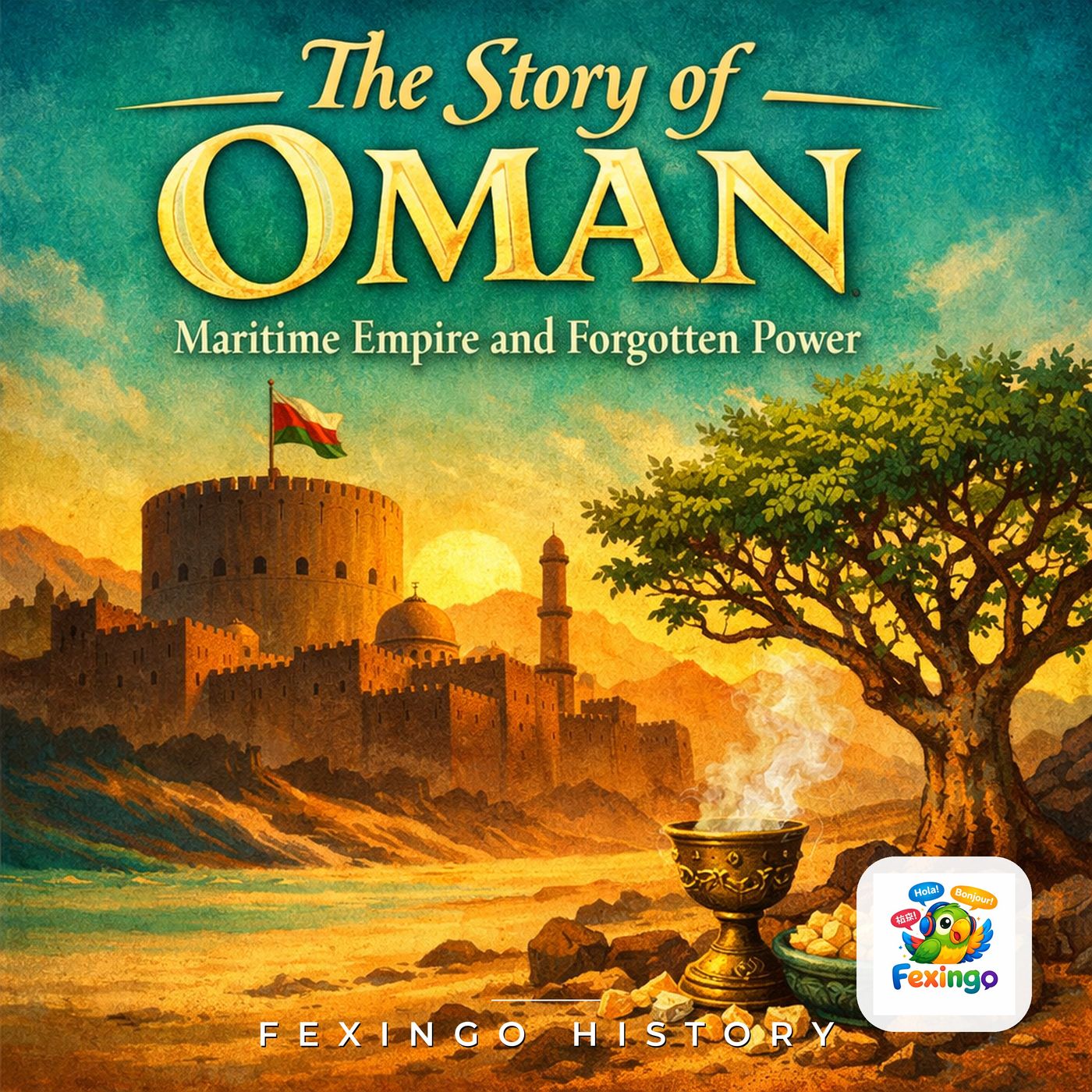
The Story of Oman: Maritime Empire and Forgotten Power — Fexingo History
by Fexingo
Oman: a name that conjures frankincense, desert forts, and a maritime empire that once rivaled Portugal and Britain. From the ancient kingdom of Magan, whose copper and diorite fueled Mesopotamian civilization, to the rise of the Yaruba dynasty that expelled the Portuguese from Muscat in 1650, this show charts Oman's extraordinary arc. Lucas and Luna guide listeners through the Omani empire's golden age under the Al Bu Said dynasty, when fleets dominated the Indian Ocean from Zanzibar to Gujarat, and slave-trading networks stretched across the Swahili Coast. We delve into the Ibadi imamate's unique blend of Islam and governance, the Omani-Portuguese wars, the contentious Omani-Zanzibar split of 1856, and the Dhofar Rebellion that reshaped the modern sultanate. We examine the frankincense trade that made Dhofar the envy of the ancient world, the construction of the Nizwa fort as a symbol of Omani resistance, and the legacy of Sultan Qaboos, who transformed a backwater into a stable, neu
-
34
The Battle of Mirbat: SAS, Dhofar Rebels, and Oman's Turning Point
In 1972, nine British SAS soldiers and a small force of Omani askaris held off hundreds of communist-backed Dhofar rebels in a desperate dawn battle at Mirbat. This episode tells the story of how a tiny garrison, armed with a 25-pounder howitzer and sheer grit, repelled the assault that could have toppled Sultan Qaboos's fledgling regime. We explore the strategic importance of the Dhofar port, the motley coalition of Baluchi troops, local firqat fighters, and SAS men who defended it, and the battle's aftermath that cemented Oman's modernisation under Qaboos. Featuring the heroic actions of Corporal Labalaba, the arrival of a Strikemaster jet, and the political context of the Cold War in the Arabian Peninsula. #BattleOfMirbat #SAS #DhofarRebellion #Oman #SultanQaboos #CorporalLabalaba #MikeKealy #ColdWar #ArabianPeninsula #BritishMilitary #MilitaryHistory #1970s #PersianGulf #MiddleEast #Firqat #Strikemaster #History #FexingoHistory Keep every episode free: buymeacoffee.com/fexingo
-
33
The Forgotten Imamate: Oman's Civil War of 1913-1920
In the early 20th century, as the Omani Empire was fading, a renewed Imamate movement rose against the Sultan in Muscat. This episode explores the revolt led by Imam Salim al-Kharusi, the 1913 tribal uprising that captured Nizwa, and the climactic Battle of Al-Hamra in 1915. We discuss the role of Ibadi revivalism, British intervention through the Political Agent in Muscat, and the Treaty of Seeb in 1920 that temporarily partitioned Oman into coastal and interior zones. The episode sheds light on a forgotten civil war that shaped modern Oman's political geography and the simmering tensions between the interior Imamate and the coastal Sultanate. #Imamate #Ibadi #SalimAlKharusi #BattleOfAlHamra #TreatyOfSeeb #Nizwa #Muscat #BritishEmpire #Oman #History #MiddleEastHistory #CivilWar #1913 #1920 #OmaniInterior #FexingoHistory #ColonialHistory #PerisanGulf Keep every episode free: buymeacoffee.com/fexingo
-
32
Oman's Frankincense Trade Routes and the Land of Punt
In this episode of The Story of Oman, Lucas and Luna explore the ancient frankincense trade that made Oman a crossroads of the ancient world. They dive into the Boswellia sacra trees of Dhofar, the port of Sumhuram at Khor Rori, and the legendary Land of Punt that sent expeditions to Queen Hatshepsut's Egypt. The conversation follows the aromatic resin from the Wadi Dawkah valley to the markets of the Mediterranean, India, and China, revealing how frankincense shaped economies, religions, and empires for millennia. Along the way, they touch on the frankincense road, the lost city of Ubar, and the role of the Hadramawt kingdom in controlling this precious trade. A small donation segment supports the ad-free mission of the show. #Frankincense #Oman #Dhofar #BoswelliaSacra #Sumhuram #KhorRori #LandOfPunt #Hatshepsut #WadiDawkah #Ubar #Hadramawt #AncientTrade #IncenseRoad #ArabianHistory #MiddleEast #History #FexingoHistory #OmanHistory Keep every episode free: buymeacoffee.com/fexingo
-
31
Oman's Dhofar Rebellion: The Forgotten War That Remade Arabia
Lucas and Luna explore the Dhofar Rebellion (1962-1976), a pivotal conflict that pitted Omani sultanate forces, backed by British SAS and Iranian troops, against Marxist insurgents from the Dhofar Liberation Front. They delve into the rebellion's origins in the mountainous Dhofar region, the role of tribal leader Musallam bin Nufl, and the strategic use of caves and wadis by the rebels. The episode covers the controversial British involvement, including the 'hearts and minds' campaign that built schools and clinics to win over locals, and the decisive Battle of Mirbat in 1972 where nine SAS soldiers held off 250 rebels. The conversation also touches on the ideological shift from Arab nationalism to Maoist insurgency, the impact of the 1970 coup that brought Sultan Qaboos to power, and how the rebellion's end paved the way for Oman's modernization. For listeners who know Oman's maritime history, this episode reveals how a land war in the south reshaped the nation's identity and forged its modern army. #DhofarRebellion #OmanHistory #SAS #SultanQaboos #MusallamBinNufl #BattleOfMirbat #DhofarLiberationFront #MaoistInsurgency #BritishMilitary #IranianImperialGuard #HeartsAndMinds #JebelAkhdar #MiddleEastHistory #ColdWarProxy #OmaniArmy #FexingoHistory #20thCenturyWarfare #History Keep every episode free: buymeacoffee.com/fexingo
-
30
Oman's Sugar Plantations: The Sweetening of Zanzibar
In the mid-1800s, the Omani Sultanate of Zanzibar became a global sugar producer. This episode follows the rise of clove and sugar plantations on the island, the forced labor of enslaved Africans from the Great Lakes region, and the boom that enriched the Busaidi dynasty. We meet Sayyid Said bin Sultan, who moved his capital to Zanzibar to profit from cash crops, and examine the brutal conditions in the sugar mills. The episode also explores the environmental toll—deforestation and soil exhaustion—and the eventual decline when British antislavery patrols disrupted the labor supply. A little-known chapter of Oman's African empire. #Oman #Zanzibar #SugarPlantations #SayyidSaid #Busaidi #CloveTrade #Slavery #IndianOcean #BritishAbolition #DhowPatrols #MoresbyTreaty #HamertonTreaty #Mzizima #Unguja #SwahiliCoast #CashCrops #History #FexingoHistory Keep every episode free: buymeacoffee.com/fexingo
-
29
Oman's Forgotten Naval Battle: The 1841 Bombardment of Sur
In 1841, the British Royal Navy bombarded the port of Sur, a key center of Omani maritime power. This episode examines the raid that shattered the Busaidi navy and cemented British dominance in the western Indian Ocean. We trace the roots of the conflict: the Omani-British treaty of 1798, the rise of Sur as a dhow-building hub, and the Qawasim pirate threat. Lucas and Luna discuss the tactical blunders of Sultan Said bin Sultan, the burning of the Omani fleet, and the long-term decline of Omani naval power. We also explore Sur's legacy as a shipbuilding center, the shift from Omani to British hegemony, and the forgotten role of Baluchi mercenaries in the sultan's service. A story of diplomacy, firepower, and the end of an era. #Oman #BritishEmpire #Sur #NavalHistory #Busaidi #Qawasim #IndianOcean #1841 #SultanSaid #RoyalNavy #Dhow #Shipbuilding #Muscat #Baluchi #Piracy #Imperialism #19thCentury #FexingoHistory Keep every episode free: buymeacoffee.com/fexingo
-
28
Oman's Swahili Coast: The Fort Jesus Siege of 1696
In 1696, a small Omani force under the Ya'aruba dynasty laid siege to Fort Jesus in Mombasa, held by the Portuguese for nearly a century. This episode follows the dramatic two-year siege that broke Portuguese dominance on the Swahili coast. We explore the key figures: Imam Saif bin Sultan, the Portuguese captain João de Sousa, and the local Swahili allies who shifted loyalties. The siege involved mining, counter-mining, and a desperate Portuguese relief fleet. When the fort finally fell in 1698, it marked the end of Portuguese rule in East Africa and the rise of the Omani maritime empire. We also discuss the legacy: how Fort Jesus became a symbol of Omani power and the Swahili coast's integration into Oman's Indian Ocean network. The episode touches on the strategic importance of Mombasa, the role of monsoon winds in naval warfare, and the cultural blending that followed Omani rule. #FortJesus #OmaniEmpire #Yaaruba #SaifBinSultan #Mombasa #SwahiliCoast #PortugueseEmpire #SiegeOfFortJesus #IndianOceanHistory #EastAfrica #NavalWarfare #17thCentury #Monsoon #JoãoDeSousa #OmanHistory #FexingoHistory #History Keep every episode free: buymeacoffee.com/fexingo
-
27
Oman's Pearl Empire: The Banks That Bankrolled the Busaidi
Long before oil, Oman's wealth came from the sea—specifically, from the pearl banks of the Persian Gulf. In this episode, Lucas and Luna explore how the Busaidi sultans controlled the pearl trade from Muscat to Bahrain, managing a network of divers, merchants, and tribal sheikhs. They discuss the grueling life of a pearl diver, the seasonal rhythms of the shu'aa fleet, and how natural pearls were graded and sold in Bombay. The episode also covers the rise of Japanese cultured pearls in the 1920s, which devastated Oman's economy, and the last Omani pearl dhow that sailed in the 1950s. Along the way, they touch on the Qawasim pirates who raided pearl convoys, the British attempt to regulate the trade, and the legacy of Saeed bin Salim al-Harasi, a legendary diver from Sur. It's a story of wealth, danger, and an empire built on the lustre of a single gem. #OmaniPearlTrade #Busaidi #PearlDiving #PersianGulf #Shu'aa #SaeedBinSalimalHarasi #Sur #Muscat #Bahrain #Qawasim #Bombay #Mikimoto #CulturedPearls #1920s #1950s #MaritimeHistory #History #FexingoHistory Keep every episode free: buymeacoffee.com/fexingo
-
26
The Omani Empire's Persian Gulf Pearl Banks
Before oil, Oman's economy was built on pearls. In this episode, Lucas and Luna dive into the pearl banks of the Persian Gulf and the Omani ports that controlled the trade for centuries. They explore the seasonal rhythms of the pearl divers, the financiers and merchants who connected the Gulf to Bombay and Basra, and the hidden labour — African-descended slaves who did the most dangerous diving. The episode traces the boom years of the 19th century, the devastating impact of Japanese cultured pearls in the 1930s, and how the pearling economy shaped Omani coastal society. Key figures include the legendary diver Saeed bin Salim al-Harasi and the merchant prince Sultan bin Ali al-Hinai. Lucas also explains the unique dhow design used for pearling, the shu'aa, and the social hierarchy aboard pearling boats. Luna asks about the role of women in the pearl trade and the environmental toll of overharvesting. #Oman #PearlDiving #PersianGulf #IndianOcean #Dhow #Shuaa #SaeedBinSalim #SultanBinAli #JapaneseCulturedPearls #SlaveDivers #Mikimoto #PearlingEconomy #OmaniHistory #19thCentury #GulfTrade #FexingoHistory #History #MaritimeHistory Keep every episode free: buymeacoffee.com/fexingo
-
25
Oman's Forgotten African General: The Tale of Sef bin Sultan
In this episode, Lucas and Luna explore the story of Sef bin Sultan, an Omani general who led a campaign into the African interior in the 1820s, nearly conquering the powerful Kingdom of Buganda in what is now Uganda. They discuss his motivations, the military strategies of his Baluchi and African troops, his temporary success in installing a puppet king, and his eventual downfall from disease and betrayal. The episode also touches on the broader Omani Empire's reach into East Africa beyond the coast, the dynamics of slave trading, and the often-overlooked role of African intermediaries in Omani expansion. A reflection on how history remembers conquerors who fail. #Oman #EastAfrica #Buganda #SefbinSultan #Zanzibar #OmaniEmpire #Baluchi #19thCentury #AfricanHistory #SlaveTrade #SayyidSaid #LakeVictoria #Uganda #ArabExpansion #History #FexingoHistory #MiddleEast #IndianOcean Keep every episode free: buymeacoffee.com/fexingo
-
24
The Omani Pirate Who Became a Qing Admiral
In the early 18th century, a young Omani sailor from Sur was captured by Chinese pirates and sold into slavery in Guangzhou. But instead of a life of servitude, he rose through the ranks of the Qing navy, commanding a fleet of junks and fighting pirates along the Fujian coast. This episode tells the story of Sayyid bin Ali bin Nasir — a man who transformed from a captive into a naval commander under the Qianlong Emperor, bridging the Indian Ocean and the South China Sea. We explore the Ming-Qing maritime trade networks, the role of Arab and Persian sailors in Chinese ports, and the remarkable career of a man who navigated two worlds. How did an Omani captive become a trusted Qing admiral? What does his story reveal about the global connections of the 18th century? Join Lucas and Luna as they unravel a forgotten tale of empire, identity, and survival. #Oman #Qing #Pirate #Admiral #SayyidBinAliBinNasir #Sur #Guangzhou #Fujian #Qianlong #IndianOcean #SouthChinaSea #MaritimeHistory #Slavery #NavalHistory #ArabSailors #ChineseHistory #History #FexingoHistory Keep every episode free: buymeacoffee.com/fexingo
-
23
The Frankincense Trade: Oman’s Ancient Incense Empire
In this episode of The Story of Oman, Lucas and Luna explore the ancient frankincense trade that made Oman a wealthy hub of the incense route. They discuss the Boswellia sacra tree native to Dhofar, the archaeological sites of Sumhuram and Khor Rori, and the port of Moscha Limen. The conversation covers the trade networks connecting Oman to Egypt, Mesopotamia, and the Mediterranean, including the role of the Himyarite and Sabaean kingdoms. Lucas explains the labor-intensive harvesting process, the religious and medicinal uses of frankincense, and the decline of the trade due to the rise of Christianity and changing Roman tastes. The episode also touches on the modern revival of frankincense cultivation and its cultural significance in Oman today. #Oman #Frankincense #BoswelliaSacra #Dhofar #Sumhuram #KhorRori #MoschaLimen #IncenseTrade #AncientOman #Himyar #Sabaean #Punt #Placenames #Egypt #Mesopotamia #RomanEmpire #History #FexingoHistory #OmanHistory #OmaniEmpire Keep every episode free: buymeacoffee.com/fexingo
-
22
Oman's Incense Empire: Frankincense and the Land of Punt
Long before oil, Oman was the world's only source of premium frankincense, a luxury that fueled empires from Rome to Han China. This episode traces the ancient trade routes from the Dhofar mountains, where the Boswellia sacra tree grows, to the temples of Thebes and the markets of Babylon. We explore the mysterious Land of Punt, where Egyptian pharaohs sent expeditions for myrrh and incense, and how Omani merchants managed the monopoly. Discover the Sumhuram archaeological site, the lost port of Moscha, and the frankincense highway that made southern Arabia the richest corner of the ancient world. Lucas and Luna discuss the Pliny quote that scandalized Rome, the role of the Himyarite and Sabaean kingdoms, and the botanical secrets of the resin. A story of desert caravans, monsoon winds, and a fragrance that built civilizations. #Frankincense #Dhofar #LandOfPunt #BoswelliaSaccharum #Sumhuram #KhorRori #Moscha #PlinyTheElder #Himyarite #Sabaean #AncientOman #IncenseTrade #AncientEgypt #Babylon #RomanLuxury #History #FexingoHistory #MaritimeHistory #OmanHistory #OmaniEmpire Keep every episode free: buymeacoffee.com/fexingo
-
21
The Omani Forts: Architecture of Power and Faith
In this episode, Lucas and Luna explore the remarkable forts of Oman—not just as military structures, but as expressions of Ibadi identity, political power, and architectural ingenuity. From the towering round tower of Nizwa, built by Imam Sultan bin Saif al-Ya'arubi in the 1660s, to the intricate falaj irrigation systems that sustained these fortresses, they uncover how forts like Bahla, Rustaq, and Jabreen were centers of learning, governance, and resistance. Lucas explains the unique Omani architectural features—beehive-shaped towers, date-palm wood doors, and wind towers—and reveals the strategic genius behind their placement at oasis crossroads and mountain passes. They discuss the role of fortifications in the Portuguese-Omani wars, the Ya'aruba revival, and how forts later became symbols of national pride under Sultan Qaboos. Luna asks about the famous 'secret tunnels' and the symbolism of the falaj channels. The episode ends with a reflection on how these stone guardians tell a story of resilience and faith in a harsh landscape, inviting listeners to see them as living monuments. #Oman #OmaniForts #NizwaFort #Ibadi #YaAruba #BahlaFort #RustaqFort #JabreenFort #Architecture #PortugueseOman #Falaj #SultanQaboos #IndianOcean #DesertFortresses #History #FexingoHistory #MiddleEastHistory #MilitaryArchitecture #OmanHistory #OmaniEmpire Keep every episode free: buymeacoffee.com/fexingo
-
20
The Ibadis of Oman: Islam's Third Branch and Its Forgotten History
Long before the oil boom or the Omani Empire's Indian Ocean reach, a quiet theological revolution shaped the country's soul. In this episode, Lucas and Luna explore the origins and unique doctrines of Ibadism — the third major branch of Islam, distinct from Sunni and Shia. They trace its roots to the early Kharijite movement, the pivotal figure of Jabir ibn Zayd in Basra, and the secretive establishment of the first Ibadi imamate in Oman under al-Julanda bin Mas'ud. Lucas explains how Ibadis rejected hereditary rule, developed a sophisticated theory of imamate that allowed for 'hidden' imams in times of oppression, and why their mosques have no minarets and their prayers differ subtly from their neighbors. The conversation covers the dramatic story of the Ibadi community's survival under the Umayyads, their role in Oman's unification, and how the Ibadi tradition of tolerance and consultation (shura) influenced Oman's modern political culture under Sultan Qaboos. Along the way, they touch on the Ibadi diaspora in Zanzibar, the Mzab Valley in Algeria, and the Nafusa Mountains in Libya. This episode sheds light on a branch of Islam that has shaped Oman for over a millennium but remains little known outside the country. #Ibadi #Oman #JabirIbnZayd #Imamate #Kharijites #Julanda #Basra #Umayyads #Shura #HiddenImam #Mzab #Nafusa #Zanzibar #Islam #OmaniHistory #ReligiousHistory #MiddleEast #FexingoHistory #OmanHistory #OmaniEmpire Keep every episode free: buymeacoffee.com/fexingo
-
19
The Azd Migration: How Yemeni Tribes Founded Oman
Long before the Ya'aruba or Al Bu Said dynasties, before frankincense and copper made Oman a crossroads of the ancient world, a massive tribal migration from Yemen transformed the Arabian Peninsula. This episode traces the great Azd migration of the 2nd–3rd centuries AD, when the collapse of the Marib Dam and the resulting exodus sent tribes like the Azd, Kinda, and Himyar across Arabia. Lucas and Luna explore how the Azd split into three branches—the Azd of Oman, the Azd of Sarat, and the Azd of Ghassan—and how the Omani branch settled around Nizwa, establishing the Julanda dynasty that would later resist Umayyad expansion. They discuss the legendary figure of Malik bin Fahm, who led the Azd into Oman, and the archaeological evidence from sites like Mleiha and ed-Dur that confirms the influx of new populations. The episode also covers the socioeconomic effects: the introduction of new irrigation techniques (falaj), the spread of South Arabian script, and the integration of Azd with earlier communities like the Samad and Wadi Suq peoples. Finally, they examine how the Azd identity persisted into the Islamic period, influencing Omani Ibadism and the region's distinct political culture. #AzdMigration #YemenTribes #MaribDam #MalikBinFahm #JulandaDynasty #OmanHistory #AncientHistory #PreIslamicArabia #FalajIrrigation #Mleiha #EdDur #SouthArabianScript #SamadCulture #WadiSuq #Ibadism #TribalMigration #History #FexingoHistory #OmaniEmpire #YarubaDynasty Keep every episode free: buymeacoffee.com/fexingo
-
18
Oman's Gwadar: The Lost Port on the Makran Coast
In this episode of The Story of Oman, Lucas and Luna explore a forgotten chapter of Omani history: the 178-year Omani rule over Gwadar, a port on the Makran coast of present-day Pakistan. They trace how the port was acquired in 1783 by the Al Bu Said dynasty, its role as a strategic naval base and trading hub linking Oman to India and Central Asia, and the multicultural society that flourished there—Baloch, Omani, African, and Khoja communities coexisting under Omani sovereignty. The episode delves into the decline of Omani power in the 19th century, the British Raj's growing influence, and the eventual sale of Gwadar to Pakistan in 1958. Through the stories of governors like Sayyid Thuwaini and the impact of the 1863 earthquake that devastated the city, Lucas and Luna reveal how this distant outpost shaped Oman's identity as an Indian Ocean empire. They also discuss the lingering legacies of Omani rule, from architecture to the Baloch soldiers who served in Oman's army. A vivid narrative of power, ambition, and loss on the edge of two worlds. #Gwadar #MakranCoast #AlBusaidi #SayyidThuwaini #OmaniEmpire #IndianOcean #Balochistan #Khoja #Pakistan #OmanHistory #LostPorts #Makran #SultanSaidbinTaimur #1958Sale #BritishRaj #NavalHistory #History #FexingoHistory #YarubaDynasty #AlBuSaid Keep every episode free: buymeacoffee.com/fexingo
-
17
The Omani Navy of Imam Saif bin Sultan
In the late 17th century, Oman's Imam Saif bin Sultan al-Ya'arubi built one of the most formidable naval forces in the Indian Ocean, challenging Portuguese hegemony from East Africa to India. This episode explores the construction of a powerful fleet at Sur, the recapture of Fort Jesus in Mombasa in 1698, and the establishment of Omani control over Zanzibar and the Swahili coast. We delve into the Imam's shipbuilding program, the role of Indian and Persian carpenters, and the innovative use of lateen-rigged dhows armed with cannons. The episode also examines the strategic importance of the fort at Nizwa and the diplomatic maneuvering between the Ya'aruba dynasty and European powers. By 1720, Oman had become a dominant maritime force, only to see its navy decline after Saif's death, when internal strife and the rise of the Al Bu Said dynasty led to the loss of many African territories. #SaifIbnSultan #YaArubaDynasty #OmaniNavy #FortJesus #Mombasa #Zanzibar #SwahiliCoast #Sur #Dhows #IndianOcean #PortugueseEmpire #Shipbuilding #LateenSail #Nizwa #AlBuSaid #History #FexingoHistory #NavalHistory #OmanHistory #OmaniEmpire Keep every episode free: buymeacoffee.com/fexingo
-
16
The Omani Plantation: Clove, Slaves, and Zanzibar's Economy
In this episode, Lucas and Luna explore the economic engine behind Oman's East African empire: the clove plantations of Zanzibar. They trace how Sultan Said bin Busaidi transformed the island of Unguja into the world's largest clove producer, using enslaved labor from the African mainland. Lucas explains the brutal conditions of the clove plantations, where slaves worked under a system called 'shamba' and were often given small plots to grow their own food. The episode also covers the decline of the slave trade after British abolition and the shift to other cash crops like rubber and copra. Listeners will learn about the Mtoni Palace, the clove boom of the 1840s, and the lasting legacy of the plantation system on Zanzibar's demographics and economy. This is a deeper dive into the specific agricultural and labor systems that made Oman's maritime empire profitable. #Oman #Zanzibar #CloveEmpire #Plantation #SlaveTrade #SaidBinSultan #MtoniPalace #Unguja #SwahiliCoast #IndianOcean #Clove #Shamba #Abolition #BritishEmpire #OmaniEmpire #EastAfrica #History #FexingoHistory #OmanHistory #YarubaDynasty Keep every episode free: buymeacoffee.com/fexingo
-
15
The Baluchi Guard: Oman's African Army
Oman's empire was not built by Arabs alone. From the 17th century onward, the sultans relied on a military force recruited far from the Arabian Peninsula: Baluchi soldiers from the Makran coast of what is now Iran and Pakistan. This episode traces how the Baluchi guard became the backbone of Omani power, from the Ya'aruba dynasty to the Al Bu Said sultans. We explore why these men were favored over local tribes, how they shaped Oman's African possessions, and what happened when they were disbanded in the 20th century. Key figures include Sultan Said bin Sultan, who used Baluchi troops to secure Zanzibar, and the British officers who later trained the Sultan's Armed Forces. The episode also touches on the legacy of the Baluchi diaspora in Oman today — their distinct identity, language, and role in the 1970 coup. A story of migration, loyalty, and the quiet backbone of an empire. #Oman #Baluchi #Zanzibar #AlBuSaid #YaAruba #MilitaryHistory #IndianOcean #Mercenaries #SultanSaid #Makran #Muscat #OmaniEmpire #Diaspora #AfricanHistory #PersianGulf #Sultanate #FexingoHistory #History #OmanHistory #YarubaDynasty Keep every episode free: buymeacoffee.com/fexingo
-
14
Oman's Copper Empire: The Lost Civilization of Magan
Long before frankincense and cloves, Oman was the center of a Bronze Age copper empire. In this episode, Lucas and Luna explore the lost civilization of Magan, which supplied copper to Mesopotamia and the Indus Valley. They trace Oman's early metallurgy at sites like Lasail and Wadi al-Jizi, examine the ancient trade networks that connected Sumer and Meluhha, and consider why this powerful kingdom vanished from history. Discover the kohl-lined eyes of Magan's miners, the palatial settlement at Umm an-Nar, and the environmental collapse that may have ended it all. This episode draws on recent archaeological findings to paint a vivid picture of Oman's first imperial age. #Magan #Oman #BronzeAge #CopperTrade #Mesopotamia #IndusValley #Dilmun #Lasail #WadiJizi #UmmAnNar #Sumer #Meluhha #AncientMetallurgy #Archaeology #History #FexingoHistory #MiddleEastHistory #LostCivilization #OmanHistory #OmaniEmpire Keep every episode free: buymeacoffee.com/fexingo
-
13
The Dhow Builders of Sur: Oman's Lost Maritime Craft
In this episode of The Story of Oman, Lucas and Luna explore the forgotten world of Sur's dhow builders. From the 18th through the early 20th centuries, the coastal town of Sur was the heart of Indian Ocean shipbuilding, producing the sturdy dhows that carried Omani trade from East Africa to India. Lucas tells the story of the Qalhati and Suri shipwrights, their techniques passed down through generations, and the unique batil and ghanjah vessels they crafted. He explains how the arrival of European steamships and the decline of the slave trade slowly eroded this industry, and how a single master builder, Khamis bin Juma, tried to preserve the art into the 1950s. The episode also touches on the cultural significance of the dhow in Omani identity and the recent revival efforts by the Omani government to document and rebuild traditional vessels. This is a story of craftsmanship, trade, and a way of life that nearly disappeared. #Sur #Dhow #Shipbuilding #IndianOcean #Oman #Qalhati #Batil #Ghanjah #KhamisBinJuma #MaritimeHistory #TraditionalCraft #SlaveTrade #Steamships #19thCentury #20thCentury #History #FexingoHistory #Craftsmanship #OmanHistory #OmaniEmpire Keep every episode free: buymeacoffee.com/fexingo
-
12
The Siege of Fort al-Hazm: Oman's Last Stand
In this episode, Lucas and Luna explore the dramatic 1728 siege of Fort al-Hazm, a turning point in Omani history where the Ya'aruba dynasty's decline became irreversible. They delve into the rivalry between Imam Saif bin Sultan II and the ambitious Persian warlord Nadir Shah, who invaded the Omani coast. The conversation covers the fort's unique architecture, the role of Baluchi mercenaries, and the siege's aftermath that paved the way for the Al Bu Said dynasty. Lucas explains how internal Ibadi divisions and the betrayal of Saif's brother, Bil'arab, weakened Omani resistance. The episode also touches on the fort's name, 'al-Hazm' meaning 'determination', and its later use as a prison. A gripping tale of desperation, cannon fire, and the end of an era. #FortAlHazm #Siege1728 #YaarubaDynasty #NadirShah #BaluchiMercenaries #OmaniHistory #Ibadi #SaifBinSultan #Bilarab #AlBuSaid #Oman #PersianInvasion #18thCentury #MilitaryHistory #Fortress #MideastHistory #History #FexingoHistory #OmanHistory #OmaniEmpire Keep every episode free: buymeacoffee.com/fexingo
-
11
The Battle of Julfar: How Oman Lost Its Pearl Empire
In this episode of The Story of Oman: Maritime Empire and Forgotten Power, Lucas and Luna explore the dramatic fall of Oman's pearl-fishing empire. They focus on the Battle of Julfar in 1819, where the Qawasim fleet was destroyed by the British East India Company, ending centuries of dominance in the Persian Gulf. Lucas explains how pearls had funded Omani expansion from the 16th century, how the Qawasim confederation challenged the Al Bu Said dynasty, and how the battle led to the General Maritime Treaty of 1820. The episode also covers the ecological and economic factors that made Julfar the world's pearl capital, the role of divers and merchants, and the lasting impact of British intervention. Specific details: the Julfar fort, pearl banks of Sir Abu Nu'ayr, Sheikh Hassan bin Rahma, the 1819 bombardment, and the subsequent trucial system that created the UAE. #Julfar #BattleOfJulfar #Qawasim #PearlFishing #OmaniEmpire #BritishEastIndiaCompany #PersianGulf #1819 #SheikhHassanBinRahma #GeneralMaritimeTreaty1820 #PearlBanks #SirAbuNuayr #TrucialStates #AlBuSaid #RasAlKhaimah #History #FexingoHistory #Oman #OmanHistory #YarubaDynasty Keep every episode free: buymeacoffee.com/fexingo
-
10
The Murti: How Hindu Merchants Shaped Oman
In this episode of The Story of Oman, we explore the pivotal role of the Murti—Hindu merchants from Kutch and Sindh—in shaping Oman's economy and politics from the 18th to the 20th century. Lucas and Luna discuss how families like the Ratansi Purshottam and Topan operated between Muscat, Sur, and Zanzibar, financing sultans and managing customs. They delve into the legal status of Hindus under Ibadism, the construction of the first Hindu temples in Muscat, and the Murti's decline after Sultan Qaboos's reforms. The episode also touches on the legacy of the Murti in Oman's multicultural identity, including the influence on architecture, trade networks, and the Omani rupee. A specific focus is on the collaborative yet contentious relationship between the Busaidi sultans and these merchant families, revealing a side of Omani history often overshadowed by maritime and tribal narratives. #Murti #HinduMerchants #OmanHistory #Busaidi #RatansiPurshottam #Muscat #Sur #Zanzibar #IndianOceanTrade #Kutch #Sindh #Ibadism #SultanSaid #Temple #Muttrah #OmaniRupee #History #FexingoHistory #OmaniEmpire #YarubaDynasty Keep every episode free: buymeacoffee.com/fexingo
-
9
The Murti: How Hindu Merchants Shaped Oman
In the 19th century, a small but influential community of Hindu merchants from Kutch and Sindh — known as the Murti — became the financial backbone of Muscat. They managed customs, lent money to sultans, and controlled the pearl trade. This episode explores their arrival under the Busaidi dynasty, their role as financiers and diplomats, and their gradual decline after Oman's oil revolution. We meet figures like the merchant Ratansi Purshottam and see how a Hindu temple stood in the heart of Muscat until the 1970s. It's a story of trade, tolerance, and forgotten diversity in the Indian Ocean world. #Murti #HinduMerchants #Oman #Muscat #Busaidi #IndianOcean #PearlTrade #Kutch #Sindh #RatansiPurshottam #HinduTemple #19thCentury #TradeDiaspora #Zanzibar #OmanHistory #FexingoHistory #History #IndianOceanTrade #OmaniEmpire #YarubaDynasty Keep every episode free: buymeacoffee.com/fexingo
-
8
The Abdali Invasion: Oman's Near Collapse
In this episode, Lucas and Luna explore Oman's darkest hour: the Abdali invasions of the 1730s and 1740s that shattered the Ya'aruba dynasty and nearly destroyed the Omani state. They trace how a tribal confederation from central Arabia, led by the Bani Sa'd and backed by the Wahhabi movement, swept across Oman, sacking Nizwa and Rustaq. Lucas details the desperate Omani resistance under Imam Saif bin Sultan II, the betrayal by the tribal leader Ahmad bin Said (future founder of the Al Bu Said dynasty), and the decisive Battle of Sohar in 1744 that turned the tide. The conversation covers the roles of Persian intervention, the decline of maritime trade, and the long-term consequences for Omani unity. Along the way, Lucas explains the religious motivations of the Abdali, the tactical use of frankincense trails, and how this invasion inadvertently set the stage for the Al Bu Said era. The episode ends with a reflection on how trauma shapes national identity. #OmanHistory #AbdaliInvasion #YaArubaDynasty #AlBuSaid #ImamSaifbinSultan #BattleOfSohar #Wahhabi #Nizwa #Rustaq #Muscat #18thCentury #MiddleEast #TribalConflict #IndianOcean #FrankincenseTrail #PersianIntervention #History #FexingoHistory #OmaniEmpire #YarubaDynasty Keep every episode free: buymeacoffee.com/fexingo
-
7
Oman's Pirate Coast: The Qawasim and the Trucial States
In this episode of The Story of Oman, Lucas and Luna turn from the familiar heartlands of Nizwa and Muscat to the rugged coastline of the Pirate Coast—today's United Arab Emirates. They explore how the Qawasim tribes of Ras Al Khaimah and Sharjah built a formidable maritime power in the 18th and early 19th centuries, challenging both the Omani Al Bu Said dynasty and the British East India Company. Lucas explains the Qawasim's origins as pearl divers and traders, their adoption of naval warfare, and the British campaign that labeled them 'pirates' to justify destruction of their fleet in 1819. The conversation covers the resulting General Maritime Treaty of 1820, which birthed the Trucial States, and the killing of Qawasim leader Hassan bin Rahma. Luna asks about the legacy of 'piracy' vs. legitimate resistance, and Lucas reflects on how this episode shaped modern UAE-Oman relations and the erasure of Qawasim history. The episode ends with a question about how the past is named by victors. #Qawasim #PirateCoast #RasAlKhaimah #Sharjah #TrucialStates #GeneralMaritimeTreaty1820 #HassanBinRahma #AlBuSaid #BritishEastIndiaCompany #MaritimeHistory #IndianOcean #PearlDiving #NavalWarfare #19thCentury #MiddleEast #Oman #UAE #FexingoHistory #OmanHistory #OmaniEmpire Keep every episode free: buymeacoffee.com/fexingo
-
6
Oman's Slave Trade: The Zanzibar Connection and British Abolition
In this episode, Lucas and Luna explore Oman's deeply entangled role in the Indian Ocean slave trade, focusing on the 19th century when Zanzibar became the world's largest slave market under Omani rule. They discuss how Sultan Said bin Sultan built a clove plantation economy dependent on enslaved labor from East Africa, the brutal conditions on the island of Pemba, and the Omani dhows that transported captives across monsoonal seas. The episode also delves into the British campaign to suppress the trade—including the 1822 Moresby Treaty and the 1845 Hamerton Treaty—and the complex figure of Sir John Kirk, British consul in Zanzibar, who negotiated the closure of the Zanzibar slave market in 1873. Lucas explains how abolition fractured Omani society, pitting coastal mercantile elites against inland tribes, and sowed seeds of resentment that fueled resistance to British influence. The conversation ends by reflecting on how this history echoes in Oman's modern relationship with East Africa. Keywords: Oman, Zanzibar, slave trade, British Empire, clove plantations, Sir John Kirk, Moresby Treaty, Hamerton Treaty, Indian Ocean, Said bin Sultan, Swahili Coast, Pemba, abolition, monsoons, dhows, Arabic, Busaidi, East Africa, 19th century. #Oman #Zanzibar #SlaveTrade #IndianOcean #BritishEmpire #Abolition #SaidBinSultan #SirJohnKirk #MoresbyTreaty #HamertonTreaty #SwahiliCoast #Pemba #ClovePlantations #19thCentury #Slavery #EastAfrica #History #FexingoHistory #OmanHistory #OmaniEmpire Keep every episode free: buymeacoffee.com/fexingo
-
5
Oman's Oil Revolution: From Imamate to Sultanate
After the death of Imam Azzan bin Qais in 1871, Oman retreated into isolation under Sultan Turki bin Said and his successors. But the discovery of oil in the 1930s changed everything. This episode follows the power struggle between the conservative interior, loyal to the Ibadi Imamate, and the modernizing coastal Sultanate backed by British oil interests. We focus on the forgotten figure of Imam Ghalib al-Hinai, who led a rebellion in the 1950s that became a proxy Cold War battle. The conflict culminated in the 1959 Battle of Jebel Akhdar, where the British SAS and Sultan Said bin Taimur crushed the Imamate forces using brutal tactics and aerial bombardment. We explore how this war reshaped Oman, the tragedy of the lost Imamate, and how Sultan Qaboos later consolidated power after overthrowing his father. A little-known chapter of Middle Eastern history with echoes in today's politics. #OmanHistory #ImamGhalib #JebelAkhdar #ColdWarProxy #BritishSAS #IbadiIslam #OilDiscovery #SultanSaid #SultanQaboos #OmaniCivilWar #MiddleEastHistory #Decolonization #1950s #Muscat #Nizwa #FexingoHistory #History #ForgottenWars #OmaniEmpire #YarubaDynasty Keep every episode free: buymeacoffee.com/fexingo
-
4
The Omani Renaissance: How Imam Azzan bin Qais Defied Empire
When the British Empire tightened its grip on Oman in the 19th century, one man dared to resist. Imam Azzan bin Qais, a charismatic leader from the Al Bu Said dynasty, briefly reestablished a unified, independent Imamate in the interior of Oman, challenging both the coastal sultanate backed by London and the expanding reach of the British Raj. His rule from 1868 to 1871 was a whirlwind of reform, tribal diplomacy, and military defiance. This episode dives into Azzan's rise, his vision of a revivalist Islamic state, the key battle of Dhank, and his tragic death at the gates of Muscat. We explore the legacy of his brief renaissance—its echoes in Oman's later unification under Sultan Qaboos—and the cost of resisting empire when the odds are stacked against you. Featuring details of tribal alliances, the role of the British Political Agent, and the enduring symbol of the white flag of the Imamate. #AzzanBinQais #OmaniImamate #AlBuSaid #BritishEmpire #Muscat #Dhank #OmanHistory #19thCentury #Resistance #Colonialism #ArabianPeninsula #InteriorOman #Rustaq #Nizwa #Sultanate #Imamate #History #FexingoHistory #OmaniEmpire #YarubaDynasty Keep every episode free: buymeacoffee.com/fexingo
-
3
Oman's African Coast: Zanzibar and the Clove Empire
This episode dives into Oman's 19th-century African empire, focusing on Zanzibar and the clove trade. We explore how Sultan Said bin Sultan moved his capital to Stone Town in the 1820s, establishing a maritime dominion that stretched from the Somali coast to Mozambique. We discuss the brutal clove plantation system on the islands of Unguja and Pemba, which relied on enslaved labor from the African mainland, and how Oman's rulers managed a vast, multi-ethnic empire through a mix of naval power, trade diplomacy, and family politics. The episode covers the rise of the Busaidi dynasty's African branch, the growing influence of European powers—particularly the British push to abolish the slave trade—and the eventual collapse of Omani authority after Said's death in 1856, when the empire split into separate Omani and Zanzibari sultanates. We also touch on the cultural legacy: the Swahili language's absorption of Arabic, the architecture of Stone Town, and the strange persistence of Omani influence in places like the Comoros and the coast of Kenya, long after the empire itself faded. It's a story of ambition, exploitation, and the messy realities of pre-colonial empire-building in the Indian Ocean world. #Zanzibar #CloveEmpire #SultanSaid #StoneTown #Busaidi #SlaveTrade #IndianOcean #OmanHistory #SwahiliCoast #Pemba #Unguja #Mombasa #AfricanEmpire #19thCentury #Abolition #OceanicHistory #History #FexingoHistory #OmaniEmpire #YarubaDynasty Keep every episode free: buymeacoffee.com/fexingo
-
2
Oman's Indian Ocean Empire: The Ya'aruba Dynasty and the Portuguese Wars
In this episode, Lucas and Luna dive into Oman's 17th-century transformation under the Ya'aruba dynasty, when a coalition of tribes expelled the Portuguese from Muscat and built a maritime empire stretching from East Africa to the Persian Gulf. They explore the key figures who led this resurgence, including Imam Nasir bin Murshid and the legendary Imam Saif bin Sultan, who captured Fort Jesus in Mombasa and turned Oman into a naval power. The conversation covers the construction of the round forts of Nizwa and Rustaq, the role of the Omani navy in challenging European dominance, and the significance of the treaty of 1650 that forced the Portuguese out of Oman for good. Lucas explains how the Ya'aruba imams balanced tribal politics with centralized authority, and how their control of the monsoon winds made them masters of the western Indian Ocean trade routes. The episode touches on the economic engine of the empire—dates, frankincense, and slaves—and concludes with the internal divisions that eventually weakened the state, setting the stage for the Al Bu Said dynasty. A focused look at a forgotten chapter of Indian Ocean history. #Oman #YaarubaDynasty #PortugueseEmpire #IndianOcean #FortJesus #Mombasa #Muscat #Nizwa #Rustaq #NavalHistory #17thCentury #TradeRoutes #Imamate #NasirBinMurshid #SaifBinSultan #ColonialConflict #History #FexingoHistory #OmanHistory #OmaniEmpire Keep every episode free: buymeacoffee.com/fexingo
-
1
The Frankincense Kingdom: Oman's Forgotten Empire
In this pilot episode of The Story of Oman, hosts Lucas and Luna travel back to 9th century BCE to the legendary port of Sumhuram on the Dhofar coast. They explore how a barren, mountainous corner of Arabia became the world's sole source of frankincense—a resin worth more than gold in the temples of Babylon, Jerusalem, and Rome. Lucas traces the rise of the early Magan civilization, the maritime trade routes that linked Oman to the Indus Valley and Mesopotamia, and the pivotal role of the monsoon winds. He explains how Oman's geography—a natural fortress of mountains and desert—shaped a distinct identity separate from the rest of Arabia. The episode previews future explorations of the Ya'aruba dynasty's empire, the Omani navy that challenged Portugal, and the forgotten sultanate of Zanzibar. Along the way, Lucas debunks myths about 'primitive' pre-Islamic Arabia and reveals a sophisticated society of sailors, merchants, and scholars. #Oman #Frankincense #Sumhuram #Dhofar #Magan #IndusValley #Mesopotamia #ArabianSea #Monsoon #MaritimeHistory #AncientTrade #Nizwa #YaAruba #Zanzibar #PortugueseEmpire #History #FexingoHistory #MiddleEast #OmanHistory #OmaniEmpire Keep every episode free: buymeacoffee.com/fexingo
We're indexing this podcast's transcripts for the first time — this can take a minute or two. We'll show results as soon as they're ready.
No matches for "" in this podcast's transcripts.
No topics indexed yet for this podcast.
Loading reviews...
ABOUT THIS SHOW
Oman: a name that conjures frankincense, desert forts, and a maritime empire that once rivaled Portugal and Britain. From the ancient kingdom of Magan, whose copper and diorite fueled Mesopotamian civilization, to the rise of the Yaruba dynasty that expelled the Portuguese from Muscat in 1650, this show charts Oman's extraordinary arc. Lucas and Luna guide listeners through the Omani empire's golden age under the Al Bu Said dynasty, when fleets dominated the Indian Ocean from Zanzibar to Gujarat, and slave-trading networks stretched across the Swahili Coast. We delve into the Ibadi imamate's unique blend of Islam and governance, the Omani-Portuguese wars, the contentious Omani-Zanzibar split of 1856, and the Dhofar Rebellion that reshaped the modern sultanate. We examine the frankincense trade that made Dhofar the envy of the ancient world, the construction of the Nizwa fort as a symbol of Omani resistance, and the legacy of Sultan Qaboos, who transformed a backwater into a stable, neu
HOSTED BY
Fexingo
Loading similar podcasts...
Frequently Asked Questions
How many episodes does The Story of Oman: Maritime Empire and Forgotten Power — Fexingo History have?
The Story of Oman: Maritime Empire and Forgotten Power — Fexingo History currently has 34 episodes available on PodParley. New episodes are automatically indexed when they're published to the podcast feed.
What is The Story of Oman: Maritime Empire and Forgotten Power — Fexingo History about?
Oman: a name that conjures frankincense, desert forts, and a maritime empire that once rivaled Portugal and Britain. From the ancient kingdom of Magan, whose copper and diorite fueled Mesopotamian civilization, to the rise of the Yaruba dynasty that expelled the Portuguese from Muscat in 1650, this...
How often does The Story of Oman: Maritime Empire and Forgotten Power — Fexingo History release new episodes?
The Story of Oman: Maritime Empire and Forgotten Power — Fexingo History has 34 episodes. Check the episode list to see recent publication dates and frequency.
Where can I listen to The Story of Oman: Maritime Empire and Forgotten Power — Fexingo History?
You can listen to The Story of Oman: Maritime Empire and Forgotten Power — Fexingo History on PodParley by clicking any episode. We provide an embedded audio player for direct listening, and you can also subscribe via your preferred podcast app using the RSS feed.
Who hosts The Story of Oman: Maritime Empire and Forgotten Power — Fexingo History?
The Story of Oman: Maritime Empire and Forgotten Power — Fexingo History is created and hosted by Fexingo.
URL copied to clipboard!