
PODCAST · history
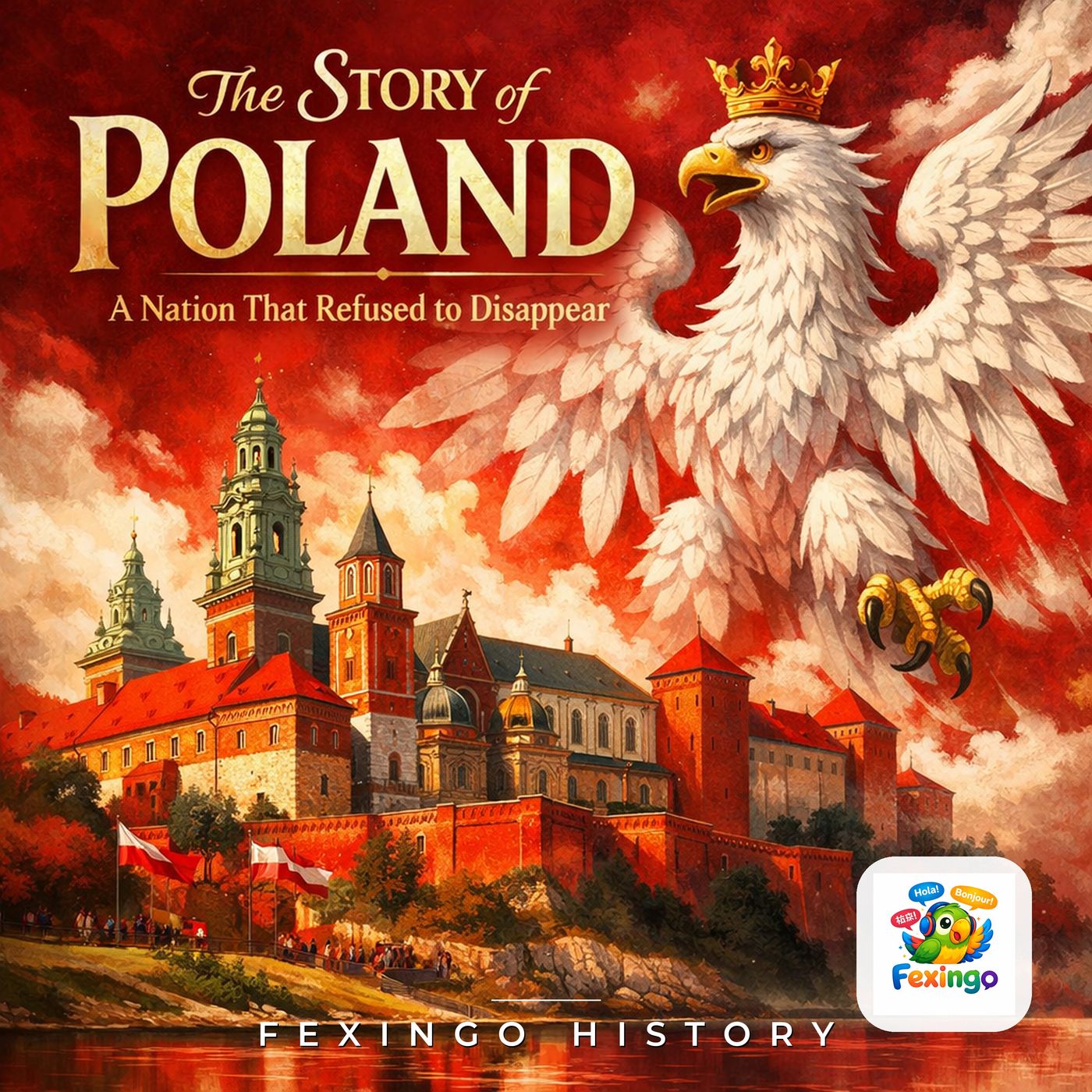
The Story of Poland: A Nation That Refused to Disappear — Fexingo History
by Fexingo
Poland's story is one of defiance—a nation that, erased from the map for 123 years, refused to disappear. Lucas and Luna guide listeners through a millennium of Polish history, from the baptism of Mieszko I in 966 to the Solidarity movement that toppled communism. Explore the Piast and Jagiellonian dynasties, the Golden Age of the Polish-Lithuanian Commonwealth, and the devastating partitions by Prussia, Russia, and Austria. Witness the rise of the Winged Hussars, the 1791 Constitution of 3 May, and the tragic uprisings of 1830 and 1863. The show delves into the Second Polish Republic's interwar rebirth, the horrors of World War II (Westerplatte, the Warsaw Ghetto Uprising, the Katyn massacre), and the postwar Soviet-imposed system. From the 'Miracle on the Vistula' to the election of Pope John Paul II, from the Warsaw Pact to the Round Table Agreement, each episode reveals how Polish identity survived through language, literature (Mickiewicz, Sienkiewicz), and the Catholic Church. Why
-
35
Jan III Sobieski and the Winged Hussars at Vienna 1683
In 1683, the Ottoman Empire laid siege to Vienna, threatening the heart of Europe. King Jan III Sobieski of Poland led a coalition army that included the legendary winged hussars in one of the most decisive cavalry charges in history. This episode explores Sobieski's rise, the politics of the Holy League, the battle itself, and how the victory reshaped European power balances. We also discuss the hussars' tactics, their iconic wings, and the legacy of Sobieski as a savior of Christendom. A story of alliance, courage, and a king who rode to war. #JanIIIISobieski #BattleOfVienna #WingedHussars #PolishHistory #OttomanEmpire #HolyLeague #1683 #Vienna #CavalryCharge #Husaria #LeopoldI #KaraMustafaPasha #Kahlenberg #PolishMilitary #EasternEurope #History #FexingoHistory #Podcast Keep every episode free: buymeacoffee.com/fexingo
-
34
The Polish Hussars: Winged Knights Who Saved Europe
In this episode, Lucas and Luna explore the legendary Polish Hussars, the winged cavalry that dominated battlefields for over a century. They trace the origins of the husaria from Serbian mercenaries to the elite shock troops of the Polish-Lithuanian Commonwealth, focusing on their peak under King Stephen Báthory and their most famous victory at the Battle of Vienna in 1683. The conversation unpacks the myths and realities of their iconic wings, their tactics with the long lance and szabla, and their eventual decline in the face of modern warfare. Specific figures include Hetman Stanisław Żółkiewski, who crushed the Russians at Klushino, and King John III Sobieski, who led the largest cavalry charge in history. The episode also touches on the husaria's role in the Polish-Swedish wars and the Khmelnytsky Uprising, and explains why their unique fighting style made them nearly invincible for generations. #PolishHussars #Husaria #WingedHussars #BattleOfVienna #JohnIII Sobieski #Stanisław Żółkiewski #PolishLithuanianCommonwealth #Cavalry #MilitaryHistory #StephenBáthory #Klushino #Szabla #Lance #EarlyModern #History #FexingoHistory #EasternEurope #WingedKnights Keep every episode free: buymeacoffee.com/fexingo
-
33
The Golden Liberty: How Poland's Unusual Democracy Worked
In this episode of The Story of Poland, Lucas and Luna explore the unique political system of the Polish-Lithuanian Commonwealth: the 'Golden Liberty' or Złota Wolność. They discuss how the szlachta (nobility) wielded extraordinary power through the Sejm (parliament) and the liberum veto, which allowed any single noble to block legislation. Lucas explains the origins of this system in the 15th and 16th centuries, its evolution under the Jagiellonian dynasty, and how it eventually contributed to the Commonwealth's paralysis. The conversation touches on key figures like Jan Zamoyski, the execution movement (egzekucja praw), and the contrast with emerging absolutism in other European states. Lucas also delves into the cultural identity of the szlachta, their attachment to the ideal of equality among nobles, and the seeds of the system's decline. This episode provides a nuanced look at one of history's most unusual experiments in noble democracy. #Poland #GoldenLiberty #Szlachta #Sejm #LiberumVeto #PolishLithuanianCommonwealth #NobleDemocracy #JanZamoyski #ExecutionMovement #Jagiellonian #Sarmatism #WawelCastle #PolishEagle #EasternEurope #MedievalPoland #EarlyModernEurope #History #FexingoHistory Keep every episode free: buymeacoffee.com/fexingo
-
32
The Polish-Saxon Union: Two Eagles, One Crown
In 1697, an obscure German prince named Augustus the Strong—Elector of Saxony—converted to Catholicism and was elected King of Poland, beginning a personal union that would last over six decades. This episode explores the Polish-Saxon Union: how Dresden's Baroque splendor was funded by Polish silver and salt, how Augustus's court became a playground for alchemists and artists, and how this dual monarchy entangled Poland in the Great Northern War and the rise of Russia. We discuss the bitter Sack of Saxony by Charles XII of Sweden, the silent resistance of the Polish nobility, and the legacy of Augustus's reign—a period of cultural brilliance and political decay. We also touch on Augustus's illegitimate son, Maurice de Saxe, who became a legendary French marshal. From the Saxon Palace in Warsaw to the Zwinger in Dresden, this is the story of two nations bound by a crown that neither fully controlled. #PolishSaxonUnion #AugustusTheStrong #ElectorateOfSaxony #PolishLithuanianCommonwealth #GreatNorthernWar #CharlesXII #MauriceDeSaxe #Dresden #Warsaw #SackOfSaxony #Baroque #DynasticUnion #Szlachta #SilentSejm #EasternEurope #History #FexingoHistory #Poland Keep every episode free: buymeacoffee.com/fexingo
-
31
King Zygmunt August and the Union of Lublin 1569
Lucas and Luna explore the Union of Lublin of 1569, the treaty that transformed the Polish-Lithuanian personal union into a real, lasting commonwealth. They trace the political maneuvering of King Zygmunt II August, the resistance of Lithuanian magnates, and the final, dramatic Sejm in Lublin where the union was forced through. Along the way, they discuss the role of the Jagiellonian dynasty, the impact on Ruthenian lands, and how the union shaped Eastern Europe for centuries. Specific topics include the Livonian War, the incorporation of Podlachia, Volhynia, and Kyiv into the Crown, and the creation of a shared parliament and currency. The episode also touches on the legacy of the union for modern Polish-Lithuanian relations. #UnionOfLublin #ZygmuntAugust #JagiellonianDynasty #PolishLithuanianCommonwealth #Lublin #Sejm #LivonianWar #Podlachia #Volhynia #Kyiv #Ruthenia #EarlyModernHistory #EasternEurope #Poland #Lithuania #History #FexingoHistory #Podcast Keep every episode free: buymeacoffee.com/fexingo
-
30
The Kościuszko Insurrection: Poland's 1794 Fight for Freedom
In 1794, Poland faced its final chance to survive as an independent state. Tadeusz Kościuszko, a veteran of the American Revolutionary War, returned to lead a national uprising against the Russian Empire. This episode follows the dramatic events of the Kościuszko Insurrection, from the oath in Kraków's Main Square to the victories at Racławice and the final tragedy at Maciejowice. We explore Kościuszko's military innovations, his controversial Peasant Proclamation promising land and freedom to serfs, and the crushing aftermath that led to Poland's third and final partition. Why did a national hero of America choose to fight for Polish independence? And what made this uprising different from earlier attempts? Join us as we uncover the last great struggle of the Polish-Lithuanian Commonwealth. #Kosciuszko #Insurrection1794 #Racławice #Maciejowice #PolishHistory #TadeuszKosciuszko #ThirdPartition #PolishLithuanianCommonwealth #PeasantProclamation #UniwersałPołaniecki #18thCentury #EasternEurope #Warsaw #Kraków #CatherineTheGreat #History #FexingoHistory #Poland Keep every episode free: buymeacoffee.com/fexingo
-
29
The Unseen War: Poland's Cursed Soldiers 1944–1963
After World War II ended, Poland's fight for freedom was far from over. Thousands of former Home Army soldiers, partisan fighters, and underground activists refused to accept Soviet domination. They took to the forests, fighting a lonely guerrilla war against the communist regime and its secret police, the UB. This episode tells the story of the 'Cursed Soldiers' — żołnierze wyklęci — through the lives of key figures like Major Zygmunt Szendzielarz 'Łupaszka', Captain Józef Franczak 'Lalek' (the last Cursed Soldier killed in 1963), and the brutal methods of the UB under Jakub Berman. We explore the 1945 Augustów Roundup, the show trials in Warsaw's Mokotów Prison, and the decades-long official erasure of their memory. These men and women were branded bandits by the communists, but to many Poles they were heroes who refused to lay down arms. A stark, sobering look at Poland's hidden post-war civil war and the price of resistance. #CursedSoldiers #ZolnierzeWyklęci #Łupaszka #JózefFranczak #AugustówRoundup #UB #MokotówPrison #PolishUnderground #HomeArmy #Stalinism #ColdWar #PostWarPoland #AntiCommunistResistance #JakubBerman #Poland #EasternEurope #History #FexingoHistory Keep every episode free: buymeacoffee.com/fexingo
-
28
The Prussian Tribute 1525: Poland's Greatest Triumph Over the Teutonic Order
In 1525, the Teutonic Order—the crusading state that had plagued Poland for centuries—was dissolved. Its last Grand Master, Albrecht Hohenzollern, knelt before King Zygmunt I Stary in Kraków's Market Square and swore an oath of loyalty, transforming the Order's Prussian lands into a secular duchy under Polish sovereignty. This was the Hołd Pruski, the Prussian Homage, a moment that marked the peak of Jagiellonian power and reshaped Eastern Europe. Lucas and Luna unpack how a fractious Commonwealth achieved what centuries of war could not: the neutralization of the Teutonic threat through diplomacy, reform, and the chaos of the Reformation. They explore Albrecht's conversion to Lutheranism, the legal intricacies of the Treaty of Kraków, and the decades of political maneuvering that led to the homage. But they also ask: was this a lasting victory, or a deal that sowed the seeds of future danger—the rise of the Hohenzollerns, who would later partition Poland itself? A nuanced look at a turning point where Polish power reached its zenith, and the shadows it cast forward. #PrussianHomage #HołdPruski #TeutonicOrder #ZygmuntIStary #AlbrechtHohenzollern #TreatyOfKrakow #Reformation #Lutheranism #JagiellonianDynasty #PolishHistory #Prussia #RoyalPrussia #16thCentury #EasternEurope #History #FexingoHistory #Commonwealth #Secularization Keep every episode free: buymeacoffee.com/fexingo
-
27
The Battle of Grunwald 1410: Poland and Lithuania Crush the Teutonic Order
In 1410, the combined forces of the Kingdom of Poland and the Grand Duchy of Lithuania met the Teutonic Order in one of the largest battles of medieval Europe. This episode walks through the lead-up, the clash near the village of Grunwald, and the aftermath that reshaped Central Europe. Learn about King Władysław II Jagiełło, Grand Duke Vytautas, the tragic death of the Order's Grand Master Ulrich von Jungingen, and the legend of the "Two Swords" sent by the Teutonic knights. We also explore the contested numbers—how many men actually fought?—and why the victory, though massive, didn't finish the Order entirely. The conversation touches on the role of the legendary Czech knight Jan Žižka, the military tactics of the day, and the political fallout including the Peace of Thorn (1411). A turning point for the Polish-Lithuanian union and the end of Teutonic expansion. #BattleOfGrunwald #TeutonicOrder #Jagiello #Vytautas #UlrichVonJungingen #JanZizka #PeaceOfThorn #Poland #Lithuania #MedievalHistory #1410 #FexingoHistory #History #EasternEurope #PolesAndLithuanians #MedievalBattles #Grünwald #PolishHistory Keep every episode free: buymeacoffee.com/fexingo
-
26
Knyaz Popiel and the Lost Legend of Poland's First Dynasty
Before Mieszko I, before the Piasts, there was Popiel. But who was he really? In this episode, Lucas and Luna peel back the layers of legend and chronicle to explore the shadowy figure of Knyaz Popiel, the 9th-century ruler of the Polans whose story was recorded by Gallus Anonymus in the 12th century — and which may hide a much older, darker tale. Was Popiel a cruel tyrant eaten by mice, as the legend says? Or was his story a political metaphor, cooked up by the Piasts to legitimize their own rise? Lucas digs into the Cronicae et gesta ducum sive principum Polonorum, the earliest written source for Polish history, and unpacks what it tells us — and what it deliberately conceals — about the pre-Christian Slavic rulers of Giecz, Gniezno, and Kruszwica. They discuss the possible historical kernel behind the mouse tower legend, the archaeological evidence from Lake Gopło, and the way medieval chroniclers used cautionary tales to draw lines between pagan chaos and Christian order. If you've ever wondered what came before the Piasts, this episode takes you right to the edge of the written record — and dares you to peer into the dark. No prior episode has covered Popiel directly. This is Episode 88 of The Story of Poland. #Popiel #GallusAnonymus #PiastDynasty #PolishLegends #MiceTower #Kruszwica #Giecz #Gniezno #CronicaePolonorum #PreChristianSlavs #MedievalChronicles #LakeGopło #Polans #Knyaz #SlavicMythology #EarlyPoland #History #FexingoHistory Keep every episode free: buymeacoffee.com/fexingo
-
25
The Świętokrzyskie Uprising 1945: Poland's Last Anti-Communist Stand
Episode 87 of The Story of Poland picks up where the Partitions, Kościuszko, and Warsaw Ghetto episodes left off — but goes somewhere unexpected: the forests of the Holy Cross Mountains after World War II. We cover the odd alliance between Home Army remnants and the nationalist NSZ, the Battle of Gruszka in May 1945, the death of Major 'Ogień' (Antoni Heda), the underground society Wolność i Niezawisłość (WiN), and the brutal pacification by NKVD and UB forces. We also look at the strange afterlife of the uprising: how it was erased from official history under the PRL, only to be rediscovered after 1989 as a symbol of national independence against Soviet domination. #ŚwiętokrzyskieUprising #AntiCommunistResistance #CursedSoldiers #Wyklęci #BattleOfGruszka #AntoniHeda #NKVB #UrządBezpieczeństwa #WolnośćINiezawisłość #WiN #NSZ #HomeArmy #HolyCrossMountains #PolishUnderground #ColdWar #EasternEurope #History #FexingoHistory Keep every episode free: buymeacoffee.com/fexingo
-
24
The Kościuszko Uprising 1794: Poland's Last Stand for Freedom
In 1794, Tadeusz Kościuszko, a Polish engineer and hero of the American Revolution, returned to his homeland to lead a desperate uprising against the Russian and Prussian empires. This episode of The Story of Poland dives deep into the military and political drama of the Kościuszko Uprising, from the oath on Kraków's market square to the decisive battles of Racławice and Maciejowice. We explore Kościuszko's strategic brilliance, the role of peasant scythemen, the controversial Polaniec Manifesto promising land reform, and the brutal suppression that sealed Poland's Third Partition. Along the way, we discuss the betrayal by Prussia, the fall of Warsaw's Praga district, and the legacy of a commander who inspired future generations. Packed with place names like Kraków, Warsaw, and Grodno, key figures like Kościuszko, Catherine the Great, and Stanisław August Poniatowski, and the ideals of liberty and independence, this episode tells the story of a nation's last stand before 123 years of erasure from the map. #KośCiuszkoUprising #TadeuszKośCiuszko #RacłAwice #Maciejowice #PolaniecManifesto #ThirdPartition #PolishHistory #Insurrection #Scythemen #CatherineTheGreat #Prussia #EasternEurope #18thCentury #History #MilitaryHistory #FexingoHistory #PolishIndependence #StanisławAugustPoniatowski Keep every episode free: buymeacoffee.com/fexingo
-
23
Wawel Castle: Poland's Sacred Heart of Sovereignty
In this episode of The Story of Poland, Lucas and Luna explore the thousand-year history of Wawel Castle in Kraków, the architectural and spiritual heart of the Polish nation. From its origins in the 10th century under the Piast dynasty to its role as the seat of kings, the site of coronations, and the burial place of national heroes like Tadeusz Kościuszko and Józef Piłsudski, Wawel has witnessed Poland's greatest triumphs and deepest tragedies. Lucas explains how the castle's Gothic, Renaissance, and Baroque layers reflect the country's changing fortunes, and how the Royal Chambers, the Sigismund Chapel, and the Wawel Cathedral each hold stories of power, faith, and resilience. The conversation dives into the controversial period when the Austrians used Wawel as a military barracks, the later restoration efforts, and the symbolic weight of the castle during the partitions and communist era. Luna's thoughtful questions draw out details about the famous Sigismund Bell, the legend of the Wawel Dragon, and the castle's role in modern Polish identity. This episode offers a vivid, on-location feel for listeners who want to understand why Wawel is more than a building—it's the nation's soul. #WawelCastle #Krakow #PolishHistory #PiastDynasty #SigismundChapel #SigismundBell #WawelCathedral #PolishKings #TadeuszKosciuszko #JozefPilsudski #GothicArchitecture #RenaissanceArchitecture #PolishPartitions #WawelDragon #PolishIdentity #History #FexingoHistory #EasternEurope #WingedHussars #PolishLithuanianCommonwealth Keep every episode free: buymeacoffee.com/fexingo
-
22
Zamość: A Renaissance Dream in Poland's Wild East
This episode explores the extraordinary story of Zamość, a planned Renaissance city founded in 1580 by Chancellor Jan Zamoyski in what was then the southeastern frontier of the Polish-Lithuanian Commonwealth. Lucas and Luna discuss how Zamoyski, a Renaissance humanist and powerful statesman, created a model city designed by the Italian architect Bernardo Morando, complete with arcaded market square, fortifications, and a university. They examine Zamość's role as a hub of trade and learning, its successful defense during the Khmelnytsky Uprising, and its later decline under partition. The conversation highlights how the city's ideal grid layout and blend of Italian and Polish architecture earned it a UNESCO World Heritage site designation, and how it was one of the few Polish cities not destroyed in World War II. The episode also touches on the darker side, including the city's role in the Zamoyski family's vast latifundia and the expulsion of Jews during the Holocaust. #Zamo #JanZamoyski #BernardoMorando #Renaissance #PolishLithuanianCommonwealth #PolishArchitecture #UNESCO #Kresy #KhmelnytskyUprising #Humanism #AkademiaZamojska #PolishHistory #EasternEurope #16thCentury #CityPlanning #History #FexingoHistory #Podcast #WingedHussars #PartitionsOfPoland Keep every episode free: buymeacoffee.com/fexingo
-
21
The Polish Language Under Partition: A Nation's Soul
When Poland was erased from the map in 1795, its language became a battleground. In Prussian-occupied Poznań, Germanization policies targeted Polish in schools and administration, while in Russia, the Congress Kingdom saw the suppression of Polish after the January Uprising of 1863. But Poles fought back—not with armies, but with books. This episode explores the quiet resistance of language preservation: secret flying universities (Uniwersytet Latający) in Warsaw, the smuggling of Polish textbooks across borders, and the work of linguist Samuel Linde, whose dictionary became a cultural fortress. We also examine the role of the Catholic Church in preserving Polish through sermons and catechism, and the impact of the 1848 Spring of Nations on linguistic rights in Galicia under Austrian rule. Through the stories of teachers, students, and families who risked punishment to speak their mother tongue, we see how language kept a nation alive. The episode ends with the irony that the very partitions that sought to destroy Polish identity actually strengthened it, creating a literary renaissance that fueled the independence movements of the 20th century. #PolishLanguage #PartitionsOfPoland #UniwersytetLatajCy #SamuelLinde #Germanization #Russification #LanguageResistance #FlyingUniversity #Galicia #Pozna #Warsaw #CongressPoland #CatholicChurch #PolishIdentity #SpringOfNations #CulturalResistance #History #FexingoHistory #PolishHistory #WingedHussars Keep every episode free: buymeacoffee.com/fexingo
-
20
The Cursed Soldiers: Poland's Anti-Communist Resistance
In this episode of The Story of Poland, Lucas and Luna dive into the untold story of the Cursed Soldiers (Żołnierze Wyklęci) — the anti-communist partisans who fought on after WWII ended. We explore their origins in the Home Army, the brutal repression by the Soviet-backed regime, and how figures like Major Zygmunt Szendzielarz 'Łupaszko' and Captain Witold Pilecki kept the flame of independence alive. From the forests of Podlasie to the cells of Mokotów Prison, we examine the moral ambiguities, the tragic betrayals, and the decades-long silencing of their memory. We also touch on their recent rediscovery and what they mean for Poland today. Specific events include the Augustów Roundup of 1945, the trial of Pilecki in 1948, and the amnesty of 1947. Names like Bolesław Bierut, Jakub Berman, and General Stanisław Tatar feature prominently. This episode challenges the official narrative of post-war Poland and asks: what does it mean to never surrender? #CursedSoldiers #ONierzeWyklCi #WitoldPilecki #ZygmuntSzendzielarz #PolishHistory #AntiCommunistResistance #HomeArmy #ArmiaKrajowa #AugustWRoundup #MokotWPrison #ColdWarPoland #SovietOccupation #PolishUnderground #1940sPoland #EasternEurope #History #FexingoHistory #Podlasie #WingedHussars #PolishLithuanianCommonwealth Keep every episode free: buymeacoffee.com/fexingo
-
19
Poland's Solidarity: How a Shipyard Sparked a Revolution
In 1980, a strike at the Gdańsk Shipyard ignited a movement that would topple communism in Poland. This episode follows the rise of Solidarity (Solidarność), led by Lech Wałęsa, from the August Agreements to the imposition of martial law in 1981. We explore the role of the Catholic Church under Pope John Paul II, the underground resistance, and how ordinary Poles used samizdat publications, underground radio, and clandestine printing presses to keep the spirit of freedom alive. The episode also examines the internal divisions within Solidarity, the brutal suppression by General Wojciech Jaruzelski's regime, and the eventual Round Table Talks of 1989 that led to semi-free elections. Key figures like Anna Walentynowicz, Bogdan Borusewicz, and Jacek Kuroń are discussed, alongside the moral struggle between nonviolence and the regime's intimidation. This is the story of how a nation refused to disappear, even in its darkest hour. #Solidarno #LechWaSa #GdaSkShipyard #MartialLaw #PopeJohnPaulII #AnnaWalentynowicz #JacekKuro #RoundTableTalks #PolishCommunism #PRL #August1980 #StanWojenny #SolidarityMovement #SecondCirculation #UndergroundPress #EasternEurope #History #FexingoHistory #PolishHistory #WingedHussars Keep every episode free: buymeacoffee.com/fexingo
-
18
Poland's Silent Resistance, 1945-1989
After the devastation of World War II, Poland fell under Soviet domination. But the nation refused to disappear. In this episode, Lucas and Luna explore the quiet resistance that kept Polish identity alive during the communist era. From the underground publishing of the 'second circulation' (drugi obieg) to the crucial role of the Catholic Church under Cardinal Stefan Wyszyński, the Solidarity movement, and the 1989 Round Table Talks that ended communist rule. They discuss Lech Wałęsa, the Gdańsk Agreement, martial law under General Wojciech Jaruzelski, and the election of Pope John Paul II. This is the story of how Poles built a parallel society, preserving history, faith, and freedom through forty-five years of oppression. #Poland #Communism #Solidarity #LechWalesa #StefanWyszynski #JohnPaulII #WojciechJaruzelski #MartialLaw #GdanskAgreement #RoundTableTalks #DrugiObieg #PolishHistory #FexingoHistory #EasternEurope #ColdWar #Resistance #CatholicChurch #1989 #WingedHussars #PolishLithuanianCommonwealth Keep every episode free: buymeacoffee.com/fexingo
-
17
The Holocaust in Poland: The Warsaw Ghetto Uprising
In this episode of The Story of Poland, Lucas and Luna delve into the darkest chapter of Polish history: the Holocaust and the Warsaw Ghetto Uprising of 1943. They explore the establishment of the Warsaw Ghetto, the largest in Nazi-occupied Europe, where over 400,000 Jews were imprisoned in appalling conditions. The conversation covers the Judenrat, the role of Adam Czerniaków, and the formation of the Jewish Combat Organization (ŻOB) led by Mordechai Anielewicz. They discuss the first armed resistance in January 1943, the April uprising, and the tragic end at 18 Miła Street. Lucas highlights the bravery of the fighters and the limited support from the Polish Underground State, including the Home Army's arms deliveries. They also touch on the legacy of the uprising and its meaning for Polish-Jewish relations. This episode sheds light on a pivotal moment of resistance against the Nazis, drawing on eyewitness accounts and historical records. #WarsawGhettoUprising #MordechaiAnielewicz #Holocaust #WarsawGhetto #JewishResistance #ZOB #ZydowskaOrganizacjaBojowa #AdamCzerniakow #Judenrat #Treblinka #GrossaktionWarschau #WW2 #Poland #NaziOccupation #18MilaStreet #HomeArmy #History #FexingoHistory #PolishHistory #WingedHussars Keep every episode free: buymeacoffee.com/fexingo
-
16
The Warsaw Uprising: Poland's 63 Days of Resistance
In August 1944, as the Red Army approached Warsaw, the Polish Home Army launched an uprising that would become one of the most tragic chapters of World War II. For 63 days, thousands of poorly armed civilians fought against German occupation, hoping to liberate their capital before Soviet control. This episode explores the political calculations behind the decision to fight, the brutal German response including mass executions and systematic destruction, and the crushing disappointment as Stalin's forces halted at the Vistula. We follow key figures like General Tadeusz Komorowski 'Bór', the civilian leadership of the Polish Underground State, and everyday Varsovians like Władysław Szpilman, whose story inspired the film 'The Pianist'. We also examine the controversial Allied airlift attempts, the role of the Polish First Army across the river, and the aftermath that saw Warsaw nearly razed to the ground. The uprising remains a powerful symbol of Polish defiance and a painful lesson in geopolitics. #WarsawUprising #Warsaw1944 #HomeArmy #ArmiaKrajowa #TadeuszBRKomorowski #WAdysAwSzpilman #Stalin #RedArmy #WWII #PolishResistance #Vistula #OperationTempest #Burza #Pianist #PolishUndergroundState #History #FexingoHistory #WorldWar2 #PolishHistory #WingedHussars Keep every episode free: buymeacoffee.com/fexingo
-
15
The Polish Underground State: A Secret Nation at War
When Poland was occupied by Nazi Germany and the Soviet Union in 1939, its government didn't surrender—it went underground. This episode explores the remarkable Polish Underground State, a parallel society that operated in secret for five years. We trace its origins in the Service for Poland's Victory (Służba Zwycięstwu Polski), its evolution into the Home Army (Armia Krajowa) under General Stefan Rowecki, and its unique structure with a clandestine parliament, court system, and education network. We discuss key figures like Jan Karski, who reported the Holocaust to the Allies, and the tragic Warsaw Uprising of 1944. We also address the painful aftermath: the Soviet takeover and the persecution of former Home Army soldiers. This is the story of a nation that refused to disappear, even when its cities were rubble. #PolishUndergroundState #ArmiaKrajowa #HomeArmy #WarsawUprising #JanKarski #StefanRowecki #SUBaZwyciStwuPolski #PolishGovernmentInExile #OperationTempest #WWIIHistory #EasternFront #Holocaust #TotalWar #Resistance #SecretState #Poland #History #FexingoHistory #PolishHistory #WingedHussars Keep every episode free: buymeacoffee.com/fexingo
-
14
Interwar Poland: Rebuilding a Nation from Scratch
After 123 years of partition, Poland re-emerged as an independent state in 1918. But what did it take to stitch three disparate regions—Prussian, Austrian, and Russian—back into a single nation? This episode follows the monumental task of unification: the chaotic first months, the Little Treaty of Versailles, the Silesian Uprisings, and the challenge of integrating economies, legal systems, and railways. We meet the forgotten architects of statehood—people like Wojciech Korfanty and Ignacy Daszyński—and explore the tension between nationalism and federalism under Piłsudski. From the brutal Polish-Ukrainian War to the establishment of the Bank Polski and the port of Gdynia, discover how Poland built a modern state amid war, inflation, and ethnic strife. A story of improvisation, grit, and the fragile dream of a sovereign homeland. #InterwarPoland #SecondPolishRepublic #WojciechKorfanty #SilesianUprisings #PolishUkrainianWar #LittleTreatyOfVersailles #IgnacyDaszySki #Gdynia #BankPolski #JZefPiSudski #PolishStatehood #1918 #EasternEurope #20thCenturyHistory #NationalRebuilding #History #FexingoHistory #Poland #PolishHistory #WingedHussars Keep every episode free: buymeacoffee.com/fexingo
-
13
The Polish-Soviet War: Miracle on the Vistula
In 1920, the fate of Poland—and much of Europe—hung in the balance as the Red Army surged westward. Józef Piłsudski, fresh from rebuilding an independent Poland, faced a seemingly unstoppable Bolshevik force. This episode dives into the war's turning point: the Battle of Warsaw, often called the Miracle on the Vistula. We explore Piłsudski's daring counteroffensive from the Wieprz River, the intelligence breakthrough cracking Soviet codes, and the role of General Tadeusz Rozwadowski. We also examine the political stakes—Lenin's dream of spreading revolution to Germany and beyond—and the war's ambiguous legacy, including the Treaty of Riga. A story of high-stakes strategy, national survival, and a moment that reshaped Eastern Europe. #PolishSovietWar #MiracleOnTheVistula #BattleOfWarsaw1920 #JZefPiSudski #RedArmy #MikhailTukhachevsky #TadeuszRozwadowski #WieprzRiver #TreatyOfRiga #CurzonLine #Lenin #Bolshevik #PolishHistory #EasternEurope #1920 #MilitaryHistory #History #FexingoHistory #WingedHussars #PolishLithuanianCommonwealth Keep every episode free: buymeacoffee.com/fexingo
-
12
Polish Independentists in World War I: A New Hope
In this episode of The Story of Poland, Lucas and Luna explore the remarkable story of Polish independence during World War I. With the three partitioning powers—Russia, Germany, and Austria-Hungary—locked in a devastating conflict, Polish leaders saw an unprecedented opportunity. Lucas details how Józef Piłsudski's Polish Legions fought alongside the Central Powers, hoping to leverage a victory for Polish autonomy. Meanwhile, Roman Dmowski's National Democracy aligned with Russia, aiming for unification under Tsarist rule. The conversation covers the Act of 5th November 1916, the Oath Crisis of 1917, and the crucial role of the Polish Military Organization (POW). Lucas explains how the collapse of all three empires in 1918 allowed Piłsudski to declare independence, becoming the head of state. The episode ends with the vital support from Ignacy Jan Paderewski and the Allies. A turning point where Polish statehood was reborn from the ashes of empire. #Poland #WorldWarI #PolishIndependence #JozefPilsudski #RomanDmowski #PolishLegions #CentralPowers #OathCrisis #Act5November1916 #PolishMilitaryOrganization #POW #IgnacyJanPaderewski #NationalDemocracy #Endecja #History #FexingoHistory #EasternEurope #Rebirth #PolishHistory #WingedHussars Keep every episode free: buymeacoffee.com/fexingo
-
11
The Polish Legions: Piłsudski's Road to Independence
After episodes covering the January Uprising and Józef Piłsudski's career, this episode zeroes in on the Polish Legions — the paramilitary forces Piłsudski built during World War I. Lucas and Luna explore how the Legions were formed in Austrian Galicia, their early battles against Russia, and their political evolution into the Polish Military Organization. They discuss the 1914 Oath Crisis, the 1917 internment at Szczypiorno, and how the Legions became the seedbed of the Second Polish Republic's army and government. Key figures include Józef Piłsudski, Kazimierz Sosnkowski, and Edward Rydz-Śmigły. The episode covers the Legions' role in the Battle of Łowczówek (1914), the Battle of Kostiuchnówka (1916), and the political maneuvering that led Piłsudski to refuse the German oath. It ends with the Legions' legacy as a national symbol and training ground for interwar Poland's leadership. #PolishLegions #JZefPiSudski #WorldWarI #KazimierzSosnkowski #EdwardRydzMigY #BattleofKostiuchnWka #AustrianGalicia #PolishMilitaryOrganization #Szczypiorno #OathCrisis #OwczWek #SecondPolishRepublic #Poland #History #FexingoHistory #Podcast #EasternEurope #Independence #PolishHistory #WingedHussars Keep every episode free: buymeacoffee.com/fexingo
-
10
Józef Piłsudski: The Man Who Rebuilt Poland
In this episode, we dive into the life of Józef Piłsudski, the revolutionary who dreamed of an independent Poland and made it a reality. From his early days as a socialist conspirator evading the Tsarist secret police — the Ochrana — to his command of the Legiony Polskie fighting alongside the Central Powers in World War I, Piłsudski's path was anything but straight. We explore his controversial decision to form the Polish Legions under Austria-Hungary, his refusal to swear loyalty to the German Kaiser, leading to his imprisonment in Magdeburg, and his triumphant return to Warsaw in November 1918. The episode also covers the baptism of fire of the reborn state in the Polish-Ukrainian War over Lwów and the dramatic Warsaw Uprising of 1920, where a small Polish force held off the Red Army, buying time for a counterattack that would come to be known as the Miracle on the Vistula. We discuss Piłsudski's complicated legacy as a military leader, his strained relationship with the Sejm, and the coup d'état of May 1926 that brought him to power as the strongman of the Sanacja regime. It's a story of stubbornness, vision, and the messy business of building a nation from scratch. #JZefPiSudski #PolishLegions #MiracleOnTheVistula #PolishUkrainianWar #BattleOfWarsaw #Sanacja #Magdeburg #Ochrana #AustriaHungary #WorldWarI #MayCoup #SecondPolishRepublic #LwW #RussianCivilWar #RedArmy #Independence1918 #History #FexingoHistory #PolishHistory #WingedHussars Keep every episode free: buymeacoffee.com/fexingo
-
9
The Curse of the Partitions: How Poles Preserved a Nation
After the January Uprising of 1863-64 crushed Polish hopes for independence, the Russian Empire intensified its Russification campaign. Yet Poles refused to disappear. In this episode, Lucas and Luna explore the quiet resistance that kept Polish identity alive: from the Flying University teaching women in secret to the Organic Work movement building economic strength, and the unlikely role of Positivist philosophy. They examine the brutal policies of Tsar Alexander II's successors, the rise of modern Polish nationalism under Roman Dmowski, and Józef Piłsudski's revolutionary beginnings. How did a nation without a state survive the 19th century? And how did the Polish language itself become an act of rebellion? This is the story of Poland between uprisings—where hope was not dead, just underground. #Poland #History #FexingoHistory #Russification #JanuaryUprising #FlyingUniversity #OrganicWork #Positivism #RomanDmowski #JozefPilsudski #Endecja #PolishNationalism #Partitions #EasternEurope #SecretEducation #UniwersytetLatajacy #TsaristRussia #Resistance #PolishHistory #WingedHussars Keep every episode free: buymeacoffee.com/fexingo
-
8
The January Uprising: Poland's Last Stand Against Tsarist Russia
In this episode of The Story of Poland, Lucas and Luna explore the January Uprising of 1863, the largest and most brutal Polish insurrection against the Russian Empire. They discuss the social and political climate under Tsar Alexander II, the radicalization of Polish youth through the 'Red' and 'White' factions, and the pivotal 'Manifesto' of January 22 that promised land reform. Key figures include Romuald Traugutt, the dictator of the uprising, and the guerrilla leader Józef Hauke-Bosak. The conversation covers the Battle of Węgrów, the role of Catholic clergy as chaplains, the brutal reprisals including public executions and mass deportations to Siberia, and the long-term cultural consequences: Russification, the rise of Positivism, and the emergence of modern Polish nationalism. This episode sheds light on a desperate struggle that unified a nation even in defeat. #JanuaryUprising #PowstanieStyczniowe #RomualdTraugutt #JZefHaukeBosak #TsarAlexanderII #BattleOfWGrW #RussianPartition #RedFaction #WhiteFaction #Siberia #Positivism #PolishNationalism #19thCenturyHistory #EasternEurope #Insurrection #History #FexingoHistory #Poland #PolishHistory #WingedHussars Keep every episode free: buymeacoffee.com/fexingo
-
7
The Spring of Nations: Poland's 1846 and 1848 Uprisings
In this episode of The Story of Poland, Lucas and Luna explore the failed uprisings of 1846 and 1848, focusing on the Kraków Uprising and the Spring of Nations. They discuss the Galician Slaughter, a bloody peasant jacquerie that undermined the szlachta's insurrection, and the role of the Polish Democratic Society. The conversation covers the brief existence of the Republic of Kraków, its annexation by Austria, and the subsequent revolutionary wave across Europe. Key figures include Ludwik Mierosławski and General Józef Bem, who fought in Hungary's 1848 revolution. The episode also examines the social tensions between nobles and peasants, the abolition of serfdom in Galicia, and the long-term impact on Polish national consciousness. Listeners will learn how these uprisings, though crushed, kept the Polish question alive on the European stage. #Poland #KrakWUprising #SpringOfNations #1846 #1848 #GalicianSlaughter #LudwikMierosAwski #JZefBem #PolishDemocraticSociety #RepublicOfKrakW #PartitionsOfPoland #Austria #Prussia #Russia #PeasantRevolt #NationalLiberation #History #FexingoHistory #PolishHistory #WingedHussars Keep every episode free: buymeacoffee.com/fexingo
-
6
The November Uprising: Poland's Fight for Freedom
In 1830, Poland rose again. Just 35 years after the Third Partition erased the Polish-Lithuanian Commonwealth from the map, young cadets in Warsaw sparked a rebellion that would become the November Uprising. Lucas and Luna explore the fiery patriotism of the 'Great Emigration,' the brutal tactics of Tsar Nicholas I, and the tragic heroism of figures like Piotr Wysocki and General Józef Chłopicki. They discuss the Sejm's dramatic dethronement of the Romanovs, the pivotal Battle of Ostrołęka, and the fall of Warsaw in 1831. They also touch on the uprising's cultural legacy—how it inspired composers like Frédéric Chopin and poets like Adam Mickiewicz. This episode examines why the uprising failed but how it kept the idea of Poland alive for generations to come. #NovemberUprising #PartitionsOfPoland #TsarNicholasI #PiotrWysocki #JZefChOpicki #BattleOfOstroKa #GreatEmigration #AdamMickiewicz #FrDRicChopin #Warsaw #CongressPoland #Sejm #RomanticNationalism #PolishHistory #EasternEurope #History #FexingoHistory #Poland #WingedHussars #PolishLithuanianCommonwealth Keep every episode free: buymeacoffee.com/fexingo
-
5
The Partitions of Poland: Erased from the Map
By the late 18th century, Poland-Lithuania was the largest state in Europe after Russia—and a dysfunctional one. Its parliament, the Sejm, was paralyzed by the liberum veto, a rule allowing any single nobleman to block all legislation. Neighboring powers Austria, Prussia, and Russia circled. In 1772, they carried out the First Partition, seizing 30% of Polish territory. The episode traces the tragic arc: the Constitution of May 3, 1791—Europe's first modern constitution—and the Targowica Confederation, a conspiracy of Polish magnates who invited Russian intervention to crush reform. The result: the Second Partition in 1793, and the final Third Partition in 1795, erasing Poland from the map for 123 years. Lucas and Luna discuss key figures like Stanisław August Poniatowski, the last king, and Tadeusz Kościuszko, whose 1794 uprising was the last gasp. They explore the irony of a nation so devoted to liberty that it couldn't govern itself, and the stubborn myth that Poland 'refused to disappear'—even when its land was divided among three empires. #PartitionsOfPoland #StanisAwAugustPoniatowski #TadeuszKoCiuszko #ConstitutionOfMay3 #LiberumVeto #TargowicaConfederation #Sejm #PolandLithuania #CatherineTheGreat #FrederickTheGreat #MariaTheresa #EasternEurope #18thCenturyHistory #PolishHistory #History #FexingoHistory #Podcast #Revolution #WingedHussars #PolishLithuanianCommonwealth Keep every episode free: buymeacoffee.com/fexingo
-
4
Tadeusz Kosciuszko: Poland's Hero of Two Worlds
In this episode, Lucas and Luna explore the life and legacy of Tadeusz Kościuszko, the Polish-Lithuanian military engineer and freedom fighter who became a hero of both the American Revolution and Poland's struggle for independence. They cover his early education in Warsaw and Paris, his crucial role at the Battle of Saratoga and the construction of West Point, his return to Poland to lead the 1794 Kościuszko Uprising after the Second Partition, the symbolic oath in Kraków's Main Square, the decisive Battle of Racławice where peasant scythe-bearers turned the tide, his final defeat at Maciejowice, his later years in exile, and his posthumous recognition as a national icon. The episode also touches on the controversial Polaniec Proclamation and Kościuszko's will freeing enslaved people in the United States. The narrative emphasizes Kościuszko's strategic brilliance, his commitment to social reform, and his enduring status as a symbol of resistance against oppression. #TadeuszKoCiuszko #KoCiuszkoUprising #BattleofRacAwice #PolandHistory #AmericanRevolution #PolishLithuanianCommonwealth #PartitionsOfPoland #KrakW #WestPoint #Saratoga #Maciejowice #PolaniecProclamation #ScytheBearers #18thCentury #EasternEurope #MilitaryHistory #Independence #FexingoHistory #PolishHistory #WingedHussars Keep every episode free: buymeacoffee.com/fexingo
-
3
The Deluge: Sweden's Invasion and Poland's Survival
In the mid-17th century, the Polish-Lithuanian Commonwealth, one of Europe's largest and most powerful states, was nearly torn apart by a Swedish invasion known as 'the Deluge.' This episode follows the harrowing years of 1655–1660, when King John II Casimir Vasa fled, and much of the nobility and military switched sides to the Swedish king Charles X Gustav. We explore the pivotal defense of the Jasna Góra monastery in Częstochowa, which became a rallying point for resistance, and the role of the Black Madonna icon in galvanizing national and religious sentiment. The treaty of Oliwa ended the war, but the Commonwealth never fully recovered, setting the stage for its eventual partitions. This is a story of betrayal, survival, and the limits of a golden age. #History #FexingoHistory #Poland #PolishLithuanianCommonwealth #SwedishDeluge #DelugePoland #JohnIICasimir #CharlesXGustav #JasnaGora #BlackMadonna #CzStochowa #TreatyOfOliwa #1655 #1660 #EasternEurope #MilitaryHistory #SeventeenthCentury #NationalSurvival #PolishHistory #WingedHussars Keep every episode free: buymeacoffee.com/fexingo
-
2
Jadwiga: Poland's Teenage King and Her Enduring Legacy
In 1384, an eleven-year-old girl was crowned King of Poland. Not queen — king. Her name was Jadwiga of Anjou, and she remains one of the most revered figures in Polish history. This episode explores her short but transformative reign: the political marriage to Jogaila that created the Polish-Lithuanian union, her role in the baptism of Lithuania, her patronage of the Academy of Kraków, and the legends of her piety and wisdom. We also confront the uncomfortable truth of her arranged marriage at age twelve and how she navigated power as a child ruler. From Wawel Castle to the Baltic, Jadwiga's story is one of ambition, faith, and the realpolitik of medieval Eastern Europe. No whitewashing — just a fascinating, complicated life that helped shape a nation. #Jadwiga #Poland #Lithuania #Jogaila #WawelCastle #AcademyOfKrakow #PolishLithuanianUnion #MedievalHistory #EasternEurope #WAdysAwJagieO #TeenageKing #WomenInHistory #BaptismOfLithuania #CrownOfPoland #14thCentury #History #FexingoHistory #Podcast #PolishHistory #WingedHussars Keep every episode free: buymeacoffee.com/fexingo
-
1
The Crown and the Eagle: Casimir the Great and the Golden Age
After Poland's baptism as a Christian kingdom under Mieszko I and Bolesław the Brave, the Piast dynasty faced fragmentation and internal strife. In the 14th century, one ruler reunited the realm and forged an era of prosperity: Casimir III, known as Casimir the Great. This episode explores how Casimir transformed a fractured duchy into a European power through legal reform, urban development, and cultural patronage. We delve into the codification of law with the Statutes of Wiślica, the founding of Kraków's Royal Castle and Wawel Cathedral's Gothic reconstruction, and the establishment of the Academy of Kraków—Poland's first university. We also examine Casimir's strategic alliances with Hungary and Lithuania, his protection of Jewish communities with the Statute of Kalisz, and the enduring symbol of the White Eagle. Discover how Casimir the Great earned his epithet and why he remains the only Polish king ever to be called 'Great'—a legacy that kept the Polish crown from disappearing when the dynasty died out. #CasimirTheGreat #Poland #PiastDynasty #KrakW #WawelCastle #GoldenAge #StatutesOfWiLica #AcademyOfKrakW #WhiteEagle #JewishHistory #MedievalLaw #14thCentury #EasternEurope #History #FexingoHistory #PolishHistory #CasimirIII #LegalReform #WingedHussars #PolishLithuanianCommonwealth Keep every episode free: buymeacoffee.com/fexingo
-
0
Poland's Baptism: The Birth of a Kingdom
In 966 AD, a pagan duke named Mieszko I accepted Latin Christianity, forever tying Poland to Western Europe. This episode goes inside that decision: the political maneuvering, the threat of the Holy Roman Empire, and the forging of a nation that would refuse to disappear for over a thousand years. We explore the legend of the White Eagle, the reality of early Piast rule, and how this single choice set Poland on a path distinct from its Slavic neighbors. Lucas and Luna discuss the geopolitics of 10th-century Eastern Europe, the mysterious origins of the Polish state, and why a baptism that happened over a millennium ago still echoes today. #History #FexingoHistory #Poland #MieszkoI #PiastDynasty #BaptismOfPoland #HolyRomanEmpire #WawelCastle #WhiteEagle #SlavicHistory #EasternEurope #966AD #PaganismToChristianity #DukeMieszko #CatholicChurch #NationBuilding #MedievalEurope #PolishIdentity #PolishHistory #WingedHussars Keep every episode free: buymeacoffee.com/fexingo
We're indexing this podcast's transcripts for the first time — this can take a minute or two. We'll show results as soon as they're ready.
No matches for "" in this podcast's transcripts.
No topics indexed yet for this podcast.
Loading reviews...
ABOUT THIS SHOW
Poland's story is one of defiance—a nation that, erased from the map for 123 years, refused to disappear. Lucas and Luna guide listeners through a millennium of Polish history, from the baptism of Mieszko I in 966 to the Solidarity movement that toppled communism. Explore the Piast and Jagiellonian dynasties, the Golden Age of the Polish-Lithuanian Commonwealth, and the devastating partitions by Prussia, Russia, and Austria. Witness the rise of the Winged Hussars, the 1791 Constitution of 3 May, and the tragic uprisings of 1830 and 1863. The show delves into the Second Polish Republic's interwar rebirth, the horrors of World War II (Westerplatte, the Warsaw Ghetto Uprising, the Katyn massacre), and the postwar Soviet-imposed system. From the 'Miracle on the Vistula' to the election of Pope John Paul II, from the Warsaw Pact to the Round Table Agreement, each episode reveals how Polish identity survived through language, literature (Mickiewicz, Sienkiewicz), and the Catholic Church. Why
HOSTED BY
Fexingo
Loading similar podcasts...
Frequently Asked Questions
How many episodes does The Story of Poland: A Nation That Refused to Disappear — Fexingo History have?
The Story of Poland: A Nation That Refused to Disappear — Fexingo History currently has 36 episodes available on PodParley. New episodes are automatically indexed when they're published to the podcast feed.
What is The Story of Poland: A Nation That Refused to Disappear — Fexingo History about?
Poland's story is one of defiance—a nation that, erased from the map for 123 years, refused to disappear. Lucas and Luna guide listeners through a millennium of Polish history, from the baptism of Mieszko I in 966 to the Solidarity movement that toppled communism. Explore the Piast and Jagiellonian...
How often does The Story of Poland: A Nation That Refused to Disappear — Fexingo History release new episodes?
The Story of Poland: A Nation That Refused to Disappear — Fexingo History has 36 episodes. Check the episode list to see recent publication dates and frequency.
Where can I listen to The Story of Poland: A Nation That Refused to Disappear — Fexingo History?
You can listen to The Story of Poland: A Nation That Refused to Disappear — Fexingo History on PodParley by clicking any episode. We provide an embedded audio player for direct listening, and you can also subscribe via your preferred podcast app using the RSS feed.
Who hosts The Story of Poland: A Nation That Refused to Disappear — Fexingo History?
The Story of Poland: A Nation That Refused to Disappear — Fexingo History is created and hosted by Fexingo.
URL copied to clipboard!