
PODCAST · arts
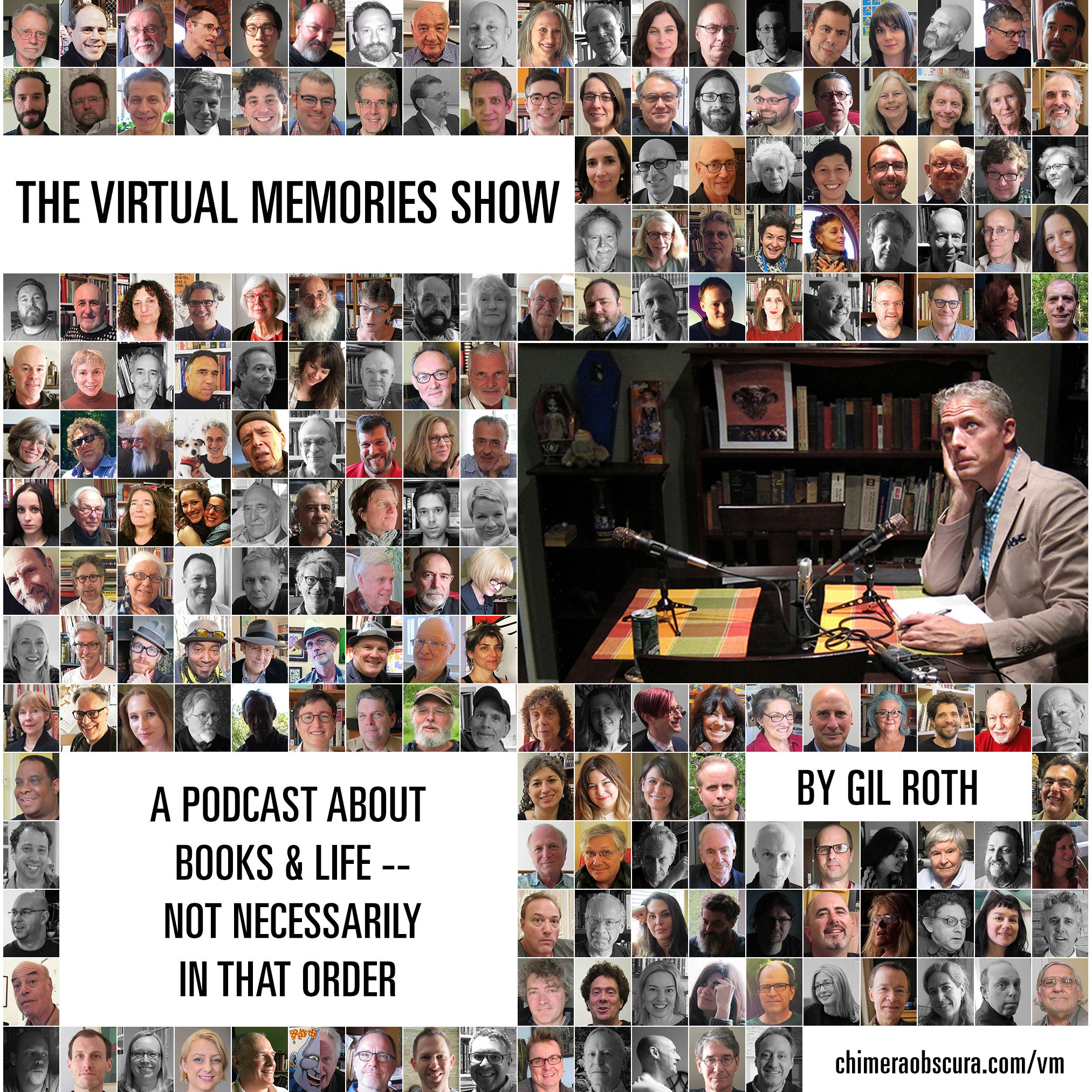
The Virtual Memories Show
by Gil Roth
A weekly conversation about books and life, not necessarily in that order.
Episodes
-
Episode 695 - Wallis Wilde-Menozzi
She's been on the show to talk about her essays, novel, and memoir, and now Wallis Wilde-Menozzi gets to talk about translation! With Emerging from the Winter Sea: Selected Poetry and Prose (FSG Poetry), Wallis has translated a career-spanning collection by Antonella Anedda. We talk about her…
more -
Episode 694 - Nate Powell
With DIANA (Abrams ComicArts), Nate Powell has completed his "accidental triptych" of Ozark horror & the punk scene. During SPX weekend, he returned to the show to talk about the creative leap he took with this book, the ways that DIANA fulfills but doesn't complete the stories of COME AGAIN and...
-
Episode 693 - Karl Christian Krumpholz
With his amazing IN THE CITY comics (self-published), cartoonist Karl Christian Krumpholz manages to capture the ephemerality and dynamism of urban life, fueled by the stories of bar and club patrons. We talk about how he began In The City and how it unfolded and grew over five parts, how he...
-
Episode 692 - Alison Fensterstock and Michael Tisserand
Let's celebrate a New Orleans legend with Alison Fensterstock and Michael Tisserand's fantastic new book, BUNNY MATTHEWS: HIS LIFE, ART, AND OBSESSIONS (Historic New Orleans Collection)! We talk about the role Bunny Matthews played in shaping New Orleans' identity with his comics, music reviews,...
-
Episode 691 - Emil Wilson
With his fantastic debut graphic novel, THE NIGHTINGALES (Avid Reader Press), Emil Wilson tells a heartbreaking and beautiful coming-of-age story of the AIDS era. We talk about his father's decision in 1985 to bring a work-friend with AIDS into their home (in a small town in Oregon), how he...
-
Episode 690 - Jonathan Ames
Jonathan Ames returns to celebrate his fantastic new crime novel, A PAST WITHOUT PICTURES (Mysterious Press). We talk about his obsession with pulp fiction, how he found the character of Maria Cole and her tortured relationship with her father after setting out to write a companion to You Were...
-
Episode 689 - Dash Shaw
With his new book, LIKE SWIMMERS (New York Review Comics), Dash Shaw brings us a supernatural murder mystery set in COVID-era Richmond, VA. We talk about how he uses that story to explore memory, identity, art, marriage, and the social breakdown in America, how a murder mystery helped him reflect...
-
Episode 688 - Phillip Lopate
Five-Timer Club Alert! Essayist Phillip Lopate rejoins the show as we celebrate his wonderful new book, A WASHINGTON IRVING SKETCH BOOK (Princeton)! We talk about the origins of the biography, incl. how he wound up with a 12-volume set of Washington Irving's complete works, his choice to write…
more -
Episode 687 - Ida Kao
"There are ways to downsize a college, but with Hampshire it felt more like a hollowing-out." Our latest installment of The Hampshire Tapes features a conversation with Ida Kao (F18) about having a ringside seat for Hampshire College's decline. We talk about how how she's trying to preserve the...
-
Episode 686 - Halstead York
"The core Hampshire experience was figuring out how to do things for myself and figuring out how to excite other people about what I wanted to do." It's time for the first installment of The Hampshire Tapes! Halstead York (F88) joins the show to talk about his experience at Hampshire College, how...
-
Episode 685 - Sarah Minor
With her amazing new book, CAROUSEL: An Essay On Seeing (Yale University Press), Sarah Minor offers a multi-threaded exploration — lecture, memoir, and art criticism — of how we see and are seen, how our language changes with our vantage points, how all these screens are changing human...
-
Episode 684 - Ali Trotta
With her debut poetry collection, OFFERINGS FOR ORDINARY GODS (Clash Books), Ali Trotta brings myth, magick, tarot, and ritual to bear on the eternal & primal struggle of women. We talk about those roots and how tarot and ancient myth inspired her work, where tarot began for her — '90s, The Craft…
more -
Episode 683 - R Sikoryak
Let's celebrate/commemorate America's independence with an amazing new double book, DECLARATION ILLUSTRATED / EMANCIPATION ILLUSTRATED (Drawn & Quarterly). R. Sikoryak rejoins the show to talk about adapting foundational American documents (verbatim!) with a mind-blowing array of comic art...
-
Episode 682 - Katie Skelly
After a 12-year Virtual Memoriesgap, Katie Skelly is back to celebrate her fantastic new graphic novel, HEAVEN (Fantagraphics)! But that's not all: she's also got the Bad Girl Tarot II (Kickstarter closing July 16, 2026), her horror comics anthology, Viscere, and the Thick Lines podcast! We talk...
-
Episode 681 - Colin Asher
With his amazing new book, THE MIDNIGHT SPECIAL: The Secret Prison History of American Music (WW Norton), author Colin Asher explores how the criminal justice system changed the course of twentieth century music. We talk about how Elmo Hope's Sounds from Rikers Island album inspired the book, how...
-
Episode 680 - Kate Maruyama and Me
During my recent LA weekend, I asked author, pal, and past guest Kate Maruyama if she'd be interested in interviewing me, and for some crazy reason, she said yes! So this time around you get me doing my best not to ask the questions, and just letting it fly, as we talk about the history of the...
-
Episode 679 - Heather Cass White
"A letter is a joy of Earth — It is denied the Gods —," sez Emily Dickinson (#1672), and THE MAN WHO READ EVERYTHING: The Literary Letters of Harold Bloom (Yale University Press) proves it! Heather Cass White rejoins the show to talk about editing Harold Bloom's letters for the book, her history...
-
Episode 678 - Paul Gravett
Happy Pride! Let's get Queer As Comics! Writer, critic, curator, publisher and broadcaster Paul Gravett rejoins the show to talk about curating a fabulous new exhibition, Queer As Comics, to help launch the Quentin Blake Centre for Illustration! We talk about what makes comics queer (it's not…
more -
Episode 677 - Luis Mendo
Welcome to Mundo Mendo! I visited artist and writer Luis Mendo in Karuizawa, Japan for a wide-ranging conversation about art, creativity, community and more. We talk about how he left design and embraced drawing and illustration, why he created the Mundo Mendo platform so fans/members can support...
-
Episode 676 - Benoit Denizet-Lewis
Can people change? How continuous is identity? With YOU'VE CHANGED: The Promise and Price of Self-Transformation (William Morrow), Benoit Denizet-Lewis explores the concepts of personal change and change-in-the-world, the ways we find identities and community, and the peril of changing into our...
-
Episode 675 - Clare Carlisle
Philosopher and biographer Clare Carlisle converses & communes with me over her new book, TRANSCENDENCE FOR BEGINNERS: LIFE WRITING AND PHILOSOPHY (NYRB). We talk about her existential moment of being invited to give the Gifford Lectures on natural theology and how it led her wonder what she…
more -
Episode 674 - Josh Alan Friedman
Pull up a chair, enjoy a kasha varnishke, and listen to me and Josh Alan Friedman talk about his kaleidoscopic novel, ALL ROADS LEAD TO GREAT NECK (Wyatt Doyle Books/New Texture)! We talk about the momentous years he spent in Great Neck as a kid and why he set his novel in 1970, the…
more -
Episode 673 - Andrew Durbin
With THE WONDERFUL WORLD THAT ALMOST WAS: A Life of Peter Hujar and Paul Thek (FSG), Andrew Durbin brings us a masterful biography of a pair of artists, their art, gay life pre- and post-Stonewall, and more. We talk about his first exposure to each of their art, why he restricted the biography to...
-
Episode 672 - Dean Haspiel and Doug Latino
With REAL LIFE COMIX: ONLY IN NEW YORK (Cosmic Lion Productions), editors Dean Haspiel and Doug Latino bring together 66 fantastic cartoonists and writers to tell 51 autobiographical comic stories about NYC . . . and I'm among them! We got together to talk about the book & its publishing history,...
-
Episode 671 - Rachel Tzvia Back
With The Dark-Robed Mother: A Memoir (Wesleyan University Press), poet-translator-professor Rachel Tzvia Back explores her life with high-functioning depression, weaving Ancient Greek myth, poetry, family history, interviews, and more into an amazing tapestry of life in the dark forest. We talk...
-
Episode 670 - Sven Birkerts
Essayist Sven Birkerts, one of my favorite past pod-guests, welcomes me back to the mic for a conversation about writing, art, mortality, resistance, technology, and selling rare books! We talk about what he's learned about writing from his Substack essay-experiment, how he rediscovered his...
-
Episode 670 - Sven Birkerts
Essayist Sven Birkerts, one of my favorite past pod-guests, welcomes me back to the mic for a conversation about writing, art, mortality, resistance, technology, and selling rare books! We talk about what he's learned about writing from his Substack essay-experiment, how he rediscovered his...
-
Episode 669 - Indefinite Hiatus
For his 2025 year-end wrap-up, Gil's putting the podcast & newsletter on hiatus: talk about your crazy New Year's resolutions! He talks about how he recognized It Was Time For A Break, whether or not this podcast is what gives his life meaning, what he might get up to (HINT: it's WAY past time he...
-
Episode 668 - The Guest List 2025
It's time for our year-end Virtual Memories Show tradition, now celebrating its thirteenth anniversary: The Guest List! I reached out to 2025's pod-guests and asked them about the favorite book(s) they read in the past year, as well as the books or authors they're hoping to read in 2026!…
more -
Episode 667 - Jonathan Sandler
Let's close out 2025 with graphic memoirist and comics journalist Jonathan Sandler! We talk about his childhood secret origin in comics, the comics course in 2017 that brought him back to the form, the process of turning his grandfather's WWII memoir into a comic, THE ENGLISH GI (with art by…
more -
Episode 666 - Morten Hoi Jensen
With THE MASTER OF CONTRADICTIONS: Thomas Mann and the Making of The Magic Mountain (Yale University Press), Morten Høi Jensen brings us a masterful biography of one of the great novels of the 20th century and shows how it and its author speak to our present moment. We talk about Morten's history...
-
Episode 665 - Prue Shaw
With her amazing new book, DANTE: THE ESSENTIAL COMMEDIA (Liveright), scholar Prue Shaw brings us a canto-by-canto journey through Dante's masterwork, interweaving translated verses with her commentary, and serving as a Virgil-like guide to the poem. We talk about how she was inspired by John...
-
Episode 664 - Glenn Kurtz
Who were the men who built the Empire State Building? Glenn Kurtz returns to the show to tell their story with MEN AT WORK: The Empire State Building and the Untold Story of the Craftsmen who Built It (Seven Stories Press). We talk about how he accidentally fell into this project, how "turn every...
-
Episode 663 - Jennifer Hayden
Who knew that olive oil makes head lice sleepy? Jennifer Hayden rejoins the show to celebrate her new graphic memoir/anti-cookbook, WHERE THERE'S SMOKE, THERE'S DINNER: Confessions of a Cartoonist Cook (Top Shelf), share comedic tales of domestic mess, and rebel against the expectations of...
-
Episode 662 - Rian Hughes
Multi-hyphenate Rian Hughes rejoins the show to celebrate his new Kickstarter, TYPERACTIVE: Thirty Years of Device Fonts (closing November 20, 2025)! We talk about designing and publishing a catalog-collection of every font he ever designed for his foundry, how the Kickstarter has proved a lot…
more -
Episode 661 - Josh Neufeld
Comics journalist Josh Neufeld joins the show to talk about the 20th anniversary of Hurricane Katrina and the legacy of his fantastic graphic reporting of the lives upended by that catastrophe, A.D.: New Orleans After the Deluge (Pantheon). We talk about his new 'zine followup, Beyond A.D., how…
more -
Episode 660 - Dean Haspiel and Whitney Matheson
Cartoonist-playwright-filmmaker Dean Haspiel rejoins the show for the homestretch of his new Kickstarter, ANTIMATTER (finishing Nov. 3, 2025), and brings his studio mate Whitney Matheson along to talk about her new story collection, THE FEELING. We talk about how Dino got the idea for a one-man...
-
Episode 659 - Ron Rosenbaum
One of my fave writers, Ron Rosenbaum, returns to the show to celebrate his amazing new book, BOB DYLAN: Things Have Changed (A Kind Of Biography) (Melville House Press). We talk about how his lifetime fandom of Dylan led to this book, why he opted for a biographical meditation over strict...
-
Episode 658 - Lance Richardson
Writer Lance Richardson rejoins the show to celebrate his magnificent new biography, TRUE NATURE: The Pilgrimage of Peter Matthiessen (Pantheon). We talk about his youthful introduction to Peter Matthiessen via The Snow Leopard, how this project grew beyond his (& his publisher's) original…
more -
Episode 657 - Tom Tomorrow
Political cartoonist Tom Tomorrow (a.k.a. Dan Perkins) is back as we celebrate his new Kickstarter project, OUR LONG NATIONAL NIGHTMARE (closing Oct. 30, 2025, so GO SUPPORT THAT), collecting 5+ years of weekly This Modern World cartoons! We talk about how he keeps his sanity (well, tries to)…
more -
Episode 656 - Kayla E
With her debut graphic novel, PRECIOUS RUBBISH (Fantagraphics), artist and designer Kayla E explores and investigates the trauma of her upbringing, the fragments of her memories, and the process of reintegration. We talk about why comics were the perfect form for this project, how she found her...
-
Episode 655 - Hunter Prosper
ICU nurse Hunter Prosper joins me this week as we celebrate his wonderful new book, STORIES FROM A STRANGER: Every Person Has a Story (Simon Element). We talk about the ICU experiences that led him to start talking to strangers in public and asking them deep questions about their lives five years...
-
Episode 654 - ML Rio
With her amazing new novel, HOT WAX (Simon & Schuster), author, critic, and inveterate road-tripper M.L. Rio evokes the rock scene of the '80s and the travails of the not-quite-Almost-Famous band GIL AND THE KILLS. We talk about the redemptive & destructive power of rock & roll, how music is...
-
Episode 653 - David Leopold
Curator and archivist David Leopold rejoins the show for a wide-ranging talk centered on the amazing new HIRSCHFELD'S SONDHEIM: A Poster Book (Abrams ComicArts). We talk about David's decades as Hirschfeld's archivist, Sondheim's love of Hirschfeld's work, the process of making his first book of...
-
Episode 652 - Dmitry Samarov
It's been a year since his last episode, so what's artist Dmitry Samarov been up to? Plenty! We talk about his new project of redesigning and illustrating public domain books, why he started off with the White Whale itself, and why Babbitt! was next in line, what the common themes are among the…
more -
Episode 651 - AMA
No guest this week, so it's time for our first Ask Me Anything (AMA) episode since 2019! Past guests and pals peppered me with questions about the podcast, my reading habits, menswear aesthetics, mental health, comics, hair care, keeping a journal, work/life balance or lack thereof, the one…
more -
Episode 650 - Dan Goldman
With RED LIGHT PROPERTIES: Unfinished Business (Kinjin Storylab), writer/cartoonist Dan Goldman brings us a wildly entertaining graphic novel of midlife, the afterlife, and the south Florida real estate market. We talk about how the concept for RLP grabbed hold of him 20+ years back & never let…
more -
Episode 649 - David Levithan and Jens Lekman
With SONGS FOR OTHER PEOPLE'S WEDDINGS (Abrams Press), writer David Levithan and singer-songwriter Jens Lekman bring the collaborative alchemy, as 20 years of fandom/friendship lead to this wonderful novel about a Swedish singer-songwriter — J — who finds a side-career playing original songs at...
-
Episode 648 - Sacha Mardou
With PAST TENSE: Facing Family Secrets and Finding Myself In Therapy (Avery), cartoonist Sacha Mardou brings us a phenomenal graphic memoir about the midlife process of overcoming lifelong traumas and anxiety. We talk about her decision to to make her therapy process (& sessions) public, first as...
-
Episode 647 - Oliver Radclyffe
With his phenomenal debut memoir, FRIGHTEN THE HORSES (Roxane Gay Books/Grove Atlantic), Oliver Radclyffe takes us on a journey into trans-selfhood. We talk about the gap between a trans narrator and a cis-het reader, the importance of trans visibility, how his understanding of masculinity and...
We're indexing this podcast's transcripts for the first time — this can take a minute or two. We'll show results as soon as they're ready.
No matches for "" in this podcast's transcripts.
No topics indexed yet for this podcast.
Loading reviews...
Loading similar podcasts...
Frequently Asked Questions
How many episodes does The Virtual Memories Show have?
The Virtual Memories Show currently has 767 episodes available on PodParley. New episodes are automatically indexed when they're published to the podcast feed.
What is The Virtual Memories Show about?
A weekly conversation about books and life, not necessarily in that order.
How often does The Virtual Memories Show release new episodes?
The Virtual Memories Show releases new episodes frequently with a large back catalog of 767 episodes. Check the episode list for recent publication dates.
Where can I listen to The Virtual Memories Show?
You can listen to The Virtual Memories Show on PodParley by clicking any episode. We provide an embedded audio player for direct listening, and you can also subscribe via your preferred podcast app using the RSS feed.
Who hosts The Virtual Memories Show?
The Virtual Memories Show is created and hosted by Gil Roth.
URL copied to clipboard!