
PODCAST · history
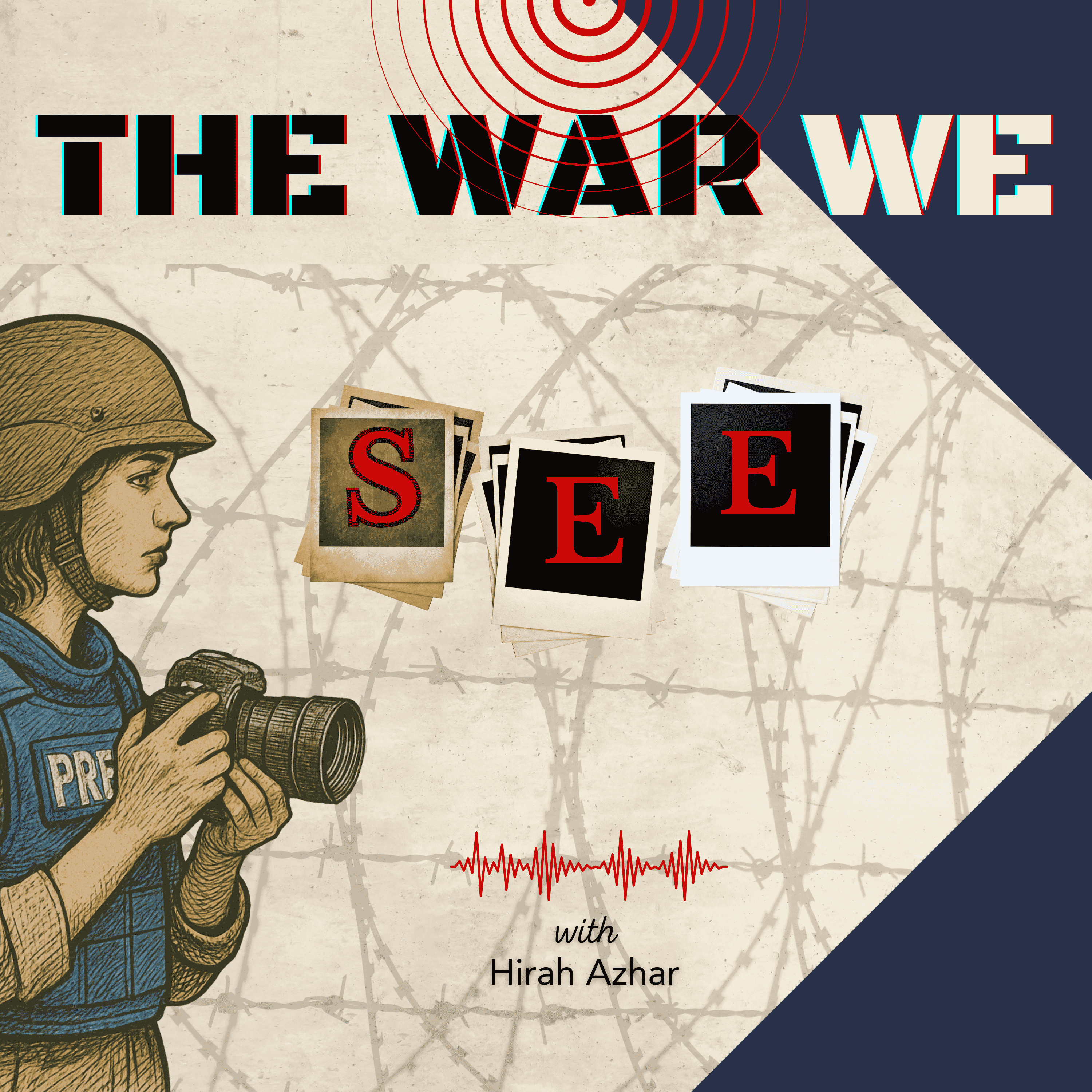
The War We See
by Hirah Azhar
Hosted by historian Hirah Azhar, this podcast explores the fascinating story of war imagery, and how it has shaped public perceptions of conflict. Drawing on conversations with a wide range of guests - including researchers, curators/archivists, photojournalists, artists, and filmmakers - this podcast moves across time and media, unearthing the stories behind the images that have defined our understanding of war. The War We See offers a critical, urgent, and thought-provoking lens on the images that continue to shape scholarship and society. New episodes released every other Wednesday.
-
12
Drone images of Mosul, photogrammetry, and the evolving aesthetics of war imagery...with Giles Price
This week, I'm joined by photographer and artist Giles Price, whose work blends photography, machine vision technologies, and aerial imaging, encouraging viewers to view war from a completely unique perspective. In this fascinating conversation, we discuss Giles' own military experiences photographing the Gulf War and reflect on how technologies of seeing have transformed over the three decades since that war. We explore the increasingly blurred boundaries between photography, mapping, and machine vision through his drone and photogrammetry practice, considering how these technologies are reshaping the production as well as the interpretation of conflict imagery.At the centre of our conversation is Phantom Pro, Giles' remarkable long-term project examining the aftermath and reconstruction of Mosul following the battle to defeat the Islamic State. Drawing on thousands of aerial images captured by consumer drone technologies, the project offers a striking meditation on war, memory, and reconstruction, while evoking important questions about the relationship between photography and data in contemporary visual culture.We also discuss synthetic imagery, image authentication, and the challenges posed by AI-generated visuals at a moment when photographs can no longer be taken at face value. From the material realities of making images in conflict zones to the future of visual documentation itself, Giles offers a thoughtful and nuanced perspective on how emerging technologies are changing what it means to witness war through images.Phantom Pro has been selected to be shown at Impact Kyiv: War/Conflict Photography Forum in October: https://www.uhop.org.ua/forum Giles’ website: https://www.gilesprice.com Links to Giles’ selected photographs: https://sotonac-my.sharepoint.com/:b:/g/personal/ha4g21_soton_ac_uk/IQB1s76mKqoFRINOHyxSzDJRAQUNlLPj573_RlqJel0mm8s?e=yjkxTX(The last photo discussed, of an FPV kill shot from the war in Ukraine, is not included due to its sensitive nature)
-
11
Media framing of contemporary war, soldiers’ visual self-representation, and AI-generated war photos...with Professor Katy Parry
For the first episode of a brand new season of The War We See, I'm joined by Dr Katy Parry, Professor of Media and Politics at the University of Leeds, whose research explores how conflict and politics are communicated, performed, and understood through visual culture. Katy's fascinating work on representations of war ranges from her enduring interest in media framing of military photography, as well as her incredibly varied work on the ways soldiers and military veterans represent themselves and are portrayed in popular media. In this insightful and wide-ranging conversation, we discuss British press coverage of the Iraq War, how military actors self-represent visually, and fast-moving developments in contemporary war imagery, including the arrival of AI-generated war visuals. Our conversation considers how visual representations do far more than depict war - they communicate key narratives, offer military actors a mode of expression, and influence what audiences believe they are seeing.Links to Katy’s selected photographs (in order of discussion):1. DALL-E 3 AI-generated image in response to the ‘create an image of a refugee’ prompt: https://air.unimi.it/retrieve/5a3e63d4-8843-4144-a2a9-7fe94c61d960/Chap3%20Parry%20Aiello%20AAM%20version%20War%20Faces.pdf [p.20].2. 'Britain's Camp Bastion Shame', front page of the i on Saturday, 10 May 2014: https://www.researchgate.net/figure/Front-page-of-the-i-on-Saturday-10-May-2014-Front-page-image-reproduced-here-with-kind_fig1_3106127433. Abduljalil Abdulhassam watches as his grand daughter Miram, aged 12, holds a picture of her missing father Yassim in Shuhaba, southern Iraq. Dan Chung/Guardian/MOD Pool: https://www.bridgemanimages.com/en/noartistknown/iraqi-abduljalil-abdulhassam-watches-as-his-granddaughter-holds-picture-of-her-missing-father-near/photograph/asset/8238742
-
10
Season 2 Trailer
The War We See is back! First episode is out on 15 July, with new episodes out fortnightly.
-
9
The War We See: Reflections & Unheard Moments
As this inaugural series of The War We See comes to a close, this episode offers a moment to pause and reflect. I look back on the conversations that have shaped this first series: the themes that emerged, the questions that still linger in mind, and what I’ve learned from listening closely to those documenting and studying the visuals of conflict. Alongside these reflections, I’m sharing three previously unheard snippets from past conversations - moments that didn’t make the original episodes but offer fresh insight, nuance, and perspective. These excerpts deepen the stories the podcast has been exploring and highlight the complexity at the heart of how we understand war through its imagery. The War We See will be going on a brief hiatus before returning for a brand new series featuring new guests and exciting new conversations. Thank you for listening, sharing, and engaging so thoughtfully with this first chapter. The conversation is far from over, and I look forward to returning soon with new voices and new stories.
-
8
Artistic resistance and the visuality of aerial imperial violence …with David Birkin (Part Two)
This episode is the second half of my fascinating conversation with David Birkin, artist, writer, and Senior Lecturer in Photography at the London College of Communication (University of the Arts London). In Part II, we discuss Visible Justice, the wonderful transdisciplinary network David and his colleague Max Houghton co-founded in 2018 at the University of the Arts London. The Visible Justice research hub brings together practitioners and thinkers from across art, activism, journalism, photography, film, writing, and human rights law who engage critically with the relationship between visual culture and social justice, creating spaces for collaboration beyond disciplinary boundaries. We also talk about David’s selected three images, drawn from his doctoral research as well more recent imagery that has resonated powerfully with him. As with the previous episode, the themes of imperial violence and visual resistance continue to dominate our conversation, with David’s unique and refreshing perspectives offering a powerfully hopeful conclusion to the discussion.Visible Justice: https://www.visible-justice.orgDavid’s website: https://lnkd.in/eqavBv9Q Note: This conversation was recorded before the ceasefire in Gaza in October 2025. However, it is important to point out that the ceasefire has done very little to ease the suffering of Palestinians, which continues largely unabated and without accountability. Links to David’s selected photos:1. Photograph from the report of the damage done to the British Aerospace Hawk jet in 1996 by the Ploughshares Four (Seeds of Hope East Timor Ploughshares Group): https://for-peace.maydayrooms.org/seeds-of-hope-ploughshares/9/ (see full collection for more photographs). 2. David’s Instagram post with the video of a US military aircraft taking off from Kabul Airport, August 2021: https://www.instagram.com/p/CSqN-Ylo98s/?utm_source=ig_web_copy_link&igsh=MzRlODBiNWFlZA== 3. Protesters demonstrate in support of 'Palestine Action', organised by the Defend Our Juries group, in front of the Mahatma Gandhi statue in London, July 5, 2025. Jeff Moore, AP: https://www.gettyimages.co.uk/detail/news-photo/people-take-part-in-a-protest-in-support-of-palestine-news-photo/2222966116
-
7
Artistic resistance and the visuality of aerial imperial violence …with David Birkin (Part One)
This is Part One of a very special two-part episode with David Birkin, artist, writer, Senior Lecturer in Photography at the London College of Communication (University of the Arts London) and currently, a Visiting Fellow in Art History at the University of Cambridge. David is known for a wide-ranging body of photography-led installations and large-scale visual performances that confront state violence and imperial power, while also enacting forms of creative resistance to them. In a conversation that is as emotionally resonant as it is captivating, we explore his practice and the questions that shape it: how images circulate power, how visual culture sustains imperial violence, and how art can intervene in these processes. We also discuss his ongoing doctoral research into histories of resistance and disarmament in the British imperial context — what he brilliantly describes as tracing “the history of the imperial through the lens of the aerial” — and consider its urgent relevance today, amid the genocide in Gaza and ongoing violence elsewhere in the world. David is a true creative, a very exciting scholar, and a committed advocate for social justice, whose work reminds us that images of war are never neutral and that visual representations of violence are always bound up with questions of power, responsibility, and justice. Part Two is out next week, featuring a discussion of David’s three selected images. David’s website: https://www.davidbirkin.net Notes1. This conversation was recorded before the ceasefire in Gaza in October 2025. 2. David's selected images will be discussed in Part Two of this conversation, posted next week, so the images will be linked then.
-
6
Agency and power in contemporary conflict imagery, photographing youth combatants in West Africa, and the Hetherington archives…with Katy Thornton
This week, I’m joined by fellow Imperial War Museum (IWM) doctoral researcher Katy Thornton (King’s College London), whose research uses the photojournalist Tim Hetherington’s archives at the IWM to examine the fascinating power dynamics between photographers, their subjects, and contemporary culture. Using her own background as a youth worker and academic grounding as a sociologist, Katy explores the intricate relationship between the photographer and the photographed within the context of youth combatants in West Africa between 1989 and 2003. In this evocative and stimulating conversation, we discuss her incredibly nuanced approach to a deeply complex subject, Hetherington’s own remarkable legacy, and the importance of acknowledging the role that power, perception, and agency play in what the camera captures of war. Katy’s doctoral research: https://www.iwm.org.uk/research/doctoral-awards/students-alumni/katy-thorntonLinks to Katy’s selected photographs 1. A LURD combatant, and member of the AA (Anti-Aircraft) brigade, in an exchange with his girlfriend during the LURD advance on the capital Monrovia. June 2003: https://www.iwm.org.uk/collections/item/object/205738356 2. The anti-Gaddafi uprising and Civil War in Libya, 2011: https://www.iwm.org.uk/history/contemporary-conflict/tim-hetherington 3. Near the port of Greenville: A fisherman sails past one of the many shipwrecks scattered along Liberia's coastline. September 2005: https://www.iwm.org.uk/collections/item/object/205738530
-
5
Photographing and filming war, bearing witness to human stories from the frontlines, and revisiting the Bosnian War 30 years on with “Unconquered: Goražde City of Heroes”…with Fiona Lloyd-Davies
In this episode, I’m joined by award-winning documentary filmmaker and photojournalist Fiona Lloyd-Davies, whose fearless storytelling has placed her on the frontlines of global conflict for more than three decades. From the besieged towns of Bosnia to the Democratic Republic of Congo, Fiona has used her camera to expose human rights abuses and amplify voices that often go unheard.We explore her remarkable career, from her early work during the Bosnian war including work on the BAFTA-winning The Unforgiving, to her own extraordinary filmmaking, such as Ordered to Rape, which revealed the use of sexual violence as a weapon of war in Congo, and her work on the groundbreaking Baghdad blogger series with Salam Pax. Fiona reflects on the ethical responsibility of witnessing, documenting, and framing war, and on filming stories of immense trauma with compassion and integrity.We also discuss her upcoming project UNCONQUERED: Goražde City of Heroes, and her BBC Radio 4 Archive on 4programme, which revisits one of the least-known sieges of the Bosnian war through powerful first-hand testimony.BBC Radio 4 (Archive on 4) “The Battle of the Drina”, now available on BBC Sounds: https://www.bbc.co.uk/sounds/play/m002nh76Fiona’s production company: https://www.studio9films.co.uk/about-1Links to Fiona's selected photographs 1. Stanley Spencer's 'Travoys Arriving with Wounded at a Dressing Station at Smol, Macedonia, September 1916’: https://upload.wikimedia.org/wikipedia/en/2/2f/Spencer%2C_Stanley_%28Sir%29_%28RA%29_-_Travoys_Arriving_with_Wounded_at_a_Dressing-Station_at_Smol%2C_Macedonia%2C_September_1916_-_Google_Art_Project.jpg 2. Serbian Epics (1992): https://www.youtube.com/watch?v=1UTmiTsmHQ4 (the gun sequence from 34:15 - 34:24)3. Lee Miller's "Fall of the Citadel, St. Malo (1944): https://rps.org/media/5p0fb2sq/copyright_leemillerarchives_fall_of_the_citadel-_aerial_bombardment_st_malo_france_1944-lr.jpg?mode=max&width=1520&rnd=1336879958511700004. Portrait of Ancilla, Fiona Lloyd-Davies: https://sotonac-my.sharepoint.com/:w:/g/personal/ha4g21_soton_ac_uk/IQCKEwiCWic0TpAM-IuDfrrMAUWQV1SH93Uiw-TIRlMUbU4?e=atH7Ci5. [Bonus] An elderly woman pushing her belongings through the rubble of Kravice village, eastern Bosnia, January 1993, Fiona Lloyd-Davies: https://sotonac-my.sharepoint.com/:w:/g/personal/ha4g21_soton_ac_uk/IQCKEwiCWic0TpAM-IuDfrrMAUWQV1SH93Uiw-TIRlMUbU4?e=atH7Ci
-
4
Terrorist imagery, navigating sensitive content, and innovating the curation of online collections…with Dr Ali Fisher
This week, I’m joined by Dr Ali Fisher from Human Cognition Ltd. and Università Cattolica in Milan. Ali’s work bridges strategic communications and data science to counter emerging threats in complex information environments, such as political disinformation campaigns, online child sexual abuse networks, and the exploitation of online platforms by terrorist groups. Ali is the creator of Mujahid Mind AI and the BlackLight data feed - tools that provide near real-time insights into Salafi-Jihadi exploitation of the Internet, which, combined with his decades’ long familiarity with the subject and his own training as a historian, mean he is uniquely placed to discuss this often-misunderstood genre of conflict imagery. In this conversation, Ali and I discuss a broad range of subjects such as deciphering Salafi-Jihadi visuals, researcher wellbeing, the important work of preserving visual content from Gaza, and his development of tools that can help curate, preserve, and decode online content. Note: Due to a discussion of atrocity imagery in this conversation - mainly some examples of graphic violence that are briefly mentioned - listener discretion is advised. Link to Mujahid Mind AI: https://www.mujahidmind.io Some of Ali’s recent co-authored publications mentioned in the episode:Decoding the Terrorist Mind, The European Institute for Counter Terrorism and Conflict Prevention (EICTP), July 2025: https://eictp.eu/wp-content/uploads/2025/07/Final_Decoding-the-Terrorist-Mind-The-Role-of-AI-Powered-Tools.pdf Gore and Violent Extremism: An Explorative Analysis of the Use of Gore Websites for Hosting and Sharing Extremist and Terrorist Content, VOX-Pol, 2025: https://voxpol.eu/wp-content/uploads/2025/07/DCUPN0751-Gore-Extremism-WEB-250704.pdf Ali’s selected photographs: Islamic State fighter on horseback at sunset: https://onlinejihad.net/wp-content/uploads/2019/03/pic5.jpgNsala of Wala in Congo looks at the severed hand and foot of his five-year old daughter. Photographed by John H. Harris in May 1904. Appears in Edmund Morel, King Leopold's rule in Africa, (1904) p. 145: https://commons.wikimedia.org/wiki/File:Nsala_of_Wala_in_Congo_looks_at_the_severed_hand_and_foot_of_his_five-year_old_daughter,_1904.jpg
-
3
Representation, access, and the artist in the world of war art…with Rebecca Newell
My guest this week is Rebecca Newell, Head of Art at the Imperial War Museum (IWM) and lead curator of the fantastic Blavatnik Art, Film and Photography Galleries at IWM London. Rebecca brings the stories of war art to life in this fascinating conversation, taking me through the history of the IWM’s vast collections of 20th and 21st century art, and breaking down how hugely influential the work of artists has continued to be in witnessing, documenting, and informing audiences, even with the accelerated rise of film and photographic depictions of war. In perhaps the most uplifting end to all my conversations on this podcast so far, with all the fears around disinformation and the challenges of managing rapidly expanding collections, Rebecca talks about her work with a thriving community of artists, and offers a gentle reminder that it’s important to ensure that we keep our focus on people and the human story of war imagery. (Sadly, the art installation at IWM North that Rebecca mentions near the end of the podcast, Chila Welcomes You by Chila Kumari Singh Burman, ended in August 2025. However, IWM North is currently running an exhibition inspired by Chila’s installation called Outrageous Women: Marriage, religion and culture until 31 January 2026: https://www.iwm.org.uk/events/outrageous-women-marriage-religion-and-culture) Rebecca’s selected imagesJohn Singer Sargent, Gassed, 1919 https://www.iwm.org.uk/gassed-by-john-singer-sargentNevison, Paths of Glory, 1917 https://www.iwm.org.uk/collections/item/object/20211Kennardphillips. Photo Op, 2007 https://www.iwm.org.uk/collections/item/object/42971
-
2
Atrocity imagery, historical film restoration, and using film evidence in war crimes tribunals…with Dr Toby Haggith
This week, I’m honoured to be joined by Dr Toby Haggith, Senior Curator in the Department of Second World War and Mid-20th Century Conflict at the Imperial War Museum, and someone who both specialises in film restoration and working with Holocaust imagery. Toby is one of my favourite historians and curators, and this was a thrilling and illuminating conversation where we discuss the painstaking process of restoring films, the challenges of working with atrocity imagery, especially from the Holocaust, and why the way in which both the moving and still war image are presented and perceived, is almost entirely dependent on context. Note: Due to a discussion of atrocity imagery in this conversation, including certain graphic examples, listener discretion is advised.About TobyToby has worked on the restoration The Battle of the Somme (1916), The Battle of the Ancre (1917) and Battle of Arras (1917) and was the director of the restoration and completion of German Concentration Camps Factual Survey (1945/2014), overseeing the production of the award-winning Blu-ray/DVD version. He is co-editor with Joanna Newman of Holocaust and the Moving Image: Film and Television Representations Since 1933 (2005) and has most recently co-authored Nuremberg: The Trial That Defined Justice with IWM colleague James Bulgin, which is out on 6 November 2025 (https://shop.iwm.org.uk/products/nuremberg?srsltid=AfmBOoo6HkD9-efMcsEU9dF6A_9x24EqFPCt56eRSrnnRiTDwa9guQFC).Links to Toby’s selected images: 1. Footage from the original Battle of the Somme (1916); For the “over the top” sequence that Toby selected, watch from 03:00 onwards: https://www.youtube.com/watch?v=jsfEOXeglBI 2. [Distressing images – viewer discretion advised)The bulldozer scene from the Berger-Belsen Concentration Camp in 1945: https://www.iwm.org.uk/collections/item/object/205194125 The same scene from other angles:https://collections.ushmm.org/search/catalog/pa7352https://www.awm.gov.au/collection/C376248 Other linksLaura Rossi’s soundtrack for the restored The Battle of the Somme performed by the BBC Concert Orchestra: https://www.youtube.com/watch?v=bTowuk_hnqU&list=RDbTowuk_hnqU&start_radio=1 “How the Battle of the Somme was Filmed”: https://www.iwm.org.uk/history/how-the-battle-of-the-somme-was-filmed
-
1
Photographing systems of control: Extraordinary Rendition and bringing the DoD’s declassified documents and image archive to public view…with Edmund Clark and Crofton Black.
In this episode, I’m joined by not one but two guests, authors of Negative Publicity (2015) and the soon-to-be-published Cosmopolemos: An Illustrated Encyclopaedia of the United States Department of Defence Contract Spending from 2001 to 2021. In this wide-ranging conversation, artist and photographer Edmund Clark and investigative journalist and writer Crofton Black explain their unique approach to research, combining forensic investigations of declassified documents with photography to shed light on systems of military power and hegemonic control. Their widely exhibited and rigorously researched work is immensely thought-provoking and important, offering rare insight into a fiercely protected world. Listeners will be able to see some of these images from Cosmopolemos and more in a collaborative exhibition with the Incite Project at Photo Oxford, running between the 25th of October and the 16th of November at Pembroke College JCR Art Gallery. Cosmopolemos [Embedded]: Representations of American Military Power from 9/11 to the Evacuation of Kabul displays images from the Incite Project made between 9/11 and the evacuation from Kabul, including those by photojournalists embedded with the US military in Afghanistan and Iraq. Link to exhibition: https://photooxford.org/exhibitions/crofton-black-edmund-clark Ed and Crofton will also be speaking about Cosmopolemos at a symposium on 31 October at the Truth and Photography Symposium at Weston Library in Oxford: (https://photooxford.org/events/symposiumLink to Ed and Crofton’s selected images: https://sotonac-my.sharepoint.com/:b:/g/personal/ha4g21_soton_ac_uk/EYf7hg48j2tAurna9XCj7UIBCNDg2oxuhRzVtCaYOQok0A?e=K5jkXa
-
0
Film archives, combatant photography, ISIS photo-propaganda, and the UK’s first exhibition on sexual violence in conflict…with Helen Upcraft
**Content Warning: This episode contains discussion of graphic violence in one small section, specifically from minute 43 to minute 44, about some ISIS images, which depict scenes of extreme violence**Imperial War Museum (IWM) Curator Helen Upcraft joins me for a conversation about her work in the museum’s film archives, including the experience of working on Peter Jackson’s First World War documentary They Shall Not Grow Old (2018); a wide-ranging discussion of key curatorial practices around visual material and the challenges of born-digital content; the increasing number of combatant photographs in the IWM’s collections; the selection and archiving of sensitive content, such as the IWM’s collection of born-digital Islamic State images; and the immense importance of the IWM’s fantastic ongoing exhibition on sexual violence in conflict, of which Helen is the lead curator. "Unsilenced: Sexual Violence in Conflict" is on at the Imperial War Museum in London and runs to 2 November 2025: https://www.iwm.org.uk/events/unsilenced-sexual-violence-in-conflict Link to Helen’s selected images: https://sotonac-my.sharepoint.com/:b:/g/personal/ha4g21_soton_ac_uk/EZS5RqckqahDoUoch6aCzosBdh2RCk8Lgt40ocZP_FDCWQ?e=aQIB7A
-
-1
Drones, photo reconnaissance, and the weaponised camera...with Dr Chris Fuller
In the very first episode of The War We See, Dr. Chris Fuller, Associate Professor in Modern History at the University of Southampton, joins me for a truly historical examination of photo reconnaissance, drone imagery, and the military's increasing weaponisation of the camera, especially within the context of US military innovation, the Gulf War, and the ongoing war in Ukraine.Links to Chris' selected images:Image 1: Screenshot in https://www.c-span.org/program/news-conference/defense-department-news-briefing/11876( To view the image within the screenshot, see p.17 https://www.airandspaceforces.com/app/uploads/1991/11/Nov1991.pdf)Image 2: https://upload.wikimedia.org/wikipedia/commons/5/57/Gulf_war_target_cam.jpgImage 3: https://artblart.com/wp-content/uploads/2012/12/jarecke-gulf-war-incinerated-iraqi-soldier.jpg
-
-2
Introducing...The War We See
Have you ever wondered how much of our understanding of war comes from what is visually presented to us? What factors determine what we see of war? And who decides what is recorded, censored, or shared? Introducing The War We See, a new podcast on war imagery that explores these questions and more, through fascinating conversations with an eclectic selection of guests.
We're indexing this podcast's transcripts for the first time — this can take a minute or two. We'll show results as soon as they're ready.
No matches for "" in this podcast's transcripts.
No topics indexed yet for this podcast.
Loading reviews...
ABOUT THIS SHOW
Hosted by historian Hirah Azhar, this podcast explores the fascinating story of war imagery, and how it has shaped public perceptions of conflict. Drawing on conversations with a wide range of guests - including researchers, curators/archivists, photojournalists, artists, and filmmakers - this podcast moves across time and media, unearthing the stories behind the images that have defined our understanding of war. The War We See offers a critical, urgent, and thought-provoking lens on the images that continue to shape scholarship and society. New episodes released every other Wednesday.
HOSTED BY
Hirah Azhar
CATEGORIES
Loading similar podcasts...
Frequently Asked Questions
How many episodes does The War We See have?
The War We See currently has 15 episodes available on PodParley. New episodes are automatically indexed when they're published to the podcast feed.
What is The War We See about?
Hosted by historian Hirah Azhar, this podcast explores the fascinating story of war imagery, and how it has shaped public perceptions of conflict. Drawing on conversations with a wide range of guests - including researchers, curators/archivists, photojournalists, artists, and filmmakers - this...
How often does The War We See release new episodes?
The War We See has 15 episodes. Check the episode list to see recent publication dates and frequency.
Where can I listen to The War We See?
You can listen to The War We See on PodParley by clicking any episode. We provide an embedded audio player for direct listening, and you can also subscribe via your preferred podcast app using the RSS feed.
Who hosts The War We See?
The War We See is created and hosted by Hirah Azhar.
URL copied to clipboard!