
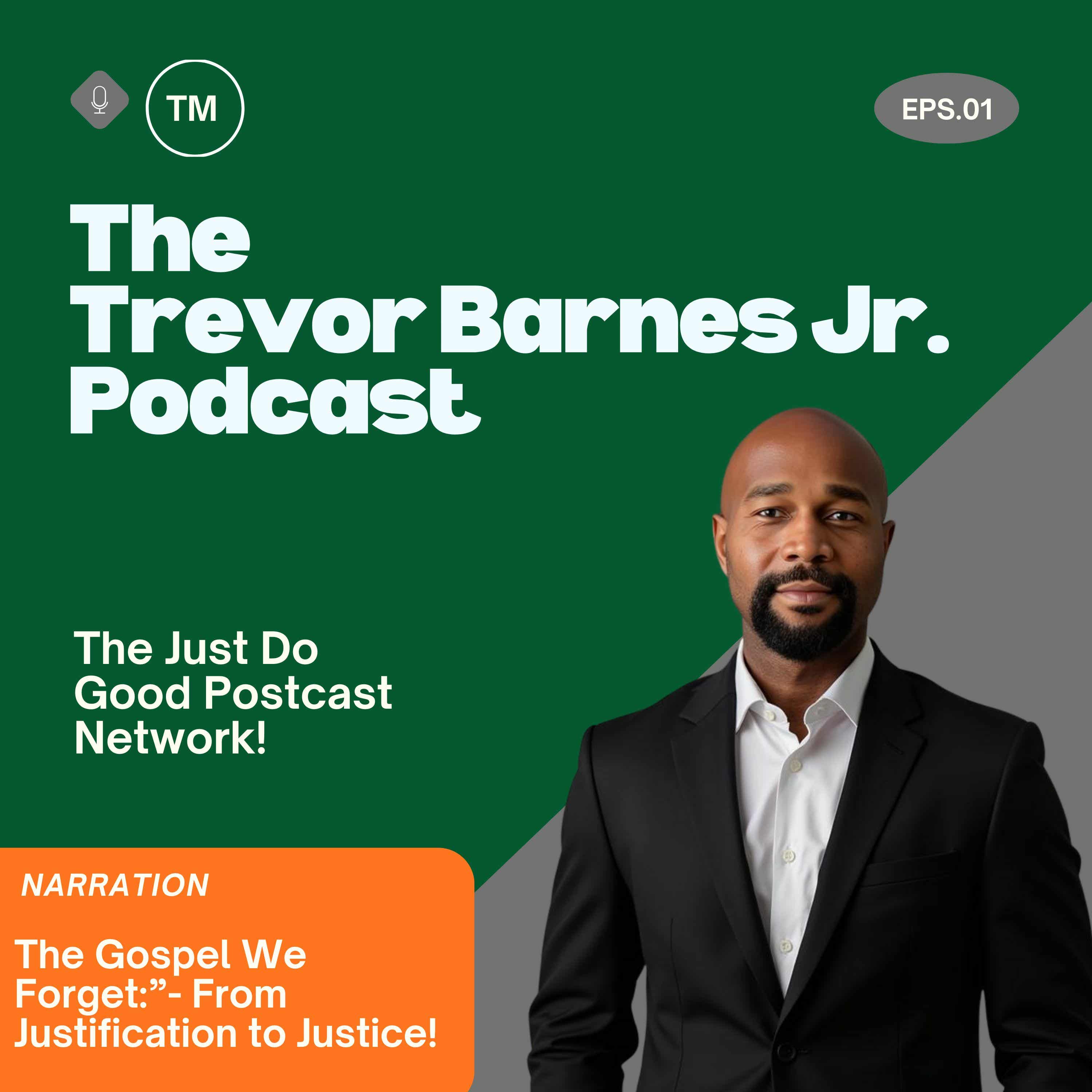
PODCAST · education
Trevor Barnes Jr Urban Theologian Podcast
by Trevor Barnes Jr
This podcast shines a light on stories of goodness inspired by the life of Jesus, who “went around doing good.” Designed for pastors, ministry leaders, and non-profits, it offers practical ideas and real-life lessons to help you impact your community and lead like Jesus. trevorbarnesjr.substack.com
-
5
A HUNGER FOR RAIN PART 1 Why Revival Requires Discernment.
I have watched people stream to the front of a church — tears on their faces, hands raised, voices broken — and felt the pull of that moment myself. Something real seemed to be happening. And yet, a few months later, those same people drifted back into the same patterns, that pulled them from God. The altar call moved them, but did it change them?That question sits at the heart of what I want to explore in this series. Not to dampen excitement about any work of God, but to ask the harder question revival culture rarely pauses long enough to ask: How do we know if a true revival is taking place?The Revival ConversationAt the 74th National Prayer Breakfast on February 5, 2026, President Trump made a striking claim — that America is in the midst of a spiritual revival. He pointed to churches reporting increases of 30, 50, even 70 percent in converts and weekly attendance.The examples are not hard to find. In 2023, a student-led chapel service at Asbury University in Kentucky quietly expanded into an around-the-clock gathering of prayer, repentance, and worship that drew tens of thousands of visitors from across the country. This year, a similar awakening has stirred on the campus of Southeastern University in Florida. Even in secular England, some 2,000 people gave their hearts to Jesus during a recent evangelistic crusade.These are real people, real gatherings, real moments of spiritual meaning. They deserve to be taken seriously.And yet — the research tells a sobering counterpoint. According to National Geographic, the religiously unaffiliated — commonly called the “nones” — are now the second largest religious group in North America, and they are growing rapidly. In the United States, nones account for nearly a quarter of the population, surpassing Catholics, mainline Protestants, and all followers of non-Christian faiths combined.The data invites an honest question: Are we witnessing a genuine, widespread revival — or a series of genuinely meaningful but localized events, amplified by a culture eager for spiritual good news?A Church That Longs for RainPart of what makes this conversation complicated is that the longing for revival is itself biblical. Greying congregations, emptying pews, and a rise in secularism — has created a hunger in the church for a revival that is understandable.Scripture promises that the spiritual power of the early church will return. Just as the autumn rain prepared Israel’s fields for the harvest, the prophets spoke of a latter rain that would fall before the final harvest of souls:“Be glad, people of Zion, rejoice in the Lord your God, for he has given you the autumn rains because he is faithful.” — Joel 2:23“Ask the Lord for rain in the springtime.” — Zechariah 10:1The book of Acts describes what that early rain looked like. The Spirit fell in Jerusalem with miraculous power — healings, tongues, signs — so tangible that people were healed by Peter’s shadow passing over them (Acts 5:12–16). Every believer who longs for the return of Jesus wants to see this power again, spreading the gospel to every corner of the earth, hastening the day when Jesus will return (Matthew 24:14).But this longing — as legitimate as it is — creates a vulnerability. An eager heart is not always a discerning one.The Counterfeit ProblemIn the same passage where Jesus promises that the gospel will go to the entire world, He issues a warning that should cause us to pause and reflect. Many false Christs and false prophets will arise, performing great signs and wonders — specifically designed to deceive (Matthew 24:24).Not every flame is fire from heaven. A demonic strategy to suppress genuine revival is to flood the field with compelling counterfeits.This is not a new tactic. It is as old as Pharaoh’s court, where his magicians matched Moses sign for sign (Exodus 7–8). The book of Revelation warns that this counterfeit power will return in the last days, with fire falling from heaven in a display designed to deceive the whole world (Revelation 13:13–14; 16:13).So, the question of discernment is not a matter of spiritual pessimism. It is a matter of spiritual survival.Three Things That Do Not Guarantee a True Revival1. Large NumbersOur safety is not in numbers — because numbers can lie. The crowd has rarely been a reliable indicator of divine favor. Micaiah stood alone against 400 prophets of Baal. Jeremiah stood alone against Hananiah and the false prophets of his day. Elijah stood alone on Mount Carmel against the prophets of Jezebel. Time and again in Scripture, God’s voice was found in the minority.Large religious gatherings can be spiritually meaningful. They can also be spiritually dangerous. Size alone tells us nothing.2. Charismatic AtmosphereThere is nothing inherently wrong with expressive, charismatic worship. God can move through drums, tears, shouting, and silence equally. But God is not bound to an emotional pendulum, and neither are counterfeits.What is striking is that God often chooses to speak in a still, small voice (1 Kings 19:11–12; Psalm 46:10). Not because the dramatic is off limits, but because emotional intensity can be shallow. Feelings fade when the music stops. God is not after an emotional reaction — He is after a deep settled conviction.The apostle Paul, writing to a church that had experienced genuine repentance, described what it looked like: “See what this godly sorrow has produced in you: what earnestness, what eagerness to clear yourselves, what indignation, what alarm, what longing, what concern, what readiness to see justice done.” — 2 Corinthians 7:11The Corinthians did not make a trivial decision. Their conviction ran soul deep. That is the standard.3. Miraculous SignsMiracles can accompany a genuine revival (Mark 16:17–18). They may even be evidence of a genuine revival. But Jesus cautioned: “A wicked and adulterous generation looks for a sign” (Matthew 16:4). Faith built primarily on the spectacular is faith built on sand because the spectacular can be counterfeited.This is not skepticism about divine power. It is a recognition that the miraculous is not the safest place to cast our anchor.So What Makes a Revival Real?That is the question I want to pursue in the next article in this series. Scripture does not leave us without an answer — the marks of genuine revival are real, testable, and deeply challenging to everything the church might prefer to settle for.But before we get there: What do you think? When you hear the word “revival,” what comes to mind? How do you discern the genuine from the counterfeit?I would love to hear your thoughts in the comments. Get full access to Trevor Barnes Jr at trevorbarnesjr.substack.com/subscribe
-
4
God Loves Bald People
If you’ve ever looked at me, perhaps you noticed: I’m bald. Today I’m a proud member of the follicly challenged community. But it wasn’t always like this. My world came crashing down when I was 15 years old.Back then, I rocked a big, bold Afro. I was the original “I whip my hair back and forth” way before Willow Smith.One day, with a pick in my fro, I walked up the stairs on my way to class. A friend was walking down the stairs. As we crossed paths, he said, “Trevor, I can see your scalp.”I thought, What? You can’t be serious. How is that possible?But he called someone over to verify it, and that person agreed.Immediately I panicked. I rushed to the bathroom to check for myself. To my horror, when the light hit just right, I could see my scalp. My world was crushed.I imagined getting Snoop Dogg cornrows—instead, I was destined to look like Captain Picard and George Jefferson in high school. That night, I cut off all my hair.But I didn’t realize how much that decision would impact the rest of my life.That weekend, family and church members condemned my new hairstyle. Why? Because they said the Bible teaches: “You should not shave your head!”I remember wondering why God was so concerned about my bald head. Shouldn’t God be busy doing other things—like running the universe?Then I started to feel like God was cruel. He created me. He gave me the genetics that made me bald. Why would He make me this way then condemn me for it? Why would He “destine” me to look like an old man in high school? I was too young for such a cruel fate! How would I ever get another girlfriend—date, get married, and have a family?To add to my “iniquity,” I grew a goatee. That led to even more impromptu Bible studies about trimming the edges of my beard.I endured the insults and side-eyes for over a year. I had enough of God! I didn’t want to have anything to do with God. But one day after a heated exchange something impressed me to check the Bible for myself. I got a concordance and looked up the word bald. Here’s what I discovered:It’s true that the Bible speaks against shaving your head and trimming the corners of your beard:V1 — “Ye shall not round the corners of your heads, neither shalt thou mar the corners of thy beard.” — Leviticus 19:27 (KJV)V2 — “They shall not make baldness upon their head, neither shall they shave off the corner of their beard, nor make any cuttings in their flesh. They shall be holy unto their God, and not profane the name of their God…” — Leviticus 21:5–6 (KJV)But those verses, taken by themselves, don’t tell the entire story. In fact, taken in isolation, they can distort the story.Deuteronomy 14:1–2 gives important context:“Ye are the children of the LORD your God: ye shall not cut yourselves, nor make any baldness between your eyes for the dead. For thou art an holy people unto the LORD thy God…” — Deuteronomy 14:1–2 (KJV)In this brief Bible study, I learned that the Bible was addressing a specific practice at a specific time. Ritual baldness was part of pagan worship of the dead. God told His people not to participate in that practice because their worship exclusively belonged to Him.That experience taught me several lessons.1. The Bible is for us, but it wasn’t written directly to us.Scripture contains timeless truth, but it was written to particular people at a particular time. If we ignore context, we can make the Bible “say” what it never said. That’s why understanding the historical context is vital to a proper understanding of scripture.2. Never build a doctrine from a single verse.Leviticus sounds like a blanket ban against shaving your head and beard, but another scripture explains the context. What seems clear can be a misunderstanding. This is why a very important bible study principle is to consider every passage on a subject before jumping to a conclusion. Never say “the Bible says…,” if you have not heard the entire witness of Scripture. Remember to hear the entire council of God because Scripture explains Scripture.3. Go to the primary source!“Experts” can be wrong—sometimes sincerely wrong. My experience taught me: don’t just go by what the “experts” say, verify, verify, verify by going to the primary source.4. Bad Bible interpretation distorts our picture of God.Most people didn’t reject God. They reject the version of God they were taught. Many people live with shame and spiritual trauma because of the false God that has been presented to them.5. God is a wonderful God!When I realized what the Bible was actually saying I gained a new appreciation for God. God was not who He was projected to be - a micromanager hell bent on subjecting us to His arbitrary will. Instead, God is gracious, loving, good, patient and merciful.My takeawayMy experience taught me a simple but life‑changing lesson: I can’t afford to outsource my understanding of God. I have to seek Him myself. I have to become familiar with His word. And the more I’ve done that, the more I’ve discovered something surprising:God is far better than the rumors about Him.For years, I carried a picture of God that wasn’t true. Maybe you have too. Maybe someone handed you a version of God who was petty, harsh, or impossible to please. Maybe you’ve been living under the weight of a God who never actually existed.But here’s the good news:When you go to the Source, you meet a God who is kinder than you expected, wiser than you imagined, and far more loving than you were ever told.And yes—God still loves bald people. Turns out He always did.Maybe you’ve carried a distorted picture of God. I’d love to hear your story! Share below! Get full access to Trevor Barnes Jr at trevorbarnesjr.substack.com/subscribe
-
3
No One Man Should have All That Power!
When Israel first pleaded for a king, God gave them Saul — his story is a warning that echoes across history. Power unchecked becomes dangerous! Get full access to Trevor Barnes Jr at trevorbarnesjr.substack.com/subscribe
-
2
The Gospel We Forget - From Justification to Justice
Have we divided the gospel? This article uncovers how Christianity’s focus on personal salvation drifted from its call to social righteousness. Get full access to Trevor Barnes Jr at trevorbarnesjr.substack.com/subscribe
-
1
"The Gospel We Forget:”- From Justification to Justice!
“The gospel is not a call to social justice. It’s a call to spiritual transformation.”— John MacArthurThis Substack is reader-supported. To receive new posts and support my work, consider becoming a free or paid subscriber.John MacArthur’s words capture what many mainstream evangelicals believe about the gospel. At the heart of this view is the idea that the gospel is exclusively for the soul. But why do so many Christians believe the gospel is just for the soul? Why is social justice so often separated from the gospel?The Roots of a Divided GospelJohn MacArthur’s view is not new. In fact, it dates back to an Augustinian monk named Martin Luther. It is impossible to overstate Luther’s influence on Western theology. He is the lens through which much of the Christian world interprets the gospel—especially the writings of Paul.Yet Luther’s own life experiences shaped the way he understood the gospel. He wrestled deeply with guilt and the fear of divine judgment. Luther would spend hours confessing his sins, yet later wrote:“After confession and the celebration of Mass, I was never able to find rest in my heart.”Luther’s struggles led him to see salvation as an intensely personal matter. He longed for freedom from guilt and shame but and when he discovered grace, he found peace with God. Grace gave Luther the assurance that God accepted him.Grace That Heals the SoulLuther was not wrong—he was right. I know because I’ve been there. I know what it feels like to wrestle with guilt and shame. And I know what it feels like to be set free by grace. I am a witness that Jesus can cleanse the soul from sin, guilt and shame! I resonate with the words of David:“Happy are those whose wrongs are forgiven, whose sins are pardoned!Happy is the person whose sins the Lord will not keep account of!”— Romans 4:6–8 (GNT)But the joy of the experience of justification is only half of the salvation story. What happens after justification?Righteousness Is Meant to Be LivedRighteousness is not just something you believe in—it’s something you practice. John writes:“Little children, let no one deceive you.He who practices righteousness is righteous,just as He is righteous.”— 1 John 3:7 (NKJV)For many Christians, righteousness has been reduced to personal piety—being careful about what we watch, listen to, or where we go. But righteousness is not just about avoiding sin. It’s also about how we treat our neighbor.Job: A Model of Lived RighteousnessThis truth first struck me while reading the book of Job. Job is described as “blameless and upright,” a man who “feared God and shunned evil” (Job 1:1).At first glance, it sounds like a divine label—God simply arbitrarily declared Job righteous. But when I read Job’s own words, I realized something powerful: Job was not arbitrarily called righteous, Job was called righteous because of how he treated his neighbors.Notice Job’s testimony:“I delivered the poor who cried for help,and the fatherless who had none to help him.The blessing of him who was about to perish came upon me,and I caused the widow’s heart to sing for joy.I put on righteousness, and it clothed me;my justice was like a robe and a turban.I was eyes to the blind and feet to the lame.I was a father to the needy,and I searched out the cause of him whom I did not know.”— Job 29:12–17 (ESV)‘“If I have denied the desires of the poor or let the eyes of thewidow grow weary, if I have kept my bread to myself, notsharing it with the fatherless— but from my youth I rearedthem as a father would, and from my birth I guided thewidow— if I have seen anyone perishing for lack of clothing,or the needy without garments, and their hearts did not blessme for warming them with the fleece from my sheep, if I haveraised my hand against the fatherless, knowing that I hadinfluence in court, then let my arm fall from the shoulder, let itbe broken off at the joint. For I dreaded destruction from God,and for fear of his splendor, I could not do such things. ‘- Job 31:16-23 NIVWhen God called Job righteous—He was stating the obvious. He was stating what anyone in Job’s community would say about him. Job lived Matthew 25:40:“Whatever you did for one of the least of these brothers and sisters of mine, you did for me.”Job demonstrated that righteousness isn’t just a spiritual possession for the soul—it’s a lifestyle. What we do for the least among us reveals whether God’s grace has truly transformed our lives.From Justification to JusticeThe person who is justified by faith naturally does good works—just as an apple seed naturally produces apples. True justification bears fruit in righteous actions. And in our time, we would call these actions social justice. It is theological malpractice to separate spiritual transformation from how we treat our neighbor. The goal of the gospel has always been love—to love our neighbor as ourselves.Instead of viewing the Christian life as exclusively vertical, we must recognize that the gospel is also horizontal. I believe this is what the cross demonstrates. The cross stretches vertically toward heaven and horizontally toward humanity—reminding us that salvation and justice belong together.The Call of the GospelToo often a gospel is preached that saves the soul but forgets the suffering. Yet scripture shows us both matter deeply to God.John MacArthur is right the gospel is a call to spiritual transformation. But that transformation does not stop at the soul—it moves into our hands, our habits, and our relationships. True transformation changes how we treat one another.The gospel is not a call to retreat from the world—it’s an invitation to reflect God’s justice in the world. I believe: the gospel is good news for the soul and for society. I’d love to know what you believe. Take a moment and share your thoughts below! Get full access to Trevor Barnes Jr at trevorbarnesjr.substack.com/subscribe
We're indexing this podcast's transcripts for the first time — this can take a minute or two. We'll show results as soon as they're ready.
No matches for "" in this podcast's transcripts.
No topics indexed yet for this podcast.
Loading reviews...
ABOUT THIS SHOW
This podcast shines a light on stories of goodness inspired by the life of Jesus, who “went around doing good.” Designed for pastors, ministry leaders, and non-profits, it offers practical ideas and real-life lessons to help you impact your community and lead like Jesus. trevorbarnesjr.substack.com
HOSTED BY
Trevor Barnes Jr
CATEGORIES
Loading similar podcasts...
Frequently Asked Questions
How many episodes does Trevor Barnes Jr Urban Theologian Podcast have?
Trevor Barnes Jr Urban Theologian Podcast currently has 5 episodes available on PodParley. New episodes are automatically indexed when they're published to the podcast feed.
What is Trevor Barnes Jr Urban Theologian Podcast about?
This podcast shines a light on stories of goodness inspired by the life of Jesus, who “went around doing good.” Designed for pastors, ministry leaders, and non-profits, it offers practical ideas and real-life lessons to help you impact your community and lead like Jesus. trevorbarnesjr.substack.com
How often does Trevor Barnes Jr Urban Theologian Podcast release new episodes?
Trevor Barnes Jr Urban Theologian Podcast has 5 episodes. Check the episode list to see recent publication dates and frequency.
Where can I listen to Trevor Barnes Jr Urban Theologian Podcast?
You can listen to Trevor Barnes Jr Urban Theologian Podcast on PodParley by clicking any episode. We provide an embedded audio player for direct listening, and you can also subscribe via your preferred podcast app using the RSS feed.
Who hosts Trevor Barnes Jr Urban Theologian Podcast?
Trevor Barnes Jr Urban Theologian Podcast is created and hosted by Trevor Barnes Jr.
URL copied to clipboard!