
PODCAST · business
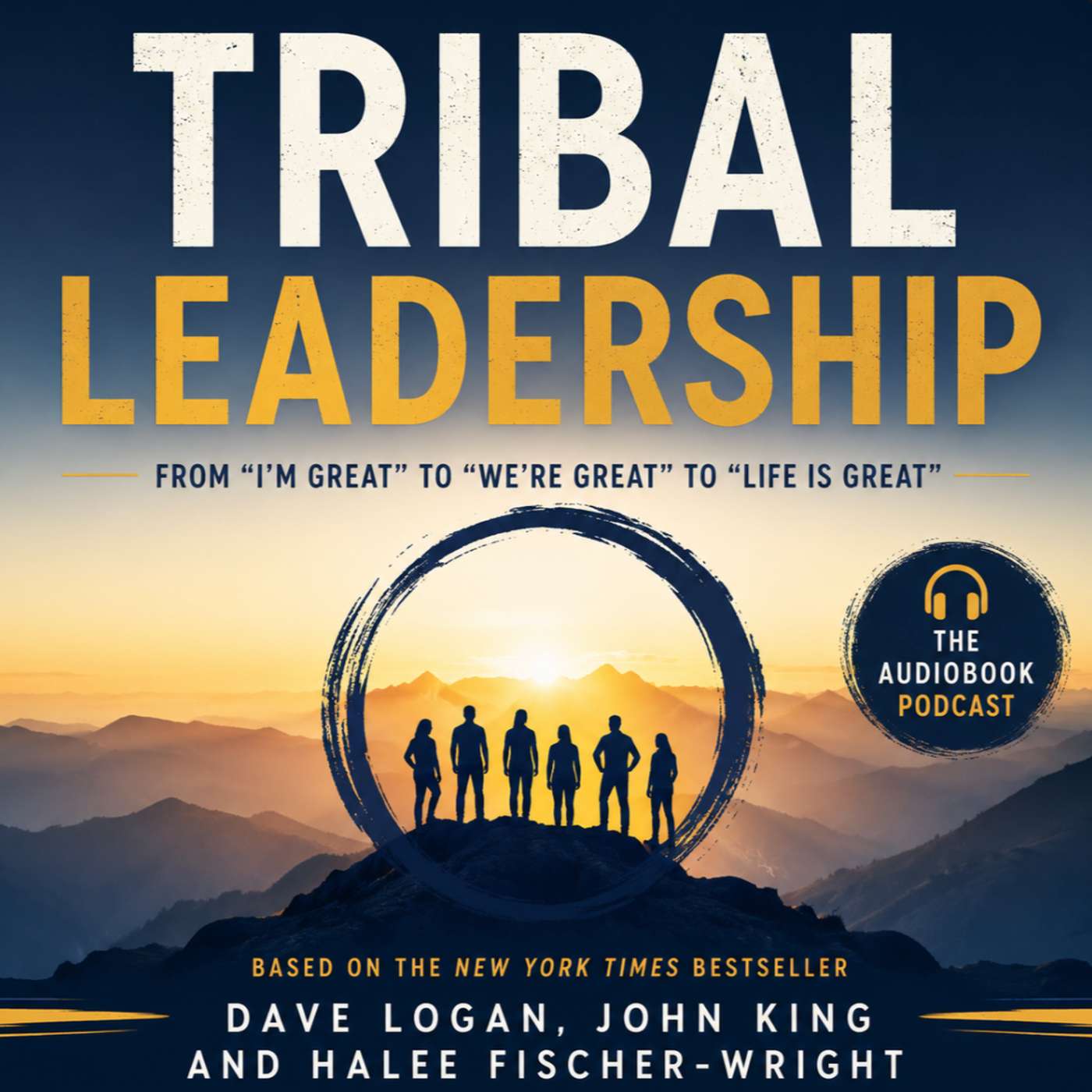
Tribal Leadership Audiobook
by Dave Logan
Tribal Leadership reveals how culture shapes performance—and how leaders can upgrade the “tribes” around them. In this abridged audiobook, read by co-author Dave Logan, you’ll learn the five stages of tribal culture and practical ways to move teams toward trust, partnership, and history-making results.
-
13
Where Tribal Leaders Go Next (Afterword)
Final Advice for Tribal LeadersMake the Message Your Own: True tribal leadership cannot be faked or run from a generic corporate manual; it must align with your authentic values.Confront Your Own Stage 3 Tendencies: Constantly monitor your personal motivations to ensure you are building a collaborative network rather than a personal empire.Connect with the Growing Movement: Seek out other values-driven leaders to expand your own triadic networks and share best practices.Leadership is Service: Remember the ultimate epiphany of the journey: leadership is never about you; it is entirely about what you do for the tribe.
-
12
Chapter 11: Into Stage 5 — Life is Great
SummaryStage 5 represents the absolute peak of organizational culture, where the tribal mindset upgrades to "Life is great." In this episode covering Chapter 11, we explore how stable Stage 4 platforms allow teams to leap into pure inspiration. Witness how organizations like Amgen, the early Apple Macintosh team, and Jim Clifton’s Gallup Organization focus on infinite human potential and global impact rather than simply beating a competitor.Key TakeawaysThe Rarity of Stage 5: Representing less than 2% of corporate cultures, Stage 5 is characterized by a mood of innocent wonderment and a total absence of artificial competition.No Internal or External Foes: Unlike Stage 4, which uses a "worthy adversary" to unite the team, Stage 5 groups compete only with what is historically possible.The Gallup Path: How focusing entirely on individual human strengths—rather than trying to fix weaknesses—serves as a primary engine for tribal performance.The Innovation Cycle: Why Stage 5 teams naturally cycle back down to Stage 4 to build infrastructure before launching their next history-making push.
-
11
Chapter 10: Triads and Stage 4 Networking
SummaryWhat separates a stable, expanding Stage 4 culture from a temporary one? The secret lies in the structure of its relationships. In this episode, we explore Chapter 10 to break down the anatomy of a triad—a three-legged relationship network where individuals actively build connections between others. Through real-world network examples like Darla Longo's corporate real estate successes, discover how triads create stability, foster innovation, and allow a tribe to scale far beyond individual capabilities.Key TakeawaysThe Gulf Between Stage 3 and Stage 4: Moving past two-person ("diadic") relationships—which create information hoarding and managerial bottlenecks—into three-person ("triadic") networks.The Anatomy of a Triad: How a tribal leader acts as a bridge, introducing two contacts based on shared core values and mutual benefit, before stepping back to let the relationship flourish.Advantages of Triadic Networks:Stability: Relationships don't collapse if one person leaves.Innovation: Diverse perspectives collide naturally to create new ideas.Scalability: Triads allow a corporate tribe to expand smoothly past the standard 150-person limit.The "Oil Change": Implementing regular cultural maintenance within a Stage 4 tribe to air grievances and realign daily habits with core principles.
-
10
Chapter 9: Core Values and a Noble Cause
SummaryWhat truly binds a Stage 4 tribe together and prepares it for the limitless potential of Stage 5? This episode focuses on identifying shared core values and aligning your team behind a timeless "noble cause." Through the historic turnaround story of Bob Tobias and the NTEU, learn how to run a cultural "oil change" to ensure your daily practices match your grandest organizational principles.Key TakeawaysDefining the Noble Cause: Crafting a pursuit so far-reaching that it can never be completely finished, only endlessly pursued.The Cultural "Oil Change": A systematic process for evaluating tribal habits and purging anything inconsistent with your core values.Unlocking Stage 5: How a stable Stage 4 platform allows a tribe to occasionally leap into Stage 5 ("Life is great"), producing historic, industry-defining innovations.
-
9
Chapter 8: Stage 4 — Establishing Tribal Leadership
SummaryStage 4 is the launchpad for exceptional organizational performance. Here, the tribe shifts its vocabulary to "We're great," forming fluid, trust-based networks around shared values. This episode provides the playbook for stabilizing your team at Stage 4, focusing on team dynamics, mutual accountability, and why a Stage 4 tribe always requires a worthy adversary to perform at its peak.Core Dynamics of Stage 4Shared Values: The transition from personal goals to a unified, values-driven mission.The Worthy Adversary: Why a strong external foil or competitor stabilizes a Stage 4 culture and binds it closer together.True Triads: Moving past simple two-person partnerships into multi-point networks of trust and accountability.
-
8
Chapter 7: The Tribal Leadership Epiphany
SummaryMoving an individual or a group from the hyper-competitive world of Stage 3 to the collaborative power of Stage 4 requires a fundamental shift in perspective. In this episode, we examine the personal turning point—the epiphany—experienced by legendary leaders. It is the moment they realize that winning alone is winning small, and that real, sustainable legacy can only be built collectively.Key TakeawaysThe Limits of "I'm Great": Recognizing that individual brilliance cannot scale to solve massive organizational problems.The Shift to "We": Dropping personal agendas to allow the tribe's collective intelligence to take over.The Cognitive Awakening: Why structural changes in an organization can only happen after leaders undergo a personal shifts in values and language.
-
7
Chapter 6: Stage 3 — The Lone Warrior
SummaryStage 3 dominates nearly half of all professional tribes. It is populated by highly competent individuals whose core driver is "I'm great (and you're not)." In this episode, we expose the hidden costs of Stage 3 cultures—including knowledge hoarding, personal burnout, and artificial silos—and why standard team-building tricks fall flat here.Fingerprints of a Stage 3 CultureKnowledge Hoarding: Information is viewed as a personal weapon to remain dominant.The "Lone Warrior" Mood: A collection of highly capable professionals who are continually disappointed that others don't match their ambition or skill.The Efficiency Trap: Relying completely on personal execution, creating a hard ceiling on what the team can achieve.
-
6
Chapter 5: Stage 2 — Disconnected and Disengaged
SummaryAccounting for roughly a quarter of workplace cultures, Stage 2 is the zone of passive resistance and institutionalized mediocrity ("My life sucks"). This episode outlines the symptoms of Stage 2 environments—where innovation goes to die and accountability is nonexistent. We look at real-world examples, including bureaucratic government agencies, to teach leaders how to transition individuals toward personal accountability.Leverage Points for Shifting Out of Stage 2One-on-One Mentoring: Establish direct, personal relationships to build trust and counter the belief that management is the enemy.Identify Personal Strengths: Help the individual identify their unique skill sets and areas of competence to build self-worth.Encourage Diads: Nudge them to form two-person friendships with colleagues who are already moving toward Stage 3 accountability.
-
5
Chapter 4: Stage 1 — On the Verge of a Meltdown
SummaryStage 1 represents a hostile, alienated culture characterized by despair and the belief that "life sucks." While it accounts for only about 2% of the professional world, its impact can be devastating. Featuring the personal history of Frank Jordan, former Chief of Police and Mayor of San Francisco, this episode analyzes the mechanics of Stage 1 tribal behavior and details the precise leverage steps required to pull individuals out of alienation.Leverage Points for Shifting Out of Stage 1Encourage Connection: Move the individual into environments where social interaction and teamwork are unavoidable.Highlight System Success: Help them notice functional areas where logic, fairness, and rules actually work to benefit people.Break Language Ties: Actively cut the cycle of defensive, survivalist rhetoric by introducing collaborative peer groups.
-
4
Chapter 3: The Tribal Leadership Navigation System
SummaryHow do you determine where your tribe currently stands? Chapter 3 serves as your diagnostic toolkit. Learn to listen for the specific linguistic markers, relational structures, and behavioral tells that signal whether your people are operating at Stage 1, 2, 3, 4, or 5. This episode maps out your navigation system, showing you exactly where to apply leverage points to nudge your culture forward.The Five Cultural Stages at a GlanceStage 1: "Life sucks." Alienated groups driven by absolute hostility and a survivalist mindset.Stage 2: "My life sucks." Passive-aggressive employees doing the bare minimum to get by.Stage 3: "I'm great (and you're not)." High energy, but completely self-focused. Knowledge is hoarded as power.Stage 4: "We're great." Fluid, trust-based networks built on shared values and common goals.Stage 5: "Life is great." Limitless potential centered on making global history rather than beating a competitor.
-
3
Chapter 2: The Five Tribal Stages
SummaryCan a failing hospital on the brink of bankruptcy transform into one of the best places to work in America? This episode features a deep-dive case study of Griffin Hospital in Derby, Connecticut. Leaders Patrick Charmel and Bill Powanda demonstrate how tribal leadership can systematically upgrade an organization's culture from a cynical, disengaged Stage 2 to a thriving, collaborative Stage 4 and 5 environment.Key TakeawaysThe Griffin Hospital Crisis: Facing a "perfect storm" of low morale, declining market share, and public avoidance.Co-Creating the Solution: How leadership engaged the staff through all-day retreats, putting employees in the patients' shoes to define what the hospital experience should be.The Result: Griffin became a national model for patient-centered care, successfully tracking on Fortune’s "100 Best Companies to Work For" list for seven consecutive years.
-
2
Chapter 1: Corporate Tribes
SummaryWhat actually drives a company’s performance? It isn't top-down mandates or lone-wolf CEOs; it is the health of its tribes. In this episode, we define the basic unit of human organization: groups of 20 to 150 people who know each other well enough that if they pass in the hallway, they stop and talk. We explore how these tribes form dynamically within corporations and why mastering tribal leadership is the ultimate competitive advantage in the modern business landscape.Key TakeawaysThe Size of a Tribe: Why human groups naturally max out around 150 people before fracturing.Tribes vs. Teams: Understanding the difference between a functional corporate tribe and a basic working unit.Cultural Influence: Why tribal culture overrides strategy every single day.
-
1
Tribal Leadership Introduction
SummaryWelcome to the audio version of Tribal Leadership. In this introductory episode, we lay the groundwork for a revolutionary way of looking at organizational culture. Discover how naturally occurring groups within your company—called tribes—dictate its eventual success or failure. We introduce the core premise of the book: corporate culture is not a vague buzzword, but a measurable metric spanning five distinct stages. Learn how your role as a leader is to transition your people from lower, self-focused stages into high-performance, collaborative cultures.Key ConceptsWhat is a Tribe? The naturally occurring human clusters inside every company.The Five Stages: A preview of the cultural ladder from Stage 1 ("Life sucks") to Stage 5 ("Life is great").The Leader's True Role: Shifting focus from individual management to upgrading the tribe's collective culture.
We're indexing this podcast's transcripts for the first time — this can take a minute or two. We'll show results as soon as they're ready.
No matches for "" in this podcast's transcripts.
No topics indexed yet for this podcast.
Loading reviews...
ABOUT THIS SHOW
Tribal Leadership reveals how culture shapes performance—and how leaders can upgrade the “tribes” around them. In this abridged audiobook, read by co-author Dave Logan, you’ll learn the five stages of tribal culture and practical ways to move teams toward trust, partnership, and history-making results.
HOSTED BY
Dave Logan
CATEGORIES
Loading similar podcasts...
Frequently Asked Questions
How many episodes does Tribal Leadership Audiobook have?
Tribal Leadership Audiobook currently has 13 episodes available on PodParley. New episodes are automatically indexed when they're published to the podcast feed.
What is Tribal Leadership Audiobook about?
Tribal Leadership reveals how culture shapes performance—and how leaders can upgrade the “tribes” around them. In this abridged audiobook, read by co-author Dave Logan, you’ll learn the five stages of tribal culture and practical ways to move teams toward trust, partnership, and history-making...
How often does Tribal Leadership Audiobook release new episodes?
Tribal Leadership Audiobook has 13 episodes. Check the episode list to see recent publication dates and frequency.
Where can I listen to Tribal Leadership Audiobook?
You can listen to Tribal Leadership Audiobook on PodParley by clicking any episode. We provide an embedded audio player for direct listening, and you can also subscribe via your preferred podcast app using the RSS feed.
Who hosts Tribal Leadership Audiobook?
Tribal Leadership Audiobook is created and hosted by Dave Logan.
URL copied to clipboard!