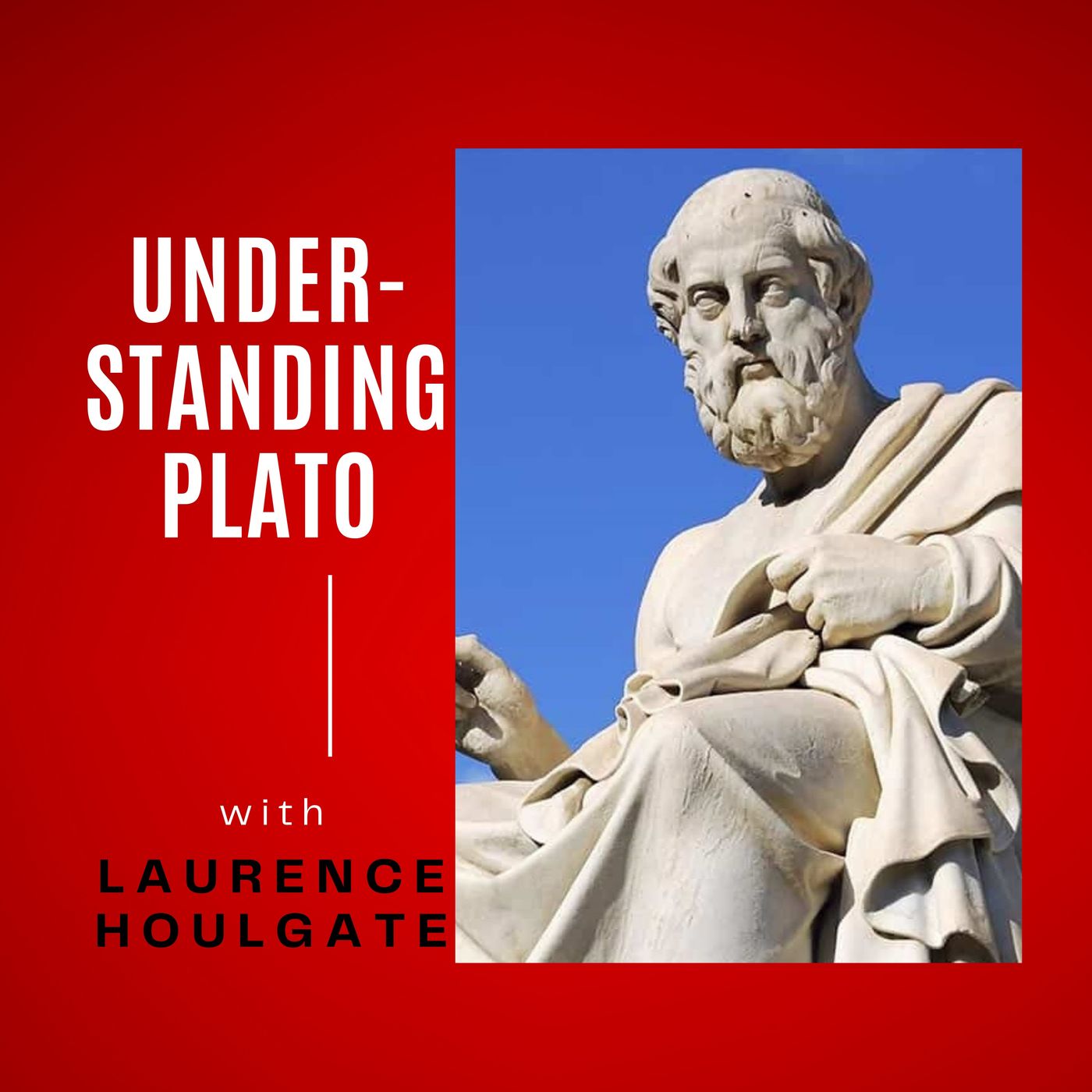
Understanding Plato
by Laurence Houlgate
Do you need help understanding the great books of philosophy? In his podcasts, Professor Laurence Houlgate reads and discusses the classic works of Plato, Thomas Hobbes, Rene Descartes, John Locke, Immanuel Kant, Jean-Jacques Rousseau, John Stuart Mill, and David Hume. His short readings are based on his acclaimed Smart Student's Guides to Philosophical Classics series (learn more at www.houlgatebooks.com). The episodes begin with the dialogues of Plato and will continue week by week through each chapter of Understanding Plato. For those who want to read along, a digital or print copy of the book can be purchased at Amazon.com at this address: https://www.amazon.com/dp/B01I5GAIJI New episodes will usually be broadcast weekly on Monday evening at 5 p.m. PST.
Episodes
-
Republic Book IX EP 22 (Final Episode) Tyranny and the Tyrannical Soul
We have come to the end of Plato's Republic and the end of the podcast. In the final episode, Socrates satisfies Glaucon's challenge to show that a just state is always preferable to an unjust state and being a just person is always better than being unjust. He has previously described the just…
more -
Republic Bk VIII & IX EP 21 Defective Constitutions and Damaged Souls
Plato extends his analogy between the constitution of the city-state and the soul of the individual by presenting a theory about how the constitutions slowly devolve from the ideal (kingship or aristocracy) to the most imperfect (tyranny) and how this is mirrored by the slow degradation of the soul.
-
Republic Book VII EP 20 Allegory of the Cave
Plato's Allegory of the Cave is one of the most famous thought experiments in the history of Western philosophy. An allegory is "a story, poem, or picture that can be interpreted to reveal a hidden meaning, typically a moral or political one" (Oxford). The question asked by Plato scholars and...
-
Republic Bk VI, VII EP 19 Analogy of the Sun
Socrates tells Glaucon that philosophers should be kings because only they have access to the Form (concept) of the Good. The concept of Justice cannot be understood unless one understands its relationship with the Form of the Good. In order to explain this relationship, Socrates turns to an...
-
Republic Bk.VI EP 18 Only Philosophers Should be Kings
This episode begin with Socrates' astounding claim that "only philosophers should be kings." However, he soon qualifies this with the remark that he does not mean philosopher in name only. He means philosophers who have a specific kind of knowledge that he calls "knowledge of the form Good." The...
-
Republic Book V EP 17 Women, Marriage and Children in the Ruling Class
Socrates argues in defense of his recommendation that women can and should be rulers in the ideal state. His argument is that there is nothing relevant about women that would prevent them from ruling. Second, he says that male and female rulers should be prevented from marrying or having a...
-
Republic Book IV (cont.) EP 16 Humunculi, Self-Control and Injustice
This episode is a discussion of the concluding paragraphs of Republic, Book IV. It is about the question "Why do we need a theory to explain self-control?" Socrates would answer this by saying "Because we need to show how one and the same person can control his or her appetites or emotions."...
-
Republic Bk. IV (cont.) EP 15 The Theory of Parts of the Soul and the Humunculus Problem
If Socrates is to convince Glaucon that justice and injustice in the soul is like justice and injustice in the city-state, then he must prove that there are parts of the soul analogous to the three classes of the city-state. Socrates believes he can do this by using the Principle of Opposites.…
more -
Republic Book IV EP 14 The Advantages of Justice in City and Soul
Socrates takes the first steps toward discovering the meaning of justice in the city-state and the place in the city where it is most likely to be found. He puts forward two analogical arguments to prove that justice is found in the city only when there is an agreement between all classes of the...
-
Republic Book II EP13 Glaucon's Challenge
Glaucon asks Socrates if he can provide a defense of justice (right conduct) that will show not only that justice is good for the sake of its consequences but it is good in and of itself. In one of the most famous parts of Book II, Glaucon presents the myth of Gyges ring -- the ring of...
-
Republic Bk. I (cont.) EP12 Is Injustice More Profitable than Justice
In the second part of Republic, Book 1, Socrates agrees with Thrasymachus that in the precise sense of the word "ruler," a ruler never makes mistakes. But he points out that in the precise sense, a ruler also rules for the benefit of others not for his own benefit. The argument shifts to the...
-
Republic Book 1 EP11 What is Justice?
It is in Book 1 of Plato's dialogue Republic that political philosophy begins. The character Socrates begins by asking a pivotal question "What is justice?" He receives and disposes of two weak definitions but is quickly confronted by Thrasymachus who ties the concept of justice to whatever is to...
-
Phaedo EP10 The Death of Socrates
This episode is about the death of Socrates. The reading is from the last pages of Phaedo, the final book in the Socratic dialogues, without commentary by the reader. The interlocutor is Phaedo, a friend of Socrates who is telling another man who was not there that day what Socrates said to his...
-
Meno (cont.) EP 9 Learning as Recollection
Socrates believes he has solved Meno's Paradox by denying that a person can never know that they have found what they are inquiring about. Socrates theorizes that if inquiring about what one does not know is a process of recollecting what one has already learned, then it is possible to inquire...
-
Meno EP8 Meno's Paradox
Meno suggests that there will never be a solution to the question "What is virtue?" because one either knows what virtue is or one does not know this. If one knows what virtue is, then there is no point in raising the question. If one does not know what virtue is, then one will not know whether…
more -
Meno EP7 On Virtue
The scene of this episode is a discussion between Socrates and a young aristocrat named Meno. The first part of the discussion is not unlike an earlier discussion between Socrates and Euthyphro. Socrates wants a clear definition of an important concept, although, in Meno, the concept is "virtue,"...
-
Crito (cont.) EP6 Moral Realism
This 4 minute episode has a short summary of the previous episode, emphasizing Socrates' passionate claim that the duty to obey the law is always superior to individual desires. But this still leaves the listener or reader with questions about "moral knowledge." Is there such a thing as objective...
-
Crito, The Duty to Obey the Law EP5
Crito is the title of the third dialogue in Plato's series of Socratic dialogues about the events before and after Socrates' execution. In this dialogue, the character Crito attempts to convince Socrates that he should escape from jail. Socrates rejects all of Crito's arguments and puts forth two...
-
Apology (cont.) EP4
This episode is about the final speech of Socrates at his trial after he has been convicted and sentenced to death. He tells the jury that no one should fear death (because to fear death falsely implies that one knows what happens after death). Socrates also argues that it is not he but they (the...
-
Apology. EP3. The Trial of Socrates
Reading from chapter 3 of his book Understanding Plato, Professor Laurence Houlgate explains how Plato's dialogue Apology is best understood by breaking it down into four parts. Each part is discussed in detail, showing how some of Socrates' defenses are inductive and others are deductive, each...
-
Euthyphro EP2 On philosophy and science
Continuing the discussion of Plato's dialogue Euthyphro, emphasizing the implicit distinction Plato makes between philosophy and science. Listeners are invited to follow the discussion in chapter 2 of Laurence Houlgate's book Understanding Plato (go to www.houlgatebooks.com).
-
Euthyphro EP1
In Episode 1, Laurence Houlgate, author of Understanding Plato, shows how the character Socrates uses the "elenchus" method to refute the character Euthyphro's four definitions of the idea of piety. The elenchus is one of the early attempts to move philosophy away from unsupported guesses about…
more
About this show
Do you need help understanding the great books of philosophy? In his podcasts, Professor Laurence Houlgate reads and discusses the classic works of Plato, Thomas Hobbes, Rene Descartes, John Locke, Immanuel Kant, Jean-Jacques Rousseau, John Stuart Mill, and David Hume. His short readings are based on his acclaimed Smart Student's Guides to Philosophical Classics series (learn more at www.houlgatebooks.com). The episodes begin with the dialogues of Plato and will continue week by week through each chapter of Understanding Plato. For those who want to read along, a digital or print copy of the book can be purchased at Amazon.com at this address: https://www.amazon.com/dp/B01I5GAIJI New episodes will usually be broadcast weekly on Monday evening at 5 p.m. PST.
Hosted by
Laurence Houlgate
Categories