
PODCAST · society
Unmarked Exits
by Oliver Ashford
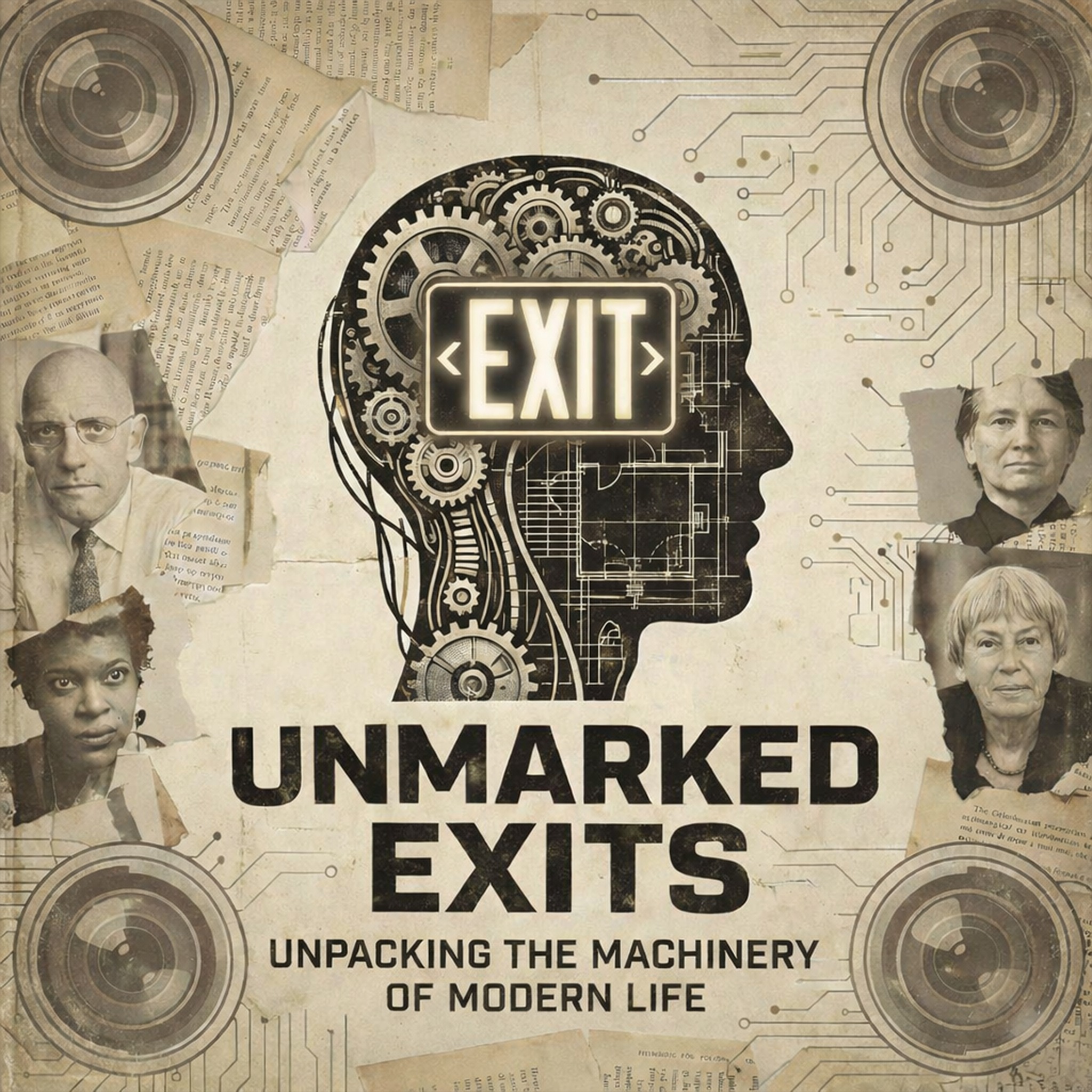
The ideas that shape how you think, work, and consume weren't accidents. They were designed.Each episode unpacks one essential text from critical theory, philosophy, fiction, and media studies that reveals how power really operates. No jargon. No academic gatekeeping. Just genuine inquiry into the forces shaping modern life.We're exploring thinkers like Guy Debord, Michel Foucault, Naomi Klein, and Mark Fisher alongside fiction from Ursula K. Le Guin, Kurt Vonnegut, and Octavia Butler. Some of these works are decades old. All of them feel uncomfortably relevant.This isn't about telling you what to think. It's about examining the machinery behind what you already believe, and finding the exits nobody marked for you.New episodes weekly.
-
14
S02 E25: The Image: Pseudo-Events and the Menace of Unreality
What's the difference between a news event and a pseudo-event? A news event happens. A pseudo-event is staged to be reported.In this episode, we explore Boorstin's 1962 study of how American life became increasingly dominated by manufactured reality. Press conferences, celebrity culture, tourist attractions, political campaigns: all designed not to be experiences but to be images of experiences.Boorstin wasn't a radical. He was a librarian and cultural historian. But he saw something happening to American culture: we were losing the ability to distinguish between the real and the fabricated.He called it "the menace of unreality." Sixty years later, we're fluent in unreality.Source: "The Image: A Guide to Pseudo-Events in America" by Daniel J. Boorstin (1962)
-
13
S02 E24: Mythologies: Decoding the Hidden Meanings of Everyday Life
A wrestling match is fake, and everyone knows it. So why do people watch? Because it's not about athletic competition. It's about the spectacle of justice, performed in exaggerated bodies.In this episode, we explore Barthes' collection of short essays decoding French popular culture: wrestling, steak and chips, soap advertisements, plastic, the face of Greta Garbo. Each essay peels back the obvious meaning to reveal the myth beneath.Myth, for Barthes, is how culture naturalizes history. It makes the constructed seem inevitable. It makes ideology invisible by making it common sense.The specific examples are dated. The method is timeless.Source: "Mythologies" by Roland Barthes (1957)
-
12
S02 E23: No Logo: Brands, Sweatshops, and the Colonization of Public Space
There was a time when companies made products. Then they discovered it was more profitable to make brands. Products can be manufactured anywhere. Brands are pure image.In this episode, we explore Naomi Klein's landmark study of how corporations colonized public space, culture, and identity itself. Nike doesn't sell shoes. It sells the idea of athletic transcendence. Starbucks doesn't sell coffee. It sells the experience of sophisticated community.Klein documented sweatshops, school commercialization, and the gutting of manufacturing. But her deeper argument is about how branding turned citizens into consumers and public life into a marketplace.Published in 1999, on the eve of the anti-globalization movement. History didn't go the way protesters hoped.Source: "No Logo: Taking Aim at the Brand Bullies" by Naomi Klein (1999)
-
11
S02 E22: The Work of Art in the Age of Mechanical Reproduction: Aura and Its Dissolution
What makes an original artwork special? Something Benjamin called "aura": its unique presence in time and space, its unrepeatable existence. But what happens when perfect copies become possible?In this episode, we explore Benjamin's famous essay on how photography and film changed art forever. Reproduction destroys aura, but it also democratizes access. Art leaves the realm of ritual and enters politics.Benjamin, writing in 1935, saw both promise and danger. Fascism aestheticizes politics, makes spectacles of rallies and war. The left must respond by politicizing aesthetics.He died fleeing the Nazis in 1940. His questions about images and power didn't die with him.Source: "The Work of Art in the Age of Mechanical Reproduction" by Walter Benjamin (1935)
-
10
S02 E21: Amusing Ourselves to Death: Public Discourse in the Age of Show Business
Orwell feared the banning of books. Huxley feared there would be no reason to ban them. Postman argues Huxley was right.In this episode, we explore how television changed not just what we think about, but how we think. Postman's argument isn't that TV shows bad content. It's that television as a medium is structurally incapable of supporting serious discourse. Everything becomes entertainment: news, politics, education, religion.Written in 1985, before the internet, before social media, before smartphones. Postman worried about what television was doing to attention spans and public discourse.He hadn't seen anything yet.Source: "Amusing Ourselves to Death: Public Discourse in the Age of Show Business" by Neil Postman (1985)
-
9
S02 E21: Amusing Ourselves to Death: Public Discourse in the Age of Show Business
Orwell feared the banning of books. Huxley feared there would be no reason to ban them. Postman argues Huxley was right.In this episode, we explore how television changed not just what we think about, but how we think. Postman's argument isn't that TV shows bad content. It's that television as a medium is structurally incapable of supporting serious discourse. Everything becomes entertainment: news, politics, education, religion.Written in 1985, before the internet, before social media, before smartphones. Postman worried about what television was doing to attention spans and public discourse.He hadn't seen anything yet.Source: "Amusing Ourselves to Death: Public Discourse in the Age of Show Business" by Neil Postman (1985)
-
8
S02 E20: Understanding Media: The Extensions of Man and the Reshaping of Thought
"The medium is the message." You've heard the phrase. But what does it actually mean?In this episode, we explore McLuhan's provocative, chaotic, often contradictory masterwork. His argument: we focus too much on what media contain and miss how they reshape us. Television didn't just broadcast new content. It rewired how people think, feel, and relate.McLuhan saw the internet coming. He called it the "global village." He saw how electronic media would retribalize humanity while simultaneously isolating individuals.He was a Catholic conservative who became a countercultural icon. He was celebrated and dismissed, often by the same people. Fifty years later, we're still catching up.Source: "Understanding Media: The Extensions of Man" by Marshall McLuhan (1964)
-
7
S02 E19: Ways of Seeing: The Politics of the Visual and the Male Gaze
Before you can critique what images show, you have to understand how seeing works. And seeing is never neutral.In this episode, we explore John Berger's revolutionary series of essays, originally a BBC programme, that changed how we think about art, advertising, and visual culture. Berger shows how oil painting served property relations, how publicity images manipulate our sense of lack, and how men look at women differently than women look at themselves.It's short, clear, and illustrated. Berger believed criticism should be accessible. He practiced what he preached.The question he keeps returning to: who benefits from the way we've been taught to see?Source: "Ways of Seeing" by John Berger (1972)
We're indexing this podcast's transcripts for the first time — this can take a minute or two. We'll show results as soon as they're ready.
No matches for "" in this podcast's transcripts.
No topics indexed yet for this podcast.
Loading reviews...
ABOUT THIS SHOW
The ideas that shape how you think, work, and consume weren't accidents. They were designed.Each episode unpacks one essential text from critical theory, philosophy, fiction, and media studies that reveals how power really operates. No jargon. No academic gatekeeping. Just genuine inquiry into the forces shaping modern life.We're exploring thinkers like Guy Debord, Michel Foucault, Naomi Klein, and Mark Fisher alongside fiction from Ursula K. Le Guin, Kurt Vonnegut, and Octavia Butler. Some of these works are decades old. All of them feel uncomfortably relevant.This isn't about telling you what to think. It's about examining the machinery behind what you already believe, and finding the exits nobody marked for you.New episodes weekly.
HOSTED BY
Oliver Ashford
Loading similar podcasts...
Frequently Asked Questions
How many episodes does Unmarked Exits have?
Unmarked Exits currently has 8 episodes available on PodParley. New episodes are automatically indexed when they're published to the podcast feed.
What is Unmarked Exits about?
The ideas that shape how you think, work, and consume weren't accidents. They were designed.Each episode unpacks one essential text from critical theory, philosophy, fiction, and media studies that reveals how power really operates. No jargon. No academic gatekeeping. Just genuine inquiry into the...
How often does Unmarked Exits release new episodes?
Unmarked Exits has 8 episodes. Check the episode list to see recent publication dates and frequency.
Where can I listen to Unmarked Exits?
You can listen to Unmarked Exits on PodParley by clicking any episode. We provide an embedded audio player for direct listening, and you can also subscribe via your preferred podcast app using the RSS feed.
Who hosts Unmarked Exits?
Unmarked Exits is created and hosted by Oliver Ashford.
URL copied to clipboard!