
PODCAST · arts
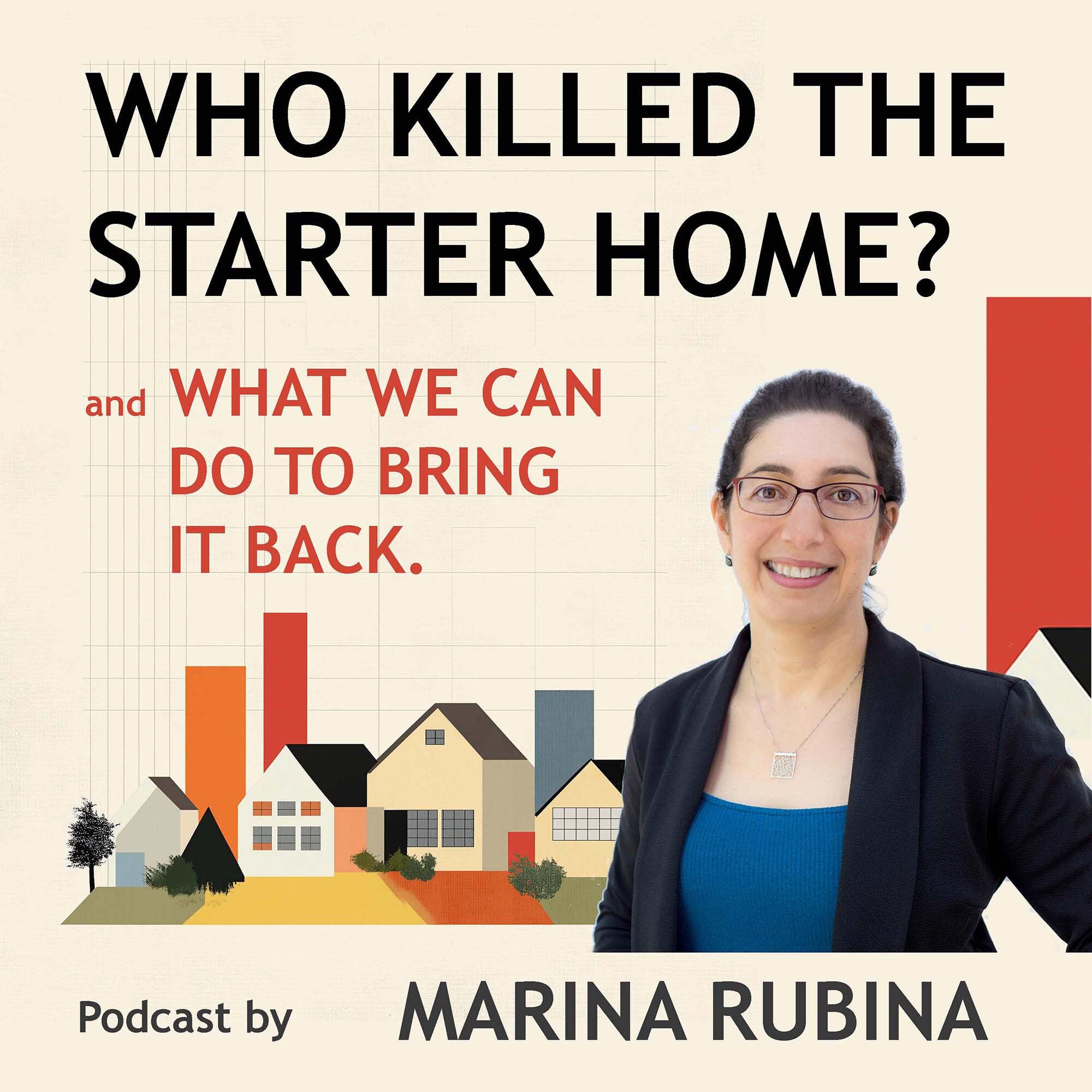
Who Killed the Starter Home?
by Marina Rubina
Have you seen any starter homes for sale lately? Neither have we. In this podcast, we speak with experts and try to figure out why this humble first home is going extinct. We’ll be exploring if it is the politicians, wielding zoning laws like a murder weapon who killed the starter home? Or maybe the scaredy-cat planners and designers? Or the developers, armed with cookie-cutter plans and corporate indifference? Is it our convoluted tax policy that subsidies homeownership, but puts every tax penalty in the way of creation of the starter homes.Spoiler alert: it’s probably a little of everything.We’ll be peeling back the layers of bureaucracy, bad faith, and bad planning, with stops along the way for affordable housing scandals, ADU success stories, and a passionate plea for building code updates. Join us for a conversation that’s part policy deep-dive, part therapy session for frustrated builders, and entirely a love letter to cities that deserve better.
-
69
The YIMBY Recipe: Clarity and Carrots. Conversation with Jack Farrell
You have probably heard of the "Yes In My Back Yard" movement, but you may be less familiar with YIMBY Law — a nonprofit organization that helps research policy solutions, offer legal support, and streamline the arbitrary and delaying tactics stalling new home construction. In this episode, research attorney with YIMBY law, Jack Farrell joins us to describe the housing doctrines in New Jersey, Pennsylvania, and New York. He discusses why simply making "local housing plans" is great in theory, but often fails in practice without clear, enforceable rules. From California's Permit Streamlining Act to battles over home rule in Colorado, Jack walks us through how enforcing clear standards and timelines along with smart incentives can bring predictability back to the housing approval process. Finally, Jack shares a sobering perspective from his early days as a public interest attorney: the direct, devastating link between housing scarcity and domestic violence. Here is the link to our YIMBY Law project support form: https://www.yimbylaw.org/submit-a-project Information for anyone interested in YIMBY Action chapters: https://yimbyaction.org/get-involved/what-is-a-chapter/
-
68
Claiming the Designer's Seat at the Developer's Table. Conversation with Christopher Calott
"Design is the easy part. I get to sit in my secret magic studio, come up with a great design, and draw it up. I can do that all day long. But getting that design to work with the budget, the zoning, the neighbors, and the construction—that’s the hard part." According to Christopher Calott, Chair and Program Founder of the Master of Real Estate Development + Design Program at UC Berkeley. In this episode, we discuss how designers can stop complaining from the sidelines and actually regain control of their vision by claiming their seat at the developer's table. When value engineering ruins a project, it’s because we aren't the ones making the final decisions. Chris breaks down the myth of the "greedy developer," the reality of managing financial risk, and how "building a return on design" can physically and socially elevate an entire neighborhood. We also tackle the harsh reality of the modern housing market: the burdensome "Drive to Value" that forces entry-level homebuyers to make a bargain with the devil just to secure a starter home.
-
67
Calibrating Caution and Unlocking Housing Choices. Conversation with Andrew Burleson
"If you try to keep anything from changing in the buildings, then what has to change is the people," shared Andrew Burleson, Board Chair of Strong Towns, as he walked me through the way out-of-proportion regulations that lead to our analysis-paralysis. Are we sure that a simple backyard cottage or a neighborhood triplex need to face a multi-year legal gridlock as if it's an airport or a nuclear power plant? In this episode, we dive deep into Denver’s promising new "Unlocking Housing Choices" initiative to see what a realistic blueprint for the missing middle could look like. With Andrew's unique background spanning architecture, urban planning, and tech, we also explore a wild but practical idea: could an interactive game help towns and residents get more comfortable with local choices and trade-offs?
-
66
The Data is In: Inclusionary Zoning is Killing Starter Homes. Conversation with Jason Sorens
As someone who advocates for affordable housing, I am having a hard time processing this data—but it is officially in, and it’s a massive reality check. Economist Jason Sorens has done extensive modeling on New Jersey’s housing landscape and found that Mount Laurel and inclusionary zoning mandates have had a 0% net impact on increasing overall housing supply or lowering housing costs. While the policy successfully produces a small number of deed-restricted units, it also creates an overwhelming lottery system and a devastating consequence for the middle of the market. When developers have to cross-subsidize the below-market units, the middle is financially impossible. The only projects that survive the math are either hyper-luxury developments with a small inclusionary component or projects that are in some form publicly funded. So, what do we do next? In this episode, we dive into solutions for moving past ineffective mandates to unlock naturally occurring, truly affordable home development. Reduced minimum lot sizes for starter home subdivisions, legalized "by-right" infill density, pre-approved architectural plans, private inspections, and eliminated parking minimums are all being tested successfully around the country. It’s time to talk about how these diverse typologies can count toward the noble goal of creating realistic opportunities to build homes for the lower and middle-income strata of our communities.
-
65
Dating like an Architect: Will You Design a House with Me? Conversation with Orange Made Architecture
When Erick and Carolina were recent architecture grads navigating a long-distance relationship between Houston and McAllen, Texas, Erick dropped a question that would completely rewrite their futures: "Will You Design a House with Me?" While standard relationship advice warns against co-managing massive financial and design projects, this single speculative starter home on Orange Avenue became the literal blueprint for their marriage, their family, and their entire business. Today, as the founders of the 10-person firm Orange Made Architecture, Erick and Carolina join the podcast to reflect on how a modest starter home didn't just launch their careers—it ignited a modern design movement and catalyzed a profound community transformation in their Rio Grande Valley town.
-
64
Why is Post-Disaster Money the Only Tool That Works? Conversation with Randi Moore
Our latest episode was recorded live at the NJ Planning and Redevelopment Conference with Randi Moore, CEO of the Affordable Housing Alliance. We dove into a frustrating paradox: under normal circumstances the standard funding, rigid compliance rules, and hyper-fragmented municipal zoning completely freeze the pipeline for modest starter homes. But when a catastrophe strikes—like Hurricane Sandy—emergency recovery funds with more flexible rules suddenly act as a regulatory bypass cutting through the red tape. Featuring plenty of audience participation that we tried our best to include in the recording, we brainstormed how to bring forward-thinking, resilient, and community-centered housing to our neighborhoods today—without waiting for disaster funding
-
63
Housing Boards:The Helpful, the Unhelpful, and the fun!
If we "just fix zoning" all our housing problems will be solved, right? Not exactly. In this episode, Professional Planner Gabby Hart joins us from Colorado to share her experience working with municipalities on master plans and zoning regulations. She explains the unexpected friction between the public process and private restrictions and how sometimes it’s deed restrictions and private covenants that kill starter homes. Another surprise could be to planners that steering committees could be helpful resources for local knowledge. And not at all surprising, but important, is the role of fun! Zoning Bingo, games, and kids change how we speak about regulations in creative and accessible ways. Fun helps us bring people together instead of driving us apart. If you had a choice, what board would you like to be on? The helpful, the unhelpful, or the fun? We would like to hear what you think about this conversation or if you have any ideas for how to bring the starter homes back from the brink of extinction, send us a note at [email protected]
-
62
Stitching the Sprawl: Reclaiming Our Streets. Conversation with John Surico
Potholes need fixing: no argument there! But while the "universal pothole consensus" keeps our eyes glued to the asphalt, it can make us miss the grander, more exciting evolution waiting to happen in our towns. In this episode, urban journalist and researcher John Surico (https://www.johnsurico.com/) challenges us to look way beyond basic maintenance. He shares his firsthand experiences bringing beautiful, community-grown temporary public spaces to life right in his own neighborhood. These grassroots pop-ups do something amazing: they shift our thinking from treating roads merely as conduits for cars to seeing them as vibrant, human-scale places. I’m also incredibly inspired by John’s take on the rapid emergence of a whole new generation of personal vehicles—from pedal-assist bikes to what are effectively unregulated motorcycles. He suggests that rather than lazily lumping them in with either traditional bikes or cars, we should embrace a more nuanced approach. By rethinking these vehicles, we can expand our shared mobility and connect our communities in entirely new, accessible ways.
-
61
You Can’t Afford NOT Having Community Engagement. Conversation with Merilee Meacock
Developers are often terrified of community engagement because they cannot control it. But in a world where projects face years of gridlock, should we admit that it is far riskier financially and socially to skip it? In this week's podcast, I spoke with architect and urban planner Merilee Meacock, partner at KSS Architects, about her experience working alongside visionary developers, planners, and organizations to create transformational projects that truly work. These developments are deeply connected to their places—not just physically through pathways, transit, and active storefronts, but socially, by meeting local needs and expressing the true character of the neighborhood. I loved learning how schools, museums, and film studios can serve as financially viable anchor tenants when they align with what is already needed and happening on the ground. Pair those with a grocery store and a savvy use of public subsidies, and you have a recipe for lasting community success.
-
60
A Tangled Mess of Rules: Is the time right for reform? Conversation with Silvia Del Fava
In this week's podcast, I spoke with urban planner Silvia Del Fava, who shares findings from her extensive research in New York State. They interviewed municipal officials, land use professionals, engineers, and developers to understand what is contributing to our current housing gridlock. Similar stories of technical, unpredictable, and unexplainable regulations that vary wildly across 1,600 different municipalities kept coming up. This fragmentation creates a compounding nightmare of repetitive local boards and 50-year-old environmental laws that stall even the simplest housing projects for years. The technical complexity and political layers of this broken system have pushed construction costs to a breaking point, effectively killing the starter home. But with mounting frustration from residents whose children can no longer afford to live in their own neighborhoods, a critical threshold of momentum is finally building. With the governor's office eyeing administrative reforms, is this widespread frustration enough to finally bring about systemic change?
-
59
What if the Housing Crisis is Intentional? Conversation with Ricardo Flores
In this episode, I spoke with Ricardo Flores, Executive Director of the nonprofit Local Initiatives Support Corporation (LISC San Diego), where he oversees financing affordable housing and investing in underserved neighborhoods in San Diego CA. Ricardo brings a rare perspective that combines politics, government policy, and finance — and he shares some uncomfortable truths: many of the barriers that make housing expensive and scarce are not accidents or laws of nature. They were designed that way. LISC commissioned research exploring which policies could bring prices down enough for people to be able to afford homes again— and what the tax implications of those changes would be. This conversation gets into the real mechanics behind housing affordability, why reform feels so politically difficult, and how to have honest conversations about density with people who are afraid of it.
-
58
Marrying Activism and Finance to Uplift the "Worst Off". Conversation with Mike Anderson
This week, our guest is Mike Anderson. Mike describes himself as a "proud survivor of the working poor". He shares the traumatic journey of growing up in subsidized housing in Plainfield during the "crack era" and the loss of his father, who was killed when Mike was only five. Thanks to the efforts and support of Mike’s mom—a union leader who showed him the power of organizing —he was able to navigate the path to a Harvard education, leadership, and the world of high finance. Mike is now utilizing his "Culture times Capital" formula to bridge the gap between activism and finance. He discusses his experience litigating civil rights cases against trillion-dollar corporations and his mission to ensure that your zip code doesn't define your destiny. Can the tools of high finance be used to liberate the marginalized, or is the system designed to keep them out? Please note that the views expressed by the candidate are his own and do not necessarily reflect the opinions of this podcast. Given the nature of these long-form interviews, we cannot independently fact-check every claim made during the conversation. We encourage listeners to research the candidates and issues further as we approach the primary.
-
57
Is Technology the Silver Bullet? Conversation with Sujit Singh
Sujit Singh hopes to bring his 30-year experience in technology consulting to Congress. He outlines a vision for leveraging robotics, AI, and space-based solar energy to reduce the cost of housing and public transit. Mr. Singh shared his story of running for mayor in our neighboring town of West Windsor and developing his "Space, Lean, Innovation" model. He proposes that technological solutions can help overcome local regulatory hurdles and lower costs by as much as 50%. Can innovation bypass traditional gridlock, or are some problems too grounded for a digital-first solution?
We're indexing this podcast's transcripts for the first time — this can take a minute or two. We'll show results as soon as they're ready.
No matches for "" in this podcast's transcripts.
No topics indexed yet for this podcast.
Loading reviews...
ABOUT THIS SHOW
Have you seen any starter homes for sale lately? Neither have we. In this podcast, we speak with experts and try to figure out why this humble first home is going extinct. We’ll be exploring if it is the politicians, wielding zoning laws like a murder weapon who killed the starter home? Or maybe the scaredy-cat planners and designers? Or the developers, armed with cookie-cutter plans and corporate indifference? Is it our convoluted tax policy that subsidies homeownership, but puts every tax penalty in the way of creation of the starter homes.Spoiler alert: it’s probably a little of everything.We’ll be peeling back the layers of bureaucracy, bad faith, and bad planning, with stops along the way for affordable housing scandals, ADU success stories, and a passionate plea for building code updates. Join us for a conversation that’s part policy deep-dive, part therapy session for frustrated builders, and entirely a love letter to cities that deserve better.
HOSTED BY
Marina Rubina
Loading similar podcasts...
Frequently Asked Questions
How many episodes does Who Killed the Starter Home? have?
Who Killed the Starter Home? currently has 13 episodes available on PodParley. New episodes are automatically indexed when they're published to the podcast feed.
What is Who Killed the Starter Home? about?
Have you seen any starter homes for sale lately? Neither have we. In this podcast, we speak with experts and try to figure out why this humble first home is going extinct. We’ll be exploring if it is the politicians, wielding zoning laws like a murder weapon who killed the starter home? Or maybe...
How often does Who Killed the Starter Home? release new episodes?
Who Killed the Starter Home? has 13 episodes. Check the episode list to see recent publication dates and frequency.
Where can I listen to Who Killed the Starter Home??
You can listen to Who Killed the Starter Home? on PodParley by clicking any episode. We provide an embedded audio player for direct listening, and you can also subscribe via your preferred podcast app using the RSS feed.
Who hosts Who Killed the Starter Home??
Who Killed the Starter Home? is created and hosted by Marina Rubina.
URL copied to clipboard!