
PODCAST · religion
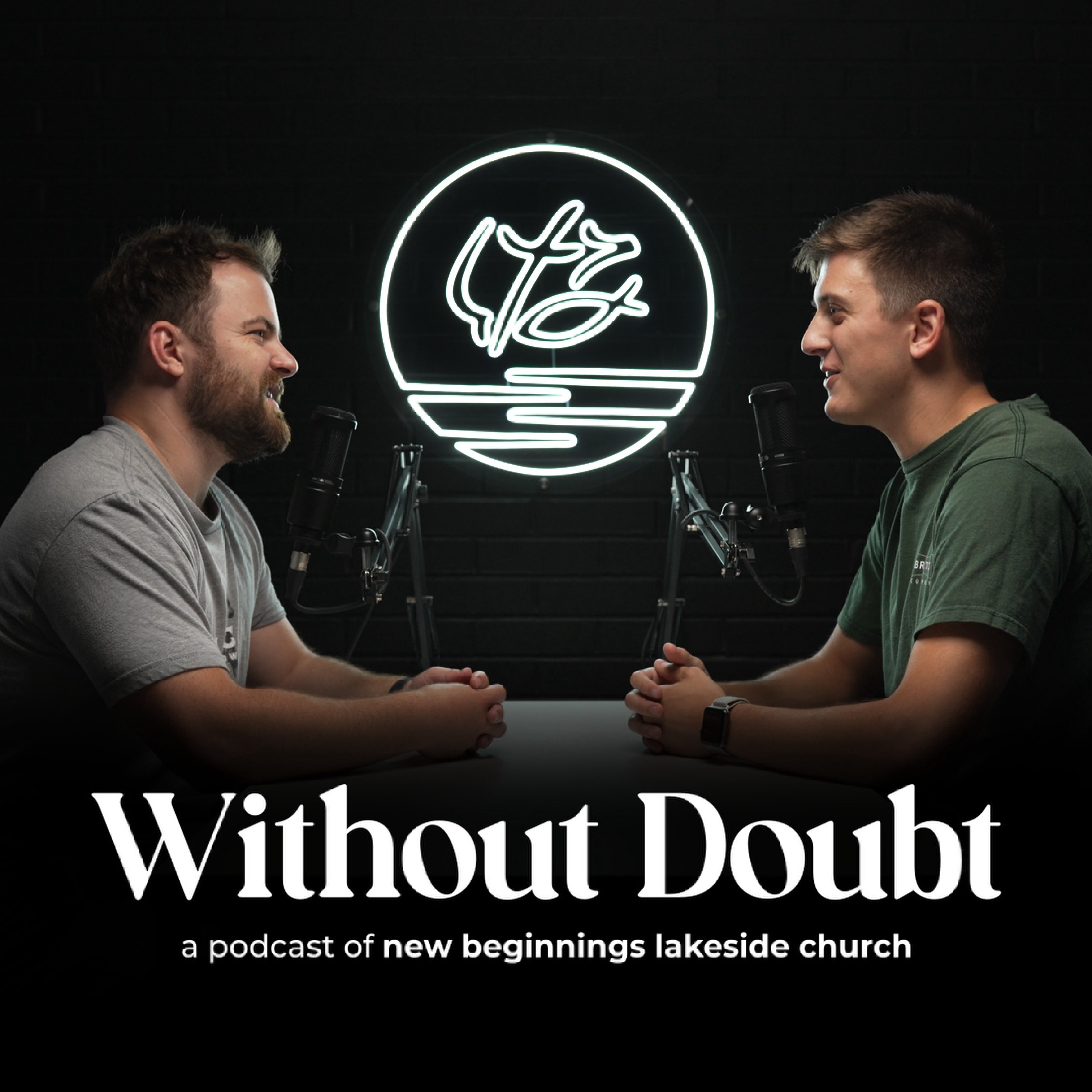
Without Doubt
by David Horner & Nathan Crowe
In this podcast, Pastor David Horner and Nathan Crowe explore hard questions submitted by real life people relating to faith, doubt, apologetics, and theology. Join us and move closer to being Without Doubt. A podcast by New Beginnings Lakeside Church.
-
46
How should Christians react to the election?
It's November and the 2024 Presidential election is now in the rearview mirror. Donald Trump won the White House, with Republicans also taking a majority in the Senate and possibly keeping a majority in the House. What can Christians learn from this election cycle? How should they respond to this new administration? What are the implications for the pro-life movement? What do we do now? David and Nathan have a conversation about these things and more in an effort to help Christians think biblically about the political landscape.Time stamps:0:00 Introduction1:22 What should shape our view of politics?7:47 God sits sovereignly enthroned over every election12:38 How should we react to Trump winning the election?15:15 What does this election mean for free speech/censorship of the Gospel?18:22 What does this election mean for liberal gender ideologies?22:30 What does this election mean for abortion?35:45 Christians must pray40:35 Christians must prioritize the Gospel42:19 Christians must walk in wisdom toward outsiders
-
45
Was Melchizedek an Old Testament appearance of Christ?
In the book of Genesis, a mysterious figure named Melchizedek meets Abraham. He is called the king of righteousness and king of peace, he brings out bread and wine, he receives tithes from Abraham and blesses him, he has no recorded genealogy. Psalm 110 and Hebrews 7 speak of the significance of Melchizedek and how he relates to Christ. But is he more than that? Is Melchizedek an actual Old Testament appearance of Christ? In this episode, David and Nathan discuss Melchizedek and have a good-spirited debate about whether or not he is an actual Old Testament appearance of Christ.Time stamps:0:00 Introduction0:52 Who is Melchizedek?1:03 Melchizedek in Genesis 142:44 Melchizedek in Psalm 1105:14 Melchizedek in Hebrews 714:17 Debate: is Melchizedek a "type" of Christ or a Christophany?16:55 The case for Melchizedek as a Christophany22:06 The case for Melchizedek as a "type" of Christ28:39 Conclusion
-
44
Can you lose your salvation?
In today's episode, one listener asks a question about the rocky soil in Jesus's parable that received the word of God but then later fell away. Was this person ever truly saved? Can a saved person lose their salvation? David and Nathan consider these questions and related themes in this episode of the Without Doubt Podcast.Time stamps:0:00 Introduction0:41 Was the rocky soil person ever saved?3:04 Passages that prove you can't lose your salvation10:38 The nature of true saving faith (endurance)20:54 Does Hebrews 6:4-6 teach that you can lose your salvation?27:37 Could Judas have repented?
-
43
How can I get wisdom?
Proverbs 1 & 2 make it seem like wisdom is readily accessible while Ecclesiastes 7 makes it seem as though it's hard to find. In this episode, David and Nathan are joined by special guests Ross Geiser and Bryce Baker to discuss what wisdom is, where it can be found, and how we can get more if it in our lives.Time stamps:0:00 Introduction0:45 How can we live wisely?2:00 Examining Proverbs 1 & 26:34 What is wisdom and who defines it?8:04 Worldy wisdom vs. God’s wisdom15:22 What truly keeps us from gaining wisdom18:53 What is Ecclesiastes 7:23-24 teaching?23:47 Practical ways to gain wisdom
-
42
What about people who never hear the Gospel?
What about people who never hear the Gospel? What happens to them? Can a person be saved apart from belief in Jesus Christ and if not, is God really being just? In this episode of the podcast, special guests Ross Geiser and Bryce Baker join David and Nathan to have a roundtable discussion about this difficult topic.Timestamps:(0:00) Introductions(04:02) The questions behind the question(06:11) How natural revelation and conscience make a person accountable to God(22:18) Is there a way to be saved apart from hearing and believing the Gospel?(28:52) How Acts 10 & Cornelius reveal God's means of saving people(33:29) How the biblical answer to this question fuels world missions(45:09) Is God being just and fair?
-
41
How old is the earth? (with Simon Woodstock)
How old is the earth? This is a question that relates to the broader topics of creationism and evolution. In this episode, David and Nathan are joined by Simon Woodstock to discuss the young earth creationist view, to consider why the earth/universe may look older in some cases than it is, the effects of the Genesis flood, issues of hermeneutics, what Jesus and the apostles seemed to believe, and more.Time Stamps:0:00 Introduction with special guest Simon Woodstock1:44 What are the different views regarding the age of the earth?4:12 The basic case for a young earth Biblically and scientifically7:09 Should we read Genesis 1-11 allegorically?10:16 Why a plain reading of the Old and New Testament points to a young earth12:35 How this issue relates to the broader issue of our hermeneutics16:37 Seeing God as a Scientist, Chemist, and Artist18:17 Why Young Earth Creationism doesn’t have to be limited to 6,000 to 10,000 years28:10 Could the earth and universe look older than it is?34:16 Having humility when discussing these issues35:42 Discussing other views with grace and keeping God at the center of this discussion39:32 Science and theology go hand in hand40:53 How the paradigm shifted in modern thought to old earth views44:27 The Romans 5 argument against old earth46:30 Closing thoughts and doing your own research
-
40
Do all religions lead to God? (Reacting to Pope Francis)
Pope Francis recently made some concerning statements at an event in Singapore when he claimed, "All religions are paths to God." He made other claims as well that are disconcerting and in this video, David and Nathan open the Scriptures and react Biblically to the Pope.0:00 Intro02:19 Video of the Pope making his statements3:39 Initial Thoughts06:40 How are Catholics reacting to these statements?11:04 Responding to the Pope's statements line by line12:13 Are all religions paths to God?17:13 Are different religions like different languages that express the divine?18:28 Are all people including non-believers God's children?19:27 Can all religions be true at the same time?22:01 Looking at Catholic doctrine on other world religions from Vatican II26:24 Paul at the Areopagus in Acts 1729:42 Are we all just worshiping the same God?32:31 Concluding thoughts
-
39
How can I practically fulfill the Great Commission? (with Jim Rairick)
In Matthew 28:18 Jesus said to "Go therefore and make disciples of all nations..." For many Christians, this seems like an impossible task and something they can only do if they sell everything and move to another country. But what if the nations were coming to us? In this episode, Jim Rairick of Horizons International shares an exciting opportunity that Christians in the West have to engage in the Great Commission: International Student ministry. With over 1 million international students attending universities in our communities, the nations have come to our backyard, and we have an opportunity to reach them with the gospel.In this episode we discuss:0:00 Intro2:18 Who's coming to our backyard?5:24 Getting into the shoes of international students9:33 Does a new culture make international students more open to the Gospel?11:38 Why should a Christian take the Great Commission seriously?15:51 Allowing the Bible to shape our thinking19:17 Should all Christians be involved in missions and evangelism?24:41 How do I engage international students?34:40 Overcoming fear when sharing Christ36:00 How can I get involved in this kind of ministry?If you would like to watch the training sessions that Jim did at New Beginnings Lakeside Church, you can view those here:Session 1: https://www.youtube.com/watch?v=txTg3J6-gMgSession 2: https://www.youtube.com/watch?v=ZFIXrLBg-zkLearn more about Horizons International and get related resources at: https://www.horizonsinternational.org/
-
38
Do we truly have free will? (with Johnny Zacchio)
In this episode, David and Nathan welcome Pastor Johnny Zacchio on to discuss the question: do we really have free will? Within this there are many other questions such as: how do God's sovereignty and man's will interact? What do we mean by "free will"? Is God morally culpable for evil of he is sovereign over all things? And much more.(0:00) Introduction(2:03) Why is this a question worth discussing and why is there a debate?(8:00) Overview of the different view relating to God's sovereignty and free will(11:49) Defining what "free will" is(22:09) What is compatibalism?(39:05) Is God morally culpable for the evil in the world if he decrees all things?(46:56) Closing thoughtsCheck out Johnny's blog at https://www.johnnyzacchio.com/!Submit your anonymous questions at slido.com by using the code #WITHOUTDOUBT.
-
37
Season two is coming soon...
Nathan Crowe and Pastor David Horner are back to update you on what's next for the Without Doubt Podcast. Season two is on the way and we are excited to welcome more guests onto our podcast. Check out this quick update.
-
36
A Gen Z Bible translation, how Old Testament people were saved, and more...
In this lightning round episode, Pastor David and Nathan discuss several different questions including:1. (0:53) How were people saved in the Old Testament since Jesus hadn't died yet?2. (9:39) Why are there differences between different Bible translations?3. (19:30) What are your thoughts on the Gen Z Bible translation?4. (24:10) Which Bible translations are good, and are there bad ones?This will be our final episode of Season 1! After this week, we will take some to update our equipment, strategize for the future, and plan some new episodes. Thanks for supporting the podcast!
-
35
What is the blasphemy of the Holy Spirit?
In Mark 3:29 Jesus said, “...whoever blasphemes against the Holy Spirit never has forgiveness, but is guilty of an eternal sin." What is the blasphemy of the Holy Spirit? Is there really a sin that God will never forgive? Can a non-believer who commits this sin later repent and be forgiven? In this episode, Pastor David and Nathan take a look at these challenging words of Jesus to find out what they mean for our lives.
-
34
If the world will get worse in the end times, is there any hope for the gospel?
The Bible clearly teaches that as we draw closer to the return of Jesus Christ, the world will continue to get worse. So what hope do we have for the effectiveness of the gospel? If the gospel is going out, why won't the world be getting better? It is easy to become dejected, hopeless, and even scared when thinking about the end times. But the Bible tells us that we don't have to be, and gives us hope.
-
33
Is being Slain in the Spirit biblical?
Many people have a desire to experience the power of the Holy Spirit. But what does that look like? Many preachers and churches such as Benny Hinn, Kenneth Copeland, David Diga Hernandez, Bill Johnson, Bethel Church, and others practice "slaying in the Spirit", a phenomenon where a person is apparently so overcome by the Spirit that they fall over and even begin shaking, laughing, yelling, or incapacitated and unable to move. But is this practice something that we find in the Bible? Is this what it looks like to experience the power of the Holy Spirit?
-
32
The Daniel 9 prophecy that predicted the day Jesus would come
Are you looking for evidence that the Bible is true? This prophecy in Daniel 9 predicted the very day Jesus Christ would ride into Jerusalem and present Himself as the King of Israel over 500 years before it happened. Listen in as Pastor David and Nathan discuss Daniel's prophecy about "the seventy sevens", break down some of the math involved, and arrive at the conclusion that the Bible accurately predicts the future.If you want to hear Pastor David's sermon on Palm Sunday, check it out here.
-
31
Praying to saints, the death penalty, dating, and more (LIGHTNING ROUND!)
In this episode, Pastor David and Nathan discuss several different questions including:• Should we be asking saints to pray for us?• Should Christians support the death penalty?• How did different races and ethnicities come about?• How do you navigate heavy issues in Christian dating relationships as you consider marriage?
-
30
How can Christians reach LBGTQ+ people?
A false dichotomy has been presented to Christians: that they either have to accept the lifestyle of LGBTQ+ people (which is equated to love) or that if they don't, they hate the LGBTQ+ community. But is this true? Scripture shows us a better option. In this episode, Pastor David and Nathan examine the way that the apostle Paul reached LGBTQ+ people, the simple and effective message that some Christians have forgotten about, and the approach of "grace and truth" that characterized Jesus' ministry.
-
29
Is homosexuality wrong?
There are few topics in our culture today that garner more attention and controversy than the issue of homosexuality. Is it wrong? And if so, why is it wrong? What even is our basis for determining right and wrong? Pastor David and Nathan dive into some biblical passages that deal with the topic and discuss what the Bible has to say about homosexuality.
-
28
Does feminism have a place in Biblical Christianity? (Part 2)
Today we continue to answer the question: "How has feminism infiltrated the church? And does it have a place in biblical Christianity?" In this episode, we specifically look at second and third-wave feminism and evaluate what we find from a Biblical perspective. Many of the agenda items of these feminist movements had to do with liberating women from "oppresive power structures" and giving them sexual freedom. As it turns out, what many feminists thought would liberate women actually puts them in chains. Jess (David's wife) shares from her personal experience how true liberation is found in Christ. Confusion about the differences between the genders and what a woman even is also found its way into feminism. So what place does feminism have in Biblical Christianity today and how is it impacting the Church?
-
27
Does feminism have a place in Biblical Christianity? (Part 1)
Today we answer the question: "How has feminism infiltrated the church? And does it have a place in biblical Christianity?" In this episode, we specifically look at the beginnings of feminism and its first wave and evaluate what we find from a Biblical perspective. Feminism is a hard topic to deal with because the word itself represents different ideas to different people. As we examine the history of different feminist movements, we find some consistent themes and some surprising things. Certainly, some good things have come out of feminist movements, but along with the good have been many destructive and unbiblical ideas. So what place does feminism have in Biblical Christianity today and how is it impacting the Church?
-
26
What does "women should keep silent" mean in 1 Corinthians 14:34?
This is part 3 of a series answering the question: can women be pastors? In 1 Corinthians 14:34-35, Paul writes, "the women should keep silent in the churches. For they are not permitted to speak, but should be in submission, as the Law also says. If there is anything they desire to learn, let them ask their husbands at home. For it is shameful for a woman to speak in church." In this episode, we examine this difficult passage head on to discover what it means and apply it to our lives.
-
25
What does 1 Timothy 2:12 mean? "I do not permit a woman to teach or exercise authority over a man.."
This is part 2 of a series of episodes answering the question: can women be pastors? In this episode, Pastor David and Nathan along with special guest, Jessica Horner, look at 1 Timothy 2, focusing especially on verses 11:-15: "11 Let a woman learn quietly with all submissiveness. 12 I do not permit a woman to teach or to exercise authority over a man; rather, she is to remain quiet. 13 For Adam was formed first, then Eve; 14 and Adam was not deceived, but the woman was deceived and became a transgressor. 15 Yet she will be saved through childbearing—if they continue in faith and love and holiness, with self-control." (English Standard Version (Wheaton, IL: Crossway Bibles, 2016)).What does this mean? Can women be pastors/elders in the church? Can they teach in any capacity? Was this passage only relevant to a specific audience in a specific time period? Have complementarians failed to consider the historical context surrounding this passage? How does the book of Genesis inform our understanding? What does it mean that "she will be saved through childbearing"?We discuss all of these questions and more on this episode of Without Doubt.
-
24
Can Women Be Pastors?
This is part 1 in a 3-part series. This week we begin to tackle one of our most asked questions. It's probably not an understatement to say that this is one of the most hotly debated topics in current evangelical Christianity. In this first episode, Pastor David and Nathan Crowe are joined by Jessica Horner, to discuss the definitions of the two main views on this issue: egalitarianism and complementarianism. We hold to a complementarian viewpoint and explain what that means in the episode. Our discussion includes a survey of the incredible ways that God used women throughout the Scripture and an exhortation to Christian women to serve the Lord.
-
23
What is the evidence for the resurrection of Jesus? (Part 2)
Last week we examined 4 facts that the vast majority of Christian and skeptic scholars agree upon surrounding the events of Jesus' life: 1) Jesus of Nazareth was EXECUTED by crucifixion and buried in Joseph’s tomb2) Jesus’ tomb was found EMPTY three days later3) Some believed they had EYEWITNESS experiences of Jesus alive after his death.4) The EARLY TESTIMONY of Christians was belief in a resurrected JesusThe question is, how can we explain these facts? What theory or explanation can account for all of the pieces of this puzzle? Many theories have been offered throughout the ages but one stands above them all. In this episode, we finish Pastor David's sermon, "How Can We Explain the Empty Tomb?"
-
22
What is the evidence for the resurrection of Jesus? (Part 1)
How can we explain the empty tomb? We have to begin by examining the facts surrounding it. The vast majority of scholars, both skeptic and Christian, agree on 4 essential facts regarding the life and death of Jesus. Those 4 facts might surprise you – but understanding them will help us to piece together what actually happened on the Sunday morning after Jesus died. In this episode, we begin to look at a sermon that Pastor David recently preached about the resurrection called, "How Can We Explain The Empty Tomb?"
-
21
LIGHTNING ROUND! If God knows what will happen, what is the importance of prayer?
Today we are doing a lightning round on the podcast! That means that Nathan has picked a handful of questions that our listeners have asked and David will give his short, off-the-cuff answers to them. In this episode, we answer:• (0:55) Does a believer go straight to heaven when they die? If so, how does that all work out with the rapture and final resurrection?• (05:42) If God knows what will happen, what is the importance of prayer for healing, etc.?• (09:06) Is it wrong to be a climate activist or a vegan?• (13:57) What does the Bible say about tithing?• (17:13) What is the point of asking God for forgiveness if I know I'm probably going to commit the sin again in the future?
-
20
Why were some New Testament books disputed?
The process of recognizing the New Testament canon took some time. When it was originally written, the New Testament was not one compiled literary work but rather 27 different writings that circulated around the early church. As the church expanded, began dealing with false teachers and doctrines, and came under intense persecution, it became necessary to spell out the recognized limits of the New Testament canon. In the process, some books like Hebrews, James, or Revelation were disputed for a time but eventually recognized as canonical. Additionally, fraudulent books began to be written, claiming to be from one of the apostles or close associates of Jesus. Dan Brown popularized the idea in the DaVinci code that all of these writings had equal weight with the rest of the New Testament writings we have today, and that at the Council of Nicea in the 4th century, the church picked the books they liked and discarded the ones they didn't. David and Nathan discuss all the disputes and dispel the myths surrounding the New Testament in this episode.
-
19
What books belong in the New Testament?
In this episode, David and Nathan discuss the New Testament canon and how the person and work of Jesus necessitated that the New Testament be written. We delve into topics such as:• The role of apostles and how they were commissioned by Jesus to give us the New Testament• The qualifications of apostleship and why the canon of Scripture is now closed• Who wrote each New Testament book• The tests of canonicity as applied to the New Testament
-
18
Is the Apocrypha Scripture? (Part 2)
Roman Catholics include 7 additional books in their Bibles that Protestants reject as Scripture. Protestants call these books the "Apocrypha" (meaning "hidden") while Roman Catholics call them the "Deuterocanon" (meaning "second canon"). Should they be included in our Bibles or not? David and Nathan discuss several topics in part 2 including:• The Church Fathers• Jerome and the Vulgate• The Reformation• The Council of Trent• Concluding Thoughts
-
17
Is the Apocrypha Scripture? (Part 1)
Roman Catholics include 7 additional books in their Bibles that Protestants reject as Scripture. Protestants call these books the "Apocrypha" (meaning "hidden") while Roman Catholics call them the "Deuterocanon" (meaning "second canon"). Should they be included in our Bibles or not? David and Nathan discuss several topics in part 1 including:• Why it matters• The time the apocrypha was written and cessation of the prophets• The Septuagint• Jesus and the apostles' view of these booksPart 2 will include discussion on:• The Church Fathers• Jerome and the Vulgate• The Reformation• The Council of Trent• Concluding Thoughts
-
16
What books belong in the Old Testament?
How did the Old Testament canon develop? What did Jesus have to say about the Old Testament Scriptures? In this episode, David and Nathan discuss the development of the Old Testament canon, Jesus' view on the OT Scriptures, and some of the books that the Jews ultimately rejected from their Scriptures like the book of Enoch or the book of Jubilee. They also discuss how some books, like Esther or Song of Solomon, were disputed at one point but eventually gained full acceptance into the canon.
-
15
How do we know what books belong in the Bible?
How do we know what books belong in the Bible? This question deals with a topic called canonization. The word canon means, "a rule, a standard, or a measure." The books that we attribute divine authority to create the "rule" or "standard" of our lives and faith – therefore it is important to know we have the right ones! In this episode, we introduce the topic of canonization including:• Defining the term "canon"• The church's role in canonization (determining vs. discovering)• 5 tests of canonicity
-
14
How did we get the Bible in our language? (Part 3 of 3)
Do you realize that people gave their lives so that the Bible could be translated into English? We talk about translation and more in this episode, including:• Textual criticism• John Wycliffe• William Tyndale• King James Version• Which English Bible translation you should read
-
13
Is the Bible reliable? (Part 2 of 3)
Can we trust that the Bible was accurately transmitted down through the ages? In this episode we discuss the reliability of the Bible including:• The original autographs• Manuscript evidence• Dead Sea ScrollsThis is part 2 of our 3-part series on how we got our Bibles.
-
12
How did we get the Bible? (Part 1 of 3)
How did we get the Bible that we hold in our hands today? The process begins with the Divine Author – God, and the human authors. In this episode, we discuss some astounding facts about the Bible and explore what the doctrine of the Inspiration of Scripture means. This is part 1 of a 3-part series.
-
11
BONUS: Bible character fantasy football draft
We wanted to have a little bit of fun with this bonus episode. Nathan and David are both big NFL fans and with the NFL season starting this past week, we thought it would be fun to do a fantasy football draft, but with Bible characters. Ground rules: Each team needed a QB, RB, WR, TE, and DEF and all the members of Trinity were not available for drafting (because whoever drafted 2 out of 3 would auto-win). Hope you enjoy!
-
10
When did Satan fall from heaven?
Also in this episode:• What was Satan's sin?• How could temptation exist in the perfect garden of Eden?• How can we define what sin is?• Why does Satan keep trying if he knows he is going to lose?
-
9
Can a Christian be demon-possessed?
Also in this episode:• Was Judas a true believer?• How can demons and Satan affect Christians?• How should Christians respond to the attacks of Satan?
-
8
How can I share my faith with unbelievers?
Sharing your faith with unbelievers or confronting a lukewarm believer can feel intimidating. How can we do it in a way that is effective and not condemning?
-
7
What does the Bible say about tattoos and birth control?
How can Christians think Biblically about tattoos and birth control? In this episode, Pastor David and Nathan look at the relevant passages that often come up in these debates, how the new covenant affects our understanding of Old Testament laws, and how a Christian should view birth control.
-
6
How should I discover God's will? (Part 2)
In this episode, Pastor David and Nathan Crowe talk about 4 practical ways to discover God's will in your life: Direction from God's Word, Discernment from a sacrificed life, Desires from a God-loving heart, and Doors that God opens.
-
5
How should I discover God's will? (Part 1)
How can we discover God's will? Is it okay to ask God for signs or does that display a lack of faith in God? Pastor David and Nathan Crowe begin exploring this question in this episode.
-
4
Was Jesus' death a true sacrifice if God knew He would rise again?
If God knew that Jesus was going to rise from the dead three days after his crucfixion and then ascend back to heaven, was his death really a true sacrifice? Pastor David and Nathan talk through the nature of Jesus' sacrifice and why the favorable end outcome of resurrection and ascension does not diminish His sacrifice.
-
3
Is it OK to lie for a righteous cause?
Rahab lied to protect the lives of the Israelite spies...and then seems to be rewarded for it! Does this mean that it is ever okay to lie? We tackle this tough question on this episode of Without Doubt.
-
2
Why Do Bad Things Happen to Good People? (Part 2)
It's the age-old question: how could a good and all-powerful God allow suffering to exist? Why do good things happen to bad people? In this episode, Pastor David Horner and Nathan Crowe address the solution to the problem of suffering that we find in Jesus and His work on the cross – a solution that is illustrated in vivid color by the story of Lazarus.
-
1
Why Do Bad Things Happen to Good People? (Part 1)
It's the age-old question: how could a good and all-powerful God allow suffering to exist? Why do good things happen to bad people? In this episode, Pastor David Horner and Nathan Crowe begin to unpack some of the assumptions implicit in this question and give a biblical answer to it.
No matches for "" in this podcast's transcripts.
No topics indexed yet for this podcast.
Loading reviews...
ABOUT THIS SHOW
In this podcast, Pastor David Horner and Nathan Crowe explore hard questions submitted by real life people relating to faith, doubt, apologetics, and theology. Join us and move closer to being Without Doubt. A podcast by New Beginnings Lakeside Church.
HOSTED BY
David Horner & Nathan Crowe
CATEGORIES
Loading similar podcasts...
URL copied to clipboard!