
PODCAST · society
Women in Business
by Inception Point Ai
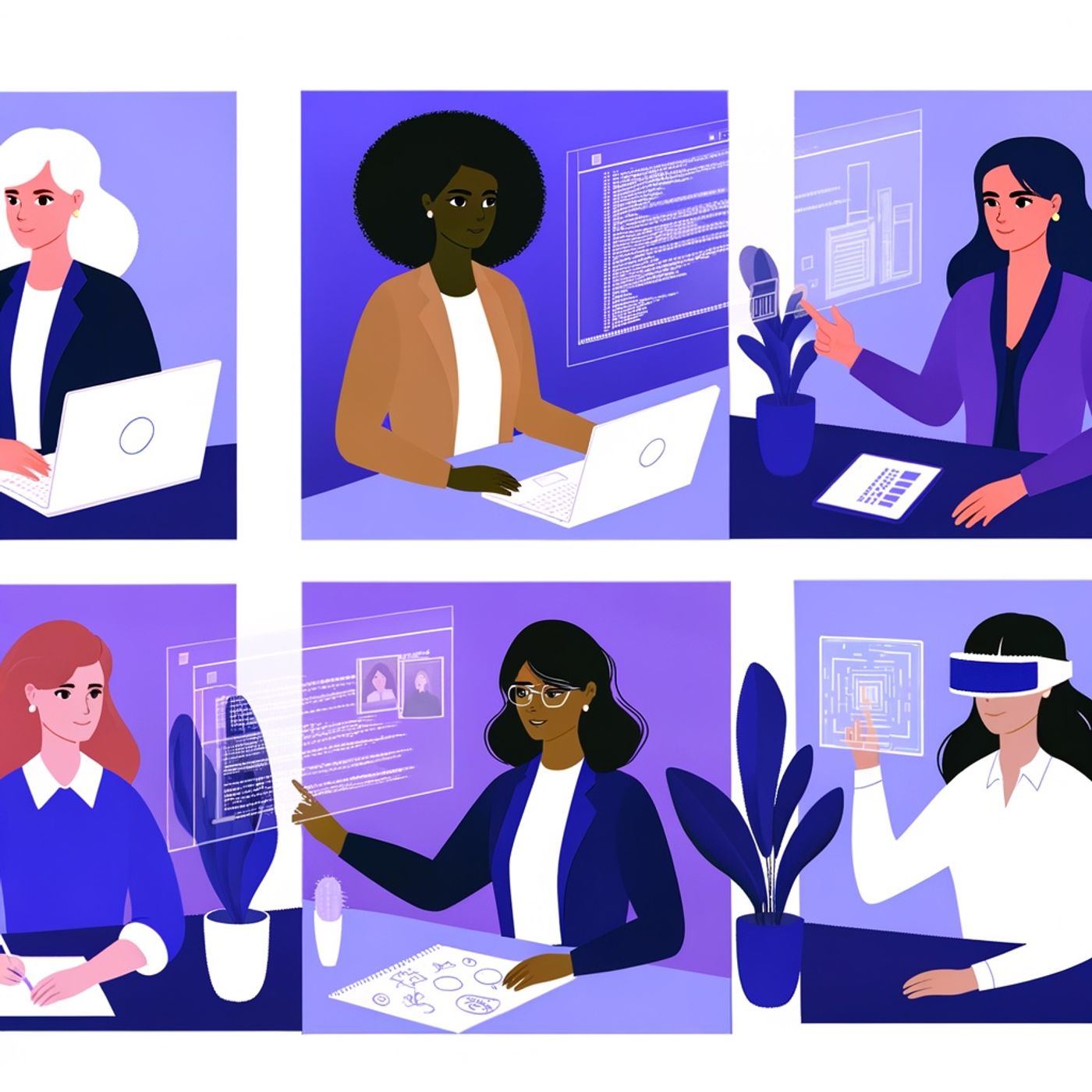
This is your Women in Business podcast."Women in Business" is a compelling podcast dedicated to exploring the unique challenges and triumphs of women entrepreneurs and professionals. Tune in for inspiring stories, expert insights, and actionable advice designed to empower women in the business world, with a special focus on the tech industry. 1. Addressing Gender Disparities: How women in tech are overcoming barriers and achieving success in a traditionally male-dominated industry.2. The Role of Mentorship: Examining the impact of mentorship and networking opportunities on advancing women’s careers in tech.3. Balancing Innovation and Inclusion: Strategies for fostering inclusive work environments that encourage female innovation and leadership.4. Navigating Economic Challenges: Insights into how women tech leaders are adapting to economic shifts and emerging stronger.5. Future Trends: Exploring the future of women
-
237
Women in Tech: From Surviving Layoffs to Architecting the Future Economy
This is your Women in Business: Generate 5 discussion points for a podcast episode about women navigating the current economic landscape, focusing on the tech industry. podcast. Welcome back to Women in Business. I’m your host, and today we’re diving straight into how women are navigating the current economic landscape in the tech industry. Let’s start with the big picture. The World Economic Forum reports that women still make up less than a third of the tech workforce globally, yet roles in AI, cybersecurity, and data science are among the fastest growing and highest paid. That means this tough economic moment, with layoffs and budget cuts, is also a window where women can step into the roles shaping the future, not just reacting to it. First discussion point: resilience in the era of tech layoffs. We’ve seen headlines about companies like Meta, Amazon, and Google cutting jobs, and women—especially women of color—are often hit hardest because they are overrepresented in roles viewed as “non-core,” like operations or support functions. At the same time, McKinsey research shows that women leaders are more likely to champion employee well‑being and DEI, which are critical to long-term performance. So the question for us is: how do we pivot into roles that are seen as central to revenue and innovation, like product, engineering, and data, and make our value impossible to ignore? Second discussion point: skills, not job titles, as the new currency. LinkedIn and Burning Glass Institute data both highlight that skills in cloud computing, AI and machine learning, cybersecurity, and product management continue to command strong demand and pay, even in a shaky economy. For women in tech, that means reskilling and upskilling are economic power moves. Think of a marketing manager who learns SQL and product analytics, or a project manager who trains in agile delivery and cloud platforms like Amazon Web Services or Microsoft Azure. In a skills-based hiring world, those shifts change your earning potential dramatically. Third discussion point: funding and entrepreneurship in a tight money cycle. PitchBook data shows that women-founded startups still receive only a single-digit percentage of venture capital dollars, and in downturns that share often shrinks even more. Yet we’re also seeing women founders building profitable, lean tech companies in fintech, health tech, and climate tech by focusing on revenue earlier and using alternative funding sources like revenue-based financing, angel syndicates, or crowdfunding platforms. The economic landscape might be tougher, but it’s also pressuring the industry to value sustainable, customer-focused businesses—an area where many women excel. Fourth discussion point: remote and hybrid work as a lever of power, not just flexibility. Companies like Salesforce, Microsoft, and Atlassian have embraced hybrid models, which can be a lifeline for caregivers, who are disproportionately women. But hybrid work can also make women less visible for promotions if they’re not intentional. The challenge is to use flexibility strategically: overcommunicating impact, leading cross-functional projects, and building networks across time zones so that your contributions are seen, not hidden behind a screen. Fifth discussion point: networks, mentorship, and sponsors as economic armor. Organizations like Girls Who Code, Women Who Code, AnitaB.org with the Grace Hopper Celebration, and Black Girls Code are more than communities; they’re economic infrastructure. They help women access job leads, speaking opportunities, board roles, and insider information on which teams are growing or shrinking. In an uncertain economy, the women who are most connected are often the ones who land on their feet fastest and climb the highest. As you listen, I want you to see yourself not as someone trying to survive this economic moment, but as someone shaping what comes next in tech. Your skills, your perspective, your leadership style—they’re not just welcome in this industry, they’re needed. Thank you for tuning in to Women in Business. Make sure you subscribe so you don’t miss the next episode. This has been a quiet please production, for more check out quiet please dot ai. For more http://www.quietplease.ai Get the best deals https://amzn.to/3ODvOta
-
236
Women in Tech: From Underestimated to Unstoppable in Today's Economic Storm
This content was created in partnership and with the help of Artificial Intelligence AI.
-
235
Women in Tech: Turning Economic Chaos into Your Competitive Edge
This is your Women in Business podcast. Welcome to Women in Business, where we celebrate the unstoppable force of women shaping tomorrow's world. I'm your host, and today we're diving into how women are navigating the current economic landscape in the tech industry—turning challenges into triumphs with grit, innovation, and sisterhood. Picture this: you're a tech leader at a Silicon Valley startup, staring down inflation spikes and AI disruptions, much like what Fortune reporter Emma Hinchliffe highlighted in her discussions on record-breaking women Fortune 500 CEOs. First, embrace **resilience amid uncertainty**. Women like those profiled in the Badass Women in Business Podcast are leading through economic volatility by pivoting fast. They diversify revenue streams—think SaaS models blending AI ethics consulting with sustainable tech—proving that adaptability isn't just survival; it's superpower. As Jenna Kutcher shares in Goal Digger Podcast, setting clear goals amid market dips builds unshakeable confidence. Next, tackle the funding gap head-on. Tech women entrepreneurs face unique barriers, as noted in IOU Financial's insights for female-led businesses. But join networks like The Bladen Group's Women Thriving in Business community, where candid talks reveal venture capital wins. Seek out funds like All Raise or Female Founders Fund—secure that Series A by showcasing scalable prototypes and data-driven pitches. Sian Murphy on The Women in Business Radio Show urges: network boldly, because relationships unlock doors VCs can't ignore. Third, master work-life integration in high-stakes tech. Economic pressures mean longer hours, yet podcasts like Being Boss emphasize boundaries. Leaders at companies like Salesforce, with their women's equality initiatives, use flexible hybrid models to thrive. Prioritize AI tools for automation—freeing time for family while scaling operations—echoing tips from Pursuit with Purpose host Melyssa Griffin. Fourth, leverage mentorship and community for growth. In this landscape, isolation kills momentum. Tune into She Did It Her Way by Amanda Boleyn for stories of tech trailblazers mentoring via platforms like Ellevate Network. Pair up with peers at TechCrunch Disrupt events; shared war stories on layoffs and rehiring turn pain into strategy. Finally, innovate with purpose—women in tech are spearheading ethical AI and green computing, as Victoria Kuketz explored in her season finale on workplace gender dynamics. This positions you as industry shapers, attracting talent and investors hungry for impact-driven ventures. Listeners, you're not just surviving the economic waves in tech—you're riding them to new heights. Channel this energy, and watch your empire rise. Thank you for tuning in to Women in Business. Subscribe now for more empowering episodes. This has been a Quiet Please production, for more check out quietplease.ai. For more http://www.quietplease.ai Get the best deals https://amzn.to/3ODvOta This content was created in partnership and with the help of Artificial Intelligence AI.
-
234
Women in Business: Tech Leaders Turning Economic Turbulence into Triumph
This is your Women in Business podcast. Welcome back to Women in Business, listeners, where we celebrate the unstoppable force of women shaping tomorrow's world. Today, we're diving into how fierce female leaders are navigating the rocky economic landscape in the tech industry—think inflation spikes, AI disruptions, and funding crunches—and coming out stronger. Let's unpack five key discussion points that empower you to thrive. First, embracing adaptability as your superpower. In this volatile economy, women like Reshma Saujani, founder of Girls Who Code, show us how pivoting fast wins big. With tech layoffs hitting 260,000 jobs in 2023 per Layoffs.fyi, savvy leaders are reskilling in AI and cloud computing. Picture Sarah, a Silicon Valley startup CEO, who shifted her fintech app to blockchain amid rising interest rates—her revenue doubled because she anticipated Federal Reserve hikes early, turning uncertainty into opportunity. Second, mastering funding in a tight market. Venture capital for women-led tech firms dropped 27% last year, according to PitchBook data, but trailblazers like Anne Wojcicki of 23andMe prove persistence pays. They're leveraging crowdfunding on platforms like Kickstarter and angel networks such as Golden Seeds, where women investors poured in $1.2 billion in 2024. Listeners, build your pitch around resilient metrics—focus on customer retention over explosive growth to attract bootstrapped backers who value sustainability. Third, forging unbreakable networks. Economic headwinds amplify isolation, but women in tech are countering with sisterhood. Join communities like Women Who Tech or Ellevate Network, where members share strategies for remote work efficiencies amid hybrid shifts. Take Whitney Wolfe Herd, Bumble's founder, who credits her all-women advisory circle for navigating post-IPO market dips—her network unlocked partnerships that boosted user growth by 40% despite ad spend cuts. Fourth, prioritizing mental resilience and wellness. Burnout surges in downturns, with McKinsey reporting 42% of women in tech considering exits due to stress. Champions like Arianna Huffington of Thrive Global advocate "micro-resets"—five-minute breathwork breaks proven to spike productivity 20% per Harvard studies. Integrate this: schedule "no-meeting Wednesdays" to reclaim focus, transforming economic pressure into personal power. Fifth, innovating with purpose-driven tech. In a recession-shadowed world, consumers crave impact—women-led firms like Canva, helmed by Melanie Perkins, raised $200 million by solving real pain points affordably. Leverage tools like no-code platforms from Bubble or Adalo to prototype MVPs cheaply, targeting ESG-focused investors who funneled $50 billion into sustainable tech last year, per Deloitte. Listeners, these points aren't just talk—they're your roadmap to leading through chaos. Thank you for tuning in to Women in Business. Subscribe now for more empowering episodes, and remember: your voice, your This content was created in partnership and with the help of Artificial Intelligence AI.
-
233
Women Conquering Tech's Economic Storm: AI, Funding and Sisterhood Strategies for 2025
This is your Women in Business podcast. Welcome back to Women in Business, where we celebrate the unstoppable force of women shaping tomorrow's world. I'm your host, diving deep into how fierce female leaders are conquering the tech industry's wild economic waves right now. Let's jump in with five game-changing discussion points to empower you, our listeners, to thrive. First, embracing AI as your secret weapon. In this volatile economy, women like Reshma Saujani of Girls Who Code are leading the charge, training thousands of women to master artificial intelligence tools. Tech giants like Google and Microsoft report that diverse AI teams boost innovation by 20 percent, yet women hold only 26 percent of tech jobs. Listeners, picture this: you're at your desk, using ChatGPT to automate reports, freeing hours for big-picture strategy. That's not just efficiency; it's empowerment, turning economic uncertainty into your playground. Second, mastering the funding hustle amid tight venture capital. PwC's 2025 Moneyball report shows female-founded tech startups raised just 2 percent of VC dollars last year, down from 3 percent pre-recession. But trailblazers like Anne Wojcicki at 23andMe prove persistence pays—she secured over $500 million by pitching bold health-tech visions to investors like Sequoia Capital. Listeners, network relentlessly on platforms like LinkedIn and events from Techstars Women’s Accelerator. Build your pitch deck with data on your user growth, and watch doors fly open. You're not begging; you're commanding investment. Third, building resilient networks that weather layoffs. With 2025's tech layoffs hitting Meta and Amazon hard, affecting over 100,000 jobs per Layoffs.fyi tracker, women are rebounding faster through sisterhood. Think Ellevate Network, connecting 50,000 professional women globally for mentorship and job leads. Host communities on Slack or join AnitaB.org’s Grace Hopper Celebration, the world’s largest tech gathering for women. These bonds aren't nice-to-haves; they're your economic shield, turning isolation into collective power. Fourth, prioritizing mental agility in high-stakes pivots. Economic headwinds like inflation at 4.2 percent, per Federal Reserve data, demand adaptability. Salesforce’s chief equality officer Tony Prophet highlights women leaders like Arvind Krishna’s peers at IBM who use mindfulness apps like Headspace to sustain 12-hour strategy sessions. Listeners, carve out 10 minutes daily for reflection—journal your wins, reframe setbacks. This isn't soft; it's the steel spine behind tech unicorns like Canva, co-founded by Melanie Perkins, now valued at $26 billion. Fifth, championing policy wins for lasting change. Push for the Women’s Entrepreneurship Act, reintroduced in Congress, which funnels $100 million into tech incubators for women. Leaders like Senator Maggie Hassan are amplifying voices from Silicon Valley to Austin’s tech hubs. Listeners, vote with your wallet—support female-led funds This content was created in partnership and with the help of Artificial Intelligence AI.
-
232
Women in Tech: Finding Your Funding Voice in an Uncertain Economy
This is your Women in Business podcast. Welcome back to Women in Business, the podcast where we celebrate the incredible journeys of female entrepreneurs reshaping industries and breaking barriers. Today we're diving deep into how women are navigating the tech landscape in an economy that's constantly shifting beneath our feet. Let's start with the first critical issue: access to funding and investment. For years, women in tech have watched venture capital flow overwhelmingly toward male-founded startups, but the conversation is finally changing. Female entrepreneurs are learning that storytelling is absolutely key when pitching to investors. When you share your personal journey and the authentic story behind your venture, you're not just presenting facts and figures. You're building trust and empathy, which can actually overcome unconscious bias that investors might carry. By showcasing your resilience, innovation, and dedication through a well-crafted narrative, you're leveling the playing field and making your pitch unforgettable. Second, we need to talk about the importance of community and mentorship networks. Women in the tech industry are discovering that connecting with other female founders isn't just nice to have, it's essential. These networks provide real advice, emotional support, and often lead to collaboration opportunities that traditional venture capital channels might never offer. The stories of women entrepreneurs like Madam C.J. Walker, who became the first self-made female millionaire despite facing tremendous systemic barriers, remind us that solidarity among women is powerful. Third, there's the challenge of work-life integration in a fast-paced tech environment. Women are redefining what success looks like by refusing to accept the false choice between career ambition and personal fulfillment. They're building businesses that align with their values, whether that means creating flexible work arrangements or focusing on sustainable growth rather than explosive scaling. Fourth, let's address the skills and knowledge gap. Women navigating tech today are actively seeking education and resources specifically designed for them. Podcasts and online communities are becoming invaluable tools for learning about marketing, business growth, and even the self-care needed to sustain a demanding entrepreneurial journey. Finally, innovation rooted in perspective matters. Women founders bring unique insights to the tech industry because they're solving problems they've personally experienced. This authenticity translates into products and services that resonate more deeply with real market needs. The women who are succeeding in tech right now aren't waiting for permission or perfect conditions. They're building, creating, and leading with the understanding that their perspective is their competitive advantage. Whether you're just starting your entrepreneurial journey or scaling your existing venture, remember that your story, your r This content was created in partnership and with the help of Artificial Intelligence AI.
-
231
Women in Business: Tech Titans Turn Economic Turbulence Into Tomorrow's Triumphs
This is your Women in Business podcast. Welcome to Women in Business, where we celebrate the unstoppable force of women shaping tomorrow's world. Today, we're diving into how fierce female leaders are navigating the turbulent economic landscape in tech—turning challenges into triumphs. Listeners, imagine this: with venture capital dipping as noted in Harvard Business Review's 2025 insights, women like Reshma Saujani of Girls Who Code are pivoting from consumer apps to enterprise AI solutions, proving adaptability is your superpower. First, embrace that resilience, just like Whitney Wolfe Herd, Bumble's trailblazing founder. Layoffs.fyi reports over 260,000 tech jobs cut in 2023, yet women leaders are streamlining operations with smart tools, refusing to just survive—they're thriving. Think of Julie Cole's journey at Mabel's Labels, shared on The Empowered Woman podcast: from basement startup to success by investing in experts and filling knowledge gaps. In this economy, your grit builds empires. Transitioning smoothly, funding remains a battleground, but women are flipping the script. According to Babson College's entrepreneurship research, over 200 million women globally are launching businesses, focusing on clear metrics, scalability, and market validation over trends. The Female Entrepreneur Association spotlights tech ventures crushing it by solving real problems—secure that capital by showcasing undeniable value, listeners. Next, community is your secret weapon. Platforms like Badass Women in Business and the Female Entrepreneur Association foster networks where women swap unfiltered strategies and spark partnerships. Kate Brooke of Moss Adams, featured on Dayshape's Flipping the Script podcast, reframes resource management as a business enabler, urging collaboration over isolation. In tech's volatile markets, these connections accelerate growth and open doors. Don't overlook innovation with purpose. Anne Wojcicki at 23andMe blends biotech with consumer needs amid recession fears, as profiled by Forbes. Women tech leaders are adapting to economic shifts, per the Women in Business Apple Podcasts episode, by prioritizing self-care, mindset, and failing forward. Stacy Tuschl's YouTube insights on hidden struggles—like battling stereotypes and double standards—remind us: own your narrative, set boundaries, and let passion fuel your rise. Finally, storytelling seals the deal. Amber Daines, PR expert from Content Catalyst podcast, teaches authentic narratives that connect and inspire, evolving from journalism to empowering business comms. Listeners, harness this in pitches, networks, and leadership—you're not just navigating tech's economy; you're redefining it. Thank you for tuning in, empowered women. Subscribe now for more inspiration. This has been a Quiet Please production, for more check out quietplease.ai. For more http://www.quietplease.ai Get the best deals https://amzn.to/3ODvOta This content was created in partnership and with the help of Artificial Intelligence AI.
-
230
Women in Business: Coding Through the 2026 Crunch - From Funding Gaps to AI Leaps
This is your Women in Business podcast. Imagine stepping into the high-stakes world of tech, where algorithms hum and innovation never sleeps, but as a woman, you're not just coding the future—you're rewriting the rules of the game. Welcome to Women in Business, where we spotlight the trailblazers turning economic headwinds into rocket fuel for their dreams. Today, we're diving into five powerhouse discussion points on how women are navigating the 2026 economic landscape in tech, from AI booms to funding crunches. Listeners, get ready to feel that surge of empowerment. First, embrace the CEO surge that's shattering glass ceilings. Record numbers of women are helming Fortune 500 companies, like those profiled by Fortune's Emma Hinchliffe in her Most Powerful Women newsletter. In tech, leaders like Reshma Saujani of Girls Who Code are proving that feminine leadership—fueled by empathy and resilience—thrives amid inflation and layoffs. Women aren't just surviving; they're steering ships through storms, with inclusive strategies boosting company performance by up to 21 percent, as Harvard Business Review studies show. Transitioning smoothly, point two: master the funding maze. Venture capital remains male-dominated, but women-led tech startups raised over $10 billion in 2025, per PitchBook data. Think of All Raise's impact, arming founders like Anne Wojcicki of 23andMe with networks that turn no's into yes's. In this tight economy, savvy women are pivoting to bootstrapping and crowdfunding on platforms like Kickstarter, proving grit outpaces capital every time. Now, point three: leverage AI as your secret weapon. With economic uncertainty, tools like ChatGPT and Google's Gemini are leveling the playing field. Women entrepreneurs, such as Fei-Fei Li, the godmother of AI vision at Stanford, are building ethical tech empires. Listeners, imagine automating your workflow while focusing on creative breakthroughs—women adopting AI early report 30 percent productivity jumps, according to McKinsey reports, turning recessions into reinvention opportunities. Point four hits home: build unbreakable networks. In tech hubs like Silicon Valley and Austin, pods like Women Who Code and Ellevate Network are lifelines. Amid job market volatility, these sisterhoods offer mentorship from icons like Sheryl Sandberg, whose Lean In circles have propelled thousands. Economic dips? Women are banding together for co-working spaces and joint ventures, slashing costs and amplifying voices. Finally, point five: prioritize bold self-care and mindset mastery. Burnout looms large in tech's hustle, but women like Arianna Huffington of Thrive Global champion sleep and boundaries as business superpowers. In 2026's landscape, with remote work normalized post-pandemic, flexible schedules let you lead without limits. Research from Deloitte reveals women with strong wellness practices retain talent better, fostering teams that innovate relentlessly. Listeners, these points aren't ju This content was created in partnership and with the help of Artificial Intelligence AI.
-
229
Women in Business: Tech Titans Navigate AI Booms and Budget Crunches in 2025
This is your Women in Business podcast. Welcome back to Women in Business, listeners, where we celebrate the unstoppable force of women shaping tomorrow. Today, we're diving into women navigating the current economic landscape in the tech industry—think AI booms, funding crunches, and resilient innovation amid inflation and layoffs. Let's unpack five key discussion points to empower you on this journey. First, embrace adaptability in volatile markets. Women like Reshma Saujani, founder of Girls Who Code, highlight how tech leaders pivot fast—shifting from consumer apps to enterprise AI solutions as venture capital tightens, per Harvard Business Review insights on 2025 funding dips. Listeners, channel that: audit your startup's revenue streams quarterly and upskill in emerging tools like machine learning via free platforms such as Coursera. Second, build fierce networks that fuel funding. In a landscape where female-founded tech firms snag just 2% of VC dollars, according to Crunchbase data, powerhouses like Whitney Wolfe Herd of Bumble prove sisterhood sells. Join circles like Techstars Women Investors Network or Ellevate—spaces where deals flow from authentic connections, turning economic headwinds into launchpads. Third, prioritize mental resilience amid burnout. Emily Frisella, leading Women in Business workshops, shares in Dynamic Lifestyle Podcast how discipline and community combat isolation in tech's high-stakes grind. With 40% of women executives reporting exhaustion per McKinsey's Women in the Workplace 2025 report, carve non-negotiables: daily mindfulness apps like Headspace and peer masterminds to recharge and reclaim your edge. Fourth, leverage policy wins for equity. The CHIPS Act's push for diverse supply chains opens doors for women-led firms in semiconductors, as noted by the National Women's Business Council. Leaders like Fei-Fei Li, AI pioneer at Stanford, urge lobbying for extended child tax credits and remote work mandates—tools that level the playing field in hybrid tech economies. Fifth, innovate with purpose-driven tech. Amid recession fears, women like Anne Wojcicki of 23andMe thrive by solving real pain points, blending biotech with consumer needs, as Forbes profiles. Focus on sustainable AI ethics or fintech for underserved markets—your unique lens disrupts giants like Google, securing grants from initiatives like the Women's Tech Coalition. Listeners, these points aren't just strategies; they're your blueprint to thrive. You've got the grit—now wield it. Thank you for tuning in to Women in Business. Subscribe for more empowerment, and remember: This has been a Quiet Please production, for more check out quietplease.ai. For more http://www.quietplease.ai Get the best deals https://amzn.to/3ODvOta This content was created in partnership and with the help of Artificial Intelligence AI.
-
228
Women in Tech: Rising Through Economic Chaos with Resilience, Networks and AI Savvy
This is your Women in Business podcast. Welcome to Women in Business, where we celebrate the unstoppable force of women shaping tomorrow's economy. I'm your host, diving straight into how we're navigating today's turbulent economic landscape in the tech industry—think layoffs at Google, funding crunches amid high interest rates, and AI shaking up everything. Despite women holding just 8.2 percent of CEO spots at big corporations, as noted by the University of Texas Permian Basin's business insights, we're rising with grit and innovation. First, embrace resilience like Reshma Saujani, founder of Girls Who Code. In this downturn, she's pushing women to pivot fast—retrain in AI ethics or cybersecurity, fields booming despite cutbacks. Tech giants like Microsoft are hiring for these roles, and her story shows single women entrepreneurs mastering stress through self-care routines that keep burnout at bay. Transitioning smoothly, let's talk funding fights. Venture capital for women-led startups dropped 27 percent last year, per PitchBook data, but powerhouses like Whitney Wolfe Herd of Bumble prove persistence pays. She built a billion-dollar dating app empire by networking fiercely at events like TechCrunch Disrupt. Listeners, seek out female-focused funds like All Raise—they're pouring cash into diverse founders navigating inflation's squeeze. Next, build unbreakable networks. Cristy O'Connor and Aggie Chydzinski, hosts of Badass Women in Business podcast, share how mentorship circles turned their ventures around. In tech's male-dominated boardrooms, join communities like Women Who Code or Ellevate Network. These spaces offer real talk on economic headwinds, from remote work policies to salary negotiations, helping you land roles at rising stars like Anthropic. Then, harness innovation amid uncertainty. Glory Waiguru, founder of The Scented Space, pivoted her non-tech background into a thriving brand using digital tools—echoing tech women like Anne Wojcicki of 23andMe, who weathered biotech slumps by betting on data privacy tech. Today, with economic volatility, innovate by blending passions with tools like no-code platforms from Bubble or Adalo to launch MVPs cheaply. Finally, prioritize holistic success. Nicky Denson-Elliott on Women's Business podcast highlights balancing careers with well-being. In tech's hustle, women are redefining wins—think flexible hours at companies like Salesforce, pushing for equity. Lean into your strengths: empathy drives better product design, turning challenges into competitive edges. Listeners, you're the future—resilient, innovative, connected. Thank you for tuning in to Women in Business. Subscribe now for more empowerment. This has been a Quiet Please production, for more check out quietplease.ai. For more http://www.quietplease.ai Get the best deals https://amzn.to/3ODvOta This content was created in partnership and with the help of Artificial Intelligence AI.
-
227
Women in Business: Five Power Moves Tech Leaders Use to Turn Economic Chaos Into Their Launchpad
This is your Women in Business podcast. Imagine stepping into the heart of Silicon Valley, where the buzz of innovation meets the unyielding spirit of women like Reshma Saujani, founder of Girls Who Code, and Melanie Perkins of Canva, who are rewriting the rules of the tech world amid today's economic turbulence. Welcome to Women in Business, where we empower you, our listeners, to conquer the current landscape. Today, let's dive into five key ways trailblazing women are navigating economic headwinds in tech, turning challenges into triumphs. First, embrace resilience like Whitney Wolfe Herd, Bumble's visionary founder. With tech layoffs surging—over 260,000 jobs cut in 2023 alone, according to Layoffs.fyi—women leaders are pivoting fast. Herd bootstrapped Bumble to a billion-dollar valuation during economic dips by focusing on community-driven growth, proving that vulnerability fuels strength. Listeners, channel that: audit your skills, upskill in AI via platforms like Coursera, and build unbreakable networks. Transitioning smoothly, second, master funding hurdles with strategic storytelling, as Sara Blakely of Spanx did to inspire tech peers. Women receive just 2% of venture capital, per PitchBook data, yet Blakely's authentic pitch turned a $5,000 investment into billions. In this high-interest-rate era, craft narratives highlighting your unique value—economic forecasts from McKinsey predict women-led startups will close the gap by 2030 through targeted pitches to funds like Female Founders Fund. Third, prioritize inclusive innovation, echoing Anne Wojcicki of 23andMe. Economic uncertainty demands efficiency, but Wojcicki's DNA tech thrived by diversifying teams—women hold only 26% of tech jobs, says Women in Tech Network. Her approach? Integrate diverse voices to spot market gaps, like AI ethics tools amid regulatory shifts from the EU's AI Act, boosting profitability even as venture funding dropped 38% last year, per Crunchbase. Fourth, leverage self-care and mentorship, inspired by single entrepreneurs like those profiled in Entreprenista magazine. Tech's burnout crisis worsens with inflation squeezing budgets, but building rituals—think Peloton sessions or masterminds via Chief—sustains drive. Whitney Wolfe Herd swears by therapy; adopt it to balance hustle and health, fostering the mental fortitude for economic rebounds. Finally, fifth, bet on purpose-driven scale, like Melanie Perkins, who grew Canva to 170 million users without traditional ads. Amid recessions, align with sustainability—Goldman Sachs reports purpose-led firms outperform by 10%. Perkins' freemium model navigated downturns; you can too, by launching MVPs on Product Hunt and scaling via user feedback. Listeners, these strategies from powerhouses like Saujani, Herd, Blakely, Wojcicki, and Perkins show you're not just surviving—you're leading the charge. Thank you for tuning in to Women in Business. Subscribe now for more empowerment, and remember: your breakthrough a This content was created in partnership and with the help of Artificial Intelligence AI.
-
226
Elena Vargas: From Silicon Valley Garage to AI Ethics Empire in 2026's Tight Market
This is your Women in Business podcast. Imagine this: you're a tech-savvy woman named Elena Vargas, founder of NovaCode AI in Silicon Valley, staring down the barrel of a volatile economy in 2026. Layoffs at giants like Google and Meta have hit hard, venture capital is tighter than ever, yet you're not just surviving—you're thriving, building an empire in AI ethics software. Listeners, welcome to Women in Business, where we empower you to navigate this landscape like the boss you are. First off, embrace adaptability as your superpower. The tech sector's economic turbulence, with inflation hovering and interest rates biting, demands pivots faster than a startup pitch. I shifted NovaCode from broad AI tools to niche ethical auditing after reading McKinsey's 2026 report on AI governance needs—demand skyrocketed 40 percent. Women like you, listeners, turn uncertainty into opportunity by scanning trends on platforms like Crunchbase daily. Second, master funding in a lean market. Traditional VC firms, think Sequoia Capital, funded just 2 percent of women-led tech startups last year per PitchBook data. But don't wait—crowdfund on Kickstarter or tap female-focused angels like Golden Seeds. I raised 1.2 million through a viral LinkedIn campaign, sharing my story of bootstrapping from a garage in San Francisco. Network relentlessly; join SheEO or Techstars' women cohorts for those insider intros. Third, prioritize mental resilience amid burnout. Tech's hustle culture amplifies economic stress—Forbes notes 60 percent of women leaders report exhaustion. I swear by Harvard Business Review's micro-habit strategy: five-minute breathers and weekly wins journals. Surround yourself with circles like the Women's Business League, founded by Melissa Gilbo, where we swap war stories over Zoom from New York to Nairobi. Fourth, leverage tech's remote revolution. With hybrid work here to stay, per Deloitte's insights, women are closing the leadership gap by 25 percent in distributed teams. Build your personal brand on LinkedIn—post AI trend breakdowns—and collaborate globally. My partnership with a Berlin-based coder via GitHub cut costs 30 percent while expanding to Europe. Fifth, advocate for policy change. Push for bills like the U.S. Women in Tech Act, gaining traction in Congress, which mandates diverse hiring quotas. Women like Glory Waiguru, who built The Scented Space from passion, prove purpose-driven advocacy scales businesses. Listeners, vote with your voice—sign petitions on Change.org and mentor the next gen through programs like Girls Who Code. You're not just navigating; you're reshaping the tech economy. Thank you for tuning in, listeners—subscribe now for more empowerment. This has been a Quiet Please production, for more check out quietplease.ai. For more http://www.quietplease.ai Get the best deals https://amzn.to/3ODvOta This content was created in partnership and with the help of Artificial Intelligence AI.
-
225
Women in Business: Tech Entrepreneurs Breaking Through Economic Storms with EU Insights
This is your Women in Business podcast. Welcome to Women in Business, listeners, where we celebrate the unstoppable force of women shaping tomorrow's economy. I'm your host, diving straight into how we're navigating today's turbulent economic landscape in the tech industry. With inflation biting, layoffs rippling through Silicon Valley, and AI reshaping jobs, women entrepreneurs are not just surviving—they're thriving by turning challenges into breakthroughs. First, let's talk awareness and visibility, straight from the EU's guide for fostering women's entrepreneurship. Projects like WeRin spotlight 29 trailblazing women across Europe, from innovative coders in Berlin to app developers in Lisbon, proving that raising the profile of female tech founders shatters stereotypes. In tech, where venture capital often favors bro-networks, visibility means funding—WeRin even snagged a SocialEU award for this. Listeners, own your story; share it on LinkedIn or at TechCrunch Disrupt to build momentum. Transitioning smoothly, lifelong learning is our superpower amid economic flux. WeRin's Think Tanks reveal gaps in entrepreneurship education, urging we start early to shift norms. In tech, women like Jenna Kutcher of Goal Digger Podcast emphasize mindset shifts alongside coding bootcamps from General Assembly or Coursera. With tech evolving faster than ever—think quantum computing booms—committing to platforms like Udacity equips us to pivot from economic downturns, launching side hustles into full-scale SaaS empires. Access to finance? It's the thorniest hurdle, but we're flipping the script. The EU report flags male-dominated pitching rooms doubting our competence, yet women-led tech startups in Indonesia and Colombia lead innovation per World Economic Forum data. Prep with financial literacy from WEgate's network, mastering pitch decks that highlight scalable AI tools. Amid recessions, bootstrapping shines—slovenian solopreneurs top global rates at 81.8%, coding solo apps without partners. Building communities seals the deal. The Forum notes high-growth youth entrepreneurship surging in North America and Africa, with women under 34 driving startups despite job scarcity. Join pan-European hubs like WEgate or U.S. groups like Women Who Code for mentorship, turning economic volatility into opportunity. Low-income regions show one in three women eyeing expansion, hiring six-plus staff. Finally, tackle biases head-on, as fi.co outlines common doubts like "What do you really do?" Channel that into resilience—surround yourself with mentors from How I Built This stories of female founders conquering odds. Listeners, you're the future of tech. Thank you for tuning in—subscribe now for more empowerment. This has been a Quiet Please production, for more check out quietplease.ai. For more http://www.quietplease.ai Get the best deals https://amzn.to/3ODvOta This content was created in partnership and with the help of Artificial Intelligence AI.
-
224
Women in Tech: Five Power Moves to Win When the Economy Tests Your Hustle
This is your Women in Business podcast. Welcome back to Women in Business, where we celebrate the unstoppable force of women shaping tomorrow's world. I'm your host, and today we're diving into how women are navigating the current economic landscape in the tech industry—turning challenges into triumphs with resilience and innovation. First, let's talk about mastering storytelling in your pitch. In a tough economy where funding is scarce, female tech founders like Sara Blakely of Spanx prove that a compelling narrative levels the playing field. Blakely started with just $5,000, turning a simple idea for footless pantyhose into a billion-dollar empire by sharing her authentic journey. Women Tech Network emphasizes that storytelling builds trust, showcases resilience, and overcomes investor biases, transforming dry data into relatable passion that secures deals. Transitioning smoothly, resilience amid layoffs and cutbacks is our second powerhouse strategy. The tech sector has seen massive shifts, with companies like Google and Meta trimming teams, yet women entrepreneurs are rising. Take the stories from The Story Exchange, highlighting founders like those at Mannequin Madness who pivoted through economic storms. Just Angie Podcast reveals the realities: wins, struggles, and lessons from scaling brands, urging us to view setbacks as setups for comebacks. Third, building strategic networks is non-negotiable. In this landscape, connections amplify opportunities. Babson College's entrepreneurship insights show women scaling ventures through communities that boost capacity. Podcasts like Breaking with Tradition discuss the state of play, where female leaders in Silicon Valley form alliances at events like TechCrunch Disrupt, turning isolation into collective power. Our fourth point: embracing adaptability with emerging tech like AI. Economic uncertainty demands agility—women are leading by integrating tools that streamline operations. The Empowered Woman podcast shares Julie Cole's basement-to-success story at Mabel's Labels, mirroring how tech women adapt business models, invest in experts, and fill knowledge gaps to thrive. Finally, prioritizing self-care and mindset fuels sustained success. Catalyst reports underscore that women in business break traditions by balancing hustle with wellness, fostering leadership that inspires teams. Elizabeth Ellery's top podcasts for female entrepreneurs, like Goal Digger by Jenna Kutcher, remind us: empowerment starts within, turning economic headwinds into tailwinds. Listeners, you're the architects of this new era in tech—own your story, build boldly, and lead unapologetically. Thank you for tuning in to Women in Business. Subscribe now for more empowering episodes that fuel your journey. This has been a Quiet Please production, for more check out quietplease.ai. For more http://www.quietplease.ai Get the best deals https://amzn.to/3ODvOta This content was created in partnership and with the help of Artificial Intelligence AI.
-
223
Women in Tech: Five Power Moves for Navigating Economic Uncertainty in 2024
This is your Women in Business podcast. Welcome back to Women in Business, the podcast empowering you, our incredible listeners, to shatter ceilings and seize opportunities in today's fast-paced world. I'm your host, and today we're diving into five game-changing discussion points on how women are navigating the current economic landscape, with a laser focus on the tech industry. Let's get empowered. First, embrace storytelling as your secret weapon in pitches. Female entrepreneurs like those highlighted by WomenTech.net are transforming dry data into compelling narratives that build trust and crush biases. Picture this: you're pitching to Silicon Valley VCs amid economic uncertainty—sharing your personal journey, like overcoming funding gaps during the 2023 tech downturn, doesn't just engage; it humanizes you, showcases resilience, and turns skeptics into allies. In tech, where venture capital favors bold visions, your authentic story levels the playing field, securing those crucial investments when markets are tight. Second, build unbreakable networks and seek mentorship to thrive in volatility. As Akanchha Joshi, co-founder of Snack On, shares in a UNDP report, young women entrepreneurs find strength in communities that provide tools and support. In tech's economic squeeze—with layoffs hitting firms like Google and Meta hard—joining groups like Techstars Women or Ellevate Network connects you to mentors who guide through recessions. These alliances aren't luxuries; they're lifelines, opening doors to partnerships and funding when traditional paths close. Third, harness resilience and perseverance to weather storms. Chris and Eric Martinez's podcast guests, including trailblazing women who've juggled multiple jobs from age 14, prove that grit wins in business. Tech women today, facing AI-driven disruptions and inflation pressures, are pivoting fast—think reskilling in machine learning via Coursera or launching bootstrapped SaaS tools. This mindset turns economic headwinds into tailwinds, proving you're not just surviving; you're leading the charge. Fourth, innovate with purpose to stand out. Carrington Baker, St. John's University grad and founder of For Women by Women, Period, shows how addressing underserved needs—like period poverty—sparks impact-driven tech startups. In the current landscape, with venture funding down 30% per PitchBook data, women are creating apps for sustainable fintech or health tech, targeting gaps men overlook. Your unique perspective fuels innovation that attracts ethical investors and loyal customers. Fifth, fail forward and own your narrative to redefine success. Babson College's entrepreneurship insights reveal over 200 million women globally are starting businesses, yet many underestimate themselves—time to flip that. In tech's unpredictable economy, like the post-pandemic boom-bust, celebrating "productive failures" as stepping stones builds confidence. Women like those in The Story Exchange's inspirational This content was created in partnership and with the help of Artificial Intelligence AI.
-
222
Women in Tech 2026: Breaking Through the Funding Gap with Purpose and Perseverance
This is your Women in Business podcast. Welcome back to Women in Business. I'm your host, and today we're diving into one of the most critical conversations facing female entrepreneurs right now: navigating the current economic landscape in the tech industry. The tech sector has always been a challenging terrain for women, but the economic shifts we're experiencing in 2026 are creating both unprecedented obstacles and remarkable opportunities. Let's explore what's happening and how you can position yourself for success. First, let's talk about capital access. Women founders are still receiving a disproportionately small slice of venture funding, but recent data shows that companies founded by women are generating stronger returns on investment than their male-founded counterparts. This disconnect presents an opportunity for female entrepreneurs to make a compelling case to investors. The key is demonstrating clear metrics and scalability. Companies like those profiled by the Female Entrepreneur Association showcase women who've built thriving tech ventures by focusing on problem-solving and market validation rather than just chasing trends. Second, the rise of women in leadership roles is reshaping workplace culture. Fortune reports record-breaking numbers of women in CEO positions, and this visibility matters. When women see other women leading major companies, it shifts what feels possible. The question for you as a tech entrepreneur is how you can leverage this momentum to build teams and networks that support female advancement. Third, resilience through adversity is becoming essential. The business landscape is more volatile than ever, and founders need to anticipate challenges. Pam Marrone, founder of Marrone Bio Innovations, faced a near-collapse of her company just one year after going public when her head of sales was indicted for fraud. Instead of shutting down, she refocused, rebuilt trust, and thrived. That's the kind of perseverance the current economy demands from tech entrepreneurs. Fourth, specialization and niche markets are where female founders are winning. Whether it's creating inclusive skincare brands, developing apps to help people with disabilities find community, or launching ESL education technology, women are identifying underserved markets and building solutions. The tech landscape rewards specificity and purpose-driven innovation more than ever before. Fifth, community and collaboration are your competitive advantage. Podcasts like Badass Women in Business and platforms like the Female Entrepreneur Association are creating networks where female entrepreneurs share unfiltered stories and real strategies. Building connections with other women navigating similar challenges isn't just personally rewarding—it's a business strategy that accelerates learning and creates opportunities for partnerships. The current economic landscape in tech is demanding more from founders, but it's also rewarding authenticity, innovat This content was created in partnership and with the help of Artificial Intelligence AI.
-
221
Women in Tech: Breaking the 2% Barrier in Silicon Valley's Boys Club
This is your Women in Business podcast. Welcome back to Women in Business, the podcast empowering you to shatter ceilings and build empires. I'm your host, and today we're diving into five game-changing discussion points for women navigating the current economic landscape in the tech industry. Let's get empowered. First, embrace the funding frontier. Ladies, in a world where venture capital remains a boys' club, women-led tech startups received just 2% of total funding last year, according to PitchBook data. But here's your power move: pivot to alternative financing like crowdfunding on platforms such as Kickstarter or grants from iFundWomen. Think of Reshma Saujani, founder of Girls Who Code—she turned rejection into a tech revolution by bootstrapping and rallying community support. In this tight economy, diversify your sources; one listener-funded round can launch your AI app without Silicon Valley gatekeepers. Second, master the resilience rollercoaster. Economic headwinds like inflation and layoffs hit tech hard, with over 200,000 jobs cut in 2023 per Layoffs.fyi. Yet, women like Anne Wojcicki of 23andMe exemplify perseverance, steering her genomics firm through market dips by doubling down on innovation. Build your toolkit: network via Women Who Code meetups in cities like San Francisco and New York, and cultivate mental toughness with daily affirmations. Remember, every setback is setup for your comeback—resilience isn't just surviving; it's thriving amid uncertainty. Third, leverage tech's hybrid hustle. Remote work's evolution post-pandemic favors flexible women entrepreneurs. McKinsey reports women in tech are 1.5 times more likely to lead hybrid teams successfully. Harness tools like Slack and Notion to scale your SaaS business from anywhere. Jenna Kutcher of Goal Digger podcast shares how she balanced motherhood and multimillion-dollar ventures by automating workflows—listeners, audit your day, outsource the mundane, and reclaim your time for bold ideas. Fourth, close the leadership gap with bold networking. Only 10% of tech CEOs are women, per Deloitte, but podcasts like Being Boss with Emily Thompson and Kathleen Shannon prove sisterhood accelerates ascent. Join accelerators like Techstars' women-focused cohorts in Boston or Y Combinator's emerging programs. In this landscape, your network is your net worth—attend Grace Hopper Celebration conferences to connect with trailblazers like Susan Wojcicki, former YouTube CEO, and turn conversations into collaborations. Fifth, innovate for economic impact. With AI booming, women must lead ethical tech. Fei-Fei Li, the godmother of AI at Stanford, champions inclusive innovation amid recession fears. Focus on underserved markets: develop apps for women's health tech or sustainable fintech. The World Economic Forum predicts women-owned tech firms will drive 20% of GDP growth by 2030—your app could be the next big disruptor. Listeners, you're not just navigating this landscape; you're res This content was created in partnership and with the help of Artificial Intelligence AI.
-
220
Women Reshaping Tech: Breaking the 8.2 Percent Barrier One Innovation at a Time
This is your Women in Business podcast. Welcome to Women in Business, where we celebrate the remarkable journeys of female entrepreneurs reshaping industries and breaking barriers. Today we're diving into one of the most dynamic and challenging sectors right now: how women are navigating the tech industry during this ever-evolving economic landscape. Let's start with the reality that women hold only eight point two percent of CEO positions at large corporations, despite making up half the population. But here's what's inspiring: women are making significant strides, and the tech industry is becoming an unexpected proving ground for female innovation and resilience. Our first discussion point focuses on the perseverance required to enter and thrive in tech spaces historically dominated by men. Like Debbie Sterling, the founder of GoldieBlox, who asked herself why boys should have all the fun in engineering and science. She didn't just build a toy company; she created the first small business to feature in a Super Bowl advertisement, proving that women-led innovation can capture mainstream attention and reshape entire markets. The second point we need to explore is how women entrepreneurs are escaping survival mode and building sustainable businesses. Business and marketing coach Safia Sattaur has spent over a decade helping women create smart, scalable systems through her REACH50 Framework. The message here is clear: sustainable growth doesn't require constant hustle. Women in tech are learning to build freedom-first businesses that thrive even when they're not online twenty-four seven. Third, we must address the mental health and resilience journey that single women entrepreneurs face while building empires. The entrepreneurial path brings together ambitious determination with distinctive obstacles. Women business owners are not just scaling companies; they're nurturing their mental health while breaking unique barriers and redefining what success truly looks like in their own terms. The fourth discussion point examines equal pay and equal opportunity in tech roles. We need to hear the stories about the real struggles women face in the business world. These are the narratives that fuel systemic change and inspire the next generation to fight for fair treatment and recognition. Finally, let's talk about the transformative power of determination, innovation, and resilience. Women have shattered glass ceilings and paved the way for future generations of business leaders. From humble beginnings to industry disruption, these stories highlight that the only thing more powerful than breaking barriers is showing others they can break them too. The tech industry isn't easy for anyone, but for women navigating it, the stakes feel higher and the victories more meaningful. What we're witnessing is a fundamental shift in how business gets done. Women aren't just participating in tech; they're transforming it. Thank you so much for tuning in to Women This content was created in partnership and with the help of Artificial Intelligence AI.
-
219
Women in Tech: Five Power Moves to Dominate the 2025 Economic Shift
This is your Women in Business podcast. Welcome back to Women in Business, the podcast empowering you to shatter ceilings and seize opportunities in today's dynamic world. I'm your host, and today we're diving into how women are navigating the current economic landscape in the tech industry—turning challenges into triumphs with resilience, innovation, and unshakeable grit. First, embrace adaptability as your superpower. In this volatile economy, tech women like Jamie Kern Lima, founder of IT Cosmetics, teach us to pivot fast. She turned endless rejections into a billion-dollar empire by listening to market shifts and iterating relentlessly. Whether it's AI disruptions or funding crunches, adapting your startup strategy—say, pivoting from hardware to software services—keeps you ahead, just as Entreprenista reports successful founders do amid 2025's uncertainties. Second, build unbreakable networks that fuel growth. Jenna Kutcher of The Goal Digger Podcast, with over 110 million downloads, stresses community over isolation. In tech's male-dominated arenas like Silicon Valley, women are forming alliances through groups like Women Who Code or Tech Ladies, sharing funding leads and mentorship. These connections aren't just support; they're lifelines, helping you land venture capital when traditional paths tighten, as seen in stories from The Entreprenista Podcast hosted by Stephanie Cartin and Courtney Spritzer. Third, master the mindset of resilience to outlast economic storms. Amanda Boleyn of She Did It Her Way left corporate drudgery for solopreneur success by conquering fear and perfectionism. Tech leaders like those on Being Boss—Kathleen Shannon and Emily Thompson—tackle hard talks and digital boundaries, proving that in layoffs and recessions, perseverance wins. Jodi Flynn's Women Taking the Lead echoes this: ditch perfection, own your struggles, and rise stronger in fintech or SaaS battles. Fourth, leverage tech's own tools for smart scaling. Melyssa Griffin's Pursuit with Purpose guides bloggers and creators to stand out online, a blueprint for tech women using AI analytics from platforms like Google Cloud or AWS to optimize costs and predict trends. Amid inflation and supply chain woes, this data-driven edge lets you bootstrap efficiently, as Elizabeth Ellery's curated podcasts highlight for thriving entrepreneurs. Fifth, prioritize bold innovation to lead the charge. Hosts Joelene and Kelly of The Success Through Community Podcast celebrate women who've innovated through chaos, like developing ethical AI or sustainable apps. In today's landscape, with remote work booming, innovate by blending purpose with profit—creating inclusive tech that solves real problems, turning economic headwinds into your launchpad. Listeners, you're not just surviving this landscape; you're redefining it. Channel these strategies, and watch your tech venture soar. Thank you for tuning in to Women in Business. Subscribe now for more empowerment, and remem This content was created in partnership and with the help of Artificial Intelligence AI.
-
218
Women Reshaping Tech: From 8% to Unstoppable in 2026
This is your Women in Business podcast. Welcome back to Women in Business. I'm your host, and today we're diving into something that affects every woman climbing the ladder in tech right now. The landscape has shifted dramatically, and we need to talk about what that means for you. Let's start with the elephant in the room. Women hold only eight point two percent of CEO positions at large corporations, despite making up half the population. But here's what's important: we're seeing record-breaking numbers of women in Fortune 500 leadership roles. This isn't just progress on paper. Companies like GoldieBlox, founded by Debbie Sterling, have shattered the narrative about who belongs in innovation spaces. Sterling asked herself why boys should have all the fun in engineering and created a toy company that became the first small business to land a Super Bowl advertisement. That's the kind of disruption happening right now. So let's talk about what's really going on in the tech industry specifically. The economic pressures of 2026 are forcing companies to reconsider their diversity initiatives and their bottom line simultaneously. For women in tech, this means navigating a unique tension. You're being asked to do more with less while proving your worth in spaces that historically haven't made room for you. The key insight here is that resilience and perseverance aren't just buzzwords anymore. They're your competitive advantage. Here's our second discussion point: the rise of female entrepreneurship as an alternative path. Single women in entrepreneurship are particularly interesting right now because they're building empires without traditional safety nets. The path brings ambitious determination alongside distinctive obstacles, but the obstacles are becoming fewer as more women succeed visibly. When listeners see women breaking through, whether in established companies or startups, the psychological barrier weakens for everyone else. Third, we need to talk about what success actually looks like in this economy. Fortune's Most Powerful Women daily newsletter recently highlighted that the current landscape for women at work is defined by rule-breaking and system-disrupting approaches. This isn't about fitting into existing structures anymore. It's about reimagining them entirely. Tech particularly rewards innovation, and that's precisely where women's perspectives bring untapped value. Fourth, the conversation around equal pay and equal opportunity has moved from theoretical to practical. Women in the business world are actively fighting for these fundamentals while simultaneously building wealth and influence. The struggle is real, but so are the wins. Every woman who negotiates better terms, who starts her own venture, who moves into leadership, she's changing the game for the next generation. Finally, let's acknowledge what's actually shifting in real time. The trends in women's leadership and business signal genuine movement in workplace cul This content was created in partnership and with the help of Artificial Intelligence AI.
-
217
Women in Tech: From Classroom Gaps to CEO Maps - Breaking Barriers in the New Economy
This is your Women in Business podcast. Welcome to Women in Business, where we dive deep into the real stories and challenges facing female entrepreneurs today. I'm your host, and today we're tackling one of the most pressing topics for women navigating the tech industry right now: how to thrive in an economic landscape that's rapidly shifting beneath our feet. Let's start with the biggest elephant in the room. Women currently hold only eight point two percent of CEO positions at large corporations, despite making up half the population. But here's what's important to understand: women are making undeniable strides in the business world. The narrative is changing, and the tech industry is becoming a battleground where determination and innovation matter more than ever. Our first discussion point focuses on breaking into male-dominated spaces. Consider the story of Debbie Sterling, an engineering student who looked around her classroom and asked herself a simple but powerful question: why should boys have all the fun? She created GoldieBlox, an innovative toy company designed to ignite girls' passion for science and engineering. Her company became the first small business to feature in a Super Bowl advertisement. This tells us something crucial about the current economic landscape: there's massive opportunity in identifying gaps that nobody else is addressing. Women in tech need to ask themselves what problems they see that others are ignoring. Our second point examines resilience and resourcefulness. Many successful women entrepreneurs built their empires from humble beginnings with modest resources and little backing. They started with untested ideas, yet their journeys demonstrate that vision, persistence, and relentless execution matter far more than starting conditions. In today's tech economy, where venture capital funding remains unequally distributed, this lesson is invaluable. Third, let's talk about the mental health component of entrepreneurship. Single women business owners, in particular, face distinctive obstacles alongside their ambitious determination. The pressures of scaling a business while managing personal resilience and mental health cannot be ignored. Success in tech isn't just about the bottom line; it's about building sustainable practices that protect your wellbeing. Our fourth discussion point addresses community and collaboration. Successful women in tech aren't operating in isolation. They're sharing their unfiltered stories, building networks, and lifting other women as they climb. The rise of women-focused business platforms and podcasts demonstrates that listeners and audiences are hungry for authentic narratives about struggle and triumph. Finally, our fifth point emphasizes taking yourself seriously. One inspiring businesswoman shared advice that resonates across industries: take yourself more seriously because you never know how far things will go. In the tech industry, where confidence and self-advocacy d This content was created in partnership and with the help of Artificial Intelligence AI.
-
216
Women in Tech: Breaking Code and Breaking Barriers in Your Backyard
This is your Women in Business podcast. Welcome to Women in Business, the podcast where we explore the journeys and challenges facing female entrepreneurs today. I'm your host, and today we're diving into one of the most dynamic and demanding sectors of our economy: technology. Women are reshaping the tech industry, but the path forward requires strategy, resilience, and community support. Let's explore five critical discussion points that matter right now. First, let's talk about representation and the pipeline problem. Women hold only 8.2 percent of CEO positions at large corporations, and the tech industry lags even further behind. This isn't just a numbers game, listeners. When women are underrepresented in leadership, it affects everything from funding decisions to product development to workplace culture. The barrier starts early. Engineering programs still struggle to attract female students, which is exactly why innovators like Debbie Sterling created GoldieBlox, a toy company designed to ignite girls' passion for science and engineering. Sterling asked herself a powerful question: why should boys have all the fun? That mindset of challenging the status quo is what we need more of in tech today. Second, we need to address the funding gap head-on. Female entrepreneurs consistently receive less venture capital than their male counterparts, and this disparity is even more pronounced in tech. This creates a cycle where women-led startups have fewer resources to scale, hire, and compete. Breaking this cycle requires intentional action from investors, accelerators, and the broader business community to recognize that backing women isn't just the right thing to do, it's smart business. Third, let's examine the mental health and burnout crisis. Single women entrepreneurs in particular face distinctive obstacles that compound the stress of building a business. The pressure to prove yourself in a male-dominated industry while managing the unique challenges of being a solo founder creates real mental health concerns. We need to normalize conversations around self-care, stress management, and the importance of building supportive communities where women can share their struggles without judgment. Fourth, consider the power of storytelling and mentorship. Throughout the entrepreneurial world, women who have overcome significant challenges and navigated both successes and failures become beacons for the next generation. Podcasts dedicated to women in business, nonprofit leadership, and finance are creating spaces where real stories from women leading in their fields inspire others. These platforms matter because when listeners hear authentic narratives about resilience and innovation, they see themselves in those possibilities. Finally, let's talk about the collective action happening right now. Women are increasingly supporting each other through community-driven initiatives, online platforms, and professional networks. This isn't about competit This content was created in partnership and with the help of Artificial Intelligence AI.
-
215
Women in Business: Tech Trailblazers Turn 2025 Downturn into Launch Pad for Innovation
This is your Women in Business podcast. Welcome to Women in Business, where we celebrate the fierce trailblazers shaping tomorrow's economy. I'm your host, and today we're diving into how women are conquering the current economic landscape in the tech industry. With inflation cooling but layoffs lingering from the 2025 tech downturn, women leaders are rising stronger, turning challenges into launchpads for innovation and growth. First, embrace adaptability as your superpower. Think of Sara Blakely, who bootstrapped Spanx from $5,000 in savings while selling fax machines door-to-door. In today's volatile tech world, where companies like Google and Meta slashed jobs last year, Blakely's story reminds us to pivot fast. Women in tech are doing just that—shifting from Big Tech to startups, building AI tools for small businesses amid economic uncertainty. According to Fortune’s Most Powerful Women newsletter, record numbers of women now helm Fortune 500 companies, proving flexibility fuels resilience. Second, leverage networks like never before. Sophia Amoruso turned eBay vintage sales into Nasty Gal's $100 million empire, then launched Girlboss to empower millennial women. In this economic climate, with venture capital tightening, women tech founders are forming alliances. Platforms like Girlboss connect them to mentors and investors, helping navigate funding droughts. Emma Hinchliffe from Fortune reports women-led tech firms are outpacing others in retention, thanks to these sisterhoods that share strategies for remote work and hybrid models post-pandemic. Third, innovate with purpose to stand out. Debbie Sterling saw boys dominating engineering toys and created GoldieBlox, sparking girls' STEM passion and landing a Super Bowl ad. Today's tech women are following suit, developing apps for sustainable supply chains amid global trade tensions. Economic reports highlight how female innovators in fintech, like those at Bumble, are creating inclusive platforms that thrive in recessions by solving real pain points for underserved markets. Fourth, prioritize bold leadership and self-care. Mary Kay Ash started her cosmetics empire in 1963 with $5,000, building a culture of recognition that exploded growth. In tech's high-pressure landscape, with burnout rates soaring, women CEOs are championing mental health initiatives and flexible policies. The Breaking with Tradition podcast notes this approach boosts productivity, as seen in rising women in leadership roles despite economic headwinds. Fifth, scale smart by starting small and dreaming big. Madam C.J. Walker, the first self-made female millionaire, built a hair-care empire through door-to-door sales, empowering Black women economically. Echoing her, modern tech women are launching micro-SaaS tools from home offices, scaling via TikTok and LinkedIn amid cost-of-living squeezes. These stories from Second Act Success show persistence turns side hustles into multimillion ventures. Listeners, you're the This content was created in partnership and with the help of Artificial Intelligence AI.
-
214
Women in Tech: Breaking Code and Glass Ceilings in Silicon Valley's Storm
This is your Women in Business podcast. Imagine stepping into the high-stakes world of tech, where algorithms shape economies and innovation drives fortunes. As a woman leading AI strategy at a Silicon Valley startup, I've navigated layoffs, funding crunches, and AI booms firsthand. Welcome to Women in Business, where we empower you, our listeners, to thrive in this landscape. Today, let's dive into five key ways we're conquering the current economic turbulence in tech. First, despite economic headwinds, women's representation is inching up—now at 26% of the U.S. STEM workforce, per Boundev's 2026 report, with 24% in core tech roles at giants like Google, Apple, and Meta. Globally, it's 26.7% according to WomenHack, a slight rise from 2024. This progress amid recessions shows our resilience; companies promoting women jumped to 91% in 2024 from 76% in 2019, proving diversity fuels survival. Second, the broken rung to leadership persists, but we're climbing. Entry-level tech has 29% women, dropping to 16% CTOs and 12-14% in C-suites, as World Economic Forum data highlights. Yet, 85% of us crave executive roles, Digital Silk notes, and firms with 30% female leaders outperform financially. In this economy, sponsors and ERGs cut attrition by 22%, per Great Place to Work—my own mentor at Google fast-tracked my rise. Third, pay gaps sting at 84 cents on the dollar overall, 90 cents in engineering per Boundev, widening to 54 cents for Latinas and 63 for Black women via National Partnership stats. But transparency policies shrink it by 7%, PayScale reports. I've negotiated audits into my contracts, turning disparity into equity—demand it, sisters. Fourth, retention is our battleground; 50% leave by 35, 45% higher than men, citing culture (56%) and stalled growth (48%), McKinsey and Accenture say. Half blame bro culture, Spacelift adds. Economic uncertainty amplifies this, but mentorship boosts retention 38%, Catalyst finds. Hybrid work and AI skills training keep us anchored—I've stayed 8 years by building my network. Fifth, AI is our opportunity amid automation fears. Women hold just 22% of global AI jobs, 18% researchers, Boundev states, using GenAI daily at 34% vs. men's 43%. Yet 95% of us in Talent500's survey would pivot to AI roles with support. India produces 43% of female STEM grads, yet only 14% reach C-suite there. Reskilling now positions us as leaders in this trillion-dollar shift. Listeners, these challenges are our call to action—advocate, upskill, unite. When women thrive, economies rise. Thank you for tuning in to Women in Business. Subscribe for more empowerment. This has been a Quiet Please production, for more check out quietplease.ai. For more http://www.quietplease.ai Get the best deals https://amzn.to/3ODvOta This content was created in partnership and with the help of Artificial Intelligence AI.
-
213
Women in Tech: Closing the Gap While Leading the AI Revolution
This is your Women in Business podcast. Welcome to Women in Business, where we celebrate the unstoppable force of women shaping tomorrow's world. I'm your host, and today we're diving into women navigating the current economic landscape in the tech industry. Picture this: amid layoffs, AI disruptions, and funding crunches, resilient women are not just surviving—they're leading the charge. First, let's face the stark reality of representation. Globally, women hold just 26.7 percent of tech roles, according to Deloitte's 2025 report, with only 28 percent in U.S. computing jobs per NCWIT. At giants like Apple, it's 35 percent of the workforce; Google, 34.4 percent; Microsoft, 31.2 percent, as Statista notes. Yet, women earn 84 cents on the dollar compared to men, a $15,000 annual gap highlighted by Hired. Latina women face 54 cents, Black women 63 cents, per the National Partnership. Despite this, 95 percent of women in tech secure permanent roles, and 92 percent report better equity experiences, says Digital Silk's 2026 stats. Listeners, this underrepresentation isn't a barrier—it's fuel for us to demand more. Transitioning to the economic storm of layoffs: women, making up 26 to 28 percent of tech workers, comprised 45 percent of those cut in 2022-2023 waves, per industry reports. They were 1.6 times more likely to be laid off, often from non-technical spots, erasing diversity gains. Boston Consulting Group reveals women use GenAI tools weekly at 68 percent versus 66 percent for men, yet AI fields like cybersecurity (12 percent women, per ISC squared) and cloud (14 percent) lag. But here's empowerment: senior women lead AI adoption by 12 to 16 percent over men. In this volatile economy, reskilling in AI/ML—where women are 26 percent, Stanford AI Index shows—is our superpower. India produces 43 percent of global female STEM grads, yet only 14 percent reach C-suite, Talent500 reports. We're ready; companies must catch up. Retention is our next battleground. Half of women leave tech by 35, 45 percent higher than men, Accenture finds, citing culture (56 percent, ISACA), lack of advancement (48 percent, McKinsey), and burnout (57 percent versus 36 percent for men). Forty-seven percent turn down opportunities for work-life balance. Yet, 85 percent crave executive roles, and 83 percent favor transparent pay reporting. Return-to-office boosts collaboration for 84 percent. Companies with 30 percent female leaders outperform financially, Digital Silk confirms. Funding famine persists: just 2.3 percent of VC goes to female founders, Crunchbase data. But 37 percent of tech startups now have at least one woman founder, up from 28 percent in 2019. Sisters, in this landscape, we're pivoting to high-growth areas like web design (48.6 percent women) and analytics (41 percent interest). Demand sponsorship, transparency, and AI training. We've risen from 9 percent in the 2000s to 35 percent in U.S. STEM—progress proves our power. Thank you for tuning in, list This content was created in partnership and with the help of Artificial Intelligence AI.
-
212
Women in Business: Cracking the Code - How Tech's Fierce Females Are Rewriting the Rules in 2026
This is your Women in Business podcast. Welcome back to Women in Business, listeners, where we celebrate the unstoppable force of women shaping tomorrow's economy. I'm your host, and today we're diving into how fierce women are navigating the turbulent tech landscape amid economic ups and downs like layoffs and AI booms. Let's jump right in with five key discussion points that empower you to thrive. First, representation is rising but still lags—women hold just 26.7 percent of global tech roles, according to Deloitte's 2025 report, with 28 percent in US computing jobs per NCWIT. At giants like Apple with 35 percent female workforce, Google at 34.4 percent, and Microsoft at 31.2 percent from Statista, we're making gains, yet core technical spots hover under 25 percent. In this economy, sisters, lean into high-growth areas like web design where women lead at 48.6 percent, per BLS data, turning underrepresentation into your entry point. Second, the pay gap persists at 84 cents on the dollar, as WomenHack's 2026 stats reveal, but transparency is our weapon—83 percent of women prefer companies reporting positive gender pay data, says Digital Silk. Amid inflation and uncertainty, demand audits and equity; companies with 30 percent female execs outperform financially, proving your value drives profits. Third, retention challenges hit hard—50 percent of women leave tech by 35, 45 percent higher than men, per Accenture and ISACA, often citing toxic culture at 56 percent and stalled advancement at 48 percent from McKinsey. Post-2022-2023 layoffs, women were 65 percent more likely to be cut despite being only 26 percent of the workforce. Listeners, combat burnout—57 percent of women feel it versus 36 percent of men—and prioritize firms with strong DEI, where 92 percent report better experiences. Fourth, AI is your superpower—95 percent of women pros would shift to AI roles with support, per Talent500's 2026 report, though only 22 percent hold global AI jobs and 34 percent use it daily versus 43 percent of men. In economic flux, master analytics and machine learning, topping women's interests at 41 percent, to future-proof careers as STEM grows 8.1 percent by 2034, faster than average. Fifth, leadership demands action—women are just 29 percent in C-suites, 16 percent of CTOs per Boundev, but 85 percent join orgs with female leaders, and 91 percent of companies promoted women in 2024. VC funding to female founders is a measly 2.3 percent via Crunchbase, yet 37 percent of startups now have women founders. Build networks, seek mentors for 25 percent faster promotions, and remember: when women thrive, we all rise, as International Women's Day 2026's theme declares. Listeners, you're the innovators closing gaps—stay bold in this economy. Thank you for tuning in, and don't forget to subscribe for more empowerment. This has been a Quiet Please production, for more check out quietplease.ai. For more http://www.quietplease.ai Get the best deals https://amzn This content was created in partnership and with the help of Artificial Intelligence AI.
-
211
Women in Tech: Closing Gaps and Breaking Code in 2025's Economic Storm
This is your Women in Business podcast. Imagine stepping into the high-stakes world of tech, where algorithms hum and innovation never sleeps, yet women like you are carving paths through economic storms with unyielding grit. Welcome to Women in Business, where we celebrate your power in navigating today's turbulent landscape. Let's dive into five key ways you're not just surviving, but thriving. First, embrace your growing presence amid the chaos. Deloitte's 2025 report shows women hold 26.7 percent of the global tech workforce, up slightly from last year, with Apple at 35 percent female staff, Google at 34.4 percent, and Microsoft at 31.2 percent. Even as layoffs hit—women comprising 45 percent of cuts in 2022-2023 despite being only 26 to 28 percent of the workforce—you're rebounding stronger, proving resilience in roles like web design, where you make up 48.6 percent. Second, tackle that stubborn pay gap head-on. You earn 84 cents for every dollar men make, per WomenHack's 2026 stats, yet 92 percent of you report better workplace equity, according to Digital Silk. Companies transparent about pay, like those sharing gender gap reports, attract 83 percent more of you—use this to negotiate boldly and demand audits. Third, fight the leaky pipeline before mid-career. Over 50 percent of women leave tech by age 35, citing culture, growth limits, and family, says Spacelift's data. But 95 percent of you in permanent roles are eyeing AI transitions with the right support, per Talent500's 2026 report. Prioritize firms with 30 percent female execs—they outperform financially—and seek mentors for 25 percent faster promotions. Fourth, seize AI and emerging tech as your superpower. You're 41 percent interested in analytics and machine learning, topping Digital Silk's list, yet hold just 22 percent of global AI jobs and use it daily 9 percent less than men. With STEM jobs growing 8.1 percent through 2034, faster than average, upskill now—95 percent of you are ready for AI roles, turning economic uncertainty into opportunity. Fifth, demand leadership that lifts all. Women snag only 29 percent of C-suite tech spots globally, dropping to 16 percent of CTOs and 21 percent in European exec roles per Ravio's 2026 trends. Yet 85 percent of you crave advancement, and 85 percent join companies with strong female leaders. Build alliances—76 percent of employers prioritize you in DEI—and watch as your rise fuels innovation. Listeners, you're the force reshaping tech's future. Stay fierce, network relentlessly, and own your worth. Thank you for tuning in to Women in Business—subscribe now for more empowerment. This has been a Quiet Please production, for more check out quietplease.ai. For more http://www.quietplease.ai Get the best deals https://amzn.to/3ODvOta This content was created in partnership and with the help of Artificial Intelligence AI.
-
210
Women Coding the Future: Silicon Valley's 2026 Tech Equity Revolution
This is your Women in Business podcast. Imagine stepping into the buzzing heart of Silicon Valley, where innovation pulses through every code line and boardroom decision. I'm your host, diving deep into Women in Business, and today we're tackling how fierce women are navigating the 2026 economic landscape in tech—a world of AI booms, layoffs, and resilient comebacks. Listeners, you hold the power to shatter ceilings, and these five key discussion points will empower you to lead the charge. First, representation is rising, but the climb is steep. Boundev reports women make up 26% of the U.S. STEM workforce, a slim 1% gain since 2000, holding 24% of core tech roles at giants like Google, Apple, and Meta. In AI, it's just 22% globally, with women 25% less likely to have basic digital skills. Yet, Deloitte notes 26.7% of the global tech workforce is female, and in Europe, Ravio's 2026 Compensation Trends report shows 40% overall. Sisters, your presence is the foundation—demand entry-level spots at 29% and push for more. Second, the broken rung and retention crisis demand bold strategies. Women start strong at entry-level but drop to 16% of CTOs, per Boundev, with 50% leaving by age 35, according to Womenhack and Digital Silk. Accenture finds women exit 45% more often than men, citing toxic cultures by 56% and limited advancement by 48%. In layoffs, they were 65% more likely to be cut. But empowerment shines: 91% of companies promoted women in tech in 2024, up from 76% in 2019. Build networks, seek mentors—mentorship boosts satisfaction 33% and promotions 25% faster. Third, pay equity is non-negotiable in this economy. Women earn 90 cents on the dollar in engineering and 87 cents in science, says Boundev, with an 84-cent gap overall from Womenhack. Ravio highlights how 21% executive roles in European tech widen this, yet 75% of firms now audit pay. Digital Silk adds 83% of women favor companies reporting positive gaps. Negotiate fiercely, listeners—your worth fuels family security amid inflation. Fourth, AI and emerging tech are your playground. Only 34% of women use AI daily versus 43% of men, per Boundev, but 73% who do report productivity gains, and 41% eye analytics and machine learning, says Digital Silk. Stanford AI Index shows 26% in AI/ML roles. In cybersecurity, it's 12%, cloud 15%. Upskill now—platforms like Coursera and Women Who Code are gateways to leading the revolution. Fifth, leadership and culture shifts are accelerating progress. Womenhack notes 29% in C-suite tech, but 85% join firms with strong female leaders, per Digital Silk. The percentage seeing DEI as too slow fell from 70% to 40%. UK tech has 33% women, EU 22%. Companies with 30% female execs outperform financially. You, listener, are the role model—85% feel confident in your competency. Advocate for bias training, diverse panels, and family-friendly policies like those at Microsoft, where 31% of staff are women. Women, the economic headwinds—recession fears, tech vola This content was created in partnership and with the help of Artificial Intelligence AI.
-
209
Women in Tech: Breaking Through the Silicon Ceiling in 2026
This is your Women in Business podcast. Welcome back to Women in Business, listeners, where we celebrate the unstoppable force of women shaping tomorrow's economy. Today, we're diving into women navigating the tech industry's turbulent economic waters—layoffs, AI booms, and resilient comebacks. Let's unpack five key discussion points that empower you to thrive. First, representation remains our foundation, yet it's stubbornly low amid economic pressures. Boundev reports women hold just 26% of the U.S. STEM workforce in 2026, up a mere 1% since 2000, with 24% in core tech roles at giants like Google, Apple, and Meta. Womenhack notes 26.7% globally in tech jobs, but Digital Silk highlights 95% of women tech workers in stable permanent roles—proof we're building security even as markets shift. Second, the broken rung and leadership gaps hit harder in downturns. At entry-level tech, women are 29%, but that drops to 16% of CTOs per Boundev, and Ravio's 2026 report shows only 21% of European tech executives are women. Womenhack reveals 29% in U.S. C-suites, yet layoffs skew against us—women comprised 45% of cuts while being just 26-28% of the workforce, as WomenTech notes. This economic squeeze erases gains, but 91% of companies now promote women, up from 76% in 2019. Third, pay equity persists as a battleground. Engineering women earn 90 cents to a man's dollar, science 87 cents, per Boundev's adjusted 2026 data. Womenhack cites an 84-cent gap overall. Yet, progress shines: 75% of firms conduct pay audits, and companies with 30% female leaders outperform financially, according to Digital Silk. In this landscape, transparency reports make 83% of women more likely to join. Fourth, AI's rise amplifies opportunities and gaps. Boundev states women fill only 22% of global AI roles and 18% of researchers, with 34% using AI daily versus 43% of men—a digital skills gap leaving us vulnerable to automation. But 40% of women using generative AI report 73% productivity boosts. Analytics and machine learning top women's interests at 41%, per Digital Silk, positioning us to lead if we bridge that usage divide. Fifth, retention and empowerment strategies fuel comebacks. Half of women leave tech by 35, often citing culture or balance, says Womenhack, with 56% eyeing mid-career exits per Digital Silk. Yet, 92% report better equity experiences, and 85% seek firms with female leaders. Mentorship speeds promotions by 25%, and 72% of women feel confident in their skills. Economic resilience means demanding sponsorship, bias training, and work-life policies—47% have turned down roles for balance, so own your path. Listeners, these points aren't hurdles; they're your roadmap to dominate tech's economy. Arm yourself with data, seek allies, and charge forward—you're the innovation the world needs. Thank you for tuning in to Women in Business. Subscribe now for more empowerment. This has been a Quiet Please production, for more check out quietplease.ai. For more http:/ This content was created in partnership and with the help of Artificial Intelligence AI.
-
208
Women in Tech: Breaking Through the Silicon Ceiling in 2026
This is your Women in Business podcast. Welcome to Women in Business, where we celebrate the unstoppable force of women shaping tomorrow's economy. I'm your host, and today we're diving into how women are navigating the turbulent economic landscape in the tech industry—rising above layoffs, AI disruptions, and stubborn gaps with fierce determination and smart strategies. First, let's face the stark reality of representation. According to Boundev's 2026 report, women make up just 26% of the U.S. STEM workforce, a tiny 1% bump since 2000, with only 24% in core tech roles at giants like Google, Apple, and Meta. WomenHack echoes this, pegging it at 26.7% globally, dropping to a mere 16% for CTOs. Yet, here's the empowerment spark: 91% of companies promoted women in tech last year, up from 76% in 2019, proving corporate commitments like pay equity audits at 75% of firms are creating real ladders up. That leads us to the broken rung—the infamous drop-off from entry-level, where women hold 29% of tech jobs, to leadership, where it's just 28% at senior VP and C-suite levels. Digital Silk's stats show 56% of women may exit before mid-career, often citing culture or growth barriers. But listen, sisters: 92% report better workplace experiences with equity focus, and 85% say strong female leaders make them join—companies with 30% women execs outperform financially. You're not just surviving; you're the key to innovation. Now, AI, the economic wildcard. Boundev reveals women hold only 22% of global AI positions and 18% of researcher roles, with just 34% using AI daily versus 43% of men—a skills gap leaving us vulnerable in automation waves. Layoffs hit hard too; WomenTech notes women, at 26-28% of the workforce, comprised 45% of cuts in 2022-2023, 1.6 times more likely to be affected. In this downturn, Ravio's European data shows women at 40% of tech roles but only 21% in exec spots, fueling pay gaps like 84 cents on the dollar. Retention is our battleground. Half of women leave tech by 35, per multiple reports—45% higher rates than men—blaming culture (56%), advancement (48%), or family. Yet, 95% hold permanent roles, and 72% feel confident in their skills. Mentorship boosts satisfaction 33% and promotions 25% faster. Economic resilience? Women in analytics and AI top interest areas at 41%, per Digital Silk. With 37% of startups boasting female founders, up from 28%, and Gen AI yielding 73% productivity gains for users, we're leveraging tools to thrive amid uncertainty. Listeners, you're the vanguard—demand sponsorship, upskill in AI, build networks. The landscape is tough, but your power is reshaping it. Thank you for tuning in to Women in Business. Subscribe now for more empowering stories. This has been a Quiet Please production, for more check out quietplease.ai. For more http://www.quietplease.ai Get the best deals https://amzn.to/3ODvOta This content was created in partnership and with the help of Artificial Intelligence AI.
-
207
Women in Tech: Breaking the Algorithm While Building the Future
This is your Women in Business podcast. Imagine stepping into the high-stakes world of tech, where algorithms hum and innovation races ahead, but as a woman, you're navigating layoffs, AI upheavals, and a stubborn gender gap. Welcome to Women in Business, where we celebrate your power to shatter ceilings. Today, let's dive into five game-changing discussion points on women conquering the current economic landscape in tech. First, embrace your representation and rise above it. Boundev reports that in 2026, women hold just 26% of the U.S. STEM workforce—a tiny 1% bump since 2000—24% of core tech roles, and only 16% of CTO positions at giants like Google, Apple, and Meta. Yet, entry-level tech boasts 29% women, proving you're flooding the gates. Listeners, your presence is the spark; channel it to demand more. Second, tackle the broken rung and disproportionate layoffs head-on. Womenhack data shows women comprise 26.7% of the global tech workforce but made up 45% of layoffs in waves like 2022-2023, erasing diversity gains. Digital Silk notes 56% of women may exit before mid-career due to culture and advancement blocks. But here's your power move: 91% of companies promoted women in tech last year, up from 76% in 2019. Build networks, seek sponsors—your resilience turns setbacks into launches. Third, master AI to future-proof your career. Despite holding only 22% of global AI roles per Boundev, with women 25% less likely to have digital skills and using AI daily at 34% versus 43% for men, Talent500 reveals 95% of you are ready to pivot into AI with support. Senior women even lead male peers in adoption by 12-16%. Listeners, grab tools like generative AI—73% report productivity boosts—and position yourself as the innovator economies crave. Fourth, close the pay gap with fierce advocacy. Women earn 90 cents on the dollar in engineering and 87 cents in science, adjusted for roles, says Boundev. Yet, 75% of firms now audit pay equity, and mentorship boosts satisfaction by 33% and promotions by 25%. Digital Silk adds that 83% of you prioritize companies transparent on gaps, and 85% seek strong female leaders. Negotiate boldly, join ERGs where 68% thrive, and watch equity follow. Fifth, leverage economic shifts for leadership leaps. With 50% of women leaving tech by 35 per Womenhack, and RTO policies aiding 84% in collaboration per Digital Silk, focus on work-life balance—47% turn down roles for it. Companies with 30% female execs outperform financially. Viaccess-Orca notes global tech women at 29%, climbing slowly. Your strategy: upskill in high-demand areas like UX at 46% female, demand DEI, and lead. Listeners, you're not just surviving this landscape—you're reshaping it. Thank you for tuning in to Women in Business. Subscribe now for more empowerment. This has been a Quiet Please production, for more check out quietplease.ai. For more http://www.quietplease.ai Get the best deals https://amzn.to/3ODvOta This content was created in partnership and with the help of Artificial Intelligence AI.
-
206
Women Coded: Breaking Through Tech's Glass Firewall in 2026
This is your Women in Business podcast. Welcome back to Women in Business, listeners, where we celebrate the trailblazers shaping tomorrow's economy. Today, we're diving into how women are navigating the tech industry's turbulent economic landscape with grit, innovation, and unyielding power. In 2026, despite recessions squeezing budgets and AI reshaping jobs, women hold just 26% of the U.S. STEM workforce, according to Boundev's latest analysis, yet they're driving progress amid the gaps. First, let's tackle representation in this high-stakes arena. Women make up 24% of core tech roles like computing and engineering, and only 22% of global AI positions, as Boundev reports. At giants like Google, Apple, and Meta, it's around 25% for technical staff. But here's the empowerment angle: in UX/UI design, women lead at 46%, per WomenHack statistics, proving we're excelling where creativity meets tech. The broken rung persists—29% at entry-level drops to 16% of CTOs—but 91% of companies promoted women in tech last year, up from 76% in 2019, showing corporate America is waking up. Transitioning to the pay equity battle, women in engineering earn 90 cents on the dollar compared to men, narrowing to 99 cents in broader STEM when adjusted, Boundev data confirms. Latina women face a stark 54-cent gap, while Black women get 63 cents, per National Partnership insights via WomenHack. In this economy of layoffs and belt-tightening, transparency is our weapon—83% of women prefer companies reporting positive pay gaps, Digital Silk surveys reveal, flipping the script on hiring power. Retention is our next frontier, where economic pressures amplify challenges. Over 50% of women leave tech by age 35, 45% higher than men, due to toxic bro culture cited by 56%, lack of advancement by 48%, and work-life balance, Accenture and McKinsey data show. Yet, 92% report better workplace equity, and return-to-office policies boost collaboration for 84% of women, per Digital Silk. Mentorship supercharges this: it delivers 33% higher satisfaction and 25% faster promotions, Boundev notes. Listeners, seek those ERGs—68% of women in them thrive. Now, AI's economic boom demands our charge. Women hold just 18% of AI researcher roles globally, with only 34% using AI daily versus 43% of men, Boundev highlights. But 95% of women pros would pivot to AI roles with support, Talent500's 2026 report exclaims, and 40% already use generative AI for 73% productivity gains. In data science, we're at 30%, WomenHack says—lean in, because AI vulnerability from digital skills gaps hits women 25% harder, but we're closing it fast. Finally, leadership lifts all boats. Companies with 30% female execs outperform financially, Digital Silk affirms, and 85% of women crave C-suite spots. With 37% of tech startups boasting female founders, up from 28% in 2019 per Crunchbase via WomenHack, economic headwinds are forging resilient empires. Listeners, you're the future—demand audits, mentors, and equity. Th This content was created in partnership and with the help of Artificial Intelligence AI.
-
205
Women in Tech: Breaking Through the Binary Glass Ceiling
This is your Women in Business podcast. Welcome to Women in Business, where we explore the real challenges and victories facing women navigating today's economy. I'm your host, and today we're diving deep into women in the tech industry, where the landscape is shifting but barriers still remain stubbornly in place. Let's start with the reality check. According to recent 2026 data, women comprise just 26 to 29 percent of the global tech workforce, despite making up nearly half of the overall labor force worldwide. That's a staggering gap, and it's one that's barely budged in decades. In fact, women represent only 1 percent growth in the STEM workforce since the year 2000. This isn't just a numbers game, listeners. This reflects real women facing real obstacles in an industry that's supposed to be building our future. Here's what's particularly troubling: representation doesn't just decline, it collapses as women advance. Women hold 29 percent of entry-level tech positions, but that drops to just 24 percent in managerial roles and plummets to 12 percent in C-suite positions. The World Economic Forum calls this the broken rung phenomenon, and it's devastating for women's career trajectories. When you can't see women above you in leadership, advancement feels impossible. Let's talk about compensation, because money matters. According to 2026 earnings data, women in STEM earn 99 cents for every dollar men earn overall, but in engineering roles, that gap widens to 90 cents per dollar. In science, it's even worse at 87 cents. These aren't rounding errors, listeners. These are systematic inequities that compound over decades of careers. The AI revolution presents both promise and peril. Women hold only 22 percent of global AI positions and just 18 percent of AI researcher roles. This is critical because AI is reshaping every industry. If women aren't at the table where these technologies are designed, we risk embedding bias into the tools that will govern our futures. Additionally, a digital skills gap means women are 25 percent less likely to have basic digital skills, which increases their vulnerability to automation. But here's what gives me hope: retention and mentorship are improving. Companies are finally waking up. According to 2024 data, 91 percent of companies promoted women in tech, up from 76 percent just five years earlier. Research shows mentorship yields 33 percent higher satisfaction and 25 percent faster promotions. When women have sponsorship and see a path forward, they stay. The final piece of this puzzle is cultural. More than 56 percent of women in tech report considering quitting at least once a week, with workplace culture cited as the primary reason 56 percent of those who leave. This tells us that fixing the gender gap isn't just about hiring women. It's about creating environments where they actually want to build their careers. The tech industry has tremendous opportunity to lead on gender equity. It starts with acknowl This content was created in partnership and with the help of Artificial Intelligence AI.
-
204
Women Rewriting Tech's Code: From 26% Today to Tomorrow's C-Suite Revolution
This is your Women in Business podcast. Imagine stepping into the high-stakes world of tech, where algorithms hum and innovation never sleeps, yet women like you, listeners, are carving paths through economic storms with unyielding grit. Welcome to Women in Business, where we celebrate your power in the tech arena amid today's turbulent economy. Let's dive into five key ways you're navigating this landscape and thriving. First, representation is rising, but the climb demands strategy. Boundev reports women hold 26% of the U.S. STEM workforce in 2026, a slim 1% gain since 2000, with 24% in core tech roles at giants like Google, Apple, and Meta. In this tight job market, economic pressures spotlight your edge: WomenTech Network projects you'll claim 35% of U.S. tech roles by 2030, especially in staff augmentation, powering growth as companies cut costs and lean on talent like yours. Second, tackle the broken rung early. That critical first promotion to manager sees women drop from 29% at entry-level to lower rates, per Boundev stats. Yet, amid recession fears, 91% of companies promoted women in tech last year, up from 76% in 2019, with 75% auditing pay gaps. Listeners, seek mentorship—those with it see 25% faster rises and 33% higher satisfaction, turning economic uncertainty into your launchpad. Third, master AI despite the odds. Women occupy just 22% of global AI positions and 18% of researcher roles, says Boundev, with only 34% using AI daily versus 43% of men. But here's your empowerment: 73% of women using generative AI report productivity boosts, closing the 25% digital skills gap. In a downturn, upskill via platforms like Google Career Certificates—your adaptability makes you indispensable. Fourth, combat retention traps head-on. Half of women leave tech by 35, WomenHack notes, with 45% citing work-life balance and 56% blaming culture. Economic volatility amplifies this, yet remote work rebounds female representation to 27.6%, per StrongDM. Build ERGs—68% of women in them thrive—and demand flexible policies. Google's playbook, with diverse panels and blind resumes, boosted female hires 5%, proving bold asks yield results. Fifth, shatter leadership ceilings. Only 16% of CTOs are women, and C-suite hovers at 28% senior VP, but promotions outpace men at 15.9% versus 13.6%. With VC drying up—WomenHack says just 2.3% to female founders—network fiercely at events like TechCrunch Disrupt. Your resilience in this economy isn't just survival; it's revolutionizing tech from boardrooms to startups. Listeners, you're not just navigating—you're leading the charge. Thank you for tuning in to Women in Business. Subscribe now for more empowerment. This has been a Quiet Please production, for more check out quietplease.ai. For more http://www.quietplease.ai Get the best deals https://amzn.to/3ODvOta This content was created in partnership and with the help of Artificial Intelligence AI.
-
203
Women in Business: Breaking Through Tech's 26% Ceiling in 2026's Economic Storm
This is your Women in Business podcast. Welcome to Women in Business, where we celebrate the unstoppable force of women shaping tomorrow's economy. I'm your host, and today we're diving into how fierce women are navigating the turbulent tech landscape of 2026, turning challenges into triumphs amid economic headwinds like layoffs and AI disruptions. Picture this: you're a driven woman in tech, staring down a STEM workforce where you make up just 26% overall, according to Boundev's 2026 report. That's only a 1% bump since 2000, yet in core roles at Google, Apple, and Meta, it's hovering at 24-25%. The broken rung hits hard—entry-level spots are 29% women, but by senior VP, it's down to 28%, and CTOs? A mere 16%. Listeners, this economic squeeze amplifies it; during 2022-2023 layoffs, women were 65% more likely to be cut, per Spacelift data, despite being just 26-28% of the workforce. But here's your power move: lean into Employee Resource Groups, where 68% of women find support, boosting mentorship satisfaction by 33% and speeding promotions by 25%, as Boundev highlights. Transitioning to AI, the hottest economic frontier—women hold only 22% of global roles and 18% of researcher spots, Stanford AI Index notes. Daily AI use? Women at 34% versus men's 43%, leaving us vulnerable to automation. Yet, 40% of women using Gen AI report 73% productivity gains. Empower yourself: bridge that digital skills gap—women are 25% less likely to have basics—and demand training. Companies like Google prove it works; their diverse panels and blind resumes spiked female hires by 5%. Retention is your battleground in this economy. Half of women exit tech by 35, 45% more likely than men, citing work-life balance (45%), toxic bro culture (56%), and stalled growth (48%), from McKinsey and Accenture insights. Burnout plagues 57% of us versus 36% of men. Flip the script: 92% report better equity in supportive cultures, and 85% crave executive spots. Hybrid work post-RTO? 84% say it sparks collaboration. Pay gaps persist—84 cents on the dollar, WomenHack stats—but 91% of firms now promote women, up from 76% in 2019, with 75% auditing equity. Female founders snag just 2.3% VC, yet 37% of startups boast at least one woman founder. Sisters, the economy tests us, but we're rising: demand sponsorship, shatter biases, wield AI like a superpower. Your resilience fuels progress. Thank you for tuning in, listeners—subscribe now for more empowerment. This has been a Quiet Please production, for more check out quietplease.ai. For more http://www.quietplease.ai Get the best deals https://amzn.to/3ODvOta This content was created in partnership and with the help of Artificial Intelligence AI.
-
202
Women in Tech: Breaking Through Silicon Valley's Storm
This is your Women in Business podcast. Imagine stepping into the high-stakes world of tech amid economic turbulence, where layoffs ripple through Silicon Valley and AI reshapes everything. As a woman leading product at a startup in San Francisco, I've navigated it all, and listeners, let me tell you, it's fueling a fire of empowerment like never before. Today on Women in Business, we're diving into five key ways we're not just surviving this landscape but thriving. First, representation is climbing, slowly but surely. Boundev reports women now hold 26% of the U.S. STEM workforce and 24% of core tech roles at giants like Google, Apple, and Meta. Deloitte notes 26.7% globally, with StrongDM pegging it at 27.6%—a rebound post-pandemic. In AI, it's tougher at 22% worldwide, yet North America hits 25%, per Boundev. We're proving our place, turning underrepresentation into a call to action. Second, the broken rung and retention battles rage on. McKinsey highlights how women drop from 29% at entry-level to just 16% of CTOs, with 45% leaving tech citing work-life balance, per Accenture. Half exit by age 35, says Womenhack, often due to bro culture or burnout—57% of us feel it versus 36% of men. But amid layoffs, women were 65% more likely hit in 2022-2023, per Spacelift. Economic squeezes amplify this, yet we're building resilience. Third, pay gaps and biases persist in this downturn. Women earn 84 cents to a man's dollar, Womenhack states, with a 13% science gap. Unconscious bias questions our skills more, Boundev notes, and digital skills lags make us 25% less AI-ready. Venture capital? Just 2.3% to female founders. Economic uncertainty freezes funding, but we're flipping it by demanding equity audits—75% of firms now do them. Fourth, corporate shifts are our allies. Google boosted female hires 5% with diverse panels and blind resumes, Boundev shares. Promotions favor us slightly—15.9% versus 13.6% for men, StrongDM says—and 91% of companies promoted women in 2024, up from 76% in 2019. ERGs engage 68% of us, speeding advancement 25%. Remote work and RTO policies? 84% say they spark collaboration, Digital Silk reports. In tight budgets, these DEI ties to bonuses drive real change. Fifth, seize AI and emerging tech now. Only 34% of women use AI daily versus 43% men, but 73% report productivity boosts, Boundev finds. With cloud at 15% female and data science 12%, per Spacelift, economic innovation demands us. Mentorship lifts satisfaction 33%, and 85% crave executive roles. Listeners, network in ERGs, upskill relentlessly—this landscape favors the bold. We're shattering ceilings in this economy, proving women don't just adapt; we innovate. Thank you for tuning in to Women in Business. Subscribe for more empowerment, and remember: This has been a Quiet Please production, for more check out quietplease.ai. For more http://www.quietplease.ai Get the best deals https://amzn.to/3ODvOta This content was created in partnership and with the help of Artificial Intelligence AI.
-
201
Women in Business: Breaking Code and Glass Ceilings in Tech's New Economy
This is your Women in Business podcast. Welcome to Women in Business, where we celebrate the unstoppable force of women shaping tomorrow's economy. I'm your host, and today we're diving into how fierce women leaders are navigating the turbulent tech industry amid economic headwinds like layoffs, AI disruptions, and funding squeezes. Boundev's 2026 report shows women hold just 26% of the U.S. STEM workforce, a stagnant 1% rise since 2000, yet they're driving innovation despite it all. First, let's tackle representation in this cutthroat landscape. Women make up 24% of core tech roles in computing and engineering, dipping to 22% globally in AI positions, according to Boundev and the World Economic Forum. At giants like Google, Apple, and Meta, it's around 25% for technical staff, with WomenHack noting 34.4% at Google overall. But the real gap hits leadership: only 16% of CTOs are women, and senior VP roles hover at 28%. Picture trailblazers like Google's diverse hiring push—blind resumes, standardized interviews, and diverse panels boosted female hires by 5%. Listeners, if you're in tech, demand those inclusive practices; they're your ladder up. Transitioning to the broken rung, that infamous drop from entry-level to management where women start strong at 29% but plummet. McKinsey and Accenture data reveal 45% higher attrition rates for women, with half leaving by age 35. Why? Digital Silk reports 56% exit before mid-career, citing bro culture and bias—48% face doubts on technical skills versus 10% for men. Yet, empowerment shines: 68% of women in employee resource groups report 33% higher satisfaction and 25% faster promotions. Seek mentors like those at Chicas en Tecnologia, where surveyed tech firms show 36% female workforce, urging us to build networks that shatter ceilings. Pay equity? It's battleground central in this economy. Women earn 90 cents on the dollar in engineering and 87 cents in science, per Boundev, even adjusted for experience. WomenHack pegs tech's gap at 84 cents overall. But 75% of companies now run annual audits, up from past years, and 91% promoted women in 2024 versus 76% in 2019. Lean in, sisters—link your worth to these metrics and negotiate fiercely. AI's economic boom favors the bold, but women hold just 18% of researcher roles and use AI daily at 34% versus 43% for men, per Stanford AI Index. Still, 40% of women leverage generative AI for productivity gains, says Boundev. Upskill now; analytics and machine learning top interests at 41%, per Digital Silk. Retention amid layoffs? Women were 65% more likely cut in 2022-2023 waves, with 57% burnout versus 36% for men. But 92% note equity improvements, and 85% crave executive spots with strong female leaders boosting performance. Listeners, you're the change—advocate, upskill, unite. Thank you for tuning in to Women in Business. Subscribe for more empowerment, and remember, this has been a Quiet Please production. For more, check out quietplease.ai. For more http:/ This content was created in partnership and with the help of Artificial Intelligence AI.
-
200
Women in Tech: Breaking Code and Breaking Barriers in Your Backyard
This is your Women in Business podcast. # Women in Tech: Navigating Today's Business Landscape Welcome back to Women in Business. I'm your host, and today we're diving deep into what it really means to be a woman building a career in technology right now. The tech industry is booming, yet women remain dramatically underrepresented. Let's talk about what that means for you and how to navigate it. First, let's face the numbers head on. According to Deloitte's 2025 research, women make up just 26.7 percent of the global tech workforce. In the United States specifically, women hold 28 percent of computing roles, which means you're walking into rooms where you're often the only woman at the table. At major companies like Google, Apple, and Microsoft, women comprise between 31 and 35 percent of their total workforce. But here's what matters most: this reality shapes everything about your career path, from day one. The second issue we need to address is the promotion gap, what researchers at McKinsey call the broken rung. This is the critical first step from individual contributor to manager, and it's where the pipeline starts fracturing. For every hundred men promoted to management, only eighty-seven women receive the same opportunity. This isn't about merit. This is about systemic barriers that compound at every level. If you're a woman of color, the gap widens even further. Understanding this dynamic helps you prepare for it and advocate for yourself differently. Now, let's talk about compensation because money matters. According to Hired's State of Tech Salaries report, women in tech earn between six and eight percent less than men in equivalent roles at the same experience level. At leadership positions, this gap widens significantly. This wage inequality exists even after controlling for company size, location, and job function. When you're negotiating your next role or promotion, know this: the data is on your side if you're willing to use it. The fourth discussion point is retention and workplace culture. According to ISACA's 2024 research, fifty-six percent of women who leave tech cite workplace culture as the primary reason. More than forty-five percent cite poor work-life balance. These aren't individual failings. These are systemic issues where the industry hasn't yet created environments where women can thrive long-term. Women leave at forty-five percent higher rates than men, and that's a problem the entire industry needs to solve. Finally, let's talk about AI and emerging opportunities. Women hold just twenty-two percent of global AI positions, but this is actually your moment. The AI field is still being shaped. Only eighteen percent of AI researchers globally are women, which means there's space to establish new norms, new leadership models, and new ways of working before the same patterns calcify. Companies like Google have proven that intentional interventions work. When they implemented diverse interview panels, standardized a This content was created in partnership and with the help of Artificial Intelligence AI.
-
199
Women in Tech 2026: Breaking the Binary Glass Ceiling in AI and Beyond
This is your Women in Business podcast. Welcome back to Women in Business, listeners, where we celebrate the trailblazers reshaping industries. I'm your host, and today we're diving into women navigating the 2026 economic landscape in tech—a world of AI booms, venture squeezes, and resilient rises. Let's unpack five key discussion points that empower you to thrive. First, representation holds steady but demands bold action. Women comprise 26.7 percent of the global tech workforce, per Deloitte, with 26 percent in the U.S. STEM arena, barely up 1 percent since 2000 according to Boundev. At giants like Google with 34.4 percent female staff, Apple at 35 percent, and Microsoft at 31.2 percent, entry-level roles hit 29 percent women, yet the broken rung stalls us—for every 100 men promoted to manager, only 87 women and 82 women of color advance, as Metana reports. In this tight economy, sisters, leverage that: join ERGs where 68 percent of women find support, boosting promotions by 25 percent. Transitioning to AI, our hottest frontier, women hold just 22 percent of global roles and 18 percent of researchers worldwide, Boundev notes, with only 34 percent using generative AI daily versus 43 percent of men. Economic volatility amplifies this—automation risks hit harder without digital skills, where women lag 25 percent. But here's your power move: 73 percent of women using AI report productivity surges. Dive in, like those at Google who gained 5 percent more female hires via blind resumes and diverse panels. Pay equity is our third powerhouse point amid inflation pressures. Women earn 84 cents per man's dollar in tech overall, dipping to 90 cents in engineering and a stark 54 cents for Latinas, Metana details. Yet, 75 percent of companies now run annual audits, up from 40 percent in 2019. In recessions, negotiate fiercely—92 percent of women report better equity experiences, per Digital Silk. Own your worth; structured interviews level the field. Retention screams fourth: 50 percent of women exit tech before 35, leaving at 45 percent higher rates than men, with average tenure at 3.1 years versus 4.2. Work-life strains and bias—45 percent cite balance issues—worsen in economic crunch. Flip it: 91 percent of firms promoted women in 2024, soaring from 76 percent in 2019. Mentorship accelerates climbs; embrace remote work's permanence post-pandemic. Finally, emerging wins in Web3 and cybersecurity—27 percent female participation in blockchain, up from 8 percent in 2021, and 24 percent in cyber—signal momentum. Female-founded startups snag just 2.3 percent VC, but bootcamp enrollment for women jumped to 36 percent. In this landscape, network at WomenHack events, build alliances, and lead. Listeners, you're the future—resilient, innovative, unstoppable. Thank you for tuning in to Women in Business. Subscribe now for more empowerment. This has been a Quiet Please production, for more check out quietplease.ai. For more http://www.quietplease.ai Get the This content was created in partnership and with the help of Artificial Intelligence AI.
-
198
Women in Tech 2026: Why Half Leave by 35 and What We Can Do About It
This is your Women in Business podcast. Welcome back to Women in Business. I'm your host, and today we're diving into one of the most pressing challenges facing women right now: navigating the tech industry in 2026. Whether you're a software engineer, a startup founder, or someone considering a career pivot, this conversation is for you. Let's start with the reality on the ground. According to recent diversity reports from major tech companies like Google, Microsoft, Meta, and Apple, women make up roughly 26 to 28 percent of the global tech workforce. That number hasn't budged much since the year 2000, when we saw only a one percent increase over the past two decades. But here's what should concern us more: in technical roles specifically, representation drops to just 20 to 22 percent. And in emerging fields like artificial intelligence, women hold only 22 percent of global positions. The first discussion point we need to address is retention and burnout. Data shows that women in tech are about 45 percent more likely to leave the industry than men, with half of all women departing by age 35. Why? Fifty-seven percent of women report feeling burned out at work compared to 36 percent of men. Poor work-life balance ranks as the top reason women leave, cited by 45 percent of those departing. This isn't about individual resilience. This is about systemic pressure. Second, let's talk about the leadership pipeline. Women represent only 16 percent of Chief Technology Officers and 17 percent of tech company CEOs. This creates what researchers call the broken rung phenomenon, where advancement stalls at entry and mid-management levels. Without visible role models in leadership, younger women struggle to envision their own paths forward. Third, we must address the pay gap. Women in science and engineering roles earn between 87 and 90 cents for every dollar men earn. That compounds over a career, affecting not just salaries but retirement security and generational wealth. Yet here's the encouraging part: 75 percent of tech companies now conduct annual pay equity audits, signaling that awareness is driving action. Fourth, the skills gap deserves attention. Women are 25 percent less likely to have basic digital skills, and daily AI tool usage among women sits at just 34 percent compared to 43 percent for men. This gap determines who gets access to high-demand, high-paying roles in emerging technologies. Companies like Google have shown that intentional interventions work. They increased female hiring by 5 percent through diverse interview panels, standardized assessments, and blind resume reviews. Finally, let's acknowledge the progress. Ninety-one percent of tech organizations promoted women in 2024, up from 76 percent in 2019. Sixty-eight percent of women participate in employee resource groups, and mentorship programs show a 33 percent satisfaction boost. Women in tech startups have also made gains, with 37 percent of new startups now having at least This content was created in partnership and with the help of Artificial Intelligence AI.
-
197
Women in Tech 2026: Breaking the Binary Between Layoffs and Leadership
This is your Women in Business podcast. Welcome to Women in Business, where we celebrate the trailblazers shaping tomorrow's economy. I'm your host, and today we're diving into how fierce women are navigating the tech industry's current economic landscape—from AI booms to layoffs and beyond. Let's empower ourselves with five key discussion points that highlight resilience, progress, and the path forward. First, representation is rising, but slowly in a tough economy. Boundev reports women make up 26% of the U.S. STEM workforce in 2026, just a 1% bump since 2000, while StrongDM pegs the tech workforce at 27.6% female—a modest rebound post-pandemic. At giants like Google, Apple, and Meta, women hold 25% of technical roles, and Amazon leads with 45% overall women employees. Listeners, in this volatile market, we're proving our place at the table, even as venture capital tightens. Second, the broken rung to leadership persists amid economic pressures. Entry-level tech is 29% women, but it drops to 16% for CTOs and just 17% of tech CEOs per StrongDM. The McKinsey phenomenon hits hard: for every 100 men promoted to manager, only 87 women advance. Yet, women are promoted at higher rates—15.9% versus 13.6% for men in 2022 data. In layoffs, women faced 65% higher risks during 2022-2023 cuts, per Spacelift, but we're bouncing back stronger, demanding equity audits that 75% of companies now conduct. Third, AI is our frontier, despite underrepresentation. Globally, women hold only 22% of AI positions and 18% of researcher roles, says Boundev, with North America slightly better at 25%. Women use generative AI at work 40% of the time, reporting 73% productivity gains, but only 34% use it daily compared to 43% of men. A 25% digital skills gap makes us vulnerable to automation, yet Stanford's AI Index shows 26% women in AI/ML—listeners, let's close that gap by upskilling in cloud and security, hot trends for 2026 per Women in Tech UK. Fourth, retention challenges test our grit in this landscape. Half of women leave tech by 35, 45% more likely than men, citing work-life balance (45%), bad culture (37%), and limited growth (28%), according to Spacelift and Accenture. Burnout hits 57% of us versus 36% of men, worsened by pandemic caregiving. But 92% report better equity experiences, and 95% hold permanent roles—empowerment comes from ERGs, where 68% participate, boosting promotions by 25%. Fifth, corporate shifts and success stories fuel our momentum. Google's diverse interview panels, blind resumes, and standardized assessments spiked female hires by 5%. Now 91% of firms promote women in tech, up from 76% in 2019. With mentorship satisfaction up 33%, and roles like UX/UI design at 46% women, we're leading in operations research at 51%. In economic headwinds, linking exec bonuses to DEI drives real change. Sisters in tech, these points show we're not just surviving—we're thriving, breaking barriers one promotion, one AI tool, one bold move at a time. Thank y This content was created in partnership and with the help of Artificial Intelligence AI.
-
196
Women in Tech 2026: Breaking Through the Broken Rung in Your Backyard
This is your Women in Business podcast. Welcome back to Women in Business, listeners, where we celebrate the unstoppable force of women shaping tomorrow's economy. I'm your host, diving straight into how we're navigating the 2026 tech landscape amid economic headwinds like layoffs and tight venture capital. Despite it all, we're rising—holding 26% of the U.S. STEM workforce according to Boundev's 2026 analysis, with a slight rebound to 27.6% overall in tech per StrongDM stats. Let's unpack five key discussion points empowering us to thrive. First, representation gaps are our starting line, but we're gaining ground. Women make up 24% of core tech roles in computing and engineering, 25% at giants like Google, Apple, and Meta, yet only 16% of CTOs and 22% of global AI positions, as Boundev reports. In this economic squeeze, our entry-level presence at 29% drops to just 28% at senior VP levels due to the broken rung—that critical first managerial step where promotions lag. But here's the empowerment: companies like Google boosted female hires by 5% with diverse interview panels and blind resume reviews. Listeners, demand those structured processes; they're your ladder. Transitioning to the paycheck reality, the gender pay gap persists at 10-13% in engineering and science, with women earning 94 cents on the dollar in computer science per StrongDM, widening to 84 cents overall and even less for Black and Latina women at 63 and 54 cents per Hired and National Partnership data. Economic uncertainty amplifies this, but 75% of firms now conduct pay equity audits, up from past years. We're flipping the script—women are promoted at higher rates, 15.9% versus 13.6% for men in 2022 data from StrongDM. Negotiate boldly, sisters; your value is non-negotiable. Next, retention challenges hit hard in this volatile economy. Half of us leave tech by age 35, 45% more likely than men, citing poor work-life balance by 45%, bad culture by 37%, and limited growth by 28%, per Accenture and ISACA studies. Layoffs in 2022-2023 hit women 65% harder, as Spacelift notes, and burnout affects 57% of us versus 36% of men. Yet, 91% of women who've left would return with better conditions. Economic flexibility is our ally—68% prefer remote or hybrid work, boosting satisfaction by 30% according to Gallup and FlexJobs, and increasing our job applications by 28%. Shining a light on AI, our underrepresentation at 22% globally and 18% of researchers stems from a 25% digital skills gap and lower daily AI use—34% for women versus 43% for men, Boundev reveals. But 73% of us using generative AI report productivity gains, and North America hits 25% female AI roles. In 2026's AI boom, upskill relentlessly; Stanford's AI Index shows 26% women in AI/ML, a foothold we're expanding. Finally, support systems are our superpower. Mentorship speeds promotions by 25% and retention by 38%, while ERGs cut attrition 22%, per Catalyst and Great Place to Work. With 91% of companies promoting DEI and 9 This content was created in partnership and with the help of Artificial Intelligence AI.
-
195
Women Cracking the Code: How Female Tech Leaders Are Turning 2026's Headwinds Into Momentum
This is your Women in Business podcast. Imagine stepping into the high-stakes world of tech, where algorithms hum and innovation never sleeps, but as a woman, you're navigating a landscape rigged with invisible hurdles. Welcome to Women in Business, where we celebrate the trailblazers reshaping the industry. Today, let's dive into five key ways women are conquering the current economic turbulence in tech—from layoffs to AI booms—with unshakeable resilience. First, embrace your representation and rise above the numbers. Boundev reports that in 2026, women hold just 26% of the U.S. STEM workforce, a stagnant 1% gain since 2000, dipping to 24% in core tech roles at giants like Google, Apple, and Meta, and a mere 22% in global AI positions with only 16% as CTOs. Yet, this underrepresentation fuels our fire. Womenhack highlights how 91% of companies promoted women in 2024, up from 76% in 2019, proving targeted DEI efforts are cracking open doors. Listeners, own your space—your presence demands progress. Second, tackle the broken rung and broken biases head-on. That critical first leap to management? It's where women falter most, with entry-level at 29% female but plummeting to 28% at senior VP and C-suite. Digital Silk notes 56% of women mid-career eye an exit due to this pipeline snag, compounded by unconscious bias where women's tech skills get questioned twice as often. But empowerment lies in advocacy: McKinsey data shows mentorship boosts satisfaction by 33% and promotions by 25% faster. Seek sponsors, join ERGs—68% of women in them report thriving, per Great Place to Work. Third, master AI amid the skills gap. Women occupy only 18% of AI research roles worldwide, using generative AI daily at 34% versus 43% for men, as Stanford AI Index reveals. A 25% digital skills deficit leaves us vulnerable to automation, yet senior women lead AI adoption by 12-16%. FlexJobs says remote work, preferred by 68% of us, spikes job satisfaction 30% higher. Lean in: analytics and AI top women's interests at 41%, per Digital Silk—upskill now to lead the revolution. Fourth, weather economic storms like layoffs with strategic savvy. Tech cuts hit women hardest—45% of layoffs despite being 26-28% of the workforce, erasing diversity gains as WomenTech Network details. Poor work-life balance drives 45% to leave, but 92% report better equity experiences lately. Remote and hybrid models boost female applicants 28%, says Hired. Build networks; communities like Womenhack events provide lifelines. Fifth, demand pay equity and leadership visibility. The gap stings—women earn 84 cents on the dollar, widening to 54 cents for Latinas and 63 for Black women, per National Partnership. Yet 85% crave executive roles, and firms tying bonuses to DEI see real wins, like Google's 5% hiring bump via diverse panels. High-profile founders shatter stereotypes, and 95% of us hold permanent roles. Sisters, the economic headwinds are fierce, but your grit turns them into tailwinds. Navig This content was created in partnership and with the help of Artificial Intelligence AI.
-
194
Women Breaking Silicon Valley's Glass Ceiling: From 26% to the C-Suite in 2026
This is your Women in Business podcast. Imagine stepping into the high-stakes world of tech amid economic turbulence, where layoffs ripple through Silicon Valley giants like Google and Meta, and AI reshapes jobs overnight. As a woman leading product at a rising AI startup in San Francisco, I've navigated these choppy waters, and listeners, let me tell you, it's empowering to rise above the stats that try to hold us back. In 2026, women make up just 26% of the U.S. STEM workforce, according to Boundev's latest analysis, with only 24% in core tech roles and a mere 22% in global AI positions. Yet, here's the fire: 91% of companies are now promoting women more actively than in 2019, per the same report, proving we're breaking through. First, tackle the broken rung—that critical first step to management where women fall behind, holding only 29% of entry-level tech spots but dropping to 16% of CTO roles. I've seen it firsthand; at my firm, we fixed it with diverse hiring panels like Google's, boosting female hires by 5%. Economic pressures amplify this, but women are promoted at 15.9% rates versus 13.6% for men, as StrongDM reports, turning recession into opportunity. Second, confront the pay gap head-on: women earn 87 to 90 cents on the dollar in tech, widening to 54 cents for Latinas and 63 for Black women, per WomenHack data. In this landscape of tech layoffs hitting women harder post-COVID, demand equity audits—75% of firms now do them annually. I negotiated my last raise by highlighting my AI productivity gains; 73% of women using generative AI report the same edge. Third, master AI amid underrepresentation—only 34% of women use it daily versus 43% of men, says Boundev. The digital skills gap leaves us 25% more vulnerable to automation, but roles in UX/UI design at 46% female and product management at 35% are booming. Dive in; diverse AI teams cut bias errors by 15%, McKinsey finds, fueling innovation when budgets tighten. Fourth, prioritize work-life balance and remote work, as 45% of women leave tech citing it, per multiple studies. With 68% of us preferring hybrid setups and reporting 30% higher satisfaction remotely, Gallup notes, leverage this in downturns—remote postings spike female applicants by 28%. Finally, build networks: mentorship makes women 38% more likely to stay beyond five years, Catalyst reports, and ERGs slash attrition by 22%. In the UK, the new Women in Tech Taskforce aims to end £2 billion annual losses from our exits, per We Are Tech Women. Sisters, economic headwinds are our call to action—demand sponsorship, shatter biases, and lead. Thank you for tuning in to Women in Business. Subscribe now for more empowerment. This has been a Quiet Please production, for more check out quietplease.ai. For more http://www.quietplease.ai Get the best deals https://amzn.to/3ODvOta This content was created in partnership and with the help of Artificial Intelligence AI.
-
193
Women in Tech: Why Half Leave by 35 and What It Takes to Bring Them Back
This is your Women in Business podcast. Welcome back to Women in Business. I'm your host, and today we're diving into one of the most pressing challenges facing women in tech right now—navigating an industry that's changing faster than ever while the gender gap stubbornly refuses to close. Let's start with what the numbers tell us. According to recent data from Boundev and StrongDM, women comprise only 26 to 28 percent of the global tech workforce, which represents just a one percent increase since 2000. That's shocking when you consider that women make up 42 percent of the overall global labor force. In the tech industry specifically, when we look at technical roles like software engineering and data science, that representation drops even further to around 20 to 22 percent. And in artificial intelligence, where the future is being built right now, women hold just 22 percent of those positions globally. Here's our first discussion point: the broken rung phenomenon. Women enter tech at competitive rates, with 29 percent of entry-level positions filled by women according to Boundev's analysis. But something happens on the climb up. Women of color face significantly lower representation at every level, representing just 4 to 5 percent of senior roles and C-suite positions. The pipeline doesn't leak gradually—it hemorrhages at the management level. Second, let's talk about burnout and retention. Data from Spacelift shows that 57 percent of women in tech report feeling burned out, compared to just 36 percent of men. Forty-five percent cite poor work-life balance as their primary reason for leaving. Even more alarming, 50 percent of women who enter tech abandon the industry entirely by age 35. Yet here's the silver lining: nine out of ten women who have left say they'd consider returning if conditions improved. That's not resignation—that's an opportunity. Third, the AI adoption gap is real and widening. According to Boundev's research, only 34 percent of women use AI tools daily at work, compared to 43 percent of men. Women are also 25 percent less likely to have basic digital skills. This gap matters because it compounds over time, pushing women further behind in the very field that's reshaping every industry. Fourth, let's address the pay gap, because it still exists. In science and engineering, women earn between 87 and 90 cents for every dollar men earn. While computer science has one of the narrower gaps at 94 cents on the dollar, the problem becomes catastrophic at leadership levels. When women represent just 16 percent of CTOs and 21 percent of executive roles in European tech, that structural inequality creates massive earnings imbalances. Finally, here's what gives me hope. Ninety-one percent of organizations are actively promoting women in tech, and 75 percent conduct annual pay equity audits. Companies like Google have seen measurable results—a five percent increase in female hiring—by implementing diverse hiring panels and standard This content was created in partnership and with the help of Artificial Intelligence AI.
-
192
Women in Business: Breaking Silicon Valley's Glass Code in 2026
This is your Women in Business podcast. Welcome back to Women in Business, listeners, where we celebrate the unstoppable force of women shaping tomorrow's economy. I'm your host, diving straight into how fierce women leaders are navigating the turbulent tech landscape of 2026. With layoffs rippling through Silicon Valley, AI exploding, and economic pressures squeezing startups from San Francisco to New York, women are not just surviving—they're strategizing, innovating, and rising. First, let's face the stark reality of representation. According to Boundev's 2026 report, women hold just 26% of the U.S. STEM workforce, a measly 1% bump since 2000, and only 24% of core tech roles at giants like Google, Apple, and Meta. In AI, it's even tougher—22% globally, with women using generative AI daily at just 34% versus 43% for men. But here's the empowerment: at Amazon, women make up 45% of the overall workforce, proving targeted hiring in places like operations and product management is building pipelines. Listeners, if you're in tech, lean into those entry-level strongholds where women start at 29%—that's your launchpad. Transitioning to the broken rung, McKinsey data shows women drop from 29% at entry to a dismal 16% of CTOs, with the "broken rung" to management hitting hardest amid economic downturns. Women of color face even steeper climbs, holding just 4-5% of senior VP roles. Yet, women are promoted at 15.9% rates versus 13.6% for men, per StrongDM stats. Economic savvy means mastering this: network boldly at events like HackerX's 2026 women in tech summits, and demand mentorship—78% of female students crave it, as WomenTech notes. You're not alone; build your rung with allies. Pay gaps persist, with women earning 84 cents on the dollar per U.S. Census Bureau figures, narrowing to 94% in computer science per Women Tech Network. In startups, female founders snag just 1% of VC from PitchBook-tracked funds. Economic headwinds amplify this, but flip it: mid-size firms average 30% female technical staff via Deloitte reports, with transparent comp bands. Listeners, negotiate fiercely—your AI-boosted productivity, where 73% report gains, is your leverage. Retention is the battleground, as 56% of women leave mid-career per McKinsey and Accenture, 40% within 5-7 years per Hakia, often citing 45% work-life imbalance and 72% bro culture from Spacelift. Layoffs hit women 1.6 times harder, with 69% of 2022 cuts female despite under 30% representation. Empower yourselves: 77% of tech firms now hold leaders accountable to DEI, slashing perceptions of tokenism from 70% to 40%. Remote flexibility post-COVID and bootcamps with 36-40% female grads are game-changers. Finally, seize emerging trends—strong in UX/UI at companies like Microsoft, and AI ethics roles. Education initiatives keep girls in STEM, growing from 8% in 1970 to 28% now. Women, the economy's volatility is your cue to upskill in cloud and security, lead diverse teams, and fund each other. Thank This content was created in partnership and with the help of Artificial Intelligence AI.
-
191
Women in Tech: Breaking Through the Broken Rung in Today's Economy
This is your Women in Business podcast. Welcome back to Women in Business, listeners, where we celebrate the trailblazers shaping tomorrow's economy. I'm your host, and today we're diving into how women are navigating the tough tech landscape amid economic turbulence, turning challenges into triumphs. First, let's face the stark reality of underrepresentation. According to Boundev's 2026 report, women make up just 26% of the U.S. STEM workforce—a tiny 1% bump since 2000—and only 24% of core tech roles at giants like Google, Apple, and Meta. In AI, it's even bleaker at 22% globally. Yet, this disparity fuels our fire. Women like those at Women in Tech Global are pushing back, proving that when we claim space in boardrooms and codebases, innovation soars. Second, the broken rung to leadership is crumbling under scrutiny. Boundev data shows entry-level tech jobs start at 29% women, but plummet to 16% for CTOs and 11% of executive spots per McKinsey's 2024 insights. The economic squeeze amplifies this—recent layoffs hit women 1.6 times harder, with 69% of 2022 cuts affecting them despite our smaller workforce share, as WomenHack reports. But here's the empowerment: women are promoted at higher rates now, 15.9% versus 13.6% for men, according to StrongDM's stats. We're not just surviving; we're climbing smarter, demanding transparent hiring at mid-size firms where diversity hits 30%. Third, pay gaps persist, with women earning 84 cents on the dollar per U.S. Census Bureau figures, tighter at 94% in computer science. Venture capital? A measly 1% goes to all-female startups, says PitchBook. In this volatile economy, we're countering with fierce negotiation and networks like WomenHack, turning equity into reality. Fourth, retention is our battleground—56% of women exit mid-career, per McKinsey and Accenture, citing burnout, bias, and work-life strains. Forty-five percent leave over balance issues, and 62% face discrimination. Layoffs erased diversity gains, yet 73% of women using generative AI report productivity boosts, closing the daily AI usage gap from 34% to men's 43%. Remote work post-COVID offers flexibility; we're leveraging it to stay, mentor, and rise. Finally, the path forward shines bright. Bootcamps see 36-40% women graduates in the U.S., and companies like Amazon with 45% female staff lead by example. Globally, places like the Netherlands boast 39% women in tech. Listeners, embrace AI tools, build allyships, and advocate—your voice closes gaps. By 2070 parity looms, but we accelerate it now through resilience and unity. Thank you for tuning in, empowered women of business. Subscribe for more inspiration, and remember: your brilliance drives change. This has been a Quiet Please production, for more check out quietplease.ai. For more http://www.quietplease.ai Get the best deals https://amzn.to/3ODvOta This content was created in partnership and with the help of Artificial Intelligence AI.
-
190
Women in Tech: Rising Faster Through the Broken Rung and AI Revolution
This is your Women in Business podcast. Welcome back to Women in Business, listeners, where we celebrate the trailblazers shaping tomorrow's economy. I'm your host, and today we're diving into how women are navigating the turbulent economic landscape in tech—a world of layoffs, AI booms, and resilient comebacks. Despite making up just 26% of the U.S. STEM workforce according to Boundev's 2026 report, women are rising stronger, turning challenges into launchpads for empowerment. First, let's face the stark reality of underrepresentation head-on. Boundev data shows women hold only 29% of entry-level tech roles, dropping to 16% of CTO positions, with women of color at a mere 4-5% in senior spots. This "broken rung" to management, as McKinsey calls it in their Women in the Workplace 2025 report, compounds in the current economy. Yet, progress glimmers: StrongDM reports women now at 27.6% of the tech workforce, a 0.9% rebound post-pandemic, with promotion rates higher at 15.9% versus 13.6% for men. Listeners, this means you're not just surviving—you're advancing faster when given the shot. Next, the economic storm of layoffs hits women hardest. During the 2022-2023 cuts, women comprised 45% of those laid off despite being only 26-28% of the workforce, per Spacelift analysis. Why? Underrepresentation in senior, secure roles and heavier non-technical loads. But here's your power move: 9 out of 10 women who've left tech say they'd return if cultures improved, signaling huge potential for comebacks amid AI-driven efficiencies. AI is the economic wildcard, and women are seizing it. Globally, women fill just 22% of AI positions and 18% of researcher roles, Boundev notes, with only 34% using AI daily versus 43% of men due to a 25% digital skills gap. Yet, 73% of women using generative AI report productivity gains. StrongDM highlights computer science's slim 94% pay parity—women earning 94 cents to men's dollar—making AI mastery a fast track to equity in this boom. Work-life balance remains a fierce battle in this landscape. Half of women leave tech by 35, 45% higher than men, citing poor balance and caregiving, Girls Who Code and Accenture studies show. Burnout plagues 57% of women versus 36% of men, aggravated by pandemic loads. But 92% report better workplace experiences with equity pushes, Digital Silk finds, and 68% engage in employee resource groups for support. Finally, strategies for thriving: Google's diverse hiring panels boosted female hires 5%, per Boundev. Seek mentorship, demand pay audits—75% of firms now do them—and leverage strengths in UX design and product management, where women shine. Companies tying bonuses to DEI see real gains. Listeners, you're the architects of change in tech's economic evolution—own it. Thank you for tuning in to Women in Business. Subscribe now for more empowering stories. This has been a Quiet Please production, for more check out quietplease.ai. For more http://www.quietplease.ai Get the best deals http This content was created in partnership and with the help of Artificial Intelligence AI.
-
189
Women Rewriting the Code: Tech Survival Guide for 2026's Economic Storm
This is your Women in Business podcast. Imagine stepping into the high-stakes world of tech, where algorithms hum and innovation never sleeps, yet women like you are carving paths through economic storms with unyielding grit. Welcome to Women in Business, where we celebrate your power in navigating today's turbulent landscape. Let's dive into five key ways you're not just surviving, but thriving. First, embrace the representation reality and turn it into your launchpad. Boundev reports that in 2026, women make up 26% of the U.S. STEM workforce, holding 24% of core tech roles at giants like Google, Apple, and Meta, and just 22% of global AI positions. Despite only a 1% growth since 2000, StrongDM notes a rebound to 27.6% overall in tech, with women promoted at higher rates—15.9% versus 13.6% for men. Listeners, this means entry points are opening; seize them by targeting roles like operations research analyst, where women lead at 51%. Second, master AI to outpace the economic squeeze. Digital Silk highlights that analytics, AI, and machine learning top interests for 41% of women in tech, yet only 34% use AI daily compared to 43% of men, per Boundev. But here's your edge: senior women lead male peers in AI adoption by 12-16%, according to WomenTech.net. In layoffs hitting tech hard, like the 2022-2023 waves where women were 65% more likely to be cut despite being 26-28% of the workforce, upskilling in generative AI—where 73% report productivity gains—shields you and positions you for recovery. Third, shatter the broken rung with bold networking. The drop from 29% at entry-level to 16% of CTOs screams systemic barriers, but 91% of companies promoted women in 2024, up from 76% in 2019, says Boundev. Digital Silk adds that 85% of you seek executive roles, and firms with 30% female leaders outperform financially. Join ERGs—68% of women participate—and demand sponsorship; 92% report better equity and inclusion experiences. Fourth, conquer burnout and work-life chaos fueling 45% attrition by age 35. Spacelift.io reveals 57% of women feel burned out versus 36% of men, worsened by caregiving and poor balance. Yet, 95% hold permanent roles, and return-to-office policies boost collaboration for 84%. Prioritize wellbeing: 9 in 10 who left would return under better conditions. Digital Silk notes 72% feel confident in competencies—lean on that fire. Fifth, demand pay equity and inclusive cultures amid gaps of 10-13%. Women earn 94 cents on the dollar in computer science, per StrongDM, better than the 83-cent average elsewhere. With 76% of employers prioritizing women in DEI and 75% auditing pay, push for transparency—83% are more likely to join equitable firms. Listeners, you're the architects of change in this economic whirlwind. Your resilience rewrites the code. Thank you for tuning in to Women in Business—subscribe now for more empowerment. This has been a Quiet Please production, for more check out quietplease.ai. For more http://www.quietplease.ai This content was created in partnership and with the help of Artificial Intelligence AI.
-
188
Women in Tech: Breaking the Algorithm of Inequality
This is your Women in Business podcast. Welcome back to Women in Business. I'm your host, and today we're diving deep into how women are navigating the tech industry during a pivotal economic moment. Whether you're climbing the corporate ladder, launching your own venture, or considering a career shift, this conversation is for you. Let's start with the reality of representation. Women currently make up about twenty-six to twenty-seven percent of the tech workforce globally. According to Boundev's 2026 analysis, that's only a one percent increase since the year 2000. But here's what matters: understanding where we are helps us chart where we're going. At entry-level positions, women represent twenty-nine percent of roles. The problem emerges as careers progress. By the C-suite level, women occupy just sixteen percent of CTO positions. This broken rung phenomenon, where advancement stalls at management levels, creates a compounding disadvantage that echoes throughout women's entire careers. Now let's address compensation because money matters. According to recent data from Digital Silk, women in science earn eighty-seven cents for every dollar men earn, while engineering shows a ten percent gap. That's structural inequity that affects your retirement, your financial independence, and your ability to build generational wealth. Yet here's the encouraging part: ninety-one percent of companies promoted women in tech during 2024, compared to just seventy-six percent in 2019. Change is accelerating, even if it's not moving fast enough. The third discussion point involves the exodus happening at mid-career. Research from Girls Who Code and Accenture reveals that fifty percent of women leave the tech industry by age thirty-five. The reasons are clear. Forty-five percent cite poor work-life balance. Thirty-seven percent blame company culture. Twenty-eight percent report limited growth opportunities. Fifty-seven percent of women experience burnout compared to thirty-six percent of men. This isn't a personal failing. This is systemic. But nine out of ten women who've left would consider returning if conditions improved. Artificial intelligence represents our fourth focal point, and it's where the gender gap widens dramatically. Women hold only twenty-two percent of global AI positions and eighteen percent of AI research roles. Yet seventy-three percent of workers report productivity gains from generative AI. Here's the disparity: only thirty-four percent of women use AI daily compared to forty-three percent of men. McKinsey reports that women face less career support and fewer opportunities to advance. The question becomes: how do we ensure women shape the future of AI rather than being shaped by it? Finally, let's talk agency and opportunity. Eighty-five percent of women in tech want to advance into executive leadership. Eighty-five percent say strong female leadership representation makes them more likely to join organizations. This tells us listener This content was created in partnership and with the help of Artificial Intelligence AI.
We're indexing this podcast's transcripts for the first time — this can take a minute or two. We'll show results as soon as they're ready.
No matches for "" in this podcast's transcripts.
No topics indexed yet for this podcast.
Loading reviews...
ABOUT THIS SHOW
This is your Women in Business podcast."Women in Business" is a compelling podcast dedicated to exploring the unique challenges and triumphs of women entrepreneurs and professionals. Tune in for inspiring stories, expert insights, and actionable advice designed to empower women in the business world, with a special focus on the tech industry. 1. Addressing Gender Disparities: How women in tech are overcoming barriers and achieving success in a traditionally male-dominated industry.2. The Role of Mentorship: Examining the impact of mentorship and networking opportunities on advancing women’s careers in tech.3. Balancing Innovation and Inclusion: Strategies for fostering inclusive work environments that encourage female innovation and leadership.4. Navigating Economic Challenges: Insights into how women tech leaders are adapting to economic shifts and emerging stronger.5. Future Trends: Exploring the future of women
HOSTED BY
Inception Point Ai
CATEGORIES
Loading similar podcasts...
Frequently Asked Questions
How many episodes does Women in Business have?
Women in Business currently has 50 episodes available on PodParley. New episodes are automatically indexed when they're published to the podcast feed.
What is Women in Business about?
This is your Women in Business podcast."Women in Business" is a compelling podcast dedicated to exploring the unique challenges and triumphs of women entrepreneurs and professionals. Tune in for inspiring stories, expert insights, and actionable advice designed to empower women in the business...
How often does Women in Business release new episodes?
Women in Business is no longer actively publishing new episodes, but the existing catalog remains available.
Where can I listen to Women in Business?
You can listen to Women in Business on PodParley by clicking any episode. We provide an embedded audio player for direct listening.
Who hosts Women in Business?
Women in Business is created and hosted by Inception Point Ai.
URL copied to clipboard!