
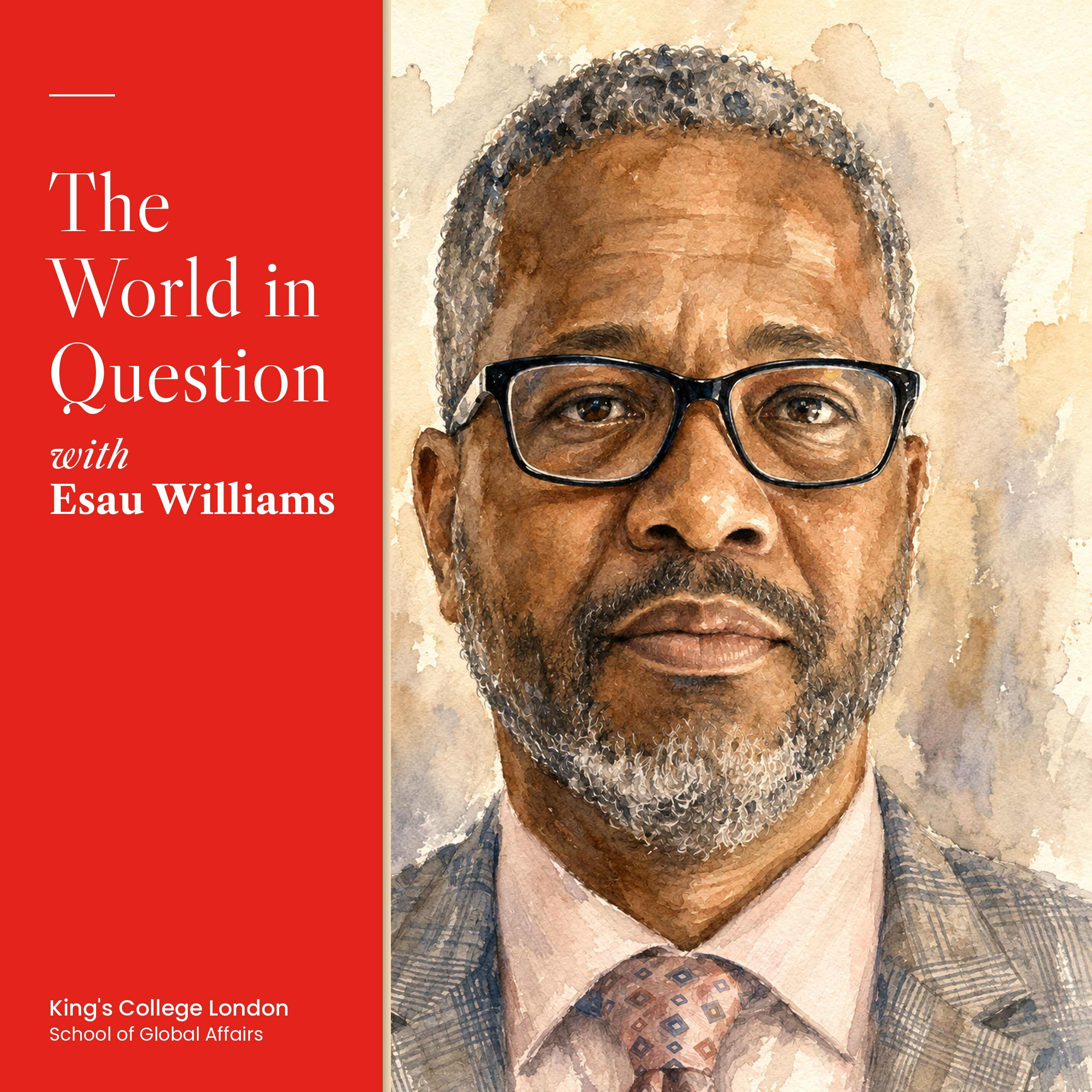
PODCAST · news
The World in Question
by King's Global Affairs | King's College London Research
Geopolitics explained through world events and international politics: the global affairs podcast from King's College London. Hosted by Esau Williams, The World in Question brings expert guests into conversation for world news analysis of some of the biggest - and most neglected - stories shaping global politics today. Formerly WORLD: we got this. kingsglobalaffairs.substack.com
Episodes
-
Sacrificing the Ocean to Save the Planet
Beneath the vast expanse of the Pacific Ocean lies an unseen world: deep seabeds dotted with metal-rich nodules that some claim are vital for the green transition. As demand grows for minerals used in renewable technologies and batteries, governments and companies are increasingly turning their...
-
Future-Proofing the UK
In this episode, host Esau Williams explores how the UK can prepare for a future shaped by rising temperatures, heavier rainfall, and rapidly shifting social and environmental pressures. From heatwaves and flooding to community resilience and communication strategies that genuinely resonate, this...
-
The Future of Overseas Aid
In this episode of The World We Got This, host Esau Williams explores how international development is being reshaped as governments cut budgets, multilateral institutions restructure, and aid becomes increasingly tied to national interest. Recorded in the wake of the International Development...
-
Invisible Water
When you pick up a packet of food in the supermarket, you can see the calories, protein and fibre listed clearly. But there’s one ingredient you’ll never find on the label, even though it’s essential to producing almost everything we eat: water. And not just the water you can see in a juicy…
more -
Dust Storm Diplomacy
In March 2021, Seoul woke up under a thick yellow haze - the worst dust storm in a decade. South Korea blamed China, who promptly blamed Mongolia. Fingers were pointed, narratives emerged, and what seemed like a weather event quickly became a diplomatic one. Since then, dust storms have continued...
-
Too hot to live
A recent assessment found that the area of Earth's landmass that will be too hot for even healthy adults to keep a safe core body temperature will approximately triple - to an area almost the size of the US – if global warming reaches 2°C above the preindustrial average. We've already reached...
-
Dam clever: is world's biggest hydro scheme a good idea?
The proposed Grand Inga dam in the Democratic Republic of Congo would be the largest power station in the world - if its ever built. With twice the output of China's Three Gorges, the dam could potentially bring electricity to those 600 million in sub-Saharan Africa currently without. But after...
-
A deep dive into DeepSeek
What is the new app DeepSeek? How does it differ from other LLM providers? And why has it caused such a significant impact on the US AI industry? In this episode, Esau is joined by Sean Starrs and Juan Grigera, from the Department of International Development, King's College London to discuss all...
-
Forty years on from Band Aid, what is the UK-Africa relationship? And what happened at COP29?
As the 40th anniversary version of 'Do They Know It's Christmas?' hits the charts, and with Ed Sheeran igniting a row over whether it and similar charity initiatives reinforce African poverty stereotypes, Esau and guests discuss the current state of the UK-African relationship. Plus, what the…
more -
What Trump 2.0 means for Ukraine, India, China and the world
Donald J Trump is set to make a historic comeback as the 47th US President after a decisive electoral victory over Democratic candidate Kamala Harris. In this episode, host Esau Williams talks to Dr Sean Starrs, an expert in international development, and Dr Anastasia Piliavsky, a Ukrainian who...
-
Should we super tax the super rich? And what happened at the BRICS+summit
In the wake of the UK budget, and a report from Greenpeace on the feasibility of a wealth tax on the super rich, the panel discuss whether such a measure is possible or even likely. Plus, what happened at the BRICS+ summit, and was it a success for Putin and his allies? Joining Esau this episode...
-
Spotlight on China – SEZs in Africa, China’s ghost cities and China in the US elections
In this special episode for the Lau China Institute’s China Week, Esau is joined by Dr Charlotte Goodburn to discuss her new report on the impact of China-linked economic development zones in Africa, Dr Jane Hayward explains China’s many vacant cities, and Professor Astrid Nordin and Dr Sean...
-
Nuclear energy; Modi in US; September flooding
With Esau this episode: Prof Frans Berkhout talks about the pledge by the big banks to triple nuclear energy by 2050; Dr Anastasia Piliavsky digs deeper into Narendra Modi's visit to the US; and PhD candidate Teyah Payne discusses recent flooding in the global north and south. Hosted on Acast.…
more -
In conversation about studying loneliness and ageing in Southeast Asia
When Samia Akhter-Khan spent a year in Myanmar with older adults, she became curious to understand how loneliness operates in such social contexts where communities are tight knit. So for her PhD project, she chose to conduct research into loneliness in later life in Thailand and Myanmar. In this...
-
The far-right and the changing politics of Europe
The far-right has seen its popularity grow across Europe in recent years and is expected to gain a quarter of the seats in the European Parliamentary elections this year. In this episode, Dr Georgios Samaras, Assistant Professor in Public Policy at King’s College London’s International School for...
-
In conversation about the disruptive potential of Argentina’s feminist movements
What can feminist movements worldwide learn from Argentina? A lot it seems. In this episode, Lea Happ, PhD student in the Department of Global Health & Social Medicine talks to her supervisor Dominique Béhague about her research on the feminist activist networks in Argentina. She studies how the...
-
What do current conflicts tell us about the world today and our prospects for peace?
As the war in Ukraine enters its third year, there is also ongoing fighting in Gaza, attacks on cargo ships in the Red Sea and subsequent US and UK air strikes. This has prompted some to warn we are a moving from a post-war to a pre-war world. In this latest episode, Dr Marina Miron, a...
-
Can we really rely on planting trees to help limit climate change?
In this episode, researcher Ol Perkins explores whether land-based carbon dioxide removal schemes such as reforestation can live up to their promises and help us meet global pledges to limit climate change. Ol outlines some of the challenging implications of this approach and why experts and...
-
In conversation about Nigeria's strategic role in West Africa
What strategic role has Nigeria played on issues of peace and security in West Africa? What do Nigeria's past interventions in Liberia and Sierra Leone tell us about its role in the region today? In this episode, Dr Folahanmi Aina, who recently completed his PhD from the African Leadership Centre...
-
The impact of colourism on people and societies around the world
This episode looks at how colourism affects people and their life chances, plus how research is helping to fill the gaps in our knowledge around this pervasive, but perhaps not widely known form of discrimination. Featuring Dr Aisha Phoenix, a social justice lecturer from the School of Education,...
-
In conversation about the Dravidian movement's transition into party politics
How does a movement for social justice transform into a viable political party? How are the ideas of the movement reshaped in the process? In this episode, Dr Vignesh Rajahmani, who completed his PhD from the King's India Institute, speaks to Professor Christophe Jaffrelot, Professor of Indian...
-
How Russia is outmanoeuvring Western sanctions
The international community imposed far-reaching sanctions on Russia following its invasion of Ukraine in a bid to weaken its economic base and curtail its ability to wage war. However, the war continues. So, what has happened? Have the sanctions not worked as hoped? And if not, why not? In this...
-
In conversation about Brazil’s defence agenda in the South Atlantic
What life skills can one learn from doing a PhD? In this episode, Dr Maísa Edwards who recently completed a joint PhD from the King’s Brazil Institute and the University of São Paulo talks about her research on Brazil’s diplomatic and defence relations in the South Atlantic region. Speaking to Dr...
-
What is the world’s problem with migration?
Migration is a topic that preoccupies many countries around the world and this new episode looks at some of the current global challenges around migration including exploring what impact immigrants have on jobs and public services, whether politicians are in step with public attitudes towards...
-
In conversation about China and UK relations through film
Why aren't mainland Chinese films box office hits in the UK? Do Chinese people watch films produced in the UK? PhD student, Giulia D'Aquila researches an agreement between China and the UK on film production and distribution. In this episode, she reflects on how films from mainland China are...
-
In conversation about digitalisation and welfare entitlements in India
Is technology really helping people in India to receive their welfare entitlements? Or is digitalisation affecting their agency? And how does it affect local state actors? These are some of the questions PhD student, Vanita Leah Falcao is exploring in her thesis. In this episode, she speaks with...
-
Guest episode - A year of war in Ukraine: what have we learned?
As we recently marked a year since Russia invaded Ukraine, we are sharing an episode of The War Studies Podcast produced by our Department of War Studies looking back at what we have learned over the past year of fighting and what it might mean for the future. It features Dr Marina Miron, who…
more -
Are public protests challenging authoritarian regimes around the world?
This new episode looks at recent large-scale public protests in Russia, China and Iran including what has sparked them and what they tell us about the balance of power of these regimes. The episode, featuring academics from the Faculty of Social Science & Public Policy, looks at the effects of…
more -
In conversation about state-society relations and studying at King's
Master's alumna Linette Lim's focused her dissertation looked at why some Indian states far out-perform others in the Human Development Index (HDI). In this episode, she shares how she came up with this research puzzle and her journey post-master's degree. This includes her life as a foreign...
-
In conversation about sand dunes, climate change and Mars
What can the life of sand dunes on Mars tell us about climate change on Earth? In this episode, PhD student Lucie Delobel shares her love of sand dunes and how she went from studying them on Earth to studying them on Mars. Her master's dissertation became a leading article for Nature Climate…
more -
Are we at a pivotal moment in the climate crisis?
This episode looks at where we are in the climate crisis, how recent events including war and economic crises have affected the priority of environmental issues and whether we still have time to make a difference. It features two academics from the Faculty of Social Science & Public Policy at...
-
In conversation about decolonising sexual reproductive health
What shapes and enables women's rights to be fully enacted in a world where sexual reproductive health is politicised? What exactly is the reproductive justice movement? And how important is it to understand our past when it comes to making informed decisions about women's bodies? In this…
more -
The political consequences of the pandemic
This podcast episode looks at the huge political consequences of the COVID-19 pandemic and how its effects are still being felt at every level around the world today. It explores how the pandemic affected the standing of global leadership organisations, as well as challenging previously held…
more -
In conversation about marine conservation
What can we do to protect our oceans? Are 'Marine Protected Areas' an effective method of ecosystem management? These are some of the questions that PhD Candidate, Constance Schéré, aims to answer through her research. Hear Constance discuss her research with Kate Schreckenberg, Head of King’s...
-
Facing up to the energy crisis
This episode explores the important role of energy in the geopolitical order on our planet. It explores how China can meet its energy needs and climate commitments, the potential impact of the war in Ukraine on Russia's role as an energy superpower, plus why we are still so reliant on fossil…
more -
In conversation about the war on drugs in Guatemala
With the mass incarceration of women quintupling in Guatemala as a result of the 'war on drugs', Gloriana Rodriguez Alvarez, PhD candidate and human rights advocate, asks how the country's policies and institutions perpetuate social prejudices and impact marginalised communities. In this episode,...
-
The role of space in modern-day warfare
The invasion of Ukraine has shown how new technologies are now used alongside more traditional means of waging war. This episode, the second on the Changing Face of War, looks at how space has become an integral part of military and security operations today, how countries around the world and...
-
How cyber operations, social media and artificial intelligence are changing warfare
In this episode Dr Tim Stevens and Dr Kenneth Payne, both based in the School of Security Studies in the Faculty of Social Science & Public Policy at King's College London, explore the role of cyber operations, social media and artificial intelligence in modern warfare. They explain how our...
-
In conversation about how foreign policy interacts with health
How does foreign policy interact with health? And how is power intertwined with health policy? In this episode, Maria Berta Ecija Salgado, PhD alumnus, discusses her research on soft and hard power in Brazil foreign affairs. This included conducting field work in Mozambique to explore the role of...
-
Why does global poverty exist and could we share wealth more evenly?
The latest episode of the ‘WORLD: we got this’ podcast explores how poverty affects people around the world and hears what could be done to distribute wealth more evenly. In the episode, Dr Eduardo Ortiz-Juarez, Dr Liz Fouksman and Otto Lehto, who are all part of the Faculty of Social Science and...
-
In conversation about a future with no humans as we know them
Last year, Sara Dahlen won King’s Biotechnology & Society Essay Contest on the theme: "In the future there will be no humans as we know them. So what?” Her essay, “Notes to No-One”, imagines a future after an ecological collapse where humanity has almost been destroyed by climate change…
more -
In conversation about communicating the risk of COVID
During the pandemic, how have governments’ approach to communication impacted our sense of risk? Have our governments helped us to feel safe and alert or just confused? In this episode, George Warren, a King’s PhD candidate, takes a look at different governments’ communications strategies around...
-
How gender inequality impacts society
The latest episode of the WORLD: we got this podcast explores how gender inequalities are having an impact on different societies across the globe and hears what could be done to create a more equal world. In the episode, Dr Ye Liu, Professor Cathy McIlwaine and Dr Aleida Borges, who all work in...
-
In conversation about corporate accountability
What is the role of companies in complex crises, such as pandemics, inequality and climate change? How responsible are they for their impact on society and the environment? And what about the CEO – what is their role in the corporate response to crises? In this episode, Marc Lepere explores these...
-
Our divided society
This episode looks at division and polarisation in society and explores what could help create a greater sense of unity in the future. It features Professor Bobby Duffy, Paula Surridge and Dr Jack Brown who all work within the Faculty of Social Science & Public Policy at King's College London,...
-
In conversation about gender bias and climate
Are women climate scientists judged for speaking out about climate change? After all, women have often, and still are, dismissed as dramatic or emotional in the public sphere. Hear from master's graduate, Lauren Armstrong as she explores her research on the topic with Dr George Adamson, Senior...
-
Inaction on climate change
This episode, released ahead of the COP26 climate summit, looks at why we aren’t doing more to tackle climate change and what society, governments and individuals can do turn current inaction into action. It features Dr Kris de Meyer, Dr James Porter and Dr Anshu Ogra from the Faculty of Social...
-
A public health approach to online abuse with Seyi Akiwowo
We speak with campaigner, activist and CEO Seyi Akiwowo about the impact of online abuse, and why taking a public health approach might be a way forward. Seyi founded and now runs the charity 'Glitch'. You can find out more by heading to https://fixtheglitch.org/ Hosted on Acast. See...
-
Feminist International with Veronica Gago
How has the feminist movement been democratised? What differentiates the feminist strike front from the conventual labour strike? And how do we bring feminist activism into the everyday? In a special WORLD: we got this takeover, we hand the podcast over to the Gender Studies Network at King’s....
-
Water diplomacy with Dr Naho Mirumachi
What is water diplomacy? Will Climate Change result in increased conflict over water access? And what should countries and organisations be doing to make sure the world be doing to make sure the world works together on water access? We speak to Dr Naho Mirumachi on World Water Day about Water...
We're indexing this podcast's transcripts for the first time — this can take a minute or two. We'll show results as soon as they're ready.
No matches for "" in this podcast's transcripts.
No topics indexed yet for this podcast.
Loading reviews...
ABOUT THIS SHOW
Geopolitics explained through world events and international politics: the global affairs podcast from King's College London. Hosted by Esau Williams, The World in Question brings expert guests into conversation for world news analysis of some of the biggest - and most neglected - stories shaping global politics today. Formerly WORLD: we got this.
kingsglobalaffairs.substack.com
HOSTED BY
King's Global Affairs | King's College London Research
Loading similar podcasts...
Frequently Asked Questions
How many episodes does The World in Question have?
The World in Question currently has 80 episodes available on PodParley. New episodes are automatically indexed when they're published to the podcast feed.
What is The World in Question about?
Geopolitics explained through world events and international politics: the global affairs podcast from King's College London. Hosted by Esau Williams, The World in Question brings expert guests into conversation for world news analysis of some of the biggest - and most neglected - stories shaping...
How often does The World in Question release new episodes?
The World in Question has 80 episodes. Check the episode list to see recent publication dates and frequency.
Where can I listen to The World in Question?
You can listen to The World in Question on PodParley by clicking any episode. We provide an embedded audio player for direct listening, and you can also subscribe via your preferred podcast app using the RSS feed.
Who hosts The World in Question?
The World in Question is created and hosted by King's Global Affairs | King's College London Research.
URL copied to clipboard!