
PODCAST · health
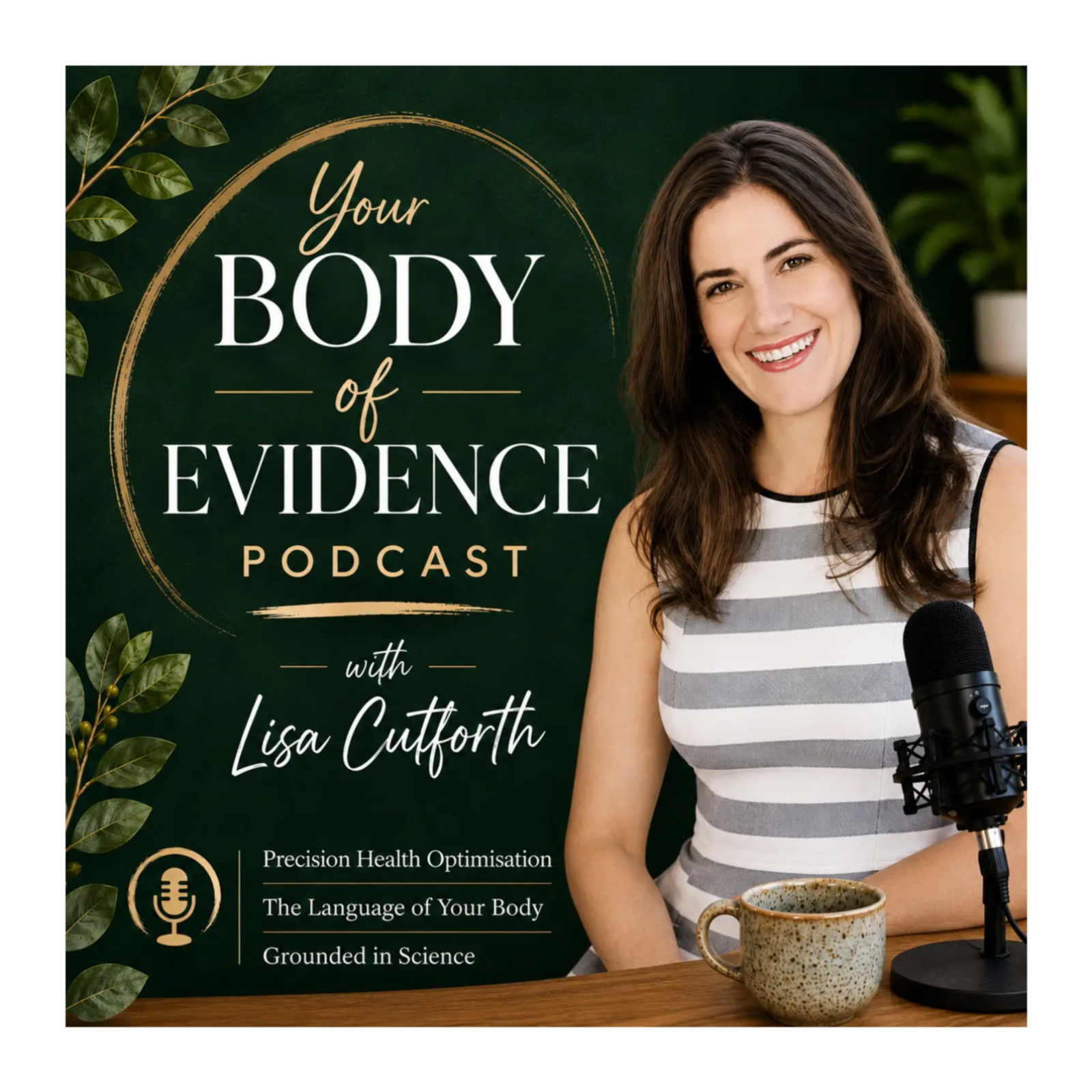
Your Body of Evidence
by Lisa Cutforth BSc. Hons. Nutrition & Psychology. Grad Cert Mental Health & Neuroscience. DNA cert pr
Nutrition, neuroscience and the biochemistry of a better life, underpinned.You are unique, it's got its own programming and instruction manual running behind the scenes, and nutrition, our psychology and our environment are at the controls. Most people have never read the instruction manual, many don't perform any regular checks, they are just driving blind. There are a multitude of health podcasts that tell you what the research says. Information is only one part of the solution, context is another, but there are also others. Your Body of Evidence gives you the research, and helps you apply it to yourself and into the context of your life, giving it more meaning and relevance. That is a different conversation entirely.
-
4
Pop-neuro Myth Busting: "The brain finds change scary" and "People are afraid of change" are inaccurate, here's what's really going on.
The brain has an accelerator, and a brake when it comes to change. Hearing professionals talking about the idea that people are afraid of change, or that the brain fears change as a blanket truth, winds me up because it's inaccurate. People don't always resist change, even though they sometimes resist the discomfort of change. I have spent 20 years helping people change behaviours and while I would agree change isn't always easy, its not because we fear it that makes it hard. It's less about fear and more about economics. The question isn't how do we overcome a fear of change, but rather how do we make the change easier and more beneficial? There's a few other things at play... in this very brief post, I challenge the idea, and explain a few ways around understanding and incentivising change.
-
3
Does your Personality decide your health?
Does your personality decide your health?Can personality affect health? The short answer is yes, but it’s not the whole story or the most interesting part.Of the five major personality traits, conscientiousness predicts health and longevity more consistently than any other. Two large studies make the case, including one of nearly half a million people in which low conscientiousness predicted poorer health, higher body mass and more substance use across every demographic tested.The effects are real, replicated, but modest. Personality nudges the odds; it doesn't write the outcome.Openness looks irrelevant to general health but seems to quietly support healthy ageing, drawing on a 2026 Sardinian Blue Zone study.In terms of health risks the old Type A myth (negative connection with health) is updated, it's hostility (the opposite end of agreeableness) that carries cardiovascular risk, not drive or busyness. And conscientiousness isn't linearly good: the same drive for structure and control is, at its extreme, a recognised vulnerability, most clearly in restrictive eating.I also mention a place for Myers Briggs Instrument Typing (MBTI) even though there’s less rigorous research in the health domain, type has a useful vocabulary; but the traits underneath explain the link. The episode also briefly covers off on genes and what heritability does and doesn't mean for you when it comes to your personality.The final third gives some practical tips. Traits aren't fixed. Low conscientiousness responds to environmental design (by reducing friction, and adding external structure and accountability) you can increase ability factors. But the big take away is self-efficacy. Self efficacy is the task-specific belief that you can do one particular thing. It can be built in weeks through small guaranteed wins. Be careful of an over-ambitious plan, it’s worse than useless: it hands you evidence against yourself.The summary: you can't choose your starting temperament, but you can choose a plan that’s right for you. Most plans fail because the plan was built for somebody else, not because the person is weak, unmotivated, lazy or doesn’t have the right information.SupportA note on the middle section: this episode briefly discusses disordered eating. If that's a live issue for you, the Butterfly National Helpline is 1800 33 4673 (open 8am–midnight, 7 days). It's not a crisis line, in a crisis, call 000 or Lifeline on 13 11 14.Reference list on lisacutforth.com.auImage credit: by Hello">https://pixabay.com/users/cdd20-1193381/?utm_source=link-attribution&utm_medium=referral&utm_campaign=image&utm_content=4915684">Hello Cdd20 from Pixabay">https://pixabay.com//?utm_source=link-attribution&utm_medium=referral&utm_campaign=image&utm_content=4915684">Pixabay
-
2
What functional testing reveals that a standard blood panel misses.
You have had blood tests. Your GP has told you everything is normal. You do not feel normal. This episode is about the gap between normal and optimal, and the testing that lives in that space. Specifically this episode talks about 5 tests I recommend you ask for.Lisa Cutforth is a degree qualified integrative health practitioner, combining her qualifications in nutrition, psychology, neuroscience and genetics to help leaders optimise their health, performance and lifespan.
-
1
Methylation: Beyond MTHFR, The Masterswitch that most execs ignore or don't know enough about.
Methylation is one of the most fundamental biochemical processes in the human body, occurring billions of times per second, in every cell. It governs gene expression, neurotransmitter production, detoxification, and how your body responds to sustained stress among so many other things. Yet many high-performing executives don't fully understand how important it is, and those who have heard of it, often think it begins and ends with MTHFR.In this episode, Lisa Cutforth unpacks what methylation actually is, why it matters for cognitive performance, resilience, and your healthspan, what happens when it quietly fails to work properly, and why everyone won't respond well to the same supplement stack. No hype. Just the science, and your body of evidence and what to do about it.Reference List:1. Cui H, Xie N, Banerjee S, et al. Methylation across the central dogma in health and diseases: new therapeutic strategies. Signal Transduction and Targeted Therapy. 2023;8:310. https://www.nature.com/articles/s41392-023-01528-y2. Fitzgerald KN. How Targeting DNA Methylation Affects These 6 Common Conditions. drkarafitzgerald.com, 4 June 2024. https://www.drkarafitzgerald.com/2024/06/04/how-targeting-dna-methylation-affects-these-6-common-conditions/3. Menezo Y, Clement P, Clement A, Elder K. Methylation: An Ineluctable Biochemical and Physiological Process Essential to the Transmission of Life. International Journal of Molecular Sciences. 2020;21(23):9311. https://doi.org/10.3390/ijms212393114. UNSW Newsroom. ‘How do we know what we don’t know?’: scientists completely define the process of methylation. 1 June 2023. https://www.unsw.edu.au/newsroom/news/2023/06/-how-do-we-know-what-we-don-t-know----scientists-completely-defi5. Kiselev IS, Kulakova OG, Boyko AN, Favorova OO. DNA Methylation As an Epigenetic Mechanism in the Development of Multiple Sclerosis. Acta Naturae. 2021;13(2):45–57. https://doi.org/10.32607/actanaturae.110436. Fitzgerald KN, Hodges R, Hanes D, et al. Potential reversal of epigenetic age using a diet and lifestyle intervention: a pilot randomized clinical trial. Aging. 2021;13(7):9419–9432.7. Walsh WJ. Nutrient Power: Heal Your Biochemistry and Heal Your Brain. New York: Skyhorse; 2014. (Clinical undermethylation/overmethylation typology, applied here as one interpretive lens.)
We're indexing this podcast's transcripts for the first time — this can take a minute or two. We'll show results as soon as they're ready.
No matches for "" in this podcast's transcripts.
No topics indexed yet for this podcast.
Loading reviews...
ABOUT THIS SHOW
Nutrition, neuroscience and the biochemistry of a better life, underpinned.You are unique, it's got its own programming and instruction manual running behind the scenes, and nutrition, our psychology and our environment are at the controls. Most people have never read the instruction manual, many don't perform any regular checks, they are just driving blind. There are a multitude of health podcasts that tell you what the research says. Information is only one part of the solution, context is another, but there are also others. Your Body of Evidence gives you the research, and helps you apply it to yourself and into the context of your life, giving it more meaning and relevance. That is a different conversation entirely.
HOSTED BY
Lisa Cutforth BSc. Hons. Nutrition & Psychology. Grad Cert Mental Health & Neuroscience. DNA cert pr
Loading similar podcasts...
Frequently Asked Questions
How many episodes does Your Body of Evidence have?
Your Body of Evidence currently has 4 episodes available on PodParley. New episodes are automatically indexed when they're published to the podcast feed.
What is Your Body of Evidence about?
Nutrition, neuroscience and the biochemistry of a better life, underpinned.You are unique, it's got its own programming and instruction manual running behind the scenes, and nutrition, our psychology and our environment are at the controls. Most people have never read the instruction manual, many...
How often does Your Body of Evidence release new episodes?
Your Body of Evidence has 4 episodes. Check the episode list to see recent publication dates and frequency.
Where can I listen to Your Body of Evidence?
You can listen to Your Body of Evidence on PodParley by clicking any episode. We provide an embedded audio player for direct listening, and you can also subscribe via your preferred podcast app using the RSS feed.
Who hosts Your Body of Evidence?
Your Body of Evidence is created and hosted by Lisa Cutforth BSc. Hons. Nutrition & Psychology. Grad Cert Mental Health & Neuroscience. DNA cert pr.
URL copied to clipboard!