
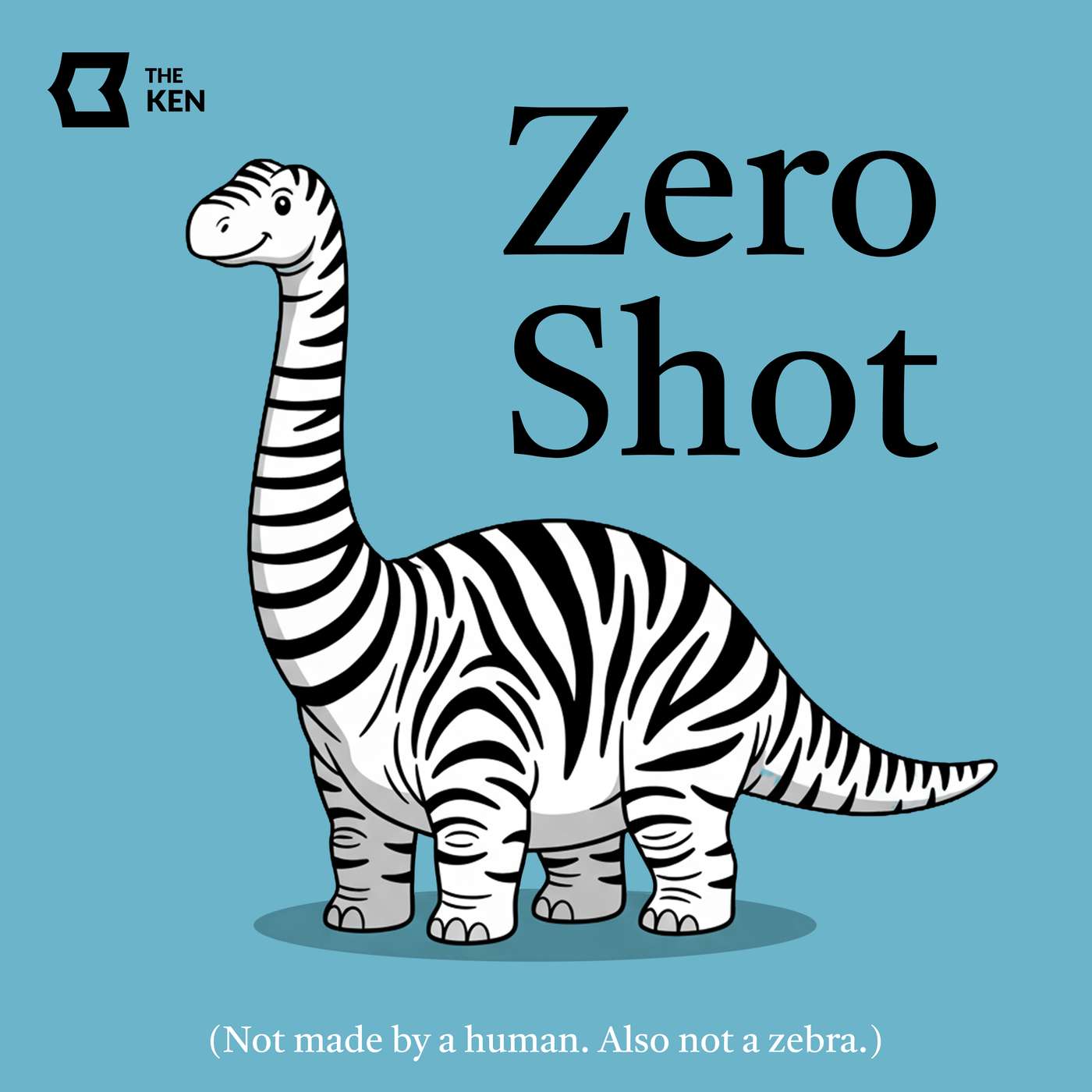
PODCAST · technology
Zero Shot (Private)
by The Ken
Join Brady Ng, Praveen Gopal Krishnan, and Rohin Dharmakumar of The Ken as they discuss the big ideas in artificial intelligence. You’ll get the macro view, explore their experiments in practical applications, go deeper than the news coverage you’ve seen, and hear about the implications of the latest developments. Nothing is off the table.
-
49
Uber and Meta have said no to toxenmaxxing. Make way for 'yieldmaxxing'
If you have been paying attention, something has been happening within tech companies. And it has to do with tokens. But not what you think.After killing its AI leaderboard, Meta announced a new platform to track AI usage and spending. Microsoft has started cancelling the Claude Code licenses of its employees. Uber said it ran out of its token budget for 2026. And then came the latest news of Anthropic disabling Fable 5's access following the US government's directive. These four developments signal a shift underway. For the past year, the game was tokenmaxxing: use as much AI as possible, as often as possible, on everything. Enterprises are now asking whether this obsession was worth it. We are giving that question a name: "yieldmaxxing". Our thesis is simple. The big challenge now is this: how we will use AI safely and reliably without lock-ins and exploding bills, while remaining strategically nimble?To figure out what the token burn and its aftermath looks like, we have Gaurav Mishra on this episode of Zero Shot. Gaurav worked across many companies we are talking about. He was at Yahoo, Meta, and headed product for Uber AI. He is now the CEO of Proshort, an AI-powered contextual sales platform.Tune in!____This episode was produced by Vidhatri Rao and edited by Rajiv CN.____Zeus, the mascot of Zero Shot, was generated using AI. Everything else is made by humans, just like all articles, columns, newsletters, and other podcasts created by The Ken.Write to us at [email protected]. We are all ears!____Zeus, the mascot of Zero Shot, was generated using AI. Everything else is made by humans, just like all articles, columns, newsletters, and other podcasts created by The Ken.Write to us at [email protected]. We are all ears!____Recommended Reading: https://finance.yahoo.com/markets/stocks/articles/meta-ai-costs-spike-company-225410935.html https://www.projectflux.ai/p/blown-by-april-why-uber-s-3-4-billion-r-d-budget-could-not-hold-the-line-on-ai-coding-spendhttps://www.thestreet.com/technology/microsoft-ceo-sends-shocking-message-to-employees
-
48
Physical AI is a Mexican standoff. Who walks away as the winner?
Think of an action or crime film. At some point, when all of the different threads and plots converge, you witness a high-stakes scene. Three characters are locked in a fight. You don’t know who emerges a winner. This is what is loosely called a Mexican standoff. Apply this analogy to physical AI. There are currently three players in the game. America has BigTech and big models that only seem to be getting bigger. China has actual manufacturing capabilities and a sharp-minded executional focus on hardware. And then there are places like India and Nigeria that provide the data for some of these robots, especially “humanoids”.In this episode of Zero Shot, host Praveen Gopal Krishnan talks to The Ken reporter Sakshi Sadashiv who wrote about the mushrooming gig economy around data collection to create robots that perform human tasks. We are also joined by Pramod Ghadge, the co-founder of Unbox Robotics, an Indian company that has deployed 700 robots across nine countries for a specific use-case: warehouses.Each has a take on who wins. But more importantly, this episode takes you inside the growing Physical AI market. Tune in! Additional Material: AI product differentiation, living with robots, world models, and extreme leverageTesla and Figure AI are building robots to act like humans. Indian workers are teaching them howThe GPT Moment for Robotics Is Herehttps://unboxrobotics.com/
-
47
Lossfunk is the third space for Indian AI, beyond industry and academia
After 15 years of building Wingify, Paras Chopra spent some time deliberating about his next stint.For years, he had chased the 0 to 1 journey of building something from the ground up and watching it grow. He wanted to chase that in his next stint too.But he knew it had to be different.There would be no product. Forget that, he decided the next project would barely have any commercial inclination. Instead, he followed his curiosity and instinct as a child passionate about science.That’s how Lossfunk, a “cosy home” for “independent researchers” was born.Paras describes Lossfunk as the place where everyone — from undergrads to PHDs to just inquisitive people— ask foundational questions on AI away from the pressures that burden academia and labs attached to big tech companies.In this episode of Zero Shot, Paras gets into the journey of Lossfunk and talks about its motivations and principles.Now, a lot of the questions Lossfunk is asking might not result in a flashy new product that changes consumer behaviour. They might just become a research paper. Or two. For Paras, that's completeley alright because building a “research attitude” may fully be the point.____This episode was produced by Vidhatri Rao and edited by Rajiv CN.____Zeus, the mascot of Zero Shot, was generated using AI. Everything else is made by humans, just like all articles, columns, newsletters, and other podcasts created by The Ken.Write to us at [email protected]. We are all ears!Additional ResourcesLossfunkhttps://lossfunk.comInverted Passionhttps://invertedpassion.comEsoteric programming languageshttps://spectrum.ieee.org/esoteric-programming-languages-daniel-temkinManifesto for doing good science in AIhttps://letters.lossfunk.com/p/manifesto-for-doing-good-scienceParticle Feverhttps://particlefever.com/
-
46
HCL invests in Sarvam and goes down the 5-layer AI cake
For decades, Indian IT grew and grew some more based on the labor arbitrage model: deploy engineers from Bangalore at one-sixth the cost of an American engineer, bill, repeat. The industry perfected the art of selling "services" instead of building and owning technology. But AI has quickly made the engineer a commodity. The big question now is how IT services will pivot and reinvent.A step in that direction was seen recently, when news spread that HCLTech looks all set to invest $150M into Sarvam and lead its latest funding round. But what exactly is HCL buying and what is Sarvam selling? That's the crux of this episode of Zero Shot. Host Rohin Dharmakumar is joined by Abhishek Pathak, the lead IT analyst at Motilal Oswal and Kashyap Kompella, the founder of RPA2AI Research, who has spent 25 years across AI strategy, M&A advisory, and industry analysis.While both agree the investment signals a shift from applications, they debate the core tensions and questions surrounding this deal. Tune in and hear them unpack the move that could define the shape IT services will take going forward. ____Additional material: https://x.com/nathanclark_/status/2056947354654355849?s=20https://the-ken.com/story/google-meta-are-building-huge-data-centres-in-vizag-nobody-told-the-power-gridhttps://www.moneycontrol.com/news/business/startup/hcltech-to-lead-300-million-sarvam-ai-round-with-150-million-bet-at-1-5-billion-valuation-13918719.htmlhttps://rpa2ai.com/about/team/https://www.linkedin.com/in/abhishek-pathak-841a3494https://blogs.nvidia.com/blog/ai-5-layer-cake/____This episode was produced by Vidhatri Rao and edited by Rajiv CN.____Zeus, the mascot of Zero Shot, was generated using AI. Everything else is made by humans, just like all articles, columns, newsletters, and other podcasts created by The Ken.Write to us at [email protected]. We are all ears!
-
45
‘The application layer is dead': SpotDraft's Shashank Bijapur on why System of Record is the real moat
Another day and another Anthropic announcement has spurred conversation. This time, it is Claude for Legal services. On May 12, Anthropic unveiled 20+ new "MCP connectors that link Claude to the software the legal industry runs on". Think Westlaw, LexisNexis, DocuSign. Alongside this, it announced 12 "new plugins tailored to specific legal work". With every new Anthropic announcement, we typically ask two questions on Zero Shot. Are actual workflows impacted? And what does this do to companies building in similar spaces?In our latest episode, we sat down with Shashank Bijapur, the co-founder and CEO of SpotDraft, to find out more. SpotDraft works on contracts, a crucial component of a lawyer's workflow that Anthropic wants to augment.But Shashank is not worried. He calls Claude the UPI layer. What you build on top of it is "heavily defensible," he adds. But what exactly is SpotDraft building that enables it to work with Claude as opposed to being pressured by its entry into the legal tech stack? Tune in!____Additional material: An AI System Built by Litigators, for Litigatorshttps://law-disrupted.fm/ai-system-built-by-litigators/Claude for the legal industryhttps://claude.com/blog/claude-for-the-legal-industryMike OSShttps://mikeoss.com/____This episode was produced by Vidhatri Rao and edited by Rajiv CN.____Zeus, the mascot of Zero Shot, was generated using AI. Everything else is made by humans, just like all articles, columns, newsletters, and other podcasts created by The Ken.Write to us at [email protected]. We are all ears!
-
44
Anthropic's agents are your new finance professionals. But they don’t offer investment advice
On May 5, Anthropic released 10 financial services agents. The company said they “pair best” with Claude Opus 4.7, a “state-of-the-art” model that leads the industry on financial agent benchmarks. And the hype followed. The media called the agents a threat to Wall Street.The reality is more complicated.In today’s episode of Zero Shot, hosts Brady Ng and Praveen Gopal Krishnan are joined by Musheer Ahmed, founder of FinStep Asia and ex-trader, and Sharath Chandra, founder of EmpowerEdge Ventures, to make sense of what actually changed.The conversation covers why financial services keeps attracting AI investment, why the 10 agents are more useful to junior analysts than to the industry at large, and why trust remains the real bottleneck in finance. They also get into data residency, the regulatory moat protecting incumbent banks, and what happens to a service like the Bloomberg terminal.____This episode was produced by Vidhatri Rao and edited by Cymasonic productions.____Zeus, the mascot of Zero Shot, was generated using AI. Everything else is made by humans, just like all articles, columns, newsletters, and other podcasts created by The Ken.Write to us at [email protected]. We are all ears!Additional ResourcesWho watches the AI watching your money?https://the-ken.com/kaching/who-watches-the-ai-watching-your-money/Anthropic releases new AI agents for financial services firmshttps://www.wsj.com/tech/ai/anthropic-releases-new-ai-agents-for-financial-services-firms-e2829b37Anthropic unveils AI agents for financial services taskshttps://www.youtube.com/watch?v=W3RLgeUiUXYAI for financial serviceshttps://www.anthropic.com/news/finance-agents
-
43
The AI wearable market is full of dead devices. NeoSapien thinks India can turn the tide
What is the market for AI wearables? And what do they do that a phone already doesn’t?These were the two main questions we asked Dhananjay Yadav, the co-founder and CEO of NeoSapien, a startup that makes an AI-powered pendant that “transcribes in real time, summarises what matters, and reminds you to follow through”. He calls it a “productivity tool” that will change how we interact with devices.But the AI wearable market is tricky. Remember Humane? The AI pin company? It raised $230 million, shipped fewer than 10,000 devices, and permanently bricked every single one of them on February 28, 2025. And Rabbit, the other AI wearable startup that made a big splash, sold 100,000 units and watched 95% of its users disappear within five months. And yet here is Dhananjay who is building a pendant in Bengaluru, telling us India can win the global AI wearable race. And the product, he says, will be used by regular people: small business owners, real estate agents, and even journalists. Tune in!____This episode was produced by Vidhatri Rao and edited by Cymasonic productions.____Zeus, the mascot of Zero Shot, was generated using AI. Everything else is made by humans, just like all articles, columns, newsletters, and other podcasts created by The Ken.Write to us at [email protected]. We are all ears!Additional material:NeoSapienWhat Anthropic’s Mythos can hack in hours, Indian banks take months to fixNote taking app PlaudCan a Note-Taking AI Bracelet Really Make You More Productive? I Tested One to Find Out.
-
42
How Presentations.AI went from $0 to $5M in revenue with zero new hires
Most AI startup success stories start in November 2022. For the story of Presentations.AI, however, we have to go back to 2005.That year, Sumanth Raghavendra, who is also the co-founder of The Ken, started his first venture. It was called InstaCall. The idea was to build an online office suite in Bangalore with a team of six engineers. They ended up cracking the product, but had no way to market and sell it. It had to wind down.In 2012, when the iPhone opened up the App Store, the team dropped the full office suite idea and bet everything on one slice of it — presentations. That became Deck, a mobile-first presentation app.Deck’s thesis was that users came to a presentation tool knowing what they wanted to say, and just needed help saying it visually. But that assumption fell apart really quickly. People would land on the first slide, type a title, and freeze.This insight sent the team down a years-long road of trying to solve presentations by gathering tons of data from designers and working with traditional machine learning tools.Then, GPT arrived. Instead of panicking, the team rebuilt itself entirely, changed its tech stack, and cracked its unit economics.It reinvented itself and unveiled Presentations.AI in 2023.Now, it surfaces at the top of every search for "AI presentation maker". The startup not only survived but rode the AI wave. Sumanth tells you the story of how that panned out.Tune in!____This episode was produced by Vidhatri Rao and edited by Rajiv CN.____Zeus, the mascot of Zero Shot, was generated using AI. Everything else is made by humans, just like all articles, columns, newsletters, and other podcasts created by The Ken. Write to us at [email protected]. We are all ears!___Recommended Reading: Your Startup Is Probably Dead on ArrivalAI and the end of SaaS playbookshttps://presentations.aihttps://aiboomi.org
-
41
China built AI differently than the US. Can India do the same?
"People in Silicon Valley and in China often have assumptions about each other. And their assumptions about each other are extremely self-centered."Our guest today is Afra Wang, a fellow at the Centre for the Governance of AI and the writer behind Concurrent, a Substack that translates the tech culture of Silicon Valley and China from angels you wouldn’t typically expect. Afra understands both these tech ecosystems and is specific about what that self-centeredness looks like on both sides.Chinese entrepreneurs assume the American government has a heavy hand in pushing AI infrastructure, for example, the way Beijing does. This is just the tip of the iceberg of assumptions that both sides keep building on. Instead, in reality, there are specific ways in which AI development occurs in both places. Consider a leather factory in China using AI to scan cowhide in real time — it maps flaws, computes optimal cutting patterns, and eliminates waste. Silicon Valley has no equivalent because America doesn't have this sector. Afra sums it up: "You cannot map everything from Silicon Valley to China. You cannot map a lot of things from China to Silicon Valley." So, what’s similar and what’s different? What’s moving between these two competing systems? And what lessons does that have for India?Tune in.____This episode was produced by Vidhatri Rao and edited by Rajiv CN.___Zeus, the mascot of Zero Shot, was generated using AI. Everything else is made by humans, just like all articles, columns, newsletters, and other podcasts created by The Ken.Write to us at [email protected]. We are all ears!____Additional ResourcesChina OS vs. America OS (2026 version)https://afraw.substack.com/p/china-os-vs-america-os-2026-versionChinese Open Source: A Definitive Historyhttps://interconnected.blog/chinese-open-source-a-definitive-history/Chinese Tech Workers Are Starting to Train Their AI Doubles–and Pushing Backhttps://www.technologyreview.com/2026/04/20/1136149/chinese-tech-workers-ai-colleaguesJack Dorsey’s Block to Cut Nearly Half Its Workforce in AI Overhaul, Shares Surgehttps://www.reuters.com/business/blocks-fourth-quarter-profit-rises-announces-over-4000-job-cuts-2026-02-26/The Dark Forest Theory, Explainedhttps://www.nationalgeographic.com/science/article/dark-forest-theory-alien-lifeThe Dark Forest by Liu Cixinhttps://en.wikipedia.org/wiki/The_Dark_ForestUS bans sale of Huawei, ZTE tech amid security fears (2022)https://www.bbc.com/news/world-us-canada-63764450
-
40
Zero Shot Live: Who will survive Agentic AI in India?
Today is not regular programming for Zero Shot.We present to you a glimpse of our first live event, which we dramatically titled “The Great Unbundling”. It had a simple premise: agentic AI is coming. Soon. Hard. Fast. For India's consumer internet companies. Who will survive it? We posed this question to Muralikrishnan B, former President of Xiaomi India; Amod Malviya, co-founder of Udaan and former CTO of Flipkart; Anant Choubey, co-founder of Capillary; and Thomas Fenn, co-founder of Mahabelly and joint secretary of the National Restaurant Association of India. This was The Ken's fifth live event, and it was sold out. A big thank you to all of you who were there. We are doing a lot more events this year and if you want to be there next time, keep an eye on our website. ____This episode was produced by Vidhatri Rao and edited by Rajiv CN.____Zeus, the mascot of Zero Shot, was generated using AI. Everything else is made by humans, just like all articles, columns, newsletters, and other podcasts created by The Ken. Write to us at [email protected]. We are all ears!___Recommended Reading: The Great Unbundling
-
39
Kuku used AI to crack micro dramas. It is now coming for Bollywood
"We have 353 billion data points on user behaviour. Why wouldn't I use them to make a better story and get into newer businesses within content?"That's Kunj Sanghvi, the vice president and head of content at Kuku, explaining their next big bet on theatrical films. Kuku has seen 10 million paid subscribers and 350 million downloads so far. This is precious data of “micro segments”, people’s consumption behaviour, preferences, sentiments and indulgences. Kuku says this is the bedrock of what they do: “turning creativity into a science”. AI has been the central to how they achieved this with audio and microdramas. It is also key to what they did with their first full-length feature film, which is ready for release on May 8. In this episode of Zero Shot, Kunj walks us through how Kuku uses AI in production. It starts off with their “proprietary content genome” that ingests millions of data points, scores incoming story pitches, flags weak cliffhangers, predicts which micro-segment an idea will resonate with, and tells you what to fix before a single frame is shot. And come production, AI is helping create scale, making possible complex shots that would require budgets, extras, and massive resources. The result? A film called Indian Institute of Zombies, made at a fraction of regular film budgets. "The audience going to cinemas wants spectacle," says Kunj. "AI lets you cheat that. You can show scale without it feeling like a low-cost production."Tune in.____This episode was produced by Vidhatri Rao and edited by Rajiv CN.____Zeus, the mascot of Zero Shot, was generated using AI. Everything else is made by humans, just like all articles, columns, newsletters, and other podcasts created by The Ken. Write to us at [email protected]. We are all ears!____Recommended Reading: ‘Indian Institute of Zombies’ Marks Kuku’s Big-Screen Debut With Campus Horror ComedyMS Dhoni Invests in AI-driven Storytelling Platform Kuku
-
38
Salary, Bonus, Equity… Tokens?
Your next job offer might just come with a "token budget" line item. The idea has been gaining steam in Silicon Valley. In February, a VC named Tomasz Tunguz dropped a blog post arguing that inference costs are becoming the fourth pillar of engineering compensation alongside salary, bonus, and equity. Here is the math: the 75th percentile software engineer in the US draws $375k. Add $100k in inference costs and you're at $475k. That's 21% in tokens.A month later, Jensen Huang took this up a notch. The Nvidia CEO said he'd be alarmed if a $500k engineer wasn't burning through at least $250k worth of tokens.What does this actually mean if you're running an AI startup today? As agents go mainstream and the competition heats up, how do you stay ahead? How is the token bill allotted and negotiated? Akash Anand, CEO of Clueso, a Y Combinator-backed startup turning raw screen recordings into polished product videos, joins Zero Shot to break down his real token math.Spoiler: more tokens does not simply equal more productivity.Tune in!___This episode was produced by Vidhatri Rao and edited by Rajiv CN.____Zeus, the mascot of Zero Shot, was generated using AI. Everything else is made by humans, just like all articles, columns, newsletters, and other podcasts created by The Ken. Write to us at [email protected]. We are all ears!____Additional ResourcesHow AI is making and remaking the products that we build More! More! More! Tech Workers Max Out Their A.I. Use.Jensen Huang says he would be 'deeply alarmed' if his $500,000 engineer did not consume at least $250,000 of tokens
-
37
The AI agent era has started in China. It looks different from anywhere else
Ever wondered what happens when AI agents are adopted at scale? Look no further than China.Over the last two months, people — yes, ordinary citizens — have been installing OpenClaw on their devices. Local governments are incentivising OpenClaw projects. Grandparents are lining up to get the software installed. And a cottage industry of "influencers" is telling people how to optimise their agent usage. It's a social and cultural moment as much as a technological one. How did China get here? To answer that question, we have Kevin Xu on this episode of Zero Shot. Kevin is the founder of Interconnected Capital, a global technology hedge fund, and a widely-read writer at the intersection of technology and geopolitics.His career is seemingly divergent: former White House press staffer, head of GitHub's international expansion, and an investor in AI startups. But it is this layered perspective — of a tech analyst, writer, fund manager, and operator all rolled into one — that can truly unpack what is happening in China.Tune in!____This episode was produced by Vidhatri Rao and edited by Rajiv CN.____Zeus, the mascot of Zero Shot, was generated using AI. Everything else is made by humans, just like all articles, columns, newsletters, and other podcasts created by The Ken. Write to us at [email protected]. We are all ears!____Additional ResourcesInterconnected | Chinese open source: A definitive historyHustlers are cashing in on China’s OpenClaw AI crazeIn China, a rush to "raise lobsters" quickly leads to second thoughtsOpenClaw, government support fuel rise of 1-person companies in China"Claw-powered" one-person companies become hot topic at China's "two sessions"Explore Intermission
-
36
India’s biggest B2B marketplace takes OpenAI to court
Say you want a chunk of plywood. Or a passenger lift. Or a power cable. Or a corrugated packaging box. Chances are you will find yourself on IndiaMART, the country’s largest B2B marketplace connecting buyers with suppliers. With 60% of market share and a 12,000 crore market cap, the company essentially commands this space. There is one major problem though: ChatGPT. In December, IndiaMART filed a petition against OpenAI in the Calcutta High Court for “selective discrimination” at the hands of the company, saying that its LLM “specifically and consciously” excludes it from its results while servicing other e-commerce platforms. In a hearing, the court said the exclusion seems to have occurred “without any logic”. The case is ongoing. As our host Praveen Gopal Krishnan says, the “specifics of the case are far less interesting” than the proverbial can it seems to have kicked down the road. The case asks some crucial second, third, and fourth order questions about AI, competition, and who gets to win in this new market. To answer all of those questions and give us a picture of the regulatory landscape of India, we have Samir R Gandhi on this episode. Samir heads Axiom5, a boutique law firm specialising in competition law. He has spent over two decades at various law firms, and has had a ringside view of the development of competition law in India from the time of its enactment.He says the case gives him a sense of “deja vu” because it is fundamentally about an old incumbent being challenged by a disrupter. But the questions posed by AI systems — “part morality, part philosophical, part business model, part geopolitics” — will have wide-ranging implications for the market from a legal standpoint. Tune in! This episode was produced by Vidhatri Rao and edited by Cymasonic Productions.____Zeus, the mascot of Zero Shot, was generated using AI. Everything else is made by humans, just like all articles, columns, newsletters, and other podcasts created by The Ken. Write to us at [email protected]. We are all ears!____Recommended Reading: Ghosted by the bot: Why IndiaMART is desperate to be visible on ChatGPTCCI Rejects Allegations of Anti-Competitive Conduct against Uber and OlaAccioAmazon V. Perplexity: Welcome To The Battle For The Future Of Commerce
-
35
AI and the end of SaaS 'playbooks'
“We were so close to the finish line and boom ‘SaaS is dead’. We are restarting…. There is one more round to run.”That’s an honest admission from Avinash Raghava, the founding volunteer and CEO of the pay-it-forward community SaaSBoomi. As someone who has spent years building networks and communities — at Nasscom, Accel, and Together Fund previously — Avinash has a full view of the inflection point that founders are at.They are having to reinvent themselves, change business models and pivot entirely to become AI-native. The idea is to disrupt their own models before the market does. SaaSBoomi is undergoing its own transformation. It is now AIBoomi, with the primary focus of helping founders navigate the new world where old SaaS playbooks are irrelevant. Can there be a new playbook? How does one write it? How does one learn, grow, and create a community along the way? Avinash takes on all of these questions in this episode. The result is a conversation that captures and dissects the crossroads that SaaS is currently at. Tune in!____This episode was produced by Vidhatri Rao and edited by Rajiv CN.____Zeus, the mascot of Zero Shot, was generated using AI. Everything else is made by humans, just like all articles, columns, newsletters, and other podcasts created by The Ken. Write to us at [email protected]. We are all ears!____Recommended Reading: Which Software Companies Will Survive the SaaSpocalypseThe Three-Body Problem (novel)Dark forest hypothesishttps://annual.aiboomi.org/Over 100 Indian AI startup founders moving to US for funds and talentVoice AI has gone from whisper to commotion. Can the market get any louder?
-
34
Engineers don’t want AI tool contracts. At least the ones they are caught in
As enterprises make sure their employees use AI, integrate it into their workflows, track productivity, and highlight AI usage in their investor calls, a new kind of tension is emerging within organisations. Engineers are simply not happy with the tools they have been assigned. They want flexibility and deals with companies that make tools that actually work for them. Some are even ready to go back to no tools. Verifying AI-generated code, they say, is an extra layer that is only burdening them. Meanwhile, India’s enterprise AI ecosystem is thriving. The country has emerged as one of the fastest-growing markets for tech giant Microsoft’s AI programmer Github Copilot. In December, the company had announced that more than 200,000 Copilot licences would be deployed across TCS, Infosys, Wipro, and Cognizant. At the recent AI summit, OpenAI and Tata Consultancy Services (TCS) agreed on rolling out Enterprise ChatGPT internally. Anthropic tied up with Infosys to deploy Claude models and AI agents into enterprise workflows.Mrunmayee Kulkarni, The Ken’s AI reporter, spoke to dozens of employees and tech leaders to get to the heart of the tension. She joins us today to dissect it along with Ashwin Sekhar, the Chief Product and Technology Officer at Incred. In fact, Ashwin commented on Mrunmayee’s story. His interesting take made us reach out to him and start a conversation. And now, he finds himself on the podcast. We’d love to hear all of your takes, opinions, and thoughts. Please write to us at [email protected] *This episode was produced by Vidhatri Rao and edited by Rajiv CN.Zeus, the mascot of Zero Shot, was generated using AI. Everything else is made by humans, just like all articles, columns, newsletters, and other podcasts created by The Ken.Additional Reading: Engineers gag as Amazon, TCS, and Cognizant ram ‘mandatory AI’ into everyday workAnthropic goes to warOur agreement with the Department of WarEveryone in Seattle Hates AI
-
33
A tale of two AI summits: Beyond the stolen robot dog
Here’s a fresh take on the India AI Impact Summit that took place last week in New Delhi: it was two events stitched together, happening at the same time. There was the expo, where companies and nations showcased their products and services to 250,000 visitors. And then there was a conference where the geopolitical effects of AI were front and centre.Inderpal Singh, one of The Ken’s reporters, was on site to find out where the action was. Hear his firsthand account about what really mattered at the summit, what India’s builders were up to, and how it felt to be at what’s called the largest AI-themed gathering ever.Then, hosts Praveen Gopal Krishnan and Brady Ng discuss the ramifications of the summit and the way India is positioned—as an AI middle power, or something else? Plus, one country’s delegates were noticeably absent, and the two hosts have opposite takes on what that means.Tune in for all that and more.If you were at the India AI Impact Summit, tell us about it at [email protected] *This episode was produced by Vidhatri Rao and edited by Rajiv CN.Zeus, the mascot of Zero Shot, was generated using AI. Everything else is made by humans, just like all articles, columns, newsletters, and other podcasts created by The Ken.Additional Reading: Indian university faces backlash for claiming Chinese robodog as own at AI summitAI impact summit layoutNew Delhi declaration At A.I. Summit, India Tries to Find a Way Between the U.S. and China
-
32
Voice AI startups are drawing in VC cheques fast. Will they 'differentiate or suffocate'?
“It’s a land grab market…” That’s how our guest Devyani Gupta, the founder of voice AI startup Arrowhead, describes the space she is operating in. A simple fact illustrates the competition she is stressing on: VC funding for Indian voice AI startups went from seven crore in 2023 to 280 crore in 2025. There is a lot to unpack in these figures. And Mrunmayee Kulkarni, The Ken’s AI reporter, followed the money to do just that. She found that the voice AI market is crowded, with many operating for BFSI clients. A senior manager in a bank summed it up best: “differentiate or suffocate”. Then, there is also the possibility of major enterprises acquiring voice AI capabilities themselves. So, what is the moat for voice AI companies? Mrunmayee joins Zero Shot hosts Rohin Dharmakumar and Brady Ng to ask Devyani this question. Devyani makes a stark differentiation between “building a demo” and “running production”. The latter part, she argues, is what got Arrowhead its 50 plus enterprise clients. She gets into the technicalities and nuances of the business to explain why. And yes, we discuss the elephant in the room that is the India AI impact summit. We couldn't help but talk about the mild chaos that is unfolding in Delhi. Tune in! What did you think of this episode? Write to us at [email protected] episode was produced by Vidhatri Rao and edited by Rajiv CN.---Zeus, the mascot of Zero Shot, was generated using AI. Everything else is made by humans, just like all articles, columns, newsletters, and other podcasts created by The Ken.---Additional Reading: Voice AI has gone from whisper to commotion. Can the market get any louder?Voice AI startups hear the sound of money as enterprises sign uphttps://arrowhead.ai/Artificial Intelligence in India's Voice AI SectorFounder stuck outside the India AI impact summit venueIndia's AI Summit opening in New Delhi marred by long queues, confusion
-
31
'Vibe coding lawyers': How AI is changing work at Trilegal
"We have vibe coding and Biryani sessions on Fridays…”This is not a scene from a tech startup or a weekend hackathon. It is a statement by Nikhil Narendran, a partner at Trilegal who heads the firm’s digital innovation group.Naturally, our host Praveen Gopal Krishnan was taken aback. Lawyers who are coding away? Who could imagine?Praveen was even more surprised when Nikhil said he almost never types and only uses Wispr Flow now. “You are the first non-tech person to say that,” he admits.This episode takes you inside a law firm that is aggressively using, collaborating, and experimenting with AI.About 75% of Trilegal’s lawyers currently use AI at various stages of their workflows. Several projects are underway and some prototypes are even created in-house. In fact, legal AI platform Lucio was incubated inside the firm and is its primary service provider. All of this is not surprising considering how tech forward Trilegal has been. For context: they started using Slack in 2012.In this episode, host Brady Ng tries to understand what Anthropic’s plugins mean beyond the immediate market shockwaves. Nikhil unpacks this through the choices made at Trilegal over the last couple of years, getting into the details of SLMs, custom-GPTs, multi-LLM systems, context windows, and much more.This is an episode on legal AI — a rapidly-growing space that does not get enough attention in our tech conversations.This is our first attempt at diving into the AI usage of a non-technical industry. What did you think of it? Would you like to hear similar stories? What other industries are you curious about? Write to us at [email protected] episode was produced by Vidhatri Rao and edited by Rajiv CN.---Zeus, the mascot of Zero Shot, was generated using AI. Everything else is made by humans, just like all articles, columns, newsletters, and other podcasts created by The Ken.---Additional Resources Trilegal's Rahul Matthan on the firm, the partnership, and the principleshttps://www.lucioai.com/https://wisprflow.ai/Lawyers don’t like tech. Businesses don’t like legal teams. Spotdraft wants to fix it allHarvey reportedly raising at $11B valuation just months after it hit $8B
-
30
Will Sarvam be to AI what PhonePe became for UPI? No.
Pick any conversation on AI in India, one project keeps coming up again and again: UPI. Every major stakeholder — across government and industry — seems to be interested in replicating the success story of the payments interface. Praveen Gopal Krishnan argues that Sarvam AI — the startup that is a VC darling and government favourite at once — is at the heart of this narrative.Here is the catch. The UPI moment came to India in very specific circumstances. We did catch the “lightning in the bottle” as Rohin Dharmakumar puts it. But it is unlikely to happen again.The AI supply chain is fundamentally different. There are many moving parts and a range of use cases to be solved for. A state-led centralised approach — with a main character around which everything pivots — is not the answer.What are the alternatives? Competing AI companies. The government enabling innovation in a diffused manner. Research incentives. Encouraging competition so that Indian AI companies are at par with the best in the world.There is precedent to this. Brady Ng, our resident China expert and tech nerd, gives us a history lesson.And if you have been wondering where the foundational model is, Sarvam AI is expected to unveil one soon. We will cover that ground when that happens. Until then, tune in for a round up of India’s AI strategy and its main company.------Zeus, the mascot of Zero Shot, was generated using AI. Everything else is made by humans, just like all articles, columns, newsletters, and other podcasts created by The Ken.This episode was produced by Vidhatri Rao and edited by Rajiv CN. Share your comments, critiques and suggestions with us at [email protected]. Or write in just to say hi. We would love to hear from you!------Additional Resources: Sarvam AI’s Rs 10,000 crore pivotIndia’s ‘UPI Moment’ in AI has ArrivedFor AI, India can build on the Aadhaar-UPI modelVoice AI is India's next UPI moment: Infosys chairman Nandan NilekaniThe Economic SurveyPhonePe dominates payments but loses money. Now what?AI is not UPI: Why going by the UPI model risks stalling progress on artificial intelligence
-
29
Google has the driver’s seat in the AI race. Who will trip it?
“Imagine the AI race is a giant F1 race where the biggest AI companies are driving in their souped-up racing vehicles around the track again and again…”Rohin Dharmakumar sets the scene. Who’s winning this? Google, he argues. OpenAI and Anthropic are on the cusp of their IPOs and are doing whatever they can to generate revenue. Microsoft is trying to integrate Copilot into everything and is primarily in the enterprise game. Meta’s AI efforts are stuck in a loop of ads and more ads. That leaves Google — “the 800-pound gorilla”. Google’s LLM Gemini now has 650 million users. Gmail — where Gemini is integrated — has a 25 to 40% market share globally, depending on who you ask. What about Android? 70% market share. YouTube? 97%. And search stands at 90% — basically the entire market. The company’s shares are moving up and up. Then, there is the latest news that affirms Google’s lead: Apple will now use Gemini models to roll out its much awaited Siri updates. It clearly has a handle on everything in the AI supply chain — from research to application to distribution. Pretty solid, right? Brady Ng has a different take — and Praveen Gopal Krishnan is in agreement. But only partly. Tune in! ----------Zeus, the mascot of Zero Shot, was generated using AI. Everything else is made by humans, just like all articles, columns, newsletters, and other podcasts created by The Ken.This episode was produced by Vidhatri Rao and edited by Rajiv CN. Share your comments, critiques and suggestions with us at [email protected]. Or write in just to say hi. We would love to hear from you!----------Additional Resources:The Seven Basic Plots Inside Apple’s AI Shake-Up and Its Plans for Two New Versions of SiriThe TPU battle Anthropic rolls out Claude AI for finance, integrates with Excel to rival Microsoft CopilotOpenAI Seeks Premium Prices in Early Ads Push
-
28
Perplexity’s rug pull in India, AI PCs are the new Chromebooks, Deepseek isn’t an AI company
Welcome back to Zero Shot, where Brady, Praveen, and Rohin discuss and analyse major developments related to artificial intelligence every week.Praveen kicks off this episode with a look at Perplexity’s changes to its Pro plan’s free trial. Perplexity has changed its terms and conditions, and now requires users who signed up for a 12-month free subscription to put a credit card on file. The hosts of Zero Shot discuss why this is happening now.Then, Rohin tells everyone about AI PCs, the spiritual successors to Chromebooks. If you’re already using cloud services every day, would you replace every function on your personal computer with AI applications? AI is truly eating everything, now including hardware—at least in the rhetoric.Finally, Brady highlights that it’s been one year since the “Deepseek Moment”. The company dispelled the notion that Silicon Valley is charting the only way forward for creating better large language models. But Deepseek isn’t an AI company in the conventional sense. It works like a research lab funded by hedge fund profits, which shapes its R&D culture and exemplifies a different vision for bringing about AGI.Zeus, the mascot of Zero Shot, was generated using AI. Everything else is made by humans, just like all articles, columns, newsletters, and other podcasts created by The Ken.Share your comments, critiques and suggestions with us at [email protected]. Or write in just to say hi. We respond to everyone who contacts us.Additional ReadingAirtel’s free Perplexity Pro paused for Indians with no credit card, angering usershttps://www.msn.com/en-in/money/news/airtel-s-free-perplexity-pro-paused-for-indians-with-no-credit-card-angering-users/ar-AA1U2ig0Jeff Bezos said the quiet part out loud — hopes that you'll give up your PC to rent one from the cloudhttps://www.windowscentral.com/artificial-intelligence/jeff-bezos-says-the-quiet-part-out-loud-bezos-envisions-that-youll-give-up-your-pc-for-an-ai-cloud-versionThe numbers behind OpenAI, Gemini, and Perplexity’s deals with Phonepe, Jio, and Airtelhttps://the-ken.com/newsletters/two-by-two/the-numbers-behind-openai-and-perplexitys-deals-with-jio-and-airtel/CES 2026 – “The Future Is Here” and “Innovators Show Up”https://hardcoresoftware.learningbyshipping.com/p/237-ces-2026-the-future-is-here-and‘The enshittification of computer repair is happening.’https://infosec.exchange/@sawaba/115924627821844963DeepSeek founder Liang’s funds surge 57% as China quants boomhttps://www.bloomberg.com/news/articles/2026-01-12/deepseek-founder-liang-s-funds-surge-57-as-china-quants-boomNo business model: DeepSeek's enduring advantagehttps://interconnected.blog/no-business-model-deepseeks-enduring-advantage/Lossfunkhttps://lossfunk.com/Sarvam AI’s Rs 10,000 crore pivothttps://the-ken.com/columns/zero-shot/sarvam-ais-rs-10000-crore-pivot/
-
27
Infosys and Cognizant's message to Microsoft: Thanks, but we found better AI
“Everyone is ignoring the 800 pound gorilla in the room. The truth is that the tool doesn’t matter unless the IT company adopting them cannot translate it into increased revenue or reduced cost. And that’s the problem”That’s Sidu Ponappa, our first guest on Zero Shot. Sidu is CEO and co-founder of Realfast, a company that uses AI to accelerate Salesforce implementations.Today’s Zero Shot episode is about a simple question – why are India’s IT majors bypassing Microsoft’s Copilot and instead adopting other tools. Infosys just announced an org wide roll-out of Devin. Cognizant has picked Lovable for its 350,000 employees, becoming their largest enterprise customer.Where is Microsoft, which had its early advantage?That’s the question we posed in our discussion, and well, Sidu went beyond to second and third order effects, beyond the tools themselves.And we have something exciting – we want to hear from you about what kind of tools are used in your organisation. If you work in Indian IT (or know someone who does), let us know. Tell us. The poll is below.Oh, also in our second segment, Brady looks at the IPOs of two “AI Tigers” in Hong Kong: Minimax and Zhipu. Often (incorrectly) labeled as China’s responses to OpenAI, these two companies’ listings inadvertently became a source of unease among some AI companies—there is a deadline for their path to public markets. If OpenAI and Anthropic gain ticker codes, these firms will be black holes for liquidity, and any other AI company that goes public after these events aren’t going to be welcomed as warmly by investors. This means AI companies need to make a choice: go public as soon as possible, or expect to stay private for a very, very long time.Take our poll: What AI tools do you use at work?Zeus, the mascot of Zero Shot, was generated using AI. Everything else is made by humans, just like all articles, columns, newsletters, and other podcasts created by The Ken.Write to us with comments, critiques, suggestions, or just to say hi: [email protected]. We respond to everyone who contacts us.
-
26
Anti-AI backlash aids big tech, CEOs and prompt-generated rhetoric, Emergent’s emergence
Welcome to Zero Shot, a weekly podcast by The Ken where Praveen, Brady, and Rohin ponder the latest developments in artificial intelligence—in India and around the world.This week, Brady starts by considering how backlashes against AI—whether it stems from job displacement, data centre construction, or general unease and uncertainty—gives major tech companies the conditions to centralise the internet even more. This is particularly true in the US, in contrast to a regulatory regime in China that encourages a set of diverse players.Praveen turns his attention to Deepinder Goyal, the outspoken CEO and co-founder of Zomato, who tweeted out a lengthy treatise in response to strikes by delivery workers. But… it turns out Goyal’s piece of text was probably generated using artificial intelligence. What prompted the change in how Goyal engages with his audience, and what does it mean if more personal messages by business leaders carry this flavour?Finally, Rohin profiles Emergent, a vibe-coding platform that lets users deploy production-ready apps and websites. It uses a multi-agent system that is favoured by non-technical users, and was one of the most-used tools by participants in The Ken’s recent Case-Build Competition. Founded by twin brothers Mukund and Madhav Jha, Emergent has roped in $30 million in funding and hit $25 million annual recurring revenue in five months.Zeus, the mascot of Zero Shot, was generated by AI. Everything else is made by humans, just like all articles, columns, newsletters, and other podcasts created by The Ken.As always, we love hearing from our listeners! Write to us with comments, critiques, suggestions, or just say hi at [email protected]. We respond to everyone who contacts us.Additional ReadingThe January Chasmhttps://the-ken.com/newsletter/first-principles/the-january-chasm/Microsoft: Out with Office, in with Copilothttps://www.office.comMicrosoft CEO begs users to stop calling it “slop”https://futurism.com/artificial-intelligence/microsoft-satya-nadella-ai-slopIndiaAI startups resist Centre’s plan to seek equity for supporthttps://economictimes.indiatimes.com/tech/artificial-intelligence/indiaai-startups-resist-centres-plan-to-seek-equity-for-support/articleshow/126356889.cmsManus gets the best of both worlds—Chinese development for a global producthttps://the-ken.com/columns/zero-shot/manus-gets-the-best-of-both-worlds-chinese-development-for-a-global-product/Mark Zuckerberg: ‘The internet needs new rules. Let’s start in these four areas’https://www.washingtonpost.com/opinions/mark-zuckerberg-the-internet-needs-new-rules-lets-start-in-these-four-areas/2019/03/29/9e6f0504-521a-11e9-a3f7-78b7525a8d5f_story.html‘Last one on this topic, and I have been holding this in myself for a while…’https://x.com/deepigoyal/status/2007030873711927381Emergenthttps://app.emergent.sh/landing/
-
25
Taking aim for 2026
It’s the end of 2025, so we don’t have a full episode of Zero Shot for you today.This podcast launched in September, and we’ve produced 14 episodes for you so far. We’ve covered a wide range of topics, and our conversations—between Praveen, Rohin, and Brady—only work because you’re willing to sit with the complexities we wade into. We know artificial intelligence will move fast in 2026, so we’ll keep asking the questions that matter in this AI hype cycle. We’re glad you’re coming along with us.So, thank you, and we’ll be back next week.As always, if you’d like to get in touch with any or all of our hosts, please drop us a note at [email protected]. We respond to all messages.The cover art of Zero Shot is generated by AI. Everything else is made by humans, just like all articles, columns, newsletters, and other podcasts created by The Ken.
-
24
Habitually outlandish valuations, AI’s trough of disillusionment
Welcome to Zero Shot, The Ken’s weekly podcast that interprets the latest big moves in artificial intelligence—in India and around the world.This week, Praveen is on leave, but our two other co-hosts held down the fort. Brady took inspiration from the tagline of a game show, Whose Line Is It Anyway?, to consider some of the wild claims and projections made by OpenAI. Aside from CEO Sam Altman’s public statements, he considered CFO Sarah Friar’s past professional moves, where she made similar (but not as exaggerated) claims about revenue projections when she was Nextdoor’s CEO. It’s a bit of information that retail investors could consider when OpenAI prepares to go public.Then, Rohin described how AI products lost their novelty in 2025, entering the trough of disillusionment as described by the Gartner hype cycle. This presents an opportunity for companies that can develop products with an “anti-AI premium”, where the absence of artificial intelligence could find fans in customers. The cover art of Zero Shot is generated by AI. Everything else is made by humans, just like all articles, columns, newsletters, and other podcasts created by The Ken.If you have comments, critiques, or suggestions, you should share them with us! Write in at [email protected]. We respond to every listener who contacts us.Additional ReadingWhose Line Is It Anyway?https://en.wikipedia.org/wiki/Whose_Line_Is_It_Anyway%3F_(American_TV_series)Impro: Improvisation and the Theatre by Keith Johnstonehttps://www.amazon.com/Impro-Improvisation-Theatre-Keith-Johnstone/dp/0878301178Why OpenAI went into crisis PR mode (in November)https://edition.cnn.com/2025/11/06/tech/openai-backtracks-government-support-chip-investmentsNextdoor secures dismissal with prejudice in securities class actionhttps://www.cooley.com/news/coverage/2025/2025-11-20-nextdoor-secures-dismissal-with-prejudice-in-securities-class-action‘How to disable all the AI features in Firefox to increase performance?’https://askubuntu.com/questions/1556081/how-to-disable-all-the-ai-features-in-firefox-to-increase-performanceThe Gartner hype cyclehttps://en.wikipedia.org/wiki/Gartner_hype_cycleEugen Rochko: ‘I've finally switched to the @Vivaldi browser.’https://mas.to/@[email protected]/115737483372515885Meta tolerates rampant ad fraud from China to safeguard billions in revenuehttps://www.reuters.com/investigations/meta-tolerates-rampant-ad-fraud-china-safeguard-billions-revenue-2025-12-15/LG will let TV owners delete Microsoft Copilot after customer outcryhttps://www.bloomberg.com/news/articles/2025-12-18/lg-will-let-tv-owners-delete-microsoft-copilot-after-customer-complaints
-
23
Energy engineers, SaaS prices and the moment of AI truth, Broadcom and the bubble
Welcome back to Zero Shot, where Brady, Praveen, and Rohin take on the big ideas and latest developments in artificial intelligence every Wednesday.This week, Praveen looks at a new future career in India—the energy engineer. With Amazon and Microsoft committing to a combined $52.5 billion of investments in India, these tech giants’ data centres will require immense power. India currently doesn’t produce enough renewable energy to service this demand, and even if there were enough power, there are other hurdles.Rohin considers how SaaS companies are contending with an existential crisis. If their clients can replace their software with AI agents, then what value do SaaS companies hold in the future? Some providers have opted to insert AI capabilities into their products and raise their prices, but that is not sustainable in the long run. Brady looked at Broadcom’s stock slump and provided another way to think about the AI investment bubble. The company designs chips for Google. Its revenue has shot up but the company is trapped in fulfilling contracts with lower margins. This all comes down to the picks-and-shovels vendors being unable to capture value in the AI supply chain. It’s another sign that the likes of Google, Microsoft, and Meta will reap the biggest benefits, no matter how the business of AI transforms in the coming years.The cover art of Zero Shot is generated by AI. Everything else is made by humans.We love to hear from our listeners! If you have comments, critiques, or suggestions, write to us at [email protected]. *Additional ReadingTower of the Sunhttps://en.wikipedia.org/wiki/Tower_of_the_SunI’m Kenyan. I don’t write like ChatGPT. ChatGPT writes like mehttps://marcusolang.substack.com/p/im-kenyan-i-dont-write-like-chatgptThe Ken’s Case-Build Competition: Disrupt the Incumbentshttps://the-ken.com/case-competition-2025/submissions/ Microsoft and Amazon’s multibillion-dollar bets on Indiahttps://www.ft.com/content/d564ba34-7514-43ca-90db-b4fa01737a10India’s e-bus dream is finally coming to life. The power grid can’t keep uphttps://the-ken.com/story/indias-e-bus-dream-is-finally-coming-to-life-no-one-told-the-power-grid/AI agents are starting to eat SaaShttps://martinalderson.com/posts/ai-agents-are-starting-to-eat-saas/Broadcom tumbles 11% despite blockbuster earnings as ‘AI angst’ weighs on Oracle, Nvidiahttps://www.cnbc.com/2025/12/12/broadcom-tumbles-10percent-after-earnings-as-ai-trade-sells-off-.htmlGlobal funds view Indian stocks as a top hedge against AI riskshttps://www.bloomberg.com/news/articles/2025-12-14/global-funds-view-indian-stocks-as-a-top-hedge-against-ai-risks
-
22
People evaluating people, AI’s changing seasons, shattering the mobile internet
Welcome back to Zero Shot, where Rohin, Praveen, and Brady deliver their takes on new developments in artificial intelligence every Wednesday.This week, Rohin considers how AI will change the way employers hire. With AI-generated responses being the norm, hiring managers see a larger variation between the quality of submitted materials and in-person interviews than ever before. Applicants might need to “show and tell” to demonstrate their expertise. The importance of strong verbal communication, quick response times, and language fluency could also matter more. Then, Praveen takes us through the four seasons of AI and how Deepseek acknowledged a growing gap between closed and open-source language models, which marks the difference between AI development in the US and China. Naturally, Deepseek is building new stuff: an attention mechanism that will be used in its newer models to handle long context more efficiently.Finally, Brady maps out how mobile apps will soon become pipes that feed agents. A new ZTE phone that is steered by an AI agent developed by Bytedance offers a glimpse into the future, where screens matter less and “machine users” emerge. There will need to be new ways of thinking about the metrics that matter—daily active users and session lengths won’t tell us much—and there are other fundamental implications for UI/UX design.Zero Shot’s cover art is generated by AI. Everything else is made by humans.Send us your ideas, critiques, and suggestions at [email protected], or drop us a note just to say hi. We love hearing from our listeners.*Additional ReadingWorry, the explainer is deadhttps://www.niemanlab.org/2025/12/sorry-the-explainer-is-dead/Japanese game studio tasks job seekers to draw in front of them to make sure their portfolios aren't AI-madehttps://80.lv/articles/japanese-game-studio-tasks-job-seekers-to-draw-in-front-of-them-to-make-sure-their-portfolios-aren-t-ai-madeWhy does AI write like… that?https://www.nytimes.com/2025/12/03/magazine/chatbot-writing-style.htmlWhat it’s like to interview a software engineer preparing with AIhttps://www.kapwing.com/blog/what-its-like-to-interview-a-software-engineer-preparing-with-ai/“There are four seasons in a year”https://x.com/mehulmpt/status/1995474826031460466DeepSeek-V3.2: Pushing the frontier of open large language modelshttps://arxiv.org/abs/2512.02556Alibaba Cloud founder expects big AI shakeup after OpenAI hypehttps://www.youtube.com/watch?v=X0PaVrpFD14 Demo of ByteDance’s AI agent on a ZTE phonehttps://x.com/TaylorOgan/status/1996539953979785521AI browsers aren’t smart enough yet to take over the internethttps://www.bloomberg.com/news/features/2025-12-08/what-is-agentic-browsing-and-why-are-ai-browsers-not-replacing-chrome-yetWoman hailed as hero for smashing man’s Meta smart glasses on subwayhttps://futurism.com/future-society/woman-hero-smashing-meta-smart-glasses-subwayOpenAI, ARIA, and SEO: Making the web worsehttps://adrianroselli.com/2025/10/openai-aria-and-seo-making-the-web-worse.htmlTrump administration moves to deny visas to factcheckers and content moderatorshttps://www.theguardian.com/us-news/2025/dec/05/trump-administration-us-visa-crackdown
-
21
One-human unicorns, Suno’s musical future, ‘back to the age of research’
Welcome back to Zero Shot, where Praveen, Brady, and Rohin discuss the biggest moves in artificial intelligence.This week, Brady mulls over the possibility of running a one-human unicorn—an idea whose most vocal proponent is Sam Altman, OpenAI’s CEO. He references the second season of Shell Game, a podcast where the host is experimenting with building a startup involving AI agent co-founders and colleagues. This brings about larger ethical and philosophical questions, such as whether humans always need to maintain a sense of community and companionship when they’re tackling big goals.Rohin points to Suno’s $250 million fundraise and the platform’s strategy to create, engage, and monetise in the long run. Besides, when it comes to music that is generated from prompts, ownership and intellectual property remain a concern. Suno is positioned as a platform where users can visit and discover new music, which brings to mind Sora, OpenAI’s app for generating short videos. The question is whether users will see Suno as a trusted place that hosts engaging, unique music.Finally, Praveen visits Ilya Sutskever’s appearance on Dwarkesh Podcast. Sutskever was the chief scientist and a co-founder of OpenAI, and makes the point that there is enough compute to prove out almost any idea involving artificial intelligence. This type of work doesn’t require the largest amount of compute, so “we are no longer in the age of scaling; we’re back in the age of research.”Zero Shot’s cover art is generated using AI. Everything else is made by humans.If you have suggestions, critiques, or fresh ideas, we’d love to hear from you. Write to us at [email protected], or just drop us a note to say hi.Additional ReadingTega Brain’s Slop Evaderhttps://tegabrain.com/Slop-Evader Low-background steelhttps://en.wikipedia.org/wiki/Low-background_steel The Plasticene era: Current uncertainties in estimates of the hazards posed by tiny plastic particles on soils and terrestrial invertebrateshttps://www.sciencedirect.com/science/article/pii/S0048969724023957 OpenAI takes stake in Thrive Holdings in latest circular dealhttps://www.ft.com/content/53e2003e-c5c0-42a1-937a-eaea77ac4d41 Accenture dubs 800,000 staff ‘reinventors’ amid shift to AIhttps://www.theguardian.com/business/2025/dec/01/accenture-rebrands-staff-reinventors-ai-artificial-intelligence ‘Google Antigravity just deleted the contents of my whole drive’https://old.reddit.com/r/google_antigravity/comments/1p82or6/google_antigravity_just_deleted_the_contents_of/ Shell Game, Season 2https://podcasts.apple.com/us/podcast/shell-game/id1753117762 James Watson and Edward O. Wilson: An Intellectual Ententehttps://www.harvardmagazine.com/2009/09/james-watson-edward-o-wilson-intellectual-entente A.F. Steadman reads the prologue of Skandar and the Unicorn Thiefhttps://www.youtube.com/watch?v=FmzH_IcYWQY Suno creates an entire Spotify catalog’s worth of music every two weeks, says investor pitch deck for $250M fundraisehttps://www.billboard.com/pro/suno-creates-spotify-catalog-music-two-weeks-pitch-deck/ Silicon Valley has more companies than ideas – Illya Sutskeverhttps://www.youtube.com/watch?v=RNq0PWHIgOw Jack Dorsey funds diVine, a Vine reboot that includes Vine's video archive | TechCrunchhttps://techcrunch.com/2025/11/12/jack-dorsey-funds-divine-a-vine-reboot-that-includes-vines-video-archive/
-
20
Perplexity kills student incentives, moving past peak Nvidia, the Google Empire strikes back
Welcome back to Zero Shot, where Brady, Praveen, and Rohin offer their perspectives on the latest developments in artificial intelligence.This week, Praveen describes how Perplexity aborted its Campus Partner Programme in India after allegations of fraud surfaced. In a bid to drum up usage for its Comet browser, Perplexity had rolled out a referral-for-pay system, enticing students to convince others to download the AI browser… except they may have been legions of bots. If living, breathing people can’t be convinced to use Comet, then what does that say about it as a product?Rohin dived into the successes of Nvidia, which is the most successful “shovel seller” among companies in the AI sector. Advanced sales of its Blackwell and Rubin chips over the next 14 months, for instance, have reached $500 billion. But given how Google’s tensor processing units (TPUs) are now able to train state-of-the-art language models, the lustre around Nvidia’s graphics processing units (GPUs) has faded just a bit.Finally, Brady unpacks the rollout of Gemini 3 by Google, which has compelled even OpenAI’s Sam Altman to pause and acknowledge that it’s a threat to everyone else. Gemini 3 excels at visual tasks, and it’s part of the architecture that makes Google’s new integrated development environment Antigravity stand out. Not only does Google have this advanced language model, but also the trust of enterprise and retail users—setting it apart from other companies such as OpenAI. Zero Shot’s cover art is generated using AI. Everything else is made by humans.If you have fresh ideas, critiques, or suggestions, we’d love to hear from you. Drop us a note at [email protected], or just write to us to say hi.Additional Reading‘It’s hell for us here’: Mumbai families suffer as data centres keep the city hooked on coalhttps://www.theguardian.com/technology/2025/nov/24/mumbai-datacentres-coal-air-pollution ‘AI eats the world’, November 2025https://www.ben-evans.com/presentations Insurers retreat from AI cover as risk of multibillion-dollar claims mountshttps://www.ft.com/content/abfe9741-f438-4ed6-a673-075ec177dc62 ‘Perplexity cancels Campus Partner Programme in India after widespread fraud’https://www.theleftshift.com/perplexity-cancels-campus-partner-programme-in-india-after-widespread-fraud/ ‘Earn thousands as a Campus Partner’ of Perplexityhttps://x.com/sherlock_ux/status/1980849775382786069?s=20 ‘Perplexity has cancelled its Campus Partner Programme in India following allegations of fraud tied to its referral system’https://x.com/arsh_goyal/status/1985255590038524346?s=20 The algorithm that detected a $610 billion fraud: How machine intelligence exposed the AI industry’s circular financing schemehttps://substack.com/home/post/p-179453867 Nvidia’s ‘I’m not Enron’ memo has people asking a lot of questions already answered by that memohttps://www.theverge.com/business/828047/nvidia-enron-conspiracy-accounting ‘Made by humans’, Perplexity says the quiet part out loud, AI in courtroomshttps://the-ken.com/podcasts/zero-shot/made-by-humans-perplexity-says-the-quiet-part-out-loud-ai-in-courtrooms/ ChatGPT Go's free year turns Indian markets into its biggest test bedhttps://www.business-standard.com/companies/news/chatgpt-go-s-free-year-turns-indian-markets-into-its-biggest-test-bed-125112401042_1.html “Attention is all you need”https://arxiv.org/abs/1706.03762 Altman Memo Forecasts ‘Rough Vibes’ Due to Resurgent Googlehttps://www.theinformation.com/articles/openai-ceo-braces-possible-economic-headwinds-catching-resurgent-google
-
19
Threat models, using taste to defend margins, ChatGPT’s ‘collab’ with Phonepe
Welcome back to Zero Shot, where Rohin, Praveen, and Brady discover new ideas and interpretations of the latest developments in artificial intelligence.This week, Rohin wonders what the threats are in our regular usage of AI tools and platforms. Conventional ways of safeguarding against exploits work to an extent, but new vectors are emerging for those who are criminally inclined.Brady encounters an ad for Anthropic’s Claude in one of the least likely of places, then examines how the company is creating scarcity around its infinitely scalable product. What appears to be a play to cast Claude as a premium consumer product is an inverse of OpenAI and Perplexity’s strategies, but could also be a move to protect its enterprise margins.Finally, Praveen looks at an OpenAI collaboration that enables Phonepe’s users to create images, seek career advice, get healthy recipes, receive astrological readings, and more. This could be a lead-in to one specific integration that matters much more to Phonepe, but it isn’t clear whether users are willing to share their financial data if it happens.Zero Shot’s cover art is generated using AI. Everything else is made by humans.We love hearing from our listeners! Send your critiques, suggestions, and ideas to [email protected], or write to us just to say hi. Additional Reading:Human behavior is an intuition-pump for AI riskhttps://invertedpassion.com/human-behavior-is-an-intuition-pump-for-ai-risk/AI and the paperclip problemhttps://cepr.org/voxeu/columns/ai-and-paperclip-problemAI status symbols are popping up everywherehttps://www.businessinsider.com/ai-status-symbols-openai-anthropic-cursor-2025-10Alexa, Siri, Netflix, Tiktok, ChatGPT, Claude—they all “feel like AI” to consumershttps://menlovc.com/perspective/2025-the-state-of-consumer-ai/At a major AI conference, one startup got voted most likely to flophttps://www.businessinsider.com/at-an-ai-conference-attendees-were-asked-which-startup-they-would-short-2025-11 Live skydiving with Google Glasshttps://www.youtube.com/watch?v=hxmbbtuRszA PhonePe Announces Strategic Collaboration with OpenAI to Bring ChatGPT to Indian Users at Scalehttps://www.phonepe.com/press/phonepe-announces-strategic-collaboration-with-openai-to-bring-chatgpt-to-indian-users-at-scale/
-
18
‘Made by humans’, Perplexity says the quiet part out loud, AI in courtrooms
Welcome back to Zero Shot, The Ken’s weekly discussion where Brady, Praveen, and Rohin go beyond the headlines to probe the major shake-ups in artificial intelligence.This week, Brady notices how media producers and creators emphasising how their work is “made by humans”. This type of disclaimer looks like the beginning of a bifurcation of content into AI-generated output and “handcrafted” media. Take a few steps further and there are consequences for education, contractual agreements, and legal disputes.Rohin looked at Perplexity’s snapback after Amazon sued it over making agentic shopping available via the Comet browser, enabling automation that places orders on behalf of users. For consumers, the question to consider is: would you hand over your credentials to an AI agent and let it represent you, while you shoulder all legal liability for its actions?Finally, Praveen presented AI’s first major use case in the Global South. Tools and platforms such as ChatGPT, Perplexity, and Adalat AI are speeding up research, stenography, and other tasks in the legal arena, making it possible for court proceedings to move faster. India isn’t alone in this; court systems in other parts of the world such as Brazil and China are using artificial intelligence in their own ways too.Zero Shot’s cover art is generated using AI. Everything else is made by humans.We appreciate your critiques, suggestions, and ideas. Send them to [email protected], or write in just to say hi. If you’d like to sponsor Zero Shot, let’s talk. Additional ReadingPluribus: “This show was made by humans”https://bsky.app/profile/thespaceshipper.com/post/3m54is34d5c2lRosalía on Lux: “It’s all human—very much human”https://www.nytimes.com/2025/10/30/arts/music/rosalia-lux-interview.htmlThis year’s Coca-Cola holiday ad exposes one of the biggest problems with AI-generated videohttps://www.businessinsider.com/coca-cola-ai-holiday-ad-glitches-highlight-ai-shortcomings-2025-11Chinese court again rules AI-generated images are eligible for copyright protectionhttps://www.chinaiplawupdate.com/2025/03/chinese-court-again-rules-there-is-copyright-in-ai-generated-images/Bullying is not innovationhttps://www.perplexity.ai/hub/blog/bullying-is-not-innovationNorway tests show Chinese-made electric buses can be halted remotely by manufacturerhttps://www.channelnewsasia.com/world/norway-tests-chinese-made-electric-bus-yutong-halted-remotely-54483664,000 Indian courts have done away with typing. An AI revolution is onhttps://theprint.in/ground-reports/4000-indian-courts-have-done-away-with-typing-an-ai-revolution-is-on/2770297/Petition in Supreme Court says GenAI in judiciary may lead to fake case lawshttps://www.thehindu.com/news/national/petition-in-supreme-court-says-genai-in-judiciary-may-cause-hallucinations-lead-to-fake-case-laws/article70262821.ece
-
17
Synthetic musical artists, the Nifty Fifty and Magnificent 7, Big AI’s ‘zero f***s given’ era
Welcome back to Zero Shot, The Ken’s weekly podcast where Brady, Praveen, and Rohin riff off each other’s commentary about the big ideas and latest developments in artificial intelligence.This week, Praveen covers the accomplishments of Xania Monet, the first AI-powered artist to debut on an airplay chart. Xania is among at least six AI artists to be included on Billboard rankings, and she’s the creation of a real-life songwriter who used Suno (and human assistance) to create her songs. Find out what this means for the streaming business and creative expression.Brady explains how the dominance of the Magnificent 7—Alphabet, Amazon, Apple, Meta, Microsoft, Nvidia, and Tesla—in the current stock market echoes the Nifty Fifty on the New York Stock Exchange in the late 1960s and early 1970s. Spoiler alert: it didn’t end well for those firms half a century ago. Whether you believe there’s currently an AI bubble, it’s still worth knowing what happened before.Finally, Rohin posits that Big AI is in its “zero f***s given” era. Investment in private AI companies is now being framed as “play or lose”. Opting out is stigmatised. The consequences could be severe.Plus: Send us your setup for a long/short strategy as a skeptical investor who is hedging against the AI bubble popping. We’ll feature the interesting, unexpected, counterintuitive ideas in the next episode.The content of this podcast is not investment advice. Always do your own research.Share your critiques, suggestions, and ideas, or just say hi by dropping a note at [email protected]. If you’d like to sponsor Zero Shot, let’s talk.*Additional Reading & ListeningHow many AI artists have debuted on Billboard’s charts?https://www.billboard.com/lists/ai-artists-on-billboard-charts/“How Was I Supposed to Know?” by Xania Monethttps://www.youtube.com/watch?v=opuDZYJuAz0 Ways of Seeinghttps://en.wikipedia.org/wiki/Ways_of_Seeing What is “involution”, China's race-to-the-bottom competition trend?https://www.reuters.com/business/autos-transportation/what-is-involution-chinas-race-to-the-bottom-competition-trend-2025-09-14/ Sam Altman shuts down question about how OpenAI can commit to spending $1.4 trillion while earning billions: 'Enough'https://www.businessinsider.com/sam-altman-defends-openai-trillion-spending-2025-11 How OpenAI uses complex and circular deals to fuels its multibillion-dollar risehttps://www.nytimes.com/interactive/2025/10/31/technology/openai-fundraising-deals.html
-
16
Confronting organisational rot, falling wages in India, Google’s sleeper AI hit
Welcome to Zero Shot, where Brady, Praveen, and Rohin tackle the big ideas and latest developments in artificial intelligence for The Ken.This week, Brady conjectures that AI adoption by enterprises hasn’t been a failure, even though many billions of dollars have been spent on generative AI pilot projects with zero return. Instead of thinking of AI as a productivity multiplier or “virtual colleague”, it can also be viewed as a forcing function for company leadership to clear out rot and settle organisational debt. Next, guess whose salaries are falling because of AI? Praveen contrasts how paycheques are shrinking by as much as 40% in India for engineering and data roles, while their counterparts in the US are getting pay bumps. He makes the point that this remedies one type of distortion, but also that value capture in AI is tough at the application level (for now).Finally, Rohin expresses his fondness for NotebookLM, which has transformed the way he and some other members of The Ken work. This episode of Zero Shot was mixed and mastered by Rajiv CN, The Ken’s resident sound engineer.Send us your critiques, suggestions, and ideas, or just say hi by dropping a note at [email protected]. If you’d like to sponsor Zero Shot, let’s talk.Additional Reading:The GenAI Divide: State of AI in Business 2025https://mlq.ai/media/quarterly_decks/v0.1_State_of_AI_in_Business_2025_Report.pdf Median tech pay in India declines sharply, US hits new highshttps://timesofindia.indiatimes.com/city/bengaluru/median-tech-pay-in-india-declines-sharply-us-hits-new-highs-report/articleshow/124856820.cmsIndia’s startup workplaces confront the rise of the ‘unhireables’https://the-ken.com/story/indias-startup-workplaces-confront-the-rise-of-the-unhireables/ The YouTube Tip of the Google Spearhttps://stratechery.com/2025/the-youtube-tip-of-the-google-spear/ Youtube just ate TV. It’s only getting startedhttps://www.hollywoodreporter.com/business/digital/youtube-impact-tv-sports-late-night-comedy-shows-1236400353/ Polish top-performing language for complex AI taskshttps://notesfrompoland.com/2025/10/26/polish-top-performing-language-for-complex-ai-language-tasks-finds-study/NotebookLMhttps://notebooklm.google
-
15
The wrong race, India needs its own datasets, why AI can’t ‘learn’
Welcome to Zero Shot, where Brady, Praveen, and Rohin tackle the big ideas and latest developments in artificial intelligence for The Ken.This week, Brady looked at the narrative collapse in how US tech executives react to AI development in China. Compliments that previously carried a sense of talking down at “losing” competitors are being replaced by a sense of urgency and alarm. It’s becoming clear that the US saw the race as about hardware and compute, while China was focusing on efficiency and architecture. Those two diverging views created vastly different approaches to creating this new technology.Rohin examined how India has been running after Nvidia’s GPUs, but needs to build its own datasets. It’s a consequence of the IndiaAI mission’s roots—accumulating hardware that is readily available for training and inference (as long as you can pay). Besides the rapid depreciation of GPUs, there’s another snag: if data isn’t treated as a sovereign national asset, then India isn’t taking advantage of its most significant and sustainable advantage.Finally, Praveen shared his thoughts on what’s really stopping AI from “learning”, based on Andrej Karpathy’s interpretation. Large language models can’t reflect, have memory that functions like the opposite of humans’, and don’t have a shared culture that provides a way to pass down knowledge. Most importantly, even the most powerful current models cognitively resemble young children.This episode of Zero Shot was mixed and mastered by Rajiv CN, The Ken’s resident sound engineer.Send us your critiques, suggestions, and ideas, or just say hi by dropping a note at [email protected].*Additional Reading:Western executives who visit China are coming back terrifiedhttps://www.telegraph.co.uk/business/2025/10/12/why-western-executives-visit-china-coming-back-terrified/The missing bullet holes and Abraham Waldhttps://medium.com/@christian.dobbert/the-missing-bullet-holes-and-abraham-wald-25e68d7a870f‘Shoestring’ R&D budgets force India to rely on Chinese tech, says steel tycoonhttps://www.ft.com/content/3acd4408-9637-4a4a-9649-7456e1705e79India risks losing cultural relevance in the AI erahttps://the-ken.com/podcasts/two-by-two/india-risks-losing-cultural-relevance-in-the-ai-era/IndiaAI Mission: Dataset Over GPUshttps://gpt3experiments.substack.com/p/indiaai-mission-dataset-over-gpus
-
14
Two views of agents, ways to win in India, dreams of an AI distribution platform
Welcome to Zero Shot, where Brady, Praveen, and Rohin comment on the big ideas and latest developments in artificial intelligence for The Ken.This week, Brady unpacks how two popular agents for software engineering represent opposing visions of working with AI. Claude Code’s more human-like way of engaging gives users a vastly different experience from the “all business, all the time” approach in OpenAI Codex. Find out how this divergence reflects Anthropic and OpenAI’s different goals.Also narrating how the two companies are locking horns, Praveen talked about OpenAI going after government partnerships and consumer adoption in India, while Anthropic is pursuing contracts with enterprises and startups. Anthropic, in particular, has been on a charm offensive in the country, but one public event led to backlash.Rohin picked up a listener’s suggestion to explore whether OpenAI can weaponise its 800 million active users and Apps SDK to become a distribution channel for everyone else. Listen to the hosts analyse the situation from different perspectives.This episode of Zero Shot was mixed and mastered by Rajiv CN, The Ken’s resident sound engineer.Send us your critiques and ideas, or just say hi by dropping a note at [email protected]. *Fancy yourself joining the Zero Shot team?Brady, Praveen, and Rohin are looking for a researcher-producer to join Zero Shot. You must be super interested in AI, business, and tech. You need to be incredibly intellectually agile. You should be comfortable working with all three of us, each with our own interests and idiosyncrasies. You would help us research, schedule, produce, and even publish columns and podcasts. You should forecast the puck even better than us.We’re looking for young and ambitious people with 1–3 years of experience. Write to [email protected] with a note introducing yourself and why we should email you back for a conversation. If you don’t hear from us, it’s because we weren’t convinced.The role will be full-time and based in Bengaluru.*Bonus Reading:Inside Nandan Nilekani’s exclusive Koramangala dinner for Anthropic CEO Dario Amodeihttps://www.moneycontrol.com/artificial-intelligence/inside-nandan-nilekani-s-exclusive-koramangala-dinner-for-anthropic-ceo-dario-amodei-article-13611458.html Vibe engineeringhttps://simonwillison.net/2025/Oct/7/vibe-engineering/“Maybe this could be the topic of your next zero-shot?”https://x.com/lazy_proc/status/1975808361917784168How Apple Got Everything Right By Doing Everything Wronghttps://www.wired.com/2008/03/how-apple-got-everything-right-by-doing-everything-wrong/OpenAI offers free ChatGPT licences. Schools see hidden costshttps://the-ken.com/story/openai-offers-free-chatgpt-licences-schools-see-hidden-costs/Radhika Dani's posthttps://x.com/theproductwoman/status/1976235987736092963"It would have been a different story saying that it was a game of luck to get in but that wasn’t the case here"https://x.com/zaidmukaddam/status/1977061060525129827"This guy's so bored he's watching Cricket at the Anthropic Accel event in BLR."https://x.com/1littlecoder/status/1977002078490042375
-
13
Anthropic vs. Microsoft, vibe coding cools off, perplexing Perplexity
Welcome to Zero Shot, The Ken’s podcast where Rohin, Praveen, and Brady connect from Bengaluru and Hong Kong to cover the big ideas and latest developments in artificial intelligence. This week, Brady discussed how even though Claude Sonnet 4.5 caught attention by autonomously building an application similar to Slack or Microsoft Teams in 30 hours, an overlooked aspect of the model’s rollout was the way it works with and creates documents, spreadsheets, and presentations. It isn’t far-fetched to expect Anthropic wooing users in non-tech roles—people whose toolkit comprises Word, Excel, Powerpoint, and therefore have to live with Copilot—giving Microsoft a run for its money.Praveen covered how vibe coding may be losing its shimmer, since these platforms’ annual recurring revenue and web traffic are in a nosedive. One reason could be the changes in pricing, which was a response to counter power users who are getting way more out of their subscriptions than any service provider had anticipated.Finally, Rohin muses about Perplexity’s strategy of giving away its Pro subscription for free via telco partnerships around the world. Perplexity needs to pay OpenAI, Anthropic, and Google to use their models. It pays telcos to distribute its product. And it now pays publishers through a revenue-share scheme. But who’s paying for a Perplexity Pro subscription (aside from Brady), and what is the company’s endgame?This episode of Zero Shot was mixed and mastered by Rajiv CN, The Ken’s resident sound engineer.Send us critiques and ideas, or just say hi by dropping a note at [email protected] *Fancy yourself joining the Zero Shot team?Praveen, Brady, and Rohin are looking for a researcher-producer to join Zero Shot. You’d have to be super interested in AI, business, and tech. You’d need to be incredibly intellectually agile. You should be comfortable working with all three of us, each with our own interests and idiosyncrasies. You’d be expected to help us research, schedule, produce, and even publish columns and podcasts. You’d need to forecast the puck even better than us.We’re looking for young and ambitious people with 1–3 years of experience. Write to [email protected] with a note introducing yourself and why we should email you back for a conversation. If you don’t hear from us, it’s because we weren’t convinced.The role will be full-time and based in Bengaluru.*Bonus Reading:Anthropic releases Claude Sonnet 4.5 in latest bid for AI agents and coding supremacyThe Rise and Fall of Clippy: From Microsoft’s Bold Vision to Internet LegendAI vibe coding tools may be going from boom to bust, new data shows. Here's why.Perplexity launches AI subscription revenue-share scheme for publishers Clip from My Best Friend's Wedding
-
12
AI product differentiation, living with robots, world models, and extreme leverage
Welcome to Zero Shot, The Ken’s podcast where Praveen, Brady, and Rohin connect from Bengaluru and Hong Kong to dive into the big ideas and latest developments in artificial intelligence.In this episode, the hosts attempt to figure out whether AI companies can truly differentiate their products when interfaces look identical, and whether the launch of OpenAI’s Pulse feed and Perplexity Search API matter to these strategies.Hear about how AI is moving off the screen and into physical space via humanoid robots. This isn’t the development of just another product category; it’s a solution to a demographic time bomb.Find out about world models, which are supposed to help artificial intelligence understand and interact with the physical world. They’re meant to lead to the next big breakthrough in AI—going from “book smart” to “street smart”—but the road ahead is long.Finally, financial commitments in the AI sector are staggering and depend on immensely optimistic revenue projections. Hear how wild the numbers are.This episode of Zero Shot was mixed and mastered by Rajiv CN, The Ken’s resident sound engineer.If you want to send us critiques, ideas, or just want to say hi, write us at [email protected].*****Fancy yourself joining the Zero Shot team?Praveen, Brady, and Rohin are looking for a researcher-producer to join Zero Shot. You’d have to be super interested in AI, business, and tech. You’d need to be incredibly intellectually agile. You should be comfortable working with all three of us, each with our own interests and idiosyncrasies. You’d be expected to help us research, schedule, produce, and even publish columns and podcasts. You’d need to forecast the puck even better than us.We’re looking for young and ambitious people with 1–3 years of experience. Write to [email protected] with a note introducing yourself and why we should email you back for a conversation. If you don’t hear from us, it’s because we weren’t convinced.The role will be full-time and based in Bengaluru.*****Bonus Reading:There Are More Robots Working in China Than the Rest of the World CombinedChina has embarked on a campaign to use more robots in its factories, transforming its manufacturing industries and becoming the dominant makerWhat Are ‘World Models’? The Key to the Next Big AI LeapTo develop knowledge beyond text and videos, AIs must have realistic virtual playgrounds where they can make mistakes and learnAI groups bet on world models in race for ‘superintelligence’Google DeepMind, Meta and Nvidia are developing systems that aim to better understand the physical worldDebt Is Fueling the Next Wave of the AI BoomFor aspiring AI players like Oracle, much rides on debt and hopeSpending on AI Is at Epic Levels. Will It Ever Pay Off?Tech companies pour hundreds of billions into data centers, taking on heavy debt, but current revenue is relatively tiny; echoes of dot-com bubble$2 trillion in new revenue needed to fund AI’s scaling trend Bain & Company’s 6th annual Global Technology ReportThe AI boom is unsustainable unless tech spending goes ‘parabolic,’ Deutsche Bank warns: ‘This is highly unlikely’
-
11
A zebra-striped dinosaur, AI giants colonising the world, and Tiktok’s deal in the US
Welcome to the first episode of Zero Shot, The Ken’s podcast on artificial intelligence.Hosts Brady, Praveen, and Rohin connect from Hong Kong and Bengaluru—braving a typhoon—to dive into the big ideas shaping the world of AI.In this debut episode, the hosts explore the provocative analogy of whether the world’s biggest AI companies are using the colonial playbook to enter markets like India, and whether India risks becoming a “DAU factory”.The conversation covers a report by Anthropic that reveals some surprising facts about high- and low-adoption countries.They also break down the latest revelations about the deal for Tiktok’s US operations.Wondering about the brontosaurus with black and white stripes? Click play to find out what he’s called and why he is Zero Shot’s mascot.This episode of Zero Shot was mixed and mastered by Rajiv CN, The Ken’s resident sound engineer.If you liked this podcast, share it with anyone who might also enjoy it. To get in touch with the hosts, write them at [email protected]. Disclaimer: Paytm founder Vijay Shekhar Sharma is an investor in The Ken.Bonus Reading:Bulletin of the Atomic Scientists — The AI Raj: How tech giants are recolonizing powerhttps://thebulletin.org/2025/09/the-ai-raj-how-tech-giants-are-recolonizing-power/The Economist — AI is erupting in Indiahttps://www.economist.com/asia/2025/09/17/ai-is-erupting-in-indiaThe Ken — India goes from free internet to free AIhttps://the-ken.com/columns/zero-shot/india-goes-from-free-internet-to-free-ai/The Guardian — The inside story of Facebook’s biggest setbackhttps://www.theguardian.com/technology/2016/may/12/facebook-free-basics-india-zuckerbergFinancial Times — EU to block Big Tech from new financial data sharing systemhttps://www.ft.com/content/6596876f-c831-482c-878c-78c1499ef543India Today — India picks 8 firms, including IIT Bombay, to build a massive 1 trillion parameter AI modelhttps://www.indiatoday.in/technology/news/story/india-picks-8-firms-including-iit-bombay-to-build-a-massive-1-trillion-parametre-ai-model-2789824-2025-09-19Anthropic Economic Index report: Uneven geographic and enterprise AI adoptionhttps://www.anthropic.com/research/anthropic-economic-index-september-2025-reportWall Street Journal — Deal to Keep TikTok in US Is Near. These Are the Details.https://www.wsj.com/tech/tiktok-deal-us-china-details-b383abe4
-
10
Introducing Zero Shot
Join Brady Ng, Praveen Gopal Krishnan, and Rohin Dharmakumar of The Ken as they discuss the big ideas in artificial intelligence. You’ll get the macro view, explore their experiments in practical applications, go deeper than the news coverage you’ve seen, and hear about the implications of the latest developments. Nothing is off the table.
We're indexing this podcast's transcripts for the first time — this can take a minute or two. We'll show results as soon as they're ready.
No matches for "" in this podcast's transcripts.
No topics indexed yet for this podcast.
Loading reviews...
ABOUT THIS SHOW
Join Brady Ng, Praveen Gopal Krishnan, and Rohin Dharmakumar of The Ken as they discuss the big ideas in artificial intelligence. You’ll get the macro view, explore their experiments in practical applications, go deeper than the news coverage you’ve seen, and hear about the implications of the latest developments. Nothing is off the table.
HOSTED BY
The Ken
CATEGORIES
Loading similar podcasts...
Frequently Asked Questions
How many episodes does Zero Shot (Private) have?
Zero Shot (Private) currently has 40 episodes available on PodParley. New episodes are automatically indexed when they're published to the podcast feed.
What is Zero Shot (Private) about?
Join Brady Ng, Praveen Gopal Krishnan, and Rohin Dharmakumar of The Ken as they discuss the big ideas in artificial intelligence. You’ll get the macro view, explore their experiments in practical applications, go deeper than the news coverage you’ve seen, and hear about the implications of the...
How often does Zero Shot (Private) release new episodes?
Zero Shot (Private) has 40 episodes. Check the episode list to see recent publication dates and frequency.
Where can I listen to Zero Shot (Private)?
You can listen to Zero Shot (Private) on PodParley by clicking any episode. We provide an embedded audio player for direct listening, and you can also subscribe via your preferred podcast app using the RSS feed.
Who hosts Zero Shot (Private)?
Zero Shot (Private) is created and hosted by The Ken.
URL copied to clipboard!