
EPISODE · Jan 31, 2026 · 59 MIN
Building Theories from Case Study Research (Eisenhardt 1989) | FT50 AMR
from Revise and Resubmit - The Mayukh Show · host Mayukh Mukhopadhyay
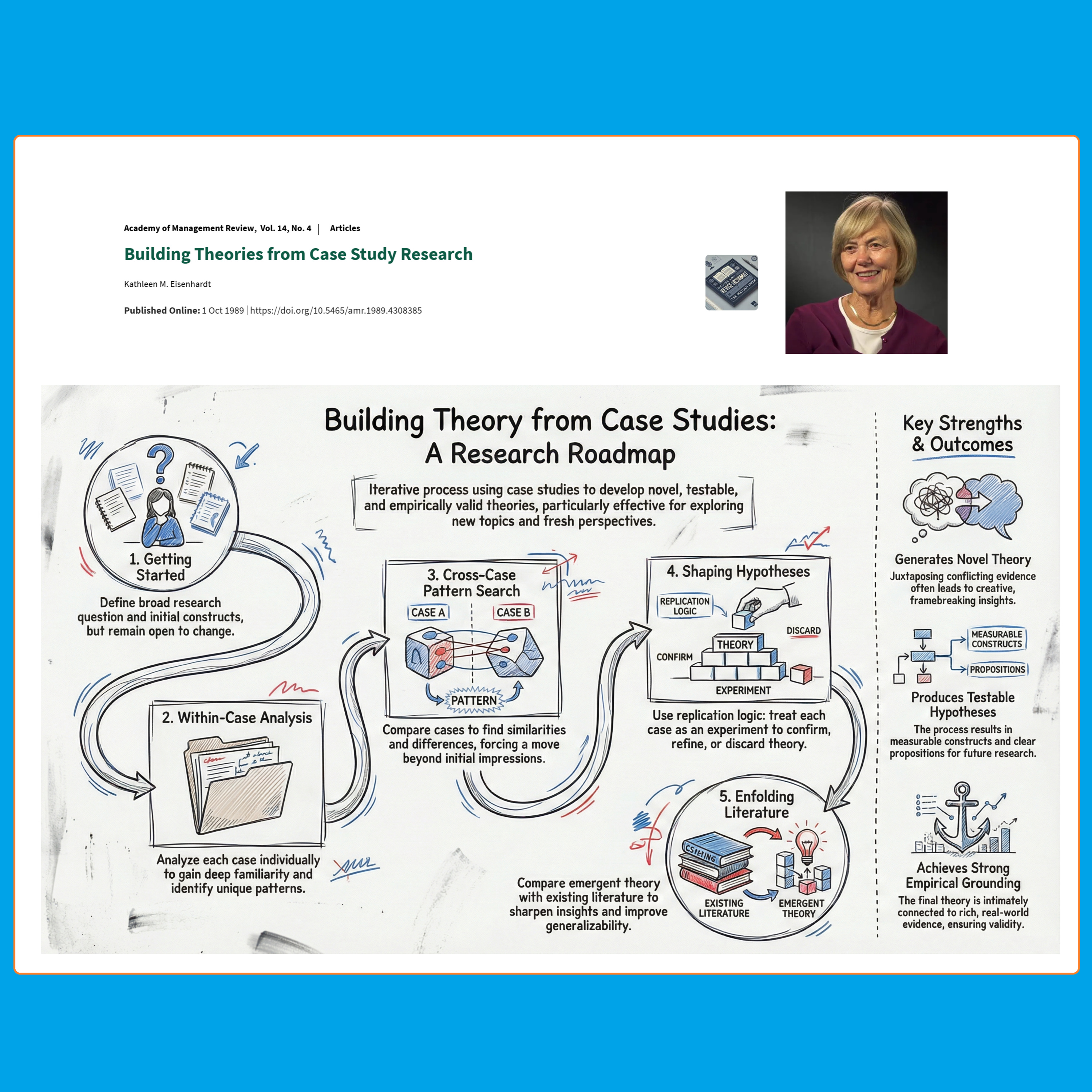
English Podcast starts at 00:00:00Bengali Podcast Starts at 00:16:12Hindi Podcast Starts at 00:32:16Danish Podcast Starts at 00:46:20ReferenceKathleen M. Eisenhardt, 1989: Building Theories from Case Study Research. AMR, 14, 532–550, https://doi.org/10.5465/amr.1989.4308385Youtube channel link https://www.youtube.com/@weekendresearcherConnect on linkedinhttps://www.linkedin.com/in/mayukhpsm/Welcome back to Revise and Resubmit, and to our episode series, “Weekend Classics.” 🎙️📚✨I keep thinking about how theories are born. Not in the clean fluorescent light of a perfectly specified model, but in the mess. In the notes you scribble too fast. In the interview moment where someone says one sentence and suddenly your entire research question feels slightly wrong, in the best possible way. That is the particular romance of method, the part we rarely admit is romantic at all. We want rigor, yes. But we also want that quiet shiver when the data starts talking back. 🔎🧠Today’s classic is Kathleen M. Eisenhardt’s “Building Theories from Case Study Research,” published in Academy of Management Review (Volume 14, Issue 4, October 1989). This is FT50 territory, the kind of paper that does not just sit on your shelf. It moves into your thinking and rearranges the furniture. 🏛️📖What Eisenhardt offers is a way to do induction without drifting into fog. She walks us from specifying research questions all the way to closure, and she makes the process feel both disciplined and alive. Some pieces will sound familiar if you come from hypothesis-testing traditions, like sharp problem definition and taking construct validation seriously. But then she takes you into the case study moves that feel almost physical: staying inside a single case long enough to hear its internal logic, then stepping back and letting multiple cases speak to each other through replication logic and cross-case pattern searching. 🧩🔁📌The heart of it is iteration. Data collection and analysis are not polite strangers who meet at the end. They keep running into each other. You gather, you analyze, you adjust, you return, you refine. And when you do it well, something powerful happens. The theory that emerges is not only novel, it is testable. Not only interesting, it is empirically valid. Not only clever, it is grounded in evidence so convincingly that the reader can feel the floor under their feet. 🧪🧱✨If you are working in a new topic area, the kind where the literature has more silence than answers, this paper feels like a field guide. It reminds you that framebreaking insights are not accidents. They are earned, then evaluated with the old, unforgiving tests of good theory: parsimony, logical coherence, and a clear line back to the data. 🎯🧠📊Before we dive in, please subscribe to the podcast on Spotify and to my YouTube channel, Weekend Researcher. 🔔🎧📺 You can also find “Revise and Resubmit” on Amazon Prime Music and Apple Podcast. 📻🍎And with gratitude, thanks to Kathleen M. Eisenhardt, and thanks to SAGE Publications for publishing this enduring work. 🙏📚So here is what I want to ask you as we begin: when your data starts pulling you somewhere you did not plan to go, do you tighten your grip on the original question, or do you follow the evidence and let it change you? 🤔🗺️
NOW PLAYING
Building Theories from Case Study Research (Eisenhardt 1989) | FT50 AMR
No transcript for this episode yet
Similar Episodes
No similar episodes found.