
EPISODE · Apr 11, 2026 · 1H 45M
Organizational Silence (Morrison & Milliken, 2000) - Weekend Classics
from Revise and Resubmit - The Mayukh Show · host Mayukh Mukhopadhyay
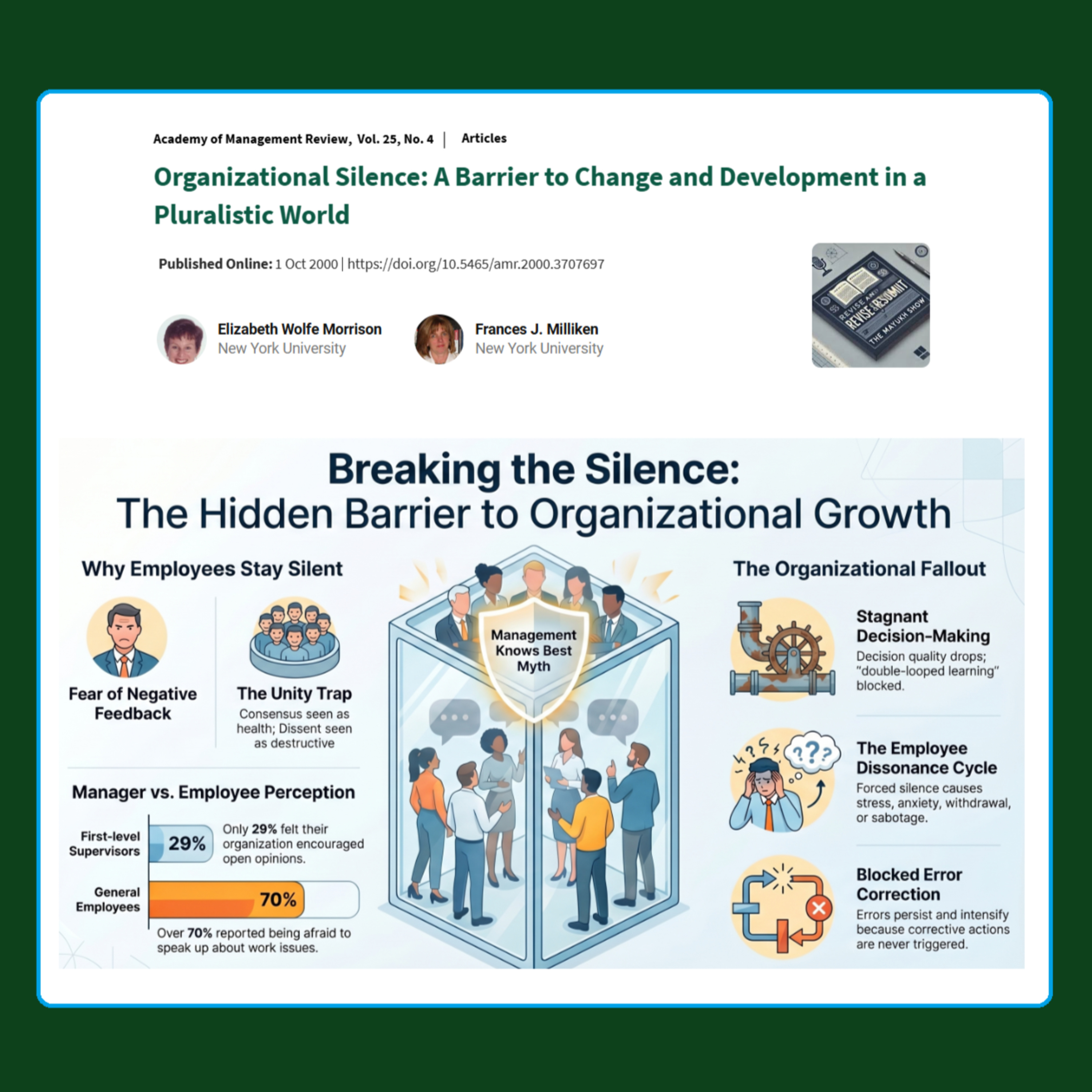
English Podcast starts at 00:00:00Bengali Podcast Starts at 00:52:19Hindi Podcast Starts at 01:09:28Danish Podcast Starts at 01:33:00ReferenceElizabeth Wolfe Morrison and Frances J. Milliken, 2000: Organizational Silence: A Barrier to Change and Development in a Pluralistic World. AMR, 25, 706–725, https://doi.org/10.5465/amr.2000.3707697Youtube channel link https://www.youtube.com/@weekendresearcherPodcast Websitehttps://mayukhmukhopadhyay.com/reviseandresubmit/Paper Explainer Websitehttps://mayukhpsm.github.io/organizational-silence/🎙️✨ Welcome to Revise and Resubmit, and this is Weekend Classics.I am always fascinated by the moments when people say nothing. Not because nothing is on their mind. Quite the opposite. Because sometimes the loudest thing in a workplace is the thing nobody dares to say out loud. 🤐Today’s classic takes us to a remarkable paper published on 1 October 2000 in the Academy of Management Review, an FT50 listed journal. The paper is titled “Organizational Silence: A Barrier to Change and Development in a Pluralistic World” by Elizabeth Wolfe Morrison and Frances J. Milliken. 📚And what these authors noticed feels almost painfully familiar. In many organizations, silence is not accidental. It is not an individual flaw. It is not just shyness, diplomacy, or caution. It is a system. A climate. A lesson people learn together. 🏢🔇You begin to see how it happens. Managers fear negative feedback. Structures become centralized. Channels for honest communication disappear, or become decorative. Employees start to believe that speaking up is risky, futile, or both. So they watch each other. They read the room. They trade stories in hushed tones. And little by little, silence becomes culture. 🪞What Morrison and Milliken gave us was not just a concept, but a mirror. They showed us that when organizations stop hearing the truth, they also weaken their own capacity to change, to adapt, and to grow. And in a pluralistic world, where difference, disagreement, and multiple perspectives are not inconveniences but necessities, that silence can become especially dangerous. ⚠️🌍I think that is what makes this paper endure. It understands something tender and troubling about human beings at work. We do not always fall silent because we have nothing to say. Sometimes we fall silent because the organization has already taught us the price of honesty. And once that lesson settles in, even intelligent, ethical, committed people can begin to confuse survival with wisdom. 💭So in this episode, I want to sit with that uneasy truth. I want to ask what happens when institutions become too fragile to hear dissent. I want to think about the cost of all the warnings never voiced, all the ideas never shared, all the problems that grow precisely because they remain politely unspoken. 🎧✨And maybe, as you listen, you might ask yourself something too: when an organization becomes quiet, is it becoming peaceful... or is it becoming afraid? ❓🙏 My sincere thanks to Elizabeth Wolfe Morrison and Frances J. Milliken for this enduring contribution, and to the Academy of Management for publishing it.🎧 If you enjoy these deep dives, please subscribe to Revise and Resubmit on Spotify, and follow the Weekend Researcher channel on YouTube. You can also find us on Amazon Prime Music and Apple Podcast 🍎🎙️
NOW PLAYING
Organizational Silence (Morrison & Milliken, 2000) - Weekend Classics
No transcript for this episode yet
Similar Episodes
No similar episodes found.