
EPISODE · Feb 12, 2026 · 39 MIN
Patho 27: Peripheral Nerves and Skeletal Muscles
from Clinical Deep Dives · host Dr Manaan Kar Ray
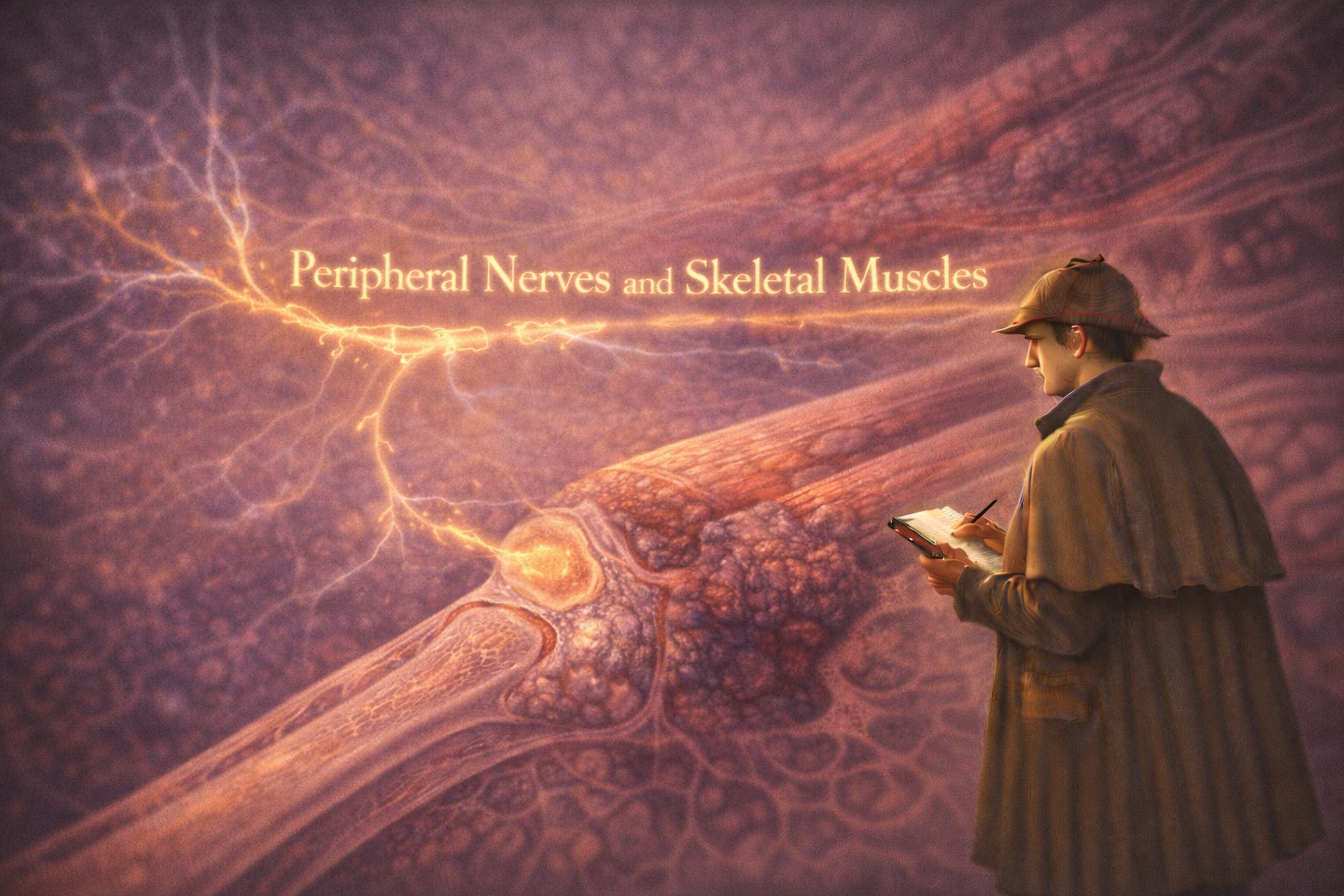
This episode explores pathology of peripheral nerves and skeletal muscle as disease of connection and power. Movement and sensation rely on uninterrupted signal transmission from nerve to muscle, adequate energy supply within muscle fibres, and structural integrity across long distances. Disease emerges when any part of this chain fails.The episode begins with normal organisation of peripheral nerves, emphasising axons, myelin, Schwann cells, and connective tissue sheaths. The importance of axonal transport and myelin integrity is highlighted, explaining why nerve injury produces predictable patterns of weakness and sensory loss depending on location and mechanism.Peripheral neuropathies are examined next as disorders of axonal injury, demyelination, or both. Metabolic, toxic, inflammatory, and hereditary causes are organised by pattern rather than aetiology alone. The episode highlights how length dependent neuropathies reflect vulnerability of long axons, while focal neuropathies reveal points of compression or entrapment.Inflammatory and immune mediated neuropathies are explored as failures of immune restraint. Guillain Barré syndrome and chronic inflammatory demyelinating polyneuropathy are introduced as examples where immune attack disrupts conduction, producing rapid or progressive weakness. The episode emphasises reversibility when structure is preserved.The episode then turns to skeletal muscle pathology. Myopathies are examined as disorders of muscle fibre integrity, metabolism, or innervation. Muscular dystrophies are presented as genetic failures of structural proteins, leading to progressive weakness and fibre replacement by fat and connective tissue. Inflammatory myopathies are explored as immune mediated muscle injury with characteristic patterns of weakness.Neuromuscular junction disorders are introduced as failures of signal transmission rather than muscle or nerve structure. Myasthenia gravis is presented as antibody mediated receptor dysfunction, producing fatigable weakness that improves with rest. The episode highlights how small molecular disruptions produce large functional effects.Finally, the episode reframes neuromuscular disease as pathology of continuity. Signals must arrive, energy must be available, and fibres must respond. When any link weakens, movement fails.Key takeaways* Peripheral nerve disease reflects axonal and myelin integrity* Neuropathy patterns reveal mechanism and site of injury* Immune mediated neuropathies disrupt conduction rather than structure* Muscle disease arises from structural, metabolic, or inflammatory failure* Neuromuscular junction disorders impair transmission without fibre loss This is a public episode. If you'd like to discuss this with other subscribers or get access to bonus episodes, visit drmanaankarray.substack.com/subscribe
NOW PLAYING
Patho 27: Peripheral Nerves and Skeletal Muscles
No transcript for this episode yet
Similar Episodes
Jun 4, 2025 ·9m
May 21, 2025 ·11m