
PODCAST · history
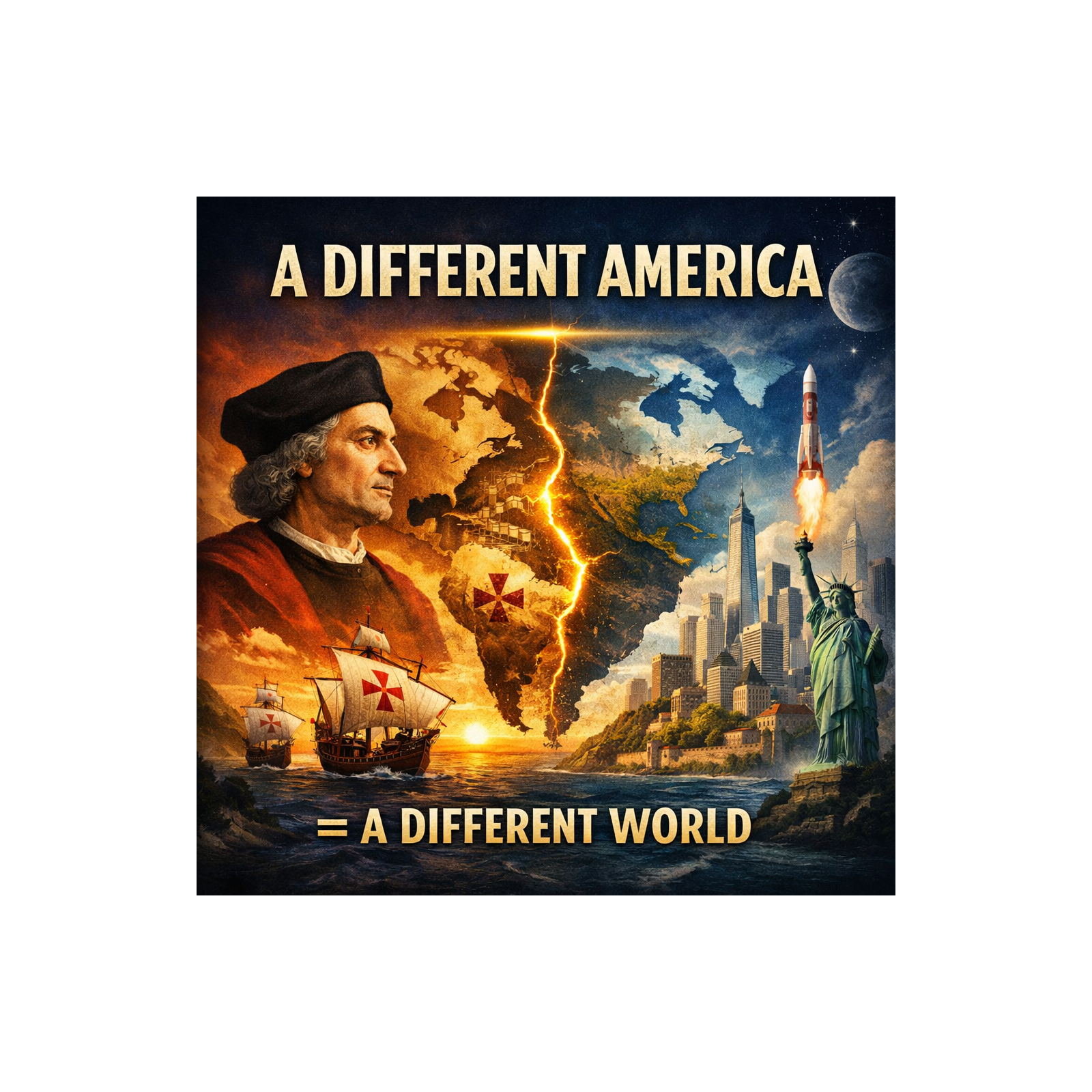
A Different America = A Different World
by Alan Maldam
What if a single decision changed the course of history?The podcast A Different America explores alternative perspectives on key moments in history — especially the age of the discovery of the New World. Each episode examines what might have happened if events had unfolded differently: if Columbus had served another nation, if great powers had made different choices, or if crucial decisions had been accepted or rejected in ways that reshaped the modern world.The series combines documentary-style analysis with carefully constructed alternative scenarios. It is grounded in real historical facts, political contexts, and the possibilities of the time, and then explores how Europe, the Americas, and global civilization might have developed differently.This is not fiction without foundation. It is a thoughtful exploration of how little it might have taken for today’s world to be entirely different.Because a different America means a di
-
19
South America, Africa, Asia, Australia, and New Zealand in the Shadow of Florentine America (1500–2026)
What if the discovery of America had not launched a Spanish empire—but a Florentine global system?In this episode, we expand the scope beyond the Atlantic and explore how a Florentine-led discovery of the New World would have reshaped the entire globe. If America had developed as a network of ports, financial hubs, and commercial republics rather than centralized colonial empires, the consequences would not have stopped at its shores. South America, Africa, Asia, Australia, and New Zealand would all have been drawn into a different kind of globalization—one driven less by crowns and conquest, and more by trade, contracts, and capital.How would South America have evolved without Spanish dominance? Instead of vast viceroyalties, we might see a fragmented but dynamic continent of port cities, commercial republics, and regional federations, with stronger indigenous continuity and greater linguistic diversity.What would Africa look like in a system shaped by Florentine commercial logic? Likely even more deeply integrated into Atlantic trade networks—yet at the cost of intensified exploitation, a highly organized slave system, and long-term economic dependency structured by finance and contracts.In Asia, the encounter might begin less with conquest and more with commerce. Florentine-American networks could establish early trading footholds, alliances, and financial ties, creating a world where Asian powers remain strong but increasingly entangled in a global system of exchange and influence.And what about Oceania? Australia and New Zealand might emerge not as extensions of a single empire, but as hybrid spaces—networks of ports, trading stations, and multicultural societies shaped by both European and Pacific connections, developing more slowly but with a broader cultural foundation.This episode explores a world where globalization is not built primarily by empires, but by interconnected commercial civilizations. A world where power flows through cities, ports, and financial systems—and where the shape of modern history is defined not by one dominant center, but by a network of competing global nodes.Because if the core changes, everything changes.
-
18
Florentine America from the Nineteenth to the Twenty-First Century (1800–2026)
What if modern America had grown not from Spanish conquest and Anglo-American expansion, but from the legacy of Florence?In this episode, we follow the long evolution of an alternative world in which Columbus’s voyage was financed by Florentine bankers and Renaissance elites. By 1800, Florentine America is no longer a distant colonial project, but a complex Atlantic civilization of port cities, commercial republics, urban elites, and Italophone culture. From there, the story moves into the modern age: independence movements, new states, industrialization, world wars, globalization, and the shape of the world in 2026.How would an America shaped by Tuscan language, banking traditions, republican city culture, and Renaissance prestige have changed modernity itself? Would a true equivalent of the United States have emerged? Would the twentieth century still have belonged to an Anglo-American world? Or would a powerful Italophone America have stood at the center of global politics, trade, and culture instead?This episode explores a different path into the modern age—one in which the New World carries the imprint not of Castile, but of Florence.
-
17
Florence in America (1500–1800)
In this episode, we explore one of the most intriguing alternative-history scenarios of the Age of Discovery: what if Christopher Columbus had been financed not by Spain or Portugal, but by Florence—the city of bankers, merchants, Renaissance thinkers, and the Medici?Instead of a New World shaped first by a conquering monarchy, America begins to develop under the influence of a commercial, urban, and financially driven republic. From 1500 to 1800, we follow how Florentine trading posts, port cities, banking networks, and Renaissance culture might have created a very different Atlantic world—one built less on crowns and feudal conquest, and more on contracts, capital, urban institutions, and mercantile power.But this is not a gentler history. Florentine America would still face violence, disease, slavery, rivalry with Europe’s great powers, and growing internal tensions. The deeper question is whether such a world might have produced a different model of modernity itself: less monarchical, more urban; less imperial in the Castilian sense, more commercial and networked; and perhaps even an America shaped by the language and spirit of Renaissance Tuscany.
-
16
Columbus in Florentine Service
What if Christopher Columbus had not sailed for Spain, but for Florence—the city of bankers, merchants, Renaissance thinkers, and the Medici?This episode explores one of the most intriguing alternatives in early modern history: a world in which Columbus is rejected by both Portugal and Spain, and his voyage is financed instead by Florence. Such a change would not only place a different flag on the horizon. It would transform the very logic of discovery. America would not begin as the project of a dynastic monarchy, but as the venture of a commercial republic driven by capital, prestige, urban power, and Renaissance ambition.We follow Europe at the end of the fifteenth century, Columbus’s search for support, and the reasons why Florence might have said yes when others said no. From there, the story unfolds into a different Atlantic world—one shaped less by royal conquest and more by finance, networks, trade, and urban foundations.What might a Florentine America have looked like? How would Europe have changed if Spain had missed its great opportunity? Could Italian, rather than Spanish, have become one of the defining languages of the New World? And how different might the modern world be if the Renaissance itself had crossed the ocean as a colonizing force?This episode is not just about a different patron. It is about a different beginning for modern history.
-
15
South America, Africa, Asia, Australia, and New Zealand in the Shadow of Venetian America (1500–2026)
What if the New World had not created empires… but a network?In this episode, we leave America and follow its shadow across the rest of the globe. Because the discovery of the New World was never just about one continent—it was the spark that connected Europe, Africa, Asia, and eventually Oceania into a single system. And if that system had been shaped not by Iberian crowns, but by the Venetian Republic, then the entire logic of globalization would have changed.Instead of vast territorial empires, the world begins to organize itself around ports, trade routes, contracts, and financial networks. America becomes not just a colony, but the beating heart of a commercial ocean—and that ocean reaches everywhere.In South America, no unified “Latin world” emerges. Instead, the continent becomes a mosaic of port republics, coastal powers, and inland regions that develop more slowly. Cities dominate over territories. Trade dominates over administration. The result is dynamic—but unstable.In Africa, the Atlantic system pulls even deeper. Coastal cities grow into cosmopolitan hubs linking continents, while the slave trade becomes even more systematized within a highly efficient commercial network. Africa is not just colonized—it is structurally woven into the global economy earlier and more intensely.In Asia, the encounter is different. Instead of immediate conquest, merchant networks arrive first—alliances, trade posts, financial ties. But over time, dependency grows. Port cities flourish, interiors resist, and the balance between cooperation and control defines a new kind of global tension.In Australia and New Zealand, colonization takes another path entirely. Not single-nation settler societies, but mixed, multicultural nodes emerge—bridges between Asia and America, shaped by trade rather than isolation.By the nineteenth century, the world no longer revolves around a few great empires. And by the twentieth, there is no single dominant superpower to define the age. Instead, power is dispersed across multiple centers—Atlantic, European, Asian, and oceanic.By 2026, this is a world that feels familiar… yet fundamentally different. Globalization exists—but not as the spread of one model. It is a web. Languages are diverse. Cultures are layered. Trade flows through many hands.This episode asks a simple but profound question:What if modernity had not been built by empires of land… but by empires of connection?Because if Venice had opened America, the world might not belong to one center.It might belong to the network.
-
14
Europe and the World in the Shadow of Venetian America (1800–2026)
What would the modern world look like if America had grown not from imperial crowns and a future superpower, but from the legacy of a maritime republic?In this episode, we follow the long shadow of a Venetian New World from 1800 to 2026. By the nineteenth century, Venetian America is no longer just a colonial network of ports and trading stations—it is a living Atlantic civilization, rich, urban, commercially driven, and increasingly unwilling to remain tied to a distant metropolis in the Adriatic.Then comes the great rupture. The Napoleonic era shatters the old Venetian order, and across the Americas new states begin to emerge—not as one vast continental giant, but as a mosaic of republics, federations, and port powers shaped by commerce, autonomy, and urban political culture. Instead of a United States in the form we know, the Western Hemisphere develops into a more fragmented but deeply interconnected world of maritime cities, trading elites, and competing Atlantic centers.That changes everything. Europe no longer lives in the shadow of an Anglo-American colossus. The Mediterranean retains greater weight. Capitalism evolves less as the story of one dominant industrial giant and more as a network of financial and commercial hubs. The world wars unfold without a single decisive American power. The Cold War becomes more diffuse, more unstable, and more multipolar. And globalization in the twenty-first century spreads not as the expansion of one model, but as the rivalry of several.By 2026, this is a world that is less American in the modern sense and more Atlantic-urban: a world of ports, republics, commercial networks, and multiple cultural centers. English still matters, but it does not dominate alone. The legacy of Venice survives not as empire, but as a way of organizing modernity itself.This episode explores how one different patron for Columbus could have transformed not only America, but the entire shape of the modern world—creating not an American century, but a civilization of competing oceans, cities, and trade.
-
13
Venice in America (1500–1800)
What if the New World had opened not to a crown of conquest, but to a republic of merchants?In this episode, we explore the rise of a very different America—one shaped not first by kings, conquistadors, and vast inland empires, but by the logic of the Venetian Republic: ports, contracts, warehouses, fortified harbors, shipping routes, and profit.After Christopher Columbus sails in Venetian service, America begins to develop as a maritime network. The Caribbean becomes a chain of commercial strongholds. Colonial cities grow around docks, customs houses, chapels, and trading compounds. Expansion moves first along coasts and islands, not deep inland—turning the Atlantic into a web of urban and financial power.But trade does not mean peace. Venetian America still brings disease, slavery, coercion, and exploitation. Indigenous worlds are disrupted, local elites are drawn into new systems of dependency, and commerce becomes another instrument of empire. The difference is not moral innocence, but structure: this is a colonial order built less on feudal conquest and more on organized exchange, information, and strategic control.As the centuries pass, a unique Atlantic society begins to emerge—urban, mixed, multilingual, commercially driven, and increasingly self-aware. Port elites grow richer, colonial identities grow stronger, and the republican spirit that Venice exported across the ocean slowly begins to turn against the metropolis itself.This episode follows the making of that world from 1500 to 1800: the first footholds, the rise of commercial colonies, the slow penetration of the interior, the rivalry with Europe’s monarchies, and the tensions that would prepare the next great transformation.Because if Venice had reached America first, the New World might not have become an empire of kings.It might have become an empire of cities.
-
12
Columbus in the service of Venice
What if the New World had not been born from crowns and conquest—but from contracts, ports, and profit?In this episode, we explore a radically different beginning of the modern world. Instead of serving Spain or Portugal, Christopher Columbus sails under the banner of the Venetian Republic—a state built not on kings and dynasties, but on trade, finance, and maritime networks.From that single decision emerges a completely different logic of expansion.Venetian America does not begin as a vast territorial empire, but as a web of ports, fortified trading stations, and commercial cities stretching across the Caribbean and beyond. Instead of viceroys and conquistadors, the key figures are merchants, ship captains, bankers, and administrators. Instead of immediate conquest, expansion moves through contracts, alliances, and control of trade routes—until wealth itself begins to demand power.This creates a New World shaped less by centralized authority and more by networks: – port cities instead of inland capitals – commercial hubs instead of feudal estates – flexible governance instead of rigid imperial hierarchiesBut this does not mean a gentler history. Trade empires can exploit just as deeply as territorial ones. Slavery, disease, and domination still spread—only through different mechanisms, driven by profit as much as by power.The deeper consequences unfold over centuries.Spain loses its historic advantage. Portugal turns even more toward Africa and Asia. France, England, and the Netherlands enter a world already shaped by a merchant empire. And the Atlantic does not become the domain of monarchies—but a contested arena of competing commercial systems.In America itself, the result is a different civilization: a mosaic of trading cities, multilingual societies, and hybrid cultures. No single dominant language. No unified colonial model. No clear path toward something like the United States.Instead, the future belongs to networks.By the time we reach the modern era, the world is not built around imperial capitals like Madrid or London—but around interconnected economic centers stretching from Europe to the Americas. Venice is no longer just a relic of the Renaissance—it becomes one of the founders of globalization itself.This episode reveals perhaps the most striking alternative of all: change not just who discovers America—but how they understand power……and you don’t just change history. You change the entire logic of the modern world.
-
11
South America, Africa, Asia, Australia and New Zealand
What happens when the center of the modern world shifts—not just in America, but everywhere?In this episode, we step beyond the Atlantic and explore how a French-led discovery of the New World reshapes the entire global system. If Christopher Columbus sails for France instead of Spain or Portugal, the consequences ripple across continents—from South America to Africa, Asia, and Oceania.South America no longer becomes a unified Iberian world. Instead, it fragments into a mosaic: French-influenced northern regions, a powerful Portuguese Brazil, and contested Andean zones where empires, resources, and Indigenous resilience collide.In Africa, French influence grows earlier along the Atlantic coast, especially in the west. Trade, forts, and later colonial structures expand—but without full domination. The continent remains divided, shaped by competition rather than control.Asia becomes a three-way chessboard between France, Portugal, and Britain. French presence is less aggressive than Iberian conquest, but more stable—built on trade, diplomacy, and long-term influence. India, Southeast Asia, and China all become arenas of balance rather than domination.And in Oceania, nothing is purely British. Australia and New Zealand emerge as contested spaces—Franco-British worlds where language, culture, and power overlap instead of align.The result? Not a world dominated by one empire, but a multipolar system from the very beginning. No single global language fully prevails. No single power defines the rules. Instead, modern history unfolds as a constant negotiation between competing centers of power.This episode reveals the deepest consequence of all: change one decision in the 15th century, and you don’t just redraw maps—you rewrite the logic of the entire world.
-
10
The World in 2026 in French America (1800–2026)
What would the modern world look like if the Americas had grown not from Spanish decline and Anglo-American ascent, but from the long legacy of a vast French Atlantic empire?In this episode, we follow the world of French America from 1800 to 2026. At the dawn of the nineteenth century, the French Empire in the Americas stands powerful but unstable—rich in trade, cities, and influence, yet already shaken by revolution, colonial tension, and the growing ambitions of its own American elites.As the old empire fractures, new Francophone states emerge across North America, Mexico, and the Caribbean. Instead of one dominant United States, the Western Hemisphere develops as a complex network of French-speaking republics, federations, and postcolonial powers. The Industrial Revolution spreads through a different Atlantic world. The world wars are fought with a stronger Francophone-American axis. The Cold War unfolds in a more multipolar West. And globalization becomes less purely Anglo-American, with French retaining far greater global weight in diplomacy, culture, and power.By 2026, this is a world where France is no longer an empire in the old sense, but the historic center of a vast transatlantic civilizational sphere. The Americas are no longer defined by an Anglophone North and a Latin South, but by a broad Francophone presence stretching from northern industrial states to Caribbean societies and a great Mexican core.This episode explores how one royal decision at the end of the fifteenth century could have reshaped the entire modern age—creating not an American century, but a French Atlantic world.
-
9
The French Empire in America (1500–1800)
What happens after discovery—when a landing becomes an empire?In this episode, we follow the rise of a world where France, not Spain, becomes the first great Atlantic power. After Christopher Columbus opens the western route under the French banner, discovery quickly turns into domination: island bases become permanent colonies, coastal outposts become cities, and trade routes become the arteries of a new French America.From the Caribbean to Mexico and deep into North America’s river systems, France builds a vast imperial space shaped by governors, merchants, missionaries, soldiers, and settlers. Plantation wealth, precious metals, fur routes, and Atlantic trade bind the New World to Paris, Bordeaux, and Saint-Malo—while French language, law, religion, and urban culture spread across continents.But empire never grows without cost. Alongside splendor come slavery, disease, violence, and the destruction of Indigenous worlds. The same colonial system that brings France power and prestige also creates deep tensions—between Crown and colonists, between wealth and injustice, between empire and the people living under it.By 1800, French America stands rich, vast, and powerful—but already unstable. Enlightenment ideas, colonial elites, enslaved populations, and regional identities begin to pull against the empire that created them.This episode explores three centuries in which France does not merely build colonies, but creates an entire Atlantic civilization—one that could have changed the language, power, and destiny of the modern world.
-
8
Columbus in French Service
What if the New World had been claimed not for Spain, not for Portugal—but for France?In this episode, we explore a world where Christopher Columbus finds his patron in Charles VIII of France, and the foundations of modern history are laid in French, not Spanish or English.From the first landing, everything begins to shift. The Caribbean becomes the cradle of a French America, and from there, influence spreads toward mainland empires, trade networks, and new political systems. Instead of a Spanish-dominated hemisphere, a vast Francophone world begins to emerge—shaping language, law, religion, and identity across continents.The consequences ripple outward. Spain loses its path to global dominance. Portugal turns even more intensely toward Africa and Asia. England and the Netherlands enter a world where the Atlantic is already claimed by a powerful rival.Over time, a “French Atlantic Age” takes shape—an interconnected system linking Europe, the Americas, and global trade under a shared cultural and political framework. Cities, institutions, and entire societies grow not from Iberian or Anglo traditions, but from French influence.This episode reveals how one decision could have reshaped not just America, but the balance of power in Europe and the language of the modern world itself. Because history is not only what happened—it is also what almost did.
-
7
South America, Africa, Asia, Australia and New Zealand in the Shadow of English America (1500–2026)
What if the greatest impact of Christopher Columbus serving England was felt not where he landed—but everywhere else?In this episode, we step beyond North America and explore how an early English-led global system would have reshaped entire continents. Because discovery was never just about land—it was about connection, power, and the birth of a new world order.In South America, the absence of a dominant Spain would leave the continent fragmented and diverse. Portugal would build a stronger Brazil as a regional giant, while France expands its influence in the north. Indigenous civilizations might endure longer, creating hybrid societies rather than disappearing overnight. The result: no unified “Latin America,” but a mosaic of cultures and powers.In Africa, earlier and stronger English influence would deepen Atlantic connections—and their consequences. Trade, migration, and exploitation would bind Africa more tightly to the oceanic system, reshaping states, societies, and identities. The Afro-Atlantic world would be even more central—and its legacy even more profound.In Asia, England enters earlier, competing with Iberian powers from the start. Trade networks, influence in India, and pressure on China and Southeast Asia would accelerate globalization centuries ahead of schedule.Even Oceania changes. Australia and New Zealand emerge earlier as strategic hubs of an expanding Anglophone world—not as distant afterthoughts, but as integral parts of a global network.By 2026, the result is a planet organized around a stronger, earlier Anglophone core—stretching across oceans, shaping trade, language, and power. But it is also a world carrying deeper historical scars.This episode reveals the true scale of one decision—not just changing a continent, but rewriting the logic of the entire world.
-
6
The World in 2026 in English America (1800–2026)
What would the modern world look like if the Americas had entered history under the English flag from the very beginning?In this episode, we follow the long consequences of an English Columbus from 1800 to 2026. By the nineteenth century, English America is no longer a colonial experiment, but a mature Atlantic civilization—stretching across the North, the Caribbean, and parts of the central American world, shaped by English law, maritime trade, imperial institutions, and deep cultural ties to Britain.From there, everything changes. The struggles over slavery, abolition, industrialization, and self-government unfold inside a much larger Anglophone world. A powerful northern federation rises through trade, industry, and migration, while plantation regions and island societies wrestle with the legacies of empire and racial hierarchy. South America develops more as a diverse counterweight than as one continuous Latin sphere.The twentieth century brings world wars, a stronger Anglophone Atlantic bloc, and a Cold War led not by Britain and America as separate powers, but by a broader English-speaking civilization. By 2026, English has become even more dominant globally, Britain retains greater symbolic importance, and the Western Hemisphere is defined less by an Anglophone North and Iberian South than by one vast English-American legacy.But this world is not simply more unified. It is also more burdened—by slavery, colonial memory, and the enduring question of who paid the price for Atlantic power.This episode explores how one different royal decision could have reshaped the modern age itself—creating not a Spanish beginning followed by a British rise and an American climax, but one long and unbroken Anglophone Atlantic world.
-
5
The English Empire in America (1500–1800)
What happens after discovery? Not just a landing, not just a flag—but the slow construction of empire. In this episode, we follow the world that might have emerged if Christopher Columbus had opened the Americas for England, and England had become the first great Atlantic power.From the Caribbean to the mainland, English America grows not as a late colonial project, but as an early oceanic civilization. Tropical islands become the first laboratories of empire—shaped by forts, governors, plantations, commerce, and violence. Sugar, tobacco, maritime trade, and slavery begin to transform not only the colonies, but England itself.As expansion spreads, the Crown, merchants, and colonial elites build a new Atlantic system. The Reformation crosses the ocean, regional identities take root, and North America develops in the shadow of an older and wealthier imperial south. By the seventeenth and eighteenth centuries, English America is no longer a distant possession, but a vast and divided world with its own political ambitions.Would such a world still produce the United States as we know it? Or would several Anglophone powers emerge instead—different, rival, and shaped by a much older empire?This episode explores how discovery becomes domination, how colonies become civilization, and how one decision could have created an English Atlantic age centuries earlier than in real history.
-
4
Columbus in English Service
History remembers Christopher Columbus as the man of Spain—but what if both Iberian powers had said no? What if the decisive yes came instead from Henry VII of England?This episode explores a world where England seizes the greatest missed opportunity of its rivals. From rejection to reinvention, Columbus arrives not as a visionary fulfilled—but as a man sharpened by failure, carrying an idea powerful enough to reshape a kingdom.An English-backed voyage would not simply change a flag on distant shores—it would transform the entire trajectory of empire. The Caribbean becomes the cradle of an early English America. Expansion moves faster, harsher, and deeper. Encounters with wealth, civilizations, and new lands accelerate England’s rise into a global power a century ahead of time.Meanwhile, Spain loses its golden foundation, Portugal turns more fiercely toward the East, and Europe’s balance of power shifts before it fully forms. Language, religion, and identity across the Americas evolve along entirely different lines—perhaps creating an English-speaking Atlantic world from the very beginning.This episode is not just about what might have happened—it’s about how close it came. Because sometimes, the fate of centuries depends not on inevitability… but on who says yes.
-
3
The Flag on an Unknown Land
Dawn reveals what weeks of uncertainty could not—a new world rising from the mist. Under the command of Christopher Columbus, Portuguese ships anchor before an island untouched by Europe, where silence speaks louder than triumph.Step by step, the unknown becomes real. Sand underfoot. Water clear as glass. A flag raised in the name of John II of Portugal. Rituals of claim unfold—but so does something far more fragile: first contact.Eyes meet across distance. No shared language, only gestures, gifts, and cautious curiosity. Two worlds stand face to face, unaware that this quiet moment will echo across centuries.As exploration begins, questions grow. This is not the India they expected. The land feels different—larger, deeper, unnamed. And in that realization lies the true discovery: not a route, but a new reality.This episode captures the instant history changes—not with conquest, but with a landing. Because sometimes, the most powerful moment is not when a world is taken… but when it is first seen.
-
2
The Western Sea
Three ships leave Lisbon and sail into the unknown—not as conquerors, but as men balancing between courage and doubt. Led by Christopher Columbus, the expedition ventures west under the authority of John II of Portugal, carrying not certainty, but a question.At first, the ocean is calm. The rhythm of wind and stars gives the illusion of control. But as days turn into weeks, whispers spread among the crew. Fear grows quietly—through glances, rumors, and the haunting thought that beyond the horizon may lie nothing at all.Storms break their strength. Doubt turns into defiance. And on the edge of mutiny, Columbus must prove not just his vision—but his leadership. Promises are made, time is bought, and hope hangs by a thread.Then come the signs: birds, drifting branches, a shift in the sea itself. Until, at last, a single cry changes everything—land.This episode captures the most fragile moment of discovery—not the triumph, but the uncertainty before it. Because the greatest journeys are not defined by reaching land, but by the courage to sail when none can see it.
-
1
The King Who Said Yes
In the salt-laden air of Lisbon, where maps blur the line between truth and imagination, a single audience will decide the fate of the world. When Christopher Columbus steps before John II of Portugal, he brings more than a proposal—he brings a gamble.Advisers laugh, pilots doubt, and reason argues against the unknown. The ocean is vast, the calculations uncertain, and the risks undeniable. Yet in a court shaped by ambition and maritime vision, one question rises above all: what if the impossible is worth the risk?In this episode, we witness the moment history almost took a different path—the silence in the royal hall, the clash between caution and boldness, and the decision that could open the western ocean under the Portuguese flag.Because sometimes, empires are not born from certainty—but from a single voice willing to say yes.
-
0
The World Beyond North America
What if Christopher Columbus had sailed not for Spain, but for Portugal—and opened not just a continent, but an entire global system?This episode explores the world beyond North America in a timeline where Portugal becomes the first true global empire. South America transforms into the core of a vast Lusophone world, stretching from the Caribbean deep into the continent’s interior. Silver-rich regions and river networks fuel expansion, turning the continent into the economic heart of a Portuguese-led system.Across Africa, coastal trading posts evolve into deeper colonial structures, tightly linked to Atlantic trade. In Asia, Portugal strengthens its grip over key routes and ports, shaping commerce from India to China and limiting the rise of rival powers. Even Oceania enters the story, as Portuguese exploration pushes toward Australia and New Zealand, opening new arenas of competition.What emerges is not just an empire—but a connected world. Oceans become highways, continents become nodes, and Lisbon stands at the center of a truly global network.This episode reveals how one decision could have reshaped every continent—creating a world where Portugal is not just a pioneer of discovery, but the architect of global history.
-
-1
The World from the 20th Century to the Present in the Alternative History of Portuguese America
What would the modern world look like if the Atlantic had been shaped by Portugal from the very beginning? This episode follows the long shadow of that decision into the twentieth and twenty-first centuries.As the modern era begins, a vast Portuguese-Atlantic world stretches across continents—linking Europe, the Americas, Africa, and parts of Asia through trade, language, and shared history. Instead of a Spanish-dominated Latin America, a powerful Lusophone world emerges, united by language and commerce, reshaping global culture and diplomacy.In this reality, global conflicts such as World War I and World War II still erupt—but with a different balance of power. Portuguese influence in the Atlantic becomes strategically crucial, while a more fragmented North America and a less dominant United States alter the course of the Cold War.By the twenty-first century, Portuguese stands among the world’s leading global languages, connecting a vast network of nations across multiple continents. Lisbon remains a symbolic center of a global legacy born from one pivotal choice.This episode explores how a single decision in the 15th century could echo across centuries—reshaping wars, cultures, and the very language of the modern world.
-
-2
Portuguese America and the Alternative Development of North America
What if the Atlantic Ocean had become, not a contested frontier, but a controlled sphere? In this episode, we explore a world where Portugal accepts Christopher Columbus and transforms the ocean into the backbone of a global empire.With early control of the Caribbean, Portugal turns the Atlantic into a network of trade routes linking Europe, Africa, and America. Lisbon rises as the central hub of a new world system—while Spain, shut out of early discoveries, is forced to seek alternative paths and challenge Portuguese dominance.As plantations spread and the Caribbean becomes the economic heart of empire, other powers—France and England—enter the race, carving out their own spheres in North America. The result is a fragmented continent, divided between Portuguese, French, and English ambitions.But the consequences reach far beyond America. Without a dominant Spanish empire, Europe evolves differently. Portugal emerges as the first true global maritime power, while the rise of Britain slows and conflicts—from colonial rivalries to the Napoleonic Wars—take on a more global dimension.This episode reveals how one decision could reshape oceans, empires, and the balance of power—turning the Atlantic into the center of a Portuguese world.
-
-3
Columbus in the Service of Portugal
At the edge of two eras, Middle Ages Europe stands on the threshold of transformation. Old structures still hold, but new ambitions are already reshaping the world. Trade, faith, politics, and knowledge are in motion—and the oceans are becoming the stage where the future will be decided.Spices, silk, and riches from the East drive European desire, yet access is blocked by distance, cost, and control. Since the fall of Fall of Constantinople, routes have grown harder, pushing kingdoms to seek new paths. Among them, Portugal emerges as a bold maritime pioneer, exploring Africa and mastering the Atlantic.Into this world steps Christopher Columbus—a man with a radical idea: reach Asia by sailing west. In real history, he is rejected. But what if that decision changed?This episode explores a Europe on the brink—and the moment one choice could reshape the entire world.
We're indexing this podcast's transcripts for the first time — this can take a minute or two. We'll show results as soon as they're ready.
No matches for "" in this podcast's transcripts.
No topics indexed yet for this podcast.
Loading reviews...
ABOUT THIS SHOW
What if a single decision changed the course of history?The podcast A Different America explores alternative perspectives on key moments in history — especially the age of the discovery of the New World. Each episode examines what might have happened if events had unfolded differently: if Columbus had served another nation, if great powers had made different choices, or if crucial decisions had been accepted or rejected in ways that reshaped the modern world.The series combines documentary-style analysis with carefully constructed alternative scenarios. It is grounded in real historical facts, political contexts, and the possibilities of the time, and then explores how Europe, the Americas, and global civilization might have developed differently.This is not fiction without foundation. It is a thoughtful exploration of how little it might have taken for today’s world to be entirely different.Because a different America means a di
HOSTED BY
Alan Maldam
CATEGORIES
Loading similar podcasts...
Frequently Asked Questions
How many episodes does A Different America = A Different World have?
A Different America = A Different World currently has 23 episodes available on PodParley. New episodes are automatically indexed when they're published to the podcast feed.
What is A Different America = A Different World about?
What if a single decision changed the course of history?The podcast A Different America explores alternative perspectives on key moments in history — especially the age of the discovery of the New World. Each episode examines what might have happened if events had unfolded differently: if Columbus...
How often does A Different America = A Different World release new episodes?
A Different America = A Different World has 23 episodes. Check the episode list to see recent publication dates and frequency.
Where can I listen to A Different America = A Different World?
You can listen to A Different America = A Different World on PodParley by clicking any episode. We provide an embedded audio player for direct listening, and you can also subscribe via your preferred podcast app using the RSS feed.
Who hosts A Different America = A Different World?
A Different America = A Different World is created and hosted by Alan Maldam.
URL copied to clipboard!